
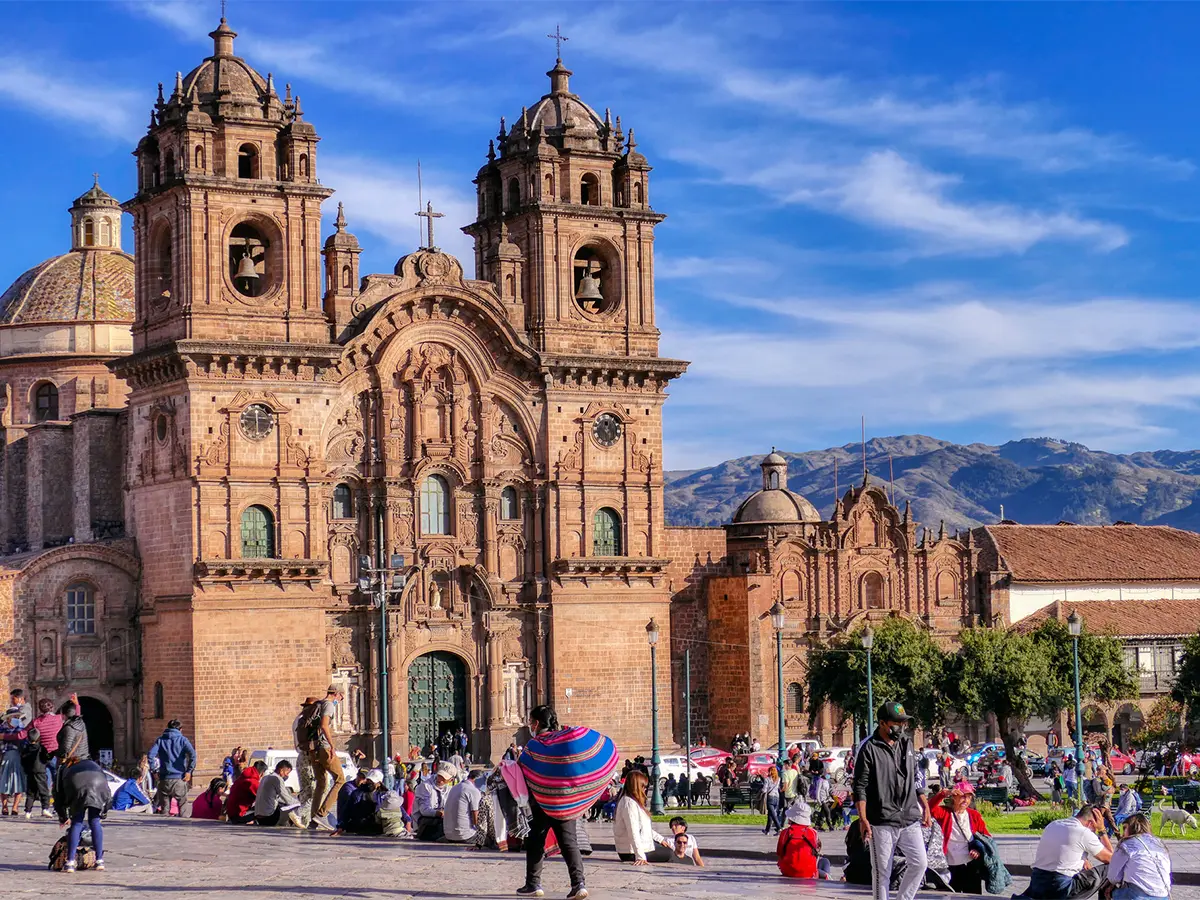
The capital of an empire, still standing under a colonial one
Cusco was the Inca Empire's capital and, in the Inca worldview, the literal center of the world: the name is thought to derive from a Quechua word for navel. When the Spanish arrived they didn't demolish the city so much as build on top of it, and the result is unlike anywhere else in South America: entire colonial buildings resting on massive, precisely fitted Inca stone foundations, the two eras stacked in the same wall. The polygonal masonry along Calle Hatun Rumiyoc, including the famous twelve-angled stone, is the clearest single place to see it.
What surprises most first-time visitors is how much of a living city Cusco still is, not a museum piece. The Plaza de Armas fills with locals as much as tourists, San Pedro Market sells the same produce it always has to the same shoppers, and San Blas's steep artisan quarter still has working ceramicists and weavers rather than only souvenir shops. The altitude changes the pace of everything, in a way that, after the first uncomfortable day, becomes part of why the city feels different from anywhere at sea level.
The honest complications
Altitude sickness catches a real share of visitors who skip acclimatization, more detail in the Safety chapter below. Machu Picchu access, the train and entrance ticket combined, is expensive relative to everyday costs in the city, and the Classic Inca Trail's daily permit cap means peak-season slots sell out four to six months ahead. The steep cobblestone streets up to San Blas are genuinely taxing at altitude for the first couple of days, and June-July nights drop close to freezing, which surprises visitors expecting a uniformly warm South American city.
A compact centre, three neighbourhoods that matter
Cusco's historic centre is small enough to walk end to end in twenty minutes at sea level, longer at altitude. Where you base yourself comes down to how much uphill walking you want and how central you need to be.
Plaza de Armas & Centro Histórico
The main square and the streets immediately around it hold the cathedral, the Compañía de Jesús church, and the highest concentration of restaurants and tour agencies in the city. Staying here means everything is walkable, at the cost of more street noise and slightly inflated restaurant prices right on the square itself.
San Blas
Uphill from the Plaza de Armas, San Blas is Cusco's bohemian, artisan neighbourhood: narrow cobblestone streets, ceramic and textile workshops, and some of the best rooftop views in the city. The climb from the Plaza is real, take it slowly on your first day or two, but the atmosphere and the concentration of good small restaurants make it a favourite base for return visitors.
San Pedro
West of the Plaza de Armas around the San Pedro Market, this is a quieter, more residential area with noticeably better prices on food and lodging than the centre, and it's still a five to ten-minute walk from the main square.
From converted convents to the best hostel dorms in Peru
Cusco's top hotels occupy genuinely historic buildings, several with their own oxygen-enriched rooms for the altitude, and the hostel scene is some of the liveliest in South America. These picks cover every budget.
At the top, Belmond Palacio Nazarenas occupies a former convent and Inca palace site steps from the Plaza de Armas, with 55 suites offering oxygen enrichment, heated bathroom floors, and Cusco's first heated outdoor pool, from around $700 a night. A few blocks away, JW Marriott El Convento Cusco is a restored 16th-century convent with 153 oxygen-enriched rooms and Inca-era artefacts on display, three blocks from the Plaza, from around $350. On the Plaza de las Nazarenas, Inkaterra La Casona, Peru's first Relais & Châteaux property, is an intimate 16th-century mansion with just 11 suites around a colonial cloister, from around $450.
For value with atmosphere, San Blas has several well-regarded mid-range guesthouses in converted colonial houses from roughly $60-100 a night with the neighbourhood's views included for free. At the budget end, Wild Rover Cusco has pod-style dorms with private curtains and an on-site Irish bar with a garden terrace overlooking the city, from about $15; Pariwana Hostel, midway between the Plaza de Armas and San Pedro Market, has pool tables, a busy bar and organized daily activities, from about $12; and Samay Wasi up in San Blas is a smaller, calmer option with some of the best city views of any hostel in Cusco, for travellers who want the neighbourhood's atmosphere without paying hotel prices.
Alpaca, cuy and one of South America's best food scenes outside Lima
Cusco eats differently from coastal Peru: less seafood, more potato, corn and highland meats, cooked with the same ambition that made Lima famous. The best value is at unpretentious lunch spots with a chalkboard menu; the best splurges hold their own against Lima's tasting menus at a fraction of the price.
Chicha
Chicha, chef Gastón Acurio's Cusco restaurant, builds its menu almost entirely from ingredients sourced within the region: alpaca, native potatoes and Andean grains done at a level the tourist circuit rarely reaches. Reserve well ahead.
Cicciolina
Cicciolina, a short walk from the Plaza de Armas, pairs Peruvian ingredients with Mediterranean technique, beet ravioli and chicken in wild mushroom sauce are menu regulars, and its adjoining café is one of the better breakfast and bakery stops in the centre.
Morena Peruvian Kitchen
Morena is known locally for a lomo saltado built with beef jus and cheesy quinoa and for its alpaca risotto, a good single stop for the range of what modern Cusco cooking is doing with traditional ingredients.
Marcelo Batata
Marcelo Batata, just off the Plaza de Armas on Calle Palacio, is one of the best places in the city for alpaca steak and infused pisco cocktails, with a rooftop terrace over the rooftops that provides blankets and heaters once the sun drops.
Jack's Café
Down the hill in lower San Blas, Jack's Café does oversized all-day breakfasts and sandwiches on its own bakery's bread, the reliable choice for homesick comfort food after a few days of Andean cooking.
Inca stonework, a working market, and views that reward the climb
Cusco's sights are compact enough to see without a car, but the altitude means pacing yourself matters more than in any other city guide we've written. This chapter walks through the city roughly the way a good two days would.
The historic centre
Start at the Plaza de Armas, flanked by the Cusco Cathedral, built in part from stones taken from the nearby Sacsayhuamán fortress, and the ornate Jesuit church, La Compañía de Jesús. From there it's a short walk to Qorikancha, the Temple of the Sun, once the empire's most important religious site and once literally covered in gold sheeting before the conquest; the Convent of Santo Domingo now sits on and around its remaining walls, and the join between Inca stonework and colonial arches is the clearest single lesson in the city's layered history. Continue up to Hatun Rumiyoc street to see the twelve-angled stone, a single block cut with twelve distinct angles fitted without mortar, still holding up the wall of what is now the Archbishop's Palace.
Sacsayhuamán and the ceremonial sites above the city
Sacsayhuamán, an enormous Inca ceremonial and defensive complex on the hill directly above Cusco, is built from stone blocks weighing up to well over a hundred tons, fitted with the same mortar-free precision as the twelve-angled stone but at a scale that's hard to photograph adequately. It's walkable from San Blas, roughly 20-30 minutes uphill, or a short taxi ride, and is also the site of the Inti Raymi festival of the sun each June 24th, one of the largest indigenous festivals in the Americas.
San Blas and San Pedro Market
The San Blas neighbourhood above the centre is Cusco's artisan quarter, its narrow streets lined with ceramic and textile workshops where you can watch pieces being made rather than only buy the finished product; expect to pay more here than in general souvenir stalls, and treat it as paying for skilled labour rather than overpaying. Down the hill, San Pedro Market is where the city actually shops: stalls selling dozens of native potato varieties, fresh cheese, flowers, and prepared Andean food, alongside the lunch counters mentioned in the Food chapter. Go with small bills and expect to be one of very few tourists among the regular Tuesday-morning crowd.
Evenings
Cusco's altitude makes a low-key evening the sensible choice more nights than not, but the bars and restaurants around the Plaza de Armas and up in San Blas stay lively regardless, many with rooftop or balcony seating looking down over the cathedral floodlit at night, one of the better free views in the city.
One, two or four days, paced for the altitude
Unlike most city guides, the Cusco itinerary has to build in a rest day: pushing hard on arrival day is the single most common mistake visitors make. These routes assume you've read the Safety chapter's acclimatization advice.
- Morning
Plaza de Armas and Qorikancha. Take it slow, this is likely your first morning at altitude. Coffee at a café on the square before the cathedral and Qorikancha.
- Midday
San Pedro Market lunch. A market lunch counter, then a gentle walk up toward San Blas.
- Afternoon
San Blas and Hatun Rumiyoc. The twelve-angled stone, artisan workshops, and city views from the neighbourhood's highest streets.
- Evening
Dinner near the Plaza. An early night; altitude and travel fatigue catch up faster than expected on day one.
- Day 1
The one-day route above, kept deliberately light for acclimatization.
- Day 2 morning
Sacsayhuamán. Walk or taxi up to the ceremonial complex above the city, ideally before midday crowds and stronger sun.
- Day 2 afternoon
Chicha or Marcelo Batata for a proper dinner, and an evening walk around the illuminated Plaza de Armas.
- Days 1-2
The two-day route above, at a gentle pace to acclimatize properly.
- Day 3
Sacred Valley day trip. Pisac's market and ruins in the morning, Ollantaytambo's fortress in the afternoon, see the Day Trips chapter below.
- Day 4
Machu Picchu. Early train from Ollantaytambo, a full day at the citadel, train back to Cusco that evening or an overnight in Aguas Calientes.
Small enough to walk, high enough to take it slow
Alejandro Velasco Astete International Airport (CUZ) sits about 15 minutes from the Plaza de Armas; nearly all flights connect through Lima, about 90 minutes in the air. A taxi or Uber from the airport costs $3-6, and arranging hotel pickup is worth the small extra cost on arrival day when you're both jet-lagged and adjusting to altitude with luggage. A long-delayed new airport at Chinchero, intended to eventually replace CUZ, remains under construction with no confirmed opening before 2027 at the earliest, so the routing above is unlikely to change during the life of this guide.
Within the city, the historic centre is compact enough to walk, but altitude makes distances feel longer and stairs harder than they look on a map; budget more time than you would at sea level, especially in your first two days. Uber operates reliably in Cusco and is the easiest way to reach Sacsayhuamán or return from a late dinner in San Blas without the climb. For the Sacred Valley and further day trips, organized tours with hotel pickup are the standard approach, and colectivo shared vans run the main valley routes cheaply for more independent travel.
Weather by month and the Inti Raymi festival
Cusco runs a dry season roughly May to September, cool and clear with cold nights, and a rainy season November to April, greener but with regular afternoon showers. June and July are the coldest months, with night temperatures at or below freezing, and also the busiest and most expensive for flights, trains and Inca Trail permits.
Inti Raymi, June 24th, is Cusco's Festival of the Sun, a major Inca-heritage celebration centered on Sacsayhuamán with a reenactment of the Inca winter solstice ceremony, and it's one of the largest and most significant indigenous festivals anywhere in the Americas. Accommodation books out well ahead; plan deliberately around it, either to attend or to avoid the crowds and prices.
Inexpensive day to day, until Machu Picchu enters the budget
Cusco itself is cheap: hostels, market lunches and local transport all cost a fraction of Western prices. The one major exception is Machu Picchu access, which functions as a separate, fixed cost on top of a normal daily budget.
- Hostel dorm $12-20
- Market lunches and menu del día $3-6
- Walking and occasional taxis
- Free plaza and San Blas wandering
- Boutique guesthouse $60-100
- Restaurant meals $12-25
- Uber and the occasional taxi
- Guided day trip or museum entries
- Belmond Palacio Nazarenas or equivalent
- Chicha or a similar tasting menu
- Private guides throughout
- Premium Machu Picchu train service
Safe from crime, honest about the altitude
Cusco and all its main tourist sites, the Sacred Valley, the Inca Trail and Machu Picchu, are explicitly carved out of Peru's one serious regional safety warning, which covers a remote area (the VRAEM) well away from any tourist route. The realistic risks here are pickpocketing in crowded spots like San Pedro Market and altitude sickness, which affects far more visitors than crime does.
Altitude sickness (soroche): what actually works
Cusco sits at 3,400 meters, high enough that a meaningful share of visitors feel some effect, typically headache, fatigue, shortness of breath or mild nausea, within the first 12 to 24 hours. Spend your first day genuinely resting: skip the ruins, avoid alcohol and heavy meals, and don't plan strenuous activity for the first 24 to 48 hours. Coca tea, offered at nearly every hotel, is a legal, traditional remedy that helps many people; staying well hydrated matters more than most visitors expect. Many hotels, including the higher-end properties listed in the Stay chapter, keep supplemental oxygen on hand, and a Diamox (acetazolamide) prescription taken from the day before arrival is a common preventive option worth discussing with a doctor before the trip. If you have extra time, spending your first night or two in the lower Sacred Valley, around 2,800 meters at Ollantaytambo or Urubamba, before coming up to Cusco eases the adjustment considerably. Severe or persistent symptoms, confusion, breathlessness at rest, a headache that doesn't respond to rest and fluids, warrant a clinic visit rather than pushing through; Cusco's clinics see this constantly and treat it well.
Pickpocketing
Concentrated in San Pedro Market and crowded festival crowds. Keep bags zipped and in front of you, and don't carry more cash than the day needs.
Unlicensed taxis
Use Uber or a hotel-arranged taxi, especially from the airport or late at night, rather than hailing a cab on the street.
Uneven cobblestones
Combined with altitude fatigue, uneven San Blas streets are a real trip-and-fall risk. Grippy, broken-in shoes matter here as much as anywhere on this site.
Solo women travelers
Cusco is one of the most solo-female-travelled cities in South America, with an established hostel and tour infrastructure used to independent women arriving alone and joining group treks and day trips. Use Uber rather than street taxis at night, take the usual precautions in busy markets, and note that many trekking and tour groups are excellent ways to meet other travelers if solo hiking companionship is a concern for the Sacred Valley or Rainbow Mountain.
Emergency numbers
The Sacred Valley, Rainbow Mountain, and Machu Picchu itself
Cusco's position makes it one of the best day-trip bases in South America. Machu Picchu is the reason most people come; the trips below are what fills the days around it.
The Sacred Valley: Pisac, Ollantaytambo & Chinchero
The valley of the Urubamba River holds some of the best-preserved Inca agricultural terracing and towns still built on Inca foundations. Pisac has both a hilltop ruin complex and one of the best artisan markets in the region, busiest on Sundays, Tuesdays and Thursdays. Ollantaytambo is a still-inhabited Inca town, its narrow original streets laid out exactly as they were five centuries ago, beneath a steep fortress-temple complex worth the climb, and it's also the main train station for Machu Picchu, making it a natural stop en route. Chinchero, the weaving capital of the Cusco region, has a Sunday market and community weaving centers where you can watch the entire process from raw wool to finished textile, plus its own Inca terraces and a colonial church built over an Inca palace. Nearby, the concentric circular terraces of Moray and the thousands of ancient salt pans still worked at the Maras salt mines are easy add-ons with their own dedicated half-day tours.
Rainbow Mountain (Vinicunca)
Vinicunca's naturally striped mineral slopes reach 5,036 meters at the viewpoint, higher than Everest Base Camp, and the altitude is the genuine challenge here, not the walking distance. Tours leave Cusco around 3-4am for the roughly three-hour drive, followed by a steep 60-90 minute hike; a local community entrance fee of about S/30 ($8) is typically separate from the tour price. Acclimatize in Cusco for at least two to three days before attempting it, and expect the cold at the top to be sharp even at midday.
Humantay Lake
A turquoise glacial lake at around 4,200 meters below the Salkantay massif, reached by a steep 60-90 minute hike from the trailhead after an early pickup and long drive. Slightly less demanding logistically than Rainbow Mountain and, for many visitors, just as visually striking; the same acclimatization advice applies.
Machu Picchu
The citadel itself is reached by train, PeruRail or IncaRail both run the route, from Ollantaytambo or Poroy to Aguas Calientes, then a short bus up the switchbacks to the entrance. Book the train and your entrance ticket and circuit together as early as you can, ticket sales for a given year open the previous November and popular months sell out. Travelers wanting to walk in rather than ride the bus have two main options: the Classic Inca Trail, which caps at 200 permits a day and sells out four to six months ahead for June-August, or the unrestricted Salkantay trek, bookable weeks rather than months out, which passes glaciers and cloud forest but arrives by the same bus as everyone else on the final day.
Cusco FAQ
Is Cusco safe for tourists?
Yes. Cusco and all its main tourist sites are explicitly excluded from Peru's one serious regional safety warning. The realistic risks are pickpocketing in crowded markets and altitude sickness, not violent crime. Standard city awareness plus a sensible acclimatization plan covers it.
How many days do I need in Cusco?
Four full days works well: one to acclimatize gently, one for the city and San Blas, one for the Sacred Valley, and one for Machu Picchu. A fifth day fits Rainbow Mountain or Humantay Lake if you're up for another early start.
How do I avoid altitude sickness in Cusco?
Rest for your first 24 hours, skip alcohol and heavy meals, drink coca tea, and stay hydrated. Many hotels offer supplemental oxygen and some Sacred Valley towns sit at a lower, gentler elevation if you want to acclimatize gradually before Cusco itself.
How much does Cusco cost per day?
Budget travellers manage on $40-60 a day with hostels and menu-del-dia lunches; mid-range runs $90-150. Machu Picchu access, the train plus entrance ticket, is a separate cost on top of daily spending.
When is the best time to visit Cusco?
May to September is the dry season and the best window for the city, the Sacred Valley and any trek. June and July are the coldest months with near-freezing nights, and also the busiest and most expensive for trains and permits.
How do I get from Cusco airport to the centre?
Alejandro Velasco Astete Airport sits about 15 minutes from the Plaza de Armas. A taxi or Uber costs $3-6; many hotels also offer airport pickup, useful on arrival day when carrying luggage uphill at altitude is best avoided.
What is the best area to stay in Cusco?
The historic centre around the Plaza de Armas and San Blas for first-timers: walkable, atmospheric and close to restaurants, though San Blas involves a steep uphill walk. San Pedro, near the market, is quieter and better value.
Do I need to book Machu Picchu tickets in advance?
Yes. Entrance tickets and trains sell out weeks ahead in June-August, and the Classic Inca Trail's 200 daily permits go four to six months out for peak season. Book the Inca Trail specifically as early as possible or use the unrestricted Salkantay trek instead.
Is Cusco walkable?
The historic centre is compact and walkable, but the altitude and steep cobblestone streets, especially up to San Blas, make it slower going than a normal city. Take stairs slowly for your first couple of days and use a taxi rather than push through breathlessness.
What is the difference between the Inca Trail and Salkantay trek?
The Inca Trail ends by walking through the Sun Gate into Machu Picchu itself but caps at 200 permits a day, sold months ahead. Salkantay has no permit system, costs less, and passes glaciers and cloud forest, but arrives at Machu Picchu by bus like everyone else rather than on foot.
What Stays With You
Cusco does not let you forget it was once the center of an empire. It's in the wall behind your hotel's front desk, in the foundation under the cathedral, in the twelve-angled stone that thousands of hands cut without iron tools or the wheel. The city gets on with its life around all of it: market vendors selling the same potato varieties their grandparents sold, weavers in San Blas still using patterns older than the buildings around them.
Take the altitude seriously, take the Sacred Valley seriously as more than a warm-up for Machu Picchu, and give the city itself the time it's asking for before you head up to the ruins everyone came for.