
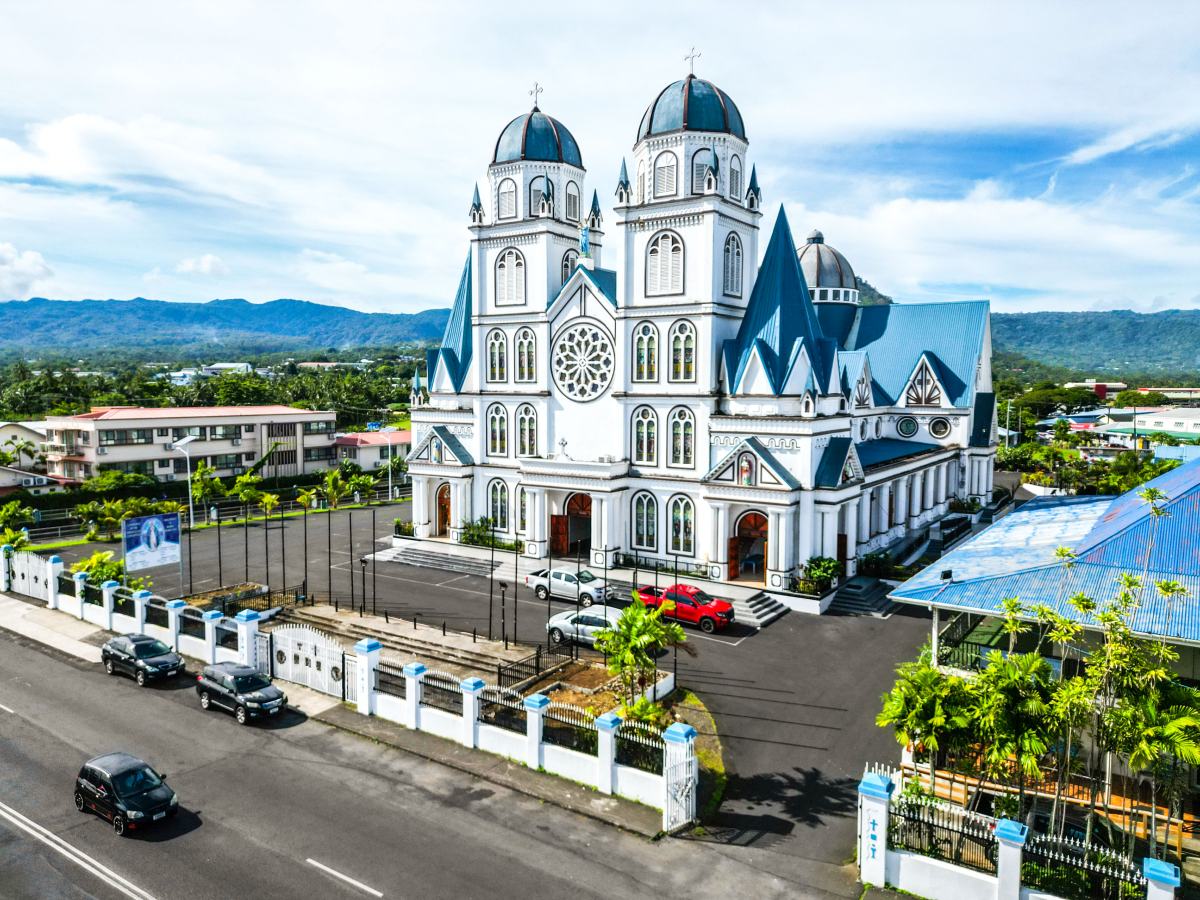
Samoa's only town, and it isn't trying to be more
Apia sits around a natural harbour on the north coast of Upolu, a scatter of low-rise streets, two markets and a waterfront that constitutes the entirety of Samoa's urban life. Everything that counts as a "city" experience in Samoa happens here: the government offices on Mulinu'u Peninsula, the fish and produce markets, the country's only real concentration of restaurants, and the ferries and buses that reach everywhere else. It is not trying to be Auckland or Suva, and it would be a strange place to visit if that's what you wanted.
What Apia does have is Robert Louis Stevenson's former home in the hills above town, a genuinely excellent snorkeling reserve a five-minute walk from the centre, and a rhythm shaped entirely by fa'a Samoa rather than tourism. Come Sunday, the town empties out for church and family lunch, and visitors are expected to slow down along with everyone else.
The honest complications
Apia is small: two focused days covers the town itself, and travelers expecting a bustling Pacific capital may find it quiet, even sleepy, outside the markets. There are no ride-hailing apps, so getting around after dark or off the main strip means a pre-arranged or flagged-down taxi with a fare agreed in advance. Sunday closures catch first-timers out more than anything else, plan your one Sunday around a hotel, the Vailima grounds, or simply resting. And while the town centre is walkable, the heat and humidity are real; pace yourself and carry water.
Four areas, all within an easy drive of each other
Apia is compact enough that "neighbourhood" is a loose term; most of the town is walkable, and nowhere is more than a short taxi ride from anywhere else. Where you base yourself comes down to whether you want the markets outside your door or the ocean.
Town Centre & Beach Road
The commercial heart of Apia runs along Beach Road on the waterfront, with the flea market, fish market and the government buildings nearby. This is the most practical base: everything is walkable, the Tanoa Tusitala Hotel sits a few minutes off the strip, and it's the easiest spot from which to catch a bus or arrange a taxi to anywhere else on Upolu.
Vaiala
East of the centre, Vaiala is Apia's beach suburb, home to Palolo Deep Marine Reserve and a handful of guesthouses and small resorts along the water. Quieter than the town centre at night, and close enough to walk in for the markets during the day.
Vailima
Up in the hills south of town, Vailima is where Robert Louis Stevenson built his estate and where his museum and grave on Mount Vaea now draw visitors for a half-day out of the heat and noise of the centre. Not a place to stay, but essential to visit.
Mulinu'u Peninsula
The old ceremonial capital at the western tip of the harbour holds Parliament House, the German-era observatory turned meteorology office, historic chiefly burial grounds, and the Independence Memorial. A quiet, largely residential stretch, good for an unhurried walk at sunset.
From a private-island resort to a family guesthouse
Apia's accommodation runs from an island resort to simple, family-run guesthouses, with a solid mid-range hotel in between. There is no traditional hostel scene here the way there is in Porto or Bangkok; budget travelers rely on guesthouses instead.
At the top end, Taumeasina Island Resort occupies its own small island a five-minute drive from central Apia and about 45 minutes from Faleolo Airport, Samoa's first resort of its kind, with 80 rooms plus two and three-bedroom villas, a cascading pool, and a private white-sand beach with its own water-sports pavilion.
For a central, established mid-range stay, Tanoa Tusitala Hotel sits on 15 acres of tropical gardens about 800m from Apia's central business district, a three-minute walk from the flea market: 95 air-conditioned rooms, a pool, gym and tennis courts, and the most complete hotel experience in the country.
At the budget end, Olivia's Accommodation offers ensuite double and triple rooms with air-conditioning or fan, plus dormitory beds with shared bathrooms for travelers keeping costs down; along with other guesthouses around Moto'otua and Vaitoloa, this is how most budget travelers sleep in Apia, since the town has no conventional hostels.
Oka, umu cooking, and an unexpected Italian streak
Apia's food scene is small but genuine: fresh reef fish, produce from the markets, and a surprising concentration of good Italian-Samoan restaurants alongside the traditional umu cooking still practiced across the country.
Paddles at the Marina
One of Apia's most popular restaurants, with lagoon views that make it a natural spot to watch the sunset over a cold Vailima beer. Regulars order the oka, marinated raw fish served with taro or breadfruit chips, but the Rossi family who run it also serve fine-tuned Italian dishes made with local produce, including a well-regarded fish lasagna.
Giordano's Pizzeria
Stone-fired, European-style pizza in a charming garden patio setting, a taste of the Mediterranean that has become one of the more reliably popular restaurants with both locals and visitors.
Apia Fish Market
Next to the flea market, the day's catch, fish, crayfish, octopus, comes in through the morning and is sold with no concession to tourism. It's the most direct look at what actually lands on Samoan tables, and worth a walk-through even if you're not buying.
A small town with an outsized former resident
Apia rewards a slow pace: the sights are few but genuine, and the best of them are as much about atmosphere, church bells, market chatter, harbour light, as about ticking a box.
Vailima and Mount Vaea
The Robert Louis Stevenson Museum, the writer's restored former estate in the hills above town, is Apia's essential half-day. Stevenson, whom Samoans nicknamed Tusitala, "Teller of Tales," built the mansion in 1890 and lived there until his death in 1894; it was fully restored after hurricane damage and reopened as a museum in 1994, kept as it looked at the time of his death, with guided tours through the rooms. Entry is around WST20 for adults. On a clear day, continue up the marked trail behind the house to his grave on top of Mount Vaea, overlooking the sea, a steep but short hike.
Palolo Deep Marine Reserve
A five-minute walk east of the centre toward Vaiala Beach, Palolo Deep is a protected blue hole ringed by coral walls and full of reef fish, good for snorkeling, diving or simply floating. Go at high tide; at low tide the walk out crosses sharp rock and coral, and water shoes are worth packing. Open daily, 8am-6pm.
The markets and Mulinu'u Peninsula
Maketi Fou, the main market behind the bus station on Fugalei Street, is where locals sell produce and where Apia's daily rhythm is most visible; the flea market and fish market sit together on Beach Road. From there it's an easy walk or short drive out to Mulinu'u Peninsula, past Parliament House, the old German observatory (now the meteorology office), the historic burial grounds of Samoan chiefs, and the Independence Memorial commemorating the country's 1962 independence.
Museum of Samoa
On Vaitele Street, marked by a large mural, the Museum of Samoa covers six galleries including 3,000-year-old Lapita pottery and the colonial period, with free guided tours available and entry by donation. Open 9:30am-4pm, Monday to Friday, closed weekends and public holidays, worth timing into a weekday itinerary.
On the water
AquaSamoa, based on Beach Road, runs scuba and snorkeling trips where divers regularly encounter black-tip reef sharks and green turtles; humpback whales pass offshore between roughly August and October for those visiting in that window.
Two days in town, a third or fourth for the coast
Two full days cover Apia itself comfortably. Add a day or two for To Sua Ocean Trench and the south coast, which most visitors treat as the real highlight of a Samoa trip.
- Morning
Vailima. The Robert Louis Stevenson Museum, then the trail up to his grave on Mount Vaea if the weather holds.
- Midday
Lunch and the markets. Oka at a Beach Road restaurant, then a walk through the flea and fish markets.
- Afternoon
Palolo Deep. Snorkel the reserve at high tide, then walk or taxi back into the centre.
- Evening
Sunset at Paddles on the marina, Vailima beer in hand.
- Day 1
The one-day route: Vailima, Mount Vaea, the markets, Palolo Deep, dinner on the water.
- Day 2 morning
Museum of Samoa. Six galleries and a free guided tour (weekdays only).
- Day 2 afternoon
Mulinu'u Peninsula. Parliament House, the old observatory, the chiefly burial grounds and the Independence Memorial, at an unhurried walking pace.
- Day 2 evening
Giordano's for stone-fired pizza in the garden patio.
- Days 1-2
The two-day route above, at a gentler pace.
- Day 3
To Sua Ocean Trench and Piula Cave Pool, a full day south along the coast, ideally with a rental car to set your own pace.
- Day 4+
Lalomanu Beach for a night or two at a beach fale, or the ferry across to Savai'i for a genuinely different side of Samoa.
Small enough to walk, spread out enough to need a taxi sometimes
Faleolo International Airport (APW) sits about 35km west of Apia; the drive takes 45-50 minutes. A taxi costs roughly WST60-80, agree the fare before you get in since none are metered; public buses cover the route for about WST5, cash only, paid on board; a hotel shuttle bus runs about WST12 each way, with tickets from the tourist office booth in arrivals.
Within Apia, the town centre, Beach Road and Vaiala are all walkable in normal heat. For Vailima, Mulinu'u or anywhere further, flag a taxi and agree the fare first; there are no ride-hailing apps anywhere in Samoa. Local buses, colorful and often blasting music, run between villages on their own unhurried schedule and stop for pretty much anyone who waves, a fun if unpredictable way to get around. For day trips down the coast or across to Savai'i, a rental car is the most practical option and lets you set your own pace around the customary land and Sunday closures.
SIM cards and best time to visit
SIM cards: Vodafone and Digicel both have kiosks at Faleolo Airport arrivals; a starter SIM runs about WST10 plus credit, with tourist data packages available. Digicel generally has the widest coverage beyond Apia.
Best time to visit: May to October is Samoa's dry season and the most comfortable time to be in Apia, lower humidity and minimal cyclone risk. November to April is wetter, with cyclones most likely from late December to early April; short, intense storms are common even outside that peak window.
Cheaper than Fiji at every level
Apia is inexpensive by Pacific standards, especially outside the resort tier. The main cost trap is assuming you can pay by card; outside hotels and a handful of larger restaurants, Apia runs on cash.
- Guesthouse or dorm room WST60-120
- Market meals and oka WST15-25
- Local buses within town
- Free Palolo Deep plus one paid sight
- Tanoa Tusitala or similar hotel
- Restaurant dinners with a drink
- Taxis or a half-day rental car
- Robert Louis Stevenson Museum, a snorkel trip
- Taumeasina Island Resort
- Private tours and transfers
- Dining at Apia's better restaurants
- A full-day car rental to To Sua and back
The safest part of a genuinely safe country
Apia rates as the safest part of Samoa, and Samoa as a whole carries the US State Department's Level 1, Exercise Normal Precautions rating, its lowest-risk tier. Violent crime against visitors is rare. The practical things to know are about transport and water, not crime.
Taxis aren't metered, and drivers at the airport and ferry terminal sometimes quote inflated fares to visitors; agree the price before you get in, every time. At night, stick to well-lit, populated areas and avoid walking alone, particularly for solo women, since unwanted attention and occasional harassment are reported. At Palolo Deep, watch the tide and wear water shoes; sharp coral and rock make a low-tide entry needlessly risky. Emergency number is 911 for police, fire and ambulance nationwide, and Tupua Tamasese Meaole (TTM) Hospital in Motootua (+685 21212) is Apia's main hospital.
To Sua Ocean Trench alone justifies the trip to Apia
Apia's position on Upolu makes it the natural base for Samoa's best-known sights, all reachable by rental car or organised tour.
To Sua Ocean Trench
A giant swimming hole near Lotofaga, reached down a steep wooden ladder into water connected to the sea through underwater lava tubes, surrounded by manicured gardens and clifftop views. Samoa's single most photographed spot, and worth the trip even with the crowds it now draws. Organised day tours combine it with other south coast stops for travelers without a rental car.
Piula Cave Pool
A freshwater pool on the grounds of a theological college, with two cave entrances linked by an underwater tunnel for confident swimmers, plus day fales and changing facilities. Open Monday to Saturday, 8am-4pm; a good stop on the way to or from To Sua.
Lalomanu Beach
A long white-sand arc on Upolu's southeastern tip, facing a protected marine reserve good for snorkeling. Rebuilt further from the waterline after the 2009 tsunami, it's now lined with simple beach fales and remains one of Samoa's best beaches for an overnight rather than a rushed stop.
Savai'i
Samoa's larger, quieter second island is a stretch too far for a rushed day trip, but the ferry from Mulifanua Wharf (60-90 minutes, roughly WST10 one way, departures about every two hours) makes it an easy add-on for the Alofaaga Blowholes and Afu Aau Waterfall if you have a spare night or two.
Apia FAQ
Is Apia safe for tourists?
Yes. Apia rates as the safest part of Samoa, and the US State Department rates the whole country Level 1, Exercise Normal Precautions. Violent crime against visitors is rare; agree taxi fares before you get in and take normal precautions at night.
How many days do I need in Apia?
Two days covers the town itself well: one for the Robert Louis Stevenson Museum, Mount Vaea and Palolo Deep, one for the markets, waterfront and Mulinu'u Peninsula. Most visitors add a third or fourth day for To Sua Ocean Trench and the south coast.
How much does Apia cost per day?
Budget travellers manage on WST170-250 (about US$60-90) a day with guesthouse rooms and market meals; mid-range with an air-conditioned hotel and restaurant dining runs WST420-560 (about US$150-200).
When is the best time to visit Apia?
May to October, Samoa's dry season, for lower humidity and minimal cyclone risk. The wet season runs November to April, with cyclones most likely from late December to early April.
Is Apia closed on Sundays?
Largely, yes. Most shops, markets, fuel stations and restaurants close, and buses run a reduced or no schedule. Plan Sunday around a hotel restaurant, the Robert Louis Stevenson Museum grounds, or simply resting, and dress and behave quietly if you're out.
How do I get from Faleolo Airport to Apia?
It's about 35km and 45-50 minutes. A taxi costs roughly WST60-80 (agree the fare first, taxis aren't metered); public buses run the route for about WST5; a hotel shuttle bus costs around WST12.
What is the best area to stay in Apia?
The town centre and Beach Road for first-timers: central, walkable to the markets and waterfront. Vaiala for a quieter beachfront base near Palolo Deep. Taumeasina's private island for a resort setting five minutes from town.
Do I need to speak Samoan in Apia?
No. English is an official language alongside Samoan and is widely spoken in hotels, restaurants and shops in Apia. A few Samoan words, fa'afetai (thank you) and talofa (hello), are genuinely appreciated.
Can I use ride-hailing apps in Apia?
No, there are no ride-hailing apps anywhere in Samoa. Taxis are unmetered, so agree the fare before you get in. For day trips, a rental car is generally more practical than relying on taxis.
What's the best day trip from Apia?
To Sua Ocean Trench, about an hour south, is the single most worthwhile day trip: a sunken swimming hole reached by ladder, fed by the sea through underwater lava tubes. Combine it with Piula Cave Pool en route and, tides permitting, Lalomanu Beach.
What Stays With You
Apia does not put on a show for visitors, and that's exactly the point. The town gets on with its week, church bells on Sunday morning, fish landing at dawn, the same family running the same market stall for decades, and lets you walk through the middle of it. The view from Mount Vaea, the first bite of oka at a table above the marina, the quiet of Mulinu'u at sunset: none of it was staged for you, which is why it sticks.
Go to Palolo Deep at high tide on your last morning, float above the coral a five-minute walk from the centre of the capital, and understand why the people who live here never felt the need to build anything bigger.