
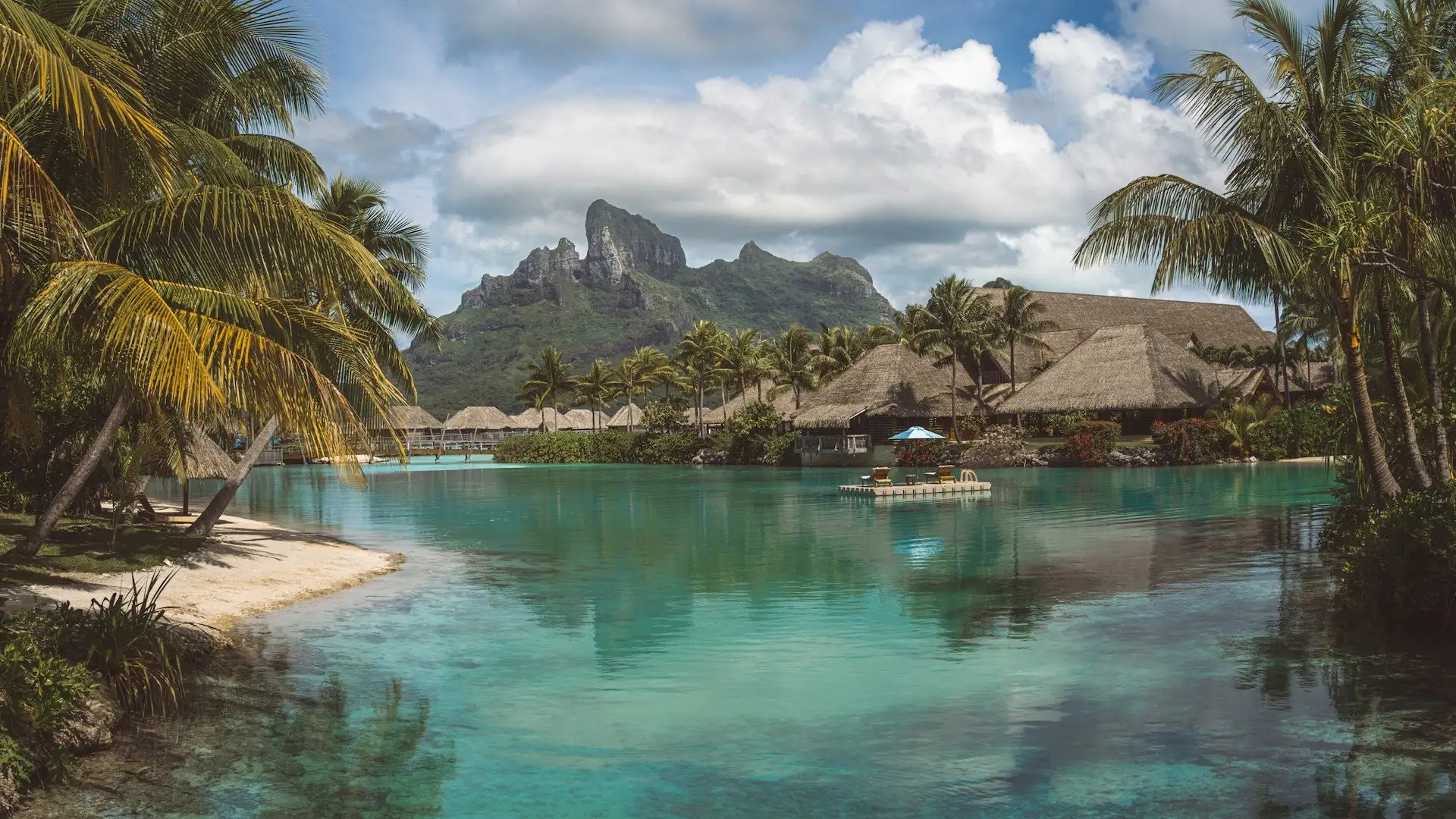
What You're Actually Getting Into
French Polynesia is not one destination, it's 118 islands spread across five archipelagos in an expanse of ocean roughly the size of Western Europe, even though the total land area is smaller than the state of Rhode Island. Most visitors see a fraction of it: Tahiti, where the only international airport sits, Moorea a short ferry away, and Bora Bora, the island the entire genre of overwater bungalow photography exists to sell. That's a legitimate trip. It's also a small slice of a place that includes coral atolls where sharks outnumber people and reefless volcanic islands in the Marquesas that most Tahitians themselves have never visited.
It is also, without much competition, one of the most expensive places on earth to travel. A resort night at the addresses in the postcards runs $500 to $1,500 and up. That's not a reason to skip it: pensions, the family-run guesthouses that exist on nearly every inhabited island, and the roulotte food trucks that set up every evening on the Papeete waterfront put a real, unfiltered version of the country within reach of a traveler willing to trade thread count for authenticity. The lagoon looks the same from a pension deck as it does from a $1,200 overwater villa.
The honest complications
The distances are real and they cost money: inter-island flights on Air Tahiti, the only carrier serving most of the network, are not cheap, and a Marquesas or Tuamotu add-on can double a trip's airfare. French is the working language of officialdom and most transactions outside resorts; English coverage is good in tourism but noticeably thinner than in, say, Fiji or Hawaii. And the place carries real historical weight that the brochures skip past: France tested 193 nuclear weapons at Moruroa and Fangataufa atolls between 1966 and 1996, and the territory's relationship with Paris, including an active independence movement, is an unresolved, present-tense political question, not a settled piece of history.
A History Worth Knowing
Polynesian navigators settled these islands centuries before any European saw them, using double-hulled canoes, stars, swells and bird flight rather than instruments; researchers now place the main settlement wave of the Society Islands closer to 1000-1200 CE than the older 300 CE estimate still repeated in some guidebooks. European contact came late and fast: Samuel Wallis for Britain in 1767, Louis-Antoine de Bougainville for France a year later, then Captain Cook three times. A French protectorate followed in 1842, full colonization in 1880, and, in the 20th century, 193 French nuclear tests at two Tuamotu atolls that still shape local politics today.
- c. 1000-1200 CE
Polynesian settlement. Voyaging canoes from central and western Polynesia reach the Society Islands, part of the last great wave of human migration on Earth.
- 1767-1769
European contact. Samuel Wallis lands at Tahiti for Britain (1767); Bougainville claims it for France (1768) and describes it as a paradise to Enlightenment Europe; Cook observes the transit of Venus from Point Venus (1769).
- 1797-1842
Missionaries and the Pomare dynasty. London Missionary Society arrives, converts the Pomare rulers, and suppresses traditional dance and tattoo. France establishes a protectorate over Tahiti in 1842.
- 1880
Colonization. King Pomare V cedes sovereignty; Tahiti and its dependencies become a full French colony.
- 1966-1996
Nuclear testing. France detonates 193 nuclear devices at Moruroa and Fangataufa atolls, ending only after international pressure and a 2010 law compensating affected residents.
- 2004-present
Autonomy and the independence question. French Polynesia becomes an overseas collectivity with its own president and assembly; the pro-independence Tavini Huiraatira party has governed since 2023, and the territory remains on the UN's list of non-self-governing territories.
Read the full history: the Bounty, Gauguin, and the nuclear years
Tahiti's 18th-century European "discovery" happened in a rush: Wallis in 1767, Bougainville in 1768, and Cook across three separate voyages between 1769 and 1777. Bougainville's account of Tahiti as an unspoiled Eden, embellished for a French audience primed for the idea of the "noble savage," did more to shape European fantasies about the South Pacific than any single document before or since; the islands have been living inside that fantasy, for better and worse, ever since. The HMS Bounty stopped at Tahiti in 1788 to collect breadfruit plants before its crew's famous 1789 mutiny, and several mutineers spent time on the island before the ship moved on to Pitcairn.
The London Missionary Society arrived in 1797 and, within a generation, had converted the ruling Pomare dynasty to Christianity and banned traditional dance, tattooing and much of pre-contact religious practice. That suppression held for well over a century: Ori Tahiti dance was not publicly revived until 1956, when Papeete schoolteacher Madeleine Moua founded the Heiva Tahiti troupe, and Polynesian tattoo culture only re-emerged as a point of cultural pride from the 1980s onward.
France's protectorate (1842) became outright colonial rule in 1880 when Pomare V ceded sovereignty. The territory was renamed French Polynesia in 1957 and, after decades as a standard overseas territory, gained the more autonomous "overseas collectivity" status in 2004, with its own president and Territorial Assembly handling most domestic affairs while Paris retains control of defense, currency and foreign policy.
The nuclear years. After Algerian independence closed France's Sahara test sites, the French military relocated its nuclear program to the remote atolls of Moruroa and Fangataufa in the Tuamotus. Between 1966 and 1996, France conducted 193 tests there, 46 of them atmospheric, exposing military personnel and nearby populations to fallout the French state spent decades minimizing. International and Polynesian pressure, along with the 1996 Comprehensive Nuclear-Test-Ban Treaty, ended the program; a 2010 French law (the Loi Morin) established a compensation process for victims, though many claims remain contested. It's the single most consequential fact about modern French Polynesian politics that visitors are least likely to hear about at a resort.
Gauguin's Polynesia. Paul Gauguin painted in Tahiti and, later, the Marquesas between 1891 and his death in 1903, and is buried in the Calvary Cemetery in Atuona, Hiva Oa, alongside the Belgian singer Jacques Brel, who lived his final years on the same island. The Gauguin Museum on Tahiti itself has been closed for years with no confirmed reopening date; his surviving legacy on the island is scattered rather than centralized in one collection.
Top Destinations
French Polynesia divides into five archipelagos, and almost no trip touches all of them. Tahiti is the transport hub and the only realistic entry point; Moorea and Bora Bora are the Society Islands most visitors actually see; the Tuamotu atolls trade lagoon glamour for some of the best shark diving on the planet; and the Marquesas, volcanic and unprotected by any barrier reef, are a different country in all but name. Budget your time by archipelago, not by island count: getting between them costs real money and real hours.
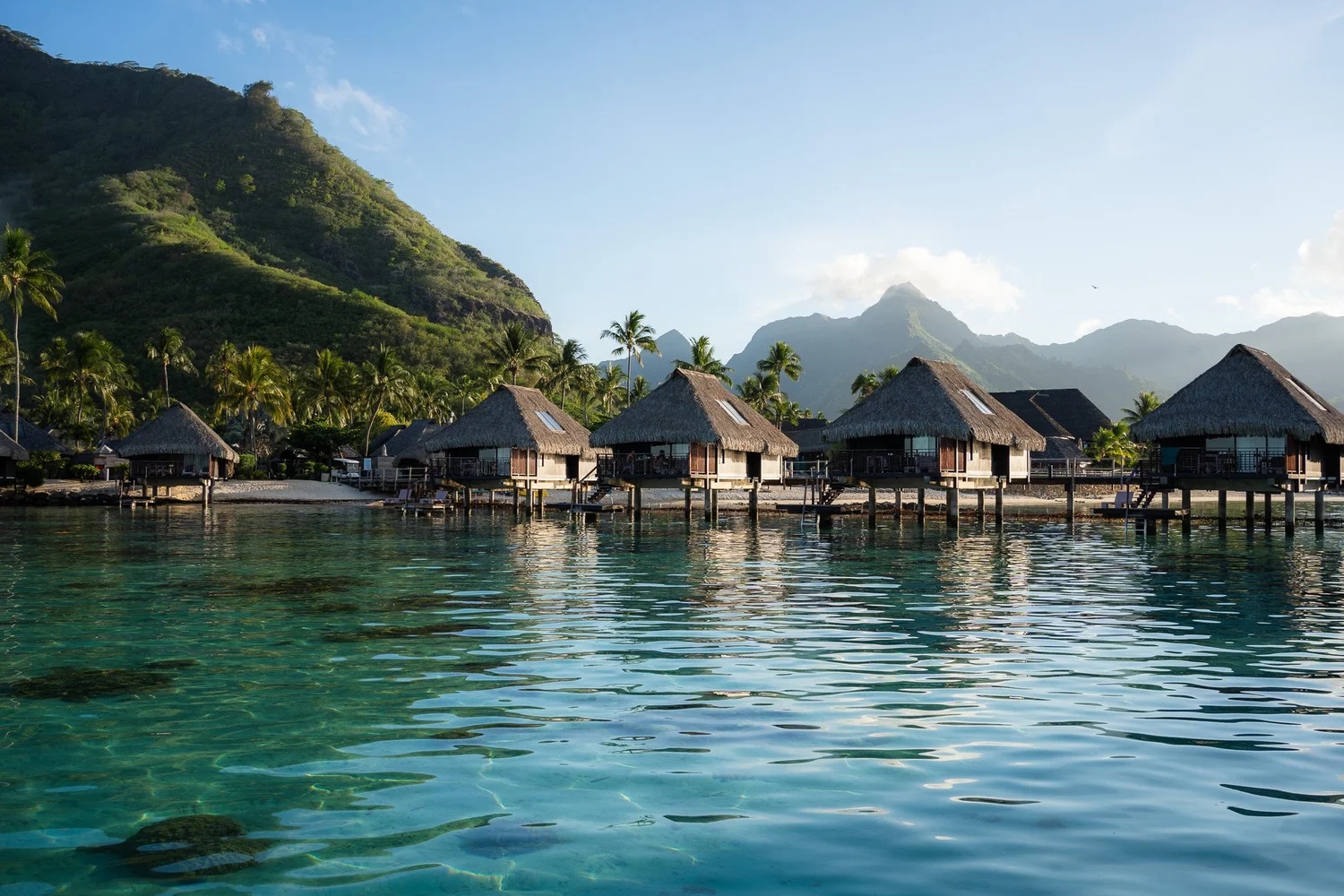
Tahiti, the hub everyone flies through and few explore
Tahiti is where every international flight lands, and most visitors treat it as a one-night stopover before the outer islands. That undersells it. The full island guide covers Papeete in detail, but beyond the capital, Point Venus, a black-sand headland where Cook observed the 1769 transit of Venus, has a 19th-century lighthouse and reliable swimming. The Papenoo Valley, the island's largest, is crossable only by 4x4 tour, threading river fords and jungle track past the Topatari, Vaiharuru and Puraha waterfalls to the Maroto restaurant in the mountains. Teahupo'o, on the island's southern peninsula, hosted Olympic surfing in 2024 and remains one of the most respected, and most dangerous, waves on earth; the village itself, largely untouched by mass tourism, is worth the drive even without a board.
Moorea, the value lagoon
Moorea sits a 30 to 45-minute ferry from Papeete (Aremiti and Terevau both run the crossing for roughly 1,350-2,030 XPF, about $12-18, one way), which makes it the only Society Island reachable without a flight. The heart-shaped island's twin bays, Cook's Bay and Opunohu Bay, are ringed by jagged volcanic peaks, and the Belvedere lookout above Opunohu Valley gives the single best panoramic view in French Polynesia for the price of a short drive. Lagoon boat tours here reliably deliver close encounters with blacktip reef sharks and stingrays in chest-deep water, a wilder and cheaper version of what Bora Bora charges a premium for. The Hilton Moorea Lagoon Resort & Spa pairs strong snorkeling straight off its overwater villas with the island's best spa, while the Sofitel Kia Ora Moorea Beach Resort sits on Moorea's longest white-sand beach inside a protected marine reserve where motorized watercraft are banned, a quieter, more swim-friendly alternative.
Bora Bora, the lagoon on every postcard
Bora Bora earns the reputation: a barrier reef encloses a lagoon in shades of blue that genuinely don't look real, with the jagged basalt spike of Mount Otemanu at its center. It's reached by a roughly 50-minute Air Tahiti flight from Papeete, then a boat transfer, since the airport sits on its own motu (islet). The overwater bungalow concept, if not invented here, was perfected here: the St Regis Bora Bora Resort has the largest villas in French Polynesia at over 1,500 square feet with glass floor panels over the lagoon, and the Four Seasons Resort Bora Bora matches it on service and setting. For a real price break without leaving the lagoon, Maitai Polynesia Bora Bora offers overwater rooms at a fraction of the flagship resorts' rates. Matira Beach, the island's one public beach, is free and genuinely excellent, proof that Bora Bora doesn't require a five-figure hotel bill to be worth the flight.
Huahine, Raiatea & Taha'a, the islands most visitors skip
Huahine, split into Huahine Nui and Huahine Iti and joined by a bridge, is the least developed of the main Society Islands and holds the largest concentration of ancient marae (stone temple platforms) in French Polynesia, alongside vanilla orchid groves and quiet, uncrowded reefs. Raiatea, the second-largest island after Tahiti, is considered by many Polynesians the spiritual birthplace of the culture: Taputapuātea marae, a UNESCO World Heritage Site since 2017, was the ceremonial and political center from which voyaging canoes are believed to have departed to settle Hawaii, New Zealand and Rapa Nui. Raiatea shares a single protective lagoon with tiny Taha'a, French Polynesia's "vanilla island," which grows a distinct, more floral variety (Vanilla tahitensis) than the beans found elsewhere.
Rangiroa & Fakarava, diving with hundreds of sharks
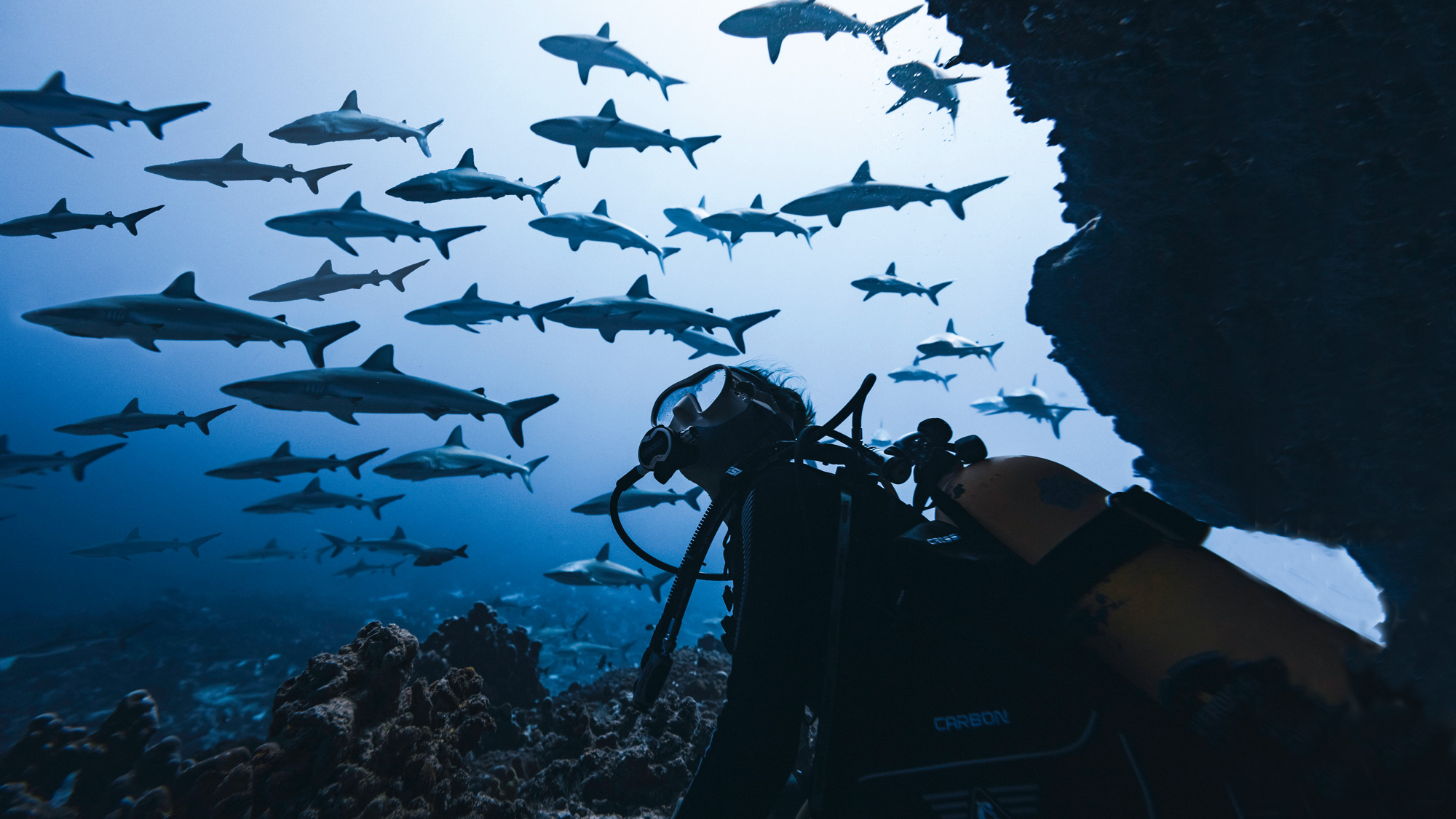
The Tuamotus trade the Society Islands' volcanic peaks for low coral atolls, and the tradeoff is some of the best diving on the planet. At Rangiroa, the world's second-largest atoll, the incoming tide through Tiputa Pass pulls in around 200 grey reef sharks at depth, and between January and March great hammerheads arrive to hunt migrating eagle rays. At Fakarava, a UNESCO Biosphere Reserve since 2006, the South Pass (Tumakohua Pass) is known simply as the "Wall of Sharks": over 700 grey reef sharks stack in the current in the largest documented natural aggregation of reef sharks anywhere, with a June-July grouper spawning event that triggers a multi-day feeding frenzy. Neither destination requires diving certification to appreciate from the surface, but divers get the real show. Tikehau, a short flight away, swaps sharks for pink sand beaches and calmer, shallower snorkeling.
The Marquesas, no lagoon, no crowds
The Marquesas sit apart, geologically and culturally, from the rest of French Polynesia: young volcanic islands with no protective barrier reef, so the ocean meets the land directly in dramatic cliffs and black-sand bays rather than calm lagoons. Nuku Hiva, the largest, has deep valleys, ancient tiki carvings, and some of the roughest, most spectacular coastline in the Pacific. Hiva Oa is quieter still and holds the Calvary Cemetery in Atuona, where Paul Gauguin and the singer Jacques Brel are buried within a few meters of each other. Getting here means a roughly 3.5-hour Air Tahiti flight from Papeete or a passage aboard the Aranui, a working cargo-and-passenger ship that still supplies the outer islands. Infrastructure is minimal and English is rarer than anywhere else in the territory; this is the archipelago for travelers who've already done Bora Bora and want the version of French Polynesia almost nobody photographs.
Beyond the main circuit
The zones above cover a first trip and most second trips well. With extra time and budget, these reward the detour.
Teahupo'o at dawn
Arrive early to watch surfers paddle out at the break that hosted the 2024 Olympics, then walk the village before the tour boats arrive. No lagoon glamour here, just one of the world's most respected waves in a working fishing village.
Vanilla plantation visits
Taha'a's vanilla farms, reachable by boat across the shared lagoon with Raiatea, grow a distinct floral variety of the bean and offer some of the least touristed lagoon scenery in the Society Islands.
Fakarava's June grouper spawn
Time a Fakarava trip to the full moon in June or July and the South Pass sharks shift from resting wall to active hunt, feeding on a spawning aggregation of over 17,000 marbled groupers.
Culture & Etiquette
Mā'ohi culture, suppressed for a century and a half by missionaries and colonial administration, has been visibly and deliberately rebuilt since the mid-20th century. Traditional dance, tattoo and va'a outrigger canoeing aren't museum pieces here, they're living practices most visibly on display every July at the Heiva i Tahiti festival, a month-long competition of dance, chant, canoe racing and traditional sport that is the single best time to see the culture at full intensity. French is the official language of government and commerce; Tahitian (Reo Tahiti) is co-official and the everyday language of much of the population, with distinct Marquesan, Paumotu and other Polynesian languages spoken in the outer archipelagos.
Do
- Learn a few Tahitian and French words. Ia ora na (hello), Māuruuru (thank you) in Tahitian; Bonjour and Merci go a long way in shops and pensions, where French is the default language, not English.
- Dress modestly at marae and religious sites. These are active spiritual places for many Polynesians, not ruins; treat them with the same respect you'd give a church.
- Try to catch the Heiva festival if visiting in July. It's the best window into contemporary Mā'ohi culture, not a staged tourist show.
- Carry cash on smaller islands and atolls. Card acceptance is reliable in Papeete and at international resorts, patchier at pensions and on the outer islands.
- Ask before photographing people, particularly in the Marquesas and other less-visited archipelagos where tourism is still a novelty.
Don't
- Assume English will get you through everything. It's common at resorts and in central Papeete tourism, considerably less so at markets, pensions and on outer islands.
- Touch or feed marine life beyond what a licensed guide directs. Ray and shark encounters are safe when guided; freelancing near wildlife isn't.
- Treat the nuclear testing history as ancient or irrelevant. It ended within living memory, compensation claims are still being processed, and it remains a live political issue.
- Skip travel insurance with medical evacuation cover. Serious medical care is concentrated on Tahiti; a diving or health emergency on an outer island can mean an expensive inter-island medevac.
- Assume Bora Bora is representative of the whole territory. It's one island out of 118, and the priciest one at that.
Deeper culture: tatau, Ori Tahiti, marae and the pearl industry
Tatau. The English word "tattoo" derives from the Polynesian tatau, and Mā'ohi tattoo tradition, banned for generations by missionaries, has re-emerged since the 1980s as one of the most visible markers of cultural identity, with specific motifs recording genealogy, rank and life events rather than functioning as decorative art alone.
Ori Tahiti. Traditional dance, suppressed from the early 1800s, was formally revived in 1956 when Papeete schoolteacher Madeleine Moua founded the Heiva Tahiti troupe. The dance forms performed at Heiva today, from the hip-driven ote'a to slower narrative dances, descend directly from that revival.
Marae. Stone temple platforms once served as sites for religious ceremony, political assembly and, in some cases, human sacrifice under the pre-contact religious system. Taputapuātea on Raiatea, a UNESCO World Heritage Site, is considered the ceremonial origin point from which voyaging traditions spread across the wider Polynesian triangle, as far as Hawaii and Rapa Nui.
Black pearls. Tahitian cultured black pearls, farmed primarily in the Tuamotu and Gambier atolls, are one of French Polynesia's major exports and a genuine point of local pride. Papeete's Robert Wan Pearl Museum, free to enter, is the best introduction to the industry before buying anywhere.
Food & Drink
French Polynesian food layers fresh Pacific seafood over a French colonial foundation, with a significant Chinese influence from 19th-century laborers brought to work cotton plantations. The best meals aren't always the priciest: a roulotte plate on the Papeete waterfront regularly beats a resort restaurant at a third of the cost.
Poisson Cru $11-18 roulotte / $35-45 resort
The national dish: raw tuna marinated in lime juice and coconut milk with cucumber and tomato. Every roulotte and most restaurants serve a version; the price gap between a food truck and an overwater resort dining room for the same dish is enormous.
Roulottes $12-20/plate
Food trucks that gather each evening, most famously at Place Vai'ete on the Papeete waterfront (roughly 6pm-2am daily), serving everything from poisson cru and grilled fish to French crêpes and Chinese chow mein side by side.
Baguettes & French Bakeries ~$0.60
A relic of French administration: the standard baguette price is regulated, so fresh bread stays absurdly cheap even as nearly everything else in the territory costs more than expected.
Fafa & Poe
Fafa, taro leaves cooked down into something close to spinach, and poe, a sweet pudding of banana, papaya or pumpkin thickened with starch and topped with coconut milk, are the two dishes most likely to appear only at a local table, not a tourist menu.
Hinano $4-6
The territory's own lager, brewed on Tahiti since the 1950s and the default beer at roulottes, pensions and beach bars alike.
Chinese-Tahitian dishes
Chow mein, steamed pork buns and other dishes reflecting the territory's large Chinese-descended population, itself a legacy of 19th-century plantation labor migration, show up on nearly every roulotte menu alongside poisson cru.
When to Go & Itineraries
May through October is the dry austral winter: lower humidity, calmer seas and the most reliable diving and boat-tour conditions. The Heiva festival fills Papeete with dance and canoe-race competition throughout July, which also makes it the busiest and most expensive month to book. November through April is the wet season, with cyclone risk peaking January to March; it's also when accommodation prices soften noticeably.
Seasons compared, with temperatures
| Season | Verdict | Temps | Prices & crowds |
|---|---|---|---|
| May-Oct (dry) | Best | 24-29°C / 75-84°F | Higher demand, especially July's Heiva; book resorts early |
| Nov-Dec & Apr | Good, shoulder | 26-30°C / 79-86°F | Lower prices, warm humid weather, manageable rain |
| Jan-Mar (wet) | Cyclone risk | 27-31°C / 81-88°F | Lowest prices; heaviest rain and highest cyclone risk of the year |
Temperatures are fairly stable year-round across the Society and Tuamotu Islands; humidity and rainfall, not heat, are what change most between seasons.
Itineraries
Seven days covers Tahiti and Moorea without feeling rushed. Two weeks adds Bora Bora or a Tuamotu atoll. Three weeks or more is what it actually takes to combine the Society Islands with the Tuamotus or a Marquesas add-on, given how much of any French Polynesia trip is spent in transit between archipelagos.
- Days 1-2
Tahiti. Papeete market and waterfront, Point Venus, a Papenoo Valley 4x4 day trip.
- Days 3-7
Moorea. Ferry across (30-45 min), Belvedere lookout, a lagoon shark-and-ray tour, and unhurried beach time before flying home from Tahiti.
- Days 1-3
Tahiti. Papeete, Point Venus, Papenoo Valley, and a Teahupo'o day trip to the south coast.
- Days 4-7
Moorea. Ferry over, Belvedere lookout, lagoon tour, pineapple-country drive.
- Days 8-14
Bora Bora. Fly from Papeete, split nights between a lagoon resort and Matira Beach exploring, a Mount Otemanu boat circuit, before flying home via Tahiti.
- Days 1-3
Tahiti. Papeete, Point Venus, Papenoo Valley 4x4, Teahupo'o.
- Days 4-7
Moorea. Lagoon tours, Belvedere lookout, snorkeling.
- Days 8-12
Bora Bora. Fly in, split between a resort stay and Matira Beach days.
- Days 13-16
Raiatea & Taha'a. Taputapuātea marae, a lagoon vanilla-farm boat trip.
- Days 17-21
Rangiroa or Fakarava. Fly to the Tuamotus for pass diving or snorkeling before returning to Tahiti for the flight home.
Getting there & around
Faa'a International Airport (PPT), 5km from central Papeete, is the only international gateway, served by Air Tahiti Nui, Air France, United and French Bee from Los Angeles, Paris, Tokyo, San Francisco and other hubs (roughly 8 hours from LAX). From there, Air Tahiti is the sole carrier reaching nearly every inhabited island, with multi-island passes available for travelers combining several stops; compare pass pricing against individual one-way fares before buying, since the pass isn't always the cheaper option. Moorea is the one exception to flying: Aremiti and Terevau fast ferries cross from Papeete in 30-45 minutes for roughly $12-18 one way, versus a short but pricier flight.
All transport details: inter-island flights, ferries, renting a car
| Option | Price | Notes |
|---|---|---|
| Air Tahiti inter-island | Varies by route | The only carrier reaching most islands; Marquesas and Tuamotu routes run under 4 hours, most Society Islands hops under an hour. |
| Aremiti / Terevau ferries | ~1,350-2,030 XPF ($12-18) | Papeete-Moorea only, roughly every 60-90 minutes from about 5:30am to 9pm. |
| Aranui cargo-passenger ship | Multi-day passage | Supplies the Marquesas while carrying passengers; a slower, more immersive alternative to flying. |
| Rental cars & scooters | Varies by island | Practical on Tahiti, Moorea and Bora Bora; the Marquesas and smaller atolls have minimal or no paved road networks. |
Practical prep: book inter-island flights and top-tier resorts well ahead for July's Heiva festival and the May-October dry season generally. Confirm which meals are included at overwater resorts before arrival: remote atolls in particular often bundle food into the room rate since there's little alternative on-site. An eSIM before landing is worth arranging, since connectivity thins out fast beyond Tahiti and Moorea.
Where to stay
Pensions
Family-run guesthouses exist on nearly every inhabited island and are both the cheapest and most authentic way to experience French Polynesia, often including home-cooked meals. The real local counterpoint to the resort economy.
Mid-range hotels
International-standard rooms on Tahiti and Moorea without the overwater premium; the Manava Suite Resort Tahiti near Papeete's ferry terminal and market is a practical, comfortable base for the capital.
Overwater bungalow resorts
The postcard experience: the St Regis and Four Seasons in Bora Bora, the Hilton and Sofitel in Moorea. Book the shoulder months for meaningfully lower rates on the same rooms.
Outer-island lodges
Rangiroa, Fakarava and the Marquesas have limited beds; dive-focused pensions and small lodges fill quickly around the June-July shark and grouper season and the dry-season peak generally.
Budget Planning
French Polynesia is genuinely one of the most expensive travel destinations on earth, and the postcard resorts are only the most visible expression of that. The good news: pensions and roulottes make a real, unglamorous version of the trip achievable on a fraction of the resort budget, without missing the lagoon itself.
- Pension room $60-100/night
- Roulotte meals $12-20
- Ferry to Moorea over flying elsewhere
- Free beaches, self-guided snorkeling
- 3-4 star hotel $150-350/night
- Restaurant meals $25-40/person
- Guided lagoon & boat tours
- One inter-island flight add-on
- St Regis / Four Seasons Bora Bora
- Private excursions & diving
- Fine dining, often meal plans
- Multiple inter-island flights
Quick reference prices: food, ferries, museums
| Baguette | ~$0.60 |
| Roulotte plate (poisson cru, chow mein) | $12-20 |
| Hinano beer | $4-6 |
| Mid-range restaurant meal | $25-40 |
| Papeete-Moorea ferry, one way | $12-18 |
| Robert Wan Pearl Museum | Free |
| Pension room, incl. some meals | $60-100/night |
| Bora Bora overwater bungalow (flagship resorts) | $500-1,500+/night |
Prices reflect 2026 research and drift over time, especially inter-island airfares and resort rates in peak season. Treat them as a planning baseline, not a quote.
Visa & Entry
Most Western passport holders, including the US, EU/Schengen countries, UK, Canada, Australia and New Zealand, can enter French Polynesia visa-free for up to 90 days with a passport valid at least 6 months beyond arrival and a return or onward ticket. Because French Polynesia is not part of the Schengen Area or the EU despite being French territory, its entry rules run separately from mainland France, and time spent here does not affect a separate Schengen 90-day allowance.
✓ Valid passport
At least 6 months validity from date of entry, longer than the 3-month standard in much of Europe.
✓ Return/onward ticket
May be checked at boarding or on arrival, since there's no land-border alternative for leaving.
✓ Proof of accommodation
Have your first pension or hotel address on hand; officials may ask at immigration.
✓ Not Schengen or EU
French Polynesia's entry rules and 90-day allowance are entirely separate from mainland France's Schengen membership.
| French Polynesia | Fiji | |
|---|---|---|
| Daily budget | $100+ even on a budget; one of the priciest destinations anywhere | Noticeably cheaper across every tier, from dorms to resorts |
| Overwater bungalows | The genre's benchmark: Bora Bora, Moorea, the Tuamotus | A smaller, more affordable selection, mostly the Mamanucas |
| Diving | Fakarava's Wall of Sharks, Rangiroa's Tiputa Pass | Strong soft-coral diving, especially around Taveuni |
| Getting there | ~8 hrs from LAX; no direct flights from Australia/NZ | ~3 hrs from Australia or New Zealand, longer from the US |
| Language | French primary; English thinner outside resorts | English is an official language throughout |
Safety, Solo Women & Family
French Polynesia is safe for tourists. Violent crime against visitors is rare across the territory, and the practical risks, pickpocketing in Papeete, unpatrolled beaches with occasional strong currents, and mosquito bites, are inconveniences rather than serious dangers. The territory's remoteness is a bigger practical safety factor than crime: medical care is concentrated on Tahiti, and a health emergency on an outer island can mean a genuinely expensive inter-island medevac.
Petty theft
Pickpocketing and bag snatching concentrate in central Papeete, especially around crowded markets and cruise-ship arrivals. Use a taxi rather than walking alone in the city center late at night.
Unpatrolled beaches
No beach in French Polynesia has lifeguards, and currents in some lagoon channels and passes can be strong even where the water looks calm. Ask locally before swimming somewhere unfamiliar.
Mosquito-borne illness
There's no malaria, but dengue fever risk exists territory-wide. Use repellent, especially at dawn and dusk, and cover up in the evenings.
Two more things worth knowing: stray dogs and marine wildlife
Stray dogs are common on Tahiti and the outer islands, and occasional attacks have been reported. Don't approach or attempt to pet unfamiliar dogs, particularly outside resort areas.
Marine wildlife encounters, shark and ray feeding in particular, are safe when run by a licensed guide who understands local behavior patterns, and genuinely risky when attempted independently. Book shark and ray tours through established operators rather than improvising.
The 2 scams to actually know about
French Polynesia isn't a high-scam destination, but two patterns catch uninformed visitors, mostly around Papeete, Bora Bora and Moorea's busiest tourist areas.
Beach vendor overcharging
Souvenir and refreshment vendors at popular beaches sometimes quote inflated prices to tourists. Ask the price before buying and, where possible, compare against another vendor first.
Fake or misrepresented rentals
Given how much of the territory runs on pensions and independent rentals rather than chain hotels, book through reputable platforms and confirm the reservation directly with the property before traveling.
Solo women travelers
French Polynesia consistently rates as one of the more comfortable Pacific destinations for solo women, with low reported rates of harassment and a generally hospitable local culture across both resort and pension settings. The practical caveats are the same ones that apply to any traveler: use a taxi rather than walking alone through central Papeete late at night, and don't leave valuables, phones or cameras unattended on the beach while swimming, since no beach here is patrolled.
Emergency numbers
Medical care and the reality of outer-island emergencies
Tahiti's Papeete hospital (Centre Hospitalier de Polynésie Française) is the territory's main medical facility; outer islands and atolls have limited clinics at best, and serious cases are stabilized locally before an inter-island medevac to Tahiti. This is the strongest practical argument for travel insurance that explicitly covers medical evacuation, not just standard trip protection, when island-hopping beyond Tahiti and Moorea.
Family travel
French Polynesia works well for families, particularly on Moorea and at resorts with calm, reef-protected lagoons where kids' clubs and shallow swimming areas are standard. The friction points are cost and flight length rather than safety: the long-haul journey and the resort price tags are the real obstacles to bringing kids, not anything about the destination itself.
French Polynesia FAQ
Is French Polynesia safe to visit?
Yes, it is one of the safer destinations in the Pacific. Violent crime against visitors is rare; the practical risks are pickpocketing in Papeete after dark, unpatrolled beaches with occasional strong currents, and mosquito bites, not crime.
How much does French Polynesia cost per day?
It is one of the most expensive destinations in the world. Budget travelers using pensions and roulottes manage on $100-150 a day; mid-range runs $250-400; an overwater bungalow at a name resort starts around $500-700 a night and climbs past $1,500 at the very top end.
Do I need a visa for French Polynesia?
Most Western passport holders, including the US, EU, UK, Canada, Australia and New Zealand, can enter visa-free for up to 90 days with a passport valid at least 6 months and a return or onward ticket. French Polynesia is not in the Schengen Area or the EU, so its entry rules run separately from mainland France.
When is the best time to visit French Polynesia?
May through October, the dry austral winter, with lower humidity and calmer seas. The Heiva festival fills Papeete with dance and canoe races throughout July. November to April is the wet season, with cyclone risk peaking January to March.
Which island should I choose: Bora Bora or Moorea?
Bora Bora has the iconic lagoon and the widest choice of overwater bungalow resorts, but needs a 50-minute flight and its top hotels charge accordingly. Moorea is a 30-45 minute ferry from Papeete, costs roughly half as much for a comparable overwater room, and delivers a similar lagoon at a fraction of the logistics.
How many days do you need in French Polynesia?
Seven days covers Tahiti and Moorea comfortably. Two weeks adds Bora Bora or a Tuamotu atoll like Rangiroa. Three weeks or more is what a Society Islands and Tuamotu combination, or a trip out to the Marquesas, actually needs given how spread out the archipelago is.
How do you get between the islands in French Polynesia?
Air Tahiti is the main inter-island carrier, flying from Faa'a Airport near Papeete to nearly every inhabited island, with multi-island passes available. Moorea is the exception: fast ferries (Aremiti, Terevau) cross from Papeete in 30-45 minutes for a fraction of the airfare.
Is French Polynesia part of the European Union?
No. French Polynesia is an overseas collectivity of France with its own local government and assembly, but it sits outside both the European Union and the Schengen Area, and it uses its own currency rather than the euro.
What currency does French Polynesia use?
The CFP franc (XPF), pegged to the euro at a fixed rate of 1,000 XPF to 8.38 euros. Cash matters on smaller islands and atolls; card acceptance is reliable in Papeete and at resorts but patchier in pensions and on outer islands.
Is French Polynesia safe for solo female travelers?
Yes, it consistently rates as one of the more comfortable Pacific destinations for solo women, with low rates of harassment and a generally hospitable local culture. Normal precautions apply: use a taxi rather than walking in central Papeete late at night, and don't leave valuables unattended on unpatrolled beaches.
Is French Polynesia good for families with kids?
Yes, especially Moorea and the calmer lagoon resorts, which run kids' clubs and shallow, reef-protected swimming areas. The main friction points are cost and the long flights, not safety.
What Stays With You
Every traveler who saves for years to reach Bora Bora arrives expecting the lagoon to be a marketing exaggeration, and it isn't. But the version of French Polynesia that stays with people longer is usually smaller: a pension host who cooked breakfast from their own garden on Huahine, a shark gliding past at eye level in three feet of water off Moorea with no glass floor or five-figure price tag involved, a roulotte plate of poisson cru eaten at a plastic table on the Papeete waterfront while the sun goes down over a lagoon that costs nothing to look at.
This is a place France tested nuclear weapons in for thirty years and is still, quietly, negotiating what independence might look like. None of that shows up in the resort brochures, and it's worth knowing before you go, if only so the beauty doesn't feel like the whole story.