
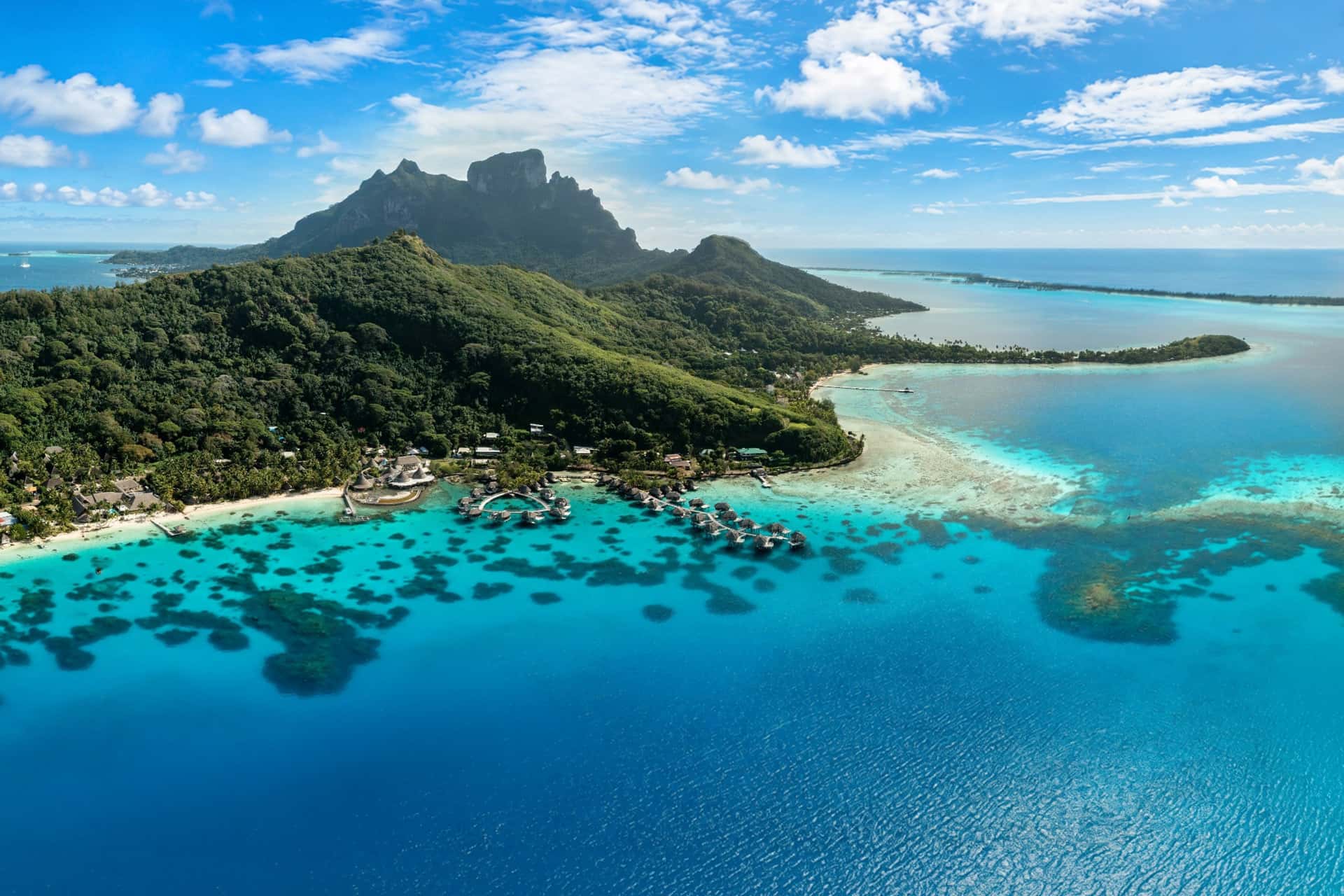
The capital that isn't trying to be the postcard
Papeete gets treated as a layover, and to be fair, most of what makes French Polynesia famous, the overwater bungalows, the technicolor lagoons, sits elsewhere. What Papeete has instead is the actual working life of the territory: a covered municipal market that's been the city's commercial heart since the 19th century, a waterfront where fishing boats, cruise ships and inter-island ferries share the same stretch of water, and a food-truck culture at Place Vai'ete that outclasses most restaurant dining rooms it's compared to. It's also, by a wide margin, the cheapest place in French Polynesia to eat, sleep and get around.
The city itself is compact and walkable in its central core, ringed by hills that climb quickly into rainforest, with Moorea's jagged silhouette visible across the channel from almost anywhere on the waterfront. Spend a night here on arrival, another before flying home, and use the days in between for the market, the pearl museum and a Moorea day trip, and Papeete earns its keep as more than a transit stop.
The honest complications
Papeete is a real, slightly rough-edged port city, not a resort town dressed up for visitors: traffic is heavier than the population suggests, pavements are inconsistent, and after dark the central waterfront thins out fast except around Place Vai'ete. French is the default language for nearly every transaction outside hotel front desks, more so than anywhere else in the territory, so a few French phrases matter more here than in Bora Bora's resort bubble. None of this makes the city unpleasant; it just means Papeete asks a little more independence of a visitor than the outer islands do.
A small capital, three areas that matter
Papeete rewards staying near the waterfront. The market, the ferry terminal for Moorea, and most of the practical tourist infrastructure sit within a fifteen-minute walk of each other, and the choice of base mostly comes down to how close you want to be to the roulottes at night.
The Waterfront & Market District
The commercial and tourist heart of the city: the covered Marché de Papeete, the harbor where the Moorea ferries and cruise ships dock, and Place Vai'ete, the roulotte square that fills with food trucks every evening. Staying here means everything worth doing on foot is close, at the cost of daytime traffic noise.
Pirae & the Eastern Suburbs
East of downtown, Pirae is where wooden houses under bougainvillea replace the commercial core's concrete, a mostly residential stretch that some hotels and pensions use as a quieter, cheaper base a short drive or taxi ride from the market and waterfront.
Punaauia & the Airport Corridor
West of the centre toward Faa'a Airport, Punaauia holds several of the island's resort-style hotels and the Museum of Tahiti and the Islands (Te Fare Iamanaha), the territory's main cultural and natural history museum, open Tuesday to Sunday, roughly 9am to 5pm. A practical base for an early flight, at the cost of needing a taxi or rental car for the market and waterfront.
From waterfront resorts to a family-run pension
Papeete's hotel scene is smaller and less glamorous than the outer islands', which is exactly its advantage: comparable rooms cost meaningfully less than the same star rating in Bora Bora or Moorea.
At the top of the market, Hilton Hotel Tahiti, fully refurbished and reopened in 2021, sits right on the water in Faa'a with front-on views of Moorea and the largest outdoor pool in French Polynesia. InterContinental Tahiti Resort & Spa, about two kilometers from the airport, pairs multiple restaurants and pools with a full-service spa.
In the mid-range, Manava Suite Resort Tahiti has a genuine waterfront position a short drive from the airport and just a few minutes further to the ferry terminal and market, with suites adding kitchens and living areas for longer stays; ask for a room off the street side, since the standard rooms facing traffic run noisier and lack balconies.
For something central and simple, Hotel Tahiti Nui, in the heart of Papeete itself, keeps an outdoor pool, fitness centre and on-site restaurant within walking distance of the market and waterfront, a practical choice for a traveler prioritizing location over resort amenities.
Roulottes after dark, French dining after that
Papeete eats well across a wider price range than anywhere else in French Polynesia. The best-known meal in the city isn't at a restaurant at all, it's a plastic table at a food truck square on the waterfront, and the fine-dining rooms a few streets back genuinely compete with mainland French cooking.
Place Vai'ete Roulottes
Papeete's food-truck square gathers a rotating line-up of roulottes serving poisson cru, grilled fish, steak-frites, Chinese chow mein and French crêpes side by side at shared plastic tables under the stars. It's touristed but not tourist-only: plenty of Papeete residents eat dinner here too, and the price gap with a sit-down restaurant serving the same poisson cru is real.
L'O à la Bouche
L'O à la Bouche, tucked down Passage Cardella off central Papeete, is consistently ranked among the city's best restaurants: modern French cooking built around local produce and fish, in a refined dining room that takes reservations for a reason.
Lou Pescadou
Lou Pescadou has been a Papeete fixture for years, a busy, unpretentious pizza and Italian spot with a menu wide enough to cover a homesick craving alongside a few Tahitian dishes.
The Municipal Market
The Marché de Papeete, the covered municipal market in the city centre, is the place for fresh produce, vanilla, pareo fabric and, on the ground floor, some of the cheapest prepared food in the city. Go early: the best fish and produce move fast, and the stalls thin out by early afternoon.
A market, a museum, a pearl collection and a lighthouse
Papeete's sights are compact enough to cover in a single focused day, with the market and the pearl museum doing more to explain the territory's economy and culture than anywhere else in the city.
Marché de Papeete
The covered municipal market in the city centre is Papeete's commercial anchor: fresh fish, tropical produce, vanilla beans, monoi oil and handicrafts spread across two levels, busiest and best in the early morning before the cruise-ship crowds arrive. It's also simply the most reliable way to see ordinary Tahitian daily life rather than the tourism version of it.
Robert Wan Pearl Museum
The world's only museum dedicated entirely to pearls, free to enter and open Monday to Saturday, 9am to 5pm, next to the Cathédrale de l'Immaculée Conception. It houses Robert Wan's private collection, including the largest Tahitian pearl on record, and is the right first stop before buying black pearls anywhere else in the city, since it explains exactly what separates a good one from an ordinary one.
Museum of Tahiti and the Islands
Out in Punaauia, Te Fare Iamanaha (the Museum of Tahiti and the Islands) is the territory's principal cultural and natural history museum, covering Polynesian navigation, pre-contact society and colonial history in more depth than anywhere else in French Polynesia. Open Tuesday to Sunday, roughly 9am to 5pm; worth the taxi ride out for anyone who wants context before island-hopping further.
Point Venus
A short drive from central Papeete, this black-sand headland is where Captain Cook observed the 1769 transit of Venus, marked today by the 1868 Phare de la Pointe Vénus lighthouse. The swimming here is genuinely good, and dolphins are occasionally spotted offshore, making it an easy half-day combined with a coastal drive.
One, two or three days, planned block by block
One full day covers Papeete's essentials. Two lets the pace relax and adds Point Venus. A third day is the Moorea ferry, and it's worth the crossing even on a tight schedule.
- Morning
The market. Marché de Papeete early, before the cruise crowds, then a coffee on the waterfront.
- Midday
Robert Wan Pearl Museum, then lunch near the market.
- Afternoon
Waterfront walk toward the ferry terminal, watching the boats and the Moorea skyline across the channel.
- Evening
Place Vai'ete roulottes. Poisson cru and a Hinano at a shared table.
- Day 1
The one-day route: market, pearl museum, waterfront, roulottes.
- Day 2 morning
Point Venus. A short drive out for the black-sand beach, the lighthouse, and a swim.
- Day 2 afternoon
Museum of Tahiti and the Islands. Out in Punaauia for deeper cultural context.
- Day 2 evening
L'O à la Bouche. A proper sit-down dinner to close out the city before flying or ferrying onward.
- Days 1-2
The two-day route above, at a gentler pace.
- Day 3
Moorea. An early ferry across (30-45 minutes), the Belvedere lookout and a lagoon tour, back in Papeete by evening.
Compact centre, taxis for everything else
Faa'a International Airport (PPT) sits about 5km from central Papeete, roughly 10-15 minutes by taxi; many hotels also arrange transfers, the more reliable option late at night when public transport thins out. The city centre itself, the market, waterfront and Place Vai'ete, is walkable end to end in under fifteen minutes, but Point Venus, the Museum of Tahiti and the Islands, and the resort hotels in Punaauia all require a taxi or rental car.
Public buses (le truck) historically covered routes between the airport and Papeete, though schedules and coverage vary and shouldn't be relied on for anything time-sensitive; a taxi or a rental car remains the dependable option for day trips out of the city centre. The Aremiti and Terevau ferry terminals for Moorea sit right on the Papeete waterfront, an easy walk from the market.
Best time to visit
Papeete is comfortable to visit year-round since it doesn't depend on lagoon weather the way the resort islands do, but May through October, the dry season, brings lower humidity and more reliable conditions for the Moorea ferry crossing. July's Heiva festival fills the city with dance and canoe-race competition, and also drives up hotel prices and demand.
The cheapest base in French Polynesia
Papeete is noticeably cheaper than Bora Bora or Moorea's resort zones, and it's the easiest place in the territory to eat and sleep well without a five-figure budget. The main cost trap is the same one that applies everywhere: eating at a hotel restaurant right on the waterfront instead of walking a few minutes to Place Vai'ete or the market.
- Pension room $60-100
- Roulotte meals $12-20
- Walking plus the occasional taxi
- Free sights: market, waterfront, Point Venus
- Hotel like Manava or Hotel Tahiti Nui
- Restaurant dinners $25-40/person
- Taxis for Point Venus/Punaauia
- Museum entries, mostly free or low-cost
- Hilton or InterContinental Tahiti
- Fine dining at L'O à la Bouche
- Private Moorea day tour
- Airport transfers over public transport
Safe by capital-city standards
Papeete is safe for tourists. Violent crime against visitors is rare, the central market and waterfront areas are fine to walk during the day with normal awareness, and the practical risks are pickpocketing and traffic, not violent crime.
The two things that actually catch visitors: pickpocketing, concentrated around the busy market and cruise-ship arrival points, so keep bags closed and in front of you in crowds; and walking alone late at night in the central waterfront area once Place Vai'ete's crowd thins out, where a taxi is the better call. Papeete rates well for solo female travelers in line with the territory's broader 8.2/10 rating, with harassment uncommon in the central tourist areas.
Emergency numbers match the rest of French Polynesia: 15 for SAMU/ambulance, 17 for police, 18 for fire, and 112 works as a general emergency number from most mobiles.
Moorea, a ferry ride from the capital
Papeete's position as the territory's transport hub makes it a genuinely workable base for one strong day trip; Bora Bora and the Tuamotus are better treated as their own multi-day stops rather than rushed from the capital.
Moorea
Moorea sits close enough across the channel from Papeete that it's visible from the city waterfront on a clear day. Aremiti and Terevau both run fast ferries roughly every 60-90 minutes from about 5:30am to 9pm, cheap enough and frequent enough to make a full day trip easy: the Belvedere lookout for the panoramic view over Cook's and Opunohu bays, a lagoon boat tour for shark and ray encounters in shallow water, and a return ferry in the evening. A rental scooter or car at the Moorea ferry dock covers the island's ring road in a day without needing an organized tour.
Papeete FAQ
Is Papeete safe for tourists?
Yes. Violent crime against visitors is rare, and central Papeete is fine to walk in during the day with normal awareness. Pickpocketing around the market and cruise-ship arrivals is the main practical risk, and a taxi is the better call late at night rather than walking.
How many days do I need in Papeete?
One full day covers the market, waterfront and pearl museum comfortably. Most visitors use Papeete as a one or two-night base before or after the outer islands rather than a standalone destination, though a Moorea day trip is an easy third day.
How much does Papeete cost per day?
Budget travellers manage on $80-120 a day eating at roulottes and staying in a pension; mid-range runs $200-320 with a hotel and restaurant meals. Papeete is noticeably cheaper than Bora Bora or Moorea's resort zones.
When is the best time to visit Papeete?
May through October, the dry season, is most comfortable. Visiting in July means catching the Heiva festival's dance and canoe-race competitions, though it's also the busiest and most expensive month to find a room.
What is Place Vai'ete?
Papeete's roulotte food-truck square on the waterfront, open roughly 6pm to 2am daily, where poisson cru, grilled fish, French crêpes and Chinese dishes are served side by side at plastic tables for a fraction of restaurant prices.
Is the Paul Gauguin Museum open in Tahiti?
No, the Gauguin museum on Tahiti has been closed for years with no confirmed reopening date. The sister museum and his grave are on Hiva Oa in the Marquesas Islands instead, a roughly 3.5-hour flight away.
How do I get from Faa'a Airport to central Papeete?
Faa'a International Airport sits about 5km from the city centre. A taxi takes 10-15 minutes; many hotels also arrange airport transfers, which is the more reliable option late at night when public transport is limited.
What is the best area to stay in Papeete?
The waterfront near the market and ferry terminal for first-timers: walkable to the roulottes, the pearl museum and the Moorea ferry dock, with hotels like the Manava Suite Resort and Hilton Hotel Tahiti covering the mid-range and upper end.
Can I do a day trip to Moorea from Papeete?
Yes, easily. Aremiti and Terevau ferries cross in 30-45 minutes for roughly $12-18 one way, frequently enough to visit Moorea's Belvedere lookout and a lagoon tour and be back in Papeete by evening.
Do I need to speak French in Papeete?
It helps significantly. French is the default language for shops, taxis and pensions; English is common at hotels and tour desks but noticeably thinner once you step off the main tourist track.
What Stays With You
Papeete doesn't have an overwater bungalow to its name, and it isn't trying to compete with the islands that do. What it has is a market that's been the city's commercial heart for over a century, a food-truck square that turns a plastic table and a plate of raw tuna into one of the best meals in the territory, and a waterfront where you can watch the ferry to Moorea come and go while the rest of your trip is still ahead of you.
Give it the day most visitors skip. The lagoon isn't going anywhere, and Papeete is the only place in French Polynesia that shows you how the territory actually runs day to day, not just how it photographs.