

What You're Actually Getting Into
Samoa is two main volcanic islands, Upolu and Savai'i, plus a scatter of smaller ones, home to around 200,000 people who run their lives by fa'a Samoa, the Samoan way: extended family (aiga), chief-led villages (matai), and the church, in roughly that order of daily importance. This is not a country that has reorganized itself around tourism. Sunday is still for church and rest almost everywhere, most land outside Apia is still communally owned by villages rather than sold to developers, and the accommodation that best represents the place is a thatched-roof, open-sided fale on the sand, not a resort tower.
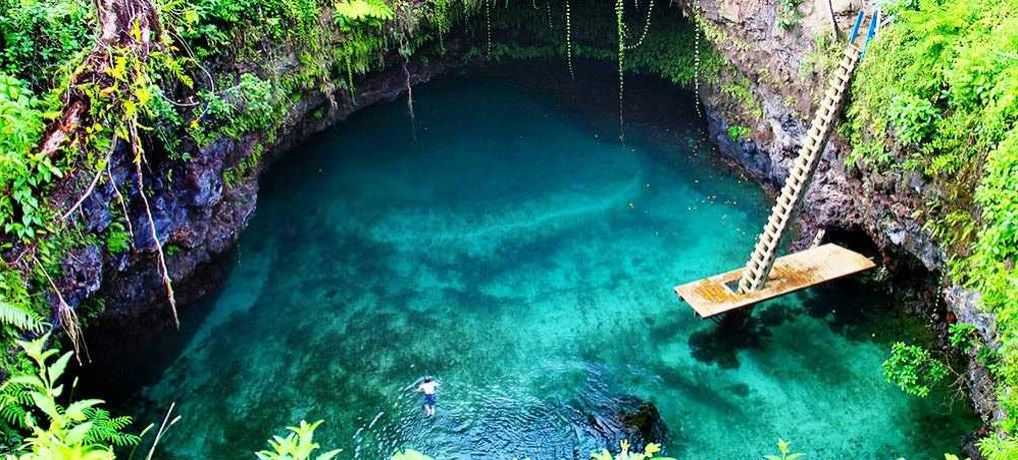
What that means practically: Samoa is quieter and less developed than Fiji, its much larger neighbor, and noticeably cheaper. A night in a beach fale with breakfast and dinner included can run WST80-150. The landscape does the rest of the selling: rainforest waterfalls, lava fields, and To Sua Ocean Trench, a swimming hole fed by underground lava tubes that has become one of the most photographed spots in the South Pacific for good reason.
The honest complications
Plan around Sunday, not just for it: fuel stations, restaurants, shops and most activities close, buses stop running, and villages expect visitors to move quietly and dress modestly. It catches first-timers off guard more than any other single thing about Samoa. Outside Apia there are no ride-hailing apps, taxis aren't metered so fares need to be agreed before you get in, and much of the land, including many waterfalls, caves and beaches, is privately owned by villages that charge a small customary access fee, typically WST5-20; this is normal, not a scam. Savai'i has far less tourist infrastructure than Upolu and rougher roads in places. And the weather can turn even in the dry season, so pack for rain regardless of when you visit.
A History Worth Knowing
Samoa is one of the places where Polynesian culture and language took shape, with oral tradition and fa'a Samoa practices reaching back more than 3,000 years. The modern nation's path was rougher: a colonial carve-up between Germany and the United States in 1899, nearly fifty years of New Zealand administration, a Samoan-led independence movement that took nonviolent resistance to colonial police gunfire, and, on 1 January 1962, the distinction of becoming the first Pacific nation to regain independence.
- 1899
The Treaty of Berlin. The Samoan Islands are split between Germany (the western islands, today's Samoa) and the United States (the eastern islands, today's American Samoa).
- 1900–1914
German colonial rule. Germany administers Western Samoa until New Zealand's Expeditionary Force lands at Apia in 1914, at Britain's request, and takes control at the outbreak of World War One.
- 1918–1919
Influenza epidemic. A ship allowed to dock despite a known outbreak brings influenza that kills roughly 8,500 Samoans under New Zealand's watch, a catastrophe that fuels the independence movement to come.
- 1927–1929
The Mau movement. A nonviolent independence movement led by paramount chief Tupua Tamasese Lealofi III gathers mass support against New Zealand rule.
- 28 Dec 1929
Black Saturday. New Zealand police open fire on a peaceful Mau march in Apia, killing Tupua Tamasese Lealofi III and eight other Samoans.
- 1 Jan 1962
Independence. Samoa becomes the first Pacific nation to gain independence in the 20th century.
Read on: the 2009 switch to left-hand driving and the day Samoa skipped
The 2009 driving switch. On 7 September 2009, Samoa switched from driving on the right to driving on the left, aligning with Australia and New Zealand, home to a large Samoan diaspora, so that families there could ship home cheaper right-hand-drive used cars. The government banned alcohol sales for three days around the changeover and declared two public holidays to help drivers adjust. It went smoothly, though a protest group, People Against Switching Sides, unsuccessfully challenged the change in court beforehand.
The day that didn't happen. On 30 December 2011, Samoa (and neighboring Tokelau) skipped that calendar date entirely, jumping the International Date Line from UTC-11 to UTC+13 so its working week would align with its main trading partners, Australia, New Zealand and China, rather than the United States. Employees scheduled to work the nonexistent day were paid for it anyway.
29 September 2009. A magnitude 8.1 undersea earthquake near the Tonga Trench triggered a tsunami with waves up to 22 meters that killed around 149 people in Samoa, mostly along Upolu's south coast, including at Lalomanu. Villages there have since rebuilt further inland and uphill, and tsunami evacuation route signs are a routine sight along the coast today, a sensible precaution rather than an active concern for visitors.
Top Destinations
Samoa is two islands with very different personalities. Upolu holds the capital, the airport, and most of the country's tourist infrastructure, along with the south coast beaches and To Sua Ocean Trench. Savai'i, the larger island by land area, has a fraction of the visitors, rougher roads, and landscapes, lava fields, blowholes, waterfalls, that feel closer to untouched. Most first trips center on Upolu with an optional Savai'i extension.
Apia, the only real town
Samoa's capital and only sizeable town sits on Upolu's north coast around a natural harbor. It is modest by capital-city standards, a few main streets, a waterfront, two markets, but it is also the country's transport hub and its most complete look at day-to-day Samoan life outside the villages. The Robert Louis Stevenson Museum at Vailima, the writer's restored former home in the hills above town, and Palolo Deep Marine Reserve, a snorkeling spot a five-minute walk from the center, are both easy half-days. Full details are in our Apia city guide.
To Sua Ocean Trench & Lalomanu Beach
Upolu's south coast is where the postcard shots come from. To Sua Ocean Trench, near the village of Lotofaga about an hour from Apia, is a giant sunken swimming hole reached by a steep wooden ladder, its water swirling gently as the tide moves through underwater lava tubes; entry is WST20 for adults, WST10 for children, and includes the surrounding gardens and clifftop viewpoints. Further east, Lalomanu Beach is a long white arc facing a protected marine reserve, good for snorkeling and lined with simple beach fales; it was among the areas hit hardest by the 2009 tsunami and has been rebuilt with accommodation set back from the waterline.
Savai'i, the quiet giant
Savai'i is Samoa's largest island by area but its least visited, reached by a car and passenger ferry from Mulifanua Wharf on Upolu to Salelologa Wharf, a 60 to 90 minute crossing that runs roughly every two hours, seven days a week, with walk-on fares around WST10 for adults. The island's signature sights are the Alofaaga Blowholes, where ocean swells force spray high through lava tubes, and Afu Aau Waterfall, a cascade into a swimmable pool in the rainforest. Roads are rougher than Upolu's and infrastructure thinner, which is exactly the appeal for travelers who found Upolu's south coast beaches too busy.
Culture & Etiquette
Fa'a Samoa, the Samoan way, is not a tourism slogan; it is the operating system of the country. It rests on the aiga (extended family), the matai (chief) system that governs each village, and the church, which most Samoans attend weekly and around which the rest of the week is organized. Visitors who understand this in advance have a much easier time than those who treat Samoa as a generic tropical beach destination.
Do
- Plan around Sunday. Most shops, fuel stations, restaurants and activities close. Move quietly and slowly through villages if you're traveling that day; loud behavior or swimming in village waters on a Sunday is genuinely offensive to residents.
- Dress modestly in villages. Women's dresses or skirts should cover the knees; men should wear trousers or a lava-lava (wraparound skirt), not just swim shorts, once away from resort beaches.
- Respect the Sa. Some villages observe a short evening prayer curfew, usually 6-7pm, marked by a bell or a conch shell. If you're driving or walking through at that time, stop or slow down until it ends.
- Carry cash in tala. Card acceptance is limited to hotels, larger restaurants and Apia's bigger shops. Villages, buses, markets and customary access fees are cash-only.
- Pay customary access fees without complaint. Most beaches, waterfalls and caves outside resorts sit on village-owned land; a small posted fee (often WST5-20) supports the village, not a private operator's profit.
Don't
- Photograph people or ceremonies without asking. Kava ceremonies, church services and family events are not backdrops.
- Assume Samoa runs on ride-hailing apps. There are none. Agree taxi fares before you get in, every time, and expect to rent a car or arrange transport in advance for anything off the main routes.
- Confuse Samoa with American Samoa. They are different countries with different currencies, governments and entry rules, about 130 km apart.
- Walk into a village and start swimming or picnicking uninvited. Most land and coastline outside Apia is communally owned; ask, or use a recognized public access point.
- Expect Savai'i to run on Upolu's schedule. Fewer services, slower pace, and the ferry timetable, not your itinerary, sets the rhythm.
Deeper culture: the matai system, kava, and church life
The matai system. Each Samoan village is governed by a fono, a council of matai (titled chiefs) elected by their extended family to represent it. Matai hold authority over land, disputes and ceremony, and the system predates and largely coexists with the national government.
'Ava (kava) ceremony. A ceremonial drink made from the root of the pepper plant, shared in a structured, hierarchical ceremony at formal occasions. Visitors invited to participate should follow their host's lead rather than the etiquette of Fiji or Tonga's kava traditions, which differ in detail.
Church and community. The majority of Samoans are Christian, and church attendance is a genuine weekly community event, not just a religious one, often followed by a large family meal (to'ona'i) cooked in the umu (earth oven). Visiting a service as a guest, dressed appropriately, is welcomed in many communities if arranged through your accommodation.
Food & Drink
Samoan food centers on the umu, an earth oven of hot volcanic stones still fired up in many villages several times a week, and on what the land and lagoon provide directly: root vegetables, coconut, and reef fish. It's simple, communal food, most of it eaten with your hands, and the best of it is served at family tables and fales rather than restaurants.
Oka WST15-25
Raw fish, usually tuna, cut into chunks and marinated in coconut cream, lime juice, onion and tomato. Samoa's answer to ceviche and the dish to order first at any coastal restaurant.
Palusami
Coconut cream baked inside parcels of taro leaves in the umu until it reduces to a rich, almost custardy filling. A staple of the Sunday to'ona'i family meal.
Koko Samoa
Pure, semi-refined local cocoa, grated and dissolved in hot water or milk and sweetened to taste. Served at breakfast in most fales and guesthouses.
Umu-roasted taro & breadfruit
The starch base of most traditional meals, cooked whole in the earth oven alongside meat or fish and split open at the table.
Francesinha-style pizza & Italian fare
Apia has a strong Italian-Samoan restaurant thread, a legacy of long-established local families; stone-fired pizza and pasta sit on menus alongside oka without any sense of contradiction.
Vailima beer
Samoa's national lager, named for Robert Louis Stevenson's former estate, and the standard accompaniment to a sunset meal on the water.
When to Go & Itineraries
May through October is Samoa's dry season: lower humidity, less rain, and minimal cyclone risk, which peaks from late December to early April. November through April is the wet season, and while it doesn't rain every day, short intense storms are common and travel insurance covering cyclone disruption is worth having if you're visiting December through March.
Seasons compared
| Season | Verdict | Temps | Notes |
|---|---|---|---|
| May-Oct | Best | ~26-29°C | Dry season, lower humidity, minimal cyclone risk |
| Nov-Dec | Good | ~28-30°C | Wet season begins; still generally travelable |
| Jan-Apr | Riskiest | ~28-30°C | Peak cyclone window late Dec-early Apr; heaviest rain |
Temperatures stay in a narrow band year-round, around 26-30°C; humidity and rainfall, not temperature, are what change between seasons.
Itineraries
A week covers Upolu properly. Ten days to two weeks adds a real Savai'i visit rather than a rushed day trip.
- Days 1-2
Apia. Robert Louis Stevenson Museum and the Mount Vaea grave hike, Palolo Deep, the fish and flea markets, orient yourself around Beach Road.
- Days 3-4
South coast. Piula Cave Pool en route, To Sua Ocean Trench, and two nights at a beach fale near Lalomanu.
- Days 5-7
Return via the east or north coast, a slower drive back to Apia with time for whichever waterfall or village market catches your eye, plus a buffer day for weather.
- Days 1-2
Apia, as above.
- Days 3-4
South coast Upolu, To Sua and Lalomanu, as above.
- Days 5-7
Savai'i. Ferry from Mulifanua, the Alofaaga Blowholes, Afu Aau Waterfall, and the island's slower pace.
- Days 8-10
Back to Upolu for any sites missed, and a final relaxed stretch near Apia before flying out.
Getting there & around
Faleolo International Airport (APW), about 35km west of Apia, is Samoa's main gateway, with connections through Auckland, Sydney, Brisbane and Pago Pago (American Samoa). A taxi into Apia costs roughly WST60-80 (agree the fare first, taxis aren't metered); public buses run the route for about WST5; a hotel shuttle bus costs around WST12. On the ground, a rental car is the most practical way to see Upolu's south coast and Savai'i, since there are no ride-hailing apps anywhere in the country and buses run on their own unhurried schedule.
SIM cards, the Savai'i ferry, and practical prep
| Option | Price | Notes |
|---|---|---|
| SIM card (Digicel or Vodafone) | ~WST10 + credit | Kiosks for both carriers are at Faleolo Airport arrivals; Digicel has the wider island-wide coverage. |
| Upolu-Savai'i ferry | ~WST10 one way (walk-on) | Mulifanua to Salelologa, 60-90 min, roughly every 2 hours, 7 days a week. |
| Car rental | Varies by season | Needed for Savai'i and useful on Upolu; drive on the left, international license required. |
Practical prep: get a Samoa eSIM before landing or buy a local SIM at the airport. Carry small tala notes for buses, markets and village access fees, since cards are only reliably accepted at hotels and larger restaurants. Sunday travel plans should assume everything but hotels and a handful of resorts is closed.
Where to stay
Beach fales
Open-sided, thatched-roof huts steps from the sand, run by local families, typically with breakfast and dinner included. Concentrated along the south coast near Lalomanu and around Savai'i's Manase area. The most distinctively Samoan place to sleep, and the best value in the country.
Apia hotels
Tanoa Tusitala Hotel, set in tropical gardens about 800m from Apia's central business district, is the country's most established mid-range option, with a pool and multiple dining venues. Full accommodation detail for the capital is in our Apia city guide.
Taumeasina Island Resort
Samoa's newest four-and-a-half-star resort, on its own small island a five-minute drive from Apia and 45 minutes from the airport, with a cascading pool and private beach. The closest thing Samoa has to a full international resort experience.
Sinalei Reef Resort & Spa
A secluded beach resort with a full-service spa in Siumu on Upolu's south coast, a quieter, more upscale alternative to the beach fales nearby for the same stretch of coastline.
Budget Planning
Samoa is noticeably cheaper than Fiji at the budget and mid-range levels, especially in the beach-fale category, where the price already includes two meals. The main cost trap is assuming card payment will work outside Apia hotels; it usually won't.
- Beach fale incl. breakfast & dinner WST80-150
- Bus travel between towns
- Market meals & oka from stalls
- Free beaches, customary access fees WST5-20
- Air-conditioned hotel or resort room
- Restaurant meals in Apia
- Rental car for touring Upolu
- To Sua Trench, Piula Cave Pool, a dive or snorkel trip
- Taumeasina Island Resort or Sinalei
- Private tours and transfers
- Dining at Apia's better restaurants
- A Savai'i extension with a private car
Quick reference prices
| Oka at a restaurant | WST15-25 |
| Beach fale incl. 2 meals | WST80-150/night |
| Faleolo Airport to Apia taxi | WST60-80 |
| Faleolo Airport to Apia bus | ~WST5 |
| To Sua Ocean Trench entry | WST20 adult / WST10 child |
| Upolu-Savai'i ferry (walk-on) | ~WST10 one way |
| Robert Louis Stevenson Museum | WST20 adult |
| SIM card | ~WST10 + credit |
Prices reflect September 2026 research and drift over time. Treat them as a planning baseline, not a quote.
Visa & Entry
Samoa is straightforward to enter: most visitors, including from the US, UK, EU, Australia, Canada and New Zealand, receive a free 90-day visitor permit on arrival at Faleolo International Airport, no advance visa needed. Longer stays require a visa arranged in advance.
✓ Valid passport
At least six months validity from your date of entry, plus a blank page for the visitor permit stamp.
✓ Onward or return ticket
Airlines and immigration officers can ask to see proof you're not staying indefinitely.
✓ Accommodation details
Have your first night's address ready; it's a routine question on the arrival card.
✓ Documents for children
Every child needs their own passport, plus a birth certificate or other proof of your relationship to them.
| Samoa | Fiji | |
|---|---|---|
| Daily budget | WST170-250 gets you far, especially in beach fales | Noticeably pricier at every tier |
| Infrastructure | Compact, quieter, fewer big resorts | 330 islands, extensive resort infrastructure |
| Diving & surfing | Good snorkeling, more limited diving and surf breaks | World-class diving and surf breaks like Cloudbreak |
| Culture | Fa'a Samoa is everyday life, not a show for visitors | Strong Fijian culture, more tourism-oriented presentation |
| Getting there | Fewer direct long-haul routes | Major Pacific hub with more international connections |
Safety, Solo Women & Family
Samoa is safe. The US State Department rates it Level 1, Exercise Normal Precautions, its lowest-risk tier, issued July 2026. Violent crime against visitors is rare. The real risks are environmental and logistical: ocean conditions, traffic on unfamiliar left-hand roads, and the odd tropical storm, not crime.
Ocean & trench safety
To Sua Ocean Trench's ladder and open water, and Piula Cave Pool's underwater tunnel, both require confidence in the water and caution around slippery rock; supervise children closely at both.
Left-hand driving
If you're used to driving on the right, the adjustment takes a day. Roads outside Apia and on Savai'i can be narrow, unlit at night, and shared with animals; avoid night driving where possible.
Cyclones
Risk peaks late December to early April. Outside that window it's a background consideration, not a daily one; travel insurance covering weather disruption is sensible if visiting in the wet season.
Tsunami awareness and village land
Tsunami evacuation signage. Following the 2009 tsunami, Samoa's coastal areas, especially the south coast of Upolu, have clearly marked evacuation routes inland and uphill. It's worth noting your nearest route on arrival at any coastal accommodation, standard Pacific-nation preparedness rather than an indication of ongoing risk.
Village land and access. Nearly all land outside Apia is communally owned. Respecting posted access fees and staying on marked paths avoids both offense and the very real hazard of unmarked private land, especially around waterfalls and caves.
The 2 things to actually know about
Samoa isn't a high-scam destination, but two patterns catch uninformed visitors. The full country list lives on our Samoa travel alerts page.
Unmetered taxi overcharging
Taxis aren't metered anywhere in Samoa, and airport and ferry-terminal drivers sometimes quote two to three times the going rate to visitors. A fair Faleolo-to-Apia fare is roughly WST60-80; agree the price before you get in, every time.
Customary access fees
Small posted fees (WST5-20) at village-owned beaches, waterfalls and caves are genuine and go to the village, not a middleman. Pay them without haggling; it's how communal land tourism works here.
Solo women travelers
Apia rates as the safest part of Samoa for solo female travelers, and violent crime against women visitors is rare. That said, unwanted attention and occasional harassment, mostly catcalling, are reported, particularly at night, and there have been isolated cases of more serious incidents. Standard precautions apply: avoid walking alone after dark, dress modestly in villages regardless of gender, and agree taxi fares before getting in. Full detail on our Solo Woman Explorer pages.
Emergency numbers
Hospitals and the US Embassy
Samoa moved to the international 911 standard for all emergencies, replacing three separate older numbers. For medical emergencies in Apia, Tupua Tamasese Meaole (TTM) Hospital in Motootua (+685 21212) is the main public hospital. On Savai'i, Malietoa Tanumafili II Hospital in Tuasivi (+685 53511) serves the island.
The US Embassy in Apia provides medical assistance referrals for US citizens; check ws.usembassy.gov for current contact details before you travel.
Family travel
Samoa works well for families. Beach fales put kids steps from calm, shallow lagoons, fa'a Samoa hospitality is genuinely warm toward children, and Palolo Deep's shallow reef is manageable for confident young swimmers. To Sua Ocean Trench is a highlight but needs close supervision: the ladder is steep and the water is deep, so it suits older children and confident swimmers better than toddlers.
Samoa FAQ
Is Samoa safe to visit?
Yes. The US State Department rates Samoa Level 1, Exercise Normal Precautions, its safest tier. Violent crime against visitors is rare; the main risks are traffic, ocean conditions and respecting the Sunday village quiet, not crime.
Do I need a visa for Samoa?
Most visitors, including from the US, UK, EU, Australia, Canada and New Zealand, receive a free 90-day visitor permit on arrival. You need a passport valid at least six months beyond your entry date and, in most cases, proof of onward travel.
How much does Samoa cost per day?
Budget travelers staying in beach fales manage on roughly WST170-250 (about US$60-90) a day including two meals. Mid-range, with air-conditioned rooms and a rental car, runs WST420-560 (about US$150-200) a day.
When is the best time to visit Samoa?
May to October, the dry season, when humidity and rainfall are lowest and cyclone risk is minimal. The wet season runs November to April, with cyclones most likely from late December to early April.
How many days do you need in Samoa?
A week covers Upolu well: Apia, the south coast beaches and To Sua Ocean Trench. Ten days to two weeks lets you add a proper visit to Savai'i, Samoa's larger and quieter second island.
What is the currency in Samoa?
The Samoan tala (WST), divided into 100 sene. Major hotels and some restaurants take cards, but villages, markets, buses and small fales are cash-based, so carry tala.
Why does Samoa drive on the left?
Samoa switched from right-hand to left-hand driving in September 2009 to match Australia and New Zealand, making it easier for the large Samoan diaspora there to send home cheaper right-hand-drive used cars.
What happened with Samoa and the international date line?
On 30 December 2011, Samoa skipped that calendar day entirely, jumping from UTC-11 to UTC+13 to align its business week with its main trading partners, Australia, New Zealand and China, rather than the United States.
Is Samoa the same as American Samoa?
No, they are two separate places. Samoa (formerly Western Samoa) is an independent nation with its own currency and government. American Samoa, about 130 km east, is an unincorporated US territory with its own entry rules and the US dollar.
What language is spoken in Samoa?
Samoan and English are both official languages. English is widely spoken in Apia, hotels and tourist areas; Samoan is the everyday language in villages.
Is Samoa safe for solo female travelers?
Generally yes, and Apia rates as the safest part of the country, but unwanted attention and occasional harassment are reported, especially at night. Dress modestly in villages, avoid walking alone after dark, and the usual precautions apply.
Is Samoa good for families with kids?
Yes. Beach fales put children steps from calm lagoons, fa'a Samoa hospitality extends warmly to kids, and sites like To Sua Ocean Trench and Palolo Deep are memorable, though supervise children closely around the trench's ladder and open water.
What Stays With You
Samoa doesn't have a single monument built to impress visitors. What it has is a country still living by rules it set for itself long before tourism arrived: family first, then village, then church, then everything else. You feel it on a Sunday morning when the whole island goes quiet, and you feel it at a beach fale when a family that has never met you serves dinner as though you were already one of theirs.
Climb down the ladder into To Sua Ocean Trench, float in water that has been finding its way through those lava tubes since long before anyone thought to photograph it, and understand that the trench was never really the point.