
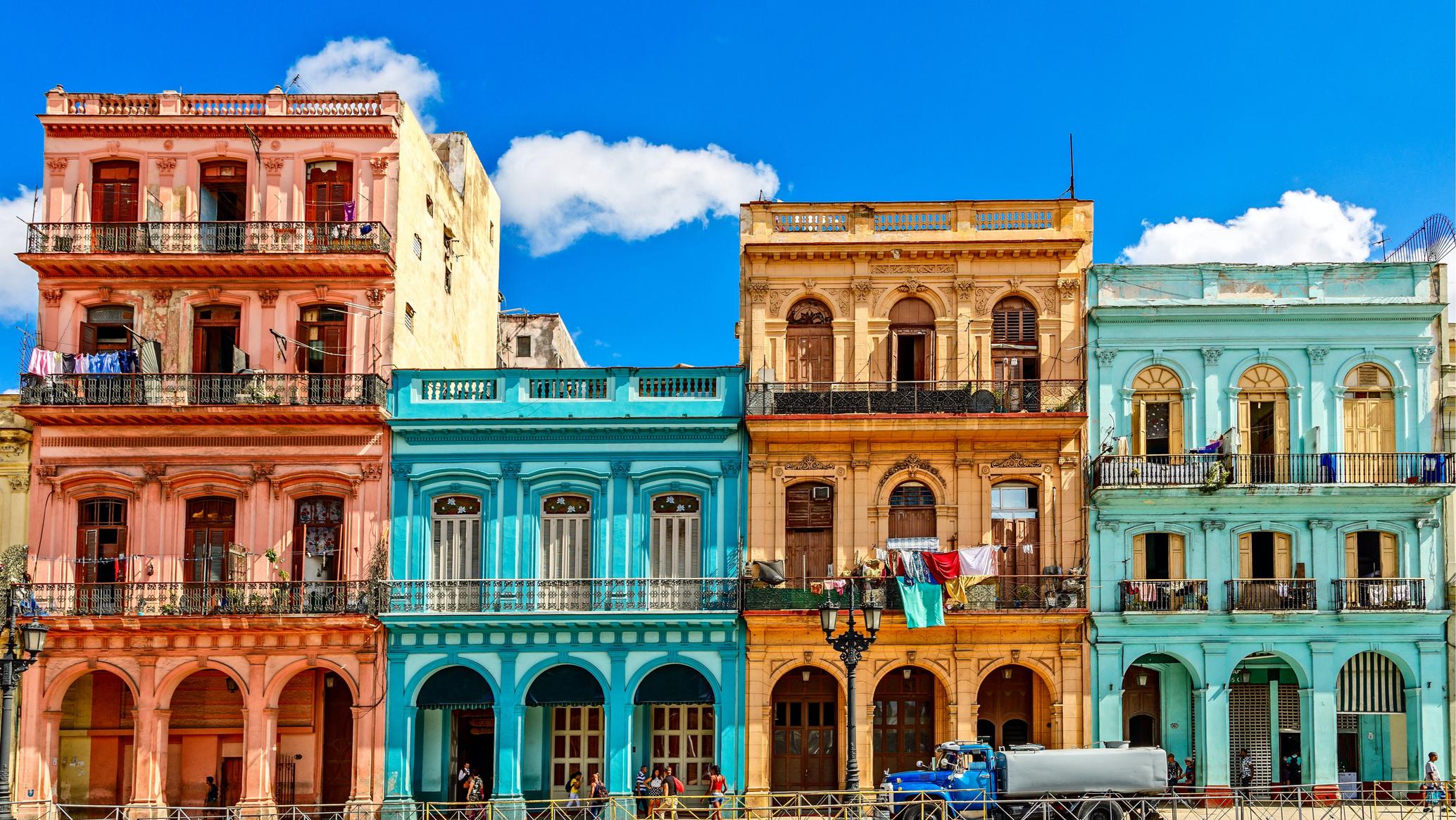
Cuba's capital, unfiltered
Havana was one of the wealthiest cities in the Americas by the mid-20th century, and the architecture still says so: Habana Vieja's baroque and neoclassical colonial core, Vedado's art deco towers and mansions, Centro Habana's dense, crumbling grandeur. Very little of it has been renovated wall to wall, which is exactly why it looks the way it does in every photo you've seen, part living museum, part working city that five generations of Cubans have adapted, subdivided and kept standing through six decades of embargo.
What's changed in the last two years is the power situation. Cuba's fuel shortage has produced rolling blackouts nationwide, and while Havana is prioritized for generator coverage over the rest of the country, the city is not exempt: expect the occasional outage even at a good hotel, patchy wifi, and evenings that shift toward candlelit paladares and live music on the street rather than screens. Most visitors report this changes the trip's rhythm more than it ruins it. Go in with that expectation and the city delivers everything it's known for.
The honest complications
Beyond the blackouts, Havana is a genuinely difficult city to navigate on foreign cards, ATMs are inconsistent and US-issued cards do not work at all, so plan the whole trip in cash. Pavements in Habana Vieja and Centro Habana are uneven and street lighting is unreliable after dark; flat shoes and a phone flashlight matter more here than in most cities this guide covers. And persistent, if generally non-threatening, street attention from touts offering cigars, taxis or restaurant recommendations is a constant in the main tourist zones; a firm no and continuing to walk resolves it every time.
Five districts, one very long Malecón
Havana stretches along the coast for miles, and the districts that matter to a visitor run roughly west to east along or near the Malecón seawall. Where you base yourself shapes how much of the city you experience on foot versus by taxi.
Habana Vieja
Old Havana is the UNESCO-listed heart of the city: four connected plazas, the Capitolio, and the highest concentration of restored colonial buildings anywhere on the island, alongside blocks that haven't been touched in decades. It's compact enough to walk everywhere and the obvious first-time base, though also the most tourist-saturated and the most persistent for street touts.
Vedado
West of Habana Vieja, Vedado is Havana's 1950s-era formal district: wide avenues, art deco and modernist buildings, the University of Havana, and the iconic Hotel Nacional perched on a bluff above the sea. Quieter after dark than Habana Vieja, with good casas particulares and easy access to the Malecón's best sunset stretch.
Centro Habana
Sandwiched between Habana Vieja and Vedado, Centro Habana is dense, residential and the least touristed of the central districts: crumbling balconies, corner domino games, and Havana's cheapest casas particulares. It's also where the Malecón crowd genuinely thickens at sunset, mostly locals rather than visitors.
Miramar
West across the Almendares River, Miramar is Havana's leafiest, most affluent district: wide boulevards, embassies, some of the city's best paladares, and noticeably steadier power supply given the concentration of diplomatic missions. Worth a dedicated evening for dinner even if you're not staying here.
Jaimanitas
A working-class fishing neighborhood further west, transformed block by block since the 1990s by the ceramic mosaic work of artist José Fuster into what's become known as Fusterlandia, one of the more unexpected art experiences in the Caribbean.
From the grand dame of Vedado to a family's spare room
Havana's accommodation splits sharply between a handful of historic hotels and Cuba's enormous, well-developed network of casas particulares, licensed private homestays that put money directly into Cuban households and are the accommodation of choice for US travelers structuring a trip around the Support for the Cuban People license. Both categories are generally better generator-covered than ordinary residential blocks during blackouts, hotels especially.
At the top, Hotel Nacional de Cuba in Vedado is the city's most storied address, a 1930s National Historic Landmark on a bluff above the Malecón with palm-lined gardens, a cigar-and-rum terrace bar, and a guest list running from Winston Churchill to Frank Sinatra, from about $150 a night. In Habana Vieja, Iberostar Selection Parque Central (from about $180) pairs a restored colonial wing with a contemporary tower, two rooftop pools looking over the Capitolio dome, and the most reliable amenities in the old city, while Hotel Saratoga (from about $170), rebuilt after a 2022 explosion and reopened with the same prime position looking straight at the Capitolio, is back to being one of the old city's best-located stays.
For casas particulares, the accommodation most independent and US travelers actually use, Casa Giraldilla in Habana Vieja (from about $35) is a colonial three-room guesthouse with a rooftop terrace, and Casa Vitrales (from about $45), named for its stained-glass windows, is a longtime favorite a few blocks from the Capitolio with a well-regarded in-house breakfast. Both illustrate the category well: a private room in a family home, breakfast for a few dollars extra, and a host who becomes the best source of real-time information on what's open and what isn't during a blackout.
Paladares, mojitos and the Hemingway trail
Havana's food scene runs almost entirely on paladares, privately run restaurants that have flourished since restrictions eased in stages from the 1990s onward, and the gap between the best of these and the average state-run restaurant is enormous. Reservations matter at the well-known ones, and blackouts can affect a kitchen's plans on short notice, so keep a backup in mind.
La Guarida
Havana's most famous paladar, set in a crumbling colonial mansion in Centro Habana made internationally known by the film "Strawberry and Chocolate," serves refined Cuban-fusion plates across three ornate dining rooms and a rooftop bar with skyline views. Reserve as far ahead as you can, this is the hardest table in the city.
San Cristóbal Paladar
A dense, art-and-curio-filled dining room in Centro Habana serving elevated Cuban classics, malanga fritters, yuca, prawns, and a cigar and digestif on the house that keeps regulars talking. Frequently cited as La Guarida's closest rival for the city's best table.
Doña Eutimia
Tucked down an alley off Plaza de la Catedral, this small paladar does the best ropa vieja in the old city and draws a line out the door most evenings; arrive right at opening or be ready to wait.
El Floridita & La Bodeguita del Medio
Hemingway's two Havana haunts, El Floridita for the daiquiri, La Bodeguita del Medio for the mojito, are now thoroughly touristed but worth one drink each for the history and the wall of signatures, even if better, cheaper versions of both cocktails exist a few blocks away.
A city best explored on foot, with a break for the heat
Havana rewards unhurried wandering as much as any city in this guide's collection: a doorway with live music, a mural, a mid-afternoon coffee window. A handful of things do benefit from booking ahead, and this chapter walks through the city roughly the way a good three days would.
Habana Vieja's four plazas
Start at Plaza de la Catedral, the baroque Havana Cathedral facing a square lined with colonial mansions, then walk to Plaza de Armas, the city's oldest square and a daily used-book market, and on to Plaza Vieja, once a slave market and now Havana's most photogenic square, ringed by restored arcaded buildings and a rooftop-camera obscura. The Capitolio, a near-replica of the US Capitol completed in 1929 and now the seat of Cuba's National Assembly, anchors the western edge of the old city and is open for a guided interior tour (roughly $10-15) worth taking for the Statue of the Republic alone, one of the largest indoor statues in the world.
The Malecón and a classic car
The Malecón, an 8-kilometer seawall promenade running the length of the city's northern edge, is where Havana actually gathers: fishermen, musicians, couples, kids jumping the wall at high tide. Walk a stretch at sunset from Habana Vieja toward Vedado, then take one of the classic car convertible tours that queue near Parque Central, roughly $30-50 an hour split between passengers, genuinely worth doing once for the photos and the driver's running commentary on the city.
Cigars and the Partagás factory
The Real Fábrica de Tabacos Partagás, one of Havana's oldest working cigar factories, runs weekday morning tours through the rolling floor where workers hand-roll Montecristo and Partagás cigars, roughly $10-15 with a guide. Buy directly from a state-run La Casa del Habano afterward rather than from a street tout claiming factory-fresh stock, a well-known scam pattern covered in the safety chapter below.
The Hemingway sites and Fusterlandia
Twenty minutes east in the San Francisco de Paula district, Finca Vigía, Hemingway's home for over twenty years, is preserved as he left it, visitors view the interior through open windows and doors rather than walking through, alongside the pool and his fishing boat Pilar in the garden (entry around 125 CUP). West in Jaimanitas, Fusterlandia is a free, wander-at-will neighborhood transformed by artist José Fuster's ceramic mosaic work, covering house facades, benches and a fountain in a style locals compare to a Caribbean Gaudí; go in daylight and allow an hour.
Evenings: son, rumba and the Fábrica de Arte Cubano
Live son and rumba spill out of Habana Vieja bars most nights with no cover charge; walk Calle Obispo after dark and follow the music. For something more curated, Fábrica de Arte Cubano in Vedado, a former cooking-oil factory converted into a multi-room gallery, concert and nightclub space, runs Thursday to Sunday from 8pm to 2am (entry a few dollars) and is the closest Havana gets to a single address covering art, music and dancing at once. For a full production, the Tropicana cabaret, running continuously since 1939 in an open-air garden setting, remains the classic Havana night out, tickets $75-95 depending on seating, and a classic-car transfer package is easy to add on.
One, two or three days, planned around the heat and the light
Three full days covers Havana properly; even one well-planned day delivers the essentials. Build in flexibility around blackout schedules where you can, mornings and early evenings are generally the most reliable stretches for sightseeing and dinner.
- Morning
Habana Vieja's plazas. Plaza de la Catedral, Plaza de Armas' book market, Plaza Vieja, then the Capitolio's interior tour before the midday heat.
- Midday
Lunch at Doña Eutimia. Arrive right at opening to beat the line, then walk off the ropa vieja through the old city alleys.
- Afternoon
Classic car tour along the Malecón. An hour in a convertible from Parque Central out along the seawall and back through Vedado.
- Sunset
Drinks at the Hotel Nacional's terrace. The Malecón and the sea from the bluff. Dinner and live music back in Habana Vieja.
- Day 1
The one-day route: plazas, Capitolio, Doña Eutimia, classic car tour, Hotel Nacional sunset.
- Day 2 morning
Partagás cigar factory tour, then El Floridita and La Bodeguita del Medio for one drink each on the Hemingway trail.
- Day 2 afternoon
Fusterlandia in Jaimanitas. A taxi out to Fuster's mosaic neighborhood, an unhurried hour of wandering.
- Day 2 evening
Miramar for dinner, then back to Habana Vieja or Fábrica de Arte Cubano if it's a Thursday through Sunday.
- Days 1-2
The two-day route above, at a gentler pace.
- Day 3 morning
Finca Vigía. The taxi out to San Francisco de Paula to see Hemingway's house and Pilar in the garden.
- Day 3 afternoon
A paladar lunch in Centro Habana, a slow walk through its residential streets, less curated than Habana Vieja and worth the contrast.
- Day 3 evening
La Guarida or San Cristóbal, booked days ahead, for the best table of the trip, or the Tropicana for a full cabaret night.
Walkable in the old city, taxi-dependent everywhere else
Habana Vieja and central Vedado are walkable; getting to Miramar, Jaimanitas or Finca Vigía means a taxi. From José Martí International Airport (HAV), an official state taxi to central Havana costs $20-35 and takes 20-30 minutes; agree the fare before getting in, since meters are inconsistent. A Viazul shuttle bus runs a handful of daily departures between the airport and the city for around $10.
Within the city, official yellow state taxis and the ride-hailing-style private taxis both charge $5-10 for most central trips, negotiate or confirm the fare upfront either way. Almendrones, shared classic-car taxis running fixed routes along main arteries like Calle 23 and the Malecón, are how most Havana residents actually move around the city, and cost the equivalent of about $1 in CUP; flag one down heading your direction and confirm the destination before getting in. Walking is genuinely the best way to see Habana Vieja itself, and cycle rickshaws (bicitaxis) are a cheap, slower option for short hops when the heat allows.
Best time to visit and the blackout schedule
Havana has a tropical climate moderated by the coast. November through April is the sweet spot: warm days, low humidity, and outside hurricane season. May and June are a reasonable shoulder before the heat and rain build; hurricane season runs June through November, with the real risk window from mid-August through early October.
On the blackouts: Havana's outages are not published on a fixed public schedule the way some countries manage rationing, and they vary block to block depending on the grid and any generator coverage nearby. Hotels and casas in the main tourist zones are the best-positioned properties in the city, but build slack into any evening plan, confirm a paladar reservation is still on the day of, and always carry a charged phone and a small flashlight after dark.
Cheap food, pricier everything else
Havana's cost structure is uneven by design: paladar meals and local transport are inexpensive, while hotels, organized tours and anything routed through the formal tourism system cost noticeably more, closer to the wider Caribbean than Cuba's reputation as a budget destination suggests. Cash, USD or EUR, is the currency of the actual trip.
- Casa particular room $25-40
- Paladar and street food $15-25
- Almendrones and walking
- Free plazas plus one paid sight
- Historic hotel or upgraded casa $80-180
- Restaurant dinners with cocktails $35-50
- Private taxis and a classic car tour
- Cigar factory tour, a museum
- Hotel Nacional or equivalent
- La Guarida or San Cristóbal tasting menus
- Private guides and drivers
- Tropicana cabaret evening
Rates well, with the blackouts as the real variable
Havana rates 7.5/10 on our safety scale, in line with Cuba's overall Level 2 rating. Violent crime against tourists is rare, and the city is reasonably comfortable to walk in the main tourist districts even after dark, though the uneven pavements and unreliable streetlighting during outages call for more caution than the crime statistics alone would suggest.
The things that actually catch visitors: pickpocketing, concentrated in crowded parts of Habana Vieja, at the Capitolio and around live music gatherings, so keep bags closed and in front of you; the cigar street scam, where a friendly local offers factory-fresh cigars at a steep discount that turn out to be fakes rolled from banana leaves, buy only from a licensed La Casa del Habano or the factory shop itself; and power-related trip hazards after dark, from broken pavement to unlit stairs, so a phone flashlight is standard kit here, not a backup. Emergency numbers are 106 for police, 105 for fire and 104 for ambulance; Cuba has no single unified emergency line.
Havana is also the best base for the west of the island
Havana's position makes it a workable base for two very different day trips, and a launch point for the longer Viñales and Trinidad legs covered in the full Cuba country guide.
Playas del Este
A string of sandy beaches east of the city, Santa María del Mar is the most developed stretch, that give Havana residents and visitors an easy, no-planning beach day without the trek to Varadero. Best on a weekday, when it's markedly quieter than weekends.
Las Terrazas
A UNESCO biosphere reserve and planned eco-community built from a 1968 reforestation project, with hiking trails, a zipline over the reservoir, and the ruins of a 19th-century coffee plantation. A quieter, greener alternative to a full Viñales trip when time is short.
Viñales
Technically doable as a very long day trip, Cuba's tobacco valley and its mogote hills reward staying at least one night far more than a rushed there-and-back; see the country guide's destinations chapter for the full case.
Havana FAQ
Is Havana safe for tourists?
Havana rates Level 2, the same as most of Western Europe, and violent crime against tourists is rare. The practical issues are pickpocketing in crowded parts of Habana Vieja, rolling blackouts, and uneven pavements at night when the streetlights are out.
How many days do I need in Havana?
Three full days covers the city well: one for Habana Vieja's landmarks, one for the Malecón, Vedado and the Hemingway sites, one for Fusterlandia, a paladar crawl and live music. A fourth day fits Las Terrazas or a slower pace around the blackout schedule.
How much does Havana cost per day?
Budget travelers manage on $50-70 a day in casas particulares with paladar meals; mid-range runs $100-160 with historic hotels and private taxis. Cash is essential since US cards do not work and foreign cards are unreliable.
When is the best time to visit Havana?
November through April: warm, dry, and outside the June-November hurricane season. December through April is also peak season with the highest hotel prices, so November is often the best value month.
How do the blackouts affect a Havana trip?
Havana is prioritized for generator power over most of the country, but outages still happen: expect occasional elevator, air conditioning and wifi interruptions even at good hotels, and plan evenings with a charged phone and a headlamp regardless of where you stay.
What is the best area to stay in Havana?
Habana Vieja for the most atmospheric, walkable base among the landmarks. Vedado for a quieter, more residential feel near the Malecón and the Hotel Nacional. Centro Habana for the cheapest casas particulares and the most unfiltered street life.
Do I need to speak Spanish in Havana?
Not in hotels and the main tourist circuit, where English is common, but it drops off quickly in casas particulares and neighborhood paladares. A phrasebook or offline translation app is genuinely useful here.
How do I get from Havana airport to the city center?
An official state taxi from José Martí International Airport (HAV) to central Havana costs 20-35 USD and takes 20-30 minutes; agree the fare before getting in. A Viazul shuttle bus runs a small number of daily departures for around 10 USD.
Can Americans visit Havana?
Yes, but not as ordinary tourists. US travelers need to qualify under an OFAC general license, most commonly Support for the Cuban People, which means structuring the trip around casas particulares, paladares and Cuban-run activities rather than state hotels and tours.
What is an almendrón?
A shared classic-car taxi running a fixed route through the city for a flat local fare, the way most Havana residents actually get around. Flag one down heading your direction on a main street like Calle 23 or the Malecón and confirm the destination before getting in.
What Stays With You
Havana does not need the classic cars or the crumbling colonial facades to make its case, though you'll photograph plenty of both. What stays with most visitors is smaller: a casa host who insists you try one more thing at breakfast, a trio playing son on a corner for the pure pleasure of it, the whole Malecón turned gold at sunset with half the city sitting on the wall watching the same view you are. None of it is staged, and in 2026 none of it is separate from the hardship the country is working through.
Go with cash, patience and a flashlight, and let the city set its own pace. It has been doing that for five hundred years and shows no sign of stopping now.