
What You're Actually Getting Into
Indonesia is the world's largest archipelago and its fourth most populous country, roughly 280 million people spread across more than 17,000 islands, speaking hundreds of languages, spanning three time zones from Sumatra to Papua. No single trip covers it, and almost nobody tries: the overwhelming majority of foreign visitors land on one island, Bali, and many never leave it. That's a reasonable choice. It's also only a fraction of the country.
What makes Indonesia remarkable is the range packed into that archipelago: an eighth-century Buddhist monument larger than any in the world, an active volcano you can watch sunrise from, a dragon found nowhere else on the planet, and reef systems that hold more fish and coral species than any other ocean on earth. Infrastructure and prices swing wildly depending on where you are: Bali's tourist circuit is as polished and easy as Southeast Asia gets, while reaching Komodo or Raja Ampat still takes real effort and a real budget for flights and boats.
The honest complications
The islands that make the highlight reel are genuinely far apart: Bali to Raja Ampat is roughly the distance from Los Angeles to New York, and connections often route through Jakarta or require multiple flights. Indonesia sits on the Pacific Ring of Fire, so earthquakes are a real background fact of life and several volcanoes near popular routes, including two close to Bali, are actively monitored, not decorative backdrops. Traffic outside Bali's tourist zones can be chaotic, and illicitly produced alcohol causes real, documented methanol poisoning cases most years, a risk covered in full in the safety chapter below. None of this makes Indonesia a hard place to visit, but it rewards a bit more planning than a straightforward beach trip.
A History Worth Knowing
Indonesia's history is a succession of trading empires, colonization and a hard-won independence. Hindu-Buddhist kingdoms built some of Asia's greatest monuments centuries before Islam arrived with traders and spread across most of the archipelago, except Bali, which stayed Hindu. Dutch traders arrived for spices, stayed for 350 years, and were followed by a brutal Japanese occupation, a declared independence the Dutch didn't recognize for four more years, and, decades later, three decades of authoritarian rule that ended in a democratic transition still shaping the country today.
- 8th-9th century
Srivijaya and Borobudur. A Buddhist maritime empire based in Sumatra builds Borobudur in central Java, still the largest Buddhist monument on earth.
- 13th-16th century
Majapahit Empire. A Hindu-Buddhist empire based in East Java unites most of the archipelago; Islam spreads through trading ports in the centuries that follow, reshaping most islands except Bali.
- 1602-1949
Dutch colonial rule. The Dutch East India Company, then the Dutch state directly, controls the archipelago for spices and resources for roughly 350 years.
- 1942-1945
Japanese occupation. Wartime rule is harsh and short-lived, and it fatally weakens Dutch authority.
- 17 August 1945
Independence declared. Sukarno and Hatta proclaim independence; the Dutch fight to reassert control and don't fully recognize it until December 1949.
- 1966-1998
Suharto's New Order. Three decades of authoritarian rule and rapid but unevenly distributed development end in the 1998 economic crisis, student protests and a democratic transition.
Read the full history: Majapahit, the spice trade, and the road to democracy
The Majapahit Empire, centered in East Java from roughly 1293 to 1527, is the historical high point most Indonesians point to: at its peak it claimed influence over most of the modern archipelago and parts of the Malay Peninsula, and its Hindu-Buddhist culture is the direct ancestor of the Bali you visit today, the one part of Indonesia where that older religious layer never gave way to Islam.
European interest arrived for one reason: spices, particularly nutmeg, cloves and pepper, worth their weight in gold in Europe. The Dutch East India Company (VOC) established control over the spice trade through a mix of treaties, warfare and, in some cases, deliberate depopulation of competing trading islands. When the VOC went bankrupt in 1799, the Dutch state took over direct colonial administration, which lasted, with the wartime interruption, until 1949.
The Japanese occupation from 1942 to 1945 was brief but brutal, and it did something the Dutch had spent centuries preventing: it gave Indonesian nationalists organizational experience and weapons. Sukarno and Mohammad Hatta declared independence two days after Japan's surrender in August 1945, but the Dutch spent four more years trying to reclaim the colony before international pressure forced recognition in December 1949.
Sukarno's presidency gave way in 1966 to General Suharto's "New Order," three decades of authoritarian, anti-communist rule that brought real economic development, foreign investment and infrastructure, alongside corruption, suppressed dissent and violent political purges, most severely the anti-communist killings of 1965-66. The 1997 Asian financial crisis triggered the economic collapse that finally ended Suharto's rule in 1998, opening the "Reformasi" era of decentralization and democracy that continues today, including the ongoing, controversial project to relocate the national capital from an overcrowded, sinking Jakarta to a newly built city, Nusantara, on Borneo.
Top Destinations
Indonesia divides into distant, distinct pieces rather than a single travel zone: Bali and its neighboring islands, Java's temples and volcanoes, the dragon islands of Komodo National Park, and the extraordinary, remote reefs of Raja Ampat. Flying between them is normal, sometimes unavoidable, and a realistic trip picks two or three rather than attempting all four.
Bali, the island most trips start on
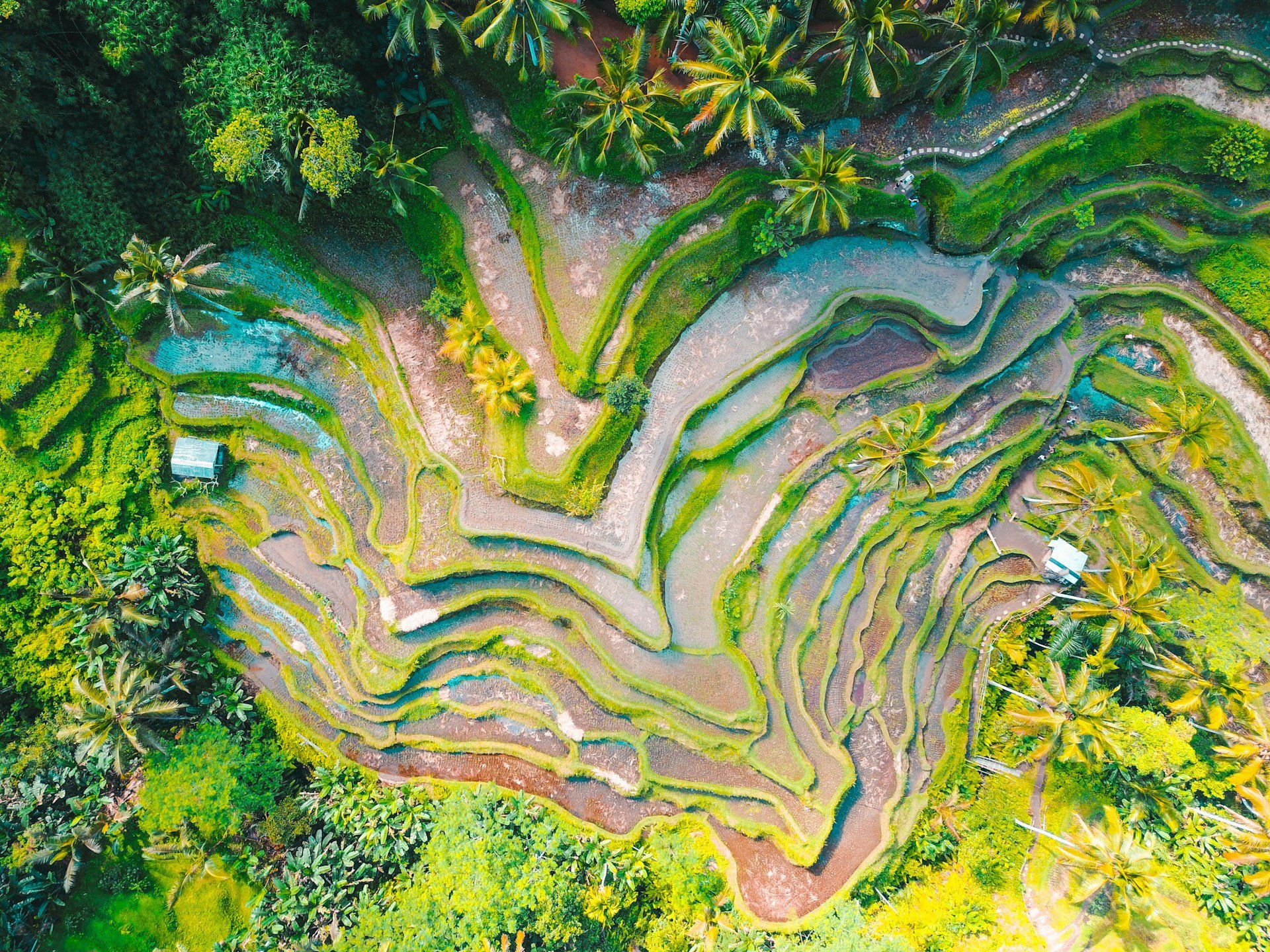
Bali is Indonesia's most-visited island by a wide margin, and for good reason: rice terraces, sea temples, a genuinely distinct Hindu culture, and a tourist infrastructure that ranges from $10 hostel dorms to some of the finest resorts in Asia. It gets its own dedicated guide because there's simply too much to cover here: neighborhoods, hotels, restaurants, day trips and a full itinerary live on our complete Bali city guide.
Yogyakarta, Borobudur & Prambanan
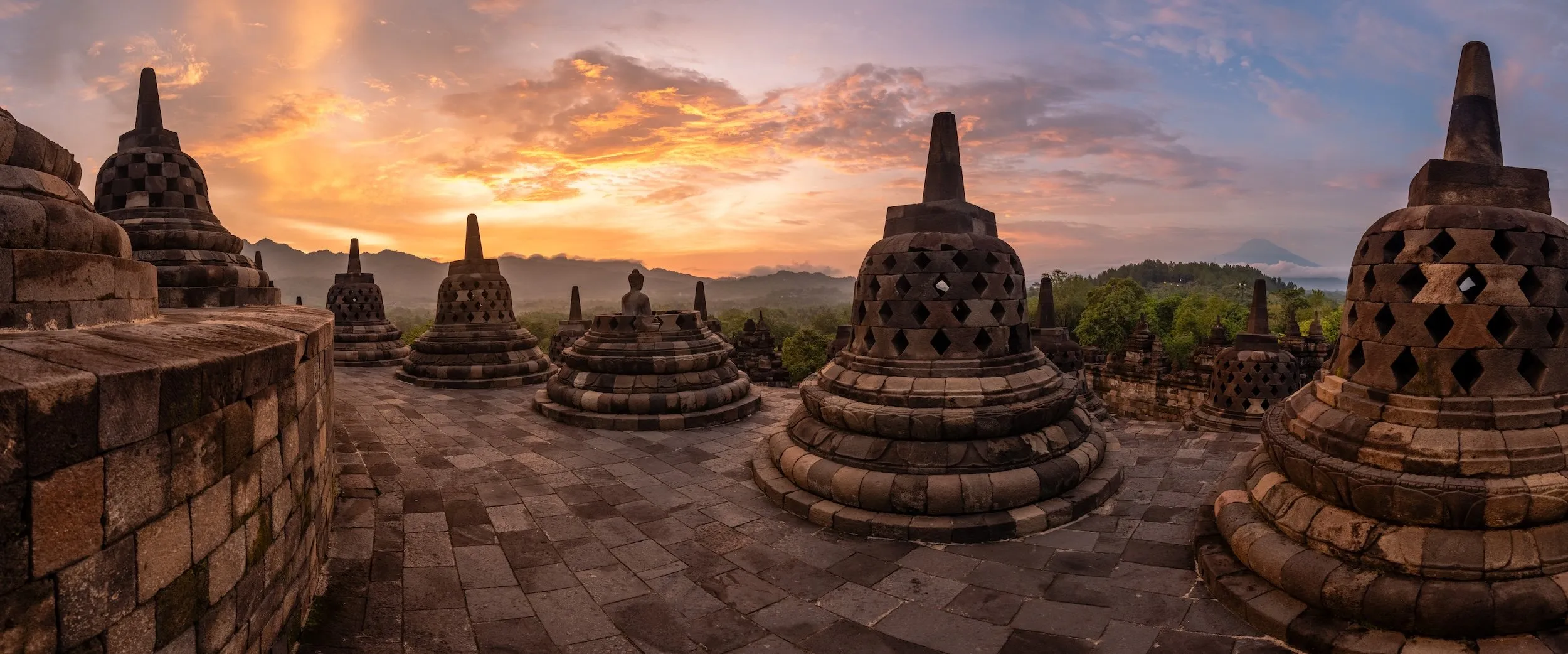
Yogyakarta is Java's cultural capital and the base for two of Southeast Asia's greatest monuments. Borobudur, roughly an hour outside the city, is the world's largest Buddhist monument, built by the Srivijaya empire in the 8th and 9th centuries: nine stacked platforms carved with 2,672 relief panels, topped with bell-shaped stupas each holding a Buddha statue. Standard entry runs around IDR 455,000 for foreign visitors; the separate sunrise ticket, roughly IDR 1,000,000 and capped at about 100 people a day, gets you inside before the general crowds. Prambanan, a 9th-century Hindu temple complex with soaring central towers, sits closer to the city and pairs naturally with Borobudur on a single sunrise tour, widely available from Yogyakarta hotels for roughly $50-85. The Kraton, the Sultan's still-functioning palace, and the pedestrian street Malioboro round out a Yogyakarta stay.
Mount Bromo
An active volcano in East Java, reached by pre-dawn jeep convoy to a viewpoint over the "sea of sand," the caldera floor, as the sun rises over Bromo's smoking crater and the peaks around it. One of Java's signature images and usually combined with Ijen's sulfur crater further east for travelers with extra days.
Labuan Bajo & Komodo National Park
Labuan Bajo, on the western tip of Flores, is the gateway to Komodo National Park, the only place on earth Komodo dragons live wild. A mandatory ranger escorts every trek on Komodo or Rinca Island, roughly IDR 200,000 per group of up to five people; park entrance itself runs IDR 650,000 for the standard Komodo-and-Padar route or IDR 900,000 including Rinca. Padar Island's viewpoint, a short, steep climb to a panorama over three differently colored bays, is one of the most photographed views in Indonesia. The surrounding waters hold their own draw: snorkeling and diving with manta rays, and Pink Beach's genuinely rose-tinted sand from crushed red coral. Multi-day liveaboard boats, from around $220 per person for a shared three-day, two-night trip, are the classic way to see the park properly; book two to three months ahead in the May-September peak season, since the park now caps visitors at 1,000 a day.
Raja Ampat, the reef at the edge of the map
Raja Ampat, off the coast of West Papua, holds the highest marine biodiversity ever recorded anywhere on earth: over 1,500 fish species and 600 coral species, with a single dive site, Cape Kri, holding the world record for the most fish species counted in one dive. Limestone karst islands rise straight out of turquoise lagoons, and the diving and snorkeling are considered by many divers the best on the planet. It is also genuinely remote and expensive to reach, generally via Jakarta and Sorong, and best combined with Komodo on the same trip: October and November is the sweet spot, the tail end of Komodo's good season overlapping with the start of Raja Ampat's best diving months.
Beyond the main circuit: Sumatra
With extra days and a taste for something rawer, Sumatra rewards the detour. These are well outside the standard Bali-Java-Komodo circuit but genuinely distinct experiences.
Bukit Lawang
A jungle village on the Bohorok River and the classic base for guided treks to see wild Sumatran orangutans in Gunung Leuser National Park, one of the last places on earth they survive outside captivity. Reached from Medan.
Lake Toba
The world's largest crater lake, formed by a colossal ancient volcanic eruption. Samosir Island, in the middle of the lake, holds Batak villages, traditional houses, weaving workshops and a slower pace than anywhere on the standard circuit.
Sipiso-Piso Waterfall
A dramatic waterfall dropping into the Lake Toba caldera, usually visited on the overland route between Bukit Lawang and Lake Toba rather than as a standalone stop.
Culture & Etiquette
Indonesia is the world's largest Muslim-majority country by population, roughly 87% nationally, but the culture you meet varies hugely by island: Bali is around 87% Hindu, a completely different religious and cultural fabric from the rest of the archipelago. What holds the country together is gotong royong, mutual cooperation and communal obligation, and a politeness code built around not causing anyone to lose face in public.
Do
- Dress modestly at temples and mosques. A sarong and sash are required at Balinese temples, usually available to rent or borrow at the entrance; cover shoulders and knees at mosques, and women should carry a headscarf.
- Use your right hand. Give and receive money, food and objects with your right hand or both hands; the left hand is considered unclean across the archipelago.
- Remove your shoes indoors, and at most homestays and some restaurants, before entering.
- Step around canang sari, the small woven palm-leaf offerings placed on Balinese sidewalks and thresholds each morning. Never step on one deliberately.
- Learn a few phrases. Terima kasih (thank you), selamat pagi (good morning), permisi (excuse me). Small effort, warmly received everywhere.
Don't
- Point with your index finger. Use your thumb instead, or your whole hand, to indicate direction or people.
- Touch anyone's head, including children's, without invitation; the head is considered sacred in Balinese and broader Indonesian culture.
- Lose your temper publicly. Raised voices and visible anger cause loss of face for everyone present and rarely resolve anything faster.
- Photograph religious ceremonies up close without asking. Balinese temple ceremonies happen constantly and visitors are usually welcome to observe respectfully from a distance, sarong on, camera discreet.
- Expect punctuality. "Jam karet," rubber time, is a real and openly acknowledged cultural trait; build slack into any schedule that depends on someone else showing up.
Deeper culture: Balinese Hinduism, wayang kulit and batik
Balinese Hinduism. A distinct tradition blending Hindu philosophy with older animist and ancestor-worship practices, expressed through daily offerings, elaborate temple ceremonies and a calendar dense with festivals. Nyepi, the Day of Silence marking the Balinese new year, is the most visible to outsiders: the entire island shuts down for 24 hours, no fire, work, travel or entertainment, even the airport closes. It falls on 8 March 2027.
Wayang kulit. Traditional shadow puppet theater, performed with intricately carved leather puppets against a lit screen, narrating episodes from the Hindu epics Ramayana and Mahabharata. Found across Java and Bali, usually at festivals and cultural performances rather than daily tourist shows.
Batik. The wax-resist dyeing technique for textiles, recognized by UNESCO as an Intangible Cultural Heritage, is centered on Java, particularly Yogyakarta and Solo, where workshops still produce hand-drawn batik tulis alongside faster stamped batik cap.
Food & Drink
Indonesian food varies by island as much as the culture does, built around rice, chili sambal in dozens of regional forms, and a spice trade legacy that still shows in every dish. Warung meals, family-run local restaurants, remain extraordinary value: a full plate with rice, a protein and vegetables typically runs IDR 15,000 to 40,000, a dollar or two.
Nasi Goreng & Nasi Campur ~$1-2
Indonesia's fried rice, nasi goreng, is the closest thing to a national dish, found from street carts to hotel breakfast buffets. Nasi campur, "mixed rice," a plate of rice with small portions of several dishes chosen from a warung's counter, is the best way to sample widely in one sitting.
Rendang $2-6
A slow-cooked beef dish from West Sumatra's Padang cuisine, simmered for hours in coconut milk and spices until the sauce reduces to a thick, dark coating. Regularly ranked among the world's best dishes in international polls, and Padang restaurants, identifiable by their tiered window displays of dozens of dishes, are found nationwide.
Satay & Gado-Gado $1-4
Skewered, grilled meat with peanut sauce, and gado-gado, a vegetable salad in the same rich peanut dressing, are found everywhere and rarely disappoint. Sambal, the chili condiment that accompanies nearly every meal, varies by island and household; ask before assuming mild.
When to Go & Itineraries
Indonesia has two seasons, not four: dry from April to October, wet from November to March. May, June and September are the sweet spot, warm and dry with lighter crowds than July and August. The wet season isn't a washout: rain usually arrives in short, heavy afternoon bursts rather than lasting all day, and it's the cheapest, quietest time to visit.
Both seasons compared, with temperatures
| Season | Verdict | Temps | Notes |
|---|---|---|---|
| May, Jun, Sep | Best | 27-32°C | Dry, lighter crowds than peak |
| Jul-Aug | Good (busy) | 27-32°C | Dry but peak season, prices rise in Bali |
| Apr, Oct | Good | 27-32°C | Shoulder months, dry season edges |
| Nov-Mar | Workable | 25-32°C | Wet season, short daily downpours, cheapest and quietest |
Temperatures are fairly consistent year-round this close to the equator; humidity and rainfall, not heat, are what actually shift by season.
Itineraries
A week covers Bali alone reasonably well. Two weeks adds Java's temples or a Gili Islands detour. Three weeks is the realistic minimum to also reach Komodo, since the distances between islands genuinely cost travel days that a map doesn't make obvious.
- Days 1-7
Bali only. Follow the full Bali city guide itinerary: Ubud's rice terraces, Uluwatu's cliffs and temple, and a beach base in Seminyak, Canggu or Sanur.
- Days 1-5
Bali. Ubud, a beach base, and Uluwatu.
- Days 6-7
Gili Islands. Fast boat from Sanur or Padang Bai; two nights on Gili Air or Gili Trawangan.
- Days 8-11
Yogyakarta. Fly from Bali; Borobudur sunrise, Prambanan, the Kraton and Malioboro.
- Days 12-14
Mount Bromo & return. Overland to East Java for the pre-dawn jeep tour, then fly home via Surabaya or back through Bali.
- Days 1-6
Bali. Full circuit: Ubud, a beach base, Uluwatu, one day trip to Nusa Penida.
- Days 7-11
Java. Yogyakarta, Borobudur and Prambanan, then Mount Bromo.
- Days 12-16
Labuan Bajo & Komodo. Fly from Bali; a multi-day liveaboard covering Komodo, Padar Island and Pink Beach.
- Days 17-21
Return via Bali. A slower final stretch back on Bali's beaches to decompress before flying home.
Getting there & around
Most international flights land at either Ngurah Rai International Airport (DPS) in Bali or Soekarno-Hatta International Airport (CGK) in Jakarta. Domestic flights, on Garuda Indonesia, Lion Air, AirAsia and TransNusa among others, connect the islands and are often the only practical option: a Bali-Yogyakarta flight runs roughly $36-70 and takes about 90 minutes. Java has a genuinely good train network, fares from around $8-30 for routes like Jakarta-Yogyakarta. Ferries and fast boats link the closer islands, Bali to Lombok or the Gilis among them.
All transport options with prices
| Option | Price | Notes |
|---|---|---|
| Domestic flights | $36-70 | Garuda, Lion Air, AirAsia, TransNusa; book ahead in peak season |
| Java trains | $8-30 | Good network; Jakarta-Yogyakarta is a comfortable, scenic option |
| Bali-Lombok fast boat | IDR 300,000-700,000 | Several operators from Padang Bai and Sanur |
| Bali-Gili fast boat | ~€14-24 one way | 1.5-4.5 hrs from Padang Bai, Serangan or Sanur |
| Grab / Gojek | Metered, low | App-based rides and scooter taxis in Bali and major cities |
Practical prep: download offline maps, since signal drops in rural Java and on the smaller islands. A local SIM or eSIM before landing covers most of the country cheaply. If your trip includes any diving or liveaboard component, standard travel insurance may not cover it automatically, check the policy specifically.
Budget Planning
Indonesia is genuinely affordable, especially outside Bali's most touristed pockets. These figures reflect Bali, the most-visited and most expensive island; Java and the outer islands generally run a little cheaper for the same standard, while Komodo and Raja Ampat cost more once liveaboards and long-haul domestic flights are added in.
- Hostel dorm or warung-side guesthouse
- Warung meals, twice daily, ~$1-2 each
- Scooter rental IDR 60,000-90,000/day
- Free beaches and temple grounds
- Boutique hotel or guesthouse with pool
- Restaurant meals, occasional splurge
- Private driver or Grab for day trips
- Paid activities: temples, tours, snorkeling
- Top-tier resorts and pool villas
- Fine dining and private tours
- Liveaboard diving in Komodo or Raja Ampat
- Domestic flights on short notice
Quick reference prices
| Warung meal | IDR 15,000-40,000 (~$1-2.50) |
| Bottled water (1.5L) | ~IDR 5,000 |
| Scooter rental | IDR 60,000-90,000/day |
| Bali tourist levy | IDR 150,000 (one-time) |
| e-VOA visa | IDR 500,000 (~$30) |
| Borobudur entry (standard) | ~IDR 455,000 |
| Komodo park entry | IDR 650,000-900,000 |
| Domestic flight, 1-1.5 hrs | $36-70 |
Prices reflect August 2026 research and drift over time, especially domestic flights and liveaboard rates in peak season. Treat them as a planning baseline, not a quote.
Visa & Entry
Unlike some destinations, Indonesia is not visa-free for most Western passport holders. US, UK, EU, Australian and Canadian citizens need a paid electronic Visa on Arrival (e-VOA): roughly IDR 500,000, about $30 though the rate drifts with the rupiah, applied for online before travel or purchased on arrival, valid for 30 days from entry. It can be extended once for a further 30 days, but as of June 2025 that extension can no longer be done online and requires an in-person visit to a local immigration office. ASEAN nationals get a separate visa-free 30-day allowance that is not extendable.
✓ Valid passport
At least 6 months' validity beyond your arrival date, with a minimum of two blank pages.
✓ Return or onward ticket
Required as part of the e-VOA application and may be checked at immigration.
✓ e-VOA payment
Apply online in advance and pay by Visa, Mastercard or JCB, or purchase on arrival at major airports.
✓ Bali tourist levy
A separate IDR 150,000 fee for anyone entering Bali specifically, paid through the official Love Bali platform.
| Indonesia | Thailand | |
|---|---|---|
| Daily budget | $30-45 gets you far; slightly better value for couples and families | $30-40; usually a touch cheaper for solo backpackers |
| Beaches | Bali's beaches are better for surfing than swimming; gray sand in places | Wider variety, clearer water on the Andaman coast |
| Culture | Balinese Hindu daily life is immersive and hard to find elsewhere | More structured, historically layered temple culture |
| Visa | Paid e-VOA required for most Western passports, ~30 days | Visa-free for many nationalities for 30-60 days |
| Getting around | Islands are genuinely far apart; flights often necessary | More compact, better overland and rail connections |
Safety, Solo Women & Family
Indonesia, and Bali specifically, is broadly safe: no major government currently advises against travel there, and violent crime targeting tourists is uncommon. The real risks are traffic accidents, water safety, petty theft and, seriously, illicitly produced alcohol, not targeted crime. A South Korean embassy advisory in 2026 flagged Jimbaran, Seminyak and Canggu as areas needing extra vigilance against opportunistic crime, worth knowing without being alarmed by it.
Methanol poisoning
The single most serious, specific risk. Illegally produced spirits, locally called oplosan, sold cheap in some bars and shops, can contain methanol; fatality rates run 20-40% and symptoms are delayed 12-24 hours, by which point permanent blindness or death is possible without treatment. Stick to sealed, branded beer, wine or duty-free spirits and avoid unbranded local liquor from unlicensed sellers.
Traffic & scooters
The most common serious injury for visitors. Helmets are legally required and widely ignored by tourists at real cost: local authorities have run visible crackdowns on shirtless, helmetless riders in Canggu, Seminyak, Kuta and Uluwatu. Get proper riding experience before renting.
Rabies & animals
Rabies is present in parts of Bali. Avoid touching stray dogs and monkeys, and seek immediate medical care for any bite or scratch rather than waiting to see if symptoms develop.
Volcanoes, earthquakes and natural hazards
Indonesia sits on the Pacific Ring of Fire and earthquakes are a genuine, regular background fact of life, most are minor and unfelt by visitors, but the risk is real, not theoretical. Bali has two active volcanoes, Agung and Batur, neither at elevated alert as of this writing; Java has several more, including Bromo and Merapi. Check Indonesia's volcanology agency (PVMBG) alerts before any volcano trek and follow closure notices without exception; they exist because these are working, monitored volcanoes, not tourist props.
The 3 scams to actually know about
Indonesia isn't an especially high-scam destination, but a few patterns catch uninformed visitors repeatedly. Knowing them in advance avoids nearly all of it.
The scooter damage claim
A bike is rented with pre-existing scratches that suddenly become your responsibility, and hundreds of dollars, on return. Film a slow walk-around video of every scratch, dent and mirror before you ride off.
Unlicensed money changers
Street exchangers advertising better rates shortchange with sleight of hand, folded bills or distraction. Only use exchange counters marked "Authorized" and registered with Bank Indonesia, and count the cash on the spot.
Unofficial transport touts
Drivers approaching arrivals before the official taxi rank quote inflated fares. Use the official rank, a metered Blue Bird taxi, or a pre-booked transfer instead.
Solo women travelers
Indonesia, especially Bali's established tourist areas, rates well for solo women (7.5/10 on our scale). Balinese culture is welcoming and street harassment is uncommon in the main tourist zones. The main practical risks are the same as anywhere: watch your drink at bars given documented drink-spiking incidents, use licensed transport apps like Grab or Gojek rather than unmarked taxis, and take extra care after dark outside busy, well-lit areas. Full detail on our Solo Woman Explorer pages.
Emergency numbers
Family travel & pets
Family travel. Bali is the easiest island for families: Nusa Dua's gated resorts and Sanur's calm, walkable waterfront both offer swimmable beaches and infrastructure built for young kids, and Balinese culture is warm toward children. Java's temples and Komodo's boat trips work better for kids old enough to manage a full day out, roughly 8 and up.
Pets. Bringing a pet into Indonesia involves a veterinary health certificate, current rabies vaccination and an import permit, arranged well in advance through Indonesia's quarantine authority. Given that rabies is present in parts of Bali, most travelers find it simpler to leave pets at home for a trip this far.
Indonesia FAQ
Is Indonesia safe to visit?
Yes, generally. Violent crime against tourists is rare and Bali sees no major government travel warnings. The real risks are traffic accidents on scooters, water safety, petty theft and illicit alcohol, not crime.
Do I need a visa for Indonesia?
Most Western passport holders need a paid e-VOA, about 500,000 rupiah, valid 30 days and extendable once for 30 more at an immigration office. It is not visa-free like some European destinations, and ASEAN nationals get a separate visa-free 30-day allowance.
What is the Bali tourist tax and how do I pay it?
A one-time 150,000 rupiah (about $10) Foreign Tourist Levy for anyone entering Bali. Pay online in advance through the official Love Bali site or app and keep the QR code voucher, or pay at the BRI bank counter in the arrivals hall if online payment fails.
When is the best time to visit Indonesia?
The dry season, April to October, is best overall, with May, June and September the sweet spot for weather and crowds. November to March is wetter but cheaper, and rain usually comes in short afternoon bursts rather than all day.
How many days do you need in Indonesia?
A week covers Bali alone reasonably. Two weeks adds Java's temples or the Gili Islands. Three weeks is a realistic minimum to also reach Komodo National Park, since the islands are genuinely far apart and domestic flights or ferries eat travel days.
Is Bali the same as Indonesia?
No. Bali is one island and one province among more than 17,000 islands that make up Indonesia. It is the most-visited by far and has its own dedicated Atlas Guide city guide, but Java, Flores, Sumatra and Raja Ampat are entirely different islands with different cultures and logistics.
What language is spoken in Indonesia?
Indonesian (Bahasa Indonesia) is the national language, though hundreds of regional and local languages are spoken across the archipelago. English is common in Bali's tourist areas and major cities, much less so in rural regions.
Is Indonesia safe for solo female travelers?
Generally yes, especially in Bali's established tourist areas, where the culture is welcoming and street harassment is uncommon. Standard precautions apply: watch your drink at bars, use licensed transport apps, and take more care after dark outside busy areas.
Is Indonesia good for families with kids?
Yes, particularly Bali, where Nusa Dua and Sanur offer calm swimmable beaches and resort infrastructure built for families. Balinese culture is warm toward children, and destinations like the Ubud rice terraces or a gentle Komodo boat trip work well for kids old enough to handle a full day out.
What is Nyepi and will it affect my trip?
Nyepi is the Balinese Hindu Day of Silence, a 24-hour island-wide shutdown with no travel, work, lights or entertainment, including a closed airport. It falls on 8 March 2027. Plan arrivals and departures around it, either landing a couple of days early or leaving the day after.
Is Indonesia cheaper than Thailand?
Roughly comparable, with Thailand usually a little cheaper for backpackers and Bali often better value for couples and families wanting comfort. Both let budget travelers manage on $30-45 a day and mid-range travelers on $70-130.
Do I need to worry about methanol poisoning in Indonesia?
It's a genuine risk worth knowing about, not a reason to avoid the country. Methanol poisoning comes from illegally produced spirits, locally called oplosan, sold cheap in some bars and shops. Stick to sealed, branded beer, wine or duty-free spirits and avoid unbranded local liquor from unlicensed sellers.
What Stays With You
Most travelers arrive for Bali and leave planning a second trip for everything else: Java's temples at sunrise, a dragon on a beach in Flores, a reef that has more fish in one dive site than most oceans have in total. Indonesia doesn't reveal itself in a single visit because it isn't a single place, it's an archipelago of more than 17,000 islands, and even a well-planned three weeks only really samples it.
Start with Bali. It earns its reputation as the easiest island to fall for. Then look at a map of the rest of the country and notice how much of it you haven't touched yet.