
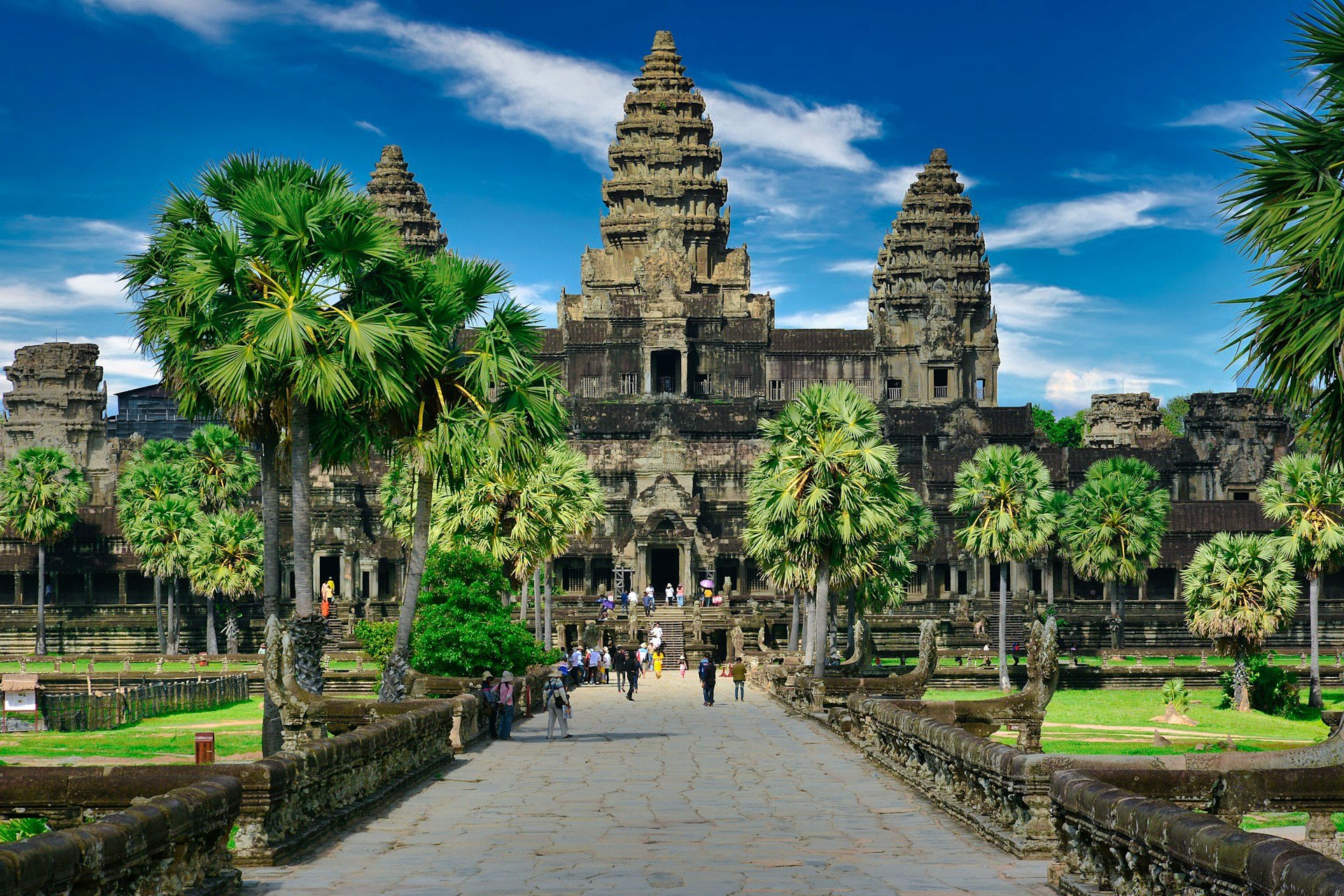
What You're Actually Getting Into
Cambodia's headline attraction is also its best argument: Angkor, the temple city built by the Khmer Empire between the 9th and 13th centuries, when it was the largest pre-industrial urban complex on the planet and Angkor Wat itself the largest religious monument ever built. That scale of ambition sits alongside a much more recent and much darker chapter. Between 1975 and 1979 the Khmer Rouge killed an estimated quarter of the population, and the country you're visiting rebuilt itself from that within a single working lifetime. Both things are true of Cambodia at once, and a good visit holds space for both rather than skipping straight to the temples.
It's also, refreshingly, one of the more affordable stops left in Southeast Asia. A bowl of noodle soup costs a dollar or two, a good plate of fish amok at a proper restaurant runs $6-10, and a guesthouse room with air conditioning starts around $15-20 a night outside peak season. The US dollar and the Cambodian riel circulate side by side, tourist infrastructure around Siem Reap and Phnom Penh is well developed, and English is common wherever visitors actually go.
The honest complications
Cambodia and Thailand have an active, unresolved border dispute that escalated into armed clashes in 2025 and flared again in July 2026; the affected zone is a roughly 50km strip of specific northern and western provinces, not the country as a whole, and this guide's recommended destinations, Siem Reap, Angkor and Phnom Penh, sit outside it. See the Safety chapter for the specifics and don't skip it. Separately: Angkor's main temples draw serious crowds at sunrise and midday in high season, tuk-tuk and moto touts can be persistent around any tourist site, and the road network outside the main cities is slower than distances on a map suggest. None of this cancels out what the country offers. It does mean going in with clear eyes rather than a brochure's version of the place.
A History Worth Knowing
Cambodians descend from the Khmer, whose empire at its height around the 12th century controlled most of what is now Thailand, Laos and southern Vietnam, and whose temple-building at Angkor remains one of the great architectural achievements in human history. Centuries of decline and foreign pressure followed, then French colonization, independence, a brutal genocide under the Khmer Rouge, and a slow, still-ongoing rebuild. Understanding roughly this arc changes what Phnom Penh and Angkor both mean once you're standing in front of them.
- 802-1431
The Khmer Empire. Founded by Jayavarman II, reaching its peak in the 12th century under Suryavarman II, who built Angkor Wat, and Jayavarman VII, who built the Bayon and Angkor Thom.
- 1431
Fall of Angkor. Siamese forces sack the capital; the court relocates and Angkor is gradually reclaimed by jungle, though never fully abandoned by local worship.
- 1863-1953
French protectorate and colony. France administers Cambodia as part of French Indochina; Angkor is restored and made a tourist site under French archaeological direction.
- 1953
Independence. Achieved under King Norodom Sihanouk, who navigates a fragile neutrality as the Vietnam War escalates next door.
- 1975-1979
The Khmer Rouge. Pol Pot's regime empties the cities, abolishes money and religion, and kills an estimated 1.7 to 2.2 million people through execution, forced labor and starvation, roughly a quarter of the population, before Vietnamese forces topple it.
- 1993-present
Rebuilding. UN-supervised elections in 1993, decades of stability and growth under Hun Sen, and a 2023 handover to his son Hun Manet, alongside a tourism industry that has grown from almost nothing to one of the country's largest.
Read the full history: the Khmer Empire, the Khmer Rouge and the long rebuild
The Khmer Empire's genius was hydraulic: vast reservoirs called barays and an extensive canal network let Angkor support a population historians estimate at up to 750,000 people, in an era when European capitals held a tenth of that. Suryavarman II built Angkor Wat in the early 12th century as a state temple and eventual mausoleum, oriented uniquely westward and dedicated to Vishnu. Jayavarman VII, Angkor's most prolific builder, converted the state religion to Mahayana Buddhism and built the walled city of Angkor Thom and the serene, enormous faces of the Bayon at its center. His public works, hospitals, roads, rest houses, were unmatched anywhere in the medieval world.
Angkor's decline after 1431 is debated among historians: Siamese invasion, drought, disease, and the strain of maintaining the hydraulic system have all been proposed as contributing causes, likely in combination. The temples were never entirely lost to the outside world, Khmer Buddhist monks maintained a presence at Angkor Wat continuously, but French naturalist Henri Mouhot's 1860 account brought them to Western attention and began more than a century of restoration, much of it disrupted by war.
The Khmer Rouge. Pol Pot's Communist Party of Kampuchea took Phnom Penh on 17 April 1975 and immediately evacuated the entire city, marching residents into the countryside within days. Money, private property, religion and formal education were abolished; the population was organized into forced agricultural labor communes. Intellectuals, professionals, ethnic and religious minorities and anyone associated with the previous government were systematically targeted for execution, most infamously processed through the S-21 prison in Phnom Penh and killed at sites like Choeung Ek outside the city. Vietnam invaded in December 1978 and toppled the regime by January 1979, but Khmer Rouge remnants continued an insurgency from remote areas into the late 1990s, and land mines from that era still affect some rural regions.
Rebuilding. The 1991 Paris Peace Accords and 1993 UN-supervised elections restored a constitutional monarchy and multi-party system, though power consolidated firmly under Hun Sen's Cambodian People's Party over the following three decades. Tourism, negligible before the 1990s, grew into one of the economy's largest sectors on the strength of Angkor alone; Siem Reap transformed from a dusty provincial town into an international travel hub within a generation. Hun Sen handed the premiership to his son Hun Manet in August 2023, the most significant political transition in the country in decades.
Top Destinations
Cambodia's tourist geography is straightforward: Siem Reap and Angkor in the northwest, the capital Phnom Penh in the center, and a southern coastline that's only recently entered wider circulation. This guide deliberately does not route you toward the northern and western border provinces currently affected by the Thailand dispute; everything below sits outside that zone. A week covers Siem Reap and Phnom Penh well; ten days to two weeks adds the coast.
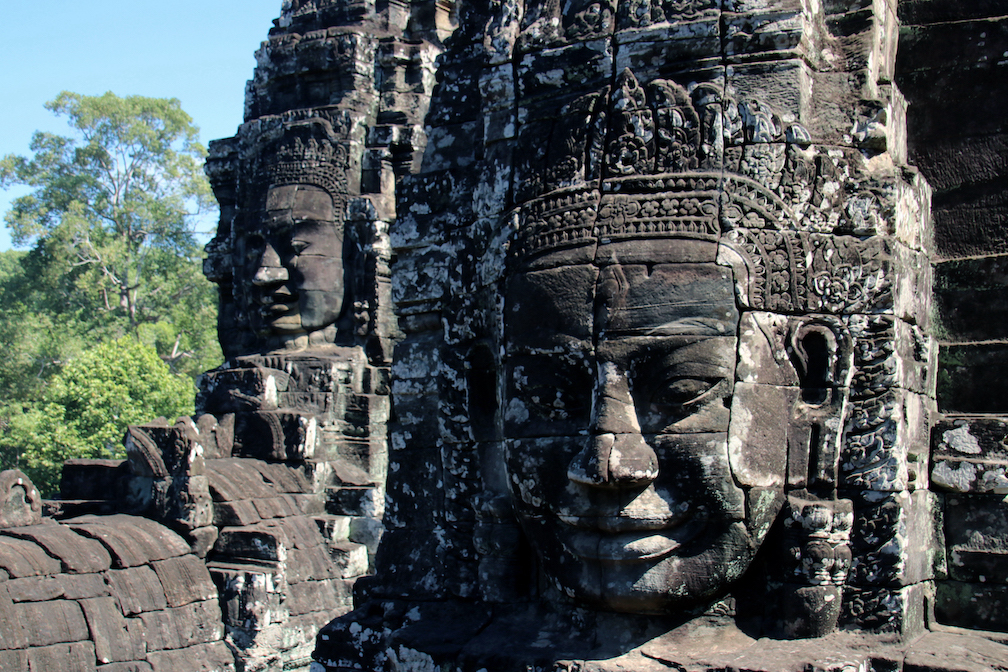
Angkor, the reason most people come
The Angkor Archaeological Park holds hundreds of temples across roughly 400 square kilometers, but three define a first visit: Angkor Wat itself, still an active place of Buddhist worship and best seen at sunrise before the heat and the crowds arrive; Angkor Thom, Jayavarman VII's walled city, centered on the Bayon's 216 serene stone faces; and Ta Prohm, where strangler fig and silk-cotton tree roots have been deliberately left engulfing the ruins, made famous by Tomb Raider but worth seeing on its own terms. Two full days covers the main circuit properly; a full guide to Siem Reap city itself, hotels, restaurants and a chapter-by-chapter breakdown of Angkor, lives on our dedicated Siem Reap page.
The capital, honestly
Phnom Penh sits at the confluence of the Mekong and Tonle Sap rivers, and doing it right means holding two very different experiences in the same one or two days. The Royal Palace and its Silver Pagoda, floored with more than 5,000 silver tiles, represent the ornate, living continuity of the monarchy. The Tuol Sleng Genocide Museum, a former high school converted into the Khmer Rouge's S-21 interrogation center, and the Killing Fields of Choeung Ek just outside the city, are unflinching about what happened here between 1975 and 1979. Most visitors do both sites the same day with an audio guide, and the shift from the Royal Palace's gilt to Tuol Sleng's bare cells is deliberately jarring; that's the honest shape of the city. Round it out with the riverside promenade at dusk and the produce and textile stalls of Phsar Thmey, the art deco Central Market.
Kampot, Kep & the islands
Cambodia's southern coast is the part of the country most visitors still skip, which is exactly its appeal. Kampot, a laid-back riverside town under French-colonial shophouses, is the base for touring the pepper farms that produce Kampot pepper, a protected-origin crop chefs across the region seek out. Kep, half an hour further, is a former French seaside resort known for one thing done exceptionally well: blue swimmer crab, stir-fried with local Kampot pepper at the crab market on the water. Offshore, Koh Rong and the smaller Koh Rong Sanloem have the white sand and clear water most people picture when they think tropical Southeast Asian island, with development still light compared to Thailand's equivalents.
Culture & Etiquette
Cambodia is a Theravada Buddhist country, and that shapes daily life visibly: the orange robes of monks on morning alms rounds, the small spirit houses outside homes and businesses, and a social code built around hierarchy, modesty and the avoidance of public confrontation. Cambodians are, by wide consensus among visitors, exceptionally warm hosts, which makes it worth the small effort of getting the basics right.
Do
- Use the sompiah greeting. Press your palms together at chest height and bow slightly. The higher the hands and the deeper the bow, the more respect it signals; save the highest form for monks and elders.
- Dress modestly at temples. Cover shoulders and knees at Angkor and any active pagoda, and remove shoes before entering temple buildings and most homes.
- Learn a few Khmer words. Suosdey (hello), orkun (thank you), and som (please) go further than in most tourist-heavy countries, precisely because fewer visitors bother.
- Carry small riel and dollar notes. Markets and tuk-tuks run on exact or near-exact change; torn or heavily worn US bills are sometimes refused.
- Agree fares before you get in. Standard practice for tuk-tuks and motos everywhere, not a sign of distrust.
Don't
- Touch anyone's head, including children's, considered the most sacred part of the body.
- Point your feet at people, Buddha images or monks. Feet are the lowest and least respected part of the body in Khmer custom; sit with legs tucked to the side in temples, not stretched out.
- Let women touch monks or hand them objects directly. Place items down for a monk to pick up, or have a man pass them instead.
- Photograph Tuol Sleng and Choeung Ek casually. Both sites welcome visitors, but treat them as memorials, not backdrops; loud conversation and posed photos are out of place.
- Beckon someone with your palm up. Wave with the palm facing down; the Western "come here" gesture with fingers curled upward is used only for animals.
Deeper culture: Buddhism, the monarchy and Khmer New Year
Theravada Buddhism is practiced by roughly 95 percent of Cambodians and structures daily and civic life: young men traditionally ordain as monks for a period, temples double as community centers, and merit-making, donating food to monks, funding temple upkeep, is a constant, visible activity rather than a once-a-week ritual.
The monarchy is constitutional and largely ceremonial today, but genuinely respected; the current king, Norodom Sihamoni, is a former ballet dancer and diplomat who took the throne in 2004. Criticism of the royal family is culturally and, in practice, legally sensitive; it's not a conversation topic worth pursuing with new acquaintances.
Khmer New Year (Choul Chnam Thmey), usually in mid-April, is the country's biggest holiday: three days of temple visits, water throwing, and family gatherings, similar in spirit to Songkran in Thailand and Thingyan in Myanmar. Much of the country, including many tourist businesses, effectively shuts down or slows significantly; plan around it rather than through it.
Food & Drink
Khmer food sits between Thai and Vietnamese cooking without being a copy of either: less chili-forward than Thai food, less herb-bright than Vietnamese, built instead around prahok (fermented fish paste), palm sugar, lime and kroeung, an aromatic paste of lemongrass, galangal and turmeric that underlies most curries. The best of it is inexpensive even by regional standards: a proper sit-down meal with rice, a curry and a drink rarely tops $8-10 outside destination restaurants.
Fish Amok $4-10
Cambodia's signature dish: freshwater fish in a kroeung-and-coconut-milk custard, steamed in a banana leaf until set. The texture, closer to a savory mousse than a curry, is what distinguishes it from anything on a Thai menu.
Lok Lak $3-7
Stir-fried cubed beef in a peppery sauce, served over lettuce and tomato with a lime-and-Kampot-pepper dipping sauce, a fried egg often on top. A Phnom Penh classic as much at a street stall as a hotel restaurant.
Kuy Teav $1-3
The everyday breakfast: a clear pork or beef broth over rice noodles with bean sprouts, herbs and often crispy garlic, sold from streetside stalls from early morning. Add lime, chili and fish sauce to taste at the table.
Num Banh Chok $1-2
Fresh rice noodles under a green fish-and-kroeung gravy, topped with raw vegetables and herbs; a breakfast dish and, arguably, the actual national dish, more than amok.
Kampot Pepper Crab $8-15
Blue swimmer crab wok-fried with green Kampot peppercorns at Kep's crab market, sold fresh from the boats moored a few meters from the tables.
Angkor Beer $1-2
Cambodia's dominant local lager, brewed in Sihanoukville, on draft ("Angkor draft" or "bia sod") for as little as a dollar at streetside stalls in Siem Reap and Phnom Penh.
When to Go & Itineraries
November through February is Cambodia's dry, cool season and the most comfortable stretch to visit: lower humidity, daytime temperatures in the high 20s Celsius, and Angkor at its most photogenic without the risk of a downpour. March through May is hot and dry, with temperatures regularly hitting the mid-30s, tolerable but demanding. June through October is the rainy, green season: short, heavy afternoon downpours rather than all-day rain, noticeably lower prices, and Angkor's moats and rice paddies at their most vivid.
All three seasons compared, with temperatures
| Season | Verdict | Temps | Prices & crowds |
|---|---|---|---|
| Nov-Feb | Best | 22-30°C, low humidity | Peak prices and crowds at Angkor, especially Dec-Jan |
| Mar-May | Good (hot) | 28-36°C, rising humidity | Lower prices, fewer crowds; heat is the tradeoff |
| Jun-Oct | Good (green season) | 25-32°C, short daily downpours | Lowest prices, thinnest crowds, lush landscapes |
Siem Reap and Phnom Penh run similar year-round temperature ranges; the coast at Kampot and Kep is a degree or two cooler with sea breeze. Khmer New Year in mid-April is hot, festive and a poor time to expect normal business hours.
Itineraries
Seven days covers Siem Reap, Angkor and Phnom Penh at a reasonable pace. Ten to fourteen days adds the southern coast without feeling rushed anywhere.
- Days 1-3
Siem Reap & Angkor. Arrive, one day for Angkor Wat, Angkor Thom and the Bayon, one day for Ta Prohm and a Tonle Sap floating village, city time in between.
- Days 4-5
Fly or bus to Phnom Penh. Royal Palace and Silver Pagoda one morning, Tuol Sleng and Choeung Ek the same or following day, riverside evenings.
- Days 6-7
Slow finish in Phnom Penh or a short add-on flight home from Siem Reap, whichever routing works better for your flights.
- Days 1-3
Siem Reap & Angkor, as above, with an extra half-day for Banteay Srei's pink sandstone carving, 45 minutes out.
- Days 4-5
Phnom Penh, Royal Palace, Tuol Sleng, Choeung Ek and the riverside.
- Days 6-8
Kampot. Bus or private transfer from Phnom Penh (2.5-3 hrs), pepper farm tour, riverside sunset cruise.
- Days 9-10
Kep. Crab market lunch, a quiet beach afternoon, return to Phnom Penh for the flight home.
- Days 1-4
Siem Reap & Angkor extended, including Banteay Srei and, for the energetic, the further jungle temple of Beng Mealea.
- Days 5-7
Phnom Penh, at an unhurried pace with time for the National Museum and Wat Phnom.
- Days 8-10
Kampot, pepper farms, cave temples and the countryside by rented scooter or bike.
- Days 11-12
Kep, crab market and a slow beach pace.
- Days 13-14
Koh Rong or Koh Rong Sanloem by ferry from Sihanoukville, two final days of beach before flying out of Phnom Penh.
Getting there & around
Phnom Penh International Airport (PNH) and Siem Reap Angkor International Airport (SAI, opened 2023, roughly 50km from Siem Reap city) are the two main international gateways, with connections from most regional Southeast Asian hubs and a growing number of direct long-haul routes. Given the current border situation, fly into Cambodia rather than crossing overland from Thailand; land border crossings between the two countries are closed. Between Cambodian cities, air-conditioned coach buses (Giant Ibis, Virak Buntham) connect Phnom Penh and Siem Reap in roughly 5-6 hours for $10-28, and domestic flights cover the same route in under an hour when time matters more than budget.
All transport options with prices: buses, domestic flights, tuk-tuks
| Option | Price | Notes |
|---|---|---|
| Phnom Penh-Siem Reap bus | $10-28 | 5-6 hrs on AC coaches; Giant Ibis and Virak Buntham are the reliable operators. |
| Domestic flights | $40-90 | Phnom Penh-Siem Reap in under an hour; worth it on a tight schedule. |
| Tuk-tuks (city) | $2-5/ride | Agree the fare before departure; PassApp and Grab work in Phnom Penh and Siem Reap. |
| Phnom Penh-Kampot bus | $5-8 | 2.5-3 hrs; several daily departures. |
| Sihanoukville-Koh Rong ferry | $15-25 return | 45-90 mins depending on operator and destination pier. |
Practical prep: buy a Cambodian SIM at the airport ($5-10 for several GB) or an eSIM before landing. Tap water is not safe to drink; stick to bottled or filtered water, including for ice unless you're confident of its source. Standard travel insurance is worth having, and worth reading the war-exclusion clause on given the border situation if your itinerary changes.
Where to stay
Siem Reap guesthouses
Family-run guesthouses with AC and a pool cluster within a 10-15 minute tuk-tuk of Pub Street and the Old Market. Full details, named picks and neighbourhood breakdowns are on our Siem Reap city guide.
Phnom Penh riverside
Boutique hotels along Sisowath Quay put the Royal Palace, National Museum and riverside restaurants within easy walking distance, with Tuol Sleng a short tuk-tuk ride south.
Kampot riverfront
Colonial-era shophouses converted into guesthouses line the Preaek Tuek Chhu riverfront, most within walking distance of the night market and pepper-farm tour desks.
Koh Rong & Koh Rong Sanloem
From simple beach bungalows to small boutique resorts; prices roughly double in the November-February high season and infrastructure, including power and wifi, is noticeably more basic than the mainland.
Budget Planning
Cambodia remains one of the more affordable countries in Southeast Asia, though the Angkor Pass is a genuine fixed cost that budget travelers elsewhere in the region don't face. Outside that one line item, food, local transport and guesthouse accommodation are all inexpensive by any standard.
- Guesthouse dorm or basic room $8-18
- Street food & local restaurants $5-10
- Tuk-tuks and buses between cities
- Angkor Pass amortized over your stay
- Boutique guesthouse or 3-star hotel
- Restaurant meals $8-20/person
- Private drivers and domestic flights
- Guided temple tours, floating village trips
- 4-5 star hotels in Siem Reap and Phnom Penh
- Fine dining and tasting menus
- Private guides and drivers throughout
- Island resort stays
Quick reference prices: food, transport, entry fees
| Kuy teav noodle soup | $1-3 |
| Fish amok at a sit-down restaurant | $4-10 |
| Angkor draft beer | $1-2 |
| Coffee (iced Khmer coffee) | $1-2 |
| Tuk-tuk within Siem Reap or Phnom Penh | $2-5 |
| Phnom Penh-Siem Reap bus | $10-28 |
| Guesthouse room with AC | $15-30/night |
| Angkor Pass (1-day) | $37 |
| Tuol Sleng entry | ~$5 |
| Phare Cambodian Circus ticket | ~$18 |
Prices reflect August 2026 research and drift over time, especially at hotels during peak December-January dates. Treat them as a planning baseline, not a quote.
Visa & Entry
Most nationalities need a visa for Cambodia. The e-visa is the simplest route for almost everyone: apply online at the official evisa.gov.kh portal, upload a passport photo and passport bio page scan, and pay $36 total ($30 visa fee plus a $6 processing fee). Processing typically takes about 3 business days; apply at least a week before travel to be safe. The e-visa is valid for a single entry within 90 days of issue and permits a 30-day stay, usable at the main international airports and select land borders, though land entry from Thailand specifically is currently closed given the border situation.
✓ Valid passport
At least 6 months validity from date of entry, with at least one blank visa page.
✓ Passport photo & bio page scan
Required for the e-visa application; digital photo requirements are listed on the official portal.
✓ $36 online payment
Visa and card, UnionPay and some digital wallets accepted on the official site only.
✓ Fly in, don't cross by land from Thailand
Land checkpoints on the Thai border are closed; arrive via Phnom Penh or Siem Reap airport instead.
| Cambodia | Vietnam | |
|---|---|---|
| Signature sight | Angkor, unmatched historical scale | Halong Bay, Hoi An, more varied landscapes |
| Daily budget | $25-35 gets you far | Similar to slightly cheaper on food and transport |
| Visa | $36 e-visa, most nationalities | E-visa also available, price and process comparable |
| Pace | Slower, smaller tourist circuit | Larger country, more time needed to cover well |
| Recent history | Khmer Rouge era is close and visible in Phnom Penh | War history present but less central to a standard visit |
Safety, the Thai Border & Solo Travel
Cambodia is safe for tourists in the places most visitors actually go. Violent crime against foreigners is rare in Siem Reap, Angkor and Phnom Penh; the realistic risks are traffic, petty theft and a handful of well-documented scams, not danger to your person. The exception, addressed directly below, is a live border dispute with Thailand that visitors need to understand before planning a route.
Traffic
The leading real risk to visitors. Motorbikes and tuk-tuks dominate the roads with loose adherence to lane discipline; wear a helmet if you rent a scooter, and cross streets the way locals do, slowly and predictably rather than in a burst.
Tuk-tuk & phone scams
A driver asking to borrow your phone for navigation, then "dropping" it and fleeing with it, is a documented pattern. Use your own offline maps or a ride-hailing app instead of handing over your device.
Card games & friendly strangers
An unusually friendly stranger inviting you to a home or a card game, most reported in Phnom Penh, is a setup for pressured losses or worse. Politely decline invitations from strangers that feel engineered.
Two more things worth knowing: unexploded ordnance and counterfeit currency
Unexploded ordnance and land mines remain in some rural areas from the Khmer Rouge era and are a specific, serious hazard away from marked paths, particularly near the northern and western borders. Stay on established trails and roads; this is not a concern at Angkor, Phnom Penh or the southern coast.
Counterfeit US currency has been reported changing hands at some budget massage parlors and informal exchange points. Check bills you receive as change, and prefer bank ATMs and reputable exchange counters over street changers.
Solo women travelers
Cambodia is a reasonable choice for solo women, particularly in Siem Reap and Phnom Penh's tourist areas, where the atmosphere is relaxed and serious incidents against travelers are uncommon. The realistic concerns are the same petty scams that affect all visitors, plus the usual advice: use ride-hailing apps like PassApp or Grab rather than flagging down a tuk-tuk at night, agree fares up front, and keep valuables secured in crowded markets. Full detail on our Solo Woman Explorer pages.
Emergency numbers
Embassies in Phnom Penh and family travel notes
- USA
- +855-23-728-000
- Australia
- +855-23-266-500
- UK
- +855-23-427-124
- France
- +855-23-430-020
- Germany
- +855-23-216-193
- Canada
- via Bangkok, +66-2-646-4300
Family travel: Cambodia works well for families in Siem Reap and along the coast, where Angkor's scale and the Tonle Sap floating villages tend to land well with kids. Phnom Penh's Tuol Sleng and Choeung Ek are appropriate for teenagers and adults rather than young children; plan a lighter day around the palace and riverside instead if traveling with under-12s. Tap water isn't safe to drink anywhere in the country, so stick to bottled or filtered water for kids in particular.
Cambodia FAQ
Is Cambodia safe to visit?
Yes, for the places most visitors go. Violent crime against tourists is rare in Siem Reap, Angkor and Phnom Penh, and the main real risks are traffic and petty scams, not danger to your person.
Is it safe to visit Cambodia given the conflict with Thailand?
Siem Reap, Angkor and Phnom Penh are unaffected and operating normally. The active risk is confined to a roughly 50km strip along the Thai border in specific northern and western provinces, which this guide does not route you through. Fly into Cambodia rather than crossing overland from Thailand, since land border crossings are closed.
Do I need a visa for Cambodia?
Most nationalities need a visa. The e-visa costs $36 total, is applied for online at the official evisa.gov.kh site, takes about 3 business days to process, and is valid for a single 30-day stay.
How much does Angkor Wat cost to visit?
The Angkor Pass costs $37 for one day, $62 for three days usable within a week, and $72 for seven days usable within a month. Children under 12 enter free with a passport.
When is the best time to visit Cambodia?
November through February: cool, dry and the most comfortable temperatures of the year. March to May is hot and dry, June to October is the rainy green season with lower prices and fewer crowds at Angkor.
How many days do you need in Cambodia?
Seven days covers Siem Reap and Angkor properly with time for Phnom Penh. Ten to fourteen days adds the southern coast around Kampot and Kep.
What currency does Cambodia use?
Both. The US dollar handles anything over a dollar or two: hotels, restaurants, tours and the Angkor Pass. Cambodian riel comes back as small change, at a fixed rate of roughly 4,000 riel to the dollar.
Is Cambodia expensive?
No, it's one of the more affordable countries in Southeast Asia. Budget travelers manage on $25-35 a day, mid-range travelers on $60-100.
Is Cambodia safe for solo female travelers?
Generally yes in the main tourist areas. Petty theft and tuk-tuk scams are the realistic concerns rather than violent crime; use ride-hailing apps at night and agree fares before getting in.
Is Cambodia good for families with kids?
Yes for Siem Reap and the coast, with caveats for Phnom Penh's genocide sites, which are heavy and better suited to teenagers than young children. Angkor's scale and the Tonle Sap floating villages work well for kids.
What language is spoken in Cambodia?
Khmer. English is common in Siem Reap, Phnom Penh and coastal tourist areas; less so in rural villages, where a few Khmer phrases go a long way.
Do I need vaccinations for Cambodia?
No vaccine is required for entry from most countries, but routine vaccinations plus hepatitis A and typhoid are commonly recommended. There is no vaccine for dengue suitable for most travelers, so mosquito bite prevention matters more than a jab. Check with a travel clinic for your specific itinerary.
What Stays With You
Most people go to Cambodia for Angkor Wat at sunrise and leave remembering something else entirely: the quiet at Ta Prohm before the tour groups arrive, a bowl of kuy teav eaten standing up at a plastic table, the specific silence inside Tuol Sleng that no photograph prepares you for. Cambodia doesn't ask you to look away from the hard parts of its recent history to enjoy the older, more triumphant ones. It asks you to hold both, and most visitors find that's exactly what makes the country stick with them longer than a typical beach-and-temples trip would.
Go for Angkor. Stay long enough to understand why Cambodians are proud of a country that has been through so much and rebuilt so much of itself since.