
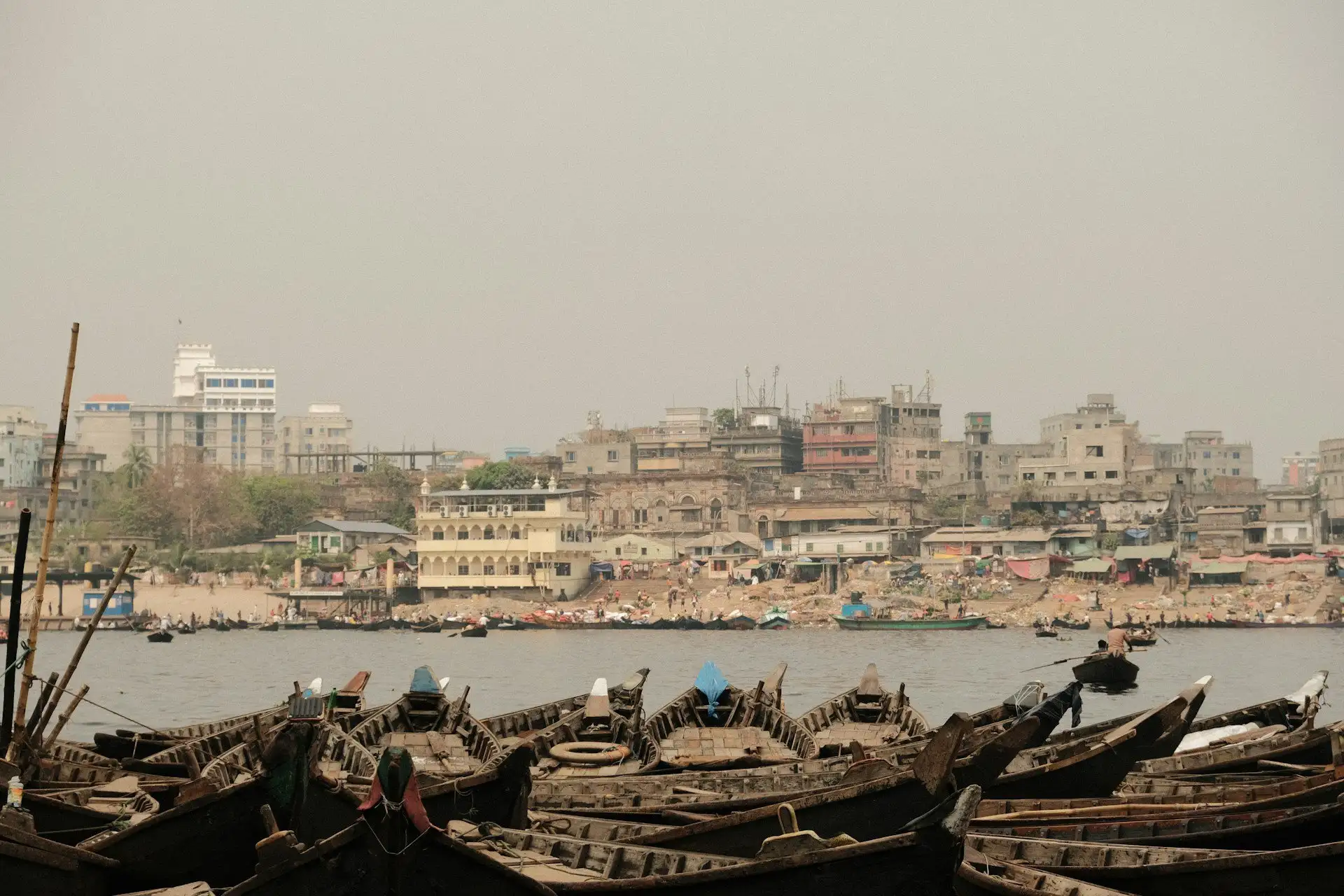
Bangladesh
One of the most densely inhabited places on earth, a country built on the silt of three great rivers, where the monsoon floods entire districts for months and the people build their houses on raised earth and wait it out. It is also where you will find the last Bengal tigers, the world's longest beach, and the most genuinely curious strangers you will meet anywhere in Asia.
What You're Actually Getting Into
Bangladesh does not make a good first impression on most people. The arrival into Hazrat Shahjalal International Airport at Dhaka brings you into one of the most chaotic traffic situations in Asia: the road from the airport to the city center is a two-lane highway that somehow accommodates twelve lanes of simultaneous movement involving CNG auto-rickshaws, trucks loaded beyond any visible limit, cycle-rickshaws threading between them, pedestrians who have concluded that the pavement is not their primary option, and the occasional cow standing in the median with the confident stillness of something that has understood the situation more clearly than everyone else. It takes an hour to cover ten kilometers and by the end of it you will either have decided this country is for you or you will not have.
The people who decide it is for them tend to come back. Bangladesh has the quality, rare and increasingly difficult to find in Asia, of genuine unexpectedness. You are not on a tourist trail here. The infrastructure for independent travel is thin: the guesthouses are functional rather than charming, the signage is in Bengali, and the number of Western visitors in any given destination outside Dhaka and Cox's Bazar is likely to be zero to one. What you get in exchange is encounters with people who are curious about you in a way that has not yet been flattened into a script by decades of tourism. A man on a ferryboat in the Sundarbans will want to know where you are from, what you think of his country, and whether you would like to share his lunch. He is not selling anything. He is just curious.
The country is also genuinely beautiful in ways that travel writing about Bangladesh almost never quite captures because they are the wrong kind of beautiful for photographs. The Bengal delta, where the Ganges, Brahmaputra, and Meghna rivers converge before emptying into the Bay of Bengal, is a landscape of flat, impossibly green fields and wide brown rivers and the specific quality of light that comes off standing water in the late afternoon. The Sundarbans, the world's largest mangrove forest and the last habitat of the Bengal tiger, are dense and primeval in a way that old-growth forests in accessible countries no longer are. The tea gardens of Srimangal in Sylhet Division, the rolling hills and sharp green rows visible for kilometers in the morning mist, look like something a landscape designer invented and a country actually grew.
The honest limitation: Bangladesh is hard work in ways that less crowded, less chaotic destinations are not. The traffic, the heat from March to June, the difficulty of getting clear information in advance, and the absence of the tourist smoothing that happens in places with more visitor infrastructure all create friction. This guide helps you navigate it, but it can't eliminate it. The visitors who find Bangladesh transformative are generally the ones who arrived not expecting it to be easy and found something else entirely.
Bangladesh at a Glance
A History Worth Knowing
Bangladesh sits where it sits because three of Asia's greatest rivers, the Ganges, the Brahmaputra, and the Meghna, converge here before reaching the Bay of Bengal. The Bengal delta they have built over millennia is among the most fertile agricultural land on earth, which meant it was always densely populated, always wealthy by the standards of subsistence agriculture, and always attractive to empires looking for somewhere productive to control. The history of Bangladesh is substantially the history of successive outside powers finding the delta irresistible and the people living in it finding ways to survive them.
The ancient kingdom of Vanga, which gave Bengal its name, left a textual record in Sanskrit epics and a physical one in the archaeological sites of the northern plains. Buddhism was the dominant religion from roughly the 3rd century BCE until the Muslim conquest in the 13th century CE, and the monastery complex of Paharpur, built during the Pala dynasty in the 8th century, is the largest Buddhist monastery south of the Himalayas and a UNESCO World Heritage Site that receives a fraction of the visitors it deserves. By the time the Palas were building Paharpur, Bengal was already the wealthiest province in the subcontinent, producing the fine muslin cloth that was traded as far as Rome.
The Mughal Bengal subah from the 16th century onward was one of the most productive provinces in the entire empire. Dhaka, called Jahangirnagar during the Mughal period, was the administrative capital and a city of palaces, mosques, and the muslin trade that made Bengal's merchants rich enough to finance Mughal military campaigns. The finest Dhaka muslin, the fabric called woven air because a sari of it could be folded to fit inside a matchbox, was the most prestigious luxury textile in the world. It was produced by skilled weavers on the banks of the Buriganga River and was valued at a higher price than silk in the markets of Europe. The British colonial policy of taxing the muslin industry, combined with the economic incentives to grow cotton for British mills instead, destroyed it within decades.
The Partition of Bengal in 1905, the reversal in 1911, and the final Partition of 1947 that created East Pakistan from the eastern part of Bengal are the political events that most directly shaped modern Bangladesh. The 1947 Partition put Bengali Muslims in a single country with the Punjabi Muslims of West Pakistan, united by religion but divided by language, culture, geography, and an economic relationship that rapidly became exploitative. The language movement of 1952, when Bangladeshi students and intellectuals took to the streets to defend their right to speak Bengali rather than Urdu as the national language, is the emotional origin of Bangladesh's national identity. The date of the first student deaths, February 21st, is now International Mother Language Day, recognized by UNESCO.
The Liberation War of 1971 is the defining event of Bangladeshi history and the knowledge that shapes every other interaction you will have in the country. On March 25, 1971, the Pakistani military launched Operation Searchlight, a systematic campaign to suppress the Bengali independence movement that began with the massacre of students, academics, and intellectuals at Dhaka University and continued for nine months. The death toll is disputed: estimates range from 300,000 to three million, with a consensus among historians settling around one to two million. Ten million refugees fled to India. The Indian military intervened in December and the Pakistani forces surrendered on December 16, 1971, a date celebrated as Victory Day. Bangladesh was born in violence and in a specific kind of grief that the country has never stopped processing.
The decades since independence have been marked by political turbulence, military coups, periods of democracy, the 1988 and 1998 floods that covered two-thirds of the country, and the emergence of the garment industry that now employs four million people and accounts for over 80 percent of export earnings. Bangladesh is also one of the countries most directly threatened by climate change: a one-meter rise in sea level would inundate 17 percent of the country's land area and displace an estimated 20 million people. The people building their houses on raised earth and waiting out the monsoon have been practicing for this for generations.
Buddhism becomes the dominant religion in the Bengal region. The Pala dynasty will later build Paharpur, the largest Buddhist monastery south of the Himalayas.
The Pala dynasty builds the Somapura Mahavihara at Paharpur: a monastery complex covering 11 hectares that becomes a center of Buddhist learning for over 400 years.
Dhaka becomes Jahangirnagar, the capital of the wealthiest Mughal province. Bengali muslin, called "woven air," is traded across the known world.
The Battle of Plassey ends Mughal Bengal. British colonial rule systematically destroys the muslin industry while extracting agricultural wealth. Two Partitions of Bengal follow in 1905 and 1947.
Students die on the streets of Dhaka defending the right to speak Bengali. February 21st becomes International Mother Language Day. The seeds of independence are planted.
Operation Searchlight begins on March 25th. One to two million people die over nine months. India intervenes in December. Pakistan surrenders on December 16th. Bangladesh is born.
The world's eighth most populous country on the world's largest delta. Garments feed the economy. The rivers threaten the land. The people remain, and are extraordinarily hospitable to visitors who come to understand them.
Top Destinations
Bangladesh's tourist infrastructure is thin and transport between destinations requires time and patience. The destinations described here are all accessible and genuinely worth the effort. The standard first-time route: Dhaka for two to three days, then either south to the Sundarbans or east to Srimangal and Sylhet, with Cox's Bazar as an optional extension from Chittagong. Two weeks covers this comfortably with time to move slowly.
Dhaka
Dhaka is one of the most densely inhabited cities on earth, with a population density that exceeds Manhattan's by a factor of several. This fact either sounds like a warning or like an invitation, depending on what kind of traveler you are. The old city, Puran Dhaka, has the highest concentration of things worth seeing: the Lalbagh Fort, an unfinished Mughal citadel whose incompleteness is part of its story; the Ahsan Manzil Pink Palace on the Buriganga River; the Sadarghat river terminal where the rocket steamers and country boats dock in a wall-to-wall density of river traffic; the narrow streets of the Hindu goldsmith neighborhood Shakhari Bazar; and the rickshaw art workshops where the painted panels on Dhaka's cycle-rickshaws are created with a folk art tradition that is uniquely Bangladeshi. Dhaka rewards the visitor who gets lost in it, which is not difficult and is generally safe.
The Sundarbans
The Sundarbans is the world's largest mangrove forest, shared between Bangladesh and India, and the last stronghold of the Bengal tiger. The Bangladeshi section covers roughly 6,000 square kilometers of tidal waterways, mudflats, and dense forest. You will almost certainly not see a tiger. The forest is thick and the tigers are actively avoiding you, which is appropriate behavior for a wild predator. What you will see is the forest itself, the silence of a place that has not been cleared or divided or managed for agriculture, and the specific wildlife that fills it: spotted deer, crocodiles on the mudflats, kingfishers in extraordinary density, Irrawaddy dolphins in the wider channels. The best access is from Mongla, where tour operators run two- and three-day boat trips into the forest. Book before you leave Dhaka.
Srimangal & Sylhet
Srimangal in Sylhet Division is the tea capital of Bangladesh and one of the most visually arresting working landscapes in South Asia. The tea gardens cover the surrounding hills in precise rows of bright green that look from above like a giant has combed them. The town itself is small and functional but the surrounding countryside, with its tea estates, bird-rich forests, and pineapple farms that produce fruit you will think about for years, is worth two to three days of slow exploration. The seven-layer tea served at Nilkantha Tea Cabin, a glass of different-density teas that stays stratified in layers of color from dark to light, is a local invention and a genuinely beautiful object. Sylhet city nearby is the commercial hub and the ancestral home of a large proportion of British Bangladeshis.
Cox's Bazar
Cox's Bazar has a 120-kilometer unbroken natural sea beach, the longest in the world by the measurement that counts it. The beach is wide, flat, and backed by low hills that turn green after the monsoon. It is also extremely popular with domestic Bangladeshi tourists, which means it is the most developed tourist destination in the country and the one with the most functional hotel infrastructure. The water is warm but the waves can be strong and rip currents are a genuine hazard: swim at beaches with visible lifeguards. The surrounding area, including the Inani Beach south of the main town with its unusual rock formations, and the boat trip to Saint Martin's Island (the only coral island in Bangladesh), are worth the extra time.
Paharpur
The Somapura Mahavihara at Paharpur is the largest Buddhist monastery south of the Himalayas and one of the most important archaeological sites in the subcontinent. Built in the 8th century during the Pala dynasty, it was a center of Buddhist learning that hosted scholars from as far as China and Tibet for over 400 years. The central shrine rises from a complex of 177 cells arranged in a square, and the terracotta plaques that line the base of the structure, over 2,000 of them, contain one of the most significant collections of early Bengali terracotta art. It is a UNESCO World Heritage Site that receives almost no foreign visitors. Finding it, which requires a journey by train and rickshaw into the northwest of the country, is part of the experience.
The Rocket Steamer
The Bangladesh Inland Water Transport Corporation runs a fleet of paddle steamers, called Rockets locally, that follow the river routes between Dhaka and various southern destinations including Khulna (the gateway to the Sundarbans). The overnight journey on a Rocket from Dhaka to Khulna takes roughly 24 hours, covers 300 kilometers of the Bengal delta's river network, and is one of the genuinely distinctive travel experiences in South Asia. The first-class cabins are small and clean. The deck is where you want to spend the daylight hours: watching the landscape of Bangladesh move past, the fishing boats and the net-drying and the children swimming in the river and the specific quality of late-afternoon light on the delta water. Book tickets at the BIWTC office in Dhaka's Sadarghat.
Chittagong Hill Tracts
The Chittagong Hill Tracts in the southeast, bordering Myanmar and India, are a mountainous and forested region that is ethnically and culturally distinct from the rest of Bangladesh. The Chakma, Marma, Tripura, and other indigenous peoples of the Hill Tracts have a complex political relationship with the Bangladeshi state following decades of conflict that ended in a partial peace agreement in 1997. Foreign visitors require a government permit to enter certain areas. The landscape of forests, rivers, and hill villages is genuinely beautiful and the cultural diversity is extraordinary by any South Asian standard. Rangamati and Kaptai Lake are the most accessible entry points. Check the current permit situation before planning.
Bagerhat
The Mosque City of Bagerhat, another UNESCO World Heritage Site, was founded in the 15th century by the Turkish general Khan Jahan Ali and contains the most remarkable concentration of early Bengali mosque architecture in existence. The Sixty Dome Mosque, the Shat Gambuj Masjid, is the largest medieval mosque in Bangladesh: 60 stone pillars support 77 domes in a structure of such assured mass and proportion that it stops visitors mid-thought. Khan Jahan Ali's tomb nearby, with its sacred pond full of turtles, is equally striking. Bagerhat is a reasonable day trip from Khulna and makes a logical pairing with the Sundarbans if you're routing through the southwest.
Culture & Etiquette
Bangladesh is a Muslim-majority country with a Bengali cultural identity that predates Islam and runs deeply alongside it. The synthesis of Islamic practice with the Bengali literary, musical, and artistic tradition produces a cultural texture that is distinct from both Pakistan and India, which is something Bangladeshis are quietly but firmly aware of. The country's founding poet Rabindranath Tagore, the Nobel Prize-winning Bengali literary giant, provides the national anthem. The Liberation War's memory infuses national identity with a seriousness that occasionally surprises visitors expecting something more like the lighter atmospheres of Thailand or Bali.
Bangladeshis are among the most hospitable people in South Asia and the most genuinely curious about foreign visitors. The attention you receive, especially outside the tourist infrastructure of Dhaka and Cox's Bazar, can be intense by Western standards: being surrounded by a curious group of twenty people within minutes of arriving in a small town is a normal experience. It is almost always friendly. The correct response is patient engagement: answer questions, show interest in return, and accept that your presence is genuinely notable in a country that sees very few Western tourists.
Bangladesh is socially conservative and modesty in dress is expected and respected across the country. Women should cover shoulders and keep legs covered below the knee. Men should avoid shorts outside beach areas and resort hotels. The standard for women is a shalwar kameez or similar loose covering. Carrying a scarf or light layer adds versatility.
Shoes off at mosque entrances without exception. At homes, the row of shoes outside the door is the universal signal. At archaeological and heritage sites, follow the posted guidance. The practice is universal and removing shoes without being asked is always appreciated.
Eat, pass food and money, and greet with the right hand. The left hand is considered unclean in Islamic and South Asian tradition broadly. This is especially important when eating with your hands, which you will do at traditional Bangladeshi meals and which is the correct method.
Chai offered by a shopkeeper, food from a family on a train, an invitation to sit and talk: accept with genuine grace. Bangladesh's hospitality is not performative. Refusing without a specific reason is rude in a way that may not be immediately apparent but is felt.
Dhonnobad (thank you), assalamu alaikum (Islamic greeting), bhalo achi (I am well, in response to how are you), and sundor (beautiful) will generate smiles wherever you use them. Bangla is a tonal and phonetically distinctive language but the attempt is always appreciated more than the accuracy.
Especially women in traditional dress, people at prayer, and children in rural areas. The curiosity about you does not automatically translate to willingness to be photographed. A gesture toward your camera and a questioning expression is understood everywhere. Accept refusals without pushing. Women foreign travelers generally find it easier to photograph local women than men do.
Alcohol is technically legal in Bangladesh for non-Muslims and available in a small number of licensed hotel bars in Dhaka and Cox's Bazar. It is not available publicly. Drinking in public or in unlicensed settings is inappropriate and illegal. The licensed hotel bars are the only appropriate context.
Public displays of affection between couples are inappropriate throughout Bangladesh. Hand-holding is acceptable in tourist areas but anything beyond it draws attention and disapproval. The social norm here is significantly more conservative than in much of South and Southeast Asia.
Bangladeshi politics is intense and the Digital Security Act has been used to prosecute people for social media posts perceived as critical of the government. Express political opinions with caution in any public context. The 2024 student protests that led to political change make this a particularly sensitive period.
Certain areas of the Chittagong Hill Tracts require government permits for foreign visitors and attempting to enter them without permits creates problems for you and for local people who may be held responsible. Check current permit requirements before any Hill Tracts travel.
Baul Music
The Baul tradition of Bengali folk music, practiced by a community of wandering mystic musicians who carry a philosophy of love and spiritual seeking expressed through song, is one of the most distinctive musical forms in South Asia. Bauls travel between villages performing songs that are simultaneously devotional and philosophical, drawing on Sufi Islam and Hindu Vaishnavism in a synthesis that is distinctly Bengali. The annual Lalon Fakir festival in Kushtia, at the shrine of the 19th-century Baul philosopher-saint Lalon Shah, is one of Bangladesh's most extraordinary cultural events. UNESCO has recognized Baul music as part of the world's intangible cultural heritage.
Rickshaw Art
The cycle-rickshaws of Dhaka carry folk art panels painted in vivid colors that form a visual language unique to Bangladesh. The panels depict film stars, rural landscapes, tigers, flowers, and the faces of departed loved ones, in a style that combines Mughal miniature traditions with Bollywood poster art and something that is entirely its own. The rickshaw art workshops in Puran Dhaka are open to visitors and the painters, who are generally young men from rural areas who have learned the trade in the city, will show you the process and sometimes let you try. The art is functional: rickshaw owners commission new panels regularly and there is a continuous production that has run since the 1950s.
Pohela Boishakh
The Bengali New Year, Pohela Boishakh, falls on April 14th and is the most important secular festival in Bangladesh: a celebration of Bengali cultural identity that cuts across religious lines and is observed by both Muslim and Hindu Bangladeshis. The streets of Dhaka fill with people in traditional white-and-red clothing, music performances run from early morning, and the Ramna Park celebration around the Chayanaut cultural organization's dawn concert is one of the great public events in South Asia. The date is in April, which is the hottest and most uncomfortable month for foreign visitors, but the festival is worth planning around.
River Life
Bangladesh has over 700 rivers and water has shaped everything: the architecture of the delta, the agricultural rhythms, the transport network, and the specific psychological quality of a country that knows it is living on borrowed land. The river markets that operate on boats, the homes built on earth platforms above flood level, the children swimming in the monsoon waters that have covered what was a road two months earlier, and the ferry crossings where the boatman navigates by memory through channels that change course every season: this is not background to Bangladesh, it is the country itself. Spend time on water and you will understand it better than any amount of time on land.
Food & Drink
Bangladeshi food is Bengali food: a cuisine built on fish, rice, mustard oil, and the specific spice profile of the Bengal delta, which differs from Indian Bengali food in ways that are subtle to the uninitiated and significant to anyone who eats both regularly. The mustard, both the oil and the seed used whole and ground in pastes, gives Bangladeshi cooking its distinctive sharp-warm base note that other South Asian cuisines don't quite replicate. The rice is aromatic, often of varieties local to the delta that don't travel well. The fish is fresh from the river or the sea, and the cooking tradition of drying, smoking, and fermenting fish produces condiments and secondary dishes that are an acquired taste to non-Bangladeshis and a source of intense homesickness to the diaspora.
Alcohol is not readily available in Bangladesh. The country has a small number of licensed hotel bars in Dhaka and a few other major cities, available primarily to non-Muslims and foreigners. Locally produced beverages are limited. The drinks culture runs on tea, specifically the strong, sweet milk tea called cha that is available everywhere and costs almost nothing, and on fresh fruit drinks and coconut water in season.
Hilsa Fish
The national fish and the national obsession. Ilish, as it's called in Bangla, is an oily, intensely flavored fish that migrates from the Bay of Bengal into the delta rivers to spawn, and the catching of the first hilsa of the season in August is a cultural event with its own rituals. The fish is eaten in dozens of ways: fried simply in mustard oil, steamed in a banana leaf, cooked in a yoghurt curry, or smoked over straw in a technique specific to the riverbank communities. A Bangladeshi who has lived abroad for twenty years and comes home will list hilsa as what they missed most. It is not available outside Bangladesh in the form it takes here.
Rice & Dal
The foundation of every meal: fragrant rice with dal (lentil soup), accompanied by vegetable dishes, fish curry, and for special occasions meat. The rice varieties grown in the Bengal delta, particularly the aromatic kataribhog and the short-grained varieties cooked in festive cooking, have a sweetness and texture that commodity rice doesn't approach. Dal in a Bangladeshi home kitchen, made with masoor or chana dal cooked with mustard seeds, turmeric, dried chili, and a finishing pour of mustard oil, is a dish of considerable complexity achieved with minimal ingredients.
Mustard Fish Curry
The quintessential Bangladeshi cooking technique: fresh river fish, most commonly rui (rohu) or katla, cooked in a sauce of ground mustard paste, turmeric, and green chili. The mustard paste provides a sharp, slightly bitter heat that is completely distinct from the chili heat of other South Asian fish curries. The dish is made in seconds by a cook who has done it thousands of times and the result is one of the great everyday foods in the world, eaten at lunch across the entire delta region every day of the year.
Beef & Biryani
Bangladesh is a Muslim-majority country and beef is the prestige meat: at Eid al-Adha, the streets of Dhaka fill with animals being prepared for slaughter and the smell of cooking meat lasts for days. The beef biryani of Dhaka, specifically the Old Dhaka style made with fragrant rice, tender beef, and the specific spicing that has been refined in the Mughal city's cooking tradition over centuries, is among the best biryani in the subcontinent. Haji Biriyani in Puran Dhaka, operating since 1939 and serving exclusively for lunch, is the benchmark. The queue forms before it opens.
Street Food
Dhaka's street food is diverse and excellent: jhalmuri, the puffed rice snack mixed with mustard oil, green chili, onion, and lemon that is available from pushcarts throughout the city; fuchka, the crispy hollow shells filled with spiced water and chickpeas that are the Bengali equivalent of pani puri; singara and samosa; and the chhal kebab rolls that are the Bangladeshi fast food tradition. In Srimangal, the fruit stalls sell pineapple and jackfruit that make most fruit sold elsewhere irrelevant. In Cox's Bazar, the dried fish market is an experience for the senses that requires both genuine curiosity and a willingness to smell something very strong.
Cha & Seven-Layer Tea
Bangladesh runs on cha: strong, sweet, milky tea in small glasses that costs 5 to 10 taka (5 to 10 US cents) at any roadside stall. It is available everywhere and at all hours and is the correct social beverage for any situation. The seven-layer tea at Nilkantha Tea Cabin in Srimangal, seven different teas of varying density and color kept separate in the glass by careful pouring technique, is an entirely different and genuinely beautiful object that has achieved international attention for something that is essentially a trick of physics applied to tea.
When to Go
Bangladesh has three distinct seasons that each offer a genuinely different experience of the country. The winter from November to February is the standard visitor window: cool, dry, and clear. The summer from March to June is hot and then extremely hot before the monsoon breaks. The monsoon from June to October transforms the landscape in ways that are simultaneously beautiful and logistically challenging. Understanding what each season offers will help you decide which version of Bangladesh you want to see.
Winter
Nov – FebThe most comfortable window for most travelers. Temperatures of 12–25°C, low humidity, and clear skies make the archaeological sites, tea gardens, and outdoor activities genuinely pleasant. The Sundarbans boat trips are most comfortable in this period. Festival season includes Victory Day in December and the Bishwa Ijtema religious gathering near Dhaka in January.
Late Autumn
Oct – NovThe monsoon retreats in October and the country is at its greenest and most lush. River levels are still high and boat travel is excellent. The hilsa fishing season is ending. Temperatures are warm but manageable. Pohela Boishakh (Bengali New Year) falls in mid-April — the cultural event of the year, worth planning around despite the heat.
Monsoon
Jun – SepThe monsoon is heavy and road travel can be disrupted. But the landscape transforms into something extraordinary: the delta floods, the rivers swell to their full width, the tea gardens shine, and the country looks as it has looked for millennia. Boat travel is at its best. Not recommended for first-time visitors, genuinely rewarding for those who understand what they're entering.
Pre-Monsoon
Mar – MayMarch is manageable but warming fast. April and May are extreme: 38–42°C in the lowlands, high humidity, and a dusty haze before the monsoon breaks. Pohela Boishakh on April 14th is worth experiencing despite the heat. Everything else about April and May actively discourages outdoor activity. Even Bangladeshis find May difficult.
Trip Planning
Two weeks is a reasonable minimum for a meaningful Bangladesh trip: three days in Dhaka, two days on the Rocket steamer and Sundarbans, two days at Bagerhat, and three days in Srimangal and Sylhet covers the core with time to breathe. Adding Cox's Bazar extends it to three weeks. Paharpur requires a specific detour that adds two to three days to any itinerary and is worth it for the right kind of traveler.
Bangladesh rewards pre-planning more than most destinations in South Asia. The Rocket steamer has limited first-class cabins that book out quickly in the winter season. Sundarbans tours need to be arranged in advance through operators in Dhaka or Khulna. The Chittagong Hill Tracts permits need to be applied for before you travel. None of this is impossible but arriving without having done it creates frustration that advance planning eliminates.
Dhaka
Day one: Puran Dhaka on foot. Sadarghat river terminal in the morning, Lalbagh Fort mid-morning, Shakhari Bazar Hindu goldsmith neighborhood, lunch at a Puran Dhaka restaurant for beef biryani or kacchi. Ahsan Manzil Pink Palace in the afternoon, Liberation War Museum before it closes. Day two: Bashundhara City or New Market area if you want contemporary Dhaka, or a second day in Puran Dhaka at the rickshaw art workshops.
Srimangal
Train from Dhaka to Srimangal (3 hours). Two nights in the tea country. Morning walk through a tea estate (arrange with your guesthouse). Seven-layer tea at Nilkantha Tea Cabin. Lawachara National Park birdwatching. Afternoon visit to the pineapple farms. The specific quality of the light and the silence after Dhaka is worth staying for.
Sylhet
Bus or train from Srimangal to Sylhet (1.5 hours). The Hazrat Shahjalal shrine is the main religious site and worth visiting for the atmosphere rather than the architecture. The Osmani Museum gives context for the Liberation War in this region. The Sylhet food scene, particularly the satay-style grills and the biryani variants, is different from Dhaka's. Fly home from Osmani International Airport or return to Dhaka.
Dhaka
Three full days in Dhaka: Puran Dhaka in depth (Sadarghat, Lalbagh Fort, Ahsan Manzil, rickshaw workshops, the narrow lanes of Shakhari and Tanti Bazaars), the Liberation War Museum, the National Museum at Shahbag, and one evening in the contemporary city at Gulshan or Dhanmondi to understand the Bangladesh that exists alongside the old one.
Rocket Steamer to Khulna
Board the evening Rocket from Sadarghat. Spend the first full day on the river watching the delta landscape move past the deck. Arrive Khulna on day five. Spend day five at the Sixty Dome Mosque at Bagerhat. Day six: depart on the pre-arranged Sundarbans boat tour into the mangrove forest.
Sundarbans
Two nights on the boat in the Sundarbans. Dawn canoe trips into the narrow channels. Ranger-guided walks to the watch towers. The silence of the forest at night. Return to Khulna on day nine and fly or bus to Dhaka.
Srimangal & Sylhet
Train to Srimangal for three nights in the tea country. Sylhet for two nights. Fly home from Osmani International or return to Dhaka for the international connection. The contrast between the green silence of Srimangal and the chaos of Dhaka is part of what makes Bangladesh coherent as a travel experience.
Dhaka in Depth
Four days to properly understand Dhaka: Puran Dhaka, the Liberation War Museum, the National Museum, a day trip to Sonargaon (the ancient Mughal capital 30 kilometers east, with its Panam City abandoned merchant houses), and one evening at Hatirjheel, the lake park in the middle of modern Dhaka that is where the city goes in the evenings.
Paharpur
Train northwest to Rajshahi, then transport to Paharpur. Two nights in the area to see the monastery ruins properly: once in the afternoon light when the terracotta panels are most readable, once in the morning when the mist is still in the surrounding fields. The journey itself, through the flat agricultural plains of northwest Bangladesh, is worth the time.
Rocket Steamer & Sundarbans
The full river experience: overnight Rocket from Dhaka to Khulna, Bagerhat's Sixty Dome Mosque, and a two-night Sundarbans boat trip. Return to Khulna and take the train to Dhaka for the onward connection.
Srimangal, Sylhet & Cox's Bazar
Three nights in the Srimangal tea country. Two nights in Sylhet. Then the flight or bus south to Chittagong and onward to Cox's Bazar for three nights: Laboni Beach sunrise, the Inani rock formations, and if timing and seas permit, the ferry to Saint Martin's Island for a night. Fly home from Cox's Bazar or Chittagong.
Vaccinations
Hepatitis A and Typhoid are strongly recommended. Cholera vaccination is advisable for those traveling during or after monsoon season. Rabies pre-exposure for rural travel. Malaria prophylaxis for the Chittagong Hill Tracts and some eastern border areas. Japanese Encephalitis for extended rural stays. Consult a travel medicine clinic six weeks before departure.
Full vaccine info →Connectivity
Grameenphone (GP) and Robi are the most reliable operators. Tourist SIMs are available at the airport on arrival. 4G coverage is good in Dhaka and the main cities, patchy in rural areas, and minimal in the Sundarbans and Hill Tracts. Download offline maps before leaving any city. A local SIM is far cheaper than roaming and essential for navigating Dhaka.
Get Bangladesh eSIM →Power & Plugs
Bangladesh uses Type C and G plugs at 220V. Load-shedding (power cuts) still occurs in some parts of the country, particularly outside the major cities. A power bank is genuinely useful. Most mid-range hotels have generators. Rural guesthouses may have power only in the evenings.
Language
Bangla (Bengali) is the national language. English is spoken in the tourism sector, by educated Bangladeshis in the cities, and by people who have family in the UK. Outside Dhaka and Cox's Bazar, English coverage drops significantly. Google Translate with Bengali downloaded offline is essential. Learning to read Bengali script for basic navigation is not realistic for a short visit but the camera translation feature works well for signs and menus.
Travel Insurance
Essential. Medical facilities in Dhaka are reasonable at the better private hospitals but limited elsewhere. In a serious medical emergency outside the capital, evacuation to Dhaka or to India or Thailand is the realistic option and requires insurance coverage. Ensure your policy covers natural disaster disruption, which is a real risk during monsoon season.
Health Precautions
Don't drink tap water anywhere. Bottled water is cheap and available everywhere. Stomach issues are common for first-time visitors: pack oral rehydration sachets and a prescribed antibiotic course from your doctor before departure. The food safety varies enormously between restaurants: eat at places where the food is cooked fresh and hot in front of you. Street food from busy stalls is generally safer than buffet food that has been sitting out.
Transport in Bangladesh
Bangladesh's transport system requires patience and flexibility that not every traveler is willing to bring. The roads are frequently congested, poorly maintained outside the main highways, and subject to flooding during the monsoon. The trains are slow but reliable and often more comfortable than the road alternative for longer journeys. The river ferries are slower still and genuinely wonderful. The domestic flight network is limited. In Dhaka, Uber and Pathao are the sanity-preserving options for getting anywhere without the CNG auto-rickshaw fare negotiation that otherwise defines city movement.
Train
৳150–600/routeThe best overland option for longer journeys. The Dhaka to Srimangal train (Upaban Express) takes about 3 hours and is comfortable. The Dhaka to Sylhet Parabat Express is 6 hours. Book at Dhaka's Kamalapur Railway Station or through the Bangladesh Railway website. First class (Shuvon Chair) is the recommended option: air-conditioned and significantly more comfortable than lower classes.
Rocket Steamer
৳700–1,500 first classThe BIWTC paddle steamers run between Dhaka Sadarghat and Khulna (and other southern destinations) on a schedule that changes seasonally. The overnight journey takes about 24 hours in first class. Book at Sadarghat's BIWTC office in advance: first-class cabins are limited and fill quickly in winter season. The journey is the destination.
Uber & Pathao
৳100–400/tripBoth apps work in Dhaka and several other major cities. Fixed prices, no negotiation, air-conditioned cars. Pathao also offers motorbike taxis that navigate Dhaka's traffic significantly faster than any four-wheeled option. Essential for city movement. Download both before you land.
CNG Auto-Rickshaw
Negotiate before boardingThe compressed natural gas three-wheelers are ubiquitous outside Dhaka and the standard local transport in smaller cities. Negotiate the fare before getting in: the opening price for foreigners is typically two to three times the local rate. Asking a local for a reference fare before negotiating gives you a baseline. In Dhaka, use Uber instead.
Domestic Flights
৳3,000–6,000/routeBiman Bangladesh Airlines and US-Bangla operate domestic routes. Dhaka to Cox's Bazar is the most useful (1 hour versus 10 hours by road). Dhaka to Sylhet (45 minutes versus 6 hours by train) and Dhaka to Chittagong (45 minutes versus 5 hours by road) are also time-effective. Schedules are variable and delays are common.
Long-Distance Bus
৳400–1,200/routeAC sleeper buses connect Dhaka to Cox's Bazar, Chittagong, and other major cities. Shyamoli and Green Line are the most reliable operators. Journey times are long (Dhaka to Cox's Bazar is 9 to 12 hours depending on traffic) but cheaper than flying. Book through operators or at bus terminals rather than from street touts.
Cycle-Rickshaw
৳30–100/tripThe cycle-rickshaw is the correct transport for Puran Dhaka, Bagerhat, and anywhere else where the streets are too narrow for a car and the distances are too far to walk. Negotiate in advance. The painted panels that decorate the rear hood are among the most distinctive folk art forms in Asia. Hiring one for a half-day in Puran Dhaka costs almost nothing and covers everything.
Local Ferries & Country Boats
৳20–200/crossingThe network of local ferries and wooden country boats connecting river communities is the transport infrastructure that the road network doesn't reach. In the Sundarbans, the only access is by boat. In the Sylhet Division wetlands called the haors, boats are the only transport during monsoon season. The country boats are exactly what they sound like: worn and functional and completely authentic.
Dhaka has some of the worst traffic in the world and it is not improving at any speed that will help your itinerary. A journey of five kilometers in central Dhaka can take 45 minutes at 9am or 20 minutes at 7am or 90 minutes at 6pm. The practical solutions are: leave early, use the Dhaka Metro Rail where it covers your route (it does not cover Puran Dhaka at time of writing), use Pathao motorbike for anything that doesn't require luggage, and build more time into every city movement than you think you need. The traffic is not personal. It is not a problem to be solved. It is the condition of being in Dhaka and the people who have been navigating it for forty years treat it with a philosophical equanimity that is worth borrowing.
Accommodation in Bangladesh
Bangladesh's accommodation sector ranges from genuinely excellent in Dhaka's upscale hotels to very basic in rural guesthouses that are clean and functional but no more. The gap between the top and the bottom is wide. The key insight for mid-range travelers: Dhaka has a strong international hotel sector that competes with the rest of South Asia for quality and price. Outside Dhaka, expect a significant step down in facilities, which is fine if you've adjusted your expectations accordingly and not fine if you haven't.
International Hotel (Dhaka)
$80–250/nightThe Pan Pacific Sonargaon Dhaka and the Radisson Blu are the two established five-star properties. Both have reliable infrastructure, restaurants, and the kind of functional luxury that serves business travelers and provides a comfortable base for exploring the city. Gulshan and Banani areas have good concentrations of international-standard mid-range hotels.
Guesthouse
$15–40/nightGuest houses in Srimangal, Cox's Bazar, and the Sylhet area can be genuinely charming: small family-run properties surrounded by tea gardens or hills, with home-cooked meals and hosts who will organize local excursions. The quality is variable: read recent reviews carefully and aim for properties that specifically mention Western guests in their booking descriptions.
Sundarbans Boat
$50–120/person/nightFor the Sundarbans, accommodation and transport are the same thing: a live-aboard boat that moves between sites while you sleep. The quality of operators varies significantly. Look for boats that specify wildlife guide inclusion, ranger-guided walks, and a safety equipment checklist. The overnight boat is the only way to access the deeper forest areas that day trips from the edge don't reach.
Beach Resort (Cox's Bazar)
$30–120/nightCox's Bazar has Bangladesh's best hotel infrastructure outside Dhaka: a range from budget guesthouses near the beach to mid-range hotels with sea views and functional amenities. The Royal Tulip Sea Pearl Beach Resort and the Sayeman Beach Resort are the most established higher-end options. Book well in advance for December and January weekends when domestic tourism peaks.
Budget Planning
Bangladesh is one of the most affordable countries in Asia and the affordability is real rather than relative: a full meal at a local restaurant costs 100 to 200 taka (under $2), a CNG auto-rickshaw across a city costs 50 to 150 taka, a guesthouse bed outside Dhaka costs 500 to 1,500 taka. The money that does go somewhere is on international hotel accommodation in Dhaka, the Sundarbans boat tour (which is not cheap given what it delivers), domestic flights, and the transport time that Bangladesh's distances require. Budget for those specifically and the rest will surprise you with how little it costs.
- Budget guesthouse or basic hotel
- Local restaurants and street food
- Train and CNG auto-rickshaw transport
- Free or very cheap site entry
- Cha at 10 taka all day
- Mid-range hotel or good guesthouse
- Mix of local and better restaurants
- Uber and occasional domestic flights
- Sundarbans boat tour (amortized)
- Guided experiences and rickshaw hire
- Five-star hotel in Dhaka
- Restaurant dining for every meal
- Domestic flights for all long journeys
- Private car and guide for heritage sites
- Premium Sundarbans operator
Quick Reference Prices
Visa & Entry
Most Western passport holders can obtain a visa on arrival at Dhaka's Hazrat Shahjalal International Airport for USD 50. The visa is valid for 30 days and can be extended at the Department of Immigration in Dhaka for additional fees. The process at the airport is generally straightforward: there is a designated visa on arrival counter before the main immigration queues. The more convenient option is to apply for an e-visa online at bangladeshevisa.gov.bd before departure, which avoids the arrival queue and provides more certainty.
Certain nationalities require a pre-arranged visa through a Bangladesh embassy or high commission. Citizens of India, Pakistan, and some other countries have specific bilateral arrangements. Check the current list at the Bangladesh Department of Immigration and Passports website before booking flights. The visa situation has been subject to periodic changes and current information from the official source is more reliable than travel guides written some time before your departure.
Available for most Western passport holders. USD 50 at the airport or apply online at bangladeshevisa.gov.bd before departure. The e-visa is recommended: it avoids the airport queue and provides documentation before you fly.
Family Travel & Pets
Bangladesh is manageable for families with older children who can handle the sensory intensity, the heat, and the logistical unpredictability that the country involves. It is not a destination for families with very young children unless the parents have specific experience with challenging travel environments. The rewards for families who do bring older children are significant: Bangladesh is a place where children are received with genuine warmth, where the natural world from the Sundarbans to the tea gardens provides experiences that cannot be replicated elsewhere, and where the history, specifically the Liberation War story, is one of the most important things a child can understand about the 20th century.
Srimangal for Families
The tea gardens are the gentlest entry point to Bangladesh for families. The guesthouses are quiet, the air is cooler than the rest of the country, the tea estate walks are flat and accessible, and the seven-layer tea ceremony at Nilkantha is something children remember. The birdwatching in Lawachara National Park works for children who have been given binoculars and a basic field guide the morning before.
Sundarbans Boat Trip
A two-night Sundarbans boat trip is one of the most distinctive family experiences in South Asia for children aged ten and up. The forest, the river wildlife, the dawn canoe trips into the narrow channels, and the persistent possibility of seeing a tiger (which almost certainly won't materialize) provide a sustained sense of genuine wildness that manufactured wildlife experiences cannot replicate. The boat is contained and safe. The ranger walks require basic fitness and attentiveness.
Cox's Bazar
Bangladesh's best family beach destination has calm sections appropriate for children, food that is broadly accessible including fresh seafood, and enough hotel infrastructure to make a family visit logistically manageable. The beach itself is spectacular in scale. The water safety issue, specifically rip currents and waves, requires supervision and limiting swimming to sections with visible lifeguard coverage.
The Rocket Steamer
A day on the Rocket steamer is one of the most genuinely educational experiences you can give an older child in South Asia: the scale of the delta, the density of life on the river, the fishing boats and the net-drying and the river markets, all visible from the deck in real time. First-class cabins are contained and safe for children. The journey itself teaches more about Bangladesh's geography than any classroom could.
Liberation War Museum
For teenagers specifically, the Liberation War Museum in Dhaka is one of the most important museum visits available in South Asia. The documentation of the 1971 genocide, presented with the care and honesty that this subject requires, is a significant experience for young people who are old enough to process difficult history. It is not for young children. For teenagers, it is essential.
Food for Families
Rice, dal, and mild fish curry are available everywhere and are broadly accessible to children who will try things. Chicken dishes are common and generally mild. The street food issue for children is food safety: stick to food cooked hot in front of you and avoid raw salads and unpeeled fruit at roadside stalls. Most mid-range restaurants in Dhaka have menus that can accommodate non-adventurous eaters. Carry oral rehydration sachets as a precaution.
Traveling with Pets
Bringing pets to Bangladesh is technically possible but practically not recommended for a tourist visit. Dogs and cats require an import permit from the Department of Livestock Services, a health certificate from an accredited veterinarian issued within 10 days of travel, current rabies vaccination, and microchipping to ISO standard. The documentation process is bureaucratically complex and Bangladesh's administrative infrastructure for processing pet imports is not streamlined.
Rabies is present in Bangladesh: the country has one of the higher rates of human rabies exposure in the world, primarily from dog bites. If you or anyone in your group is bitten or scratched by any animal in Bangladesh, including street dogs, seek post-exposure treatment immediately. Do not wait for symptoms. The treatment is available at the Infectious Disease Hospital in Dhaka and at major city hospitals. This warning applies to all travelers, not only those with pets.
Pet-friendly accommodation in Bangladesh is essentially nonexistent. Street dogs are common throughout the country. The practical recommendation for pet owners is to leave animals at home.
Safety in Bangladesh
Bangladesh is generally safe for tourists by South Asian standards. Violent crime targeting foreigners is rare. The most significant risks are traffic, political demonstrations that can escalate without warning, health, and the natural hazards of the delta environment. Understanding each of these specifically removes most of the anxiety that general safety warnings generate.
General Safety
Tourist areas and the major cities are generally safe. Petty theft (bag snatching, pickpocketing) exists in crowded areas of Dhaka. Violent crime against tourists is uncommon. The overwhelming majority of Bangladeshis you encounter will be genuinely curious and welcoming rather than threatening.
Solo Women
Solo female travel in Bangladesh requires more active management than in most of Southeast Asia. Unwanted attention is common in public spaces, particularly in smaller cities and rural areas. Dress conservatively throughout. Travel with a companion where possible, especially for evening movement. Cox's Bazar and Dhaka's tourist areas are more comfortable than smaller towns.
Traffic
Road traffic injuries are a leading cause of tourist problems in Bangladesh. The roads are chaotic, pedestrian crossing is genuinely dangerous, and accidents involving cycle-rickshaws, CNGs, and buses are common. Use crossings carefully, give traffic full attention as a pedestrian, and do not assume any vehicle is going to stop for you. Uber reduces the risk of road accidents compared to less reputable transport options.
Political Demonstrations
Bangladesh has a history of political demonstrations that can become violent with limited warning. Student protests, particularly those linked to political opposition activities, have resulted in significant unrest in recent years. The 2024 protests that resulted in political change are recent context. Avoid any public gatherings, demonstrations, or crowds that appear politically motivated. Monitor local news through BBC or the Daily Star Bangladesh.
Natural Hazards
Bangladesh is a flood-prone delta. Cyclones affecting the coastal regions including Cox's Bazar are a seasonal risk. The monsoon creates genuine infrastructure challenges: roads flood, rivers rise, and transport disruptions are common from June to September. Monitor weather alerts and be prepared for plans to change if you travel during the monsoon season.
Healthcare
Private hospitals in Dhaka (Square Hospital, United Hospital, and Labaid Hospital) are the best medical facilities in the country and adequate for most needs. Outside Dhaka, medical facilities drop significantly in quality. For serious emergencies outside the capital, evacuation to Dhaka is the priority. Travel insurance with full medical and evacuation coverage is essential.
Emergency Information
Your Embassy in Dhaka
Most major Western embassies have a physical presence in Dhaka, concentrated in the Gulshan and Baridhara diplomatic zone.
Book Your Bangladesh Trip
Everything in one place. These are services worth actually using.
The Country That Keeps Coming Back
The travelers who go to Bangladesh once tend to either never return or never stop returning. The ones who don't come back generally went expecting something other than what Bangladesh is: a country that is difficult in ways that are real and not romantic, that does not smooth itself for visitors, and that offers in exchange an authenticity of encounter that places which have been smoothed cannot provide. The ones who keep returning describe the same experience: a first trip that was hard and extraordinary in roughly equal measure, and a flight home on which they realized that the country had done something to their understanding of what travel is for.
The Bangladeshis have a word, adda, that translates approximately as a leisurely, expansive conversation between friends: not a meeting, not small talk, but the kind of prolonged, ranging, argumentative, affectionate exchange that can go on for hours over tea and cover everything from politics to poetry to last night's cricket match. It is a practice that the culture takes seriously as a thing of value in itself, not a means to another end. The traveler who has the patience for adda, who can sit with a stranger on a ferry deck or a tea garden bench and let the conversation go where it goes for as long as it goes, will find Bangladesh one of the most rewarding places in Asia to be. The country is made of water and silt and language and the specific human warmth that comes from 170 million people living very close together and learning, across centuries, how to make it work.