
A small city built around one very large reason to visit
Everything in Siem Reap orients toward Angkor, the way every street in a pilgrimage town points at the shrine. The city itself is compact and low-rise, a river running through its center, and it has absorbed two decades of rapid tourism growth without losing an underlying calm once you're a street or two off the main strip. Mornings start early here, most visitors are up before dawn at least once for a sunrise temple run, and the city rewards that rhythm with cooler air and a version of Angkor that midday visitors never see.
What's changed in the last five years is the airport and the infrastructure around it: a new international terminal 50km out, a wider range of hotels from serious luxury to excellent hostels, and a restaurant scene, led by places like Cuisine Wat Damnak, that now draws food travelers who'd otherwise skip Cambodia entirely. None of this has diluted the core experience. Angkor Wat at 5:30am is still one of the most genuinely moving things you can see in Southeast Asia.
The honest complications
The temples draw real crowds, particularly at Angkor Wat sunrise and at Ta Prohm's most photographed tree-root corner, in the December-February peak season; arriving at opening time or building in flexibility helps more than any specific trick. Tuk-tuk touts and unofficial "guides" work the temple entrances and can be persistent; a firm, friendly no works fine. The heat outside the November-February window is serious, especially April and May, and Angkor's temples have very little shade between them. None of this changes the basic verdict: it's worth the early alarms and the heat.
Four areas, all within a short tuk-tuk of each other
Siem Reap is small enough that no choice of base is a bad one, everything worth reaching is a $2-3 tuk-tuk ride away, but the four areas have distinct personalities.
Old Market & Pub Street
The tourist heart of the city: the covered Old Market (Phsar Chas) for souvenirs and produce, and Pub Street's bars, night market stalls and $2 draft-beer signs running until late. Good for short, social stays where you want to walk everywhere; less good for early sunrise wake-ups if your room faces the street.
Kandal Village
A pocket of design-forward cafes, tailors and concept stores a short walk from the Old Market, widely considered the city's most stylish few blocks. Quieter than Pub Street after dark, with some of the better coffee in Siem Reap.
Wat Bo
Named for one of the city's oldest pagodas, Wat Bo sits just across the river from the Old Market: close enough to walk in on a quiet morning, far enough to sleep through the night undisturbed. The area has become a genuine dining destination in its own right, and for a first visit this is the base that balances atmosphere and quiet best.
Taphul Village
A more residential strip northwest of the center with a growing cluster of guesthouses and small hotels at lower prices than Kandal Village or Wat Bo. A 10-15 minute tuk-tuk from the Old Market rather than a walk, but noticeably cheaper for the same standard of room.
From $6 dorm beds to some of Asia's most celebrated hotels
Siem Reap's accommodation range is unusually wide for a city this size, a reflection of two decades of tourism investment stacked on top of a genuinely excellent backpacker infrastructure. These picks cover every budget, and each one earns its place.
At the very top, Amansara, built around King Sihanouk's former guesthouse, is one of the most exclusive small hotels in Asia, from roughly $1,600 a night, with a design language that's deliberately understated rather than showy. Raffles Grand Hotel d'Angkor (from around $200-300, higher for suites) has anchored the city since the French colonial era, all white colonnades and a bar that's been serving the Airavata cocktail since long before Angkor was back on the map, and Park Hyatt Siem Reap brings a sleeker, more contemporary take on colonial architecture right in the city center.
In the upper-boutique bracket, Jaya House River Park (from around $250) is a favorite for its free bicycles, real coffee program and a rooftop pool with genuine Angkor-trip-planning staff, while Viroth's Hotel (from around $130) in Wat Bo pairs mid-century-modern design with one of the better small pools in the neighbourhood.
At the budget end, Mad Monkey Siem Reap, five minutes from Pub Street with its own pool and a reliably social atmosphere, and Onederz Siem Reap, three minutes from Pub Street with four separate pools including a 26-meter main pool, are the two hostels that come up again and again; dorm beds run $5-15, private rooms $15-35.
A food scene that has quietly become a reason to visit on its own
Siem Reap's dining runs from $1 noodle stalls to a genuinely internationally recognized tasting-menu restaurant, often within a few blocks of each other. Several of the best kitchens also double as social enterprises training disadvantaged Cambodian youth, which makes eating well here feel like less of a compromise than it can elsewhere.
Cuisine Wat Damnak
Cambodia's most awarded restaurant, and the first to appear on Asia's 50 Best Restaurants list. Chef Joannès Rivière's five-to-six-course set menus rework Khmer ingredients and technique into something closer to French fine dining without losing the underlying flavors; menus change fortnightly based on the market. Reserve at least a few days ahead in high season.
Chanrey Tree
A stylish riverside dining room doing refined, traditional Khmer cooking: the amok served in a coconut shell is the benchmark version many visitors compare every other amok to afterward, and the Kampot pepper steak rivals the best versions found on the coast itself.
Marum
Part of the Tree Alliance family run by Friends International, which trains young Cambodians from difficult backgrounds in hospitality. The candlelit garden setting and tapas-style plates, red ant stir-fry, tamarind-glazed pork ribs, reinvent Khmer street food as shareable small plates without losing the point of the original dish.
Angkor, temple by temple, plus the city itself
Angkor is not one temple but hundreds spread across roughly 400 square kilometres, and almost nobody sees more than a handful properly. This chapter walks through the core circuit the way a good two days actually unfolds, then covers the city beyond the temples.
Angkor Wat
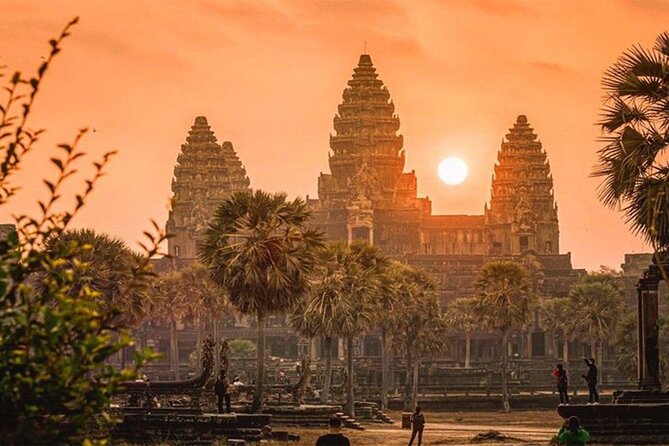
Buy the Angkor Pass ($37 for one day, $62 for three days usable within a week, $72 for seven days usable within a month; children under 12 free) at the official ticket center on Road 60 before 5pm the day before if you want a sunrise start, or at the gate itself. Arrive by 5:15am for sunrise over the western towers, the classic reflecting-pool shot, then spend the cooler early hours inside exploring the bas-relief galleries on the outer gallery walls before the tour buses arrive around 8am. It is still an active place of Buddhist worship, not only a monument, and is treated that way by many Cambodian visitors.
Angkor Thom & the Bayon
Jayavarman VII's walled capital, entered through one of five monumental gates topped with giant faces. At its center, the Bayon holds 216 enormous stone faces carved into 54 towers, each interpreted as either the king himself or the bodhisattva Avalokiteshvara, and best explored slowly rather than rushed through with the crowds heading straight for Ta Prohm.
Ta Prohm
Left deliberately unrestored, or minimally so, to show how the jungle reclaims Khmer architecture: strangler fig and silk-cotton tree roots grip the stone walls and towers in a way that photographs suggest but don't quite prepare you for in person. It gained wider fame from Tomb Raider, but the temple earns the visit regardless of the film connection.
Beyond the temples
The Angkor National Museum in town is worth an hour either before or after your temple days, giving context, particularly on Jayavarman VII and the empire's religious shifts, that the sites themselves don't provide. In the evening, Phare, the Cambodian Circus (about $18, nightly at 8pm) stages a genuinely excellent hour of contemporary circus performed by graduates of a social enterprise arts school, live music and narrative theater rather than a novelty tourist show. Around the Old Market, browse the covered market by day and the Angkor Night Market by evening for crafts and textiles at fixed, reasonable prices compared to temple-gate vendors.
One, two or three days, temple by temple
Three full days covers Angkor and the city properly; two days works if you accept skipping the further temples. These routes are sequenced to front-load the cool morning hours at the busiest sites.
- Dawn
Angkor Wat at sunrise. Gates open at 5am; find your spot by the reflecting pool before 5:30.
- Morning
Angkor Thom & the Bayon. The faces, then a walk through the Terrace of the Elephants before the heat builds.
- Midday
Ta Prohm, then back into town for lunch and to wait out the hottest hours.
- Evening
Old Market and dinner at Chanrey Tree or Marum, then Pub Street if you have energy left.
- Day 1
The one-day route above: Angkor Wat sunrise, Angkor Thom, the Bayon, Ta Prohm.
- Day 2 morning
Banteay Srei, 45 minutes out, for the finest carved detail in Khmer architecture, in pink sandstone.
- Day 2 afternoon
Angkor National Museum for context, then the Angkor Night Market for crafts.
- Day 2 evening
Phare, the Cambodian Circus, booked ahead for the 8pm show.
- Days 1-2
The two-day route above, at a slightly gentler pace.
- Day 3 morning
Kompong Khleang or Kompong Phluk floating village on the Tonle Sap, ideally with a tour that pays local boat rowers directly.
- Day 3 afternoon
Slow finish in Wat Bo or Kandal Village, a massage, and a last dinner at Cuisine Wat Damnak if you booked ahead.
A 50km drive before your trip even starts
Siem Reap Angkor International Airport (SAI), opened in 2023, was deliberately built 50km from the city to protect Angkor's UNESCO site from noise and vibration, which means every arrival faces a 45-60 minute transfer before checking in anywhere. The official taxi counter in arrivals offers a fixed price to the city center, an airport shuttle bus runs for about $8 but stops around 10pm, and a private transfer for 1-3 passengers costs around $45. Book your hotel transfer in advance rather than assume you'll sort it on arrival.
Within the city and at Angkor, tuk-tuks are the default: $2-3 for short hops around town, and a full-day driver for the temple circuit runs $15-20, often arranged directly through your guesthouse. PassApp and Grab both operate in Siem Reap and are useful for fixed, upfront pricing without negotiation. E-bikes and bicycles ($5-10 a day) work well for the flatter parts of Angkor Thom if you want to set your own pace between temples, though the distances between the further sites still favor a driver.
Best time to visit and Angkor's crowd patterns
December and January are the coolest, driest and most crowded months, with Angkor Wat's sunrise viewpoint genuinely packed. November and February offer nearly the same weather with somewhat thinner crowds. March to May is hot, with April's Khmer New Year adding festival crowds and reduced business hours around the holiday itself. June to October is the green season: short, heavy afternoon downpours, a noticeable drop in both prices and crowds, and rice paddies and moats at their most vivid, a genuinely underrated time to visit if you don't mind an afternoon indoors most days.
One of Southeast Asia's better-value city breaks
Siem Reap remains inexpensive by regional standards once you get past the one fixed cost every visitor faces: the Angkor Pass. Food, tuk-tuks and guesthouse rooms are all cheap even by Southeast Asian benchmarks.
- Hostel dorm or basic guesthouse $8-18
- Street food and local restaurants $5-10
- Shared tuk-tuks and E-bike rental
- Angkor Pass amortized over your stay
- Boutique guesthouse or 4-star hotel $60-120
- Restaurant meals $10-25
- Private tuk-tuk driver for the day
- Circus ticket, floating village tour, a museum
- Amansara or equivalent $250+
- Cuisine Wat Damnak and fine dining
- Private licensed guide for Angkor
- Private driver throughout
One of Cambodia's safest cities, with a short list to know
Siem Reap is safe for tourists, including at night around the Old Market and Pub Street. Violent crime against visitors is rare, and the tourist police maintain a visible presence around the main sights and nightlife area. Siem Reap and Angkor are entirely unaffected by the current border tension between Cambodia and Thailand, which is confined to a strip along the border roughly 50km wide in specific provinces well away from here; see our full Cambodia country guide for the details if your trip extends beyond this city.
The realistic issues: temple-gate touts and unofficial guides, who can be persistent about tickets, "closed" temples or unofficial parking fees, a firm decline and walking on works fine; tuk-tuk overcharging, avoided by agreeing the fare before you get in or using PassApp; and heat exhaustion, a more realistic daily risk at the temples than crime, addressed with water, a hat and pacing yourself between sites. Emergency numbers are the national police at 117, ambulance at 119, and the English-speaking tourist police at 118 or 012 942 484.
Beyond the main circuit: further temples and the Tonle Sap
Siem Reap's position makes it an easy base for temples too far out for the standard one or two-day circuit, and for the floating villages of the Tonle Sap, Southeast Asia's largest lake. All of these can be arranged through your guesthouse or a tour desk near the Old Market.
Banteay Srei
A small 10th-century temple built from pink sandstone, carved with a level of ornamental detail unmatched anywhere else at Angkor. Its scale makes it an easy add-on to a temple day rather than requiring a full separate trip.
Beng Mealea
A jungle-swallowed temple in the same architectural style as Angkor Wat but left almost entirely unrestored: visitors pick a way across collapsed sandstone blocks on wooden walkways, with none of the crowds of the main park. Often paired with Banteay Srei in a single full-day trip.
Phnom Kulen
The mountain considered the birthplace of the Khmer Empire, where Jayavarman II declared himself god-king in 802. A waterfall and a reclining Buddha carved into riverbed rock are the draws, along with cooler air at altitude, a relief from the heat of the plains below.
Tonle Sap floating villages
Kompong Phluk, the closer and better-known option, has houses on stilts up to eight meters high to survive the lake's seasonal rise. Kompong Khleang, a little further, sees far fewer tourists and channels more of the tour fee directly to the community; look for operators who cap groups at around 10 people and hire local women as boat rowers who keep their own earnings, rather than the mass-tour operations at Chong Kneas closer to town.
Siem Reap FAQ
Is Siem Reap safe for tourists?
Yes. Siem Reap is one of Cambodia's safest cities for visitors; violent crime against tourists is rare. The realistic concerns are traffic, overcharging by unofficial tuk-tuk drivers, and temple-ticket touts, not danger to your person.
How many days do I need in Siem Reap?
Three full days covers it well: one for Angkor Wat and Angkor Thom, one for Ta Prohm and the further temples like Banteay Srei, one for a Tonle Sap floating village and the city itself. Two days works if you focus only on the core temples.
How much does Siem Reap cost per day?
Budget travellers manage on $25-35 a day including a share of the Angkor Pass; mid-range runs $60-100. The Angkor Pass itself is the one unavoidable fixed cost, from $37 for one day.
When is the best time to visit Siem Reap?
December through February: cool, dry and the most comfortable temperatures of the year, though also the most crowded and most expensive stretch. The June-October green season has short daily downpours, thinner crowds and noticeably lower prices.
How do I get from Siem Reap airport to the city centre?
Siem Reap Angkor International Airport sits about 50km from the city, a 45-60 minute drive. The official taxi counter in arrivals offers a fixed price, an airport shuttle bus runs for about $8 until around 10pm, and a private transfer for 1-3 people costs about $45. Book your hotel transfer ahead given the distance.
What is the best area to stay in Siem Reap?
Wat Bo or Kandal Village for first-timers: central, walkable to Pub Street and the Old Market, and quieter at night. Old Market and Pub Street itself for short, social stays close to the nightlife. Taphul Village for a quieter, cheaper, more residential base.
How much are Angkor Wat tickets?
The Angkor Pass costs $37 for one day, $62 for three days usable within any 7-day window, and $72 for seven days usable within any 30-day window. Children under 12 enter free with a passport.
Do I need a guide for Angkor?
Not strictly, the main temples have signage and are easy to navigate independently, but a licensed guide (roughly $30-45 a day) adds real historical context, especially at the Bayon and Angkor Wat's bas-reliefs, and can route you around the worst crowds.
Is Siem Reap walkable?
The central area around the Old Market and river is walkable, but Angkor itself is not: the temples are spread across roughly 400 square kilometres and require a tuk-tuk, bike or car with driver.
What should I wear to the temples?
Shoulders and knees covered at every temple, no exceptions enforced at Angkor Wat itself. Lightweight long trousers or a long skirt and a t-shirt work well; bring a scarf or light layer to cover up quickly between stops.
What Stays With You
Every visitor to Siem Reap has the same sunrise photo of Angkor Wat's towers over the reflecting pool, and every visitor who stays a few days extra ends up remembering something else more: the particular quiet of Ta Prohm's back corridors once the tour groups move on, a plate of amok that reset your expectations of what Cambodian food could be, or the wooden houses of Kompong Khleang rising on stilts over water that will be dry ground again by April. The temples are the reason to come. What you actually take home tends to be everything built up around them.
Get up for the sunrise at least once. Then give the city, and the people who rebuilt it, the rest of your trip too.