
Bhutan's capital does not perform for visitors
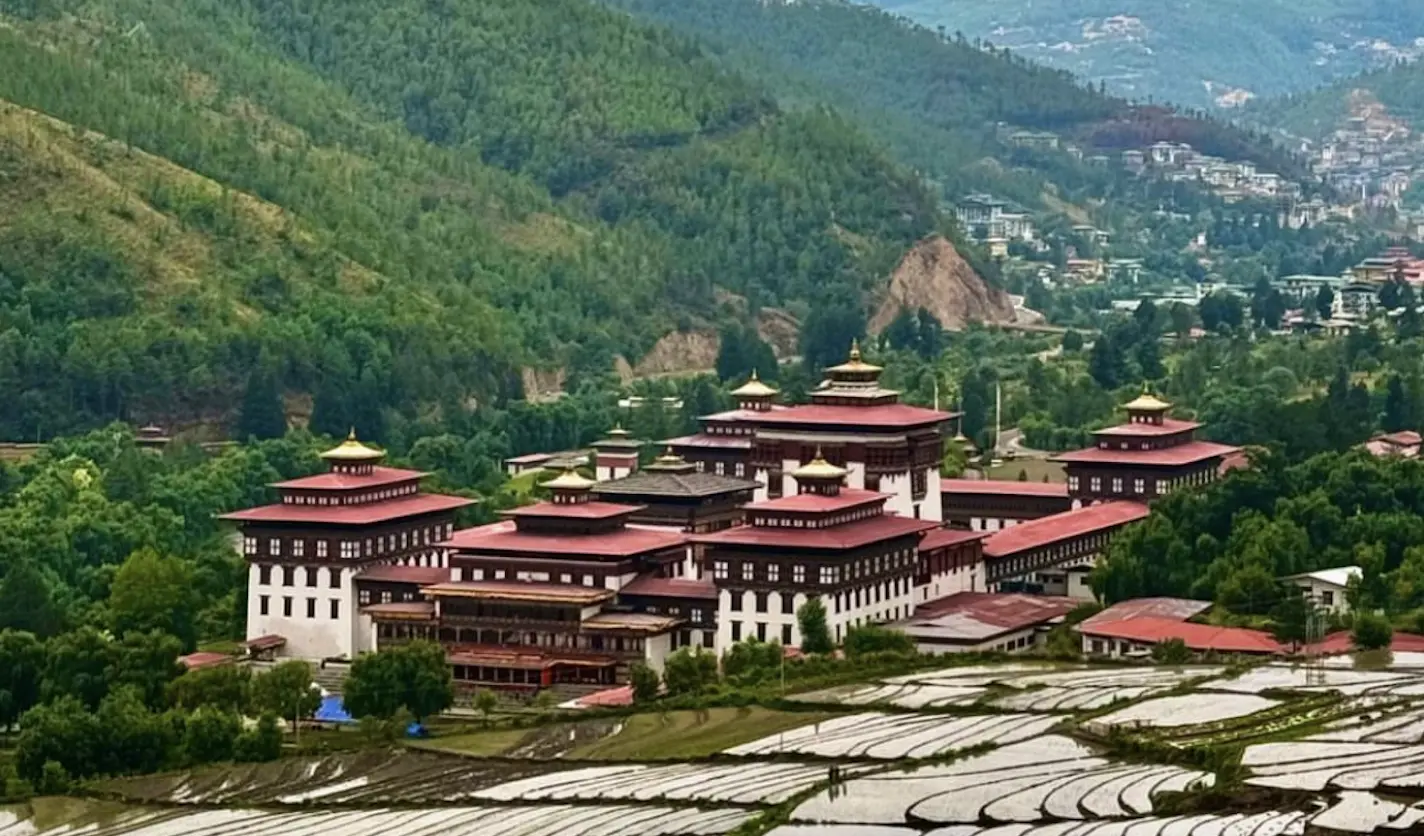
Thimphu became Bhutan's permanent capital in 1961 and is still, genuinely, a small city: home to roughly a fifth of the country's population, ringed by pine-covered hills, with a skyline that stays low by law so nothing outbuilds the dzong. Government ministries, the central monastic body and the King's offices all share space inside Tashichho Dzong, a working fortress rather than a museum piece, and the city's rhythm still bends around that fact more than around tourism.
What makes Thimphu worth two or three nights rather than a rushed afternoon is the density of things that are simply going on around you: monks crossing the dzong courtyard between debate sessions, archers competing at a range on a Sunday afternoon, a weekend market that Thimphu residents actually shop at, and a traffic officer directing the city's busiest intersection by hand, not for visitors, but because Thimphu tried traffic lights once and preferred the officer.
The honest complications
Thimphu is not a nightlife city and closes early by the standards of most Asian capitals; if you want late bars and street food chaos, this isn't it. The altitude, 2,300 meters, catches some visitors off guard on the first day, especially combined with a same-day flight from sea level. And because Bhutan's guide and tour-operator rules have shifted more than once since 2022, don't assume the exact independence you'll have moving around the city; confirm current terms with your operator before you land.
A small enough city that neighbourhood barely matters, except when it does
Thimphu is compact enough to walk across in under an hour, so where you stay affects convenience more than experience. Two areas cover almost every visitor's needs.
Norzin Lam & Chubachu
Thimphu's main commercial spine, Norzin Lam, runs through the Chubachu area and is lined with shops, banks, bakeries and the famous hand-directed Main Traffic Circle. Staying here puts restaurants, the weekend market and Tashichho Dzong within easy walking or a short taxi ride, and it's the practical default for a first visit.
Motithang
Uphill and northwest of the center, Motithang trades Norzin Lam's bustle for pine air, quieter streets and proximity to the Motithang Takin Preserve, home to Bhutan's unusual national animal. It's a five to ten minute taxi ride from downtown rather than a walk, and suits travelers who'd rather wake up to mountain views than shopfronts.
Changlam Street
A cluster of family-run hotels a short walk from Norzin Lam, offering some of Thimphu's best value without sacrificing a central location.
From dzong-style luxury to family-run value on Changlam Street
Thimphu has Bhutan's widest hotel range by far, from heritage-style luxury properties built in dzong architecture to simple, well-run family hotels. These five cover every budget.
At the top, Taj Tashi sits in the heart of downtown, its dzong-style architecture and hand-drawn Buddhist murals wrapped around 66 rooms with mountain and town views, a spa, and two restaurants; from around $250 a night, and the most central of Thimphu's luxury options. Le Méridien Thimphu, also central, pairs Bhutanese-style furnishings with an indoor pool and easy walking access to the Memorial Chorten and Tashichho Dzong.
Up in Motithang, Zhiwa Ling Ascent, Bhutan's first contemporary-design hotel, sits on a 25-acre hillside property beside the Motithang Takin Preserve with sweeping valley views, a strong choice for travelers who'd rather trade a few minutes of taxi time for quiet and mountain air.
For solid mid-range value, Hotel Osel is a 35-room 4-star property just off the main road, a five-minute drive from both the Memorial Chorten and Tashichho Dzong and a ten-minute walk from the National Textile Museum. And on Changlam Street, the family-owned Hotel Norbuling is a well-regarded value option in its bracket, central, simple and well looked after.
Ema datshi, momos, and Thimphu's small but growing independent scene
Most of Bhutan's meals are still included in a tour arrangement and served buffet-style at hotels, but Thimphu is the one place in the country with a genuine independent restaurant scene worth seeking out beyond that.
Ema Datshi
Whole chilies stewed in melted homemade cheese, eaten at nearly every meal across the country. For a refined, sit-down version, Chig-ja-gye, the signature restaurant at Taj Tashi, serves Bhutanese classics under gold-leaf ceiling paintings with valley views, a step up from the canteen-style version most itineraries otherwise deliver.
Traditional dining
The Folk Heritage Museum Restaurant, attached to Thimphu's folk heritage museum, serves a full traditional set meal, guests sit on cushions at low tables and eat from handmade wooden bowls in the old style, a genuinely immersive way to eat ema datshi and phaksha paa rather than a themed gimmick.
Momos & casual eats
For something lighter or less chili-forward, The Zone on Norzin Lam does reliable pizza, pasta and burgers alongside Bhutanese staples, a popular pick with both locals and visitors who want a night off from ema datshi. Ambient Café is the city's best stop for coffee and a light lunch between sightseeing stops, and street stalls around the market sell momos fresh through the day.
Dzongs, a giant Buddha, and the traffic circle everyone photographs
Thimphu's sights are spread across the valley rather than clustered downtown, so most visitors see them across a driver-assisted day rather than entirely on foot. None of it needs to be rushed.
The dzong and the valley Buddha
Tashichho Dzong, the "fortress of the glorious religion," houses the throne room, government ministries and the central monk body behind whitewashed walls and a gold roof; the public courtyards are open to visitors, best after 5pm on weekdays once government offices close, and a passport is required for entry. On the hillside above town, the Buddha Dordenma, a 51-meter gilded statue containing 125,000 smaller Buddha statues inside its base, looks out over the whole valley and is lit at night, worth a return visit after dark if your schedule allows it.
Markets, museums and living crafts
The Centenary Farmers Market, Bhutan's largest fresh-produce market, takes over the riverside every weekend with chilies, red rice, suja butter tea ingredients and local crafts, and is the best single stop for watching ordinary Thimphu life rather than a curated version of it. The National Institute for Zorig Chusum, the government arts school, lets visitors watch students training in Bhutan's thirteen traditional arts, from painting to woodcarving, and the nearby National Textile Museum covers the weaving traditions behind the kira and gho. Simply Bhutan Museum offers a hands-on, family-friendly introduction to rural Bhutanese life for those short on time elsewhere.
Hillside temples and the takin
Changangkha Lhakhang, on a ridge above the city and among Thimphu's oldest temples, dating to the 12th century, draws local parents bringing newborns for a blessing and offers a genuine slice of everyday devotional life alongside its views. The National Memorial Chorten, built in 1974 in memory of the third king, is a constant, quiet flow of elderly Thimphu residents circling clockwise with prayer wheels, worth timing for early morning. Up in Motithang, the Motithang Takin Preserve protects Bhutan's genuinely strange national animal, a goat-antelope hybrid tied to a Drukpa Kunley legend, in a large forested enclosure.
The traffic circle
At the junction of Norzin Lam, Thimphu's Main Traffic Circle is directed entirely by a white-gloved police officer using hand signals, the reason Thimphu remains the only capital city in the world without a single traffic light. It's not staged for visitors; the city tried lights once and found an officer worked better. A few minutes watching it, especially at a busy hour, is one of the more quietly memorable things to do in the city.
One, two or three days, at a pace the city actually keeps
Two full days cover Thimphu properly; a third fits comfortably around a Dochula Pass or Punakha day trip.
- Morning
Tashichho Dzong and the Memorial Chorten. Start at the chorten early, while locals are still circling with prayer wheels, then the dzong courtyards.
- Midday
Buddha Dordenma. Up the hillside for the giant statue and the valley views, then lunch back in town.
- Afternoon
Norzin Lam and the market. Wander the main street, watch the traffic circle in action, and browse the Centenary Farmers Market if it's a weekend.
- Evening
Dinner in the center. Chig-ja-gye for a refined take on ema datshi, or The Zone for something lighter.
- Day 1
The one-day route: Memorial Chorten, Tashichho Dzong, Buddha Dordenma, Norzin Lam and the market.
- Day 2 morning
Changangkha Lhakhang. The hillside temple, then the National Institute for Zorig Chusum to watch students training in traditional crafts.
- Day 2 afternoon
Textile Museum and the takin. The National Textile Museum, then Motithang Takin Preserve for Bhutan's odd national animal.
- Day 2 evening
Folk Heritage Museum Restaurant. A traditional cushion-and-low-table dinner to close out the city portion of the trip.
- Days 1-2
The two-day route above, at an unhurried pace.
- Day 3, option A
Dochula Pass and Punakha. A full day trip: the 108 chortens at the pass, then Punakha Dzong at the river confluence.
- Day 3, option B
Simply Bhutan and a slow finish. A hands-on morning at Simply Bhutan Museum, then a relaxed final afternoon back on Norzin Lam.
Small, walkable in the center, and a taxi everywhere else
Paro International Airport, Bhutan's only international airport, sits about 54 kilometers from Thimphu, a drive of roughly 1 to 1.5 hours on a paved mountain road. A taxi costs around Nu 600 (about $7-8); most visitors are met by their tour operator's driver as part of their arranged transport rather than arranging one independently. Within Thimphu, the center around Norzin Lam is genuinely walkable, and taxis are cheap and plentiful for Motithang, the Buddha Dordenma hillside, and anywhere else outside easy walking range.
Best time to visit and the Thimphu Tshechu
Thimphu sits at 2,300 meters, so its climate stays cooler than lowland South Asia year-round. March to May and September to November bring the clearest skies and most comfortable daytime temperatures. Winter (December-February) is cold, often near or below freezing at night, but dry and clear with the fewest visitors. June to August brings the monsoon: regular rain, cooler days, and a green, quiet city.
Thimphu Tshechu, held 21-23 September 2026 at Tashichho Dzong, is the capital's biggest festival: three days of masked sacred dances performed in the dzong courtyard, drawing Bhutanese from across the country in full national dress. Book well ahead if your trip lines up with it; hotels fill quickly.
The SDF is fixed; everything else in Thimphu is genuinely reasonable
Bhutan's mandatory $100/night Sustainable Development Fee applies regardless of where you are in the country, so it isn't repeated below; these figures cover what you'll actually spend day to day in Thimphu on top of it.
- Guesthouse or budget hotel $25-50
- Momos and local eats $8-15
- Taxis around town $3-8
- Free temples, markets and viewpoints
- 4-star hotel like Hotel Osel $100-160
- Restaurant meals $15-30
- Private driver for the day
- Museum and institute entries
- Taj Tashi or Zhiwa Ling Ascent $250+
- Chig-ja-gye and fine dining
- Private guide throughout
- Spa and cultural extras
One of the safest capitals anywhere
Thimphu is exceptionally safe, even measured against Bhutan's already very low national crime rate. Violent crime against visitors is virtually unheard of, walking at night in the central area is unremarkable, and Thimphu rates very well for solo female travelers, with harassment rare and women holding genuine social standing in Bhutanese culture.
The two things actually worth knowing: altitude, since the city sits at 2,300 meters and mild headaches or breathlessness in the first day are common, especially arriving same-day by flight, so pace your first day and drink water; and thin evening options, since Thimphu genuinely quiets down early by regional standards, which is a lifestyle fact rather than a safety one. Emergency numbers are 113 (police), 112 (ambulance) and 110 (fire), all free and reachable from any phone.
Thimphu is the easiest base for the rest of western Bhutan
Thimphu's position at the center of Bhutan's main tourist corridor makes it a practical base for day trips, though most itineraries treat these as one-way stops en route to an overnight elsewhere rather than round trips.
Dochula Pass & Punakha
The road climbs to the Dochula Pass at roughly 3,100 meters, where 108 memorial chortens frame a full Himalayan panorama on a clear day, then descends to Punakha Dzong at the confluence of two rivers, widely considered Bhutan's most beautiful fortress. Most visitors treat this as the start of an onward overnight in Punakha rather than a there-and-back day trip from Thimphu.
Paro & Paro Taktsang
Paro, where every international flight lands, holds Bhutan's single most famous sight, the cliffside monastery of Paro Taktsang, the Tiger's Nest, a 4-5 hour round-trip hike best attempted after a day or two of altitude acclimatization. Rinpung Dzong and the National Museum round out a full day in the valley.
Chimi Lhakhang
A short walk across rice paddies leads to this small temple dedicated to Drukpa Kunley, the "Divine Madman," the reason phallus paintings appear on houses across the region as a fertility and protection symbol. Usually combined with the Punakha day trip rather than visited alone.
Haa Valley
Opened to tourism only in 2002, Haa remains one of Bhutan's quietest valleys, with its own dzong and monasteries well outside the main tourist flow, a good option for a second visit or an extra day with no fixed agenda.
Thimphu FAQ
Is Thimphu worth visiting?
Yes. As Bhutan's capital and only real city, Thimphu has the country's best hotel and restaurant range, its main dzong-fortress and government seat, the giant Buddha Dordenma statue, and the famous hand-directed traffic circle. Most itineraries spend two to three nights here.
How many days do I need in Thimphu?
Two full days covers the essentials: Tashichho Dzong, Buddha Dordenma and the National Memorial Chorten on one day, the weekend market, Motithang Takin Preserve and the textile and craft institutions on the other. A third day allows a Punakha or Dochula Pass day trip.
Do I need a guide in Thimphu?
Under current rules you can explore Thimphu itself without a guide, though most visitors arrive with one as part of their wider Bhutan trip. Confirm current terms with your licensed tour operator, since guide requirements have shifted more than once since 2022.
What is the best area to stay in Thimphu?
Norzin Lam and the central Chubachu area for walkable access to restaurants, shops and the dzong. Motithang, uphill and quieter, suits travelers who want mountain air and takin sightings over nightlife.
How much does Thimphu cost per day?
On top of Bhutan's mandatory 100 dollar Sustainable Development Fee, budget travellers spend roughly 30-50 dollars a day on food and local transport in Thimphu; hotels range from about 25 dollars for a simple guesthouse to 300 dollars or more for 5-star properties.
When is the best time to visit Thimphu?
March to May and September to November: clear mountain views and the Thimphu Tshechu festival, held 21-23 September 2026 at Tashichho Dzong. Winter is cold but dry and quiet; June to August brings the monsoon.
How do I get from Paro Airport to Thimphu?
By road, about 54 kilometers and roughly 1 to 1.5 hours depending on traffic. A taxi costs around 600 ngultrum (about 7-8 dollars); most visitors are met by their tour operator's driver as part of their arranged transport.
Is Thimphu safe?
Yes, exceptionally so, even by Bhutan's already very safe standards. Violent crime is virtually unheard of and petty theft is rare. The main practical concern is altitude, since the city sits at 2,300 meters.
Why doesn't Thimphu have traffic lights?
Traffic lights were trialled at the city's main intersection and found less effective than a trained officer directing traffic by hand, so they were removed. Thimphu remains the only capital city in the world without them.
What is the Centenary Farmers Market?
Bhutan's largest fresh-produce market, held on the Thimphu riverside every weekend, selling chilies, red rice, butter tea ingredients and local crafts. It's the best place to see everyday Bhutanese life rather than a curated tourist version of it.
What Stays With You
Thimphu doesn't try to impress you, and that restraint is exactly what makes it stick. The officer at the traffic circle, unbothered by cameras, doing a job a machine already lost at. The dzong that is still, actually, where the government works, not a preserved shell of one. The Buddha on the hillside, lit up after dark, looking over a valley that has no interest in becoming a bigger city than it needs to be.
Give it two unhurried days before you head onward to Punakha or the Tiger's Nest. Thimphu rewards exactly the pace it keeps for itself.