

What You're Actually Getting Into
Bhutan opened to its first tourists in 1974, for the coronation of the fourth king, and has controlled visitor numbers deliberately ever since. There is no budget backpacker circuit here and there isn't meant to be: the country's tourism policy is built around a Sustainable Development Fee, currently 100 US dollars per person per night, that funds free healthcare and free education for Bhutanese citizens and is presented to visitors not as a tax but as the price of keeping the place intact. The result is a country that feels, more than almost anywhere else in Asia, genuinely unhurried by tourism.
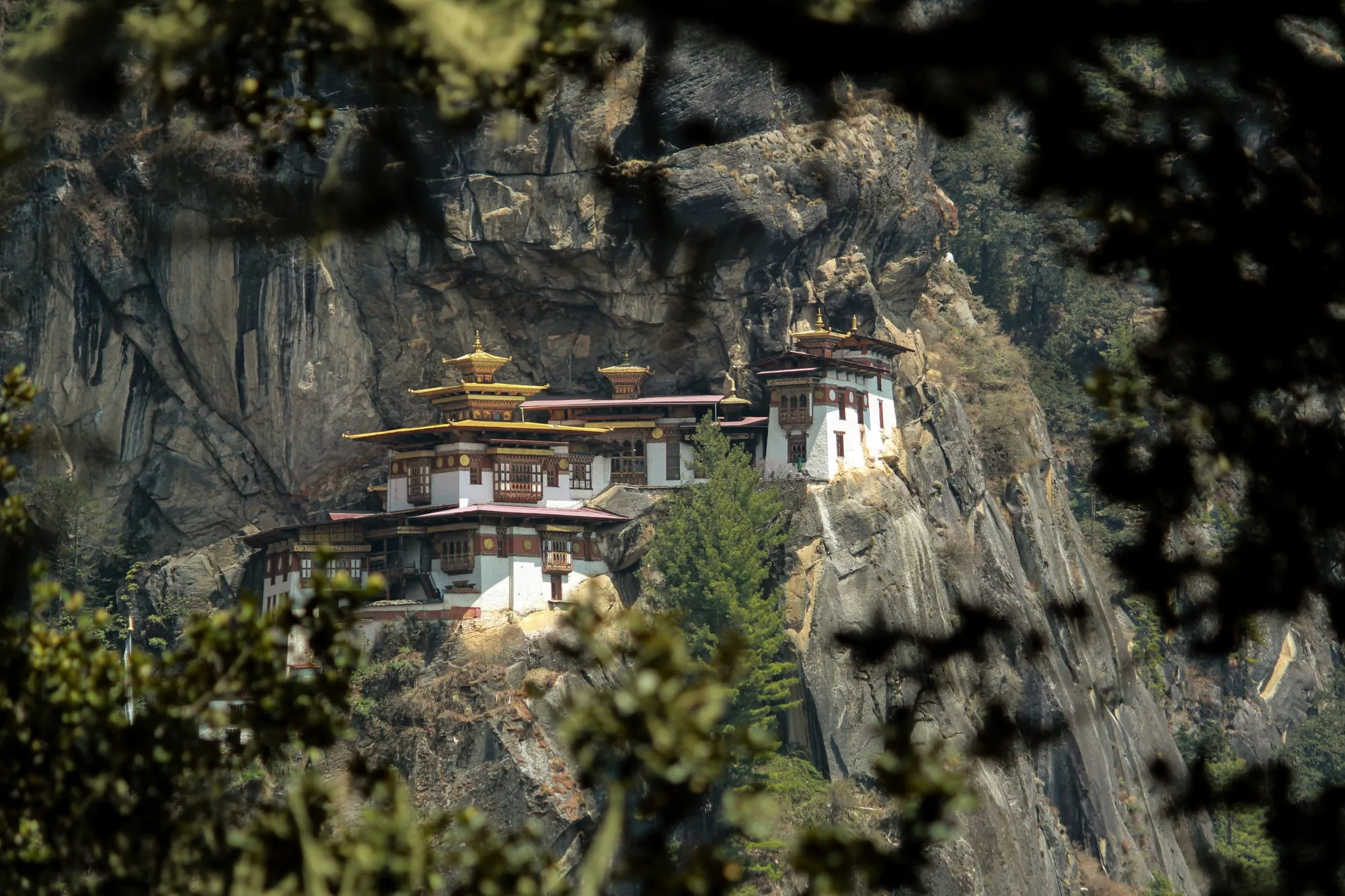
What that money buys access to is real. Vajrayana Buddhism here isn't a heritage display, it's the operating system: dzong fortresses that still house both the monastic body and the local district government, monks debating philosophy in courtyards tourists are welcome to watch, and a cliffside monastery, Paro Taktsang, that Guru Rinpoche is said to have flown to on the back of a tigress in the 8th century. Bhutan was never colonized, has no fast food chains, and only introduced television and the internet in 1999, the last country in the world to do so.
The honest complications
This is not a cheap trip, and it isn't trying to be: the SDF alone adds 100 dollars a day before a single hotel night or meal is paid for, and a realistic all-in budget starts around 200 to 250 dollars a day. The rules around guides and independent movement have genuinely changed more than once since 2022, so treat any specific policy detail, including the ones in this guide, as a starting point to confirm with a licensed operator rather than a fixed fact. Tourism infrastructure outside the Paro-Thimphu-Punakha corridor is still thin: restaurant variety drops off fast once you leave the capital, and central and eastern Bhutan involve long mountain drives on roads that can close in bad weather. None of that makes the trip less remarkable. It does mean this isn't a spontaneous, book-it-next-week destination in the way Southeast Asia is.
A History Worth Knowing
Bhutan calls itself Druk Yul, Land of the Thunder Dragon, and unlike its neighbors it was never colonized. A Tibetan lama unified the country's warring valleys in the 17th century and built the dzong system that still defines its towns. A hereditary monarchy followed in 1907, and in one of the more unusual moves in modern political history, the fourth king spent the 1990s and 2000s deliberately handing his own absolute power to an elected parliament, against the wishes of much of the population, who wanted him to keep it.
- 1616
Zhabdrung Ngawang Namgyal. A Tibetan lama flees a succession dispute, arrives in Bhutan, and over the following decades unifies the valleys into a single state under a dual system of religious and civil rule, building the great dzong fortresses as he goes.
- 1907
The monarchy begins. Ugyen Wangchuck is unanimously chosen as the first hereditary Druk Gyalpo, ending a period of regional infighting among rival governors.
- 1974
Tourism opens. The first foreign visitors are admitted for the coronation of the fourth king, Jigme Singye Wangchuck, marking Bhutan's cautious first opening to the outside world.
- 1999
Television and the internet arrive. Bhutan becomes the last country in the world to introduce broadcast television, deliberately delayed until the government judged the country ready for it.
- 2006
Voluntary abdication. The fourth king abdicates in favor of his son, Jigme Khesar Namgyel Wangchuck, as part of a planned transition toward democracy.
- 2008
Constitutional monarchy. A new constitution takes effect and Bhutan holds its first democratic parliamentary elections, becoming a constitutional rather than absolute monarchy.
Read the full history: the Zhabdrung, the dual system, and Gross National Happiness
The Zhabdrung's dual system of government, chhoesid nyiden, split authority between a spiritual head, the Je Khenpo, and a temporal ruler, a structure that shaped Bhutanese governance for centuries and still echoes in how dzongs house both monastic and administrative functions today. After the Zhabdrung's death, Bhutan fragmented into competing regional governors for over two centuries before Ugyen Wangchuck, the governor of Trongsa, consolidated power and was crowned the first king in 1907 with British support, following the 1910 Treaty of Punakha that formalized Bhutan's relationship with British India.
The third king, Jigme Dorji Wangchuck, began cautious modernization in the 1950s and 1960s: abolishing serfdom, building the first roads, and joining the United Nations in 1971. His son, the fourth king, coined the concept of Gross National Happiness in 1972, arguing that national success should be measured by collective wellbeing rather than GDP alone, a framework that now genuinely shapes Bhutanese policy on everything from forest cover (constitutionally mandated to stay above 60 percent) to tourism.
Bhutan maintains close ties with India, which handles much of its trade and defense relationship, and has no formal diplomatic relations with China, with a long-unresolved northern border that occasionally makes regional headlines. Internally, the country's Buddhist majority (Drukpa Kagyu in the west, Nyingma in parts of the east) coexists with a Hindu minority concentrated in the south, a legacy of Nepali-origin settlement in the 19th and 20th centuries that remains a sensitive point in modern Bhutanese politics.
Top Destinations
Nearly every first trip to Bhutan runs the same western corridor: Paro, Thimphu and Punakha, connected by paved mountain roads and covered without a guide under current rules. Central Bhutan's Bumthang valley and the far east are a different trip entirely, quieter, harder to reach, and rarely attempted on a first visit. Trekking is its own category again, run by licensed operators with camping crews.
Paro, the gateway valley
Every international flight lands at Paro, and most visitors spend their first and last nights here. The valley's main event is the hike to Paro Taktsang, the Tiger's Nest, a 900-meter cliff-face monastery reached by a 4 to 5 hour round-trip trail; most operators schedule it on day two or three so you've had a night to adjust to the altitude first. Rinpung Dzong, the valley's own fortress-monastery, and the National Museum of Bhutan in its former watchtower are both worth half a day. Budget two nights.
Thimphu, the world's only capital with no traffic lights
Bhutan's capital, and the country's only real city, is worth its own guide, covered in full in our Thimphu city guide. The short version: Tashichho Dzong, the giant Buddha Dordenma statue on the hillside above town, and the weekend Centenary Farmers Market are the essentials, and the traffic officer directing cars by hand at the Main Traffic Circle is a genuinely strange, genuinely charming sight worth seeing for yourself.
Punakha Dzong, at the meeting of two rivers
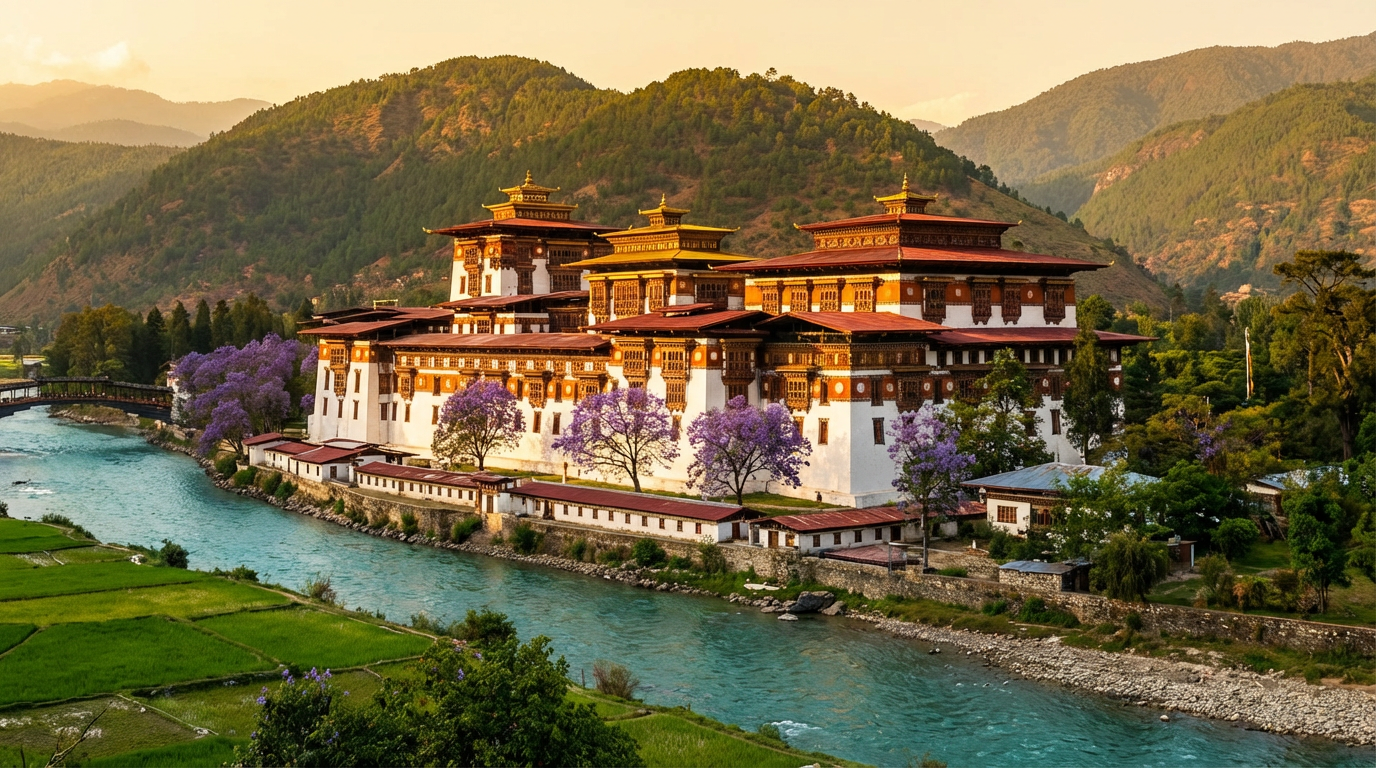
Punakha Dzong sits at the confluence of the Pho Chhu and Mo Chhu rivers, connected to the riverbank by a long wooden cantilever bridge, and is widely considered Bhutan's most beautiful fortress. It served as the capital until 1955 and is still the winter residence of the Je Khenpo, the head of Bhutan's central monastic body. En route from Thimphu, the Dochula Pass at roughly 3,100 meters holds 108 memorial chortens and, on a clear day, a full Himalayan panorama.
Chimi Lhakhang, the temple of the Divine Madman
A short walk across rice paddies from the road near Punakha, this small temple is dedicated to Drukpa Kunley, a 15th-century yogi whose unconventional teaching methods are the reason phallus paintings appear on houses across the region, a fertility and protection symbol, not a joke at the culture's expense. Wangdue Phodrang, just beyond Punakha, adds a working market town largely bypassed by the main tourist flow.
Bumthang, the spiritual heartland
Central Bhutan's Bumthang valley holds some of the country's oldest and most sacred temples, including Jambay Lhakhang, said to date to the 7th century, and Jakar Dzong overlooking the valley. It's a full day's drive from Punakha over high passes, or a short domestic flight, and sees a fraction of the visitors that Paro and Thimphu do. Add it if you have eight days or more; it rewards a slower pace than the western circuit.
Trashigang & the far east
Eastern Bhutan sees the fewest foreign visitors of any region, reachable by long mountain roads or a domestic flight to Yongphula, and requires a guide throughout. What's there is a version of Bhutan without the tour infrastructure of the west: working monasteries, weaving villages, and valleys most guidebooks barely cover. Not a first-trip destination, but worth knowing about for a second or third visit.
Druk Path, Jomolhari & the Snowman
Trekking in Bhutan is fully organized, camping-based, and run by a licensed operator with a crew; there is no teahouse network like Nepal's. The Druk Path Trek (4-6 days, Paro to Thimphu past alpine lakes) is the accessible option for a first Himalayan trek. The Jomolhari Trek (7-9 days) climbs closer to the 7,300-meter peak of the same name. The Snowman Trek, often called the hardest trek in the world, runs 25 days or more through remote high passes and is attempted by only a handful of trekkers each year.
Beyond the main circuit
The western corridor above covers a first trip well. With extra days, these reward the detour.
Gangtey & Phobjikha Valley
A wide glacial valley with no power lines by law, the winter home of the rare black-necked crane, which arrives from the Tibetan plateau each November. The Gangtey Monastery sits above the valley floor.
Haa Valley
Opened to tourism only in 2002, a quieter alternative valley with its own dzong and monasteries, still well outside the main Paro-Thimphu-Punakha flow.
Trongsa Dzong
The largest dzong in Bhutan, dramatically sited above a gorge, and the ancestral seat of the royal family. Most itineraries pass it on the way to central Bhutan without stopping long enough.
Culture & Etiquette
Bhutan is the world's only country with Vajrayana Buddhism as its state religion, and the practice here is lived daily rather than performed for visitors. National dress, the gho for men and kira for women, is mandatory by law in government offices, schools and dzongs, and Bhutanese people wear it with evident pride rather than obligation. Gross National Happiness isn't a marketing slogan; it's a genuine policy framework that shapes everything from the constitutional minimum forest cover to how the SDF gets spent.
Do
- Dress modestly at dzongs and temples. Long sleeves, long trousers or skirts, and shoes off before entering shrine rooms. Ask your guide before photographing inside.
- Ask before photographing monks or ceremonies. Religious sites and rituals deserve the same courtesy you'd extend to a place of worship anywhere.
- Walk clockwise around chortens, prayer wheels and mani walls, the traditional direction of circumambulation in Bhutanese Buddhism.
- Try national dress at a festival if invited or offered; it's welcomed, not appropriated, when done respectfully.
- Learn a few Dzongkha words. Kadrinche (thank you) and Kuzuzangpo (hello) land well with guides and hosts.
Don't
- Point your feet at people, altars or images of the Buddha. Feet are considered the least clean part of the body in Bhutanese and wider Buddhist etiquette.
- Touch monks, especially on the head, or hand things directly to them; place items down for them to pick up instead.
- Expect fast wifi or fast food outside Thimphu and Paro. Infrastructure thins out quickly once you leave the main corridor.
- Be surprised by phallus paintings on houses. They're a genuine cultural and religious symbol tied to Drukpa Kunley, not a joke aimed at visitors.
- Underestimate the altitude. Paro sits at 2,200 meters and passes on the way to central Bhutan clear 3,000 meters; mild headaches in the first day or two are common.
Deeper culture: Gross National Happiness, the Tshechu festivals, and Drukpa Kunley
Gross National Happiness. Formalized under the fourth king from the 1970s onward, GNH rests on four pillars: sustainable development, environmental conservation, cultural preservation and good governance. It's measured through a national survey and genuinely informs policy, including the constitutional requirement that at least 60 percent of the country remain forested.
Tshechu festivals. Annual masked dance festivals held at dzongs across the country, each on its own local calendar, commemorating Guru Rinpoche, the 8th-century figure who brought Buddhism to Bhutan. Paro Tshechu (30 March to 3 April 2026) and Thimphu Tshechu (21-23 September 2026) are the two most visited, drawing large crowds of Bhutanese in full national dress alongside visitors.
Drukpa Kunley, the Divine Madman. A 15th-century Buddhist yogi and teacher whose unconventional, often deliberately shocking methods, including the phallus symbolism still painted on houses today, were aimed at cutting through hypocrisy and spiritual pretension. Chimi Lhakhang near Punakha, built where he is said to have subdued a demon, remains a working fertility temple.
Food & Drink
Bhutanese food runs on chili and cheese, eaten as a vegetable rather than a garnish, and it takes most first-time visitors a meal or two to adjust. Meals are typically included in your tour arrangement and served buffet-style at hotels and guesthouses, though Thimphu now has a genuine independent restaurant scene, covered in the Thimphu guide.
Ema Datshi
The national dish: whole green or red chilies stewed in a homemade yak or cow's milk cheese sauce called datshi. Fiery, creamy, and served at nearly every meal, often with variations like kewa datshi (with potato) or shamu datshi (with mushroom).
Momos ~$2-5
Steamed or fried dumplings filled with meat, cheese or vegetables, sold from street stalls in Thimphu and Paro and on nearly every restaurant menu. A reliable, milder option if the chili is too much.
Red Rice
A nutty, slightly chewy staple grain grown at altitude in Bhutan's valleys, served with nearly every meal instead of white rice, and the base that makes the chili and cheese dishes work as a full plate.
Phaksha Paa
Stewed pork belly with dried red chilies and radish or spinach, a hearty, smoky mainstay of Bhutanese home cooking, usually served alongside ema datshi and red rice.
Suja (Butter Tea)
Salted tea churned with yak butter, an acquired taste for most visitors but a genuine daily staple, especially in colder highland areas. Worth trying once at a farmhouse or guesthouse.
Ara
A home-distilled spirit made from rice, maize or millet, traditionally offered at celebrations and to guests. Strength and flavor vary widely from household to household.
When to Go & Itineraries
March to May and September to November are Bhutan's best months: clear mountain views, comfortable daytime temperatures, and the country's two biggest festivals, Paro Tshechu in spring and Thimphu Tshechu in autumn. Winter (December to February) is cold but dry and clear, with far fewer visitors and lower demand on guides and hotels. June to August brings the monsoon, with regular rain and clouded mountain views, though the western valleys stay green and the crowds thin out further.
All four seasons compared, with temperatures
| Season | Verdict | Temps (Thimphu/Paro) | Notes |
|---|---|---|---|
| Mar-May & Sep-Nov | Best | 10-22°C daytime | Clear views, Tshechu festivals, busiest season |
| Dec-Feb | Good (cold) | -2 to 12°C daytime | Dry, clear, quiet; nights well below freezing at altitude |
| Jun-Aug | Fair (monsoon) | 16-25°C daytime | Regular rain, clouded high views, valleys lush and green |
Central Bhutan (Bumthang) runs several degrees cooler than Paro and Thimphu year-round; mountain passes above 3,000 meters can hold snow into April.
Itineraries
Five days covers the core western circuit adequately. Eight days adds central Bhutan's Bumthang valley. Twelve days or more allows a proper trek or a push into the rarely visited east.
- Day 1
Arrive Paro. Fly into Paro, settle in, easy afternoon at Rinpung Dzong; acclimatize before any real hiking.
- Day 2
Paro Taktsang. The Tiger's Nest hike, 4-5 hours round trip, ideally starting early to beat both crowds and afternoon cloud.
- Day 3
To Thimphu. Drive to the capital, Buddha Dordenma, Tashichho Dzong, the weekend market if timing allows.
- Day 4
Punakha. Dochula Pass, Punakha Dzong, and Chimi Lhakhang across the rice paddies.
- Day 5
Return & depart. Drive back to Paro for the flight out, or a final morning in Thimphu if your flight allows.
- Days 1-3
Paro & Thimphu, as in the 5-day route, at a slightly gentler pace.
- Days 4-5
Punakha & Gangtey. Dochula Pass, Punakha Dzong, then on to the Phobjikha valley for the black-necked cranes (winter) or the glacial valley scenery year-round.
- Days 6-8
Bumthang. The long drive or short flight to central Bhutan, Jakar Dzong, Jambay Lhakhang, and the valley's older, quieter temples.
- Days 1-5
The 5-day western circuit, Paro, Thimphu and Punakha, as above.
- Days 6-9
Druk Path Trek. 4-6 days from Paro to Thimphu past alpine lakes, a genuine but accessible first Himalayan trek, arranged with a licensed operator.
- Days 10-12
Bumthang or Haa Valley. A slower final stretch in central Bhutan or the quieter Haa valley near Paro, depending on time and road conditions.
Getting there & around
Paro International Airport (PBH) is Bhutan's only international airport, served by Drukair and Bhutan Airlines, the only two carriers certified for the mountain approach, from Bangkok, Delhi, Kolkata, Kathmandu, Singapore, Dhaka and other regional hubs; the airport operates daylight hours only, so build in generous connection times. Overland entry from India is possible at Phuentsholing, Gelephu or Samdrup Jongkhar for those combining Bhutan with a Northeast India trip. Within the country, your tour operator arranges a private vehicle and driver; there is no practical public transport network for visitors and self-drive rental isn't part of how Bhutan tourism works.
Practical prep: SIM cards, altitude and what to pack
Connectivity: local SIM cards (B-Mobile, TashiCell) are available at Paro Airport; coverage is reliable in Paro and Thimphu and thins out fast in the mountains. An eSIM booked before landing covers the basics if you'd rather not queue at arrivals.
Altitude: Paro sits at 2,200 meters and Thimphu at 2,300; most itineraries build in a light first day for this reason. Mountain passes toward Punakha and central Bhutan clear 3,000 meters. Mild headaches or breathlessness in the first day or two are common and usually resolve with rest and water.
Packing: layers, regardless of season, since mornings and evenings are cold even in summer; sturdy, broken-in shoes for the Tiger's Nest hike; a scarf or shawl for temple visits; and modest clothing generally, since shorts and sleeveless tops are discouraged at religious sites.
Where to stay
Full city guide
Bhutan's best hotel range and most of its independent restaurant scene are in the capital. Full coverage, hotel picks across every budget, and things to do in our Thimphu city guide.
Paro, Punakha & Bumthang
Outside Thimphu, accommodation is generally arranged by your tour operator as part of the itinerary: farmhouse-style guesthouses and a handful of higher-end lodges, with far fewer independent booking options than the capital.
Budget Planning
Bhutan's costs start with a fixed floor: the 100 dollar Sustainable Development Fee applies per person, per night, regardless of how simply or luxuriously you travel. Everything above that, hotel, food, transport, and a guide where required, is now booked and priced separately rather than as a single bundled package, so the ranges below are estimates for what sits on top of the SDF.
- SDF ($100) included
- Simple 3-star hotel or guesthouse
- Included meals, shared vehicle
- Guide only where mandatory
- SDF ($100) included
- 4-star hotel, private vehicle
- Full-time guide, restaurant meals
- Cultural extras: archery, weaving demos
- SDF ($100) included
- 5-star and heritage properties
- Private guide and vehicle throughout
- Spa, hot stone baths, tailored itinerary
Quick reference prices: SDF, momos, taxis, museum entries
| Sustainable Development Fee | $100/person/night |
| Visa fee | $40, one-time |
| Plate of momos | $2-5 |
| Mid-range restaurant meal, Thimphu | $8-15 |
| Taxi, Paro Airport to Thimphu | ~$7-8 (Nu 600) |
| National Museum of Bhutan entry | ~$5-8 |
| Local SIM card | ~$5-10 |
Prices reflect August 2026 research and drift over time. The SDF is fixed by the government through 31 August 2027; a 5 percent GST applies to tour services (not the SDF) from January 2026. Treat all figures as a planning baseline, not a quote.
Visa & Entry
Almost all foreign nationals need a visa to enter Bhutan, arranged through a licensed Bhutanese tour operator rather than an embassy. The operator submits your passport details and photo, and processing typically takes 5-7 business days; you'll receive a visa clearance letter to travel with, and the physical visa is stamped on arrival at Paro. Indian, Bangladeshi and Maldivian nationals travel under a separate permit system rather than this visa process.
✓ Valid passport
At least 6 months validity from your date of entry, per most current guidance; confirm with your operator as final arbiter of entry rules.
✓ Licensed tour operator
Required to process the visa and, in most cases, arrange hotels, transport and a guide for any travel beyond Paro, Thimphu and Punakha.
✓ Visa fee & SDF paid in advance
$40 visa fee plus the $100/night Sustainable Development Fee, both settled through your operator before travel, usually by card or wire transfer.
✓ Confirm guide rules before booking
Requirements for guided versus independent movement within the Paro-Thimphu-Punakha corridor have changed more than once since 2022; treat any fixed claim, including ours, as provisional.
| Bhutan | Nepal | |
|---|---|---|
| Daily budget | $200-250+ including the mandatory SDF | $50-150 for most travel styles, budget-friendly |
| Trekking style | Fully organized, camping crews, no teahouses | Teahouse trekking on famous routes like Everest and Annapurna |
| Crowds | Deliberately limited by the SDF policy | Iconic trails can be genuinely crowded in peak season |
| Independence | Tour operator required; solo entry very limited | Open border policy, easy independent travel |
| Culture | Living Vajrayana Buddhism, dzong government system | Deep Hindu and Buddhist heritage, more visited over decades |
Safety, Solo Women & Family
Bhutan is among the safest countries in the world to visit. Violent crime against tourists is virtually unheard of, and even petty theft is rare by regional standards. The genuine risks for visitors are altitude and mountain road conditions, not crime, and both are manageable with basic preparation and a guide who knows the terrain.
Altitude
Paro and Thimphu sit above 2,200 meters, and passes toward Punakha and central Bhutan clear 3,000. Build in a light first day, drink water, and mention any pre-existing conditions to your guide before trekking or hiking to the Tiger's Nest.
Mountain roads
Two-lane mountain roads with real drops are standard between towns. Drivers arranged through licensed operators are experienced with the terrain; landslides can close roads briefly in the monsoon (June-August).
Petty theft
Low even by the standards of very safe countries. Normal precautions, don't leave valuables unattended in busy markets, cover the basics.
Solo women travelers
Bhutan rates consistently well for solo women travelers: harassment is rare, and Bhutanese culture holds women in high social regard by regional standards, with women prominent in business and public life. Standard precautions apply after dark in poorly lit areas, as anywhere, and having a guide for most of the trip (a near-default given how Bhutan tourism works) adds a further layer of practical support. Full detail on our Solo Woman Explorer pages.
Emergency numbers
Family travel & practical health notes
Family travel: Bhutan works well for families who can handle the cost and the altitude; children under 5 are exempt from the SDF and ages 6-12 pay half. The Tiger's Nest hike is demanding for young children, but pony rides cover part of the trail for those who can't walk the whole way. Dzongs, festivals and the Motithang Takin Preserve in Thimphu all land well with kids.
Health: Thimphu has Bhutan's best medical facilities, including the national referral hospital; care outside the capital is more basic. Travel insurance that explicitly covers high-altitude activity and medical evacuation is worth confirming before you go, especially if trekking.
Bhutan FAQ
How much does it cost to visit Bhutan?
Budget at least 200-250 dollars a day all in. That covers the mandatory Sustainable Development Fee of 100 dollars per person per night, plus a hotel, meals, transport and a guide once you leave the Paro-Thimphu-Punakha corridor. Bhutan is not a backpacker destination and is not trying to be.
What is the Bhutan Sustainable Development Fee?
A mandatory government fee of 100 US dollars per person per night, in effect through 31 August 2027, that funds free healthcare, free education and conservation. It's separate from your hotel and tour costs and is paid as part of the visa process. Indian nationals pay a lower rate in rupees.
Do I need a guide in Bhutan?
It depends where you go, and the rules have shifted more than once since 2022, so confirm current terms with your tour operator before booking. A guide is mandatory once you travel beyond the main Paro, Thimphu and Punakha corridor, and mandatory everywhere for trekking. All visitors still arrange their trip through a licensed Bhutanese tour operator, who handles the visa.
When is the best time to visit Bhutan?
March to May and September to November, for clear mountain views and the two big Tshechu festivals: Paro Tshechu in spring and Thimphu Tshechu in autumn. Winter is cold but dry and clear with far fewer visitors; June to August brings the monsoon and clouded views.
How many days do you need in Bhutan?
Five days covers the core Paro-Thimphu-Punakha circuit including the Tiger's Nest hike. Eight days adds central Bhutan's Bumthang valley. Two weeks allows a proper trek or eastern Bhutan, which very few visitors reach.
What is the Tiger's Nest?
Paro Taktsang, a 17th-century monastery built into a cliff face 900 meters above the Paro valley floor. The round-trip hike takes 4-5 hours and is Bhutan's single most iconic sight; most operators schedule it on your second or third day to allow for altitude acclimatization.
Is Bhutan safe to visit?
Yes, exceptionally so. Bhutan has one of the lowest crime rates in the world and violent crime against visitors is virtually unheard of. The main real risks are altitude and mountain road conditions, not crime.
Is Bhutan good for solo female travelers?
Yes, consistently rated one of the safest countries in the world for solo women. Harassment is rare and women are traditionally held in high social regard. Normal precautions apply at night in unlit areas, as anywhere.
What currency does Bhutan use?
The ngultrum (Nu), pegged one-to-one with the Indian rupee, which is also accepted everywhere. Card use is limited outside hotels in Thimphu and Paro, so carry cash for markets, temples and rural areas.
Can I travel to Bhutan independently?
You no longer need a fixed, pre-booked all-inclusive package, but you still arrange your visa through a licensed Bhutanese tour operator, who can now book hotels, transport and guides individually rather than as a bundle. True unguided solo entry is not available to most nationalities.
Is Bhutan expensive?
Yes, deliberately. The Sustainable Development Fee alone adds 100 dollars a day before you've paid for anything else, and Bhutan's high-value, low-volume policy is designed to keep visitor numbers modest rather than compete on price with Nepal or Northeast India.
How do you fly into Bhutan?
Through Paro International Airport, the country's only international airport, on Drukair or Bhutan Airlines, the only two carriers certified for the mountain approach. Flights connect from Bangkok, Delhi, Kolkata, Kathmandu, Singapore, Dhaka and a handful of other regional hubs.
What Stays With You
Most travelers arrive in Bhutan expecting the Tiger's Nest to be the highlight, and it is genuinely extraordinary, but what tends to stay with people longer is quieter: a monk debating philosophy in a dzong courtyard who has no idea you're watching, a traffic officer directing cars by hand because a computer did the job worse, a country that decided, deliberately and against easy money, that it would rather have fewer visitors who paid attention than more who didn't.
Go with a realistic budget and an open mind about the pace. Bhutan was never built to be rushed, and it shows no sign of changing that for anyone.