
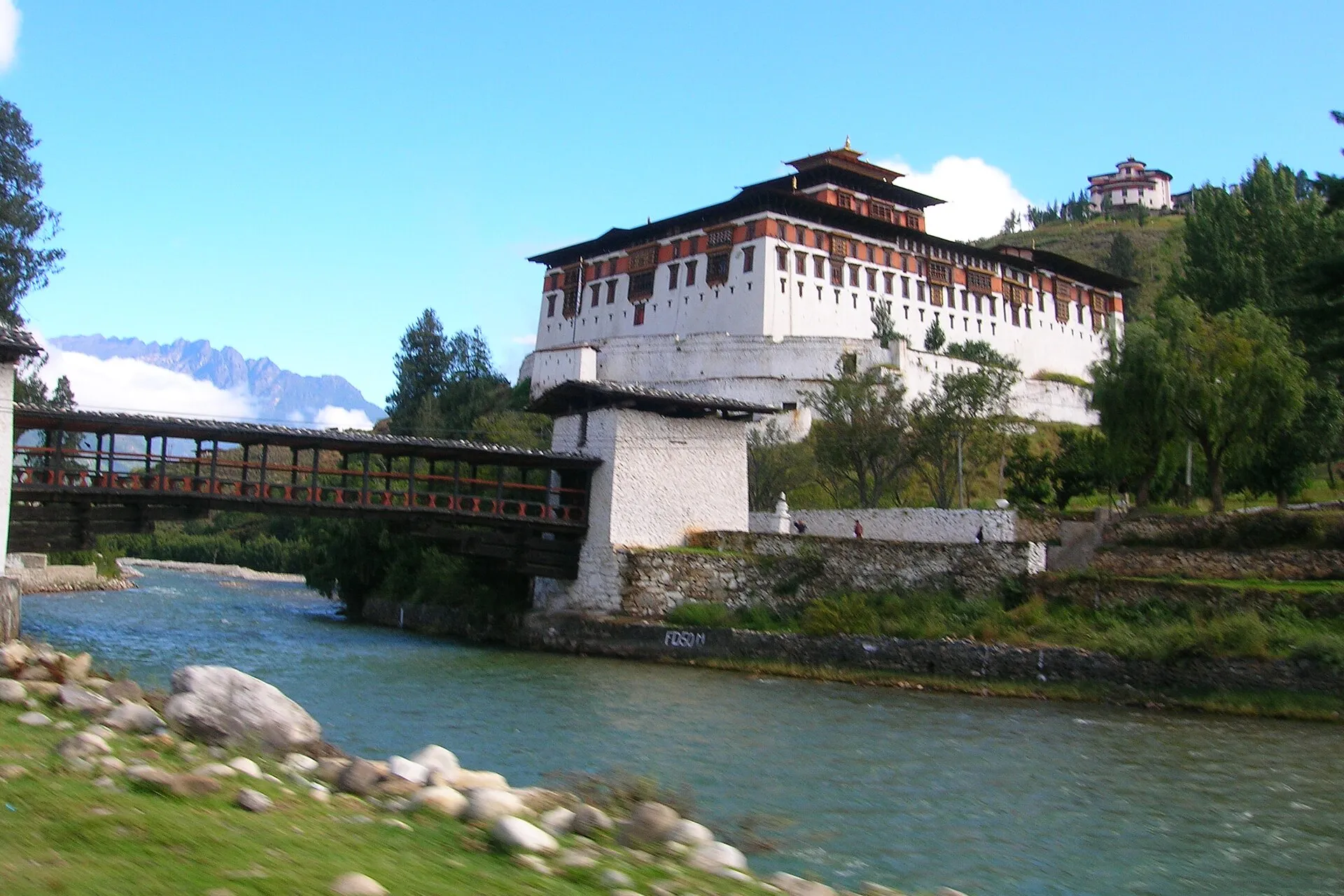
The valley where Bhutan begins
Paro International Airport is Bhutan's only international airport, so for most travellers the country starts in this valley. It is also the most visited stop on the standard western circuit: the Bhutan Tourism Monitor report for 2018, the latest edition with a district table that we could find, counted 62,781 visits to Paro against 60,100 to Thimphu and 53,555 to Punakha. Paro is a small town, with a population of 11,448 in 2017, so the sights are spread across the valley rather than packed into streets.
The valley rewards a slow first day. At around 2,200 metres you are already high, and the headline sight, the Tiger's Nest, sits at 3,120 metres. Most of what makes Paro worth two or three nights rather than a transfer stop is close together: Rinpung Dzong and the National Museum above the town, Kyichu Lhakhang and Dungtse Lhakhang on the valley floor, the ruins of Drukgyel Dzong up the valley, and a spring festival that fills the dzong grounds with dancers and families in national dress.
The honest complications
Paro is a quiet town. Do not expect a nightlife scene, and plan your evenings around dinner and an early start. Flights into Paro operate only in visual conditions between sunrise and sunset, according to the Department of Air Transport, so cloud and wind can shift arrivals. Entry fees have changed more than once since 2022, so treat any specific figure here, including the ones below, as a starting point to confirm with your licensed tour operator. A Department of Tourism notification of 8 April 2026 requires tourists to be accompanied by a licensed guide at all times, including at monument sites.
The Tiger's Nest is the one sight that decides the shape of your stay. It is a hike at altitude, not a short stroll, and it is better done after a night or two in the valley. See the Bhutan country guide for visas, the Sustainable Development Fee and how trips are arranged.
Four corners of one valley
Paro is the district seat, but the valley is where the interesting places to sleep and see are. Where you base yourself matters more here than in Thimphu, because the lodges sit in different parts of the valley.
Paro Town
The compact town centre along the main street is where the restaurants, cafes and shops are, and where the weekend vegetable market is held. Rinpung Dzong and the National Museum sit just above it, with the traditional wooden bridge over the Paro Chhu leading to the dzong. It is the practical base if you want to walk to dinner.
Airport and Bondey
The area around the airport is where Tou Zaiga, the training restaurant of the Bongde (Bondey) Institute of Hotel and Tourism, is based, and COMO Uma Paro describes itself as about a 10-minute drive from the airport. Handy for arrival and departure days.
Hillside lodges
The most distinctive places to stay sit out of town among the pines. COMO Uma Paro occupies a tree-clad hill overlooking Paro, Amankora Paro is hidden in pine forest in the Paro valley, and Zhiwa Ling Heritage is at Satsam Chorten at 2,200 metres, within sight of Taktsang. Expect a drive into town rather than a walk.
Upper valley and Drukgyel
Further up the valley, around 16 kilometres from Paro town according to Wikipedia, the ruins of Drukgyel Dzong stand in the upper part of Paro district. It is a side trip rather than a base, but Amankora's dining room terrace looks out toward it.
Three valley lodges worth the detour
Paro's best-known places to stay are luxury lodges set apart from the town. We only list properties whose own sites we could check, and we leave out rates because they vary by season and by how your trip is packaged. Check prices with your operator or the property.
Amankora Paro is a 24-suite lodge hidden in pine forest at 2,250 metres. Each suite is 52 square metres with a king bed and a wood-burning stove, the dining room terrace overlooks Drukgyel Dzong, and the lodge lists a four-hour hike to Taktsang (Tiger's Nest) among its experiences.
COMO Uma Paro sits on a tree-clad hill overlooking the town, about a 10-minute drive from the airport. It has its own restaurant, Bukhari, and the COMO Shambhala spa with an indoor pool and gym.
Zhiwa Ling Heritage is a 45-room hotel at Satsam Chorten, at 2,200 metres, within sight of Taktsang and the Paro Chhu. Its room types run from 49 square metre Junior Suites to a 220 square metre Royal Raven Suite, and its spa, Menlha & Healing, draws on Bhutanese healing traditions.
For anything simpler, Paro has plenty of guesthouses and mid-range hotels that we have not individually verified, so we do not name them here. Your licensed operator will normally book accommodation as part of the trip, and the Thimphu guide covers the capital's wider hotel range.
Thukpa in town, organic produce in the valley
Many visitors eat most meals through their tour arrangement, but Paro has a small set of places worth choosing yourself. We list only places that at least two independent listings or the venue's own site confirmed, and leave out prices because we could not source current menus.
Sonam Trophel Restaurant
A restaurant above Paro Canteen at the Tshongdue (town centre), known for thukpa, the Bhutanese noodle soup. Local guides note that it closes early, so go for lunch or an early dinner.
Bukhari at COMO Uma Paro
The main restaurant at COMO Uma Paro, serving Bhutanese cuisine with a menu that changes with the season. Much of the produce comes from the hotel's organic kitchen garden, grown with local Paro Valley farmers.
Tou Zaiga
Run by trainees of the Bongde (Bondey) Institute of Hotel and Tourism, Tou Zaiga blends Western and Bhutanese dishes built on local seasonal organic produce, according to Lonely Planet. A tailored three-course Bhutanese menu is available if you call the day before. Check it is open before you drive out, since one recent reviewer found it closed.
Mountain Cafe
A vegetarian cafe in the town centre with breakfast, brunch and coffee, and a menu that includes salads, pastas and pizzas. A useful change from chili and cheese for a day.
A fortress, a museum, a cliff and a festival
Paro's sights are old, active religious sites rather than museums, and a Department of Tourism notification of 8 April 2026 requires tourists to be accompanied by a licensed guide at all times, including at monument sites. Fees below come from Bhutan Broadcasting Service reporting on the Department of Tourism's revised entry fees and from the museum's own site; confirm before you go, because they have changed recently.
Paro Taktsang, the Tiger's Nest
The monastery complex clings to a cliff at 3,120 metres, about 900 metres above the valley floor. The complex was formally built in 1692 by Gyalse Tenzin Rabgye, on a site tied to Padmasambhava, who legend says flew here from Singye Dzong on the back of a tigress. A fire in the main building in April 1998 was followed by a restoration completed in 2005. Entry is Nu 1,000 for adults and Nu 500 for children aged 6 to 17. Amankora describes the hike as four hours there and back from its lodge; the country guide gives 4-5 hours, so plan a morning and start early.
Rinpung Dzong and the National Museum
Rinpung Dzong, the fortress above the town, was ordered built by the Zhabdrung Ngawang Namgyal in the 1640s, and you approach it over a traditional wooden bridge across the Paro Chhu. Reporting on the revised fee list says visitors no longer pay to enter it. Above it, the National Museum of Bhutan is open 9 a.m. to 5 p.m. (the ticket counter closes at 4 p.m.) every day except government and local holidays; tourist admission is Nu 500, according to the museum's own website.
Kyichu Lhakhang and Dungtse Lhakhang
Kyichu Lhakhang dates to the 7th century and is credited to King Songtsen Gampo; its main image is an original 7th-century Jowo Shakyamuni statue. Dungtse Lhakhang is a circular, chorten-style temple of three floors attributed to the bridge-builder Thangtong Gyalpo. Entry is Nu 500 at each, and Dungtse only began charging after being recognised as a national monument.
Drukgyel Dzong
The ruined fortress in the upper valley was built in the 1640s to commemorate a victory over Tibetan invaders, and was almost completely destroyed by fire in the early 1950s. Wikipedia lists it on Bhutan's tentative list for UNESCO World Heritage. It makes an easy extra stop on the way up the valley.
The Paro Tshechu
Paro's big festival is held at the Deyangkha festival ground beside Rinpung Dzong and runs for five days. The Department of Tourism's tentative 2027 festival list gives 18 to 22 March 2027, with the thongdrel, the giant sacred appliqué, unveiled on the final day; Little Bhutan reports it is unfurled at about three in the morning. The list is marked tentative and the dates follow the lunar calendar, so reconfirm with your operator before buying flights. Dress as for a dzong visit, with long trousers or a long skirt and covered shoulders, and book six to nine months ahead.
One, two or three days in the valley
Most trips treat Paro as the first and last stop of the western circuit. These routes assume you sleep in the valley and let the altitude settle before the Tiger's Nest.
- Morning
Rinpung Dzong and the National Museum. Cross the wooden bridge, then climb to the museum while the museum is open from 9 a.m.
- Midday
Lunch in town. Thukpa at Sonam Trophel, or coffee and a change of pace at Mountain Cafe.
- Afternoon
Kyichu Lhakhang and Dungtse Lhakhang. Two of the valley's oldest temples, both on the valley floor.
- Evening
Dinner in the valley. Bukhari at COMO Uma Paro, or Tou Zaiga if you have called ahead.
- Day 1
The valley sights: Rinpung Dzong, the National Museum, Kyichu Lhakhang and Dungtse Lhakhang, at an easy pace to adjust to the altitude.
- Day 2 morning
Paro Taktsang. Start early for the hike to the Tiger's Nest. Amankora describes it as a four-hour round trip from its lodge.
- Day 2 afternoon
Recover in town. A late lunch, then a slow walk along the main street.
- Days 1-2
The two-day route above, with the weekend vegetable market if your dates line up.
- Day 3, option A
Drukgyel Dzong. The ruined fortress in the upper valley.
- Day 3, option B
Haa Valley via Chele La. A pass about 35 kilometres from Paro, commonly given as 3,988 metres, and a quieter valley beyond.
One runway in, a private driver out
Paro International Airport (PBH) is Bhutan's only international airport, and only Drukair and Bhutan Airlines are authorised to fly into it. The Department of Air Transport says flights operate only under visual conditions between sunrise and sunset, so build slack into onward connections. Paro town and the main sights are within the same valley, and most visitors are driven by their operator's driver rather than arranging transport themselves.
To reach Thimphu, the road is about 54 kilometres and takes roughly 1 to 1.5 hours on a paved mountain road. Paro town itself is small enough to walk around, while the lodges, Kyichu Lhakhang, the Tiger's Nest trailhead and Drukgyel Dzong are a drive away. See the Bhutan country guide for how transport is arranged and which airlines serve which cities.
Best time to visit and the Paro Tshechu
March to May and September to November are the usual recommendation for Paro, with spring bringing blooming rhododendrons and the Paro Tshechu, and autumn clear skies and mountain views. December to February is dry and cold. June to August is the monsoon, with muddy trails and more cloud.
Practical prep: mornings and evenings are much colder than afternoons in every season, so bring layers, and an eSIM before landing saves a queue at arrivals. If you want the 18-22 March 2027 Paro Tshechu, plan early.
Fixed fees first, then everything else
Bhutan's costs start with fixed fees that do not change with your budget. We list only figures we could source and do not give daily budget ranges for Paro, because hotel, guide and transport prices depend on how your trip is packaged. Ask your licensed operator for a current quote.
- Sustainable Development Fee: 100 US dollars per person per night
- Visa application fee: 40 US dollars, one time
- Both are arranged through your licensed operator
- Children's rates differ; ask your operator
- Paro Taktsang: Nu 1,000 adults, Nu 500 children 6-17
- Kyichu Lhakhang: Nu 500
- Dungtse Lhakhang: Nu 500
- National Museum of Bhutan: Nu 500 for tourists
- Rinpung Dzong: no entry fee reported
A Level 1 country, with altitude as the real issue
The US State Department lists Bhutan at Level 1, Exercise Normal Precautions (advisory dated 4 September 2026), and describes it as generally safe. It notes that medical services are limited, especially in rural areas, and that the country regularly sees flooding, landslides and wildfires and is vulnerable to earthquakes. Enrolling in the Smart Traveler Enrollment Program is recommended.
In Paro the practical concern is altitude. The town is around 2,200 metres and the Tiger's Nest is at 3,120 metres, so pace your first day and keep the hike for a day when you have slept in the valley. Royal Bhutan Police list 113 as the general emergency hotline, 112 for ambulance and medical emergencies, 110 for fire and rescue, and 111 for traffic. For scams and what to watch for before you travel, see the Bhutan travel alerts.
Thimphu and Haa are the natural next stops
Paro is the start of the western circuit, so its day trips are really the next legs of the trip. Both involve mountain roads, so allow extra time.
Thimphu
Bhutan's capital is the usual next overnight: Tashichho Dzong, the Buddha Dordenma and the weekend market. Our Thimphu city guide covers where to stay and eat, and what to do in two or three days.
Haa Valley and Chele La
The road to Haa climbs over Chele La, commonly given as 3,988 metres and described as Bhutan's highest motorable pass, on the divide between the Paro and Haa valleys. It is paved but narrow and steep, and can be dangerous in winter because of snow and ice. Sources put the drive from Paro to the pass at anything from about an hour to two hours.
Paro FAQ
Is Paro safe for tourists?
Yes. The US State Department rates Bhutan Level 1, Exercise Normal Precautions (advisory dated 4 September 2026), and describes it as generally safe. It does flag limited medical services, especially in rural areas, plus flooding, landslides, wildfires and earthquake risk. The practical everyday concern in Paro is altitude, since the town sits around 2,200 metres.
What is the Tiger's Nest and how much does it cost to enter?
Paro Taktsang, the Tiger's Nest, is a cliffside monastery complex at 3,120 metres, about 900 metres above the Paro valley floor, built in 1692. Recent Bhutan Broadcasting Service reporting puts entry at Nu 1,000 for adults and Nu 500 for children aged 6 to 17. Confirm with your operator before you go.
When is the Paro Tshechu in 2027?
The Department of Tourism's tentative 2027 festival list gives 18 to 22 March 2027 at Rinpung Dzong, with the thongdrel unveiled on the last day. The dates follow the Bhutanese lunar calendar and the list is marked tentative, so reconfirm with your operator before booking non-refundable flights.
Does every international flight land in Paro?
Yes. Paro International Airport is Bhutan's only international airport, and only Drukair and Bhutan Airlines are authorised to fly into it. The Department of Air Transport says flights operate only in visual conditions between sunrise and sunset, so weather can delay arrivals and departures.
How do I get from Paro to Thimphu?
By road, roughly 54 kilometres in about 1 to 1.5 hours on a paved mountain road. Most visitors are driven by their licensed tour operator's driver as part of the arranged trip.
What is the best time to visit Paro?
March to May and September to November are the usual recommendation, with clear mountain views and the Paro Tshechu in spring. December to February is cold and dry, and June to August is the monsoon.
Do I need a guide in Paro?
Yes. A Department of Tourism notification of 8 April 2026 says tourists must be accompanied by a licensed tour guide at all times, including while visiting monument sites and when travelling from Paro airport to other districts. Confirm current terms with your licensed tour operator or bhutan.travel.
How much does it cost to visit Paro?
Every visitor pays Bhutan's Sustainable Development Fee of 100 US dollars per person per night, plus a one-off 40 US dollar visa fee. On top of that come hotel, meals, transport and entry fees such as Nu 1,000 for the Tiger's Nest. See the Bhutan country guide for the full cost picture.
Is the National Museum of Bhutan in Paro?
Yes. The National Museum sits above Rinpung Dzong. According to its own website it is open 9 a.m. to 5 p.m. with the ticket counter closing at 4 p.m., every day except government and local holidays, and tourist admission is Nu 500.
Can I visit Haa Valley from Paro?
Yes. The road to Haa climbs over Chele La, commonly given as 3,988 metres and described as Bhutan's highest motorable pass, about 35 kilometres from Paro. Sources put the drive to the pass at between one and two hours, and the road can be icy in winter.
What Stays With You
Paro is where the plane banks between the ridgelines and the valley appears, and where the first breath of thin pine air tells you that you have arrived somewhere that does things at its own pace. The sights are real and in use: a fortress still serving its community, temples that have been tended since the 7th century, a monastery that burned in 1998 and was rebuilt.
Walk back over the wooden bridge toward Rinpung Dzong at the end of a day and notice how quiet it is. That quiet is the point.