
What You're Actually Getting Into
Bangladesh does not do things by half measures. It packs roughly 178 million people into a delta smaller than the state of Iowa, making it one of the most densely populated countries on the planet, and yet outside Dhaka the landscape is startlingly green: rice paddies, river channels, and the world's largest mangrove forest at the southern edge. The country has also just been through two political upheavals in two years: a 2024 uprising that ended 15 years of one party's rule, an interim government led by a Nobel Peace Prize laureate, and, as of February 2026, its first elected government since. Travelers who come expecting a quiet detour from the South Asia trail instead find one of the most intense, unfiltered places on the continent to visit.
Very few Western tourists make it here, which cuts both ways. Infrastructure for independent travelers is thinner than in neighboring India or Thailand, English is spoken unevenly outside hotels and universities, and Dhaka's traffic is genuinely one of the worst in the world. But the flip side is a country where a foreign visitor is still a novelty rather than a target, where a plate of kacchi biryani costs less than a coffee back home, and where UNESCO-listed rickshaw art rolls past you on every street rather than sitting behind glass in a museum.
The honest complications
Dhaka's traffic is not an exaggeration: cross-city trips that should take 20 minutes can take two hours, and this shapes every day you spend in the capital. The country is still stabilizing politically after 2024, and while the February 2026 election passed without major incident, demonstrations can still form quickly and are worth avoiding on principle. Outside Dhaka's international hotels, cash is king, English is patchy, and the tourist infrastructure that exists elsewhere in South Asia (fixed-price tourist buses, well-worn backpacker circuits, English menus everywhere) is much thinner here. None of this makes Bangladesh a hard place to visit responsibly, but it does mean building in more flexibility and patience than a first-time visitor to, say, Thailand or Vietnam would need.
A History Worth Knowing
Bangladesh's modern identity was forged twice in one generation: first by a language, then by a war. Understanding both explains almost everything about how the country sees itself today, from its national symbols to the political turbulence of the last two years.
- 21 Feb 1952
The Language Movement. Students and activists in Dhaka were killed protesting Pakistan's attempt to impose Urdu as the sole state language. The date is now Ekushey February, a national holiday, and UNESCO's International Mother Language Day worldwide.
- 1971
The Liberation War. Nine months of war ended West Pakistani rule over what was then East Pakistan, and Bangladesh became independent on 16 December 1971 under founding leader Sheikh Mujibur Rahman.
- 1971-2024
Decades of growth and instability. Cycles of military and civilian rule gave way to a long period of two-party politics, and, from 2009, 15 unbroken years under Sheikh Hasina and the Awami League.
- Jul-Aug 2024
The uprising. Student-led protests against a civil service job quota escalated into a mass movement that forced Sheikh Hasina from power on 5 August 2024. Nobel laureate Muhammad Yunus took over as head of an interim government on 8 August.
- 12 Feb 2026
The election. Bangladesh's first general election since the uprising. The Bangladesh Nationalist Party, led by Tarique Rahman, won a landslide two-thirds majority and formed the new government.
Read the full history: from the Mughals to the 2026 election
The Bengal delta has been a center of trade and culture for over a thousand years, ruled in turn by Buddhist Pala kings, the Hindu Sena dynasty, and from the 13th century onward, a series of Muslim sultanates and then the Mughal Empire, which made Dhaka a provincial capital in the 17th century. British colonial rule from the mid-18th century restructured the region around jute and indigo exports, and the 1947 Partition of British India split Bengal along religious lines, with the Muslim-majority east becoming East Pakistan, over a thousand kilometers from the seat of power in West Pakistan.
The mismatch was immediate: East Pakistan had the majority of the population but a fraction of the political and economic power, and the 1952 imposition of Urdu as sole state language, in a region that spoke Bangla, became the first flashpoint. Economic grievance and political exclusion built for two more decades until the Pakistani military's crackdown on East Pakistan in March 1971 triggered a nine-month war. Estimates of the dead vary widely and remain politically contested, ranging from the hundreds of thousands into the millions; independence was achieved on 16 December 1971 with support from India.
The following five decades saw repeated swings between civilian and military government, including the 1975 assassination of founding leader Sheikh Mujibur Rahman, before a return to electoral politics in the 1990s dominated by two rival parties: the Awami League, associated with Mujibur Rahman's daughter Sheikh Hasina, and the Bangladesh Nationalist Party (BNP). Hasina's Awami League held power from 2009 until 2024, a period of significant economic growth in the garment export sector alongside growing complaints about democratic backsliding, corruption and a shrinking space for dissent.
The 2024 uprising and after. What began in July 2024 as student protests against a controversial quota system for government jobs escalated after a violent state crackdown into a nationwide movement demanding Hasina's resignation. She fled the country on 5 August 2024. An interim government led by Muhammad Yunus, the microfinance pioneer and 2006 Nobel Peace Prize laureate, took over days later with a mandate to stabilize the country, pursue accountability for the crackdown, and organize new elections. After a series of delays and disputes over timing, the election was set for 12 February 2026; the BNP won a decisive two-thirds majority, and Yunus, who had said from early on that he did not intend to stay in power after the vote, handed over to the newly elected government.
Top Destinations
Bangladesh divides into four zones worth knowing: the capital and its day trips, the Sundarbans mangrove forest in the southwest, the coast around Cox's Bazar in the southeast, and the tea hills of Sylhet in the northeast. Domestic flights connect the far-flung ones; nothing here is a quick hop from anywhere else, so pick two or three rather than trying to see all four on a first trip.
Dhaka, the megacity capital
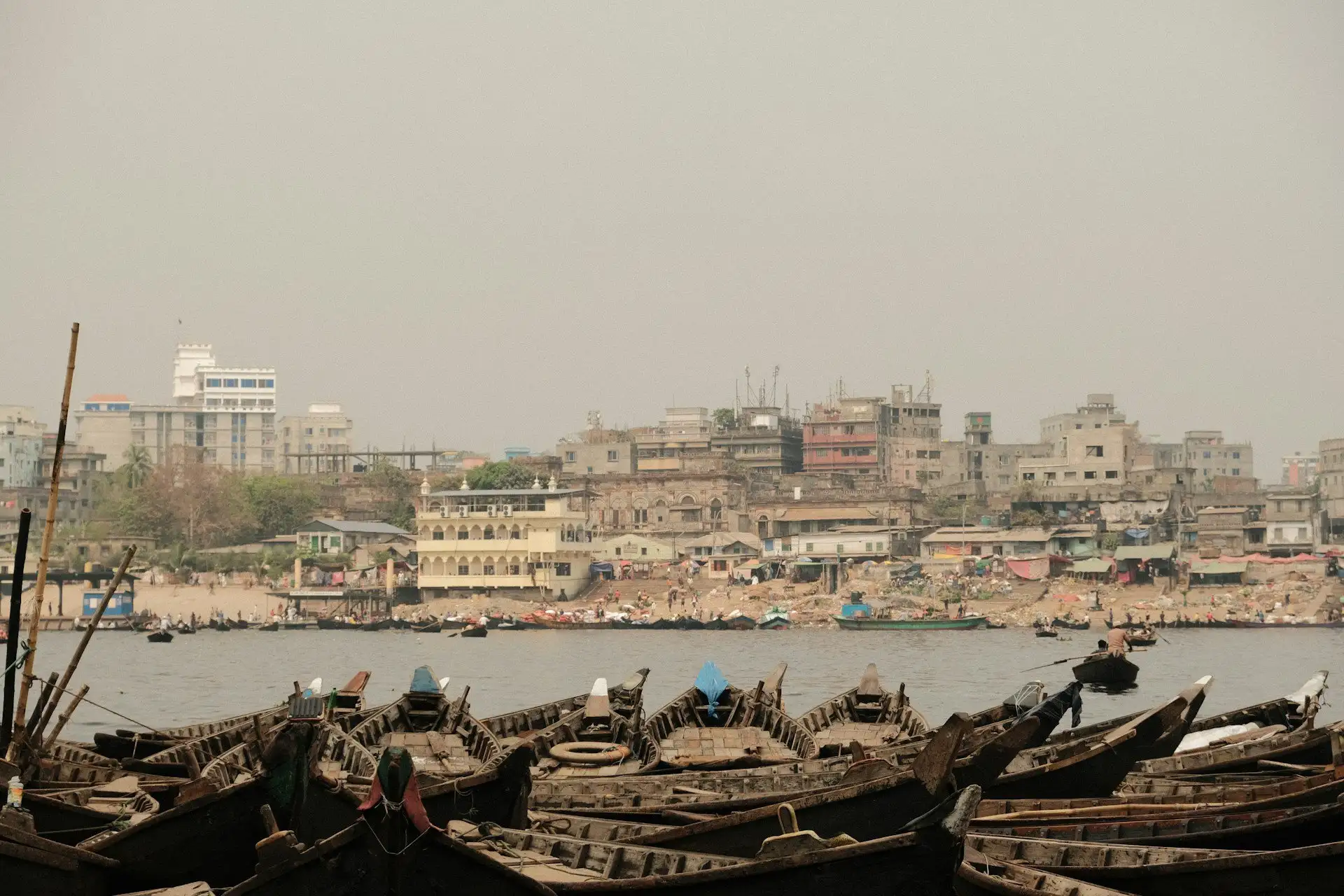
Dhaka is where nearly every trip to Bangladesh starts and, for most travelers, where it's based throughout. Old Dhaka's Mughal-era core, Lalbagh Fort and the Sadarghat river port, sits in obvious contrast to the diplomatic quarter of Gulshan and Banani, with their five-star hotels and embassy row. See our full Dhaka city guide for neighborhoods, food and a proper itinerary.
The world's largest mangrove forest
The Sundarbans is a UNESCO World Heritage Site spanning roughly 10,000 square kilometers across the Bangladesh-India border delta, and the last real stronghold of the wild Royal Bengal tiger, with an estimated 100 to 150 individuals on the Bangladesh side. Crocodiles, spotted deer, and Irrawaddy dolphins share the tidal channels. This is not a day trip: multi-day boat tours run from Khulna or Mongla, sleeping aboard, and tiger sightings are genuinely rare, this is a landscape and wildlife trip, not a safari guarantee.
Cox's Bazar, the world's longest beach
Cox's Bazar stretches 120 kilometers along the Bay of Bengal, the longest unbroken natural sea beach anywhere on earth. It is also Bangladesh's most developed beach resort town, meaning hotel infrastructure is real but the beach itself gets crowded near the town center; walk further out for space. It's a 55-minute flight from Dhaka or a long overnight bus. Note that the areas near the Myanmar border and the refugee camps to the south of Cox's Bazar town are advised against by most governments and are not part of any standard visit.
Sylhet & the Srimangal tea gardens
Northeastern Bangladesh is the country's tea-growing heartland, with more than 150 estates rolling across the hills around Sylhet and, especially, Srimangal, nicknamed the tea capital of Bangladesh. The terraced tea gardens are some of the most photographed landscapes in the country and a genuine change of pace from the delta lowlands: cooler, greener, and quieter. A domestic flight from Dhaka to Sylhet takes about 40 minutes.
One thing worth planning around
Paharpur (Somapura Mahavihara)
A 27-acre quadrangular monastery complex from the 8th century, with a cruciform central shrine visible from a distance across the surrounding plains. Far fewer visitors than anywhere else on this list.
Sonargaon & Panam City
An abandoned 19th-century merchant town of ornate, decaying facades, plus the Folk Arts Museum and a boat ride on the Meghna. The single best day trip from the capital.
The tea estates
Terraced hillsides of tea bushes stretching to the horizon, with pineapple and lemon groves worked into the same land. Best seen slowly, on foot or by rented bicycle.
Culture & Etiquette
Bangladesh is roughly 90 percent Muslim, with a significant Hindu minority and smaller Buddhist and Christian communities, and Bangla (Bengali) is both the everyday and the ceremonial language: the country's identity is built as much around its language as its religion, a legacy of 1952. Hospitality runs deep and direct; expect curiosity, questions, and often outright generosity from strangers, especially outside Dhaka's more jaded tourist zones.
Do
- Dress modestly. Shoulders and knees covered for both men and women, looser and less fitted clothing generally, especially outside Gulshan and Banani's international hotels.
- Eat with your right hand if eating without cutlery, as is standard across South Asia; the left hand is considered unclean for eating.
- Remove your shoes before entering homes, mosques and temples.
- Learn a few Bangla words. Dhonnobad (thank you), Assalamu alaikum (a common greeting), Kemon achen? (how are you). Even a little effort is warmly received.
- Carry cash. Bangladesh runs on taka outside international hotels; cards are unreliable even in Dhaka's mid-range restaurants.
Don't
- Photograph people, especially women, without asking first. Ask, and accept no gracefully.
- Show public affection. Holding hands as a couple is generally fine; anything more is not.
- Drink alcohol in public. Legal for foreigners in licensed hotel bars and clubs, illegal on the street.
- Walk into a demonstration or political gathering out of curiosity. They can turn unpredictable quickly, and it is a genuine safety recommendation, not just etiquette.
- Assume Dhaka traffic will move on your schedule. Build in double the time you think a crossing-town trip needs.
Deeper culture: rickshaw art, the 1971 legacy, and Bengali New Year
Rickshaw art. On 6 December 2023, UNESCO inscribed "Rickshaws and rickshaw painting in Dhaka" on its Representative List of the Intangible Cultural Heritage of Humanity, Bangladesh's fifth such listing. Street artists hand-paint the canvas hoods and body panels of cycle rickshaws with folk motifs, film stars, birds, flowers and scenes from history: a living, working art form rather than a museum piece, and one you'll see on nearly every street in the country.
The weight of 1971. The Liberation War remains close to the surface of public life: war memorials, museums and the annual 16 December Victory Day and 26 March Independence Day observances are taken seriously across the political spectrum, even amid the sharp divisions of the last two years.
Pohela Boishakh. The Bengali New Year, usually mid-April, is marked with processions, music and the traditional breakfast of panta bhat (fermented rice) with fried fish and green chili, a rare moment of shared, largely secular national celebration.
Food & Drink
Bangladeshi food is rice, fish and mustard oil at its core, distinct from the North Indian food most Western travelers know as "Indian food," with its own biryani tradition, its own sweets, and a national obsession with hilsa, the fish that shows up in poetry as often as on plates.
Kacchi Biryani 300-800 BDT
Dhaka's signature dish: marinated raw mutton and basmati rice cooked together in a sealed pot, rather than layered and steamed separately as in most other biryani traditions. Judge a Dhaka trip by how many plates of this you eat.
Hilsa (Ilish) Seasonal
The national fish, bony and rich, traditionally cooked in mustard oil and mustard paste. Best from monsoon through early autumn, when the fish runs upriver from the Bay of Bengal.
Fuchka ~30-60 BDT
Bangladesh's version of the South Asian panipuri: crisp hollow shells filled with spiced potato and chickpeas, doused with tangy tamarind water. Sold from carts everywhere, best eaten hot and fast.
Mishti Doi ~50-100 BDT
Sweetened, caramelized yogurt set in clay pots, a Bengali dessert staple found everywhere from street stalls to five-star hotel buffets.
Panta Bhat
Rice soaked overnight in water and lightly fermented, traditionally eaten for breakfast with fried fish, onion and green chili. The centerpiece of Pohela Boishakh, the Bengali New Year.
Rasmalai & Rasgulla
Bengal's milk-based sweets, spongy cheese balls soaked in cardamom cream (rasmalai) or light sugar syrup (rasgulla). Every neighborhood sweet shop has its own version.
When to Go & Itineraries
November through February is unambiguously the best window: dry, sunny, and 12-25C, a real relief after the heat and rain of the rest of the year. March through May turns hot, with temperatures regularly over 40C, and June through October is the monsoon, when parts of southeastern Bangladesh can see 1,000mm of rain in a single month, roughly the UK's entire annual rainfall.
All three seasons compared
| Season | Verdict | Temps | Notes |
|---|---|---|---|
| Nov-Feb | Best | 12-25°C | Dry, low humidity, the only realistic Sundarbans/trekking window |
| Mar-May | Hot | Up to 40°C+ | Pre-monsoon heat builds; humid and uncomfortable by May |
| Jun-Oct | Avoid if possible | 28-34°C | Monsoon; heavy rain, flooding risk, disrupted transport |
Itineraries
- Days 1-3
Dhaka. Old Dhaka's Lalbagh Fort and Sadarghat, the National Parliament House, Gulshan and Banani for food, and a day trip to Sonargaon and Panam City.
- Days 4-5
Cox's Bazar. Fly down for two days on the world's longest beach, staying north of the town center for space and quiet.
- Days 6-7
Sylhet or Srimangal. Fly back via Sylhet for a night among the tea gardens before returning to Dhaka for departure.
- Days 1-3
Dhaka extended. The 7-day Dhaka plan plus more time in Old Dhaka's markets and the National Museum.
- Days 4-7
The Sundarbans. A multi-day boat trip from Khulna or Mongla, sleeping aboard, through the mangrove channels.
- Days 8-10
Cox's Bazar. Three days on the beach, with time to properly explore beyond the town center.
- Days 11-14
Sylhet & Srimangal. The tea gardens at a slower pace, plus a stop at Paharpur en route back if travel time allows.
Getting there & around
Hazrat Shahjalal International Airport (DAC) in Dhaka is the main gateway, with connections from the Gulf, Southeast Asia and a handful of European hubs. Domestic flights from Dhaka reach Chittagong, Cox's Bazar, Sylhet and Jessore in well under an hour and are the only practical way to cover the country's distances on a normal trip. Within cities, Uber and Pathao operate ride-hailing in Dhaka and Chittagong, and CNG auto-rickshaws (small green three-wheelers) and cycle rickshaws cover shorter distances everywhere else.
Budget Planning
Bangladesh is inexpensive by nearly any international standard, with the caveat that Dhaka's international-standard hotels (the kind with reliable hot water, English-speaking staff and Western toilets) cost noticeably more than everything else in the country. As of early August 2026, one US dollar buys roughly 124 taka.
- Local guesthouse or budget hotel
- Street food and local restaurants
- CNG auto-rickshaws and buses
- Free or low-cost sites
- Business-class hotel in Gulshan/Banani
- Restaurant meals, occasional hotel bar
- Ride-hailing apps for most trips
- Domestic flights between regions
- 5-star international hotels
- Private guide and driver
- Multi-day Sundarbans boat tour
- Domestic flights, no overland buses
Quick reference prices
| Kacchi biryani, local restaurant | 300-800 BDT |
| Fuchka, street cart | ~30-60 BDT |
| CNG auto-rickshaw, short trip | 100-300 BDT |
| Airport taxi to Gulshan/Banani | $18-43 |
| Domestic flight, Dhaka-Cox's Bazar | $50-100 |
| Lalbagh Fort entry (foreign visitor) | 200 BDT |
| 5-star hotel, Gulshan/Banani | $150+/night |
Prices reflect August 2026 research and drift over time, especially the BDT exchange rate, which has been weakening through the year. Treat them as a planning baseline.
Visa & Entry
Many nationalities, including the US, UK, EU, Canada, Australia, New Zealand, and most of East Asia and the Gulf, are eligible for a 30-day single-entry visa on arrival at Dhaka's Hazrat Shahjalal International Airport, or at Chittagong or Sylhet international airports. It is not guaranteed: the final decision rests with the immigration officer on duty, and it is not reliably available at land border crossings, so arriving by air is the safer route if you're relying on it.
✓ Valid passport
At least 6 months validity is the safe standard to travel with, though requirements can vary; check before you fly.
✓ Return/onward ticket
May be requested at immigration, along with proof of accommodation for your stay.
✓ Visa fee in USD or major currency
Fees vary by nationality; have cash in a major currency ready, as card payment on arrival is not reliable.
✓ Air arrival, not land
Visa on arrival works reliably at the three international airports; land border crossings should not be relied on for this.
Safety, Solo Women & the Current Situation
On 1 August 2026, the US State Department lowered its Bangladesh travel advisory from Level 3 (Reconsider Travel) to Level 2 (Exercise Increased Caution), citing improved conditions since the 2024 uprising and the peaceful February 2026 election. That's a genuinely meaningful downgrade, not a rounding error, and it reflects real, recent stabilization. It is not the same as saying Bangladesh is a low-risk destination: crime, occasional unrest and a still-consolidating political system remain part of the picture, and this guide treats it accordingly.
Demonstrations
Can form with little warning and turn confrontational quickly, a legacy of 2024 that hasn't fully faded. Avoid any gathering, political or otherwise, on principle, and check local news before heading into central Dhaka on short notice.
Petty crime & traffic
Pickpocketing and bag-snatching happen in crowded markets and on public transport; Dhaka's traffic, not crime, is the more constant daily hazard, and pedestrian caution is genuinely necessary.
Restricted areas
The Chittagong Hill Tracts and the areas near the Myanmar border and the refugee camps south of Cox's Bazar are advised against by most governments and are not part of any standard tourist route.
Solo women, emergency numbers, and embassy contacts
Solo women. Bangladesh takes more preparation than most of Southeast Asia for solo female travelers. Expect stares and occasional unwanted attention, particularly on public transport; a Salwar Kameez or similarly modest, loose-fitting outfit reduces friction considerably. Prefer ride-hailing apps and pre-arranged transport over walking alone after dark outside the hotel districts of Gulshan and Banani.
Emergency numbers. Dial 999 from any phone, including at zero balance, for police, fire or ambulance: a free, 24/7 national service run by Bangladesh Police.
Health. Tap water is not safe to drink; stick to bottled or filtered water throughout the trip. Dengue fever is present, especially during and after the monsoon; use repellent and cover up at dusk.
Emergency numbers
Bangladesh FAQ
Is Bangladesh safe to visit?
The US State Department lowered Bangladesh from Level 3 to Level 2, Exercise Increased Caution, on 1 August 2026. Dhaka and the main tourist areas are visitable with normal precautions; the Chittagong Hill Tracts and the areas near the Myanmar border and the refugee camps near Cox's Bazar are still advised against.
Do I need a visa for Bangladesh?
Many nationalities, including the US, UK, EU, Canada, Australia and most of East Asia and the Gulf, can get a 30-day single-entry visa on arrival at Dhaka, Chittagong or Sylhet international airports. It is not guaranteed and is issued at the immigration officer's discretion, and it is not reliably available at land borders.
How much does Bangladesh cost per day?
Budget travelers manage on $20-35 a day outside Dhaka's international-standard hotels. A kacchi biryani meal costs 300-800 taka (about $2.50-6.50), and a CNG auto-rickshaw ride across town runs 100-300 taka.
What is the best time to visit Bangladesh?
November to February, the dry winter season, with temperatures of 12-25C and minimal rain. March to May is hot with temperatures over 40C, and June to October is the monsoon, when southeastern Bangladesh can see 1,000mm of rain in a single month.
What is the political situation in Bangladesh right now?
Bangladesh held its first general election since the 2024 uprising on 12 February 2026. The Bangladesh Nationalist Party won a landslide two-thirds majority and formed a government, ending the interim administration led by Nobel laureate Muhammad Yunus.
Can tourists drink alcohol in Bangladesh?
Yes. Bangladesh is a Muslim-majority country with restrictions for its own citizens, but foreigners can legally drink at licensed hotel bars and clubs without a permit. Public drinking is prohibited, and licensed venues close on Fridays and Islamic holidays.
What is the currency in Bangladesh?
The Bangladeshi taka (BDT, symbol Tk or Bengali currency mark). As of early August 2026 one US dollar buys roughly 124 taka. Cards are accepted at international hotels; smaller shops, rickshaws and street food are cash only.
Is the Sundarbans worth visiting?
Yes, if you have the extra days. It is the world's largest mangrove forest shared with India and a UNESCO World Heritage Site, home to an estimated 100-150 Royal Bengal tigers on the Bangladesh side. Multi-day boat trips from Khulna or Mongla are the only realistic way to see it.
How do I get around Bangladesh?
Domestic flights connect Dhaka to Chittagong, Cox's Bazar, Sylhet and Jessore quickly and cheaply. Intercity trains and buses cover the rest of the country; within cities, ride-hailing apps like Uber and Pathao plus CNG auto-rickshaws are the main options.
Is Bangladesh good for solo female travelers?
It takes more preparation than most Southeast Asian destinations. Dress modestly, expect stares and occasional unwanted attention especially on public transport, and prefer ride-hailing apps and pre-booked transport over walking alone after dark outside hotel districts.
What Stays With You
Bangladesh is not an easy add-on to a South Asia itinerary, and it doesn't try to be. It is a country that fought for its language before it fought for its independence, that just elected its first government after two years of upheaval, and that still finds room to hand-paint every rickshaw on the street with birds and film stars and half-remembered folk tales. The traffic will test you. The kacchi biryani will make up for it. And the quiet of the Sundarbans, after the noise of Dhaka, is the kind of contrast that stays with you longer than most postcard views do.
Go with patience, go in the dry season, and go knowing that very few people you meet at home will have been here before you.