
What You're Actually Getting Into
Vietnam is 1,650 kilometers of coastline, mountain and river delta stretched into an S-shape between China and the South China Sea, and the distance matters more than most itineraries admit: Hanoi in the north and Ho Chi Minh City in the south are as different from each other as two cities in the same country can be. The country has moved fast since the 1986 Doi Moi economic reforms opened it up, and tourist infrastructure, from the Reunification Express railway to the new expressways to Ha Long Bay, has largely kept pace with demand.
It is also still one of the cheapest countries to travel well in Asia. A bowl of pho from a street stall costs $1.50 to $2.50. A private room in a well-run hostel runs $10 to $20 a night. The food is the reason many people come back a second and third time: Vietnamese cuisine is built on fresh herbs, rice noodles, fish sauce and grilled meats, eaten on plastic stools at a folding table, and it is genuinely among the best food cultures in the world at any price point.
The honest complications
Traffic is the thing that catches first-time visitors most: Vietnamese cities run on motorbikes in numbers that feel chaotic until you learn to cross the street at a steady pace and let them flow around you. Overland travel between regions eats real time, Hanoi to Ho Chi Minh City is over 1,700 km by road or rail, so most itineraries fly at least one long leg. Tourist-zone hassle, from inflated taxi meters to insistent vendors, is real in the busiest pockets of Hanoi's Old Quarter and Ho Chi Minh City's District 1, though it is manageable with the same awareness you'd use anywhere. None of it changes that Vietnam is, on balance, an easy and rewarding country to travel independently.
A History Worth Knowing
Vietnam spent roughly a thousand years under Chinese rule before independence in 938 CE, a period that still shapes its language, philosophy and cuisine. French colonization from 1858 reorganized the country as Indochina; a first war ended French rule in 1954 and split the country in two, and a second, the Vietnam War, consumed the next two decades before reunification in 1975. What follows is the short version of how the country you're visiting got here.
- 938 CE
Independence from China. Ngo Quyen's victory at the Battle of Bach Dang River ends roughly a millennium of Chinese rule and begins nearly a thousand years of independent Vietnamese dynasties.
- 1858–1954
French Indochina. France seizes Da Nang and Saigon in 1858 and formalizes colonial rule by the 1880s. Resistance builds for decades and comes to a head at Dien Bien Phu in 1954.
- 1954–1975
Division and war. The Geneva Accords split the country at the 17th parallel. The Vietnam War pits communist North Vietnam against the US-backed South until Saigon falls on 30 April 1975.
- 1976
Reunification. North and South Vietnam unify under a socialist government; Saigon is renamed Ho Chi Minh City.
- 1986
Doi Moi. Sweeping market reforms open Vietnam's economy to the world and set the stage for the growth, and the tourism industry, of the following decades.
- 2020s–present
Tourism boom. Visa rules ease, high-speed expressways and expanded flight routes shrink the country, and Vietnam becomes one of Southeast Asia's fastest-growing travel destinations.
Read the full history: Chinese rule, the dynasties, colonization and the war
The millennium of Chinese rule that ended in 938 CE left a permanent imprint on Vietnamese writing, Confucian social structure, and cuisine, even as Vietnam's dynasties, the Ly, Tran, Le and Nguyen among them, fiercely maintained a distinct identity and repeatedly repelled subsequent invasion attempts, including three defeats of the Mongols in the 13th century. The Nguyen dynasty, based in Hue, was the last independent Vietnamese royal house before French colonization absorbed the country into Indochina alongside Cambodia and Laos.
Ho Chi Minh declared independence in Hanoi on 2 September 1945, drawing explicitly on the language of the American Declaration of Independence, but France fought to retain its colony until its defeat at Dien Bien Phu in 1954. The Geneva Accords that followed split Vietnam at the 17th parallel pending elections that never happened, and the resulting Cold War standoff between the communist North and the US-backed South escalated into the Vietnam War, known in Vietnam as the American War, which killed an estimated 2 to 3 million Vietnamese along with roughly 58,000 American service members before Saigon fell in 1975.
The decade after reunification was economically difficult, marked by international isolation and a centrally planned economy that struggled to feed the country. The 1986 Doi Moi ("renovation") reforms introduced market mechanisms and opened Vietnam to foreign investment and trade, triggering three decades of rapid growth that transformed Vietnam from one of the world's poorest countries into a global manufacturing hub and, more recently, one of Southeast Asia's fastest-growing tourism markets.
Top Destinations
Vietnam divides naturally into five travel zones running roughly north to south: Hanoi and the northern lowlands, Ha Long Bay and Ninh Binh's karst country, the mountains around Sapa, the central coast around Hoi An and Hue, and Ho Chi Minh City with the Mekong Delta. The country's length is the real constraint: a week covers the north well, two weeks lets you add the center, and three weeks is what it takes to see the whole thing without a lot of overnight buses.
Hanoi, a thousand years of layered history
Vietnam's capital is one of Asia's most walkable old cities: a tangled Old Quarter of 36 medieval guild streets, French colonial boulevards, and a millennium of continuous settlement around Hoan Kiem Lake. It has our full Hanoi city guide for neighborhoods, food and a full itinerary. Budget two to three days minimum, more if you're using it as a base for Ha Long Bay, Ninh Binh or Sapa.
Ha Long Bay, the limestone seascape
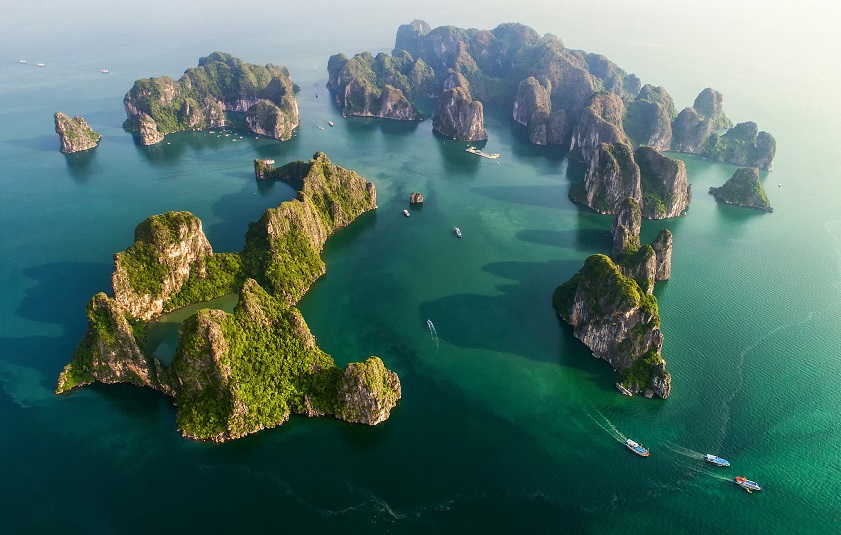
Nearly 2,000 limestone karst islands rising from emerald water, a UNESCO World Heritage Site and Vietnam's single most photographed landscape. Day cruises from Hanoi run $35-80 per person including transport, lunch and kayaking; an overnight cruise on the water is worth the extra cost if you have the time, since the bay is at its best at sunrise and sunset when the day-trip boats have gone. Lan Ha Bay, the quieter southern section, has fewer boats and better beaches.
Ninh Binh, the "Ha Long Bay on land"
Two hours south of Hanoi, Ninh Binh's Trang An and Tam Coc river systems wind between the same limestone karsts as the coast, but by small rowing boat through rice paddies and cave tunnels rather than by cruise ship. A full-day tour ($40-65) typically combines a boat trip, the Hoa Lu ancient capital temples, and either a bike ride or the steep climb up Mua Cave for a viewpoint over the whole valley.
Hoi An, the lantern-lit trading port
A UNESCO-listed Ancient Town of 15th-to-19th-century merchant houses, Japanese and Chinese temples, and a river lined with silk lanterns, largely untouched by the war that damaged much of the rest of the country. Famous for its tailors, who can turn around a made-to-measure suit or dress in 24 to 48 hours, and for the monthly Lantern Festival on the full moon, when the Old Town switches off electric lighting entirely.
Hue, the imperial capital
Home to the Nguyen dynasty's Imperial City, a walled citadel modeled on Beijing's Forbidden City, plus a string of royal tombs set in the countryside along the Perfume River. Quieter and less touristed than Hoi An, an hour and a half away by the scenic Hai Van Pass road or a short flight.
Ho Chi Minh City, the engine room
Vietnam's largest city and commercial capital, still widely called Saigon, is a faster, denser, more modern counterpoint to Hanoi: French colonial landmarks like the Notre-Dame Cathedral Basilica and Central Post Office sit blocks from glass towers, rooftop bars and a genuinely excellent, cosmopolitan food scene. The War Remnants Museum and the Cu Chi Tunnels, the underground tunnel network used by Viet Cong fighters an hour outside the city, are the two essential war-history sites.
The Mekong Delta
South of the city, the Mekong Delta's floating markets, coconut candy workshops and river villages are best seen on a multi-day boat trip rather than a rushed day tour; Can Tho's Cai Rang floating market, busiest at dawn, is the classic image of the region.
Sapa, rice terraces and hill-tribe villages
A former French hill station in the far northwest, reached by overnight sleeper train or bus from Hanoi, surrounded by terraced rice paddies and villages of the Hmong, Dao and Giay ethnic minorities. The classic trek descends through the Muong Hoa Valley to Lao Chai and Ta Van, and the Fansipan cable car reaches Indochina's highest peak (3,143m) in about 15 minutes for those who'd rather not hike it. Rice terraces are greenest in May-June and golden in September.
Beyond the standard circuit
The zones above cover a first or second trip well. With extra days, these reward the detour.
Mai Chau Valley
A quieter, greener alternative to Sapa: White Thai stilt-house villages set among rice paddies, with homestays and easy cycling rather than serious trekking. A good add-on for travelers short on time who still want the mountains.
Phong Nha-Ke Bang caves
Home to Son Doong, the largest cave passage on Earth (permit-only, book a year ahead), and the more accessible Paradise Cave and Phong Nha Cave, both open to independent visitors on boat and walking tours.
Phu Quoc Island
Vietnam's largest island, with white-sand beaches, an international airport, and a rapidly developing resort scene that is still considerably cheaper than comparable islands in Thailand.
Culture & Etiquette
Vietnamese culture is shaped by Confucian social structure, ancestor worship, and a strong emphasis on collective harmony and "face," the idea that public embarrassment or confrontation damages a person's standing in ways worth actively avoiding. Family and community obligations run deep, and hospitality toward guests, especially over a shared meal, is a genuine cultural value rather than a tourist-industry performance.
Do
- Use both hands. Give and receive money, business cards and gifts with both hands, or your right hand supported by your left, as a mark of respect.
- Remove your shoes before entering someone's home, many guesthouses, and some temples; look for a pile of shoes at the entrance as the cue.
- Dress modestly at temples and pagodas. Cover shoulders and knees at religious sites, including the Temple of Literature and the Ho Chi Minh Mausoleum.
- Bargain gently in markets, not on fixed-price receipts. A smile and a counter-offer works better than a hard line; walking away often produces the best price.
- Learn a few words. Xin chao (hello), cam on (thank you) and xin loi (sorry/excuse me) are appreciated even said imperfectly, though Vietnamese is genuinely tonal and hard to get right on the first try.
Don't
- Touch anyone's head, including children's, without invitation. The head is considered spiritually significant in Vietnamese and broader Southeast Asian culture.
- Raise your voice or show anger in public, even during a genuine dispute over a bill or a fare. Losing your temper causes both parties to lose face and rarely resolves anything faster.
- Point with a single finger, especially at people or at Buddha images; use an open hand instead.
- Discuss the Vietnam War casually or take a side. Many Vietnamese have direct family history with the war; museums and war sites are approached respectfully, not as a debate topic.
- Leave chopsticks standing upright in a rice bowl. It resembles incense sticks at a funeral altar and is considered bad luck; rest them on the bowl's edge or a chopstick rest instead.
Deeper culture: ancestor worship, Tet, and Vietnam's religious mix
Ancestor worship. Most Vietnamese homes and businesses keep a small altar for deceased family members, with incense, fruit and photographs. This coexists comfortably with Buddhism, Confucianism and Taoism, often practiced together rather than as separate exclusive religions, plus significant Catholic and Cao Dai minorities.
Tet, the Lunar New Year. Vietnam's most important holiday, usually falling in late January or February, when much of the country closes for a week to travel home, clean house, settle debts and visit family. Traveling during Tet itself means crowded transport and many closed businesses outside tourist zones; the weeks before and after are unaffected and often decorated beautifully with peach blossoms and kumquat trees.
Regional identity. Northern, central and southern Vietnam have distinct dialects, cuisines and cultural temperaments, a legacy of the country's long geography and its 20th-century division. Don't assume what's true in Hanoi holds in Ho Chi Minh City, or the reverse.
Food & Drink
Vietnamese food is built on fresh herbs, rice noodles, fish sauce, and a north-south spectrum from subtle and balanced (Hanoi) to sweet (the south) to spicy and intense (the center, especially Hue). Street food is not a budget compromise here, it's where the best cooking happens, on plastic stools at a folding table for a fraction of restaurant prices.
Pho $1.50-3
Vietnam's signature dish: rice noodles in a slow-simmered beef or chicken broth, herbs, lime and chili on the side. Hanoi's version is more restrained than the sweeter, herb-heavy southern style; both are correct.
Bun Cha & Banh Mi $1-3
Bun cha is Hanoi's grilled pork patties in a sweet-sour broth with rice noodles and herbs, famously eaten by Barack Obama at Bun Cha Huong Lien. Banh mi, the French-Vietnamese baguette sandwich, is sold from carts nationwide.
Vietnamese Coffee $1-2.50
Strong drip coffee (ca phe), served over condensed milk (ca phe sua da) or, in Hanoi specifically, whipped into egg coffee (ca phe trung) at spots like the original Cafe Giang.
Cha Ca $8-12
Turmeric and dill-marinated fish grilled tableside over charcoal, a Hanoi specialty since the 1870s and the origin of the street named after it, Cha Ca.
Bia Hoi $0.30-0.50/glass
Fresh, unpasteurized draft beer brewed daily and served cheap at street corners, most famously around Ta Hien and Luong Ngoc Quyen in Hanoi's Old Quarter, the "Bia Hoi Corner."
Fresh Spring Rolls & Che $1-4
Goi cuon, rice-paper rolls of herbs, prawn and vermicelli, dipped in peanut or fish sauce, and che, a category of sweet dessert soups and puddings sold from street carts.
When to Go & Itineraries
Vietnam's length means no single month suits the whole country. The north, including Hanoi, is best March-April and September-November, with a cool, sometimes drizzly winter (November-April) and a hot, humid, rainier summer. The south, including Ho Chi Minh City and the Mekong Delta, has just two seasons: dry (December-April) and wet (May-November), and stays warm year-round. The center sits in between and is most exposed to typhoons September-November.
Regional seasons compared, with temperatures
| Region | Best months | Temps | Notes |
|---|---|---|---|
| North (Hanoi) | Mar-Apr, Sep-Nov | 17-28°C | Cool, drizzly Dec-Feb; hot, humid Jun-Aug |
| Center (Hoi An, Hue) | Feb-Aug | 22-33°C | Typhoon risk Sep-Nov; can flood |
| South (HCMC, Mekong) | Dec-Apr | 25-34°C | Wet season May-Nov, short daily downpours |
| Sapa (mountains) | Mar-May, Sep-Nov | 10-22°C | Can be cold and foggy Dec-Feb, occasional frost |
If your trip spans north to south, October-November and March are the best compromise windows for the whole country at once.
Itineraries
Seven days covers the north well. Two weeks is the sweet spot for a first trip, adding the center. Three weeks lets you do the whole country at a reasonable pace, including at least one internal flight to skip the longest overland legs.
- Days 1–3
Hanoi. Old Quarter, Hoan Kiem Lake, Temple of Literature, the Ho Chi Minh Complex, egg coffee and bun cha.
- Days 4–5
Ha Long Bay. Overnight cruise if possible; a long day trip if not.
- Days 6–7
Ninh Binh. Trang An boat trip, Mua Cave viewpoint, Hoa Lu temples, then back to Hanoi to fly out.
- Days 1–4
Hanoi & Ha Long Bay. Two days in the city, an overnight bay cruise.
- Days 5–6
Ninh Binh. Trang An, Mua Cave, a night in a homestay among the rice paddies.
- Days 7–9
Hoi An. Fly to Da Nang, transfer to Hoi An's Ancient Town, tailor a suit or dress, a day trip to the Marble Mountains.
- Days 10–11
Hue. The Imperial City and royal tombs via the Hai Van Pass road.
- Days 12–14
Ho Chi Minh City. Fly south, the War Remnants Museum, Cu Chi Tunnels, rooftop bars to close out the trip.
- Days 1–5
Hanoi, Sapa. Two days in the capital, then the overnight train to Sapa for a two-day trek through the Muong Hoa Valley.
- Days 6–9
Ha Long Bay & Ninh Binh. Overnight bay cruise, then Trang An and a rice-paddy homestay.
- Days 10–13
Hoi An & Hue. Ancient Town, tailoring, Marble Mountains, the Imperial City and royal tombs.
- Days 14–17
Ho Chi Minh City & the Mekong Delta. City sights, Cu Chi Tunnels, a two-day Mekong boat trip to Can Tho's floating market.
- Days 18–21
Phu Quoc. A slower final stretch on Vietnam's largest island before flying home.
Getting there & around
Noi Bai International Airport (HAN) serves Hanoi and Tan Son Nhat International (SGN) serves Ho Chi Minh City, both well connected from Europe, North America, Australia and across Asia; flying into one and out of the other avoids backtracking. Inside the country, budget carriers (VietJet, Bamboo Airways, Vietnam Airlines) make domestic flights cheap, often $25-60 for routes that would otherwise take a full day overland. The Reunification Express train runs the full length of the country between Hanoi and Ho Chi Minh City with sleeper berths, scenic but slow (around 30 hours end to end); it's better used for shorter scenic legs like Hanoi-Sapa or Da Nang-Hue.
All transport options with prices: Grab, sleeper buses, motorbikes
| Option | Price | Notes |
|---|---|---|
| Grab (ride-hailing) | $1-6 in-city | The default in every major city; fixed fares shown upfront, avoids taxi-meter scams entirely. |
| Domestic flights | $25-60 | VietJet, Bamboo Airways and Vietnam Airlines; book a few weeks ahead for the best fares. |
| Sleeper buses | $10-25 | Overnight lie-flat buses connect most major towns; a reasonable budget alternative to flying. |
| Reunification Express | $15-60 | Soft-sleeper cabins on the Hanoi-Ho Chi Minh City line; book scenic short legs rather than the whole route. |
| Rented motorbike | $5-10/day | Common for the Hai Van Pass and Mai Chau; requires genuine riding experience and an international permit for full legal coverage. |
Practical prep: a Vietnamese SIM or eSIM (5-10 dollars for several GB, available at the airport or via before landing) makes Grab and offline maps far easier to manage. Standard travel insurance covers most itineraries; check specifically for motorbike and trekking coverage if you plan to ride or hike Sapa's higher trails.
Where to stay
Hostels
Vietnam's hostel scene is excellent value, with social atmospheres and often a rooftop bar or pool table, concentrated in Hanoi's Old Quarter, Hoi An's Ancient Town edge and Ho Chi Minh City's District 1 and Pham Ngu Lao backpacker area.
Boutique & mid-range hotels
Converted shophouses and family-run boutiques, especially strong in Hoi An and Hanoi's Old Quarter, often include breakfast and a rooftop terrace at prices well under comparable Western European or North American cities.
Ha Long Bay cruises
Overnight cabins on a bay cruise function as both transport and accommodation; book a boat with genuine reviews rather than the cheapest listing, since bay cruise quality varies enormously.
International-standard & heritage hotels
Colonial-era landmarks and modern five-star properties in Hanoi, Ho Chi Minh City, Hoi An and Da Nang compete with anywhere in Asia on quality at a fraction of the price.
Budget Planning
Vietnam is one of the cheapest countries in Southeast Asia to travel well, and prices have stayed relatively stable even as neighboring Thailand has crept upward. The gap between budget and mid-range travel is mostly about accommodation quality and how many organized tours you book rather than food, which is cheap at every level.
- Hostel dorm or basic room $6-15
- Street food meals $1-3
- Grab rides & sleeper buses
- Free temples, walking tours
- Boutique hotel $30-60
- Restaurant meals $5-15/person
- Domestic flights, day tours
- Ha Long Bay overnight cruise
- Four/five-star hotels
- Fine dining, private guides
- Luxury Ha Long Bay cruise
- Private drivers between cities
Quick reference prices: pho, coffee, tours, sleeper buses
| Bowl of pho from a street stall | $1.50-3 |
| Vietnamese coffee | $1-2.50 |
| Bia hoi draft beer | $0.30-0.50/glass |
| Restaurant meal (mid) | $5-15 |
| Grab ride, in-city | $1-6 |
| Ha Long Bay day cruise | $35-80 |
| Ninh Binh day tour | $40-65 |
| Domestic flight | $25-60 |
| Hostel dorm bed | $6-12/night |
| Hoi An tailored suit | $100-300 |
Prices reflect August 2026 research and drift over time, especially organized tours. Treat them as a planning baseline, not a quote.
Visa & Entry
Vietnam's e-visa covers most nationalities not on its visa-exemption list, including the US, Canada and Australia: apply online at the official portal, evisa.gov.vn, for $25 single entry or $50 multiple entry, both valid up to 90 days. Around 38 nationalities, including the UK and most of the EU, currently get visa-free entry for periods of 14 to 45 days depending on citizenship. Rules do change; evisa.gov.vn is the only authoritative source, not the many paid third-party sites that rank well in search and charge a markup for a form you can file yourself.
✓ Valid passport
At least 6 months validity from date of entry, with at least one blank page.
✓ Passport photo
A recent 4x6cm photo without glasses is required for the e-visa application, uploaded as a digital file.
✓ E-visa approval letter
Print or save the approval to your phone; immigration at major airports checks it alongside your passport on arrival.
✓ Onward or return travel
May be requested at immigration, particularly for long-stay applications.
| Vietnam | Cambodia | |
|---|---|---|
| Main draw | Ha Long Bay, Hoi An, layered history, food | Angkor Wat and the Khmer temple complexes |
| Daily budget | $30-45 covers most of it | Similar, $25-35 a day |
| Getting around | Easy: domestic flights, sleeper trains and buses | Harder: fewer flights, rougher roads |
| Coast | Long coastline, Phu Quoc, Ha Long Bay | Shorter coast, Koh Rong and the southern islands |
| Visa | E-visa for most, $25-50, or visa-free up to 45 days | E-visa, $36, or visa on arrival for most |
Safety, Solo Women & Family
Vietnam is safe for tourists and carries a Level 1 rating, Exercise Normal Precautions, the US State Department's lowest tier. Violent crime against visitors is rare, and Vietnamese hospitality culture generally makes overt hostility toward guests uncommon. The real risks are traffic, the leading cause of visitor injury and death in Vietnam, and opportunistic petty theft, not crime targeting tourists specifically.
Traffic
Motorbikes dominate every city street in numbers that overwhelm first-time visitors. Cross at a steady, predictable pace and let traffic flow around you rather than stopping or running; never assume a crosswalk or green light guarantees right of way.
Bag & phone snatching
Drive-by phone and bag snatching by motorbike passengers occurs in busy tourist areas of Hanoi and Ho Chi Minh City. Walk with bags on the building side of the sidewalk, away from the street, and keep phones out of sight while walking near traffic.
Unexploded ordnance
Landmines and unexploded ordnance from the war remain in some rural areas of central Vietnam, though risk in cities and established tourist sites is minimal. Stay on marked paths in rural areas near the former DMZ.
Health: water, food and vaccine guidance
Tap water is not safe to drink; use bottled or filtered water, including for brushing teeth outside major hotels. Ice in tourist-facing restaurants and hotels is generally made from treated water and considered low-risk.
Vaccines. No vaccines are legally required for most travelers, but routine vaccinations plus hepatitis A and typhoid are commonly recommended, and travelers heading to rural or forested areas sometimes add Japanese encephalitis. Confirm current guidance with a doctor or travel clinic before departure rather than relying on a generic list.
The 3 scams to actually know about
Vietnam is not a high-scam destination overall, but a handful of patterns catch uninformed visitors in the busiest tourist pockets, especially Hanoi's Old Quarter and Ho Chi Minh City's District 1. The full country list lives on our Vietnam travel alerts page.
Fake taxis & rigged meters
Unofficial taxis and cloned versions of reputable brands wait outside airports and run fast meters. Book through the Grab app before you leave arrivals, or use only official Mai Linh or Vinasun taxis with their real logos.
Forced shoe shining & photo props
Unsolicited shoe shiners grab a foot and start polishing before you can decline, then demand inflated fees; the same happens with fruit-basket yoke "free photos." Firmly decline before contact and keep walking.
Currency confusion
Large VND denominations make it easy to misread a bill or be shortchanged in the confusion; count change deliberately, and be specific when paying with a large note ("gui lai," meaning "give change") at markets and street stalls.
Solo women travelers
Vietnam rates well for solo women travelers relative to the wider region, particularly in Hanoi, Hoi An and organized tour settings where other travelers are close by. Street harassment is less common than catcalling-heavy destinations elsewhere in Asia, though it does happen. Practically: use Grab rather than unmarked taxis or motorbike taxis at night, dress modestly at temples and in rural villages, and keep valuables in a bag worn across the body on the building side of the sidewalk. Full detail on our Solo Woman Explorer pages.
Emergency numbers
Embassies in Hanoi and healthcare notes
Operators may have limited English outside major cities; hotel staff or your embassy are often faster for non-emergency help. In Hanoi, major international-standard clinics include Family Medical Practice and Vinmec International Hospital, both used to treating foreign visitors. Most embassies cluster around the Ba Dinh and Ciputra districts of Hanoi.
- USA
- +84-24-3850-5000
- UK
- +84-24-3936-0500
- Australia
- +84-24-3774-0100
- Canada
- +84-24-3734-5000
- Germany
- +84-24-3845-3836
- France
- +84-24-3944-5700
Family travel & pets
Vietnam works well for families: hospitality extends readily to children, food is easy to adapt for picky eaters, and destinations like Ha Long Bay cruises, the water puppet theatre and Hoi An's lantern-lit evenings all land well with kids. The main practical challenges are traffic, which requires close supervision when crossing streets, and long overland travel days, which are easier broken up with a domestic flight or two.
Kids on Ha Long Bay cruises, and bringing pets
Ha Long Bay with children: day cruises work for most ages; overnight cruises suit children old enough to handle a boat cabin and swim safely off the deck, generally 6 and up. Check a specific boat's policy on minimum age before booking.
Pets: importing dogs and cats requires a valid rabies vaccination certificate, a health certificate issued shortly before travel, and in most cases an import permit arranged in advance with Vietnam's Department of Animal Health. Requirements and enforcement vary by port of entry; confirm directly with the department or a pet relocation specialist well ahead of travel rather than assuming tourist-visa rules apply.
Vietnam FAQ
Is Vietnam safe to visit?
Yes. The US State Department rates Vietnam Level 1, Exercise Normal Precautions, its lowest risk tier. Violent crime against visitors is rare; the real risks are traffic and opportunistic petty theft, not crime against tourists.
Do Americans need a visa for Vietnam?
Yes. US citizens are not on Vietnam's visa-exemption list and must get an e-visa before arrival, $25 for single entry or $50 for multiple entry, valid up to 90 days, applied for at the official portal evisa.gov.vn.
How many days do you need in Vietnam?
Seven days covers Hanoi, Ha Long Bay and Ninh Binh well. Two weeks adds Hoi An and Ho Chi Minh City; three weeks lets you add Sapa or the Mekong Delta without rushing.
How much does Vietnam cost to visit?
Budget travelers manage on $30-45 a day, mid-range on $70-120. A street food meal costs $1-3 and a hostel dorm bed runs $6-12 a night, making Vietnam one of the cheapest countries in Southeast Asia.
What is the best time to visit Vietnam?
October to April overall. The north, including Hanoi, is best March-April and September-November; the south stays warm and dry December-April. Vietnam is long enough that no single month suits every region.
Is Vietnam cheaper than Thailand?
Generally yes, by a meaningful margin. Vietnam runs roughly 20-30% cheaper than Thailand for comparable accommodation, food and transport, though popular pockets like Hoi An and Ha Long Bay tours have caught up in price.
Should I fly into Hanoi or Ho Chi Minh City?
Fly into whichever end of the country you'll see first and fly out the other, since Vietnam is long and north-to-south overland travel eats days. Hanoi suits a first-timer prioritizing history, Ha Long Bay and Sapa.
What language is spoken in Vietnam?
Vietnamese, a tonal language written in the Latin-based quoc ngu script since French colonization. English is common in tourist areas, hotels and among younger city residents; less so in rural villages and with older generations.
Is Vietnam safe for solo female travelers?
Generally yes, and Vietnam rates well among solo women travelers in Southeast Asia. Standard precautions apply: use Grab rather than unmarked taxis at night, and keep bags zipped and in front of you in crowded markets.
Do I need to be vaccinated to visit Vietnam?
No vaccines are legally required for most travelers, though routine vaccines plus hepatitis A and typhoid are commonly recommended by travel clinics. Check current guidance with a doctor or your national health service before departure.
Is tap water safe to drink in Vietnam?
No, stick to bottled or filtered water, including for brushing teeth in smaller towns. Ice in tourist restaurants and hotels is generally made from treated water and is considered safe.
What is the currency in Vietnam?
The Vietnamese dong (VND). Notes come in large denominations, so ATM withdrawals and prices in the hundreds of thousands or millions of dong are normal; most travelers mentally divide by 25,000 for a rough dollar estimate.
What Stays With You
Every traveler who spends real time in Vietnam comes home talking about the same two things: the food and the pace. A $2 bowl of pho eaten standing at a folding table at 7am, a boat gliding under a cave mouth at Trang An with the karst walls closing in, the exact moment on a Ha Long Bay overnight cruise when the day-trip boats leave and the bay goes quiet. None of it is staged for visitors, which is why it works.
Cross the street like a local: steady pace, no sudden stops, and trust that the motorbikes will flow around you. It's the single best piece of advice anyone will give you here, and also, in a way, the whole country in one instruction.