

Thailand vs Vietnam at a glance
Ten rounds, scored honestly. Thailand takes beaches, cities and ease; Vietnam takes value and regional depth. Food and culture are ties in different ways. Select a category to jump to the full comparison.
| Category | ThailandVietnam |
|---|---|
| The ten rounds | |
| BeachesSoutheast Asia's gold standard, with mature infrastructure | Thailand wins |
| FoodBold and accessible against light and regional | A genuine tie |
| CultureBuddhist temple culture against historical depth | Different strengths |
| CitiesBangkok is a world-class city | Thailand wins |
| CostSlightly cheaper at street level | Vietnam wins, narrowly |
| NightlifeA bigger, more varied scene | Thailand wins |
| Things to doDiving and cooking against caves and trekking | Different strengths |
| Getting aroundThe best infrastructure in Southeast Asia | Thailand wins |
| WeatherNovember to March suits both | A genuine tie |
| SafetyBoth generally safe, with scams and road risks | A draw |
| Best for | |
| First-time Southeast Asia visitorsThe easiest introduction to the region | Thailand |
| Regional-food explorersThree distinct regional cuisines | Vietnam |
| Beach and island loversKrabi, Phi Phi, Koh Tao and mature island infrastructure. | Thailand |
| OverallEasy and polished or varied and rewarding | Depends on your priorities |
Easy vs rewarding
Thailand is Southeast Asia's most accessible gateway. Vietnam is its most geographically and culturally varied country.
The world's most visited Southeast Asian country, for good reason
It has perfected exceptional travel at every budget: chaotic, delicious Bangkok, temple-filled Chiang Mai, and islands like Railay, Phi Phi and Koh Tao. Everything works, English is enough, and Thai hospitality makes first-time visitors feel welcome from day one.
1,650km of country that changes every few hundred kilometres
The north is cool and historically dense, with Hanoi's Old Quarter, Ha Long Bay and Sapa's terraces. The centre holds Hue's imperial citadel and Hoi An's lantern-hung old town, and the south is faster and hotter, with Saigon and the Mekong Delta. It rewards time and slow travel.
Key facts side by side
| Fact | 🐘 Thailand | 🛵 Vietnam |
|---|---|---|
| Mid-range daily budget | €35–80 | €30–70 |
| Best beaches | Krabi, Phi Phi, Koh Tao, Koh Lanta | Phu Quoc, Da Nang, Mui Ne |
| Best cities | Bangkok, Chiang Mai | Hanoi, Ho Chi Minh City, Hoi An |
| Best season | Nov–Apr (Andaman), Feb–Oct (Gulf) | Regional: Nov–Mar north and south |
| Food highlight | Pad thai, green curry, som tam | Pho, banh mi, cao lau |
| Ease of travel | Very easy, best infrastructure in the region | Good and improving, north to south takes time |
| Visa | 60-day visa-free for most Western passports | 45-day e-visa, some nationalities visa-free |
| Country length | ~1,600km, north to south | ~1,650km, three distinct regions |
Typical 2026 prices excluding flights. Check the current visa rules for your nationality before travel.
Round 1 of 10
Beaches and islands
Thailand wins
Thailand's islands remain Southeast Asia's gold standard. Vietnam's beaches are good and getting better, and Ha Long Bay is a coastal highlight of its own.
 🐘 Thailand
Krabi, Koh Tao and the Phi Phi Islands, Southeast Asia's finest beaches
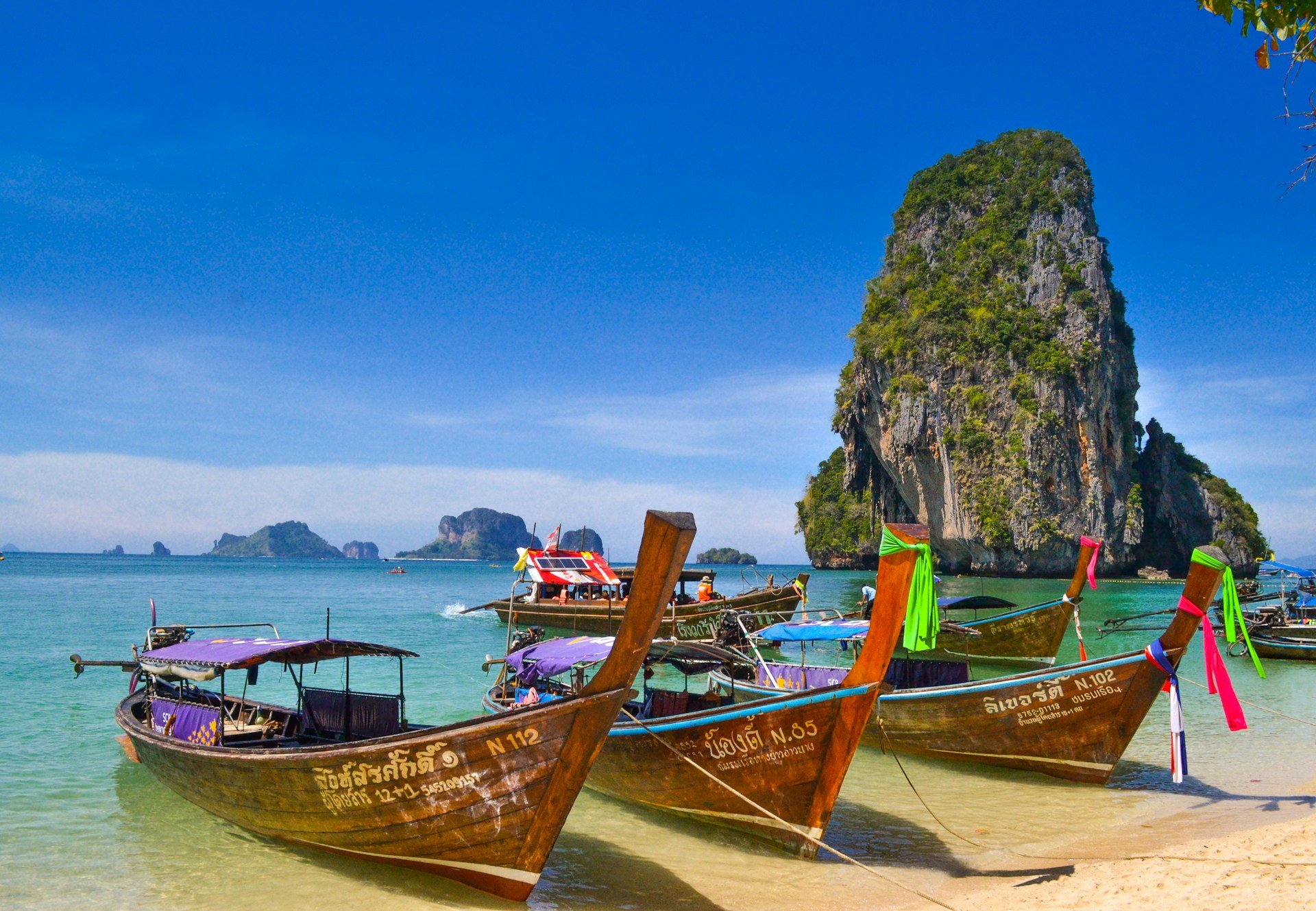
Railay Beach, reached only by longtail boat and backed by vertical karst cliffs, is consistently rated one of Asia's most beautiful. Maya Bay has been restored after conservation closure, Koh Tao is the region's best-value diving, and boats, dive operators and accommodation at every budget are mature.
- Don't miss
- Railay Beach, Phi Phi, Koh Tao
 🛵 Vietnam
Ha Long Bay, Phu Quoc and some of Asia's most dramatic coastal scenery
Ha Long Bay's 1,600 limestone karsts across 1,553 km² are a UNESCO site best seen on a two-night junk cruise, with cave kayaking and still sunrises. Phu Quoc has developed long white beaches, and Da Nang and Mui Ne add long sands and kite-surfing. Unlike anything in Thailand.
- Don't miss
- A Ha Long Bay junk cruise, Phu Quoc
Round 2 of 10
Food
A genuine tie
Two of the world's great food cultures, both exceptional, both different in character.
 🐘 Thailand
Pad thai, green curry and the world's greatest night-market scene
A consistent balance of sweet, sour, salty and spicy, from Michelin-starred Jay Fai's crab omelette to pad see ew at a market stall for THB 60. Green and massaman curry, tom yum, som tam and mango sticky rice are globally loved, Chiang Mai adds khao soi, and cooking classes are a highlight.
- Must eat
- Pad thai, green curry, khao soi
 🛵 Vietnam
Pho, banh mi and three distinct regional cuisines
Lighter, fresher and more regionally distinct: Hanoi's pho bo, simmered for hours, the banh mi at VND 20,000–40,000, Hoi An's cao lau, Hue's refined imperial cooking and Saigon's banh xeo. It rewards the traveller who eats regionally.
- Must eat
- Hanoi pho, banh mi, cao lau
Honest verdict: most people who eat seriously in both consider them equal but different. Thailand for bold, accessible flavours and night markets; Vietnam for regional depth and food as a journey.
Round 3 of 10
Culture, temples and history
Different strengths
Thailand's Buddhist temples are extraordinary in number and beauty. Vietnam's historical depth is longer and more complex.
 🐘 Thailand
Wat Phra Kaew, Chiang Mai's 300 temples and ancient Sukhothai
The Grand Palace's Emerald Buddha temple is Thailand's most sacred site, Wat Pho's 46m reclining Buddha is one of Asia's great religious images, and Wat Arun glitters across the river. Chiang Mai has over 300 wats including Doi Suthep, and Sukhothai's 13th-century ruins add depth.
- Don't miss
- The Grand Palace, Wat Pho, Doi Suthep
 🛵 Vietnam
Hoi An Ancient Town, Hue's imperial citadel and 1,000 years of history
Chinese rule, the Cham kingdom, French colonialism and the American War are all written into the landscape. Hoi An's UNESCO old town of lantern-hung trading houses is among Southeast Asia's most beautiful, Hue's citadel and royal tombs take a full day, and Saigon's War Remnants Museum and the Cu Chi tunnels add a confronting, important dimension.
- Don't miss
- Hoi An, the Hue citadel, the Cu Chi tunnels
Round 4 of 10
Cities
Thailand wins
Bangkok is one of Asia's greatest cities. Hanoi has more character and Ho Chi Minh City has more energy.
 🐘 Thailand
Bangkok and Chiang Mai, a great city plus a perfect second stop
Bangkok is chaotic, sensory and impossible to exhaust, with the Grand Palace circuit, Chatuchak's 15,000 stalls, world-class rooftop bars and Yaowarat street food, all navigable by the BTS. Chiang Mai, 700km north, is a moated, temple-filled, slower counterpoint.
- Don't miss
- Chatuchak, Yaowarat street food, Sky Bar
 🛵 Vietnam
Hanoi's Old Quarter atmosphere and Ho Chi Minh City's relentless energy
Hanoi's Old Quarter has 36 streets named for guild trades, French colonial shophouses and plastic-stool pho kitchens, with Hoan Kiem Lake as a calm counterpoint. Saigon is faster and more commercial. Neither is Bangkok, but both give a real sense of inhabiting another culture.
- Don't miss
- Hanoi's Old Quarter, Hoan Kiem Lake, Ben Thanh Market
Round 5 of 10
Which is cheaper, Thailand or Vietnam?
Vietnam wins, narrowly
Both are excellent budget destinations. Vietnam edges slightly cheaper for street-level travel.
| Typical cost | 🐘 Thailand | 🛵 Vietnam |
|---|---|---|
| Budget guesthouse | THB 400–900 (~€11–25) | VND 200,000–400,000 (~€7–15) |
| Mid-range hotel | THB 1,500–3,500 (~€42–97) | VND 500,000–1,200,000 (~€18–44) |
| Street meal | THB 50–120 (~€1.30–3.15) | VND 30,000–60,000 (~€1.10–2.20) |
| Island accommodation | €30–200/night (Koh Samui, Phuket) | €15–80/night (Phu Quoc) |
| Beer at a bar | THB 60–120 (~€1.60–3.15) | VND 15,000–25,000 (~€0.55–0.90) |
| Long-distance transport | Cheap flights ~€20–50 | Sleeper trains, buses and flights ~€15–40 |
Typical 2026 prices.
In practice: €25–40 a day covers comfortable budget travel in either country outside the priciest island resorts. Thailand's resort islands cost significantly more than Vietnamese beach options.
Round 6 of 10
Nightlife
Thailand wins
Thailand has the deeper, more varied nightlife. Vietnam's is lively but more concentrated.
Rooftop bars, night markets and full moon parties
Bangkok's rooftop bars and night markets run late, Koh Phangan's full moon parties are world-famous, and Phuket and Pattaya have large beach and party scenes. Chiang Mai's scene is more relaxed.
Bui Vien, Hanoi's Beer Corner and riverside rooftop bars
Ho Chi Minh City's Bui Vien backpacker street runs loud into the small hours, and Hanoi's Ta Hien Beer Corner serves bia hoi, fresh draught beer, for pennies. Rooftop bars add skyline views, but the scene is smaller and more concentrated.
Round 7 of 10
Things to do beyond the beach and temples
Different strengths
Thailand has diving, cooking and wildlife sanctuaries; Vietnam has caves, trekking and motorbike journeys.
| Activity | 🐘 Thailand | 🛵 Vietnam |
|---|---|---|
| Diving | Koh Tao, Southeast Asia's best-value diving | Nha Trang and Con Dao, smaller scene |
| Cooking classes | Curry paste from scratch in Bangkok and Chiang Mai | Hoi An and Hanoi classes, also good |
| Trekking | Chiang Mai hill-tribe treks | Sapa's rice terraces and Ha Giang |
| Caves and karst | Phang Nga Bay | Phong Nha caves and Ha Long Bay |
| Motorbike journeys | The Mae Hong Son Loop | The Ha Giang Loop and the Hai Van Pass |
| Wildlife | Ethical elephant sanctuaries | Cat Tien National Park and the Mekong Delta |
Honest verdict: a real split. Thailand offers polished, well-organised activities; Vietnam offers more adventurous, regional exploring.
Round 8 of 10
Getting around
Thailand wins
Thailand is the easier country to move through. Vietnam's length means more time between regions.
Cheap flights, reliable transport and a mature tourist network
Budget airlines like AirAsia link Bangkok to the islands and north for around €20–50, the BTS and MRT make Bangkok easy, and ferries, minivans and tours are well organised. English is widely spoken in tourist areas.
Sleeper trains, buses and cheap flights across a long country
The north-to-south journey covers 1,650km via sleeper trains, buses and cheap domestic flights at roughly €15–40. Between Ha Long Bay, Hoi An and Ho Chi Minh City you need internal flights or long rides, so planning matters more than in Thailand.
Round 9 of 10
When to go: the best time for Thailand and Vietnam
A genuine tie
November to March is the sweet spot for both countries, though regional differences matter, especially in Vietnam.
Regional timing: Thailand's Andaman coast is dry November to April. Vietnam's north and south are best October to March, while central Vietnam (Hoi An, Da Nang) is best February to August. November to February hits the best weather nearly everywhere, and is also the busiest, priciest period.
Round 10 of 10
Is Thailand or Vietnam safer for tourists?
A draw
Both are generally safe for tourists. The real risks are scams, traffic and petty theft.
🐘 Thailand: what to watch
- Tuk-tuk and gem scams in Bangkok tourist areas; agree fares first and ignore "closed today" approaches.
- Motorbike accidents are the biggest real danger; wear a helmet and be cautious renting.
- Jet-ski and island scams Agree terms in advance and take photos of rental damage.
- Petty theft on beaches and at full moon parties.
🛵 Vietnam: what to watch
- Traffic is chaotic; cross streets slowly and steadily, and be cautious on motorbikes.
- Bag snatching by motorbike in Ho Chi Minh City; carry bags away from the road.
- Taxi and cyclo overcharging Use Grab or agree prices first.
- Visa rules Check the e-visa requirements for your nationality before travel.
Normal travel awareness, and choosing reputable tour and transport operators, covers most risks in both.
Which is better for specific trips?
Thailand for first-timers, beaches, diving and nightlife. Vietnam for food, history, slow travel and budgets.
First-time Southeast Asia visitors
Thailand
The best infrastructure, widely spoken English and a proven two-week route.
Regional-food explorers
Vietnam
Pho, cao lau, bun bo Hue and banh xeo change by region.
Beach and island lovers
Thailand
Krabi, Phi Phi, Koh Tao and mature island infrastructure.
History lovers
Vietnam
Hoi An, Hue and the War Remnants Museum add real depth.
Divers
Thailand
Koh Tao is Southeast Asia's best-value scuba destination.
Slow, three-week travellers
Vietnam
The north-to-south journey richly rewards patience.
Nightlife and party seekers
Thailand
Bangkok rooftops, full moon parties and beach scenes.
Tight budgets
Vietnam
Slightly cheaper at street level, and cheaper island beaches.
Can you combine Thailand and Vietnam in one trip?
Yes, one of Southeast Asia's best combinations. Flights between Bangkok and Hanoi or Ho Chi Minh City take 1.5 to 2 hours, several times daily.
Thailand: days 1 to 8
- Days 1–2
Bangkok. The Grand Palace, Wat Pho and Yaowarat street food.
- Days 3–4
Chiang Mai. Temples, a cooking class and Doi Suthep.
- Days 5–8
Krabi or Phi Phi. Railay Beach and island days, then fly to Hanoi.
Vietnam: days 9 to 16
- Days 9–11
Hanoi and Ha Long Bay. The Old Quarter, then a two-night junk cruise.
- Days 12–14
Hoi An. The Ancient Town, lantern-lit river and a cooking class.
- Days 15–16
Ho Chi Minh City. Cu Chi tunnels, the War Remnants Museum and banh xeo, then fly home.
Open-jaw option: Vietnam also suits flying into Hanoi, travelling south and flying home from Ho Chi Minh City. A full three-week circuit adds extra days in Thailand's islands and central Vietnam.
Verdict: Thailand or Vietnam?
There's no single overall winner. Ease or reward, and most travellers who choose one eventually do both.
Choose Thailand if…
Thailand, for beaches, ease and a first Southeast Asia trip
The right choice for a first Southeast Asia trip, when beaches are the priority, when you want the most developed tourist infrastructure, or when Bangkok is on the itinerary.
- A first Southeast Asia trip, easier and more accessible
- A beach holiday is the primary goal
- Diving at Koh Tao
- Bangkok is specifically on the list
- Buddhist temple culture is a priority
- Two weeks or less
Choose Vietnam if…
Vietnam, for depth, food and the north-to-south journey
The right choice when time allows the north-to-south journey, food culture and regional variety appeal, Ha Long Bay and Hoi An are bucket-list items, or the budget is tight.
- Ha Long Bay is a must-do
- Hoi An Ancient Town is on the list
- Three or more weeks for north to south
- Regional food depth, pho, banh mi, cao lau
- Budget is tighter
- The history of the American War period
Weigh it for your own trip
Select everything that matters to you.
Pick what matters on this trip and the needle will move.
Thailand vs Vietnam: frequently asked questions
Is Thailand or Vietnam better for beaches?
Thailand wins for beaches: the Andaman coast's karst cliffs, turquoise water and white sand at Railay, Phi Phi and Koh Lanta remain Southeast Asia's best. Vietnam's greatest coastal sight is Ha Long Bay, a landscape of 1,600 karst islands best seen on a junk cruise. Phu Quoc is improving and good value, but doesn't match Thailand's islands.
Is Thailand or Vietnam better for food?
Both are world-class, differing in style. Thailand's street food is bold and immediately accessible: pad thai, green curry, som tam. Vietnam's is lighter, herb-forward and more regionally distinct: Hanoi pho, banh mi, Hoi An's cao lau and Hue's imperial cuisine. Most people who eat seriously in both consider them equal but different.
Is Thailand or Vietnam cheaper?
Vietnam is slightly cheaper at street level: pho or banh mi for €0.70–1.50 and a beer for €0.55–0.90, with budget guesthouses at €7–15 against €11–25. Thailand's resort islands are significantly dearer than Vietnamese beach options. €25–40 a day covers comfortable budget travel in either.
Is Thailand or Vietnam better for a first Southeast Asia trip?
Thailand, for ease: the best tourist infrastructure in the region, widely spoken English, reliable transport and a proven Bangkok-and-islands route. Vietnam is excellent but needs more planning, since the north-to-south journey takes time. For two weeks, Thailand; for three weeks with patience, Vietnam.
Can you combine Thailand and Vietnam in one trip?
Yes. Flights between Bangkok and Hanoi or Ho Chi Minh City take 1.5–2 hours. A classic three-week circuit is Bangkok, Chiang Mai, Krabi or Phi Phi, then Hanoi, Ha Long Bay, Hoi An and Ho Chi Minh City. Vietnam also suits an open-jaw trip, flying into Hanoi and out of Ho Chi Minh City.
What is the best time to visit Thailand and Vietnam?
November to March is the sweet spot for both. Thailand's Andaman coast is dry November to April, Vietnam's north and south are best October to March, and central Vietnam (Hoi An, Da Nang) is best February to August. November to February is also the busiest and most expensive.
Is Thailand or Vietnam better for nightlife?
Thailand has the deeper, more varied scene, with Bangkok's rooftop bars and night markets, Koh Phangan's full moon parties and big beach-party scenes. Vietnam's Bui Vien in Ho Chi Minh City and Hanoi's Beer Corner are lively but more concentrated.
Are Thailand and Vietnam safe for tourists?
Both are generally safe. The main risks are scams, traffic and petty theft: tuk-tuk and gem scams in Bangkok, motorbike accidents in both, and bag snatching in Ho Chi Minh City. Choosing reputable operators and normal awareness cover most risks.
There's no wrong answer here
Thailand and Vietnam are compared so often because they are the two great gateways to Southeast Asia. Pick on what you want from this trip: Thailand's ease, beaches and Bangkok, or Vietnam's regional depth, history and value. Better still, do both, a short flight links them.