
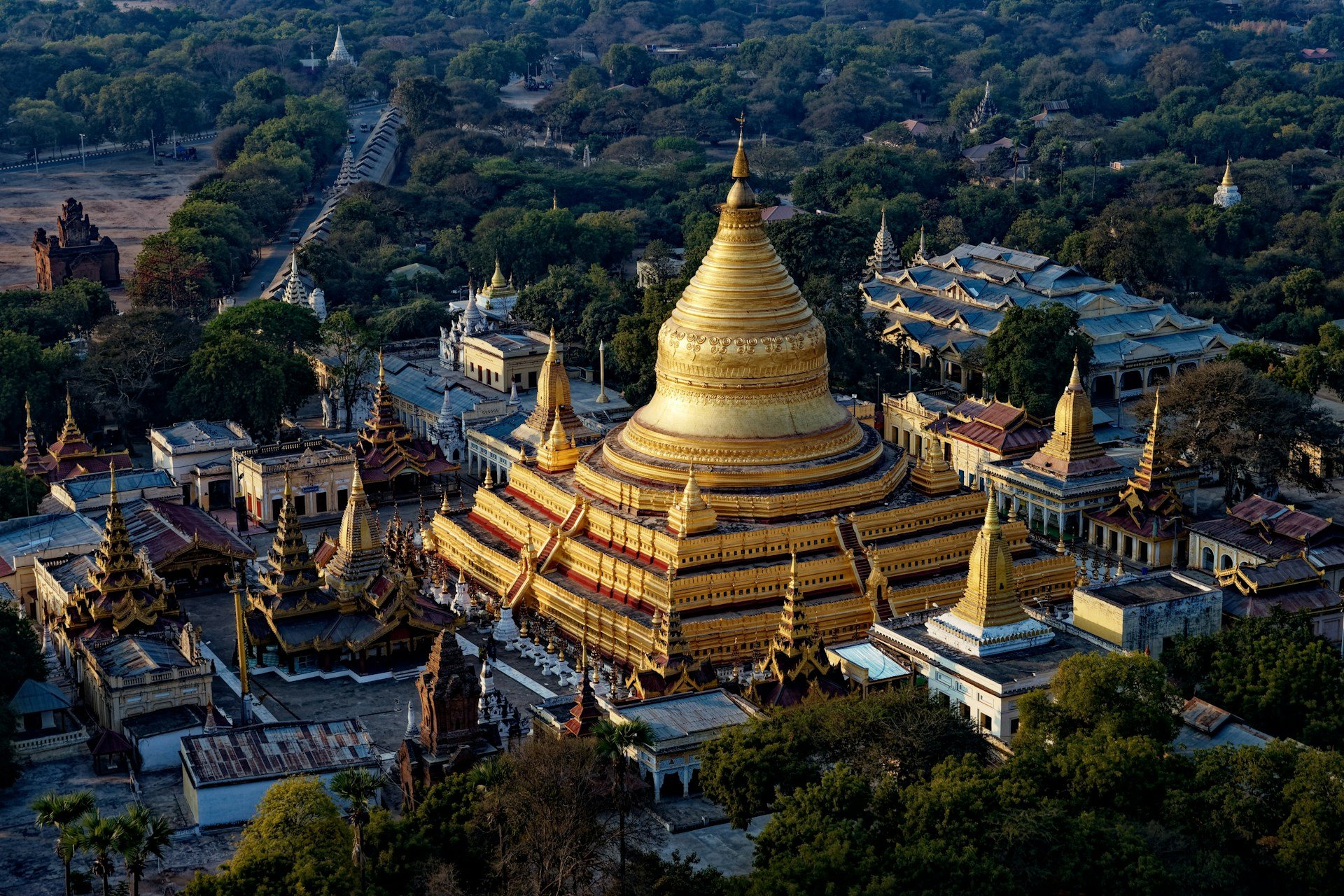
What You're Actually Getting Into
Myanmar holds two things that are both true at the same time. It has one of the great archaeological landscapes on earth at Bagan, over 2,000 surviving Buddhist temples and stupas built mostly between the 11th and 13th centuries across a plain beside the Irrawaddy River, plus Inle Lake's floating gardens and leg-rowing fishermen, plus a strong claim to some of the best-preserved living Buddhist culture in Southeast Asia. It has also been fighting a civil war since a February 2021 military coup toppled the elected government, a conflict that has since expanded rather than contracted, and that has left the country's own military-appointed authorities and most Western governments in rare agreement: this is not currently a place to visit for an ordinary holiday.
This guide exists because organized tourism has not entirely stopped. A calmer circuit through Yangon, Bagan, Mandalay and Inle Lake, sometimes called the tourist kite for the rough diamond shape it traces on a map, continues to run on domestic flights, with functioning hotels, guides and the country's 2026 push to double annual visitor numbers to 1.8 million. It is written for the traveler weighing that specific, narrower trip, not as an invitation to anyone treating Myanmar as a normal Southeast Asia stop alongside Thailand or Vietnam. Read the safety chapter before anything else on this page.
Why this guide is different from most Atlas Guide country pages
Most of the destinations on this site are places we can recommend without much qualification. Myanmar is not one of them. The advisory chapter comes second on this page instead of ninth, the destinations chapter covers only the calmer circuit rather than the whole country, and every venue, price or fact named in this guide has been checked against current 2026 sources rather than carried over from an older edit. Where we could not verify something, particularly around a specific site's current accessibility, we left it out or flagged the uncertainty rather than guess.
The Advisory, in Plain Language
The US State Department rates Myanmar Level 4, Do Not Travel, the same category as Afghanistan, Syria and North Korea. The stated reasons are armed conflict, civil unrest, arbitrary enforcement of local laws, landmines, poor healthcare infrastructure and wrongful detention. The UK, Australian and other Western governments carry similarly serious warnings. This is not a blanket "the whole country is a war zone" situation, but it is a country where large regions are under active fighting and where the risk profile changes by district, sometimes literally by township.
Active conflict states
Rakhine, Sagaing, Kachin, Kayin, Kayah and Chin states, plus parts of Shan State, see ongoing fighting between the military and ethnic armed organizations or resistance forces. These are not covered as destinations anywhere in this guide.
Wrongful detention
The State Department specifically flags a risk that the military government may not recognize dual US-Burmese citizenship, may prevent dual nationals from departing, and may attempt to conscript them. This is a real, named risk category, not boilerplate language.
Unrest & healthcare
Protests and checkpoints can appear with little warning even in calmer cities, and medical care outside Yangon's better private hospitals is limited. Comprehensive evacuation insurance is the baseline, not an upgrade.
What this means in practice for the circuit this guide covers
The organized trips that still run move between Yangon, Bagan, Mandalay and Inle Lake by domestic flight, on airlines including Air KBZ, Myanmar National Airlines and Air Mandalay, specifically to avoid overland routes that pass through military checkpoints and areas with less predictable security. Recent travelers describe this diamond of four cities as feeling calmer and more functional than the rest of the country, and Yangon in particular is classified a lower-risk "green zone" by the UK's Foreign, Commonwealth & Development Office relative to most of the rest of Myanmar. None of that changes the countrywide Level 4 rating, and this guide is not going to imply otherwise to make a better story.
Landmines are a documented risk in and near conflict-affected regions, not on the standard tourist circuit itself, but stay on marked paths and established sites regardless. A magnitude 7.7-7.8 earthquake centered near Mandalay and Sagaing on 28 March 2025 killed more than 5,000 people, damaged the former royal palace and numerous monasteries, and recovery was still ongoing through 2026; some historic sites in and around Mandalay remain closed or under repair, and this guide flags that uncertainty in the destinations chapter rather than assuming everything has reopened.
Emergency numbers
US Embassy Yangon contact information
The US Embassy's American Citizen Services unit in Yangon is at 110 University Avenue, Kamayut Township, open 7:30am-4:30pm Monday to Friday, reachable at +95-1-753-6509 or by email at ACSRangoon@state.gov. From outside Myanmar, the State Department's 24/7 citizen services line is +1-202-501-4444 (or +1-888-407-4747 from the US and Canada).
Solo travelers & women
This is not a country this guide can recommend for solo or first-time Southeast Asia travel under current conditions, regardless of gender. Travelers who do go on the Yangon-Bagan-Mandalay-Inle circuit almost always book through a tour operator or guide who manages logistics, transport and local knowledge rather than moving independently, and that structure is part of what makes the trip currently workable at all. If Myanmar is genuinely the plan, book through an operator with verifiable, current experience on this specific circuit, register with your embassy before you travel, and confirm their current security guidance immediately before departure rather than relying on this page alone.
A History Worth Knowing
Myanmar's Bagan Empire unified the region in the 11th century and built the temple field that still defines the country's image abroad, before Mongol invasion and internal fracture ended it in the 13th century. Successive Burmese kingdoms, British colonization from the 19th century, Japanese occupation during World War II, independence in 1948, and then nearly five decades of military rule from 1962 shaped a country that briefly opened toward democracy in the 2010s before a February 2021 coup reversed it and triggered the civil war still underway today.
- 11th-13th century
The Bagan Empire. King Anawrahta unifies the region in 1044 and Buddhist temple-building accelerates for two centuries, leaving the more than 2,000 structures that survive on the Bagan plain today.
- 1885
British annexation. The Third Anglo-Burmese War ends the Konbaung Dynasty; Burma is absorbed into British India and later administered separately from 1937.
- 1948
Independence. Burma becomes independent on 4 January, beginning a fragile parliamentary period that lasts just over a decade.
- 1962-2011
Military rule. General Ne Win's coup begins nearly five decades of direct or dominant military control, interrupted only briefly, including the brutal suppression of the 1988 pro-democracy uprising.
- 2011-2020
Partial opening. Reforms allow Aung San Suu Kyi's National League for Democracy to govern from 2016, and international tourism grows quickly during this decade.
- 2021-present
Coup and civil war. The military seizes power on 1 February 2021; nationwide resistance escalates into a civil war between the junta, allied People's Defence Forces, and long-standing ethnic armed organizations that continues today.
Read more: the Bagan Empire, colonial Burma and the road to 2021
The Bagan Empire's temple-building program was driven by royal and merchant patronage competing to earn religious merit, which is why the plain holds thousands of structures ranging from single-brick shrines to the towering Ananda and Thatbyinnyu temples rather than one grand complex. The empire's collapse after Mongol incursions in the late 13th century fragmented Burma into competing kingdoms for centuries, a period that also produced the Shan, Mon and Arakanese states whose descendants form some of today's ethnic armed organizations.
British rule from 1885 reorganized Burma's economy around rice and teak exports and imported large numbers of Indian laborers and administrators, a demographic shift that fed resentment feeding into the independence movement led by General Aung San, assassinated in 1947 just months before independence was formally achieved. His daughter, Aung San Suu Kyi, later became the defining civilian face of Burma's democracy movement, under house arrest for much of the 1990s and 2000s before her National League for Democracy won landslide elections in 2015 and 2020.
The military's February 2021 coup, justified on disputed fraud claims about the 2020 election, was met with nationwide civil disobedience that the junta suppressed with lethal force, driving much of the resistance underground and into alliance with ethnic armed organizations that had fought the central government for decades already. That war, now in its fifth year, is the backdrop against which any current travel decision about Myanmar has to be made.
The Tourist Kite
Only one part of Myanmar currently functions as an organized, bookable travel circuit: the rough diamond traced by Yangon, Bagan, Mandalay and Inle Lake, connected by short domestic flights rather than overland roads. This chapter covers what that circuit actually offers, not a wish list of everywhere in the country.
The gateway, and the calmest city
Yangon is Myanmar's largest city, its main international gateway, and the one part of the tourist kite classified a lower-risk "green zone" by the UK's Foreign, Commonwealth & Development Office relative to the rest of the country. It's where every trip to Myanmar starts, and it holds enough on its own, the gilded Shwedagon Pagoda, the colonial downtown, the Circular Train, to fill two or three days before heading onward. The full Yangon guide covers it in detail.
Bagan, the temple plain
Over 2,000 Buddhist temples and stupas, most built between the 11th and 13th centuries, spread across a dusty plain beside the Irrawaddy River. Bagan has not seen active fighting and remains part of the calmer circuit; fly in from Yangon or Mandalay rather than travelling overland. The Archaeological Zone entry ticket costs around 25,000 MMK (roughly $25) and is valid for the length of your stay, covering access to the major temples including Ananda, Thatbyinnyu and Shwezigon. Hot air balloon flights over the temple field run only in the cool dry season, October to April, at sunrise, from around $230 to $400 per person depending on the operator; book ahead, as the season is short and popular. E-bikes are the standard way to get between temples spread across a wide area.
Mandalay, still recovering
Myanmar's second city and last royal capital sits close to the epicenter of the 28 March 2025 earthquake, which damaged the former royal palace and a number of historic monasteries; recovery was still ongoing through 2026, and this guide cannot confirm which specific sites have fully reopened at any given moment. Confirm current access to individual monuments with your operator or hotel before building an itinerary around them, rather than assuming everything described in older guides is intact. Mandalay remains part of the flown tourist circuit and its own onward connections to Bagan and Inle Lake by air are unaffected.
Inle Lake
A large freshwater lake in Shan State reached by flying into Heho Airport, known for the Intha people's distinctive leg-rowing technique, floating villages built on stilts over the water, and floating gardens where tomatoes and flowers are grown on rafts of woven vegetation. Most visitors base themselves in the lakeside town of Nyaungshwe and take a full-day private boat tour to see the leg rowers at work, visit the Phaung Daw Oo Pagoda, and stop at weaving and cheroot-rolling workshops around the lake's edge.
Culture & Etiquette
Myanmar is majority Theravada Buddhist, and that shapes daily life more visibly than in most Southeast Asian countries: saffron-robed monks collecting morning alms, gold leaf applied to Buddha images by hand, and a rhythm of merit-making that structures ordinary weeks as much as major festivals. Burmese is the official language, though the country is home to well over 100 ethnic groups and their own languages, including Shan, Karen and Kachin, several of whose homelands are also the conflict areas covered in the safety chapter above.
Do
- Remove shoes and socks before entering any pagoda or temple compound, not just the inner shrine; this applies across the entire platform at sites like Shwedagon and throughout Bagan.
- Dress modestly. Cover shoulders and knees at religious sites; a longyi, the wraparound garment worn by both men and women, is easy to buy locally and doubles as appropriate temple dress.
- Use your right hand, or both hands, when giving or receiving anything, and avoid pointing your feet at people or at Buddha images.
- Carry your passport and printed e-visa approval letter at all times; document checks happen more often here than in most Southeast Asian countries.
- Learn a few Burmese phrases. Mingalaba (hello) and Kyay zu tin ba de (thank you) go further than in most tourist-heavy destinations, since fewer visitors bother.
Don't
- Discuss politics, the military, or the 2021 coup with strangers, including your guide unless they raise it first. This is not idle caution in the current climate.
- Photograph checkpoints, military installations or government buildings, and be cautious photographing security personnel anywhere.
- Touch a monk if you are a woman, or hand anything directly to a monk; place items down for them to pick up, or have a man do it.
- Travel overland between the main tourist cities. Fly instead; this is a safety recommendation as much as a convenience one given checkpoints on the road network.
- Assume ATMs or card payments will work outside Yangon, Mandalay, Bagan and Inle Lake's main tourist areas. Carry sufficient clean, crisp US dollars and kyat.
Food & Drink
Burmese food sits between its neighbors, milder and more oil-forward than Thai food, with the fermented and pickled flavors that show up across mainland Southeast Asia. Rice and noodles are the base for most meals, and tea, both drunk and eaten as a salad, runs through the culture in a way that surprises first-time visitors.
Mohinga
Myanmar's unofficial national dish: a fish-based broth with rice noodles, topped with hard-boiled egg, crispy fritters, cilantro and fried onion. Sold from street stalls on almost every corner, usually eaten for breakfast.
Lahpet thoke
Fermented tea leaf salad tossed with crunchy fried beans, garlic, sesame and dried shrimp. One of the more distinctive dishes in Southeast Asian cuisine and a good measure of a kitchen's quality.
Ohn no khao swe
A rich coconut milk noodle soup with chicken, related to Southeast Asian laksa traditions but distinctly Burmese in its balance of spice and coconut.
When to Go & Getting There
Myanmar's cool, dry season runs November to February, with warm days, low humidity and the only window for Bagan's hot air balloon flights: this is comfortably the best time to visit. March to May turns hot and increasingly humid ahead of the rainy season, which runs roughly June to October with heavy downpours and flooding risk in low-lying areas, complicating travel around Inle Lake and the Irrawaddy basin in particular.
Getting to and around Myanmar
By air: Yangon International Airport (RGN) is the main international gateway, with connections through regional hubs including Bangkok, Singapore and Kuala Lumpur. There are no direct flights from North America or Europe; expect a connection through Southeast Asia.
Within the country: domestic flights on Air KBZ, Myanmar National Airlines and Air Mandalay connect Yangon, Mandalay, Bagan (Nyaung-U) and Heho (for Inle Lake), and are the recommended way to move between them rather than overland roads, which pass through military checkpoints and areas with less predictable security. Book domestic flights a little ahead in the November-to-February peak season.
SIM cards and connectivity: international roaming SIMs have not worked in Myanmar since 2021; buy a local SIM (MPT, ATOM or Ooredoo/U9) or a dedicated Myanmar eSIM before you rely on connectivity, and register it with your passport as required. Connectivity on the tourist circuit has improved but remains less reliable than in Thailand or Vietnam.
Budget Planning
Myanmar is inexpensive by regional standards for accommodation and food, but the domestic flights that this guide recommends over overland travel add up quickly compared to a typical Southeast Asia budget trip, and archaeological zone fees, balloon rides and guided boat tours are priced closer to international rates.
- Guesthouse or budget hotel
- Street food and tea house meals
- Domestic flights booked ahead
- Self-guided temple and pagoda visits
- Mid-range hotel with breakfast
- Restaurant meals, a private guide some days
- Domestic flights, e-bike or car hire
- Inle Lake boat tour, Bagan balloon ride
- Upper-tier Yangon and Bagan hotels
- Private guide and driver throughout
- Balloon ride, private boat tours
- Full operator-managed itinerary
Visa & Entry
Most nationalities, including the US, UK, EU and Australia, need a tourist e-visa applied for in advance through the official government portal; there is no visa on arrival for most Western passport holders. The standard government fee is $50, processing takes a minimum of 3 working days and typically 3 to 5, and your passport needs at least 6 months of validity from your arrival date. Apply directly through the official portal rather than third-party sites that charge extra for the same service.
✓ Valid passport
At least 6 months validity from your date of arrival, with a recent passport-style digital photo for the online application.
✓ E-visa approval letter
Apply online, pay the $50 fee, and print the approval letter to present with your passport on arrival for stamping.
✓ Onward travel
May be requested at immigration; keep confirmation of your return or onward flight accessible.
✓ Apply 3-5 working days ahead
Standard processing takes a minimum of 3 working days; don't leave it until the last minute.
| Myanmar | Thailand | |
|---|---|---|
| US advisory | Level 4, Do Not Travel, countrywide | Level 1-2, routine precautions for most of the country |
| Buddhist heritage | Bagan's 2,000+ temples, largely to yourself | Ayutthaya and Sukhothai, similar era, far busier |
| Daily budget | $35-55 budget, plus costly domestic flights | $36-64 budget, with cheap overland transport throughout |
| Ease of travel | Guide or operator recommended, fly between cities | Straightforward independent travel almost everywhere |
| Visa | Mandatory e-visa, $50, apply days ahead | Visa-free or simple e-visa for most Western passports |
Myanmar FAQ
Is it safe to travel to Myanmar?
No, not by the standard travel-advisory definition. The US State Department rates Myanmar Level 4, Do Not Travel, its highest risk category, citing armed conflict, civil unrest, arbitrary enforcement of local laws, landmines and wrongful detention risk. The Yangon-Bagan-Mandalay-Inle Lake circuit is calmer than the rest of the country, but the advisory covers Myanmar as a whole.
Do I need a visa for Myanmar?
Yes. Most nationalities, including the US, UK, EU and Australia, need an e-visa applied for online in advance through the official government portal, at a cost of $50 with 3-5 working days of processing. There is no visa on arrival for most Western passport holders.
What is the Yangon-Bagan-Mandalay-Inle Lake circuit?
Sometimes called the tourist kite, it's the diamond of four destinations where most of Myanmar's functioning tourism infrastructure and relative calm are concentrated, connected by short domestic flights rather than overland roads. It's the one part of the country this guide can discuss as an organized travel circuit.
Is Bagan safe to visit?
Bagan itself has not seen active fighting and remains part of the calmer tourist circuit, though it sits inside a country under a Level 4 advisory. Fly in from Yangon or Mandalay rather than travelling overland, and go with a general awareness that conditions can change quickly.
Was Mandalay damaged by the 2025 earthquake?
Yes. The magnitude 7.7-7.8 earthquake of 28 March 2025 was centered near Mandalay and Sagaing, damaged the former royal palace and numerous monasteries, and killed more than 5,000 people nationwide. Recovery was still ongoing through 2026, and some historic sites remain closed or under repair.
What currency does Myanmar use?
The Myanmar kyat (MMK). Multiple exchange rates coexist, an official rate and a much weaker market rate, so change money at licensed exchange counters or hotels rather than the official rate. Cash is essential; card acceptance is limited to some hotels and larger businesses.
What language is spoken in Myanmar?
Burmese is the official language, alongside more than 100 ethnic minority languages including Shan, Karen and Kachin. English is spoken in hotels and tourist-facing businesses along the main circuit, less so elsewhere.
When is the best time to visit Myanmar?
November to February, the cool dry season, is best: warm days, low humidity, and the only window for hot air balloon flights over Bagan. March to May is hot, and the rainy season from roughly June to October brings heavy downpours and flooding risk in low-lying areas.
How do you get to Myanmar?
By air into Yangon International Airport (RGN), the main international gateway, with connections from Bangkok, Singapore, Kuala Lumpur and a handful of other regional hubs. There are no direct flights from North America or Europe. Domestic flights, not overland roads, are the recommended way to move between Yangon, Bagan, Mandalay and Inle Lake.
Which parts of Myanmar should travelers avoid?
Rakhine, Sagaing, Kachin, Kayin, Kayah and Chin states, along with parts of Shan State, are active conflict zones with landmine risk and are not covered by this guide as destinations. The calmer circuit runs through Yangon, Bagan, Mandalay and Inle Lake, reached by air.
What Stays With You
The travelers who do make it to the Yangon-Bagan-Mandalay-Inle Lake circuit tend to come back describing a specific kind of light at Bagan sunrise, hundreds of temple spires emerging from morning mist, that they say they haven't seen matched anywhere else in Southeast Asia. None of that changes what the advisory says, and this guide is not going to soften it to make a better story.
If you go, go through a reputable operator, go in the cool dry season, fly rather than drive between cities, and go with your eyes open about what Level 4 actually means. If you don't, that is very likely the right call for most travelers right now, and Myanmar will still be there, hopefully under calmer circumstances, when it might make sense to reconsider.