
What You're Actually Getting Into
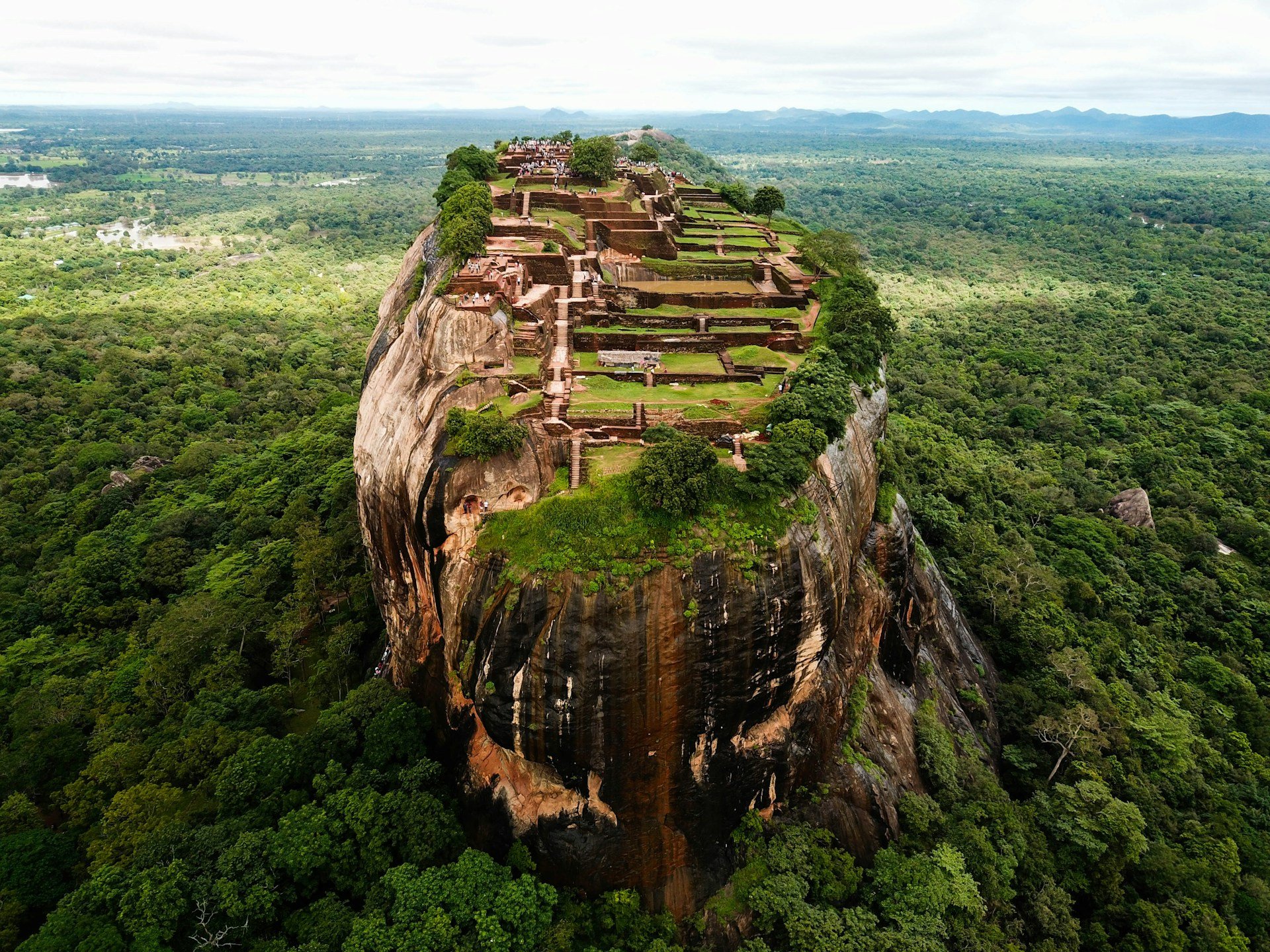
Sri Lanka fits more variety into a smaller space than almost anywhere on earth. A four-hour drive can take you from a rock fortress with 1,500-year-old frescoes to misty tea plantations at 1,800 meters to a beach where whales surface offshore between December and April. The island's ancient Sinhalese kingdoms built irrigation and religious engineering that still functions and still amazes, then three successive European colonizers, Portuguese, Dutch and British, layered forts, churches and railways on top of it, then a 26-year civil war and a 2004 tsunami tested the country in ways few nations face twice in a generation. Tourism has come back from all of it, and the island's reputation as one of Asia's best-value, most rewarding trips is earned rather than marketed.
What makes Sri Lanka work as a single trip is density: the Cultural Triangle's ancient cities, the hill country's tea estates and cool climate, the south coast's beaches and surf, and Yala's leopards are all within a day's drive of each other. A ten-day loop genuinely covers all four without feeling rushed, something few countries this rich in contrast can claim.
The honest complications
Sri Lanka is still working through the aftershocks of its 2022 economic collapse: prices at major sites and hotels have risen since then even as the broader economy stabilizes under an IMF program, and foreign-visitor entry fees at places like Sigiriya run many multiples of what locals pay, a two-tier pricing system that catches first-timers off guard. Cyclone Ditwah struck the hill country in late 2025 and, as of this writing in August 2026, the iconic Colombo-Kandy-Ella railway is still not running as a through service while repairs continue on the most damaged section. Roads outside the main highways are slow and drivers are assertive; budget more time between destinations than the map distance suggests. And touts, tuk-tuk fare tricks and gem-shop scams are a real, low-level nuisance in Kandy, Galle and Colombo that a little preparation neutralizes almost entirely.
A History Worth Knowing
Sri Lanka's recorded history stretches back to the 6th century BCE with the founding of the Anuradhapura kingdom, and Buddhism arrived in the 3rd century BCE and has shaped the island's culture and politics ever since. Three European powers colonized it in succession, a brutal 26-year civil war ended in 2009, the 2004 tsunami killed more than 30,000 people here alone, and a 2022 economic collapse forced the country into its worst crisis since independence. The short version of how the island you're visiting got here.
- 3rd c. BCE
Buddhism arrives. Mahinda, son of the Indian emperor Ashoka, brings Buddhism to the Anuradhapura kingdom, which becomes the island's dominant religion and the foundation of its ancient architecture.
- 12th century
Polonnaruwa's golden age. King Parakramabahu I turns the second capital into a center of Buddhist art and vast irrigation works after Anuradhapura's decline.
- 1505–1815
Three colonizers. Portuguese traders arrive in Colombo in 1505, the Dutch take the coast in the 17th century, and the British complete the conquest by capturing the independent Kingdom of Kandy in 1815, the island's last holdout.
- 1948
Independence. Ceylon becomes independent from Britain; the country is renamed Sri Lanka under a new republican constitution in 1972.
- 1983–2009
Civil war. A brutal conflict between the government and the Tamil Tiger separatists (LTTE) kills tens of thousands before the military declares victory in May 2009.
- 2004
Indian Ocean tsunami. More than 30,000 people are killed on Sri Lanka's coastline, one of the deadliest natural disasters in recorded history.
- 2019
Easter bombings. Coordinated suicide attacks hit churches and tourist hotels, killing over 260 people and devastating the tourism industry for years.
- 2022
Economic collapse. Fuel and food shortages, rolling blackouts and a sovereign default trigger mass protests (the Aragalaya) and a change of government.
- 2025–2026
Recovery, then a cyclone. An IMF-backed program stabilizes inflation and rebuilds reserves as tourism rebounds past a million arrivals, then Cyclone Ditwah damages the hill country railway in late 2025, with repairs still ongoing into this guide's publication.
Read the full history: ancient kingdoms, colonial rule and the civil war
The Anuradhapura kingdom, founded around the 6th century BCE according to the island's ancient chronicles, became one of the great hydraulic civilizations of the pre-modern world: its reservoirs and irrigation canals, some still in use, allowed a sophisticated urban Buddhist civilization to flourish in the dry zone for over a thousand years. When Anuradhapura declined under repeated South Indian invasions, the capital shifted to Polonnaruwa, which reached its own golden age under Parakramabahu I in the 12th century before it, too, was eventually abandoned, and the political center of Sinhalese civilization retreated to the wet-zone highlands around Kandy.
The Portuguese arrived in 1505 seeking the cinnamon trade and controlled the coastal lowlands for over a century, forcibly converting many coastal communities to Catholicism, a legacy still visible in Sri Lankan surnames and churches today. The Dutch ousted them in the mid-17th century and ran the coast as a spice-trading enterprise. The British arrived in 1796, and in 1815 captured the independent hill kingdom of Kandy, ending over two thousand years of Sinhalese monarchy and completing the colonization of the entire island for the first time in its history. British rule (1815-1948) reshaped the highlands with tea, coffee and rubber plantations worked largely by Tamil laborers brought from South India, a demographic legacy that fed directly into the ethnic tensions of the following century.
The civil war. Post-independence tensions between the Sinhalese Buddhist majority and the Tamil Hindu minority, aggravated by discriminatory language and university-access policies, erupted into anti-Tamil riots in July 1983 and a full civil war between the government and the Liberation Tigers of Tamil Eelam (LTTE), who sought an independent Tamil state in the north and east. The 26-year war, one of Asia's longest and most brutal internal conflicts, included the LTTE's pioneering use of suicide bombings, ended with the government's military defeat of the LTTE in May 2009, and left deep and still-unresolved questions about accountability and reconciliation, particularly in the Northern Province, which remains the most economically underdeveloped part of the island.
Since 2004. The Indian Ocean tsunami of December 2004 devastated the southern and eastern coastlines in the middle of the peace process, killing more than 30,000 people in Sri Lanka alone. The 2019 Easter Sunday bombings, coordinated attacks by a local Islamist extremist group on churches and tourist hotels in Colombo, Negombo and Batticaloa, killed over 260 people and collapsed inbound tourism for the following two years, a blow compounded almost immediately by the COVID-19 pandemic. The 2022 economic crisis, triggered by years of unsustainable borrowing, tax cuts and reduced foreign reserves, produced fuel queues, 13-hour power cuts and Sri Lanka's first sovereign default, and public anger forced the resignation of President Gotabaya Rajapaksa amid the largest protest movement in the country's history. An IMF-backed recovery program since 2023 has brought inflation down from nearly 70% to low single digits and rebuilt tourism into one of the strongest sectors of the recovering economy.
Top Destinations
Sri Lanka divides naturally into four travel zones that a single loop can cover: the Cultural Triangle's ancient cities, the hill country's tea estates, the south coast's beaches and surf towns, and the dry-zone national parks. The island is compact, roughly the size of Ireland or West Virginia, so a ten-to-fourteen-day trip genuinely covers all four zones without feeling rushed.
Sigiriya, the rock fortress
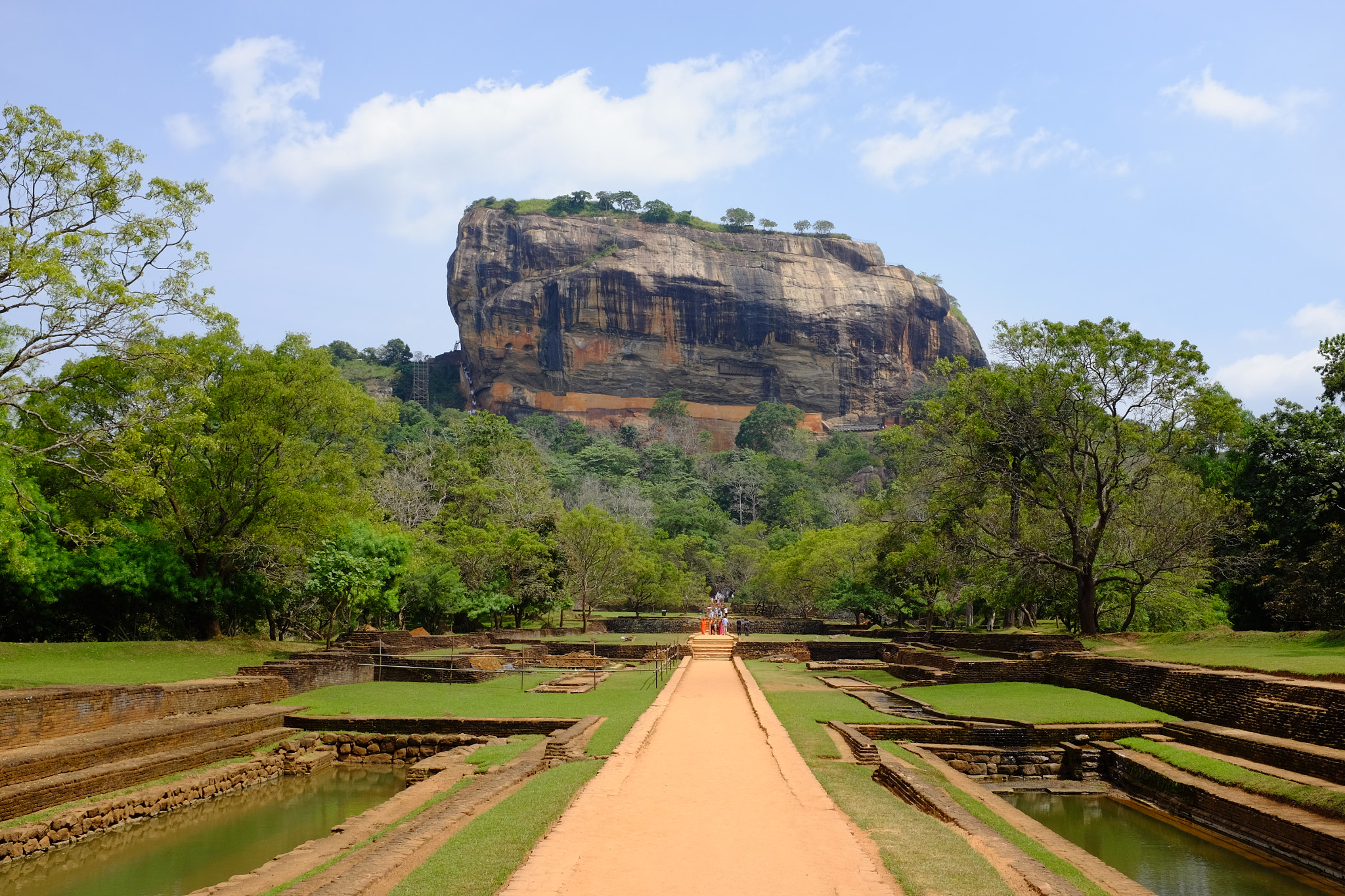
A 200-meter granite monolith rising sheer out of the jungle, with the ruins of a 5th-century royal palace on its summit, frescoes of celestial maidens painted into a sheltered rock face partway up, and symmetrical water gardens at its base that still function on original hydraulics. The climb takes 1.5 to 2 hours round trip up metal stairways bolted to the rock; go at opening (7am) to beat both the heat and the crowds. Entry runs around $30 for non-SAARC foreign visitors, one of the steeper single-site fees in the country but worth it.
Dambulla, Polonnaruwa & Anuradhapura
Dambulla's cave temple complex, a 20-minute drive from Sigiriya, holds five caves of Buddhist murals and statues carved and painted over two millennia, still an active pilgrimage site. Polonnaruwa, Sri Lanka's 12th-century second capital, has the best-preserved ruins in the country, a compact, walkable or cyclable archaeological park including the Gal Vihara's four monumental rock-cut Buddha statues. Anuradhapura, the older and larger of the two ancient capitals, is more spread out and holds the Sri Maha Bodhi, said to be grown from a cutting of the tree the Buddha sat beneath, one of the oldest documented trees in the world.
Kandy, the last royal capital
Sri Lanka's last independent kingdom, held out against every colonizer until the British finally took it in 1815. The Temple of the Sacred Tooth Relic, said to house one of the Buddha's teeth, is the country's most important Buddhist pilgrimage site, and the Royal Botanical Gardens at Peradeniya nearby span 147 acres and 4,000 plant species. See our full Kandy city guide for neighbourhoods, hotels and a complete itinerary.
Nuwara Eliya & Ella, tea country
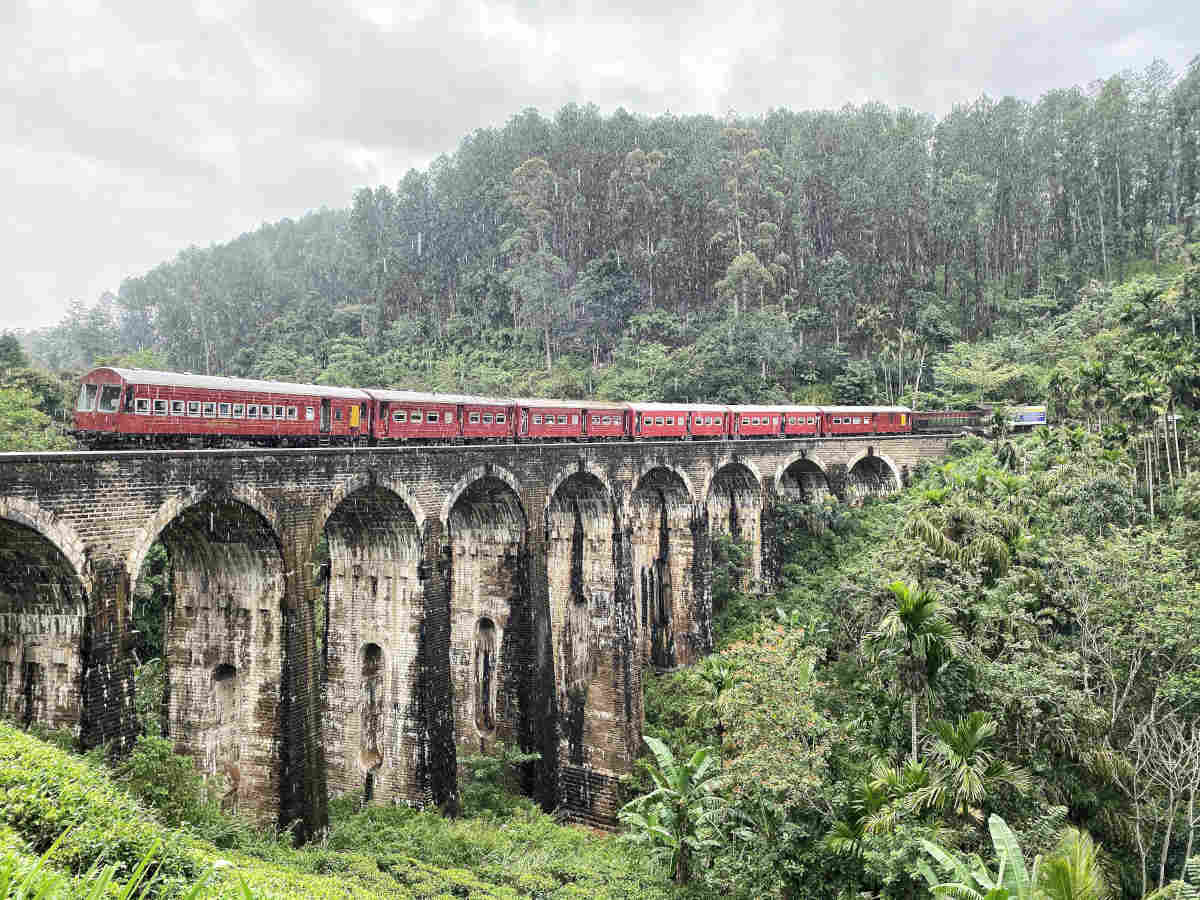
Nuwara Eliya, nicknamed "Little England" for its colonial-era cool climate and Tudor-style buildings, sits at 1,868 meters amid rolling tea estates; Pedro Tea Estate and Mackwoods both run factory tours with tastings. Ella, further along the hill country, is a laid-back backpacker town with two of the best short hikes in the country, Little Adam's Peak (about 1.5 hours round trip) and Ella Rock (3-4 hours), plus the Nine Arches Bridge, a colonial-era railway viaduct that's become one of the most photographed spots in Sri Lanka. The Kandy-Ella train, when running, is the scenic way to link them; see the Getting There chapter below for its current, disrupted status.
Galle, the Dutch fort city
A UNESCO-listed 17th-century Dutch fort on a promontory above the Indian Ocean, its ramparts enclosing a walkable old town of boutique hotels, cafes and courtyard gardens behind colonial facades. Walk the sea wall at sunset and get genuinely lost in the grid of small streets; two hours covers the highlights, a full day lets it breathe.
Mirissa & Unawatuna
Mirissa is the main departure point for whale watching (blue whales and sperm whales, December to April, boats depart around 6:30am) and has a long, easy beach with a lively strip of cafes and surf schools. Unawatuna, closer to Galle, has calmer, more family-friendly water. Both are firmly on the tourist circuit; further east, Tangalle and Weligama offer a quieter or more surf-focused alternative respectively.
Yala National Park
Yala has one of the highest leopard densities documented anywhere in the world, alongside elephants, sloth bears, crocodiles and prolific birdlife, all in dry-zone scrub and lagoon terrain in the island's southeast. Morning and afternoon jeep safaris (3-4 hours, typically $40-60 per person in a shared jeep including park fees) run from Tissamaharama or from lodges just outside the park. Block E and D fill with vehicles in peak season; ask your operator about the quieter blocks.
Udawalawe & Wilpattu
Udawalawe, a smaller and more reliable park for elephant sightings with far fewer vehicles than Yala, also has the Elephant Transit Home, which rehabilitates orphaned calves for release. Wilpattu, the country's largest national park in the northwest, sees far fewer visitors and offers a wilder, less jeep-crowded safari experience, with its own resident leopard population.
Colombo, arrival and a day, not a base
Sri Lanka's commercial capital and main international gateway (the official administrative capital, Sri Jayawardenepura Kotte, is a Colombo suburb where parliament sits) is worth a day rather than a full base for most itineraries. Galle Face Green draws a nightly crowd for street food and sunset; the Dutch-era Pettah market district is chaotic and rewarding; and the Gangaramaya Temple mixes Buddhist, Hindu and colonial influences in a single compound. Most travelers land, spend a day or two, and head straight for the Cultural Triangle or the coast.
Hidden gems beyond the main circuit
The zones above cover a strong first trip. With extra days, these reward the detour.
Arugam Bay
One of Asia's best right-hand point breaks, plus a laid-back surf-town scene that feels closer to Bali twenty years ago than to the south coast's more developed strip. Opposite monsoon window to the south.
Knuckles Mountain Range
A UNESCO-listed range of jagged peaks and cloud forest an hour from Kandy, with multi-day trekking and village homestays far less visited than Ella's hills.
Kalpitiya
A kitesurfing peninsula on the northwest coast with dolphin-watching boat trips and a fraction of the crowds of Mirissa, best May to October when the wind is reliable.
Anuradhapura's outer ruins
Beyond the Sri Maha Bodhi and the main dagobas, the outer monastic ruins spread over kilometers and see a fraction of Polonnaruwa's tour-bus traffic.
Horton Plains & World's End
A high-altitude plateau with a cliff that drops 870 meters, best at dawn before cloud rolls in; the 9.5km loop trail also passes Baker's Falls.
Adam's Peak (Sri Pada)
A pilgrimage mountain climbed overnight by pilgrims of four religions to reach the summit shrine for sunrise; December to May is the pilgrimage season and the best-lit stairway.
Culture & Etiquette
Sri Lanka is roughly 70% Buddhist with significant Hindu, Muslim and Christian minorities, and Buddhist customs shape public life, dress codes at religious sites and the rhythm of festivals like Kandy's Esala Perahera. Hospitality is warm and genuine, and visitors who show basic respect at temples and toward elders find it returned many times over.
Do
- Cover shoulders and knees at temples, and remove shoes and hats before entering. Some sites also require covering tattoos of the Buddha, a real and enforced rule, not a suggestion.
- Never turn your back on a Buddha statue for a photo. Posing with your back to a statue, or worse, sitting on one for a photo, has led to arrests and deportations of tourists in past years. Treat every Buddha image, however old or ruined, as an active object of worship.
- Use your right hand to give, receive and eat, especially when eating rice and curry by hand, the traditional and still common way to eat it.
- Learn a few words. Ayubowan (a Buddhist greeting, "may you live long") and istuti (thank you, Sinhala) go a long way; Tamil-speaking areas use vanakkam and nandri.
- Bargain gently in markets and with unmetered tuk-tuks, but agree the fare before you get in rather than negotiating after the ride.
Don't
- Point your feet at people, statues or monks, considered disrespectful throughout South and Southeast Asia; tuck your feet under you when sitting on the floor.
- Wear swimwear away from the beach. Modest dress is expected in towns, temples and on public transport even in coastal areas.
- Assume every "free" tour is free. Tuk-tuk drivers offering a discounted or free city tour are usually working a commission arrangement with gem or spice shops; expect a hard sell at each stop.
- Photograph military installations or checkpoints, still a sensitive area given the country's recent conflict history, particularly in the north.
- Discuss the civil war casually with strangers. It remains a sensitive, unresolved topic for many Sri Lankan families on both sides; let locals raise it if they choose to.
Deeper culture: the Perahera, Ayurveda and the tea legacy
The Esala Perahera. Kandy's ten-night festival, held around the July-August full moon (18-28 August 2026), parades decorated elephants, dancers, drummers and fire performers through the city each night, honoring the Sacred Tooth Relic. It's one of Asia's great processions and draws huge crowds; book accommodation in Kandy well ahead if your dates overlap.
Ayurveda. Sri Lanka has practiced Ayurvedic medicine, a South Asian holistic health tradition using herbs, oils and dietary principles, for over two thousand years, and it remains part of mainstream healthcare alongside Western medicine. Numerous hill-country and coastal resorts offer genuine Ayurvedic treatment programs rather than spa-industry approximations.
The tea legacy. British planters shifted the hill country from coffee to tea after a coffee blight in the 1870s, and Ceylon tea, still the trade name, became one of the island's defining exports and a source of national identity, even as the industry's Tamil plantation workforce, descended from indentured laborers brought from South India, remains among the country's most economically marginalized communities.
Food & Drink
Sri Lankan food is built on rice, coconut and a spice blend that's hotter and more distinctive than its Indian cousins, with strong Malay, Dutch, Portuguese and South Indian influences layered in over centuries. The best meals are frequently the cheapest: a roadside kade doing rice and curry for a few dollars often beats a hotel buffet charging ten times as much.
Rice & Curry $1-4
The everyday meal: rice with four or five small curries, vegetable, fish, dhal, plus sambols and pickles, all mixed by hand. Every region and even every household has its own version; this is the dish to judge a kade by.
Kottu Roti $2-5
Chopped roti bread stir-fried on a hot griddle with vegetables, egg, spices and often chicken or cheese, the loud metallic chopping sound a fixture of any street-food night market. Best eaten hot off the griddle after dark.
Hoppers (Appa) $1-3
Bowl-shaped fermented rice-and-coconut-milk pancakes, crisp at the edges and soft in the center, eaten for breakfast plain, with an egg cracked into the middle (egg hoppers), or as tiny string hoppers with curry.
Ceylon Tea $0.30-1
Hill-country black tea, drunk strong and sweet as "milk tea" from roadside stalls or straight from an estate at a Nuwara Eliya factory tasting. Buy loose-leaf direct from an estate shop over a supermarket brand.
Seafood $6-15
Coastal towns grill fresh catch nightly; jaffna crab curry, a fiery Tamil-influenced specialty, and deviled prawns are worth seeking out specifically rather than settling for the generic tourist-menu fish.
Arrack $2-5/glass
A coconut-flower spirit distilled since colonial times, drunk neat, on ice, or mixed with ginger beer. Old Reserve and Ceylon Arrack Reserve are the widely available better bottles.
When to Go & Itineraries
Sri Lanka has two monsoons on opposite schedules, which is the single most important planning fact about the island. December to March is the dry, peak season for the south and west coasts, the Cultural Triangle and the hill country, all of which most first-time itineraries prioritize. May to September is the better window for the east coast around Trincomalee and Arugam Bay. April and October-November are shoulder-season transition months with more rain but fewer crowds and lower prices.
All seasons compared, with temperatures
| Season | Verdict | Temps | Notes |
|---|---|---|---|
| Dec-Mar | Best for south/west/hills | 26-30°C coast, 16-20°C hill country | Peak season and prices; book Kandy and Ella ahead |
| May-Sep | Best for east coast | 28-32°C | Southwest monsoon soaks the south coast; head to Trincomalee/Arugam Bay instead |
| Apr & Oct-Nov | Shoulder, more rain | 27-30°C | Inter-monsoon transition; lower prices, less predictable weather |
| Jul-Aug | Good, plus Perahera | 26-29°C | Kandy's Esala Perahera festival; book Kandy accommodation early |
Hill country (Nuwara Eliya, Ella) runs noticeably cooler year-round, dropping to 5-10°C at night in Nuwara Eliya in January. Yala safaris run year round but the park closes for maintenance most Septembers, confirm before booking.
Itineraries
Ten days covers a strong first circuit. Two weeks adds Yala and more time on the coast without feeling rushed.
- Days 1–2
Colombo & Sigiriya. Land, one night in Colombo or push straight on, then two nights near Sigiriya for the rock fortress and Dambulla caves.
- Days 3–4
Kandy. Temple of the Tooth, Peradeniya gardens, Pinnawala elephants en route, and if dates align, the Esala Perahera procession.
- Days 5–6
Hill country. Nuwara Eliya tea estates, then Ella for the Nine Arches Bridge and a sunrise hike, by bus or driver given the current rail disruption.
- Days 7–10
South coast. Galle Fort, Mirissa for whale watching if in season, and a beach day before flying out of Colombo (about 2.5-3 hours from the south coast).
- Days 1–4
Cultural Triangle. Sigiriya, Dambulla, Polonnaruwa and a half-day in Anuradhapura from a Dambulla or Sigiriya base.
- Days 5–6
Kandy. Temple of the Tooth, Peradeniya, Pinnawala, Udawattakele forest walk.
- Days 7–9
Hill country. Nuwara Eliya, Horton Plains at dawn for World's End, then Ella for two nights.
- Days 10–11
Yala safari. Two morning or afternoon jeep drives from Tissamaharama, en route to the coast.
- Days 12–14
South coast. Mirissa whale watching, Galle Fort, and a final beach stretch before flying from Colombo.
- Days 1–2
Sigiriya & Dambulla. The rock fortress and cave temples from a single base.
- Days 3–4
Kandy. Temple of the Tooth and Peradeniya gardens, Pinnawala en route.
- Days 5–7
South coast. Galle Fort and a beach base at Mirissa or Unawatuna before flying from Colombo.
Getting there & around
Bandaranaike International Airport (CMB), north of Colombo, is the main gateway, with direct flights from the Middle East, South and Southeast Asia and a growing number of European routes; expect $600-1,200 from the US or Europe and $150-400 from within Asia. A private driver ($40-60/day including fuel, the standard way most visitors get around) is by far the easiest way to cover the loop above, since public buses are cheap but slow and crowded, and self-driving is legally possible but not recommended given assertive local driving and unfamiliar roads.
All transport options with prices: trains, buses, PickMe and the current rail disruption
| Option | Price | Notes |
|---|---|---|
| Private driver | $40-60/day | Standard for multi-stop itineraries; hotels and guesthouses can arrange one. |
| Intercity trains | $0.50-9 | Cheap and scenic where running; see the disruption note below before planning around the hill country line. |
| PickMe / Uber | City-dependent | Works well in Colombo and Kandy; less reliable in smaller towns. |
| Tuk-tuks | Negotiated or metered | Agree the fare before getting in, or use the PickMe app's tuk-tuk option for a metered price. |
| Intercity buses | $1-4 | Cheapest option, frequent but crowded and not for tight luggage or a relaxed pace. |
The rail disruption, in plain terms: Cyclone Ditwah damaged the Colombo-Kandy-Ella hill country line in late 2025 at 223 separate locations. As of this writing in August 2026, trains from Colombo still terminate at Rambukkana, well short of Kandy, with the most difficult remaining section between Rambukkana and Kadugannawa still under repair; the Nanu Oya-Badulla section (covering Ella) reopened in June 2026, but the Kandy-Nanu Oya link connecting the two halves has not. Full restoration is projected for late 2026 or early 2027. In practice this means budgeting for a private driver or bus between Kandy and the hill country rather than assuming the famous scenic train is available; confirm current status before booking any Kandy-Ella train ticket.
Practical prep: buy a local SIM (Dialog or Mobitel, $5-10 for 15-20GB) on arrival at the airport, or an eSIM before landing. Standard travel insurance covers most needs; confirm it covers activities like whale-watching boats and safari jeeps if included in your plans. GetTransfer offers fixed-price airport pickups from CMB.
Where to stay
Family guesthouses
The classic Sri Lankan budget stay, common everywhere from Kandy to Ella to the south coast, often including a home-cooked breakfast and genuinely helpful hosts who'll arrange onward transport.
Boutique heritage hotels
Colonial-era buildings converted into small hotels, common in Galle Fort and Kandy, offering more character than the international chains at a fraction of the price.
South coast beach resorts
From simple beachfront guesthouses to design-forward boutique resorts around Mirissa, Weligama and Tangalle. Prices roughly double in the December-March peak.
Hill country tea bungalows
Restored planter's bungalows and tea-estate stays around Nuwara Eliya and Ella, several with working estate tours included, a genuinely distinctive Sri Lanka-specific stay.
Budget Planning
Sri Lanka remains one of Asia's better travel values even after prices rose following the 2022 economic crisis. The main budget trap isn't daily living costs, it's entry fees: major sites and national parks charge foreign visitors many times the local rate, and these add up fast across a multi-stop itinerary.
- Guesthouse room $15-25
- Rice-and-curry meals $1-4
- Public buses and trains
- One paid site every few days
- Boutique guesthouse or hotel
- Restaurant meals $6-15
- Private driver $40-60/day (shared across the trip)
- Sigiriya, Yala safari and other entry fees
- Tea-estate bungalows and boutique resorts
- Private safari jeeps
- Dedicated driver-guide throughout
- Whale-watching and diving trips
Quick reference prices: entry fees, meals, transport
| Rice-and-curry lunch packet | $0.60-1.30 |
| Kottu roti | $2-5 |
| Sigiriya entry (non-SAARC) | ~$30 |
| Temple of the Tooth entry | ~$10 |
| Yala half-day jeep safari | $40-60/person |
| Private driver | $40-60/day |
| Guesthouse double room | $15-30/night |
| Local SIM, 15-20GB | $5-10 |
Prices reflect August 2026 research and drift over time, especially site entry fees, which have risen repeatedly since the 2022 crisis. Treat them as a planning baseline, not a quote.
Visa & Entry
Most visitors need an ETA (Electronic Travel Authorization), applied for only through the official eta.gov.lk portal, priced around $35-50 depending on nationality and approval route. A growing list of nationalities receive a free ETA under periodic waiver programs, and this list changes; check the official site directly rather than a paid third-party lookalike site that ranks well in search but charges for something that may be free or cheaper through the government portal.
✓ Valid passport
At least 6 months validity from date of entry, plus blank pages for the entry stamp.
✓ Return/onward ticket
May be requested at immigration; the ETA application also asks for planned entry and exit dates.
✓ Proof of funds
Around $50/day recommended, rarely checked in practice but worth having documentation of if asked.
✓ 30 days, extendable
The ETA grants an initial 30-day stay, extendable up to 90 additional days at the Department of Immigration in Colombo.
| Sri Lanka | Maldives | |
|---|---|---|
| Daily budget | $25-80 covers most travel styles | Resort-dominated; rarely under $150-200/day even at the budget end |
| What you get | Culture, wildlife, tea country and beaches in one trip | Overwater bungalows and reef diving, little beyond the beach |
| Pace | A moving multi-stop circuit | Resort-based, minimal movement between islands |
| Best for | First-timers who want variety and value | Honeymoons and pure beach relaxation |
| Visa | ETA required, $35-50 | Free visa on arrival for most nationalities |
Safety, Solo Women & Family
Sri Lanka is safe for the vast majority of visitors. The US State Department rates it Level 2 (Exercise Increased Caution, last updated October 2025), citing terrorism risk, the possibility of civil unrest and old landmines confined to rural parts of the Northern and Eastern Provinces, well outside the standard south, central and Cultural Triangle circuit most first-time visitors follow. Violent crime against tourists is rare; the real, everyday risks are traffic and low-level scams, not crime.
Traffic
Roads are narrow, drivers are assertive, and buses and tuk-tuks pass on blind corners. Use a private driver or established taxi apps rather than self-driving, and cross streets with care in towns.
Unexploded ordnance
Old landmines and unexploded ordnance remain in rural parts of the Northern and Eastern Provinces from the civil war. Stay on marked paths and roads in these regions; the standard tourist circuit doesn't pass through affected areas.
Gatherings & protests
The State Department advises avoiding all gatherings, even peaceful ones, since past protests over the 2022 economic crisis turned unpredictable with little warning. Political demonstrations can still occur; check local news and avoid them.
Two more things worth knowing: sun and stray dogs
Sun and heat are a genuine, underrated risk close to the equator, especially climbing Sigiriya or on a Yala safari midday. Carry water, wear a hat, and start big climbs at opening time.
Stray dogs are common island-wide and mostly harmless but occasionally territorial at night; avoid petting unfamiliar animals and get a rabies-risk assessment promptly after any bite or scratch, since rabies remains present in Sri Lanka.
The 3 scams to actually know about
Sri Lanka isn't a high-crime destination, but a specific set of tourist-targeted scams recur constantly enough that knowing them going in avoids nearly all of it. The full country list lives on our Sri Lanka travel alerts page.
Tuk-tuk fare tricks
Drivers skip agreeing a price, claim a "broken meter," or inflate the fare at the destination. Agree the fare before getting in, every time, or use the PickMe app's metered tuk-tuk option.
Gem & "free tour" scams
A friendly local offers a free city tour that always ends at a gem or spice shop, where a hard sell and inflated, fake-certified stones await. Politely decline unsolicited tour offers and buy gems only from shops registered with the National Gem and Jewellery Authority.
Fake "closed" claims
Touts near major sites or train stations claim a site is closed, sold out, or the train is cancelled, then offer an alternative paid tour or taxi instead. Verify directly at the ticket counter or official entrance before believing any unofficial claim.
Solo women travelers
Solo women travel Sri Lanka regularly and safely, though street harassment and unwanted attention happen more than in Western Europe, particularly on crowded public buses, at busy sites and after dark. Dressing modestly, avoiding late-night solo tuk-tuk rides in favor of the PickMe app, and choosing well-reviewed guesthouses with other travelers all help. Full detail on our Solo Woman Explorer pages.
Emergency numbers
Embassies in Colombo and hospital notes
112 is not a reliable emergency number in Sri Lanka; use the local numbers above. The Tourist Police (1912) are English-speaking and specifically trained to assist visitors with theft, harassment or general emergencies, with a presence at the airport and major tourist areas. In Colombo, Asiri Hospital and Nawaloka Hospital are well-regarded private hospitals with English-speaking staff.
- USA
- +94-11-249-8500
- UK
- +94-11-539-0639
- Germany
- +94-11-258-0431
- France
- +94-11-263-9400
- Australia
- +94-11-246-3200
- Canada
- +94-11-522-6232
- India
- +94-11-232-7587
- Netherlands
- +94-11-258-9219
Family travel & pets
Sri Lanka works well for families: Pinnawala's elephants, Yala's safari jeeps and the south coast's calm beaches at Unawatuna all land well with kids, and Sri Lankan hospitality extends warmly to children. Long drive times between destinations are the main planning challenge; build in fewer stops than an adult itinerary would.
Kids at temples and bringing pets
Temples with children: the Temple of the Tooth's ceremonies and Pinnawala's elephant bathing time both work well for kids old enough to sit through a short ceremony or watch from a riverbank; dress-code rules (covered shoulders and knees) apply to children too.
Pets: Sri Lanka requires an import permit, a veterinary health certificate and proof of current rabies vaccination for dogs and cats, arranged in advance through the Department of Animal Production and Health. Given the country's rabies-endemic status and the complexity of the import process, most visitors do not bring pets for a standard tourist trip.
Sri Lanka FAQ
Is Sri Lanka safe to visit?
Yes, for the overwhelming majority of visitors who stick to the south, central and Cultural Triangle circuit. The US State Department rates Sri Lanka Level 2 (Exercise Increased Caution) for terrorism risk, occasional civil unrest and old landmines confined to rural parts of the Northern and Eastern Provinces, well outside any standard itinerary.
Do I need a visa for Sri Lanka?
Most nationalities need an ETA (Electronic Travel Authorization), applied for only through the official eta.gov.lk portal, currently around $35-50 depending on route and valid for a 30-day stay extendable to 90 days. A growing list of nationalities get a free ETA; check the official site rather than paid third-party lookalikes.
How much does Sri Lanka cost per day?
Budget travelers manage on $25-40 a day with guesthouses and rice-and-curry meals; mid-range runs $50-80. Entry fees to major sites like Sigiriya and national parks are the biggest single cost, often $20-30 per person.
When is the best time to visit Sri Lanka?
December to March is dry and best for the south, west coast and hill country, which is also peak season. May to September is drier on the east coast around Trincomalee and Arugam Bay. Sri Lanka has two monsoons, so somewhere is usually dry.
What is the Sri Lanka Cultural Triangle?
The area between Kandy, Anuradhapura and Polonnaruwa holding most of Sri Lanka's ancient Buddhist heritage: the Sigiriya rock fortress, the Dambulla cave temples and the ruined cities of Anuradhapura and Polonnaruwa, all reachable on day trips from Kandy or Dambulla.
Is the Kandy to Ella train running?
Not currently as a through service. Cyclone Ditwah damaged the hill country line in late 2025; as of August 2026 trains from Colombo still terminate at Rambukkana, well short of Kandy, with the most difficult section under repair and full restoration expected by late 2026 or early 2027. Check current status before booking and be ready to bus or drive instead.
How many days do you need in Sri Lanka?
Ten days covers a solid first circuit: Cultural Triangle, hill country and south coast. Two weeks adds Yala safari and more time on the beaches without feeling rushed.
Is Sri Lanka cheaper than the Maldives?
Considerably. Sri Lanka runs $25-80 a day for most travelers against the Maldives' resort-dominated pricing that rarely dips under $150-200 even at the budget end, and Sri Lanka adds culture, wildlife and hill country a Maldives atoll trip doesn't offer.
What language is spoken in Sri Lanka?
Sinhala and Tamil are the official languages. English is widely spoken in hotels, restaurants and tourist areas, a legacy of British colonial rule, though less so in rural villages.
Is Sri Lanka safe for solo female travelers?
Generally yes with normal precautions. Street harassment and unwanted attention happen more than in Western Europe, especially on public buses and at crowded sites; dressing modestly and using registered taxis or the PickMe app after dark help.
Can you drink tap water in Sri Lanka?
Not recommended for visitors. Stick to bottled or filtered water, widely available and cheap, even though Colombo's tap water meets local safety standards.
Is Sri Lanka recovered from its 2022 economic crisis?
Substantially. Inflation has fallen from nearly 70% to low single digits under an IMF-backed program, foreign reserves have rebuilt, and tourist arrivals have rebounded strongly, though prices at some sites and hotels have risen accordingly since 2022.
What Stays With You
Sri Lanka has a habit of overdelivering against expectations. Travelers arrive expecting beaches and leave talking about the leopard that crossed the track at Yala, the frescoes halfway up Sigiriya's rock face, the tea picker's hands moving faster than seemed possible on a misty morning in Nuwara Eliya, or a lunch packet from a roadside kade that outclassed every restaurant meal that followed. None of it feels curated for visitors. It is simply what the island does, and has been doing, in one form or another, for over two thousand years.
Go before the Kandy-Ella line reopens and everyone who waited for the postcard train ride shows up at once. The rock, the tea, the leopards and the lunch packets are already worth the trip exactly as it stands today.