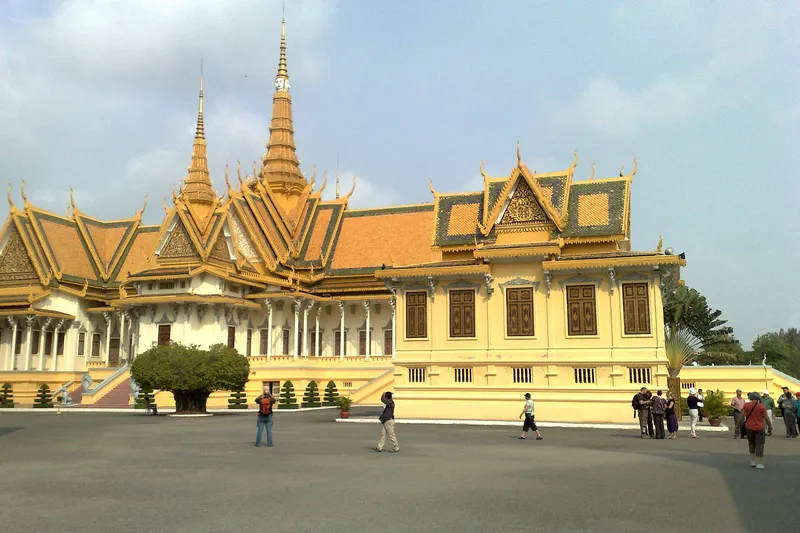
Royal compound
Royal Palace & Silver Pagoda
The Throne Hall and the Silver Pagoda, whose floor is covered in more than 5,000 silver tiles, share one compound.

Updated October 2026 · Fact-checked
Gilded roofs of the Royal Palace, a riverfront where three rivers meet, covered markets and two memorials that explain modern Cambodia better than any textbook. Phnom Penh is the country's capital and its most visited destination, and it rewards a slow two days far more than a stopover on the way to Angkor.
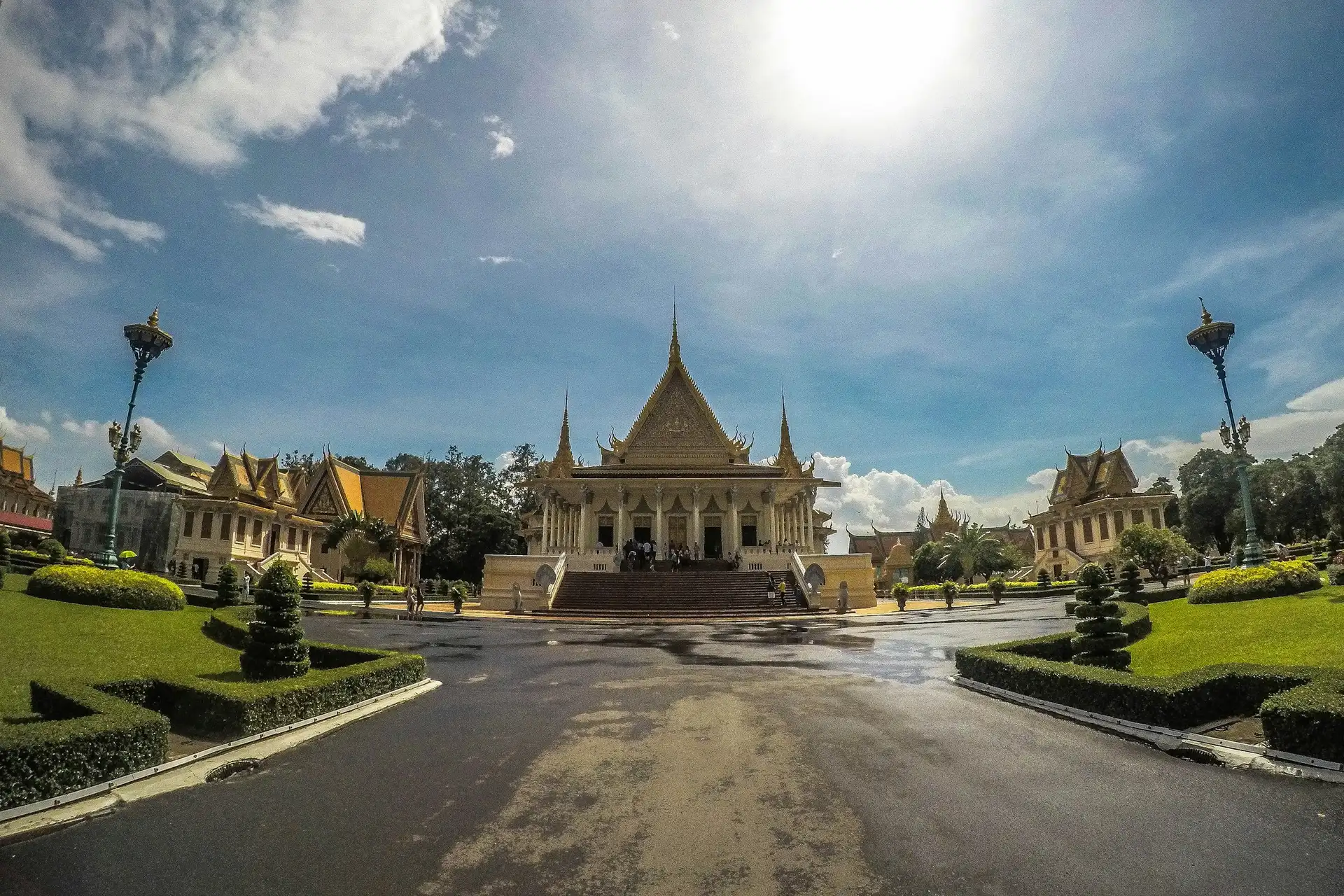 PHNOM PENH · 11.6°N 104.9°E
Phnom Penh sits where the Mekong, the Bassac and the Tonlé Sap meet, and it is the most visited place in Cambodia: the Ministry of Tourism counted 1,885,756 foreign visitors here in 2025, against 955,131 for Siem Reap Angkor and 415,459 for Preah Sihanouk province. The city takes its name from Wat Phnom, the hilltop temple tied to the legend of a woman called Penh, and it has been the seat of the Royal Palace since King Norodom began building it in 1866.
For many travellers it is the stop between the temples of Siem Reap and the coast. That undersells it. In one compact area you can see a working royal palace, the country's national collection of Khmer art, a riverside promenade and a covered market from 1937, and two memorial sites that document the Khmer Rouge years. The Cambodia country guide covers the rest of the country.
Phnom Penh is hot for much of the year: tourismcambodia.com puts the hot season at March to May, with highs of up to 38 C. Two of the main sights, Tuol Sleng and Choeung Ek, are memorials to mass killing and are heavy going. Plan them for a day when nothing else is booked.
Bag and phone snatching is the real nuisance. The UK FCDO and Canada both single out the riverfront and the Boeung Keng Kang area. It is easy to avoid with simple habits (see the safety chapter), but it catches many visitors who carry a phone in hand beside the road.
Most sights sit within a few kilometres of the river. Decide first whether you want to walk to the palace and museum, or be near the restaurants and nightlife a short ride away.
Sisowath Quay is a riverfront strip of about 3 km along the Tonlé Sap, lined with hotels, restaurants, bars and cafes. The Royal Palace is a short walk away and the National Museum sits just north of it. It is the most convenient base for a first visit and also the area where the UK FCDO and Canada flag petty theft, so keep phones and bags away from the road.
In the north of the old centre, Wat Phnom crowns a tree-covered hill, and the yellow Art Deco Central Market, opened in 1937, stands with four wings radiating from a central dome. Raffles Hotel Le Royal is also in this part of the city, in Sangkat Wat Phnom.
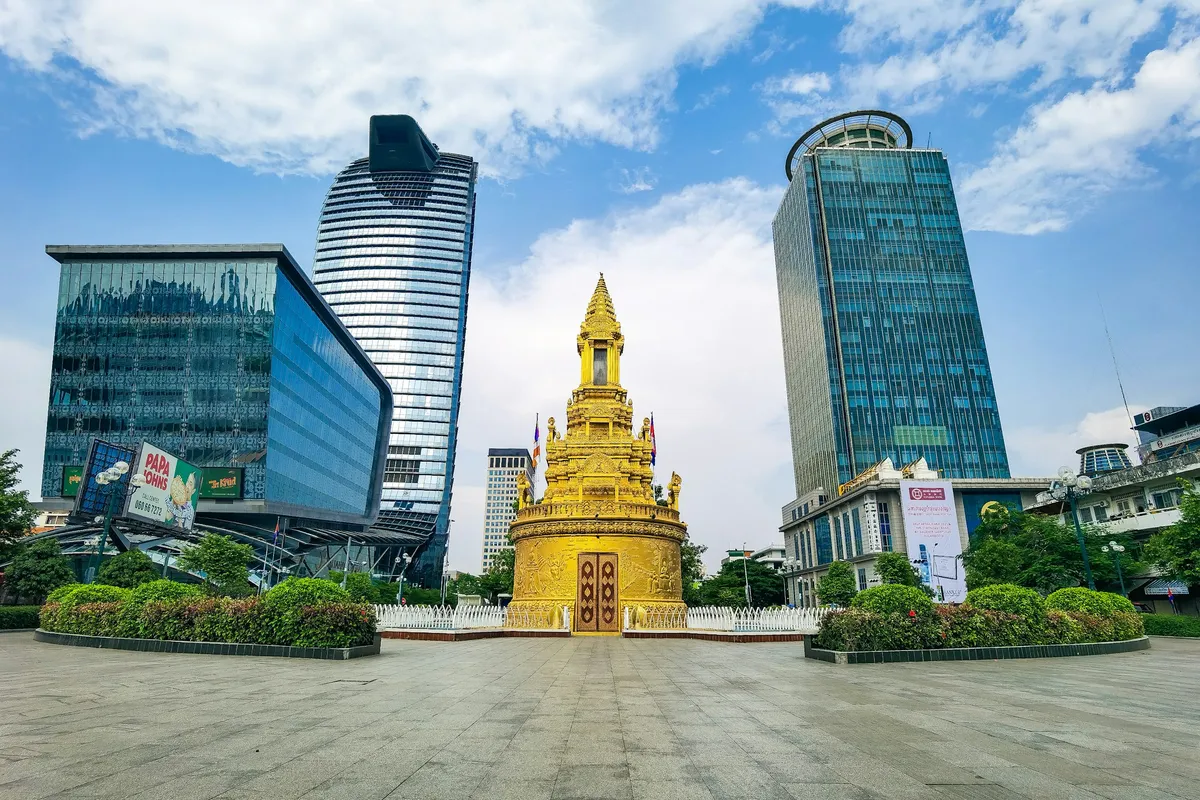
The lotus-shaped Independence Monument, designed by Vann Molyvann and opened in 1962, stands at the crossing of Norodom and Sihanouk boulevards. It is a landmark to see from the road or on a walk between areas rather than a destination for an afternoon.
Boeung Keng Kang is the district around Tuol Sleng Genocide Museum (Street 113, BKK III) and has many of the city's restaurants and cafes. Canada notes that theft targeting foreigners is common here and along the riverfronts, and advises avoiding walking alone after dark.
The Russian Market (Tuol Tom Poung) is known for paintings and antiques. Tourismcambodia.com warns that prices can start very high, so bargain.
These four picks cover the range, checked against the hotels' own sites and listings. Room rates change by season, so we list none: check the hotel's own booking page.
Raffles Hotel Le Royal was built in 1929 and reopened as a Raffles hotel in 1997, at 92 Rukhak Vithei Daun Penh in Sangkat Wat Phnom. Its Elephant Bar offers signature cocktails, 200 gin labels and afternoon tea. For a modern high-rise stay, Rosewood Phnom Penh sits in the Vattanac Capital Tower at 66 Monivong Boulevard and has eight restaurants and bars, including the CUTS steakhouse, Sora and the Whisky Library.
Sofitel Phnom Penh Phokeethra on Sothearos Boulevard has 201 rooms and suites, two pools, a spa, the Phokeethra Sports Club with tennis and squash courts, and four restaurants (La Coupole, Hachi, Fu Lu Zu and Do Forni). On a budget, Mad Monkey Phnom Penh lists mixed and female-only dorms, each with an ensuite bathroom, plus private doubles, triples and twins.
Khmer cooking is the reason to eat out in Phnom Penh. Start with fish amok, then try the training restaurants that fund programmes for young people.
Amok is a steamed Khmer fish curry with a mousse-like texture, made with a spice paste called kroeung, coconut cream and egg, and steamed in a banana-leaf container. It is considered one of Cambodia's national dishes and is served with steamed rice.
Romdeng (Street 174) and Friends the Restaurant (Street 13) are vocational training restaurants run by Mith Samlanh, the Friends-International programme in Phnom Penh, with trainees who are former street children. Romdeng's menu goes from Khmer curries and pork belly with Kampot pepper to insect dishes such as fried tarantula, for the curious.
Malis, on Street 41, markets itself as "living Cambodian cuisine" and serves dishes such as samlor Khmer, kuy teav noodle soup and Kep crab with Kampot pepper. Its menu and hours change, so check before you go.
Prices below are the foreigner fees listed on the site or by guides at the time of checking. Palace opening hours vary and the palace can close for ceremonies, so confirm on the day.
The Throne Hall and the Silver Pagoda, whose floor is covered in more than 5,000 silver tiles, share one compound.
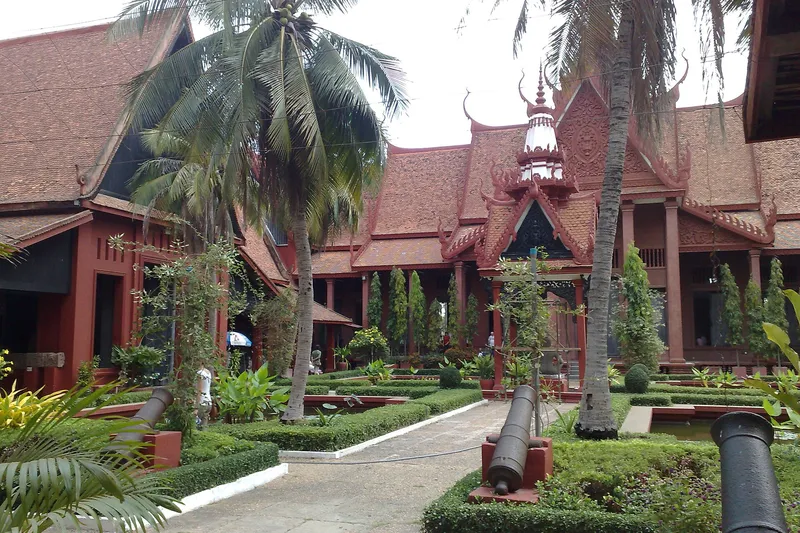
One of the world's largest collections of Khmer cultural material, in a terracotta building just north of the Royal Palace.
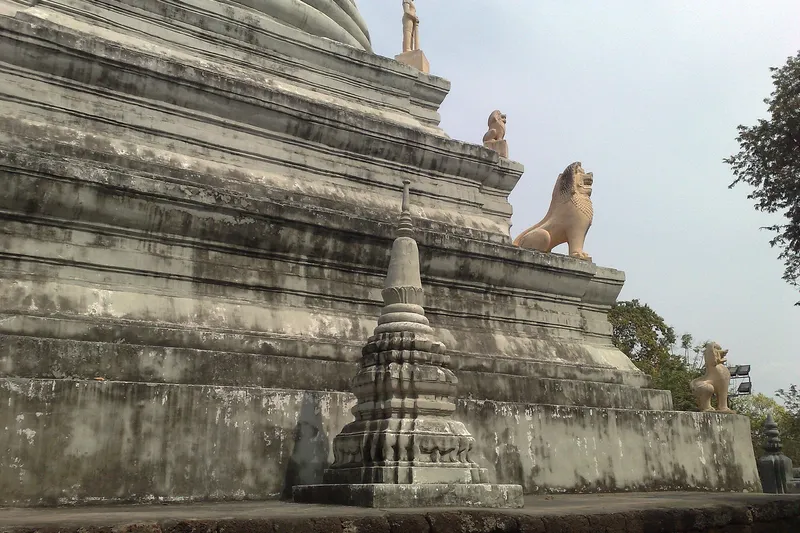
The temple on a tree-covered hill that gave the city its name, tied to the legend of Lady Penh.
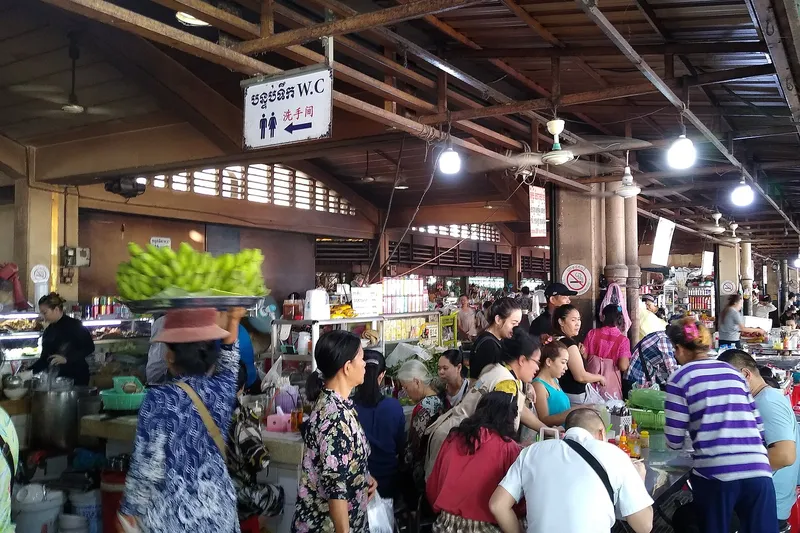
A yellow Art Deco hall opened in 1937, with four arched wings leading off a central dome.
King Norodom began the Royal Palace in 1866 and it was largely rebuilt under King Sisowath. Visitors can see the Silver Pagoda compound, the central compound with the Throne Hall and the Chan Chhaya Pavilion; the king's residence, about half the grounds, is closed. Guides list a US$10 ticket that covers the palace and the Silver Pagoda, no photography inside the Silver Pagoda, and a midday closure. The National Museum is open daily from 8:00 to 17:00 with last tickets at 16:30; the entry is US$10 for foreigners aged 18 and over and US$5 for ages 10 to 17, and photography inside is prohibited.
The Tuol Sleng Genocide Museum on Street 113 is the memorial site of S-21, the Khmer Rouge interrogation and detention centre. It is open daily from 8:00 to 17:00 including public holidays. Foreigner admission is US$5 for adults, US$3 for ages 10 to 17 and free under 10, an audio guide costs US$5, and payment is in cash. Dress modestly with arms and legs covered; mobile phones are not allowed in the exhibition buildings. Choeung Ek, about 17 km south of the centre, is where people from S-21 were executed. Wikivoyage lists US$6 including an audio tour and opening hours of 7:30 to 17:30.
The Central Market sells gold and silver jewellery, clothing, flowers, food and fabrics, and Wikivoyage calls it pricier and more touristy than Orussey Market. Wat Phnom is listed at US$1 for foreigners. The Independence Monument, 37 metres high, is the focus of national celebrations; independence from France is marked on 9 November.
Two days cover the main sights. Keep the memorial sites together on one day so the rest of the trip stays lighter.
Royal Palace and Silver Pagoda. Go when the palace is open, with shoulders and knees covered.
National Museum. Just north of the palace; last tickets 16:30.
Wat Phnom and the Central Market. The hill temple, then the Art Deco market hall.
Riverside and dinner. Walk Sisowath Quay with your bag away from the road, then dinner at a Khmer restaurant.
The one-day route: Royal Palace, National Museum, Wat Phnom, Central Market and the riverside.
Tuol Sleng. Open from 8:00; take the audio guide and allow time afterwards.
Choeung Ek. About 17 km south, open until 17:30.
A quiet dinner. Romdeng or Friends the Restaurant support youth training programmes.
The two-day route above, adding the Russian Market and the Independence Monument.
Oudong. The former royal capital about 35 km northwest, with a royal necropolis on its hill.
Techo International Airport (KTI) opened on 9 September 2025 and replaced the old Phnom Penh International Airport as the main hub. It is about 20 km from the centre. The Airport Express Bus, run by Phnom Penh City Bus, operates daily from 5:30 am to 11:30 pm between the airport and Kouch Kanong Circle Bus Station along Monivong Boulevard, with stops at Canadia Garden, the Royal University of Law and Economics, Bred Bank and AEON Mall Mean Chey. Wikivoyage lists the fare as 1,500 riel and a tuk-tuk from the airport as about US$8.
In the city, Wikivoyage lists tuk-tuks at US$2 to US$3 per trip (agree the fare first), PassApp as a metered app usually cheaper than a tuk-tuk, Grab as also available, and the city bus at 1,500 riel per ride in daytime. The riel is the national currency but US dollars are widely used. The UK FCDO warns of fake or torn dollar notes given as change, so check them.
Tourismcambodia.com gives the cool season as November to March (22 to 28 C), the hot season as March to May, the rainy season as May to October, the heaviest rain in September and October, the coolest months as December and January and the hottest month as April.
Practical prep: the UK FCDO says visitors need a visa, either an e-visa applied for at least 4 days ahead or a visa on arrival paid in US dollars, with a passport valid for at least 6 months. Air arrivals also submit a free electronic arrival card within 7 days before arrival. See the Cambodia country guide for the e-visa fee and the rest. An eSIM before landing saves a queue at the airport.
We give no daily budget here because we found no source for one. Instead, these are the prices we could check, grouped by what you spend on. Fees are for foreign adults.
Canada asks travellers to exercise a high degree of caution in Cambodia, mainly because of petty crime. The UK FCDO says most theft is bag snatching, often by thieves riding past on motorbikes, and names the riverfront and Boeung Keng Kang as hotspots in Phnom Penh. Carry your bag on the side away from the road and do not use a phone beside the road.
Both governments also warn about the Thailand border: the UK FCDO advises against all but essential travel within 20 km of it and Canada says to avoid all travel within 50 km. Land crossings between Cambodia and Thailand are suspended, and landmines remain in the border area. Phnom Penh itself is not in that zone. Other points to know: fake or torn dollar notes given as change, unmarked mined areas in rural Cambodia, and dengue, which Canada flags as a risk; protect yourself from mosquito bites all day. Wikivoyage lists the tourist police at 012 942 4840 and notes that real monks do not beg from tourists. Read the Cambodia scam guide before you land.
Phnom Penh is a hub for the rest of Cambodia, and Wikivoyage lists coach routes to the north-east and across the border into Vietnam. These are the nearest places worth a visit.
Oudong lies about 35 km northwest of Phnom Penh on National Road 5. It was the royal residence and Cambodia's capital for almost 250 years until King Norodom moved the court to Phnom Penh in 1866. At the foot of Phnom Oudong, a royal necropolis of sovereigns from several centuries spreads across the hilltop, with stupas and Prasat Nokor Vimean Sour.
The Choeung Ek memorial is about 17 km south of the centre, 40 to 60 minutes by taxi, motorbike or tuk-tuk. Wikivoyage lists a tuk-tuk at about US$7 one way and a tour bus at US$16 that also stops at Tuol Sleng.
Kampot is known for high-quality pepper exported worldwide and, unlike most Cambodian provincial capitals, has a centre of 19th-century French colonial architecture. The Cambodia guide covers the coast.
The main risk is petty crime. The UK FCDO says most theft is bag snatching, often by thieves on motorbikes, and lists the riverfront and Boeung Keng Kang (BKK) as hotspots. Canada advises a high degree of caution in Cambodia because of petty crime. The Thailand border warnings concern the border area, not the capital.
Two days cover the main sights: the Royal Palace, National Museum and riverside on one day, Tuol Sleng and Choeung Ek on the other. A third day fits a trip to Oudong.
Listed foreigner prices: Tuol Sleng US$5 (audio guide US$5), Choeung Ek US$6 with audio tour, National Museum US$10 (US$5 for ages 10 to 17), Royal Palace and Silver Pagoda US$10, Wat Phnom US$1. Only the Tuol Sleng and National Museum prices come from the sites themselves, so confirm the rest at the gate.
The cool season runs from November to March (22 to 28 C) and December and January are the coolest months. The rainy season runs from May to October, with the heaviest rain in September and October. April is the hottest month.
Phnom Penh's main airport is now Techo International Airport (KTI), which opened on 9 September 2025 about 20 km from the centre. The Airport Express Bus runs daily from 5:30 am to 11:30 pm to Kouch Kanong Circle Bus Station. Wikivoyage lists the fare as 1,500 riel and a tuk-tuk as about US$8.
Yes, UK citizens need a visa. The UK FCDO says to apply for an e-visa at least 4 days ahead through the official channels, or get a visa on arrival at airports and land borders, paying in US dollars. Passports must be valid for at least 6 months. Arrivals by air also submit a free electronic arrival card within 7 days before arrival. Check the rules for your own nationality.
The Cambodian riel is the national currency, but US dollars are widely used. The UK FCDO warns of fake or torn dollar notes given as change, so check notes before you accept them. Wikivoyage lists ATM fees of about US$5 per withdrawal at most banks.
Cover your shoulders and knees at the Royal Palace and Silver Pagoda. Tuol Sleng asks visitors to dress modestly with arms and legs covered. Phones are not allowed inside its exhibition buildings.
Yes. Choeung Ek is about 17 km south of the centre, 40 to 60 minutes by taxi, motorbike or tuk-tuk. Wikivoyage lists a tour bus for US$16 that also stops at Tuol Sleng. Both sites deal with the Khmer Rouge years and need time and a quiet mood.
The riverside and Royal Palace area puts the palace, National Museum and Sisowath Quay on foot. Boeung Keng Kang has Tuol Sleng and many restaurants but is also a theft hotspot after dark, so keep bags secure.
Phnom Penh is a city of contrasts: the gold roofs of the Royal Palace, the crowded market halls, the glass towers and, a few kilometres away, two places that record what happened to the people of this city in the 1970s.
Give the memorials a quiet morning, then walk the river in the evening, and the rest of Cambodia will make more sense.