
What You're Actually Getting Into
India is not one trip, it is dozens of different ones stacked on top of each other and sold under a single visa. The Mughal marble of the Taj Mahal, the pastel forts of Rajasthan, the palm-lined backwaters of Kerala, the burning ghats of Varanasi and the Buddhist monasteries of Ladakh have almost nothing in common except the passport stamp that gets you to all of them. With around 1.46 billion people, dozens of major languages and a landmass bigger than all of Western Europe, treating "India" as a single destination is the first mistake most first-time visitors make.
It is also, for the money, one of the richest travel experiences on earth. A heritage haveli room in Rajasthan costs less than a mid-range hotel in Europe. A full thali lunch costs 150 to 400 rupees, under five dollars. A private driver for a week of the Golden Triangle costs less than a single night at a mediocre hotel back home. The trade-off is that nothing about India is frictionless: the crowds, the noise, the traffic and the constant low-grade hustle of touts and commission-seekers are part of the deal, not a bug to be planned around.
The honest complications
Delhi and much of the north suffer genuinely severe air pollution from late November through January, driven by crop burning, vehicle emissions and winter temperature inversion; some travelers reroute their trip around it, and this guide addresses it directly in the Plan chapter rather than glossing over it. Touts, commission-driven "guides" and fake travel agencies are a real and constant presence at major sites and near railway stations, not an occasional nuisance. Tap water is unsafe everywhere, and the CDC estimates better than a 60% chance of travelers' diarrhea on a two-week trip even with careful eating. Trains and buses run late as a matter of course, and booking Indian Railways tickets online requires either an Indian phone number or a separate Foreign Tourist Quota process that catches unprepared visitors out. None of this is a reason to skip India. It is a reason to build in slack, hire a driver for at least part of the trip, and arrive with patience budgeted as carefully as money.
A History Worth Knowing
India's history runs in overlapping layers: one of the world's oldest urban civilizations along the Indus, empires that produced some of the largest and most sophisticated states of the ancient and medieval world, four centuries of Mughal rule that left the marble monuments most visitors come to see, two centuries of British colonization, and independence in 1947 arriving alongside Partition, one of the largest and most traumatic mass migrations in human history. The short version of how the country you're visiting got here.
- c. 2500 BCE
Indus Valley Civilization. Planned cities at Mohenjo-daro and Harappa with drainage systems centuries ahead of their time, among the world's earliest urban societies.
- 3rd century BCE
The Maurya Empire. Emperor Ashoka unifies most of the subcontinent, then renounces violence after the bloody conquest of Kalinga and spreads Buddhism via inscribed edict pillars still standing today.
- 1526–1857
The Mughal Empire. Babur founds a dynasty that under Akbar, Shah Jahan and Aurangzeb builds the Taj Mahal, the Red Fort and much of what visitors now think of as "historic India."
- 1858–1947
The British Raj. Direct Crown rule follows the 1857 uprising; railways, English-language administration and a nationalist movement led by figures including Mahatma Gandhi all take shape under it.
- 1947
Independence and Partition. India and Pakistan become independent on 14-15 August; the hurried border drawing displaces an estimated 10-20 million people and causes immense loss of life.
- 1991–present
Liberalization and growth. Economic reforms open India to global trade and technology; today it is the world's most populous country and a major global economy, with tourism infrastructure that has expanded dramatically but still varies enormously by region.
Read the full history: empires, the Raj and Partition
After the Mauryas, the Gupta Empire (4th to 6th century CE) is remembered as a golden age of mathematics, astronomy and the arts; the concept of zero as a number is credited to Indian mathematicians of this era. Regional kingdoms, including the Chola dynasty in the south, built extraordinary temple architecture that predates the Mughals by centuries and survives across Tamil Nadu and Karnataka today.
The Mughal Empire, founded by the Central Asian conqueror Babur in 1526, reached its cultural peak under Shah Jahan, who built the Taj Mahal (completed 1653) as a mausoleum for his wife Mumtaz Mahal, and under Akbar, whose policy of religious tolerance is still studied as a model of pluralistic governance. Mughal decline through the 18th century opened space for the British East India Company, which governed as a commercial entity until the 1857 uprising, often called the First War of Independence, prompted the British Crown to take direct control.
The independence movement of the early 20th century, led by the Indian National Congress and figures including Mahatma Gandhi with his philosophy of nonviolent resistance (satyagraha), forced British withdrawal in 1947. The same act that granted independence partitioned British India into India and Pakistan along religious lines, a division drawn in weeks by a British lawyer who had never visited the subcontinent. The resulting migration and communal violence killed an estimated one to two million people and remains a defining, still-discussed trauma on both sides of the border.
Since independence, India has built the world's largest democracy, fought several wars with Pakistan and one with China, and since the 1991 economic liberalization become a major global technology and manufacturing power, all while retaining the extraordinary regional, linguistic and religious diversity that makes travel here feel like visiting several countries at once.
Top Destinations
India divides into travel zones large enough that most visitors pick one or two per trip rather than attempting the whole country. The Golden Triangle is the standard first circuit; Rajasthan, Kerala, Varanasi and the Himalayas each reward a dedicated week or more of their own. Distances are large: Delhi to Kerala is further than London to Cairo, so plan around one or two regions rather than a grand tour.
Delhi, the capital and gateway
Delhi is where nearly every India trip begins: Mughal monuments, colonial New Delhi, and a food scene that alone justifies a couple of days. Read the full Delhi city guide for neighborhoods, hotels, restaurants and a complete itinerary.
Agra, for the Taj Mahal alone
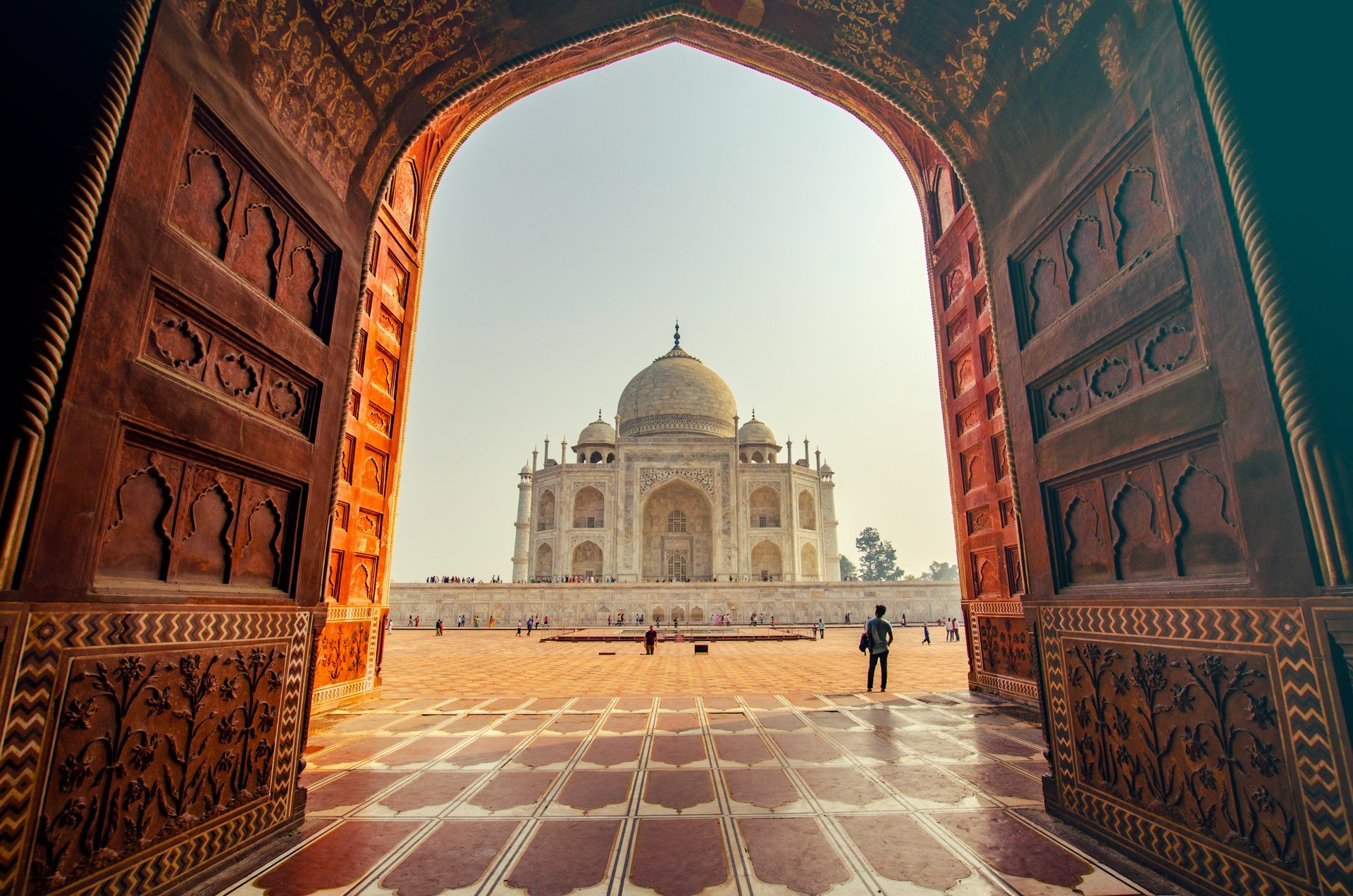
Agra is a rough, workaday city built almost entirely around one extraordinary reason to visit: the Taj Mahal, Shah Jahan's marble mausoleum for his wife Mumtaz Mahal, completed in 1653 and still the single most photographed building in the country. Entry for foreign visitors costs around ₹1,300; go at sunrise both to beat the heat and the crowds and to see the marble shift color as the light changes. The Agra Fort, a red sandstone Mughal fortress-palace on the Yamuna river, and Fatehpur Sikri, Akbar's abandoned capital 40km away, both deserve a half day each. Most visitors see Agra as a day trip from Delhi via the Gatimaan Express, India's fastest train (1 hour 40 minutes), rather than overnighting.
Jaipur, the Pink City
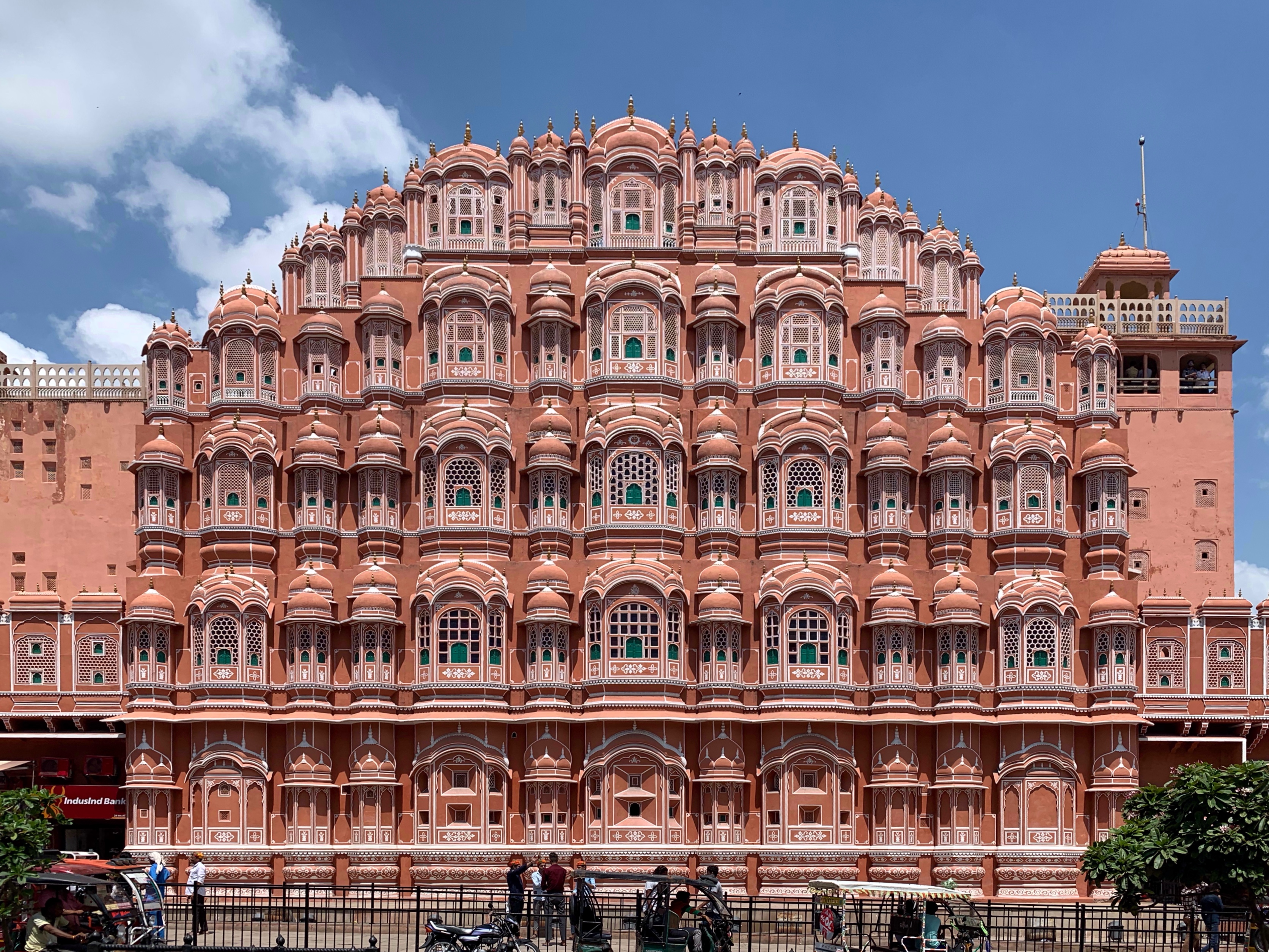
Jaipur, Rajasthan's capital, was painted pink in 1876 to welcome the Prince of Wales and has kept the color ever since. The Amber Fort, a hilltop palace-fortress of honey-colored sandstone and marble 11km from the center, the City Palace still partly occupied by Jaipur's royal family, the Hawa Mahal's honeycomb facade of 953 windows, and the Jantar Mantar astronomical observatory with its giant stone sundials are the core sights. The old walled city's bazaars are the best in Rajasthan for block-printed textiles, gemstones and traditional jootis (leather shoes), though the gemstone "export scheme" scam targeting tourists is genuinely common here, more below in Safety.
Udaipur, the City of Lakes
Udaipur is Rajasthan's most romantic city, built around Lake Pichola with the City Palace complex rising above the water and the white marble Lake Palace, once a royal summer retreat and now a hotel, appearing to float on the surface. James Bond fans will recognize the setting from Octopussy; most rooftop restaurants in the old city screen it nightly, a small local industry of its own.
Jodhpur, the Blue City
Jodhpur's old town is painted in shades of indigo blue, historically linked to Brahmin caste tradition and mosquito deterrence, and viewed from above from Mehrangarh Fort, one of India's largest and best-preserved forts, the effect is striking. The fort museum is genuinely excellent, with an audio guide covering the palace's history in real depth rather than the perfunctory version common elsewhere.
Jaisalmer, the desert fortress
Jaisalmer's "Golden Fort" is a living fort, meaning around 3,000 people still reside within its sandstone walls, the last such inhabited fort in India. It's the jumping-off point for camel safaris into the Thar Desert, with overnight dune camps a genuine highlight for travelers with the extra days to reach this far west.
Kerala's backwaters
Kerala, "God's Own Country" in the state's own tourism branding, is a different India: greener, calmer, and organized around a network of lagoons, canals and rivers running parallel to the Arabian Sea coast. A night or two on a converted rice-barge houseboat drifting through Alleppey's backwaters, watching village life along the banks, is one of the most-loved experiences in the country. Munnar's tea plantations, terraced hills of impossibly even green at 1,500m elevation, are a cool, quiet contrast to the coastal heat.
Kochi and the Malabar coast
Kochi mixes Portuguese, Dutch and British colonial history with Chinese fishing nets strung along the Fort Kochi waterfront, a legacy of 14th-century trade links. It's a manageable, walkable introduction to Kerala before heading into the backwaters proper.
Tamil Nadu's temples
Tamil Nadu's Dravidian temple architecture predates the Mughals by centuries: the Meenakshi Amman Temple in Madurai, with its towering, carved gopuram gate towers covered in thousands of painted deity figures, is the classic example and among the most visually overwhelming religious buildings in the country.
Varanasi, the oldest living city
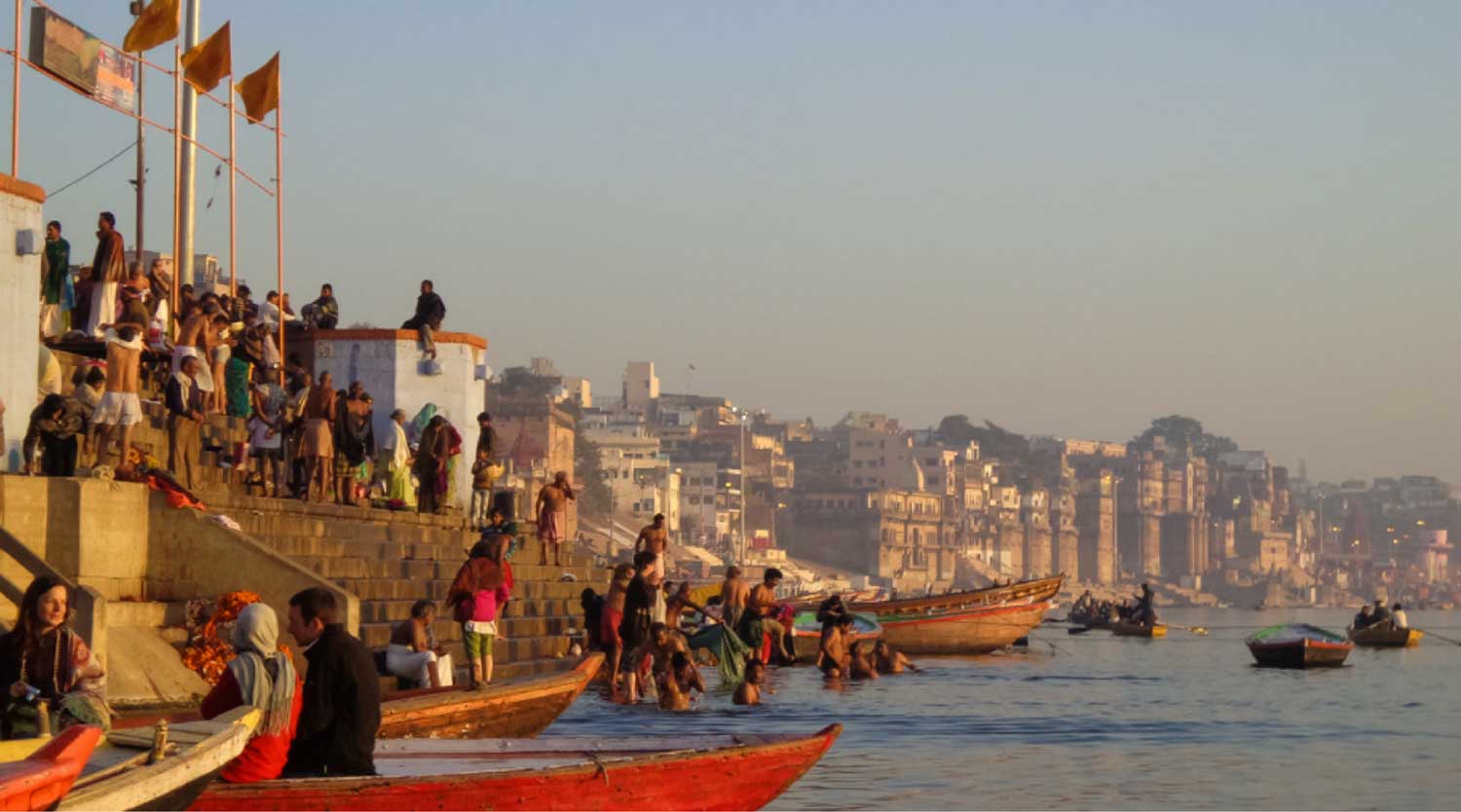
Varanasi sits on the Ganges and is among the oldest continuously inhabited cities on earth, and for Hindus one of the holiest: pilgrims come to bathe in the river and to cremate their dead on the burning ghats, an open practice that visitors witness directly rather than at a remove. The Ganga aarti fire ceremony at Dashashwamedh Ghat each evening, performed by priests with brass lamps to drums and chanting, draws large crowds; a dawn boat ride along the ghats, quieter and softer-lit, is the experience most visitors remember longest. This is an intense, unfiltered place: come with respect for its role as a place of death and mourning as much as spectacle.
Rishikesh, for yoga and the river
Rishikesh, in the Himalayan foothills where the Ganges emerges from the mountains, is India's yoga capital, made internationally famous when the Beatles studied at Maharishi Mahesh Yogi's ashram here in 1968. Whitewater rafting on the Ganges, ashrams offering short courses, and a calmer, cooler climate than the plains make it a popular add-on for travelers heading north from Delhi.
Ladakh and Himachal Pradesh
Ladakh, a high-altitude desert region bordering Tibet, has Buddhist monasteries, stark mountain scenery and a culture closer to Tibet than the rest of India; Leh, its main town, is reachable by flight from Delhi (road access closes with winter snow). Himachal Pradesh's hill stations, Manali and McLeod Ganj (seat of the Dalai Lama's government-in-exile since 1960), offer trekking and a cooler climate within easier reach of Delhi.
North Goa
Goa was a Portuguese colony for 450 years until 1961, and the legacy shows in whitewashed churches, Indo-Portuguese architecture and a laid-back coastal culture distinct from the rest of India. North Goa (Baga, Calangute, Anjuna) has the beach clubs, nightlife and flea markets; Anjuna's Wednesday flea market has run since the hippie era of the 1960s and 70s.
South Goa
South Goa (Palolem, Agonda) is quieter and greener, with a slower pace better suited to travelers who want the coast without the party. Old Goa's UNESCO-listed churches, including the Basilica of Bom Jesus holding the remains of St. Francis Xavier, are an easy half-day between the two.
Hidden gems beyond the main circuit
The zones above cover a first or second trip well. With extra days or a repeat visit, these are the spots that rarely make the standard itinerary and reward the detour.
Hampi
The ruins of the Vijayanagara Empire's 14th-century capital, scattered across a surreal boulder-strewn landscape, with temples, elephant stables and a stone chariot that once featured on the Indian 50-rupee note.
Living Root Bridges
Bridges grown from the aerial roots of rubber fig trees over generations by the Khasi people, in India's wettest state. Remote, genuinely unlike anywhere else in the country, and largely untouched by mass tourism.
Rann of Kutch
A vast white salt desert that floods seasonally and dries into a blinding, mirage-prone flat; the annual Rann Utsav festival (roughly November to February) turns part of it into a desert camping and cultural festival.
Pushkar
A holy lake town built around one of India's few Brahma temples, best known for its November camel fair, when tens of thousands of camels, cattle and traders converge for a week of trading, races and festivities.
Spiti Valley
A high-altitude cold desert valley on the Tibetan plateau's edge, with centuries-old Buddhist monasteries and some of the most dramatic mountain scenery in India. Accessible only in the warmer months.
Andaman Islands
A remote island chain with genuinely clear water and coral reefs, closer to Thailand than to mainland India geographically. Reached by flight from Chennai or Kolkata; a different, beach-and-diving India entirely.
Culture & Etiquette
India's cultural diversity means etiquette varies by region, religion and setting, but a few norms hold nationwide. Modesty in dress, respect at religious sites, and awareness of the right hand versus left hand distinction go furthest. Namaste, palms together at chest height with a slight bow, is the standard greeting and a safe default when unsure whether a handshake is welcome, particularly with elders or across genders.
Do
- Dress modestly. Cover shoulders and knees in most settings, and carry a scarf or shawl for temples, mosques and gurudwaras that require head covering.
- Remove your shoes before entering temples, mosques, gurudwaras and most private homes; watch what others do at the entrance if unsure.
- Use your right hand for eating, giving and receiving anything, including money and business cards; the left hand is considered unclean.
- Accept the head wobble. The side-to-side head movement generally signals agreement or acknowledgment, not disagreement, and takes visitors a few days to stop misreading.
- Bargain in markets where prices aren't marked, but expect fixed prices in malls, chain stores and government emporiums.
Don't
- Show public affection. Kissing and overt physical affection between couples in public draw attention and disapproval in most of India, including tourist areas.
- Touch people's heads, including children's, without invitation; the head is considered spiritually significant in Hindu and Sikh tradition.
- Photograph people, ceremonies or funeral rites (including at Varanasi's ghats) without asking first, particularly at religious and cremation sites.
- Assume every "helpful" stranger is neutral. Unsolicited offers of help near stations, monuments and taxi ranks are frequently a lead-in to a commission scam; polite firmness works better than engagement.
- Point your feet at people, shrines or books. Feet are considered the least clean part of the body; tuck them away when sitting, especially in religious settings.
Deeper culture: religion, vegetarianism and regional diversity
Religious diversity. India is majority Hindu (around 80%) with large Muslim, Christian, Sikh, Buddhist and Jain populations, and the everyday texture of most cities reflects genuine religious pluralism: temples, mosques, gurudwaras and churches often sit within a few streets of each other. Religious festivals, Diwali (the festival of lights, October or November) and Holi (the festival of colors, March) chief among them, are worth timing a trip around if the dates align, though both also mean higher prices and heavier domestic travel.
Vegetarianism. India has one of the highest rates of vegetarianism in the world, driven by Hindu, Jain and Buddhist dietary traditions, and vegetarian food is never a compromise option here: "pure veg" restaurants are common, thoughtfully spiced, and treated as a cuisine in their own right rather than an afterthought.
Regional diversity. A traveler moving from Rajasthan to Kerala to Kolkata crosses more linguistic, culinary and cultural distance than a trip across several European countries. Assume little carries over between regions: greetings, food, dress and even the alphabet on signage change as you move.
Food & Drink
Indian food outside India bears only a loose resemblance to the range on offer inside it: what most Western menus label "Indian food" is largely a Punjabi and Mughlai subset. Regional cuisines from Kerala's coconut-and-seafood cooking to Bengal's fish and mustard oil to Gujarat's all-vegetarian thalis are as different from each other as French cooking is from Moroccan.
Thali ₹150-400
A round platter of small bowls: dal, vegetable curries, rice, bread, yogurt, pickle and a sweet, refilled on request at most restaurants. The best introduction to regional cooking, since every state's thali is different.
Street food & chaat ₹30-100
Chaat, savory snacks built from fried dough, chutneys, yogurt and spice, and stuffed parathas are the everyday street food. Old Delhi's Paranthe Wali Gali has served stuffed fried breads from the same handful of family stalls for over a century.
Chai & lassi ₹10-80
Sweet, milky spiced chai from a roadside stall (₹10-20) is the constant background rhythm of Indian travel. Lassi, a yogurt drink, ranges from a plain salted version to Rajasthan's thick, elaborate sweet lassi.
Biryani ₹150-350
Layered rice and meat or vegetables, slow-cooked under a sealed lid (dum style). Hyderabadi and Lucknowi biryani are the two most famous regional traditions, distinct enough to have partisans on each side.
Dosa & South Indian ₹80-150
Fermented rice-and-lentil crepes served with sambar and coconut chutney, the everyday breakfast of the south. Saravana Bhavan, a South Indian chain with branches nationwide, is a reliable, hygienic introduction.
Mithai (sweets) ₹200-500/kg
Milk-based sweets like gulab jamun and jalebi, sold by weight from dedicated sweet shops. Old Famous Jalebi Wala in Chandni Chowk has been frying its jalebi in the same spot since 1884.
When to Go & Itineraries
October through March is the standard high season across most of India: warm days, cool nights and low rainfall. Within that window, one honest caveat matters: late November through January brings severe air pollution to Delhi and much of the north, driven by crop burning, vehicle emissions and winter temperature inversion trapping smog at ground level. October and February-March offer similar temperatures with meaningfully cleaner air, and are the better choice if Delhi and the north are on the itinerary. April to June is extremely hot across most of the country (35-45°C), and July to September is the monsoon: humid, with heavy rain and travel disruption in places, but also lush landscapes, lower prices and far fewer tourists at major sites.
All four seasons compared, with temperatures
| Season | Verdict | Temps (Delhi/north) | Notes |
|---|---|---|---|
| Oct & Feb-Mar | Best | 15-30°C | Warm days, cool nights, cleanest air of the cool season |
| Nov-Jan | Good, but smoggy | 5-22°C | Pleasant temperatures but severe air pollution in Delhi and the north |
| Apr-Jun | Hard | 30-45°C+ | Extreme heat on the plains; Himalayan hill stations are the escape |
| Jul-Sep | Monsoon | 25-35°C, humid | Heavy rain, some transport disruption, lush scenery, lowest prices |
Kerala and the far south run warmer and more humid year-round than the north; the Himalayan regions run considerably cooler and are only reliably accessible May to October.
Itineraries
Seven days covers the Golden Triangle comfortably. Two weeks adds Rajasthan's other cities or a Varanasi-Himalayan foothills extension. Three weeks stretches as far as Kerala or Goa without the trip feeling rushed. India rewards slower travel more than almost anywhere; resist the urge to add a fourth or fifth region to a one-week trip.
- Days 1–3
Delhi. Old and New Delhi, Red Fort, Humayun's Tomb, Qutub Minar, food in Old Delhi and Khan Market. Full detail in the Delhi city guide.
- Day 4
Agra. Day trip via the Gatimaan Express: Taj Mahal at sunrise, Agra Fort, back to Delhi or on to Jaipur by road.
- Days 5–7
Jaipur. Amber Fort, City Palace, Hawa Mahal, Jantar Mantar, and the old city bazaars for block-print textiles and jootis.
- Days 1–7
The 7-day Golden Triangle above.
- Days 8–10
Udaipur. Road or short flight from Jaipur; Lake Pichola, the City Palace complex, a sunset boat ride.
- Days 11–14
Jodhpur. Mehrangarh Fort and the Blue City, then fly back to Delhi for departure.
- Days 1–10
The 14-day Golden Triangle and Rajasthan route above, at a gentler pace.
- Days 11–14
Varanasi. Fly from Jodhpur or Delhi; dawn boat ride, the evening Ganga aarti, a day trip to Sarnath where the Buddha gave his first sermon.
- Days 15–21
Kerala. Fly south to Kochi; Fort Kochi's colonial waterfront, Munnar's tea plantations, and two nights on an Alleppey backwater houseboat to close the trip.
Getting there & around
Indira Gandhi International Airport (DEL) in Delhi and Chhatrapati Shivaji Maharaj International (BOM) in Mumbai are the two main international gateways, with direct flights from most major global hubs (roughly 8-9 hours from London, 15-16 from New York). Budget domestic carriers, IndiGo chief among them, connect major cities cheaply and are often faster and more reliable than long train journeys on tight schedules. Trains remain the classic way to see the country and are dramatically cheaper: an AC sleeper berth on an overnight train can cost less than a mid-range hotel room. Booking through IRCTC as a foreign visitor requires either an Indian mobile number for OTP verification or the separate Foreign Tourist Quota, which has its own booking counters and process, so plan this before relying on trains for a tight itinerary.
All transport options with prices: trains, flights, drivers, rickshaws
| Option | Price | Notes |
|---|---|---|
| Domestic flights | ₹2,500-8,000 | IndiGo, Air India and others; book 2-4 weeks ahead for the best fares on popular routes. |
| Gatimaan Express (Delhi–Agra) | ₹900-2,300 | 1h40m, India's fastest train; departs Hazrat Nizamuddin 08:10, returns from Agra 17:50. |
| AC sleeper trains (overnight) | ₹800-2,500 | Cheaper and more atmospheric than flying; book via IRCTC's Foreign Tourist Quota or with an Indian SIM. |
| Private driver (per day) | ₹2,500-4,500 | The most practical way to cover the Golden Triangle or Rajasthan; a fixed daily rate covers the car, fuel and driver. |
| Auto-rickshaws (city) | ₹50-150/ride | Agree the fare first or insist on the meter; ride apps (Ola, Uber) remove the negotiation entirely. |
Practical prep: buy an Indian SIM or an eSIM before landing to sidestep the airport SIM queue and enable ride-hailing apps immediately. GetTransfer offers fixed-price airport pickups that avoid the arrivals-hall taxi touts entirely, worth the small premium on a first arrival.
Where to stay
Hostels & budget guesthouses
Zostel and Moustache both run well-regarded hostel chains across major cities and backpacker circuits, with social common areas and included breakfast at the better locations.
Heritage havelis
Converted merchant mansions and small palaces, concentrated in Rajasthan, offer character no chain hotel matches, often for less than an international mid-range brand.
Boutique & mid-range hotels
Concentrated in Delhi, Jaipur, Udaipur and Goa, with genuinely high standards of design and service at prices well below equivalent Western properties.
Heritage palace hotels
Former royal palaces converted into hotels, several run by the Taj and Oberoi groups, are among the most distinctive luxury stays anywhere in the world.
Budget Planning
India remains one of the cheapest major travel destinations in the world, though Delhi and Mumbai run 40-60% above the national average and should be budgeted for accordingly. Smaller cities, Varanasi, Hampi and rural Kerala among them, run well below typical guidebook figures.
- Hostel dorm ₹400-900
- Street food and thalis ₹200-400
- Sleeper-class trains and local buses
- Free sights, modest monument entries
- Boutique hotel or heritage haveli
- Restaurant meals ₹500-1,200/person
- Private driver or AC trains and domestic flights
- Guided tours at major monuments
- Heritage palace hotels
- Private guide and driver throughout
- Fine dining and premium experiences
- Domestic flights over long train journeys
Quick reference prices: chai, meals, monument entries
| Chai from a roadside stall | ₹10-20 |
| Street food meal | ₹30-100 |
| Restaurant thali | ₹150-400 |
| Mid-range restaurant meal | ₹500-1,200 |
| Taj Mahal entry (foreigner) | ~₹1,300 |
| Red Fort entry (foreigner) | ~₹600 |
| Qutub Minar / Humayun's Tomb (foreigner) | ~₹550 each |
| Auto-rickshaw short ride | ₹50-150 |
| Private driver, full day | ₹2,500-4,500 |
| Hostel dorm bed | ₹400-900/night |
Prices reflect August 2026 research and drift over time, especially domestic flights and Delhi/Mumbai accommodation. Treat them as a planning baseline, not a quote.
Visa & Entry
Most Western passport holders need an e-Tourist Visa arranged in advance; India does not offer visa-free entry or broad visa-on-arrival to US, UK, EU, Australian or Canadian citizens. Apply only at the official government portal, indianvisaonline.gov.in, not the numerous third-party sites that rank well in search and charge a markup for a service the government portal provides directly. A 30-day e-Tourist Visa costs around $25 for US citizens ($10 during the April-June low season), with 1-year and 5-year multiple-entry options also available; fees vary by nationality due to reciprocal pricing agreements, so check the exact figure for your passport on the official site. Processing typically takes 72 hours to a few business days; e-visas are non-extendable and non-convertible, so apply with confirmed travel dates.
✓ Valid passport
At least 6 months validity from date of arrival, with at least two blank pages.
✓ e-Tourist Visa
Apply online in advance; approval usually arrives by email within a few days as a PDF to print or show on your phone.
✓ e-Arrival Card
A free digital arrival card, mandatory since 1 April 2026 for all foreign nationals, completed online before flying.
✓ Onward/return ticket
May be requested at immigration; keep a digital or printed copy accessible on arrival.
| India | Nepal | |
|---|---|---|
| Scale | A subcontinent; months could still leave regions unseen | A single country you can meaningfully cover in 2-3 weeks |
| Entry | e-Tourist Visa required in advance for most nationalities | Visa on arrival for most nationalities, simpler process |
| Pace | Intense, crowded, constant sensory input | Calmer pace even in Kathmandu, especially outside peak trekking season |
| Mountains | Ladakh and Himachal for Himalayan scenery within a bigger trip | The Himalayas are the trip: Everest and Annapurna trekking infrastructure is unmatched |
| Budget | ₹1,800-3,500/day (~$20-42) gets you far | Broadly comparable, with trekking permits and lodges as the main added cost |
Safety, Solo Women & Family
India is safe for the large majority of travelers who visit. The US State Department rates India Level 2, Exercise Increased Caution, the same level applied to France, Italy and Germany, citing petty crime and, in specific areas, terrorism and civil unrest risk. Millions of foreign tourists visit Rajasthan, Kerala, Goa, Delhi and Agra every year without incident. The most likely problems are traffic, scams targeting tourists and travelers' diarrhea, not violent crime, with the specific exception of Jammu and Kashmir outside eastern Ladakh, which carries its own separate advisory to avoid.
Traffic
Chaotic, dense and the leading practical risk to visitors. Look both ways repeatedly when crossing streets, and treat lane markings and traffic lights as advisory rather than binding.
Travelers' diarrhea
The CDC estimates better than 60% risk on a two-week trip. Drink only bottled or filtered water, eat hot freshly cooked food, and carry basic rehydration salts and an anti-diarrheal as routine trip kit.
Petty theft
Pickpocketing and bag-snatching happen at crowded stations, markets and festivals at a level comparable to any major world city. Keep valuables secured and out of easy reach in crowds.
Two more things worth knowing: Kashmir and health prep
Jammu and Kashmir. Terrorism and civil unrest risk is concentrated here; check current government advisories before planning any travel beyond eastern Ladakh and Leh, which operate as a normal, popular tourist region.
Vaccinations. No vaccine is legally required for entry from most Western countries, but a travel health consultation before the trip is worthwhile: hepatitis A and typhoid are commonly recommended, along with confirming routine vaccinations are current. Malaria precautions matter for rural and forested itineraries; discuss with a travel clinic based on your specific route.
The 3 scams to actually know about
India's tourist-facing scam ecosystem is more developed than most destinations in this guide, concentrated around major stations, monuments and markets. Knowing these three in advance neutralizes most of it. The full country list lives on our India travel alerts page.
The gem & export scheme
A friendly stranger, sometimes posing as a fellow tourist or teacher, describes a government export scheme for buying gems cheaply to resell at home; the gems are worthless and the scheme doesn't exist. Especially common in Jaipur and Pushkar. Never buy jewelry or gems on a stranger's recommendation, and only from certified stores if buying at all.
Fake tourist offices & agents
A well-dressed person claims the official tourist office is nearby, then leads you to a private agency disguised as a government office, pressuring you into overpriced packages or fake "special quota" train tickets that don't exist. Book only through the official IRCTC site or verified agencies, and treat any claim of a nearby "government office" with suspicion.
The "monument is closed" detour
A rickshaw driver or tout claims your destination is closed today and offers to take you to a different site or shop instead, earning a commission. Confirm opening hours independently before you go, agree the route and price with any driver upfront, and say clearly that you won't be stopping at shops.
Solo women travelers
India rates 5.5/10 on our scale for solo women, reflecting a destination that is genuinely rewarding for solo female travelers but requires more consistent, active vigilance than most countries in this guide, not a reason to avoid it. Street harassment and unwanted attention are more common here than in most of the destinations covered on this site, particularly in crowded public spaces and on public transport outside major cities. The Delhi Metro's dedicated women's coach, marked clearly on the platform, is a genuinely useful and widely used option, and app-based cabs (Uber, Ola) with driver tracking are safer than hailing an unmarked taxi or rickshaw. Modest dress reduces unwanted attention meaningfully, especially outside cosmopolitan neighborhoods and beach towns. Many thousands of solo women travel India successfully every year using a private driver for intercity travel, staying in accommodation with strong reviews from other female travelers, and avoiding isolated areas after dark, the same baseline precautions as any large, dense, unevenly-lit country. Full detail on our Solo Woman Explorer pages.
Emergency numbers
Embassies and the women's helpline
112 is India's unified emergency number, replacing separate police, fire and ambulance lines; calling the old 100 (police) number now diverts to 112. The national women's safety helpline is 1091. The US Embassy in New Delhi can be reached at +91-11-2419-8000, and most Western embassies maintain consular sections in New Delhi with 24-hour emergency lines for citizens in serious difficulty.
Family travel & pets
India works well for families (7.0/10) with a slower pace and more planning than a typical family trip: forts and palaces genuinely capture kids' imaginations, and Indians are broadly warm toward traveling children. The main challenges are heat, food safety for younger stomachs and the intensity of crowds at major sites; a private driver rather than public transport, and hotels with reliable air conditioning and Western-style bathrooms, smooth out most of the friction. Stick to bottled water and freshly cooked food strictly with young children, and pack rehydration salts as routine kit.
Bringing pets to India
Importing pets requires an import permit from India's Department of Animal Husbandry, a health certificate and current rabies vaccination, arranged well in advance; the process is more bureaucratic than most Western countries and generally impractical for a short tourist trip. Most travelers visiting India do not bring pets.
India FAQ
Is India safe to visit?
Yes, for the vast majority of travelers. The US State Department rates India Level 2, Exercise Increased Caution, the same level as France or Italy. The main risks are traffic, petty scams and travelers' diarrhea, not violent crime, though Jammu and Kashmir outside eastern Ladakh is a separate advisory to avoid.
Do I need a visa for India?
Yes. Most Western passport holders need an e-Tourist Visa, applied for in advance at the official government portal. A 30-day e-Visa costs around $25 for US citizens ($10 in the April-June low season) and takes 72 hours to a few days to process. Since April 2026, a free digital e-Arrival Card is also required before flying.
How much does India cost per day?
Budget travelers manage on ₹1,800-3,500 a day (about $20-42) with hostel dorms, street food and sleeper trains. Mid-range runs ₹6,500-12,000 a day. Delhi and Mumbai run 40-60% above the national average; smaller cities and rural areas are considerably cheaper.
When is the best time to visit India?
October through March for most of the country: warm days, cool evenings and low rainfall. Late November through January brings severe smog to Delhi and the north, so October or February-March are the cleaner-air choices. April to June is extremely hot, and July to September is the monsoon.
How many days do you need in India?
Seven days covers the Golden Triangle: Delhi, Agra and Jaipur. Two weeks adds Rajasthan's other cities or Varanasi and the Himalayan foothills. Three weeks stretches to Kerala or Goa without feeling rushed. India rewards more time than most trips allow.
What is the Golden Triangle?
The classic first-time circuit linking Delhi, Agra (the Taj Mahal) and Jaipur (the Pink City), roughly 250km apart and connected by highway and rail. It's the most-visited route in India and a sensible spine for a first trip of any length.
Is the tap water safe to drink in India?
No. Drink only bottled, boiled or filtered water throughout the country. The CDC estimates more than a 60% chance of travelers' diarrhea on a two-week trip; eat freshly cooked hot food from busy stalls and avoid raw salads and pre-cut fruit from street vendors.
Is it better to fly or take the train between Indian cities?
Both have a place. Budget domestic flights (IndiGo, Air India) are fast and often cheap on longer routes; trains are cheaper, scenic and part of the experience, but booking through IRCTC requires either an Indian phone number or the separate Foreign Tourist Quota, so plan ahead.
Is India in the European Union or Schengen Area?
No. India is an independent republic in South Asia, entirely outside the EU and Schengen systems, with its own e-Tourist Visa regime for foreign visitors.
What language is spoken in India?
Hindi and English are the two official languages at the union level, alongside 22 constitutionally recognized regional languages and hundreds more. English is widely spoken in tourist areas, hotels and by educated urban Indians nationwide.
Is India safe for solo female travelers?
It takes more active precaution than most destinations: dress modestly, avoid isolated areas after dark, use the metro's women's coach and app-based cabs rather than unmarked taxis, and choose accommodation with good reviews from women. Many solo women travel India successfully every year, but it is not a low-vigilance destination.
Is India good for families with kids?
Yes, with planning around food and heat. Indians are generally warm toward traveling children, forts and palaces have genuine wow factor for kids, and a slower pace with private transport between sights manages the crowds and climate better than public transport-heavy backpacking.
What Stays With You
Nobody comes back from India describing it as easy. Ask any traveler what they remember and it's rarely the monuments alone: the color shifting across the Taj Mahal's marble at sunrise, the drum and firelight of the Ganga aarti reflecting off the water at Varanasi, a stranger's genuine insistence that you share their chai, the particular chaos of Old Delhi at rush hour, all of it delivered with an intensity that most destinations simply don't have the scale or history to match.
The trade-off is real, and the country doesn't apologize for it. Come with patience budgeted alongside your money, and India tends to give back more than almost anywhere else you could have spent the same two weeks.