
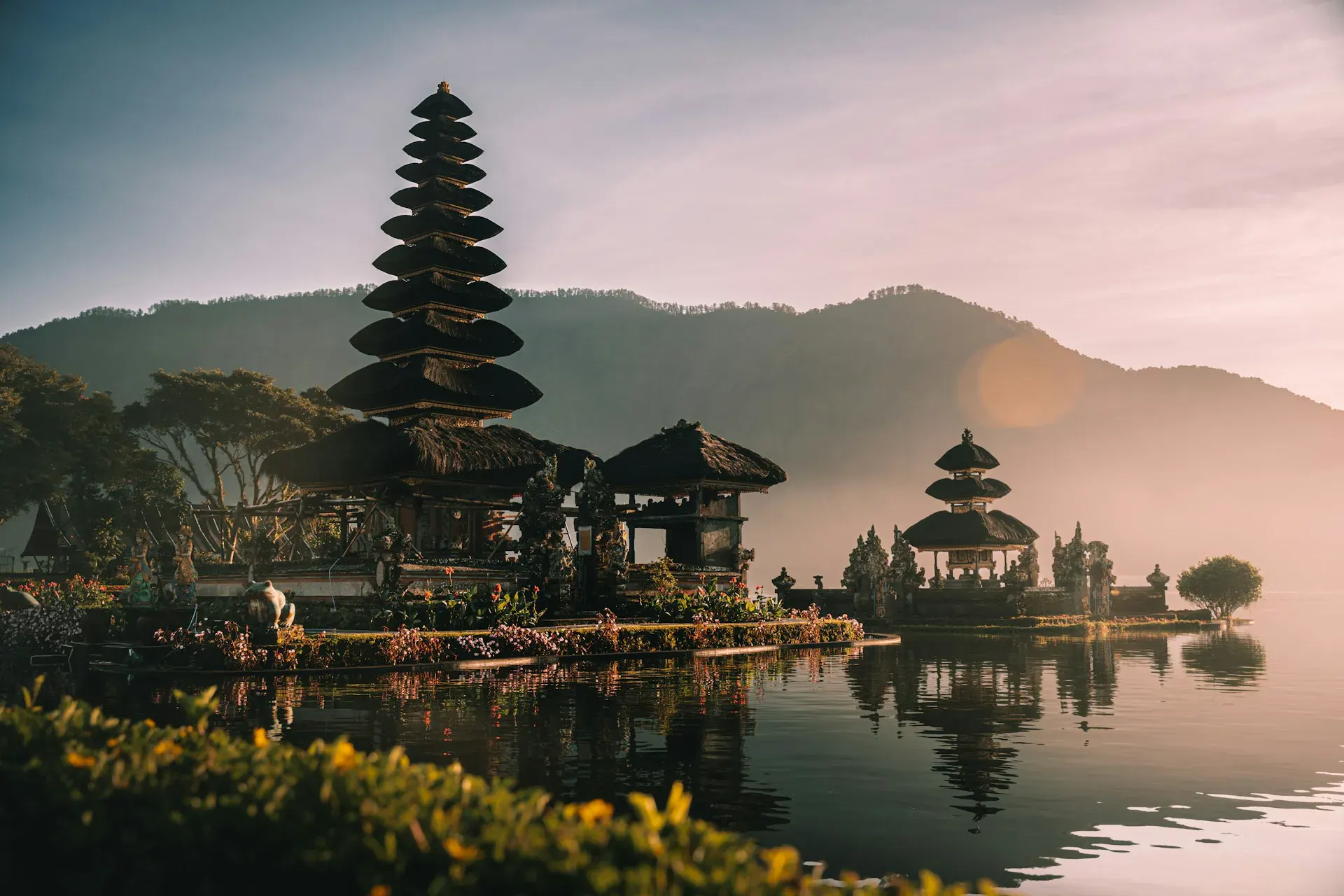
Indonesia's easiest island, and one of its best
Bali is a small, Hindu-majority island in an overwhelmingly Muslim country, and that distinction shapes nearly everything visitors notice: daily canang sari offerings on the pavement, temple ceremonies that spill into daily life, a calendar dense with festivals. Add rice terraces stepping down volcanic hillsides, a coastline that ranges from world-class surf breaks to gentle family beaches, and a tourist infrastructure built and rebuilt over five decades, and it's easy to see why Bali, not Indonesia, is often what people mean when they say they're "going to Indonesia."
What changed in the last decade is scale. Bali went from well-known secret to one of the most-visited islands in Asia, and Canggu in particular now runs on digital-nomad money as much as tourism. The upside is genuinely excellent infrastructure: fast wifi, English everywhere in tourist areas, and a food and hospitality scene operating at a level far beyond the island's size. The tradeoff is real crowding in the most famous spots and a cost of living that has climbed accordingly, though it remains cheap by Western standards.
The honest complications
Traffic in Canggu, Seminyak and around Ubud during peak hours can turn a 15-minute trip into 45, and Bali's roads were not built for the volume of scooters and cars now on them. The beaches most visitors picture, Kuta, Legian, Seminyak, have gray-brown sand and strong rip currents rather than postcard turquoise; the clear water is mostly on the Nusa Penida side trip or the smaller Gili Islands. And Bali has a real, not hypothetical, methanol poisoning problem tied to illicitly produced spirits, covered in full in the safety chapter, that is worth understanding before your first night out rather than after.
Six areas, six completely different trips
Bali's south and center hold nearly everything visitors come for, and each area delivers a genuinely different version of the island. Most first-time trips split time between two of these rather than trying to base in one.
Ubud
Bali's cultural and spiritual center, surrounded by rice terraces and jungle, with the island's best art scene, yoga studios and wellness retreats. No beach, and traffic through the center can be slow, but it's the base for the Tegallalang terraces, the Sacred Monkey Forest and some of Bali's finest boutique hotels.
Seminyak
Bali's most polished beach town: upscale beach clubs, fine dining and boutique shopping along Jalan Kayu Aya (Oberoi Street). More developed and more expensive than neighboring Canggu, with a gray-sand beach best for sunset rather than swimming.
Canggu
Bali's surf-and-coworking hub, built around Echo Beach and Batu Bolong, dense with cafes, co-working spaces and a young, international crowd. Traffic has become a genuine issue as the area has grown; book accommodation with the specific sub-area (Berawa, Batu Bolong, Pererenan) in mind.
Uluwatu & the Bukit
The dramatic limestone peninsula at Bali's southern tip, home to the clifftop Uluwatu Temple and legendary surf breaks at Padang Padang, Bingin and Impossibles. Padang Padang has the bigger tourist scene and beginner-friendly surf lessons; Bingin is smaller, more boho, with boutique clifftop stays.
Sanur & Nusa Dua
Sanur has a calm, swimmable beach, a walkable boardwalk and an older, quieter crowd; Nusa Dua is a gated resort enclave with the most secure, controlled environment on the island. Both are the easiest choices for families with young kids and the departure points for boats to Nusa Penida and the Gilis.
From clifftop villas to some of Asia's best hostels
Bali's accommodation range is enormous: private pool villas for the price of a mid-range European hotel room, and a hostel scene dense enough that Canggu and Ubud both have genuine competition for "best in Bali." These picks span every budget and area.
In Ubud's luxury tier, Mandapa, A Ritz-Carlton Reserve sits on the Ayung River with 35 suites and 25 private pool villas blending modern design with traditional Balinese craft, while Bisma Eight is a Michelin Key boutique property filled with local crafts, jungle-view rooms and barrel bathtubs, and an infinity pool that seems to flow into the treetops. Viceroy Bali, recognized as a top luxury honeymoon resort, and Anantara Ubud, with seventy suites and pool villas across a peaceful jungle hideaway, round out Ubud's top end. For boutique value, Cicada Resort Bali Ubud, Autograph Collection in Tegalalang has 27 rooms from around $432 a night.
On the Bukit peninsula, Suarga Padang Padang offers clifftop villas and curated wellness spaces within walking distance of Padang Padang and Bingin beaches, while DreamSea Bali at Padang Padang covers the boutique mid-range with a pool and beach access nearby. Uluwatu-area budget guesthouses run roughly $25-40 a night, mid-range hotels and villas $60-150, and luxury clifftop resorts $200-400 and up.
For the hostel scene, Canggu's Lushy Hostel Canggu and jungle-themed The Jungle House anchor the surf-and-coworking crowd around Batu Bolong, while Ubud's Savanna Ubud and the family-run Puri Garden Hotel & Hostel, with morning yoga and communal dinners, cover the culture-focused base. Dorm beds across Bali's better hostels run roughly $8-20 a night, a genuine bargain for the quality on offer.
Warung lunches, beach club dinners, and everything between
Bali's food scene runs from IDR 25,000 warung plates to internationally recognized fine dining, often within a few blocks of each other. The best value is almost always the least Instagrammed option: a family-run warung with a chalkboard menu and a queue of locals at lunch.
Babi guling & nasi campur
Balinese roast suckling pig, babi guling, stuffed with spices and slow-roasted, is the island's signature dish, traditionally served for ceremonies but widely available daily at warungs across Ubud and the south. Nasi campur, rice with a rotating selection of small dishes, is the everyday version and the best way to sample widely at a single sitting.
Naughty Nuri's
Naughty Nuri's is Bali's best-known pork ribs restaurant, a casual, no-frills warung-turned-institution that has been drawing lines for its smoky, char-grilled ribs and stiff martinis since long before Ubud became a wellness-retreat destination.
Seminyak fine dining
Seminyak and neighboring Petitenget hold Bali's highest concentration of serious restaurants. Shichirin does Japanese teppanyaki with premium Angus and wagyu (also in Canggu and Ubud); Merah Putih reinterprets Indonesian classics in a striking bamboo-lattice dining room; and Boy'N'Cow pairs a serious steak menu with cocktails in a lounge setting.
Temples, terraces and the surf that built Bali's reputation
Bali rewards a mix of planned sights and unplanned wandering. A handful of experiences genuinely justify their popularity, and each is specific enough to plan a half or full day around.
Uluwatu Temple and the Kecak dance
Uluwatu Temple sits 70 meters above the Indian Ocean on the southern tip of the Bukit peninsula, one of Bali's six key directional sea temples. Entry runs around IDR 50,000; arrive for sunset to catch the traditional Kecak fire dance, performed on a clifftop stage with the ocean as backdrop, for an additional roughly IDR 150,000. Watch for the resident macaques, who are practiced at grabbing sunglasses and hats.
Tegallalang Rice Terrace
A short drive from Ubud, Tegallalang displays the subak irrigation system Balinese farmers have used since the 9th century, recognized on UNESCO's World Heritage list. Walk the terraces on marked paths past working rice paddies and small family plots, or simply take the view in from one of the cafes built into the hillside over a plate of nasi goreng.
Mount Batur sunrise trek
An active volcano near Kintamani, climbed in the pre-dawn dark with a guide to reach the summit for sunrise over the caldera lake and, on clear days, Mount Agung beyond it. The trail is relatively accessible, no technical climbing, but it is a genuine hike; book a guide the night before through your accommodation.
Sacred Monkey Forest Sanctuary
A shaded nature reserve in central Ubud, home to several hundred long-tailed macaques and three 14th-century temples within the forest. Keep sunglasses, food and dangling jewelry secured; the monkeys are habituated and opportunistic.
Tanah Lot
An offshore sea temple perched on a rock outcrop, one of the most photographed sites in Bali, especially at sunset when the silhouette against the water draws crowds. Come early or late to avoid the tour-bus peak between mid-morning and mid-afternoon.
Surfing the Bukit and Canggu
Bali is one of the world's great surf destinations. Uluwatu, Padang Padang, Bingin and Impossibles on the Bukit peninsula hold reliable swell for experienced surfers nearly year-round, while Echo Beach and Batu Bolong in Canggu are the beginner-friendly, lesson-heavy breaks close to the cafes and coworking spaces.
Three, five or seven days, mapped by area
Five to seven days covers Bali properly without feeling rushed between areas. Three days is workable for a shorter trip but means committing to one zone rather than splitting between Ubud and the coast.
- Day 1
Ubud. Tegallalang Rice Terrace in the morning before the heat, the Sacred Monkey Forest, and a warung nasi campur lunch.
- Day 2
South to Uluwatu. Transfer to the Bukit, an afternoon at Padang Padang or Bingin, Uluwatu Temple and the Kecak dance at sunset.
- Day 3
Seminyak or Canggu. A beach club afternoon, dinner at Merah Putih or Shichirin, and a last night out before flying home.
- Days 1-2
Ubud. Tegallalang, the Monkey Forest, a Balinese cooking class, and one early-morning Mount Batur sunrise trek if energy allows.
- Days 3-4
Uluwatu. Surf lessons at Padang Padang or Batu Bolong, the temple and Kecak dance, cliffside sunset drinks.
- Day 5
Seminyak or Canggu. Beach club, fine dining, and Tanah Lot at sunset en route back toward the airport.
- Days 1-3
Ubud, at a gentler pace, adding the Mount Batur sunrise trek and a full day trip to Tegallalang and the Blue Eye-style springs nearby.
- Day 4
Nusa Penida day trip. Boat from Sanur, Kelingking Beach viewpoint, manta ray snorkeling if the season allows.
- Days 5-6
Uluwatu. Surf, the temple, and slow clifftop days at Bingin or Padang Padang.
- Day 7
Seminyak or Canggu. Shopping, beach clubs, and a final dinner before departure.
Scooters, Grab and traffic that's worse than it looks on a map
Bali's Ngurah Rai International Airport (DPS) sits just south of Kuta. An official airport taxi to Seminyak runs around IDR 250,000 ($16); to Ubud, roughly IDR 450,000 ($28) and 60-90 minutes depending on traffic. Grab and Gojek, the region's ride-hailing apps, are not permitted to pick up directly at the airport, walk a short distance off the terminal grounds first, or simply pre-book a transfer.
Scooter rental is the classic way to get around, roughly IDR 60,000-90,000 a day, but Bali's roads carry real traffic and enforcement of helmet and licensing rules has tightened noticeably, with visible police checkpoints in Canggu, Seminyak, Kuta and Uluwatu. A metered Blue Bird taxi is the trusted option for longer or evening trips if you'd rather not ride yourself, and Grab and Gojek work well once you're away from the airport.
Best time to visit and Nyepi
Bali has a tropical climate with a dry season, April to October, and a wet season, November to March. May, June and September are the sweet spot: dry, warm and less crowded than July and August, which are also dry but the busiest and most expensive months. The wet season brings short, heavy afternoon downpours rather than all-day rain and is noticeably cheaper and quieter.
Nyepi, the Day of Silence, is the Balinese Hindu new year and a genuine 24-hour island-wide shutdown: no travel, work, lights or entertainment, and the airport closes completely. It falls on 8 March 2027. Plan arrivals and departures around it deliberately; landing a day or two early or leaving the day after avoids the disruption entirely.
One of Asia's best-value islands, if you eat where locals eat
Bali is significantly cheaper than most of Western Europe and broadly comparable to Thailand, sometimes a touch pricier for backpackers, better value for couples and families wanting comfort. The main cost trap is eating at tourist-menu restaurants on the main beach roads instead of a warung two streets back.
- Hostel dorm $8-20
- Warung meals $1-2.50 each
- Scooter rental IDR 60,000-90,000/day
- Free temples, beaches and viewpoints
- Boutique hotel or villa with pool
- Restaurant meals $10-30
- Private driver or Grab for day trips
- Uluwatu Temple, Nusa Penida day trip
- Mandapa or equivalent, $400-600+
- Fine dining tasting menus
- Private surf lessons and boat charters
- Spa days and wellness retreats
Broadly safe, with specific things worth knowing
Bali rates well for overall safety: violent crime against tourists is rare and no major government currently advises against travel to the island. That said, a few specific risks catch visitors who haven't been briefed on them, and one of them is serious enough to name clearly rather than bury in a general warning.
Methanol poisoning is the risk that matters most. Illegally produced spirits, locally called oplosan, are sold cheaply in some bars and shops and can contain methanol; fatality rates run 20-40% and symptoms are delayed 12-24 hours, by which point permanent blindness or death is possible without prompt treatment. Stick to sealed, branded beer, wine or duty-free spirits, and only drink arak, which is genuinely part of Balinese culture, from a source you trust. Traffic and scooter accidents are the most common cause of serious injury for visitors; wear a helmet regardless of local norms and get real riding experience before renting. Rabies is present in parts of Bali via stray dogs and monkeys; treat any bite or scratch as a medical emergency requiring immediate care, not a wait-and-see situation. A 2026 advisory also flagged Jimbaran, Seminyak and Canggu as areas needing extra vigilance against opportunistic theft, worth normal city awareness rather than alarm.
The two scams to actually know: the scooter damage claim, where pre-existing scratches on a rental bike suddenly become your expensive problem on return, avoided by filming a full walk-around video before you ride off; and unlicensed money changers offering suspiciously good rates and shortchanging with sleight of hand, avoided by using only exchange counters marked "Authorized" and registered with Bank Indonesia. Bali also rates well for solo female travelers (7.8/10): street harassment is uncommon in the main tourist areas, though watching your drink at bars given documented spiking incidents and using Grab or Gojek rather than unmarked taxis at night are sensible standard precautions. Emergency number is 112 from any phone; ambulance is 118.
Nusa Penida alone is worth building a day around
Bali's position among smaller neighboring islands makes it an excellent base for day trips and short island-hops, without needing a domestic flight.
Nusa Penida
A rugged island southeast of Bali reached by fast boat from Sanur, known for the dramatic Kelingking Beach viewpoint, a T-rex-shaped cliff over turquoise water, and manta ray snorkeling at Manta Point during the right season. Roads on the island are rough, so most visitors book an organized day tour with a driver rather than self-navigating.
Gili Islands
Three tiny, car-free islands off Lombok's coast: Gili Trawangan for nightlife and dive shops, Gili Air and Gili Meno for a quieter pace and snorkeling straight off the beach. Fast boats run from Padang Bai, Serangan or Sanur, roughly €14-24 one way; while technically doable as a long day trip, an overnight makes far better use of the crossing.
Amed & Tulamben
Bali's northeast coast is the island's diving and snorkeling base, anchored by the USAT Liberty shipwreck at Tulamben, a WWII-era wreck sitting close enough to shore for shore-entry dives and even snorkeling over its shallowest sections. Amed's black-sand villages nearby are quieter and less developed than the south.
Bali FAQ
Is Bali safe for tourists?
Yes, broadly. No major government currently advises against travel to Bali, and violent crime against tourists is rare. The real risks are traffic accidents, water safety, petty theft and illicit alcohol, worth a specific read before you go.
How many days do I need in Bali?
Five to seven days covers Bali properly: two or three in Ubud, two or three at a beach base like Seminyak, Canggu or Uluwatu, plus a day trip to Nusa Penida. Three days works for a shorter trip but means picking one zone over the other.
How much does Bali cost per day?
Budget travelers manage on $25-40 a day with hostels and warung meals; mid-range runs $70-130. Bali is cheaper than most of Western Europe and comparable to, sometimes slightly pricier than, Thailand for backpackers.
When is the best time to visit Bali?
May, June and September: dry, warm and less crowded than peak season. July and August are also dry but busiest and priciest. November to March is the wet season, cheaper and quieter with short daily downpours rather than constant rain.
Do I need a visa for Bali?
Most Western passport holders need Indonesia's paid e-VOA, about 500,000 rupiah for 30 days, extendable once in person. It applies to all of Indonesia, not just Bali, and is separate from Bali's own tourist levy.
What is the Bali tourist tax?
A one-time 150,000 rupiah (about $10) Foreign Tourist Levy paid by every international visitor entering Bali, on top of any visa fee. Pay online in advance via the official Love Bali site or app, or at the airport's BRI counter on arrival.
What is the best area to stay in Bali?
Ubud for culture and rice terraces, Seminyak or Canggu for beach clubs and nightlife, Uluwatu for surf and cliffs, Sanur or Nusa Dua for calm, family-friendly beaches. Most first-timers split their stay between Ubud and one beach base.
Is it safe to drink the tap water in Bali?
No. Stick to bottled or filtered water, which is cheap and available everywhere, including for brushing your teeth. Most hotels and villas provide free refillable bottled water.
Do I need to worry about methanol poisoning in Bali?
It is a genuine, documented risk from illegally produced spirits (oplosan), not a reason to skip alcohol altogether. Stick to sealed, branded beer, wine or duty-free spirits, and avoid cheap unbranded arak or cocktails at unlicensed venues.
What Stays With You
Bali doesn't need to perform for visitors, it has been receiving them for fifty years and has settled into a version of itself that works for everyone: the surfer at Uluwatu, the retreat guest in Ubud, the family on Sanur's calm beach, the couple splitting a warung nasi campur between a rice terrace and a beach club. None of it is staged, which is why the small moments, the smell of incense and frangipani at a temple gate, the first bite of babi guling, the light on the terraces at Tegallalang, stay with people longer than the sights they planned around.
Go to Uluwatu for sunset on your last evening, watch the Kecak dancers against the cliff and the ocean, and understand why this small Hindu island in the world's largest Muslim-majority country became the one everyone wants to see first.