
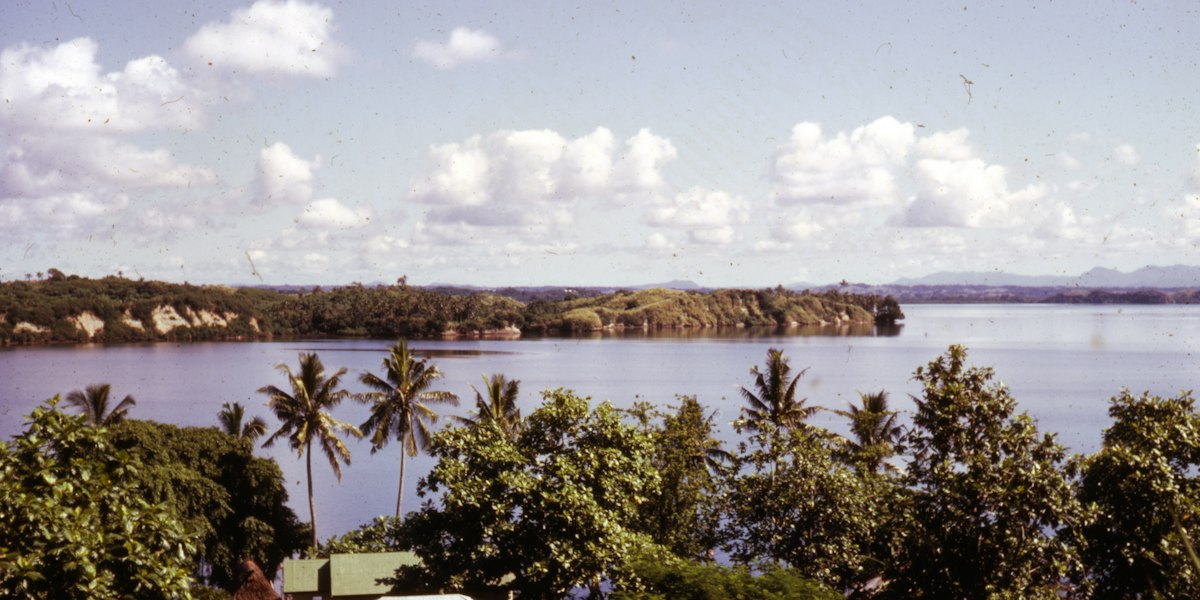
A capital built from a battlefield
Honiara exists where it does because of the war: after the Battle of Guadalcanal, the retreating and rebuilding administration relocated the colonial capital here to use the infrastructure the Americans had already built around Henderson Field. Eighty years on, that airfield is Honiara International Airport, and the city that grew up around it is a genuine working Pacific capital of around 130,000 people, not a resort town built for visitors. It can feel unpolished on arrival: traffic on the Kukum Highway, patchy pavements, a skyline of low, practical buildings rather than postcard architecture.
What Honiara has instead of polish is proximity to the reason most visitors come at all. The Vilu War Museum and the Bonegi wrecks are a short drive west; Iron Bottom Sound, holding one of the densest concentrations of WWII shipwrecks anywhere, is visible from the Point Cruz waterfront; and the Central Market is as real and unstaged a slice of Solomon Islands daily life as you'll find anywhere in the country. Two days is enough to see the city properly and set up whatever comes next, a Western Province dive lodge or a Malaita day trip.
The honest complications
Honiara is not a city to wander at night without a plan: petty theft and occasional violent incidents targeting foreigners do occur, concentrated around crowded areas and after dark, and hotel-arranged or pre-booked transport is the sensible default rather than an overcautious one. Infrastructure is thinner than in most Pacific capitals, card payment outside hotels and larger restaurants is unreliable, ATMs can run out of cash, and the city has had real, if intermittent, political volatility: riots in 2021 damaged parts of Chinatown, and as recently as September 2026 a no-confidence motion against the prime minister created a few tense days in town before being withdrawn. None of this should cancel a trip built around the WWII sites and diving, but it's worth planning around rather than discovering on arrival.
A coastal strip, three areas that matter
Honiara runs in a long, narrow strip along the coast, hemmed in by the sea on one side and rising ridges on the other, with the Kukum Highway as its spine connecting the centre to the airport 11km east. Almost everything a first-time visitor needs sits within that strip.
Point Cruz
The peninsula at the geographic centre of Honiara and the city's CBD: government offices, the main waterfront, the Point Cruz Yacht Club, and the Central Market all sit here or a short walk away. It's the most walkable base for travelers without a rental car, close to the market, ferries and several hotels.
Kukum
Running east from the centre toward the airport, Kukum has grown into Honiara's main hotel and dining strip, with a wider spread of restaurants than Point Cruz and easier access if you're arriving or departing by air. A reasonable base if you'd rather have restaurant choice on your doorstep than be inside the CBD itself.
Chinatown & the Matanikau
Established on the east bank of the Matanikau River southeast of the centre, Chinatown was badly damaged in the November 2021 riots and has been rebuilding since. It's a legitimate part of the city's history and daily commerce rather than a sight in the usual sense, worth a daytime walk-through if you're curious about the city beyond the waterfront, but check current conditions if there's political tension in the news during your visit.
From a beachfront four-star to a mission-run resthouse
Honiara's hotel scene is small and practical rather than resort-glossy, built around business travelers, aid workers and divers passing through as much as tourists. These picks cover the realistic range, from the city's established top address to the budget resthouse most independent travelers end up in.
At the top, Heritage Park Hotel is Honiara's established four-star, five acres of beachfront gardens right in the city centre on the former residence of the Governor General, with three restaurants on site, from around $190 a night. Coral Sea Resort & Casino pairs a waterfront pool and its well-regarded steakhouse dining room with airport shuttle access, from around $200.
In the mid-range, King Solomon Hotel has a swimming pool and a reliable, central mid-range base from around $109, and Solomon Kitano Mendana Hotel is a long-established downtown option on the Point Cruz waterfront with its own restaurant and activities desk.
At the budget end, Chester Resthouse, run by the Melanesian Brothers on a hillside above Mendana Avenue in Point Cruz, is the pick most independent and mission-connected travelers land on: basic but clean family and twin rooms with cooking facilities, from around $55 a night, and Tripadvisor's top-rated B&B in the city.
Market fish, Japanese sushi, and a sunset at the yacht club
Honiara eats better than its size suggests, a legacy of decades of aid workers, divers and expats who wanted somewhere decent to go on a Friday night. The Central Market is still the best single food experience in the city; the restaurant scene around it fills in everything else.
Honiara Central Market
Between Mendana Avenue and the Point Cruz waterfront, the market is where fresh fish, tropical fruit and vegetables arrive daily from outlying islands, alongside woven mats, shell jewelry and carvings. Come in the morning for the best selection and the least crowding, and treat it as the city's real culinary centre rather than a photo stop.
Sunset at Point Cruz Yacht Club
Point Cruz Yacht Club is Honiara's long-running institution for expats and visitors alike, a relaxed bar and kitchen open for lunch and dinner with wide views over Iron Bottom Sound out to Savo Island. It's less about a specific dish than the setting: a cold drink here at sunset is close to a mandatory Honiara ritual.
Japanese & sushi
Hakubai Japanese Restaurant is a long-established, popular sushi and Japanese dining room with a genuinely broad menu, a reflection of Honiara's sizeable Japanese business community. Tenkai Sushi Cafe downtown is the more casual alternative, with a kava bar next door for a drink afterward.
Steaks & Sunday roast
Haydn's Steakhouse, at the Coral Sea Resort, is the city's benchmark for a proper steak dinner. For something more local and social, Troppo Bar & Kitchen's Sunday market and roast is one of the best-loved weekly fixtures among Honiara regulars.
Coffee & cafe
Lime Lounge, open since 2003, is the city's benchmark cafe: home-cooked meals, quiches and cakes alongside what many locals and long-term expats call the best coffee in Honiara, all served with the easy hospitality the Solomons is known for.
Wrecks, a market, and a war that's still visible
Honiara's sights split cleanly into the city itself and the WWII battlefield sites just west of it, all coverable in two focused days.
Honiara Central Market and Point Cruz
Start at the Central Market in the morning for produce, fish and handicrafts, then walk the short distance to Point Cruz itself for the waterfront and the Yacht Club. The National Museum and Cultural Centre brings together exhibitions on the country's island cultures, its 63 local languages, the missionary period and the Pacific War, free entry with donations encouraged, and is the best single primer on kastom, the customary law and tradition that still structures village life, before you head out to the battlefields.
Vilu War Museum
About 25km west of the city, this open-air museum at Aruligo brings together US, Japanese, Australian, Fijian and New Zealand memorials alongside four Japanese field guns and the wrecked remains of several US and Japanese aircraft, including a Betty bomber, a Lightning fighter and a Wildcat. Open daily 7:30am-5pm, entry around 100 SBD; most visitors combine it with the Bonegi wrecks on the same drive west.
The Bonegi wrecks
The Bonegi 1 wreck, the Hirokawa Maru, a 6,860-ton Japanese transport ship beached and sunk during the Battle of Guadalcanal, lies close enough to shore for snorkelers to explore straight off the beach, with trucks and a bulldozer still visible in the hold. Tulagi Dive, based in Honiara, runs trips here and further out into Iron Bottom Sound for certified divers wanting to go deeper, including technical dives to wrecks like the USS Aaron Ward at 60 meters.
Skyline Ridge and the war memorials
The American memorial at Skyline Ridge and the Japanese Solomons Peace Memorial on Mount Austen both overlook the city and the battlefield below, reachable by taxi, and are a quieter, more reflective counterpoint to the open-air museums. Local guides offer tours that combine these sites with the foxholes, caves and rusting equipment still scattered through the surrounding jungle from the campaign.
One, two or three days, planned street by street
Two full days cover Honiara and the nearby WWII sites properly. A third day is really the Savo Island or Tulagi day trip, worth adding if your schedule and the weather allow it.
- Morning
Central Market and the National Museum. Fresh produce and handicrafts, then the Pacific War and kastom exhibits.
- Midday
Drive west to Vilu and Bonegi. The open-air war museum, then snorkel the Bonegi 1 wreck straight off the beach.
- Evening
Sunset at Point Cruz Yacht Club, dinner at Hakubai or the Central Market food stalls.
- Day 1
The one-day route: Central Market, National Museum, Vilu and Bonegi, sunset at the Yacht Club.
- Day 2 morning
Skyline Ridge and Mount Austen. The American and Japanese war memorials, with wide views over the city and battlefield.
- Day 2 afternoon
Chinatown and the Matanikau. A daytime walk through the rebuilding district, back toward the centre.
- Day 2 evening
Haydn's Steakhouse or Troppo Bar's Sunday roast, if your second evening lands on a Sunday.
- Days 1-2
The two-day route above, at a gentler pace.
- Day 3
Savo Island or Tulagi. A 30-minute boat to Savo's volcano, hot springs and megapode egg fields, or an hour to Tulagi for a first taste of Solomon Islands wreck diving, back in Honiara by evening.
A coastal highway, minibuses, and negotiated taxi fares
Honiara International Airport (HIR), built on the WWII-era Henderson Field, sits about 11km east of the centre along the Kukum Highway. A taxi into town costs roughly 100-150 SBD (about $13-19); meters are rarely used, so agree the fare before you get in. Non-stop flights connect Honiara to Brisbane (Solomon Airlines, Qantas, Nauru Airlines) and Nadi (Solomon Airlines, Fiji Airways, Air Niugini).
Within the city, shared minibuses known as PMVs run the coastal road and cross-town routes: cheap, informal, and left when full, you wave one down and shout when you want out, with fares around 3 SBD (about $0.40) within central Honiara. The Central Market bus stop is the main interchange for routes across the city. Taxis are the more convenient option for the Vilu and Bonegi run west of town or for evenings, negotiate the fare in advance.
Best time to visit
Honiara sits close to the equator and stays hot and humid year-round around 27°C, but the dry season (May-October) brings noticeably less rain and calmer seas, better for the Bonegi snorkel and any boat-based day trip. The wet season (November-April) sees Honiara receive around 70% of its annual rainfall, though showers typically pass through quickly rather than settling in.
Not the cheapest Pacific capital, but manageable
Honiara costs more than its infrastructure might suggest, a function of most goods being imported and a small domestic tourism market. The Central Market and PMV minibuses are where the savings are; hotels and organized tours are where the budget goes.
- Chester Resthouse or similar $55+
- Central Market meals $3-6
- PMV minibus transport
- Free sights: market, waterfront, museum
- King Solomon or Mendana Hotel $109+
- Restaurant dinners $15-30/person
- Taxis for the Vilu/Bonegi run
- Vilu War Museum & guided tours
- Heritage Park or Coral Sea Resort $190+
- Tulagi Dive trips into Iron Bottom Sound
- Private WWII battlefield guide
- Savo Island day charter
Ordinary caution, a few specific risks
Honiara needs more active awareness than a resort-built Pacific capital, in line with the country's US State Department Level 2, Exercise Increased Caution rating. Petty theft and occasional violent incidents targeting foreigners occur, concentrated around the Central Market, bus interchanges and after dark; daytime sightseeing in the areas covered in this guide is routine for most visitors.
The specific things to know: after-dark travel, where hotel-arranged or pre-booked taxis are the sensible default rather than walking or flagging an unmarked car; WWII ordnance, still discovered regularly around and beyond marked battle sites, so stay on established paths at Vilu and Bonegi and never touch a metal object you don't recognize; and malaria and dengue, both present, so use repellent and cover up especially at dawn and dusk, and discuss prophylaxis with a travel doctor before you arrive. Solo women should take more active precautions here than in Fiji or similar resort destinations, using booked transport and avoiding walking alone after dark.
Emergency numbers: 999 police, 111 ambulance (St John), 988 fire and rescue. The National Referral Hospital, with over 300 beds, is the country's main hospital and the right first call for anything serious; comprehensive travel insurance with medical evacuation cover is strongly recommended for any trip that includes diving or provincial travel.
Savo Island's volcano, or a first taste of Tulagi diving
Honiara's position on Iron Bottom Sound makes two genuinely different day trips workable, both weather-dependent and best booked through a Honiara tour operator or the Solomon Islands Visitors Bureau rather than arranged independently.
Savo Island
Savo, across Iron Bottom Sound from Honiara, is an active volcano with steaming hot springs and a two-hour trail to the crater along a path cut by the island's last mid-19th-century eruption. Its real draw for most day-trippers is the megapode egg fields: chicken-sized birds that lay their eggs at dawn in the warm volcanic beach sand, with the nesting sites visible even if the birds themselves are shy of daytime visitors. The boat crossing can get rough when the wind is up, so check conditions before committing to the trip.
Tulagi
Tulagi, the pre-WWII British colonial capital before Honiara took over the role, is one of the easiest dive destinations in the country to reach from the city, with its own share of Iron Bottom Sound's wrecks close offshore. A manageable first stop for divers who want to see beyond the shore-accessible Bonegi wreck without committing to a full Western Province trip.
Honiara FAQ
Is Honiara safe for tourists?
With normal caution, yes, though it needs more care than a resort-town Pacific capital. Petty theft and occasional violent incidents targeting foreigners occur, mainly after dark and around crowded areas like the Central Market and bus interchanges; use hotel-arranged or booked transport at night.
How many days do I need in Honiara?
Two days covers the city itself: the Central Market and National Museum, plus the Vilu War Museum and Bonegi wrecks west of town. A third day fits a Savo Island or Tulagi day trip and is worth adding if you have it.
How much does Honiara cost per day?
Budget travelers manage on $50-70 a day with a guesthouse and market meals; mid-range runs $120-220. Honiara is not a cheap Pacific capital once hotel-standard accommodation and tours enter the picture.
What is Point Cruz?
Point Cruz is the peninsula at the centre of Honiara and the city's central business district, home to the Central Market, the Point Cruz Yacht Club, government offices and the main waterfront.
Can I dive the Bonegi wrecks from Honiara?
Yes. The Bonegi wrecks, two Japanese transport ships beached during the Battle of Guadalcanal, sit close enough to shore for snorkelers, with operators like Tulagi Dive running trips from Honiara for divers who want to go deeper into the wreck and Iron Bottom Sound beyond it.
How do I get from Honiara airport to the city centre?
Honiara International Airport sits about 11km east of the centre along the Kukum Highway. A taxi to town costs roughly 100-150 SBD (about $13-19); agree the fare before you get in, since meters are rarely used.
What is the best area to stay in Honiara?
Point Cruz or the Kukum strip toward the airport for first-timers: central, close to the Central Market and restaurants, and a short taxi from the WWII sites. Point Cruz suits travelers without a car; Kukum has more hotel and dining choice.
Can I do a day trip to Savo Island from Honiara?
Yes. Savo Island, an active volcano with hot springs and megapode bird egg fields in its warm volcanic sand, is about a 30-minute boat ride across Iron Bottom Sound, best booked through a Honiara tour operator or the Solomon Islands Visitors Bureau rather than arranged independently.
Is Honiara's Chinatown safe to visit?
Yes, day to day. Chinatown was badly damaged in riots in November 2021 tied to national political grievances, not an ongoing local safety issue, and has been rebuilding since. It's worth checking current conditions before visiting if political tension is in the news during your trip.
What Stays With You
Honiara doesn't have the polish of a purpose-built Pacific capital, and the sea in front of the Yacht Club has a heavier history than the view lets on. What it has instead is a directness: a market that's genuinely the city's own, a museum built inside the story of the war rather than sanitizing it, and a wreck you can swim to from the beach with the machinery still inside it. It's not trying to be Fiji, and once you've stood at Bonegi with the hull of a sunken transport ship visible under the water, you won't want it to be.
Have a drink at Point Cruz Yacht Club on your last evening, watch the fishing boats head out toward Savo as the light goes, and you'll understand why the travelers who make it here talk about the Solomons differently than they talk about the rest of the Pacific.