
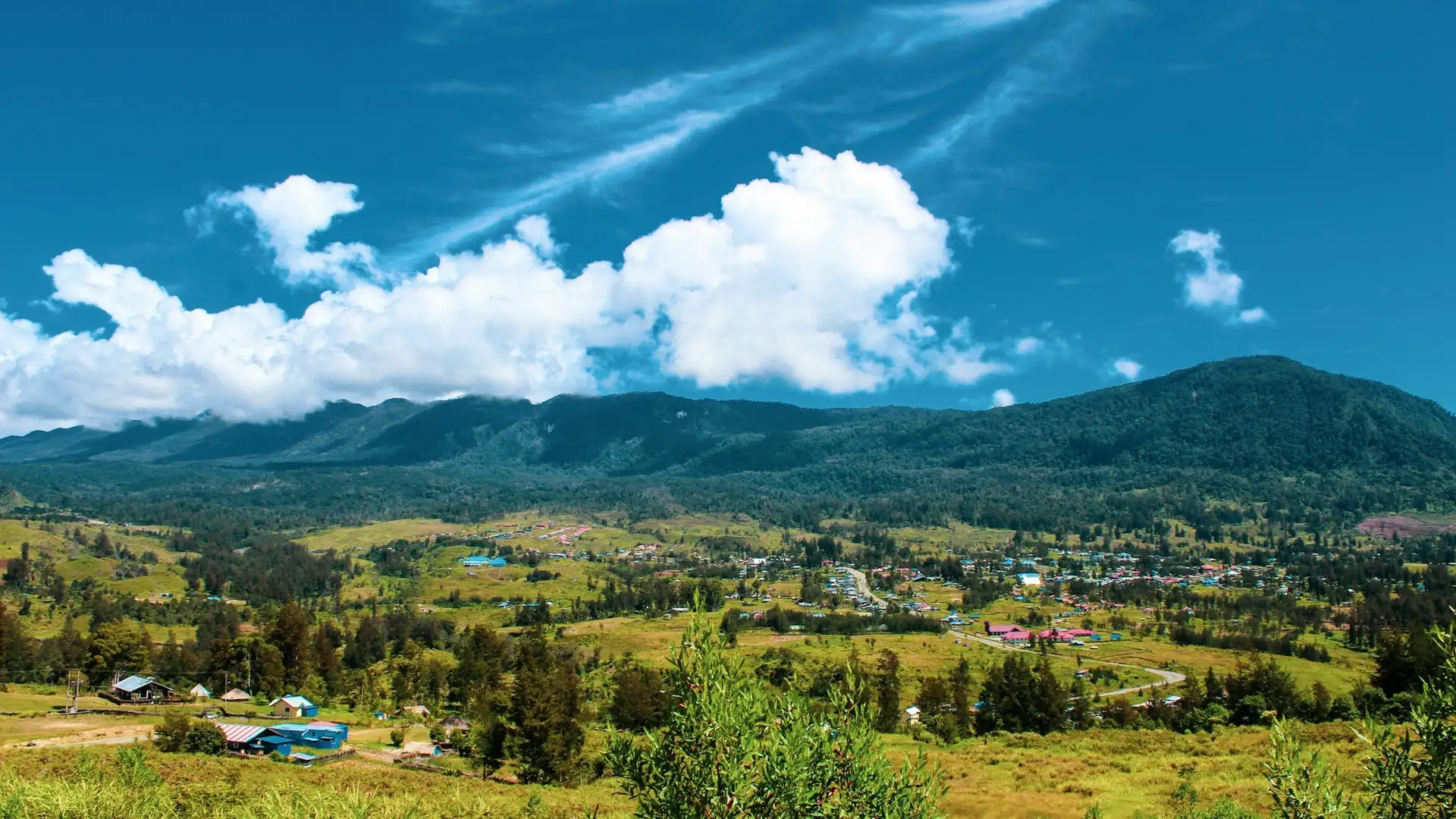
Papua New Guinea
850 languages. Tribes in the Highlands who had no contact with the outside world until the 1930s. Sing-sing festivals where a hundred clans gather in full traditional paint and feathers. Coral Triangle diving that rivals Palau. A WWII track through jungle so dense it cost more per meter than almost any battle in the Pacific. One of the last genuinely wild places on earth.
What You're Actually Getting Into
Papua New Guinea occupies the eastern half of the world's second-largest island, plus several hundred offshore islands including New Britain, New Ireland, Manus, and the Autonomous Region of Bougainville. The mainland is mostly jungle-covered mountain range, with the Owen Stanley Range in the southeast rising above 4,000 meters and the Central Highlands averaging 1,500 to 2,500 meters. The rivers run brown and wide. The forest is old enough and intact enough that scientists find new species in it regularly. In 2022 a survey of the Nakanai Mountains found 40 species new to science in a single expedition.
The human landscape is equally extraordinary and equally complex. PNG has roughly 10 million people speaking around 850 distinct languages — more than 10% of all languages on earth, in a country the size of California. The Highlands were largely unknown to the outside world until Australian gold prospectors flew over the interior valleys in 1930 and found dense populations of people who had been living in complete isolation from the coast, from each other in many cases, and from the rest of the world for thousands of years. First contact in the Highlands — the meeting of people who had no frame of reference for each other's existence — happened within living memory of people still alive today.
The consequences of this extraordinary human diversity play out in every aspect of PNG life: the sing-sing festivals where tribal groups gather in full ceremonial regalia, each clan's costume, dance, and music entirely distinct from every other; the Tok Pisin creole that emerged as a lingua franca between groups who share no language; the traditional conflict patterns between clans that persist in modified form into the present; and the cultural knowledge encoded in hundreds of oral traditions that no outsider has fully documented.
PNG is not an easy destination. Port Moresby has a serious urban crime problem. Roads outside the capital are limited. The medical infrastructure is fragile. Tribal conflict in parts of the Highlands is ongoing and can affect access without warning. Malaria is present across most of the country below 1,800 meters. The heat and humidity are relentless at low altitude.
None of this cancels out what PNG offers. The Goroka Show, staged each September around Independence Day, is arguably the greatest cultural spectacle on earth — over a hundred tribal groups in full traditional dress performing simultaneously at the showgrounds. Milne Bay Province produces diving that competes with Palau for marine biodiversity. The Kokoda Track is a physically brutal and historically profound 96-kilometer jungle trek that means something specific to the Australian and Papua New Guinean people who do it. The Sepik River basin is one of the great river journeys of the world, lined with spirit houses and wood-carving traditions of a standard that belongs in international galleries. PNG demands more of its visitors than almost any other destination. What it gives in return is proportional.
Papua New Guinea at a Glance
A History Worth Knowing
Human settlement in New Guinea dates back at least 50,000 years, making it one of the oldest continuously inhabited places outside Africa. Agriculture developed independently in the New Guinea Highlands around 7,000 BCE — among the earliest independent developments of farming in human history — with taro, yam, and banana cultivation established millennia before most of the world had begun that transition. The extraordinary linguistic diversity of modern PNG reflects tens of thousands of years of relatively isolated community development in mountain valleys separated by terrain so difficult that neighboring groups could live entirely separate linguistic and cultural lives for generations.
European contact began with Portuguese and Spanish explorers in the early 16th century, but the island's interior remained essentially unknown to outsiders until the 20th century. The coastal areas came under German control in the northeast (German New Guinea) and British control in the southeast (British New Guinea, later Papua) in the 1880s. Australia took administrative control of both territories — as a League of Nations mandate for German New Guinea after WWI and directly as Papua — and administered them as separate entities until independence.
The Highlands remained a world apart until 1930, when Australian gold prospectors Michael Leahy and Michael Dwyer flew a small aircraft over the Wahgi Valley in the Central Highlands and found it densely populated — an estimated 100,000 people living in a valley that no outsider had known existed. The subsequent first contact, documented by Leahy in photographs and later in film, is one of the most remarkable episodes of mutual discovery in modern history. The mountain people encountered aircraft, metal tools, and skin colors they had no category for. Leahy's party encountered a complex, populous society with elaborate agriculture, ceremonial life, and warfare that they had no framework to fully comprehend. The films and photographs Leahy took are now held by the National Archives and have been incorporated into documentaries that are essential context for any serious PNG visitor.
World War II came to PNG's coast with devastating force. The Japanese campaign of 1942 began with the landing at Buna and the attempt to take Port Moresby via the Kokoda Track through the Owen Stanley Range. Australian forces, many of them militia with minimal training, fought a retreat over the track under conditions — jungle, disease, supply collapse, terrain — that still define the campaign's reputation. The Japanese advance was halted at Imita Ridge, 48 kilometers from Port Moresby, in September 1942. The subsequent Allied counter-advance back over the track and the battles at Buna, Gona, and Sanananda cost more casualties from disease than from combat. The Kokoda campaign has a particular resonance in Australian national memory that shapes how Australian visitors experience the track today.
PNG achieved independence from Australia on September 16, 1975, under founding Prime Minister Michael Somare, known as the Grand Chief and Father of the Nation. The country has maintained democratic governance since independence, though political stability has been uneven and the gap between the mineral wealth extracted from PNG's resources (gold, copper, LNG) and the services available to most citizens is one of the country's defining tensions. The Bougainville conflict — a separatist war that ran from 1988 to 1998 and cost up to 20,000 lives over a copper mine dispute — resulted in Bougainville's current autonomous status and a 2019 referendum in which 98% voted for independence, still subject to negotiation with Port Moresby.
Among the earliest human settlements outside Africa. New Guinea's terrain isolates communities into thousands of distinct linguistic and cultural groups over millennia.
New Guinea Highlands develops agriculture independently — taro, yam, banana. One of the earliest independent origins of farming in human history.
Germany takes the northeast, Britain the southeast. Australia takes administrative control of both territories and runs them separately until independence.
Michael Leahy flies over the Wahgi Valley and finds hundreds of thousands of people unknown to the outside world. First contact documented in photographs and film still in circulation today.
Japanese forces land at Buna and advance toward Port Moresby over the Owen Stanley Range. Australian militia hold the track and halt the advance 48km from the capital.
Papua New Guinea achieves independence on September 16, 1975 under Michael Somare. September 16 is now Independence Day and the date of the Goroka Show each year.
A separatist war over the Panguna copper mine costs up to 20,000 lives. Bougainville becomes autonomous and in 2019 votes 98% for independence from PNG.
98% of Bougainvilleans vote for independence in a referendum agreed under the peace process. Formal independence is subject to ongoing negotiation with Port Moresby.
Papua New Guinea's Destinations
PNG's destinations fall into four broad categories: the Highlands (festivals, tribal culture, trekking), the coast and islands (diving, WWII history, island scenery), the Sepik (river journey, art, remote community life), and Port Moresby (gateway, unavoidable transit). Most visitors combine two of these in a single trip. Attempting all four requires at minimum three weeks and very careful logistics planning around the domestic flight schedule.
Goroka Show & Mount Hagen Cultural Show
The Goroka Show runs on the third weekend of September every year, anchored to Independence Day on September 16. More than 100 tribal groups converge on Goroka's showgrounds, each performing their own sing-sing — a ceremonial gathering of dance, song, and display — in full traditional dress. The Huli wigmen from the Southern Highlands wear wigs made from their own hair, decorated with bird of paradise feathers, and paint their faces in yellow and red ochre. The Asaro mudmen wear grey clay masks and caked mud bodies. The Melpa of Mount Hagen cover their faces in glossy black and yellow paint. The Wahgi valley groups construct elaborate headdresses from Bird of Paradise plumes, tree kangaroo fur, and beetle wings. The scale and density of ceremonial art assembled in one space on a single weekend defies description. Arrive at the showgrounds by 7:30am before the crowds and before the midday heat. The Mount Hagen Cultural Show in August is smaller but increasingly popular and set against the Western Highlands landscape. Both require booking accommodation months in advance.
Milne Bay Province
Milne Bay, at the southeastern tip of the PNG mainland, is where the Coral Triangle reaches its western edge and where some of the planet's most biodiverse reefs are dived by a fraction of the people who dive Palau or the Maldives. Alotau is the provincial capital, accessible by domestic flight from Port Moresby in 55 minutes. The reefs around the Engineer Islands, Samarai Island, and the Cape Vogel area produce encounters that experienced divers describe as the best of their lives: pygmy seahorses on sea fans, dugong in shallow seagrass, wobbegong sharks on the bottom, mantas in the passes, and WWII wrecks in 10 to 30 meters with intact superstructure. The Milne Bay dive season runs October through May for best conditions, with November through April producing the clearest water. Operators including Tawali Resort run liveaboard programs that access sites requiring a week of consecutive travel to cover properly.
Kokoda Track
The Kokoda Track runs 96 kilometers from Kokoda on the northern slopes of the Owen Stanley Range to Owers' Corner, 50 kilometers outside Port Moresby, crossing terrain that maxes out at 2,190 meters at the Ghost Mountain summit. The track passes through 13 villages and crosses 11 major river systems, all without permanent bridges. The trekking time is 8 to 12 days depending on pace and conditions. You descend into creek beds and climb back up ridgelines on repeat, in heat that at lower elevations exceeds 35°C and humidity that never drops below 80%. The mud is its own character — sections of the track after rain are ankle-deep for hours. The historical sites — Isurava, Brigade Hill, Templeton's Crossing — are marked with memorials and explained by local guides whose families lived through the campaign as carriers for both sides. A licensed PNG guide is legally required. A registered tour operator is strongly recommended and practically essential for logistics. Book 6 to 12 months in advance for the May through September dry season window.
Sepik River
The Sepik is the largest river in PNG and the cultural heartland of the country's most celebrated wood-carving tradition. The river runs 1,126 kilometers through lowland jungle, navigated by dugout canoe and motorized longboat between villages that have no road connection to the outside world. Each village has a haus tambaran — a spirit house of elaborately carved wood that functions as the ceremonial center of community life, off-limits to women in most communities and open to male visitors with appropriate cultural protocol. The carving produced along the Sepik — masks, figures, hooks, shields, story boards — is collected internationally and recognized as among the Pacific's most important art traditions. Getting to the Sepik involves flying to Wewak or Ambunti from Port Moresby, then boat travel upriver. The journey is best organized through a specialized operator, as independent navigation requires language skills, local knowledge, and improvisation capacity that goes well beyond typical independent travel. A week on the Sepik is a minimum for any meaningful engagement with the river communities.
Varirata National Park & Bird of Paradise
PNG has 38 of the world's 42 species of bird of paradise, including all the most spectacularly plumed. Varirata National Park, 42 kilometers from Port Moresby, is the closest accessible location for bird of paradise watching, with raggiana bird of paradise displaying on established leks from June through September from around 6am. The Highlands also produce superb bird of paradise encounters, particularly around Kumul Lodge at 2,600 meters above Enga Province, where multiple species display within sight of the viewing deck. Birding in PNG generally is world-class — over 700 species including 60+ endemics — and specialist birding operators run dedicated itineraries covering forest, Highlands, and coastal habitats.
New Britain — Rabaul & Walindi
New Britain's eastern tip holds Rabaul, a town that was largely destroyed by volcanic eruptions in 1994 and has rebuilt in the shadow of active volcanoes that still steam visibly from the caldera rim. The Rabaul WWII sites — Japanese tunnels, aircraft wrecks, harbor wrecks including the Sanko Maru — are among the Pacific's most accessible WWII dive sites. Walindi Plantation Resort on the western end of New Britain is the base for Kimbe Bay diving: a deep bay that rises abruptly from 800 meters to shallow reef, producing some of the most productive fish and coral diversity in PNG, with schooling hammerheads in season and resident mantas year-round. A flight from Port Moresby to Hoskins takes 90 minutes.
Mount Wilhelm
At 4,509 meters, Mount Wilhelm is PNG's highest peak and the highest point in Oceania east of Puncak Jaya in Indonesian Papua. The summit is reached in two days from the trailhead above Keglsugl village in Simbu Province, with a high camp at Lake Piunde at 3,700 meters. The summit push begins at 2am for a dawn arrival — on a clear morning you can see both the northern and southern coasts of PNG simultaneously. The trail is steep, often wet, and requires good fitness but no technical climbing. A local guide hired in Keglsugl is essential and costs around 150 PGK per day. Altitude sickness is a genuine risk above 3,500 meters for visitors arriving from sea level without acclimatization time in the Highlands first.
Port Moresby
Port Moresby is where almost everyone arrives and where almost no one chooses to spend more time than necessary. The city has genuine highlights: the National Museum and Art Gallery on Waigani Drive has excellent collections of traditional material culture from across the country; the National Parliament building incorporates a massive traditional roof structure inspired by a Sepik haus tambaran; and the Port Moresby Nature Park has rescued bird of paradise and tree kangaroos in naturalistic enclosures. The waterfront suburb of Ela Beach is where the city's restaurants and bars concentrate. Spend one or two nights in Port Moresby as a planned transition, navigate by organized transfer or taxi rather than on foot, and move on to your primary destination. The city's crime situation is real and requires active management rather than avoidance of the city entirely.
Culture & Etiquette
PNG's cultural diversity makes generalization about etiquette difficult — what applies in a Highlands village may not apply in a Sepik community or in Port Moresby. The consistent principles are respect, patience, and following the lead of your local guide or host. PNG operates on a wantok system — a social network of mutual obligation binding people who share a language (one-talk, wantok) that functions as the primary safety net, social structure, and economic system for most of the population. Understanding that decisions and hospitality in PNG are rooted in wantok obligations helps make sense of many interactions that otherwise seem confusing to outsiders.
In PNG, a good local guide is not a convenience — they are the mechanism through which you access communities safely and respectfully. They navigate the wantok networks, understand which communities require what approaches, and translate not just language but context. Follow their lead entirely on questions of photography, access, and community interaction.
At festivals, most performers expect and enjoy being photographed and may ask for a small tip — PGK 2–5 is customary. In villages and community settings, always ask through your guide. Taking photographs without permission is considered highly disrespectful and can escalate quickly.
Shoulders and knees covered in villages and community areas. Women particularly should avoid tight or revealing clothing in Highlands communities where gender norms are traditional. Men wearing shorts is generally acceptable.
Betel nut (buai), tobacco, or trade items are traditional exchange gifts in many PNG communities. Your operator will advise what is appropriate for the specific community you're visiting. Cash gifts are not traditional and should be avoided in favor of the established exchange items.
Tok Pisin is genuinely accessible to English speakers — "Gude" (hello), "Tenkyuu tumas" (thank you very much), "Bai mi baim dispela?" (can I buy this?). Making any effort in Tok Pisin creates immediate goodwill and signals that you are engaging seriously rather than treating PNG as a spectacle.
Walking alone or in small groups in Port Moresby and Lae — particularly in non-tourist areas, at night, or in the markets — presents serious crime risk. Use organized vehicle transfers between hotel, airport, and specific destinations. Your hotel can arrange secure transport. Do not walk from your hotel to anywhere.
The spirit houses along the Sepik and in Highlands communities are ceremonial spaces with specific access rules. In many communities women are prohibited from entering. Visitors require explicit invitation and guidance from a male community member. Never enter any haus tambaran structure uninvited.
Inter-clan conflicts over land are ongoing in many parts of the Highlands. These disputes have their own deep history and social logic. Asking about them as a curious outsider can put your local contacts in difficult positions. Observe, ask general questions, and follow your guide's lead on what topics are appropriate.
Camera equipment, GPS devices, and phones visible in public spaces attract attention that creates risk. Keep equipment in bags when not in active use. Withdraw cash in modest amounts. Your operator will advise on the specific risk profile of each location on your itinerary.
Particularly for women travelers: solo female travel in PNG is genuinely challenging. The social norms in many communities create situations that require more active management than in most other destinations. Travel with a reputable mixed-gender group or operator team, and be explicit with your guide about your comfort boundaries from the start.
The Wantok System
Wantok (one-talk) is the primary social organization of PNG life — a network of mutual obligation binding people who share a language group. When someone gets a job, they are expected to support their wantok network. When someone is in trouble, the wantok network responds. Understanding this helps explain why PNG's formal economy and government services function so differently from Western expectations: the wantok system operates in parallel, often more reliably.
Betel Nut Culture
Betel nut (buai) — the seed of the Areca palm chewed with mustard plant and lime — is the social lubricant of PNG. The red-stained teeth and pavement of any PNG town are evidence of its ubiquity. Being offered buai is an act of social inclusion. Accepting it, or gracefully declining with a genuine thank-you, both work. Buai chewing is banned in many government buildings and some hotels, and the signage will make this clear.
Traditional Art
PNG's artistic traditions are some of the Pacific's most significant. Sepik wood carving, Highlands bilum weaving (string bags with specific clan patterns), Trobriand Islands canoe carving, and the bark painting and body decoration traditions of dozens of groups all represent living art practices rather than tourist reproductions. Buying directly from the maker, through your operator, is always preferable and ensures the income reaches the community.
Kastom Law
Customary law (kastom) operates alongside the formal legal system in PNG and is often the more immediately relevant authority in community contexts. Land ownership, marriage, compensation for wrongs, and community governance are all primarily managed through kastom rather than through the courts. When disputes arise in community contexts, they are resolved through customary mechanisms — compensation payments, mediated agreements, and community authority — rather than through police or courts.
Food & Drink
PNG's food in tourist contexts is broadly functional rather than exciting — hotel buffets, Chinese restaurants in provincial towns, and resort meal packages that keep you fed and healthy. The genuinely interesting food is what you encounter in villages and markets: earth-oven-cooked pork at community gatherings, fresh sago prepared in village communal areas, taro and sweet potato roasted over fire. If you eat with a community during a visit, eat what you're given. The hospitality is real and the food is generally safe if cooked. In towns and hotels, stick to cooked food and bottled water.
Mumu (Earth Oven Pork)
The mumu is the PNG version of the Pacific earth oven — hot stones in a pit, layers of taro, sweet potato, greens, and pork wrapped in banana leaves, covered and cooked for several hours. It's the centerpiece of any significant community gathering and the best food PNG produces. You're unlikely to encounter it in a restaurant. You will encounter it if you attend a village celebration or a community event arranged by your operator.
Sago & Root Vegetables
Sago, extracted from the pith of the sago palm, is the staple carbohydrate across much of lowland PNG — processed into a paste or dried into flat cakes. Taro, sweet potato, yam, and banana in various forms complete the traditional diet. In the Highlands, kaukau (sweet potato) is the primary staple and appears at virtually every meal in some form. The variety of kaukau cultivated in PNG — hundreds of distinct types — is itself a living agricultural heritage.
Fresh Fish
In coastal areas and particularly in Milne Bay, fresh fish is excellent and available. Tuna, barramundi, and reef fish cooked simply in coconut milk or grilled over fire are the best coastal food. Fish markets in Alotau, Madang, and Wewak operate in the early morning and the quality of what comes off the boats is outstanding.
Town Restaurants
Every provincial capital has Chinese restaurants that serve the standard Pacific Chinese-PNG hybrid menu: fried rice, chow mein, sweet and sour, and some local fish or chicken dishes. They are universally functional, usually safe, and rarely memorable. The Chinese community has been present in PNG since the German colonial period and the food reflects a century of adaptation to local ingredients and tastes.
SP Lager
South Pacific Lager — SP — is the national beer and appears on every bar menu from Port Moresby to the most remote guest house. It is cold, inoffensive, and exactly what you want after a day on the Kokoda Track or a long boat journey on the Sepik. PNG also produces a local rum (Bounty Rum) and various spirits, though the quality of anything beyond beer is inconsistent. Alcohol is banned in some Highlands communities — respect local rules.
Water Safety
Do not drink tap water anywhere in PNG. Bottled water is available in all towns and should be your only source. In villages and remote areas, use water purification tablets or a filter for any water that isn't sealed commercial bottled. Dehydration in PNG's heat and humidity is fast — drink more water than you think you need throughout each day.
When to Go
The single most important timing consideration for PNG is the festival calendar. If the Goroka Show is your primary reason to visit — and for many people it is — your trip dates are determined by the third weekend of September. Build everything else around that. For Kokoda, the May through September dry season is strongly preferred — the track in wet season is an entirely different and considerably more dangerous proposition. For Milne Bay diving, October through May is optimal.
Dry Season
May – OctBest conditions for Kokoda, Highlands trekking, and Mount Wilhelm. The Goroka Show falls in September. Lower humidity in the Highlands. Festival season runs August through October — Goroka Show (Sept), Mount Hagen (Aug), various smaller sing-sings.
Wet Season
Nov – AprMilne Bay and New Britain diving is optimal November through April. The Highlands are wetter and Kokoda is significantly harder. Port Moresby and coastal areas are hot and humid. Fewer tourists at cultural sites outside festival season.
Trip Planning
PNG requires more pre-trip preparation than almost any other destination in this guide. The items below are not optional add-ons. They are the baseline for a safe and successful trip.
Port Moresby Arrival
Arrive, transfer directly to hotel (pre-arranged). National Museum visit in the afternoon — it's in a safe compound and your hotel can arrange transport. SP Lager at the hotel bar. Briefing with operator for the days ahead.
Goroka — Show Days
Domestic flight Port Moresby to Goroka (1 hour). Arrive, check in. Showgrounds from 7:30am on day two — two full days at the show gives you time to move between arenas, spend time with specific groups, and avoid the worst of the midday heat by resting and returning in the afternoon light. Evenings: guesthouse dinner and early sleep.
Highlands Village Visit & Surrounds
Arranged village visit through your operator in the Goroka valley — traditional sing-sing performance in a community context smaller than the show, followed by garden walk and community lunch. Day five: Asaro mudmen village visit (30 minutes from Goroka), the source of one of PNG's most famous ceremonial traditions.
Varirata Birding & Departure
Return flight to Port Moresby. Afternoon at Varirata National Park for bird of paradise watching (dawn visit if returning the previous evening). Departure from Port Moresby on day seven or eight.
Port Moresby & Varirata
Arrive, settle, National Museum. Day two: Varirata National Park bird of paradise dawn visit (arranged transfer, 5am departure), then Port Moresby Nature Park. Fly to Goroka in the afternoon.
Goroka Show & Highlands
Two full show days. Two additional days: Asaro mudmen village, Eastern Highlands valley drive with stops at roadside markets, kaukau gardens, and a family-hosted lunch arranged by your operator. Optional: day trip to Kainantu for the cultural centre's bilum weaving and stone-tool demonstrations.
Milne Bay — Alotau Diving
Fly Port Moresby to Alotau (55 min). Three days of Milne Bay reef diving from Tawali Resort or local dive operator. WWII wrecks on day one, outer reef and Engineer Islands on days two and three.
Sepik River Exploration
Fly to Wewak. Motorized longboat upriver to Ambunti over two days with stops at haus tambaran villages. Three nights on the river with village stays arranged by operator. Return downriver and fly Wewak to Port Moresby for departure.
Port Moresby
Arrive, National Museum, Nature Park, Varirata birding. Full two-day Port Moresby program including the Parliament building and waterfront area with organized transport.
Highlands — Goroka, Mount Hagen & Huli Country
Goroka Show (Sept) or Mount Hagen Show (Aug) as the anchor. Drive the Highlands Highway west from Goroka to Mount Hagen (4 hours) with stops at roadside markets and valley viewpoints. From Mount Hagen, fly or drive to Tari in the Southern Highlands for three days with the Huli wigmen — the most visually striking tribe in PNG, known for their wig-wearing tradition and formal sing-sing performances.
Kokoda — 4-Day Section
Non-full Kokoda option: fly to Kokoda and walk the first four days of the track (Kokoda to Templeton's Crossing), covering the historically significant northern section including Isurava Memorial. Charter flight out from an intermediate airstrip. Not the full 96km but genuinely representative of the track's challenge and history.
New Britain — Rabaul & Kimbe Bay
Fly Port Moresby to Rabaul. Volcano rim walk, WWII tunnel system tour, harbor wreck diving from Rabaul. Fly west to Hoskins for three days of Kimbe Bay diving from Walindi — hammerhead school, manta rays, extraordinary wall dives.
Sepik & Departure
Fly to Wewak. Three days on the Sepik River: upriver to Palimbei for the best haus tambaran carving collection, wood carving market, village stay. Return to Wewak, fly Port Moresby, depart.
Malaria Prophylaxis
Malaria is present throughout PNG below 1,800 meters and is a genuine, serious risk. Antimalarial medication must begin before arrival — the timing depends on which drug you're prescribed (atovaquone-proguanil/Malarone starts 1–2 days before; doxycycline 2 days before; mefloquine 2–3 weeks before). Consult a travel medicine clinic, not your GP, for current PNG-specific advice. Also use DEET repellent and sleep under a mosquito net every night at low altitude. Do not skip this.
Full vaccine info →Use a Licensed Operator
For almost every itinerary in PNG, a licensed local operator is not optional. The PNG Tourism Promotion Authority maintains a register of licensed operators. For Kokoda specifically, a licensed guide is required by law. For the Sepik, Highlands villages, and Goroka Show logistics, an operator manages security, community access, transport, and medical contingency in ways that are beyond independent capacity.
Travel Insurance
Medical evacuation from PNG to Australia costs $15,000–50,000 without insurance. Get a policy that explicitly covers PNG, covers medical evacuation from remote areas, and covers adventure activities (Kokoda, diving) specifically. Royal Flying Doctor Service Australia covers evacuations from PNG in some circumstances — check with your policy provider. Verify the policy before you depart.
Other Vaccinations
Recommended: Hepatitis A, Hepatitis B, Typhoid, Yellow Fever (if arriving from a yellow-fever zone), Japanese Encephalitis (for rural areas), Rabies (for extended rural travel), and routine vaccines including tetanus booster. Dengue fever is also present. Start your vaccination schedule at least 6 weeks before departure.
Connectivity
Digicel PNG is the main mobile provider with the widest coverage. A local SIM is available at the Port Moresby airport. Coverage in Goroka, Alotau, Madang, and main towns is functional. Remote areas — Sepik River, Kokoda Track, outer islands — have limited to no coverage. A satellite communication device (SPOT or Garmin InReach) is strongly recommended for any remote travel.
Power & Supplies
240V, Australian Type I plugs. Power outages are common in all towns. A power bank for device charging is essential. For Kokoda and remote areas, bring all medications, first aid supplies, and personal items in excess of what you think you need. There is no resupply on the Kokoda Track and limited resupply on the Sepik.
Transport in Papua New Guinea
PNG has one of the lowest paved road densities in the world relative to its area. The Highlands Highway connecting Port Moresby (via Lae) to Goroka and Mount Hagen is the main intercontinental road and is passable but slow, affected by landslides in wet season and raskol (bandit) activity in some sections at night. For most inter-city travel, domestic flights are the practical and safer option. For everything else — village access, river travel, remote areas — you are on whatever transport exists locally.
Air Niugini & PNG Air
PGK 300–900 per flightThe two main domestic carriers connect Port Moresby with Goroka, Mount Hagen, Alotau, Madang, Wewak, Lae, Rabaul/Kokopo, and other centers. Schedules run once or twice daily on main routes. Cancellations and delays occur. Always allow a full buffer day on each side of domestic connections. Book directly through Air Niugini or PNG Air websites — third-party booking often produces problems with PNG domestic tickets.
Mission Aviation & Charter
PGK 500–2,000+ per charterMission Aviation Fellowship (MAF) and several private charter operators fly Cessna and similar light aircraft to airstrips across the country that commercial airlines don't serve. This is how you access outer Sepik villages, remote Highlands communities, and intermediate Kokoda airstrips. Your operator arranges these. They are more reliable than scheduled services for remote areas but require advance booking and flexibility around weather.
PMV (Public Motor Vehicle)
PGK 2–10 per tripThe standard public transport across PNG — open-sided trucks or minibuses running informal routes between towns. Cheap, authentic, and high-risk by traveler standards. Your operator will advise on whether PMV travel is appropriate for specific legs. Tourists using PMVs in Port Moresby and Lae without local accompaniment have had bad experiences. In smaller Highlands towns, PMVs are safer and a more reasonable option.
Motorized Longboats
PGK 100–500/day charterThe transport of the Sepik and coastal PNG — long, narrow aluminum or fiberglass boats with outboard motors, operated by local boatmen who navigate by memory and landmark. Wear a life jacket regardless of local practice. Carry extra fuel for any journey more than 2 hours from a town. River journeys on the Sepik can run 8 to 12 hours between significant stops.
Organized Vehicle Transfer
PGK 100–300 per tripIn Port Moresby, Lae, and other larger centers, use only organized vehicle transfers arranged through your hotel or operator. Do not flag taxis on the street or accept rides from vehicles that approach you. Your accommodation can arrange a vehicle for airport transfers, inter-site movements, and market visits.
Coastal Shipping
PGK 200–600 per legLutheran Shipping and several other operators run passenger and cargo vessels between Port Moresby, Alotau, Lae, Madang, Wewak, and island destinations. Slow (Lae to Madang takes a full day), basic, and a genuine PNG experience. Not suitable as a primary itinerary transport mode for most visitors but worth considering for specific legs where the journey is as interesting as the destination.
Accommodation in Papua New Guinea
PNG's accommodation ranges from the Holiday Inn and Crowne Plaza in Port Moresby at the top end, through a substantial middle tier of provincial guesthouses and lodge operations designed for the corporate and NGO market, to basic village guesthouses and mission accommodation at the simple end. The best accommodation experiences in PNG are often in the destination-specific lodges: Kumul Lodge for birding, Tawali Resort for Milne Bay diving, Ambua Lodge in Tari for Huli wigmen culture. These are built for the purpose and provide a level of managed safety and access that generic guesthouses don't.
Port Moresby — Gateway Hotels
PGK 400–900/nightHoliday Inn Express, Crowne Plaza, and Airways Hotel are the main international-standard options. All have secure compounds, restaurants, and can arrange airport transfers. Stay within the hotel compound after dark. Airways Hotel near the airport is convenient for early departures. Crowne Plaza has the best pool.
Destination Lodges
PGK 500–1,500/nightTawali Resort (Milne Bay), Ambua Lodge (Tari/Huli), Kumul Lodge (Enga/birding), Walindi Plantation (Kimbe Bay) — each purpose-built for its specific destination and activity. These are the best PNG accommodation experiences and are typically booked as part of operator packages. Research current operational status before booking — some have had periods of reduced capacity.
Provincial Guesthouses
PGK 150–400/nightIn Goroka, Mount Hagen, Madang, Wewak, and Alotau, guesthouses serving the NGO and government traveler market provide clean, secure accommodation at reasonable prices. Your operator will recommend specific properties they have worked with and trust. Security varies — always ask specifically about compound security and whether rooms have locks that work.
Village Homestays
Arranged by operatorFor Sepik River and remote Highlands itineraries, village homestays are organized by your operator with specific communities they have established relationships with. Basic sleeping facilities, shared ablutions, and meals prepared by the community. The experience is genuinely extraordinary — the access to community life that these arrangements provide is the reason to choose them over lodge accommodation for these specific destinations.
Budget Planning
PNG is not cheap relative to its infrastructure level. The cost structure reflects high import costs, limited competition, and the expense of operating safely in a country with poor road networks and unreliable utilities. The operator-led travel model — which safety and access considerations largely require — adds a significant cost layer. Budget approximately AUD 400–600 per person per day for an organized PNG itinerary, all in. Genuine budget travel in PNG is possible but requires a risk tolerance and self-sufficiency level that most travelers should not assume they have without prior PNG experience.
- Provincial guesthouses
- PMV transport where safe
- Local market food
- Self-organized with local guides only
- Not recommended for first-time PNG visitors
- Licensed operator with all transfers
- Provincial guesthouses or mid-range lodges
- Domestic flights included
- All community fees and permits
- Guided festival, village, and site visits
- Destination lodges (Ambua, Tawali, Walindi)
- Private charter aircraft for remote access
- Specialist guides (birding, Kokoda veterans)
- Private liveaboard for Milne Bay
- Full operator management of all logistics
Quick Reference Prices
Visa & Entry
Most Western nationalities — including Australian, UK, US, Canadian, and EU citizens — can obtain a 60-day single-entry tourist visa on arrival at Jackson's International Airport in Port Moresby. The visa on arrival costs approximately PGK 100 (around AUD 40). You'll need a valid passport, return ticket, completed arrival card, and sufficient funds. Some nationalities must obtain an advance visa through a PNG embassy or high commission — check current requirements with the PNG Immigration and Citizenship Authority before booking.
A one-year multiple-entry visa is also available for those planning extended or repeat visits, applied for in advance through PNG diplomatic missions.
Available at Jackson's International Airport. PGK ~100 fee. Requires valid passport, return ticket, and arrival card. Check current requirements for your specific nationality before travel.
Safety in Papua New Guinea
Safety in PNG requires honest, specific assessment rather than general reassurance. The risks are real and unevenly distributed — Port Moresby and Lae have significant urban crime problems, parts of the Highlands have active tribal conflict that can affect travel routes without warning, and the medical infrastructure is fragile enough that illness or injury in a remote area has serious consequences. None of this makes PNG off-limits. Tens of thousands of visitors travel safely each year. But safe PNG travel requires active management of risk rather than passive assumption that things will be fine.
Port Moresby & Lae Urban Crime
Both cities have significant rates of opportunistic crime, robbery, and carjacking. Do not walk anywhere in Port Moresby or Lae. Use only organized transfers. Do not display expensive equipment or jewelry. Stay inside your hotel compound after dark. This is not an exaggeration — it is the consistent advice of every experienced PNG operator, embassy, and long-term resident.
Highlands Tribal Conflict
Inter-clan conflict — involving machetes, bows and arrows, and increasingly firearms — occurs periodically in parts of the Highlands, particularly in the Hela, Southern Highlands, and Enga provinces. These conflicts are localized and often short-duration, but they can close roads and make areas dangerous without warning. Your operator monitors current conditions. Always check the situation in specific areas within 48 hours of planned travel there.
Malaria & Tropical Disease
Malaria is the single most significant health risk in PNG below 1,800 meters. Begin prophylaxis before arrival, use repellent consistently, and sleep under nets. Dengue fever is also present and has no prophylaxis — repellent is your only protection. Typhoid and hepatitis A are risks from food and water. Stick to cooked food and bottled water everywhere.
Remote Area Medical Risk
On the Kokoda Track, the Sepik River, and remote Highlands itineraries, you may be 12 to 48 hours from meaningful medical care. Your operator should carry a comprehensive first aid kit and have an evacuation plan. Carry your own medications including a course of antibiotics, anti-malarials, and oral rehydration salts. A satellite communicator for remote areas is strongly recommended.
Solo Women Travelers
Solo female travel in PNG is genuinely challenging. The combination of cultural norms in many communities, the security situation in urban areas, and the physical demands of some itineraries creates a risk profile that is higher than most other destinations. Women visiting PNG are strongly advised to travel with a reputable operator who has a mixed-gender guide team, and to be explicit about safety expectations from the start of the relationship with their operator.
Highlands Highway & Road Travel
The Highlands Highway between Lae and Goroka/Mount Hagen is the main intercontinental road. Road travel at night is strongly discouraged due to raskol (bandit) activity on several sections. Landslides close sections during wet season. If driving between Highlands centers, travel in convoy where possible, depart early, and arrive before dark. Your operator will have current road condition intelligence.
Emergency Information
Embassies in Port Moresby
Book Your Papua New Guinea Trip
Everything in one place. These are services worth actually using.
Gutpela
Gutpela is Tok Pisin for good, beautiful, fine — a word that covers quality, wellbeing, and the state of things being right. "Em gutpela tumas" — it's very good — is the standard way Papuans describe something they rate highly, delivered with a directness and warmth that makes the English words feel thin by comparison.
PNG does not try to make itself easy for visitors. The infrastructure is what it is. The risks are real and require management. The distances are long and the logistics are complicated. What the country offers in exchange is access to human experience so various, so deep, and so far outside the frame of most travelers' reference that the difficulty genuinely stops feeling like a complaint once you're standing at the Goroka showgrounds at 8am watching the Huli wigmen arrive in formation, their wig feathers catching the morning light, and understanding — in a way you couldn't have understood before — that human culture has gone in more directions than you had thought possible.
Em gutpela tumas.