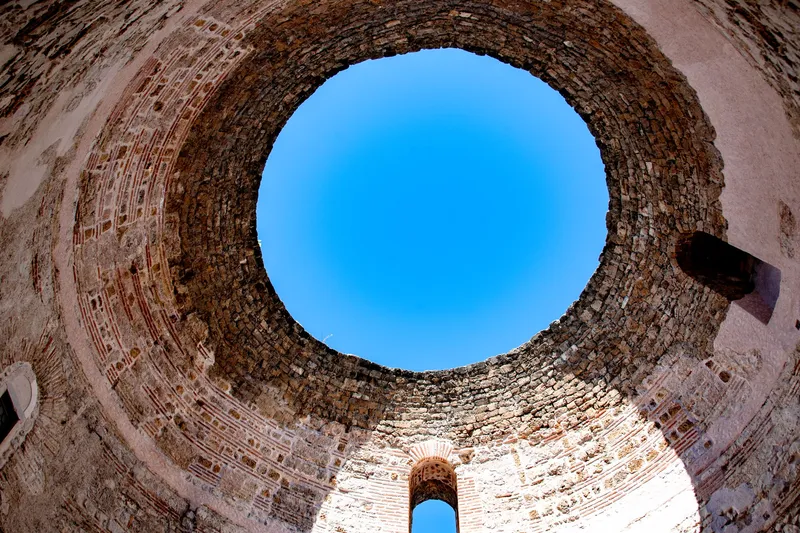
Roman palace
Diocletian's Palace
A villa and Roman military camp in one, still lived in, and a UNESCO site since 1979.
Book a guided walking tour
Updated November 2026 · Fact-checked
A Roman emperor's retirement palace that never emptied out. Washing lines, cafes and front doors sit inside walls laid for Diocletian, a palm-lined Riva runs along the south facade, and a forested hill rises at the end of the waterfront. Split is where Dalmatia lives, eats and catches the boat to the islands, and it rewards a slower look than the ferry timetable allows.
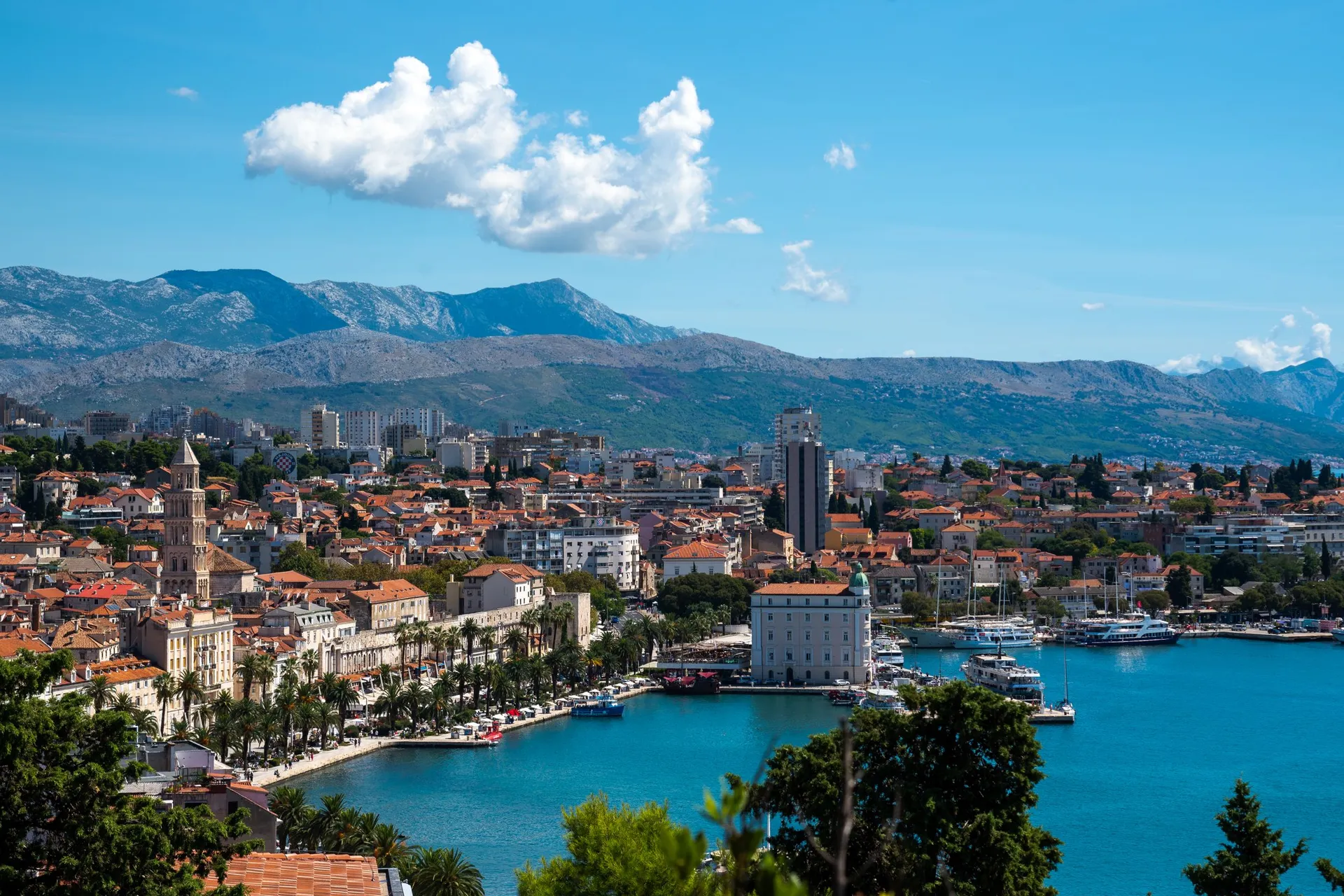 SPLIT · 43.5°N 16.4°E
Split grew up inside and around Diocletian's Palace, which the Split Tourist Board describes as a combination of a luxury villa and a Roman military camp, divided into four parts by two main streets. The historic core has been on the UNESCO World Heritage List since 1979, yet the official tourist board is quick to say the city is not a museum: it is a lively place thriving among the historical layers of its monuments. That is the right way to read it. The palace is where people live and meet, not a fenced ruin.
Split is also one of Croatia's busiest destinations. The Croatian National Tourist Board ranks it third among destinations for overnight stays in 2025, after Dubrovnik and Rovinj, and Split-Dalmatia County recorded 20.9 million overnights, second only to Istria's 30.3 million. It is the ferry and catamaran hub for the central Dalmatian islands and the base for day trips to Krka, Trogir and Klis, so most visitors pass through even if they only plan to stay a night. Give it two days, and it repays them.
The city has written rules for its busiest streets. Under the Split Public Order Act, drinking alcohol in public places inside Zone A, the area within the baroque ramparts, is fined 300 euros, as are climbing or sitting on monuments, bathing in fountains and offering or contracting a taxi that is not prearranged. Sleeping in public parks, squares and parking lots is a 150 euro fine. The tourist board's own message is to respect the locals and enjoy Split.
Pickpocketing is the everyday risk, and the Diocletian's Palace area is a named hotspot in our Croatia scams guide, particularly when cruise passengers arrive. The best-documented scam is taxi overcharging at the ferry terminal, which is easy to avoid by booking a ride before you land. And if you are visiting in winter, note that the Skradin boat transfer to Krka only runs from 1 April to 31 October.
Split is compact. Almost everything a first-time visitor wants sits within a short walk of the palace, so the choice of area is mostly about atmosphere, noise and whether you want to be on the sea.
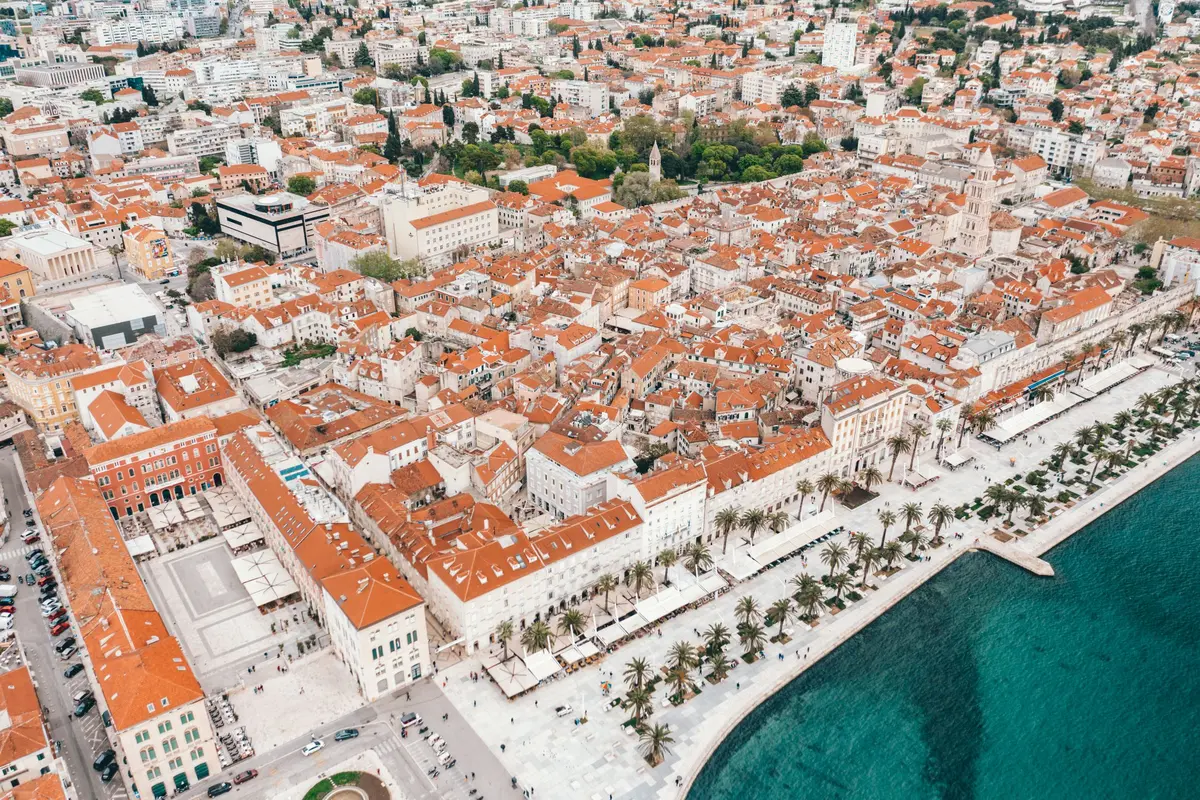
The historic core is built inside the palace walls and the streets that grew around them. The Split Tourist Board notes that the old part of the city resembles a maze but is easy to navigate, and runs information centres on the Riva and at the Peristyle where you can pick up city plans. Staying here means waking up among the monuments, and it also means the most foot traffic. Several of the hotels we found are inside the old town, including Heritage hotel Santa Lucia, Central Square Heritage Hotel and Hotel Kastel 1700.
The tourist board calls the Riva the city's living room: a pedestrian promenade along the south facade of the palace, lined with cafes and restaurants, where the French built the present layout two centuries ago. It is where Split meets for a morning coffee or an evening drink, and the natural start or end of any walk. Treat it as a place to sit, not to dine, since quality tends to rise as you move a street or two away from the water.
West of the palace, the old fishermen's quarter of Varoš is a quieter tangle of lanes, and it is where the konoba Fetivi sits. Guided walks of the old town often include Varoš and its historic fishermen's port. It is a good pick if you want to be near the sights without sleeping on top of them.
Marjan is the forested hill at the western end of the waterfront, and the tourist board stresses that you climb to it directly from the Riva. For sleeping, the stretch below it along Trumbićeva obala holds Hotel Ambasador, which Booking.com places in the Marjan district, and the Marjan paths are the natural run or walk when you want green space.
The city beach east of the old town is famous for picigin, a ball game the tourist board says was invented on that very spot. Hotel Park Split and several apartments in the Bačvice area are listed as beachfront on Booking.com. It is the choice for a beach-and-city mix, a short walk from the Riva rather than inside the palace.
Split's hotels cluster in three places: inside the old town in restored heritage buildings, along the western waterfront, and east at Bačvice by the beach. We checked each of these with Booking.com for midweek nights in February 2027, so prices below describe a winter rate and will move with the season.
At the top, Hotel Ambasador on the western waterfront has a rooftop pool and spa and guests rate it 9+ from over 1,800 reviews, while Hotel Park Split is a 5-star beachfront hotel at Bačvice, also rated 9+ from over 1,200 reviews. Expect around €210 to €340 a night in this bracket in winter, check current rates.
For the old town itself, Heritage hotel Santa Lucia on Narodni trg is rated 9+ by guests from over 1,100 reviews, and Central Square Heritage Hotel is a 4-star property that guests rate 8.8 from over 1,100 reviews. Heritage Hotel FERMAI MGallery Split sits just outside the old town and is rated 9+ by guests. In winter these 4-star heritage hotels came to around €130 to €155 a night.
On a tighter budget, Hotel Kastel 1700 is a 3-star hotel inside the old town (around €115 a night in winter) with over 700 reviews averaging 8.8, and the guesthouse Rooms Tomic and the apartment Apartment heart of the city are both rated 9+ by guests. Guesthouses and apartments in this search ran around €70 to €80 a night in winter, so check current rates for your dates.
The Split Tourist Board's advice for eating here is simple: wherever the road leads you, look for a good seafood restaurant or tavern. Dalmatian cooking is built on fish, olive oil and slow braises, and the best tables are usually a street or two away from the Riva.
Krug entered the Michelin Guide Croatia directly with one star in the 2025 selection. It is the place for a special-occasion dinner, and a restaurant at this level needs booking well ahead.
Toni Boban's K.užina was added to Michelin's Bib Gourmand list in 2025, the guide's category for good-value cooking. It is the better-value way to eat well in Split.
Konoba Fetivi on Tomica Stine in Veli Varoš is a stone-walled konoba with a terrace, known for grilled Adriatic fish and pašticada, the slow-braised Dalmatian beef dish. It is the kind of place that rewards leaving the Riva behind.
Villa Spiza on Kružićeva street is a small restaurant that takes no reservations at all, so expect to wait or arrive early. Gault&Millau lists it.
Brudet is the Dalmatian fish stew cooked in red wine, pašticada is slow-braised beef, and soparnik is a savoury chard pie from the nearby Poljica region. The Split Tourist Board also runs a food-heritage programme and lists cooking classes and food and wine tours, if you want to learn rather than just order.
Split rewards a simple order: the palace and the city core first, then the Riva, then Marjan, and a beach at Bačvice if you have time. That is the same sequence the Split Tourist Board recommends for a single day, and it works for two.
A villa and Roman military camp in one, still lived in, and a UNESCO site since 1979.
Book a guided walking tour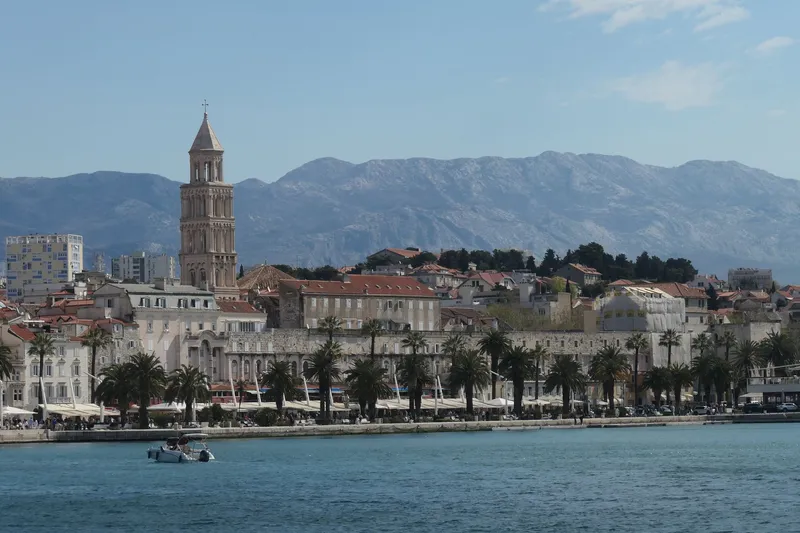
A cathedral in Diocletian's former mausoleum, with walnut doors carved by Andrija Buvina.
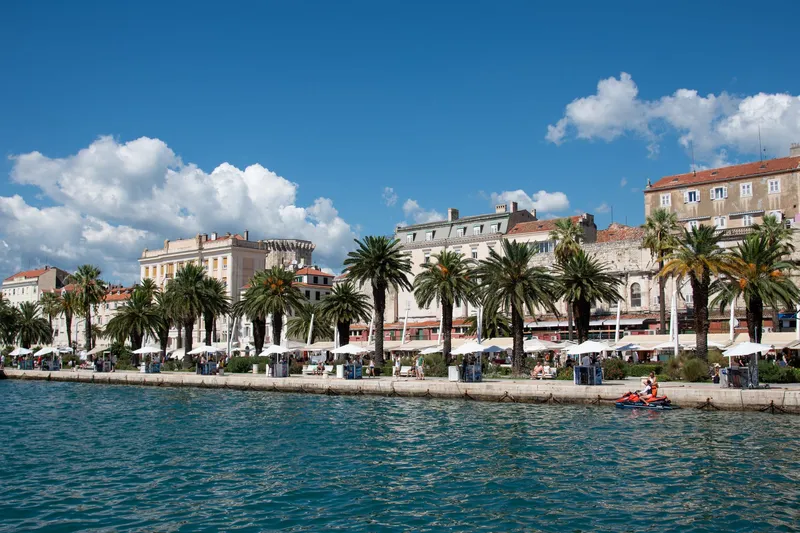
The pedestrian promenade the tourist board calls the city's living room.
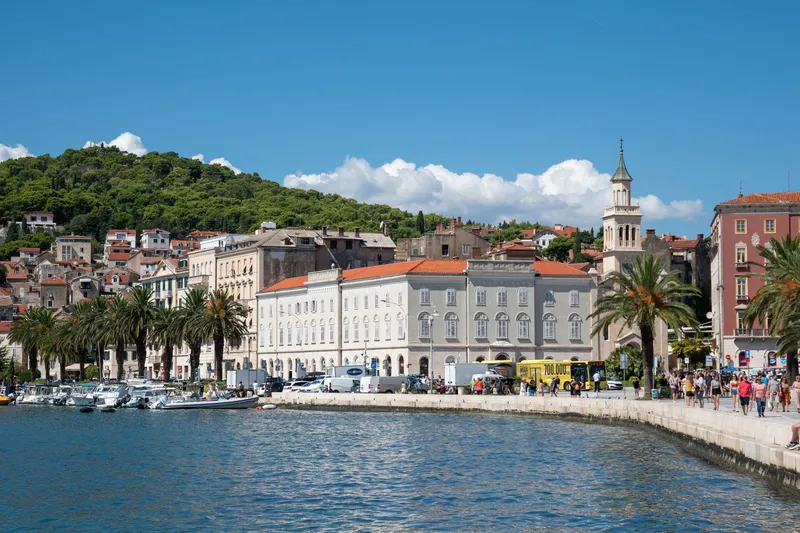
A park-forest peninsula you can climb straight from the Riva, with lookouts over the city and islands.
Book an electric tuk-tuk tourStart in the Peristyle, the central courtyard, where the tourist board runs one of its two information centres. The Cathedral of St Domnius is, in the tourist board's words, seated in the oldest building of any European cathedral: the emperor's mausoleum became a cathedral in the 7th century, with an octagon ringed by 24 columns, a 13th-century hexagonal pulpit of green porphyry and the walnut doors of Andrija Buvina, with fourteen Gospel panels on each door post. The official site confirms you can climb the steps to the top of the bell tower. Under the palace, the Substructures, the cellars, are among the best preserved ancient complexes of their kind. You enter through Porta Aenea from the Riva or down the stairs from the Peristyle, and the halls host exhibitions and events.
The Riva reached its present form two centuries ago under the French, and the south facade of the palace is its backdrop. Walk it end to end, then cut back into the lanes. Guided walks of the old town often add the green market, the fish market, Marmontova street, the Prokurative square and the old fishermen's port of Varoš, and group walking tours run from about €15 to €40 a person on GetYourGuide, with the best-reviewed ones rated 4.9 from thousands of reviews.
Marjan is a park-forest with natural paths and trim trails and several lookout points. The old watchtower at Sedlo was rebuilt under an EU project so visitors can go inside, while still serving as a fire lookout. If you want to see the viewpoints without the climb, an electric tuk-tuk city tour of about 2 hours stops at Vidilica terrace and Marjan hill and is rated 4.9 from over 2,000 reviews. For a swim, Bačvice is the city beach, famous for picigin.
Split appears among the Game of Thrones filming locations, and the Split Tourist Board lists Game of Thrones tours on its own site. The best-reviewed option on GetYourGuide is a history and Game of Thrones walking tour of about 100 to 105 minutes, rated 4.9 from over 650 reviews. A cheaper alternative is a general small-group old town tour, rated 4.9 from over 5,800 reviews. Tour prices vary by group size and season, so check current rates before you book.
Two days cover Split itself properly, and a third works best as a day on the water or at Krka. The routes below follow the order the Split Tourist Board suggests and keep everything on foot.
The palace and the cathedral. Start at the Peristyle, climb the bell tower and go down into the Substructures from the Riva or the Peristyle stairs.
Lunch in Veli Varoš. Konoba Fetivi is a short walk west of the palace.
Marjan. Climb from the Riva to the lookouts, or ride the hill in an electric tuk-tuk.
The Riva. A drink or dinner along the waterfront, then back into the old town lanes.
The one-day route: palace, cathedral and bell tower, Veli Varoš, Marjan and the Riva.
Salona and Klis, or Trogir. A half-day tour, or line 37 to Trogir.
Bačvice. A swim at the city beach, and a look at a game of picigin.
Dinner at K.užina or Villa Spiza. Book K.užina ahead; Villa Spiza takes no reservations.
The two-day route above, at an easier pace.
Krka waterfalls. Group day trips run about 8.5 to 10 hours; the boat from Skradin only operates from 1 April to 31 October.
Hvar and the Pakleni islands. A catamaran day tour of about 9.5 hours, or a Jadrolinija catamaran to Bol on Brač in about 1 hour 5 minutes.
Split's old town and Riva are best done on foot. The airport (SPU) is linked to the city by Promet Split's line 37 (Split, airport, Trogir): the airport-to-Split trip takes 50 minutes at €3.00, and the hop to Trogir takes 10 minutes at €2.50, according to Promet Split's own airport-line page. It is the cheapest option, and the timetable it shows has been valid since 8 September 2025, so check the current schedule before you travel.
Uber and Bolt both operate in Split and show a fare up front, which is the safest way to avoid the ferry terminal taxi scam: book the car before you disembark. Ferries and catamarans leave from the harbour next to the old town, and Jadrolinija's catamaran line 9603 links Split with Bol on Brač, Stari Grad and Jelsa on Hvar, with the Split to Bol leg listed at about 1 hour 5 minutes. For Dubrovnik, buses are the standard option and now use the Pelješac Bridge, so the Neum corridor crossing is no longer needed; see our Dubrovnik guide and the Croatia guide for the route.
May-June and September-October are the sweet spots, the same as for the rest of the Dalmatian coast: warm enough for the sea, fewer crowds and lower prices than high summer. In winter the city is quieter, hotel rates are lower, and the Krka boats stop running, but the old town and the Riva are as good as ever.
Practical prep: an eSIM before landing saves the airport queue and gives you data for ride-hailing apps from the first minute. Croatia uses the euro and is in the Schengen area.
We do not quote a daily budget for Split because we could not source one. What we can show are the prices we did find: winter hotel brackets from Booking.com for midweek nights in February 2027, tour prices from GetYourGuide, the airport bus fare from the operator, and the Krka park entrance fee.
Split is safe for visitors, in line with the rest of Croatia. The US State Department rates Croatia Level 1, "exercise normal precautions" (updated 18 May 2026), Canada advises normal security precautions (updated 11 August 2026), and the UK government does not advise against travel. Canada notes that violent crime is low but petty crime such as pickpocketing and purse snatching is common, so keep your valuables out of sight in crowds.
The practical risks are small and specific. Pickpockets work the busy palace area and the Riva when cruise passengers are in town, and unlicensed drivers meet arrivals at the ferry terminal, so book a ride before you land. The Split Public Order Act sets 300 euro fines for drinking alcohol in public inside the old town's baroque ramparts, and for sitting on monuments or bathing in fountains. From 1 June to 30 September 2026 seasonal tourist medical clinics operate in Split and other Split-Dalmatia towns, and the county's visitor safety portal is safeindalmatia.hr. Emergency number is the EU-standard 112 from any phone.
Split is a natural base. The tourist board lists national parks, towns, islands and walking routes as excursions, and the options below are the ones with the best-reviewed tours from Split.
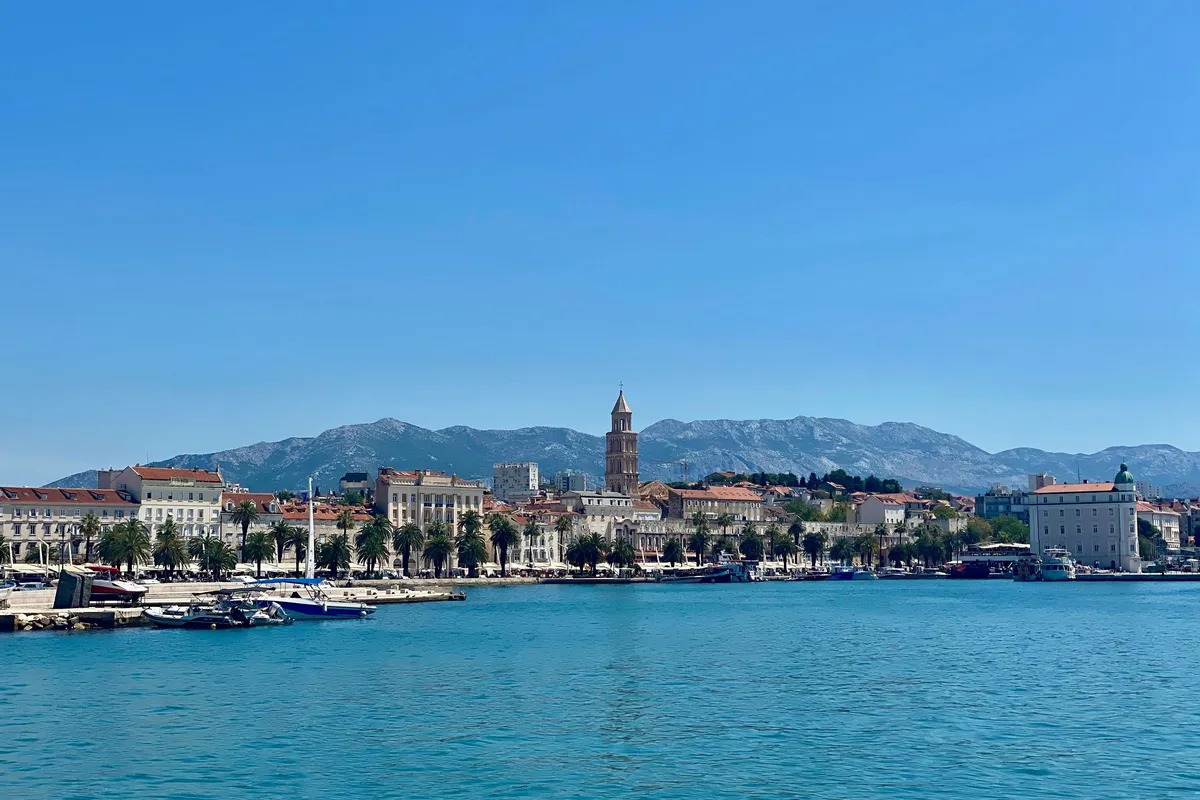
Krka National Park is the classic day out: waterfalls, a river cruise and swimming stops. Group tours from Split run about 8.5 to 10 hours, and the best-reviewed Krka waterfalls tour with boat cruise and swimming is rated 4.8 from over 13,000 reviews. The boat from Skradin only runs from 1 April to 31 October; in winter you walk.
The all-inclusive Hvar, Pakleni, Brač and Šolta catamaran tour takes about 9.5 hours with three swim stops and is rated 4.8 from over 1,700 reviews. On your own, Jadrolinija's catamaran line 9603 runs from Split to Bol, Stari Grad and Jelsa.
The historic town of Trogir sits on the same line 37 as the airport bus, so you can reach it independently. A half-day tour of Split and Trogir takes about 5 hours and is rated 4.8 from over 240 reviews.
Klis Fortress, a Game of Thrones filming location in the hills above Split, is often paired with the ruins of the Roman city of Salona. Guided combinations run about 7 hours, and shorter ship-return tours exist for cruise passengers.
Longer excursions reach Plitvice Lakes, a 12-hour guided day tour that is rated 4.9 from over 3,500 reviews, and Mostar in Bosnia and Herzegovina, a 12-hour day with a real border crossing. Both are long days; most visitors choose one of them over a fourth night in Split.
Yes. Croatia holds a US Level 1 advisory, and Canada advises normal security precautions. Violent crime is low, but pickpocketing is common in crowds around Diocletian's Palace and the Riva, so keep valuables out of sight. Emergency number is 112.
Two days cover Diocletian's Palace, the cathedral and bell tower, the Riva and Marjan hill. A third day fits a trip to Krka waterfalls, Trogir, Klis and Salona, or an island such as Hvar or Brač.
In our February 2027 midweek search on Booking.com, guesthouses and apartments ran around €70 to €80 a night, 4-star heritage hotels around €130 to €155, and 5-star hotels around €210 to €340. Rates change with the season, so check current rates for your dates.
May-June and September-October: warm enough for the sea, fewer crowds and lower prices than high summer. In winter the city is quiet and rooms are cheaper, but the Krka boat transfer only runs from 1 April to 31 October.
Promet Split's line 37 runs from the airport to Split in about 50 minutes for €3.00, and on to Trogir in about 10 minutes for €2.50 from the airport. Uber and Bolt also operate in Split and show the fare in advance.
The old town for atmosphere and walking to everything, though it is the busiest part. Bačvice for the city beach and beachfront hotels, and the western waterfront below Marjan for a quieter base with the Riva a short walk away.
Not inside Zone A, the area within the baroque ramparts of the old town. Under the Split Public Order Act, drinking alcohol in public places there is fined 300 euros, as are sitting on monuments and bathing in fountains.
Yes. The old town and the Riva are pedestrian, and the Split Tourist Board describes the palace area as a maze that is easy to navigate. Marjan hill is a climb from the Riva, and Bačvice beach is a short walk east.
Krka National Park is the classic, with group tours of about 8.5 to 10 hours. Other options are the Hvar and Pakleni islands catamaran day, Trogir, Klis Fortress and the Roman ruins of Salona, and longer days to Plitvice Lakes or Mostar.
Worth two full days. The Croatian National Tourist Board ranks Split third among destinations for overnight stays in 2025, and the old town is a living part of a Roman palace rather than a ruin, with islands and national parks within a day.
Split is the rare tourist city where the main attraction is also somebody's neighbourhood. People hang washing, drink coffee and argue about football inside walls built for a Roman emperor, and the Riva fills at the same hour every evening whether or not anyone is watching. That is why it feels lived in rather than preserved.
Climb Marjan once before you leave and look back at the bell tower over the palm trees. The ferries will still be there; the view of a city that never moved out of its palace is the thing to take home.