
What You're Actually Getting Into
Albania is the European country that travelers consistently describe as their best discovery of recent years, and it has been saying that for a decade without fully losing it. The country was sealed almost entirely from the outside world during Enver Hoxha's communist dictatorship (1944 to 1985), one of the most isolationist regimes in the history of modern states, which banned private car ownership, made religion illegal, and studded the entire country with 173,000 concrete bunkers for an invasion that never came. It emerged with extraordinary landscapes and UNESCO heritage intact, minimal tourist infrastructure, and a population whose cultural tradition of hospitality the isolation had, paradoxically, intensified rather than diminished.
Albania is also genuinely one of the cheapest countries in Europe. A meal at a good restaurant costs 7 to 10 euros. A guesthouse bed in the mountains costs 15 to 20 euros. A coffee in Tirana costs 1 euro. The Albanian Riviera, the strip of Ionian coast from Vlorë to Sarandë with mountains dropping into turquoise water, has sea-view doubles from 30 euros a night, coves that would cost 200 euros a night in Santorini.
The honest complications
Albania's road infrastructure, while significantly improved, is still variable outside the main highways, and driving requires attention. The summer on the Riviera (July to August) is hot, crowded, and accommodation prices double or triple. Tirana is a genuinely interesting city but it operates on Albanian time, things happen when they happen. And the bunkers, while iconic, are a reminder that the country you're visiting was, within the lifetime of most of its adult population, one of the most closed and repressive societies on earth. The warmth of the welcome and the beauty of the landscape are all the more remarkable for this context.
A History Worth Knowing
Albanians descend from the Illyrians, an ancient people of the western Balkans, and speak Shqip, a linguistic isolate related to no other living language, the same category as Basque. Their national hero Skanderbeg held off the Ottomans for 25 years in the 15th century; his double-headed eagle is the flag today. Four centuries of Ottoman rule, independence in 1912, Europe's most extreme communist regime under Hoxha, a near-civil war in 1997, and EU candidacy since 2014: the short version of how the country you're visiting got here.
- 15th century
Skanderbeg. Gjergj Kastrioti defects from the Ottomans and leads Albanian resistance 1443 to 1468. His double-headed eagle becomes the national symbol.
- 1912
Independence. Declared at Vlorë on 28 November. The border settlement leaves large Albanian-speaking populations in Kosovo, Macedonia and Greece.
- 1944–1985
Hoxha's Albania. Religion banned in 1967, making Albania the world's first officially atheist state. Private cars illegal. 173,000 bunkers built. Complete isolation.
- 1990–1991
Fall of communism. Mass emigration to Italy and Greece. The statues fall, the democratic transition begins.
- 1997
Pyramid scheme collapse. National savings wiped out, near-civil war, roughly 1.5 million Kalashnikovs distributed from army depots before the country stabilizes.
- 2014–present
EU candidate. Accession negotiations open, infrastructure improves, tourism grows from almost nothing to a significant industry.
Read the full history: Illyrians, Skanderbeg, the Ottomans and Hoxha
The claim to Illyrian descent is central to Albanian national identity and distinguishes Albanians linguistically from their Slavic neighbors. The language and the claimed ancient heritage are the foundations of the Albanian argument for indigeneity in their own land against centuries of competing imperial claims.
Skanderbeg, a 15th-century Albanian nobleman, converted to Christianity from Islam, defected from the Ottoman Empire where he had served as a military commander, and led Albanian resistance to Ottoman expansion until his death in 1468. He is, in the Albanian mind, the reason their language and national identity survived centuries of Ottoman rule that obliterated the distinct identities of many neighboring peoples.
The Ottoman period (roughly 1479 to 1912) left a complex legacy. A significant portion of the population converted to Islam, making Albania today the only Muslim-majority country in Europe, though Albanian Islam has historically been notably secular and syncretic. The saying attributed to the 19th-century nationalist Pashko Vasa, "the religion of Albanians is Albanianism," captures something genuine about how many Albanians historically understood the hierarchy of their identities.
The interwar period brought Fan Noli's short-lived progressive administration, then Ahmet Zogu, who made himself King Zog I in 1928 and maintained an Italian-influenced authoritarian monarchy until the Italian invasion of 1939. Communist rule began in 1944 under Enver Hoxha; after 1961 he broke with the Soviet Union, after 1978 with China, and Albania spent its final communist decades in isolation even within the communist world. His successor Ramiz Alia oversaw the transition to democracy in 1990 and 1991, one of the most chaotic in Eastern Europe. The country has rebuilt steadily since the 1997 collapse, and the transformation is real if incomplete: the roads are better, the cities livelier, and the country's extraordinary natural and cultural heritage is finally visible to the outside world.
The bunkers. Hoxha's 173,000 concrete bunkers are scattered across the entire country, from city parks to mountain passes to beaches. Some have been converted into cafes, art spaces, hostels or storage; many sit abandoned in fields. The Bunk'Art museums in Tirana, converted underground shelters from the communist era, are the best way to understand both the bunker program and the nature of the regime.
Top Destinations
Albania divides naturally into four travel zones: the capital and central lowlands, the UNESCO cities of the south, the Albanian Riviera, and the northern mountains. The country is roughly the size of Maryland, so distance is not the constraint: road quality and the time each zone deserves are. A two-week trip covers all four; a week covers two or three well. Don't spend the whole trip in Tirana.
Tirana, the colorful capital
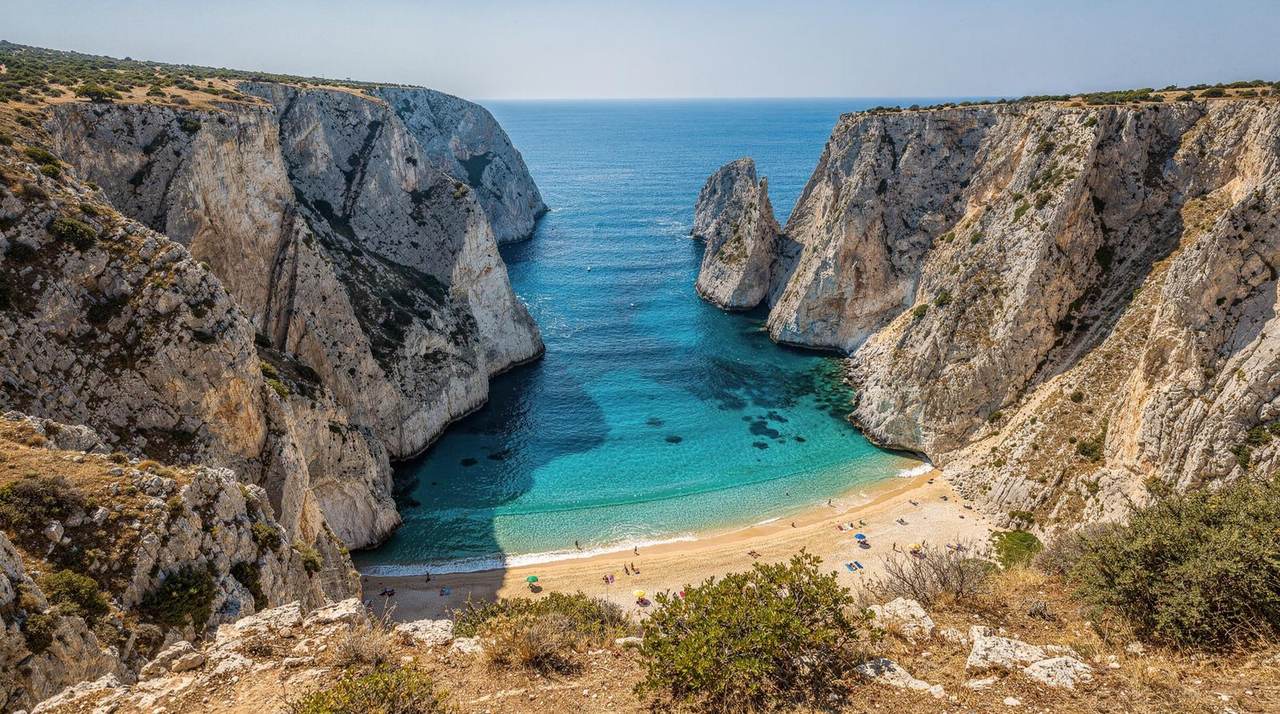
Tirana is one of the most unexpectedly enjoyable capitals in Europe. Grey and crumbling in the 1990s, a former mayor commissioned the painting of every building facade in bright colors, and the resulting urban landscape, chaotic, energetic and covered in murals, is the city's visual signature. Skanderbeg Square is the center, dominated by the National History Museum's enormous Socialist Realist mosaic and the Et'hem Bey mosque. The Blloku district, once the exclusive residential zone of the communist party leadership and now the nightlife and cafe hub, has the best eating in Albania: Oda near the Pazari i Ri market for old-school Albanian home cooking, Piceri Era in Blloku for a livelier version of the same, and Mullixhiu for a farm-to-table take on fërgesë and tavë kosi. For a drink, Komiteti Kafe-Muzeum behind the Pyramid of Tirana serves 25-plus kinds of raki in a room furnished like a communist-era apartment. The two Bunk'Art museums, in converted nuclear bunkers, tell the story of the Hoxha years more honestly than any textbook, and Ballkoni Dajti, the restaurant at the top of the Dajti Express cable car, is worth the ride for the view alone. Budget two days.
Gjirokastër, the Ottoman stone city
Gjirokastër sits on a steep hillside in a southern valley, its stone Ottoman houses stacked above each other like a collapsed bookshelf, a massive citadel on the ridge above. Part of the joint UNESCO World Heritage listing with Berat, it's the birthplace of Enver Hoxha, which the city observes with a complicated silence, and of the novelist Ismail Kadare, whose "Chronicle in Stone" describes the city of his childhood. Buy a pair of qeleshe (white felt traditional caps) in the bazaar, eat byrek at the stalls, and see the captured US Air Force plane from the 1957 cold war incident up in the Citadel. Most beautiful in the morning before the day-trippers arrive from Sarandë.
Berat, the city of a thousand windows
Berat sits in a river valley in central Albania with two UNESCO-listed neighborhoods: Mangalem, where rows of Ottoman houses with many windows climb the hillside in terraces, and Kala, the castle district above. Uniquely in the Balkans, the castle is inhabited: people live inside the medieval citadel, which also holds several Byzantine churches with intact frescoes attributed to Onufri. Walk up through the Kala at dusk when the Mangalem houses below are lit up: this is when the effect is most affecting.
Dhërmi, Himara & Sarandë
The Albanian Riviera runs 150 kilometers from Vlorë south to Sarandë, the SH8 coast road hugging steep mountains above the Ionian Sea. The water, turquoise, clear to the bottom at 8 meters and warm from June to October, is the equal of anywhere in the Mediterranean. Dhërmi has the most developed beach infrastructure and small stylish stays like Gogo's Boutique Hotel up in the old village above the beach. Himara is the largest town on the coast, with a quieter, more atmospheric option in Aphrodite's Garden. Borsh has the longest beach with fewer tourists. Sarandë has the best nightlife and the ferry to Corfu. In May, June, September and October the coast is excellent; in July and August it is crowded and prices double.
Valbona & Theth, the Accursed Mountains
The Bjeshkët e Namuna, the Accursed Mountains of northern Albania, are the country's most dramatic landscape and best hiking. The classic route: ferry across Koman Lake through a dramatic limestone canyon, a van to Valbona village, the full-day hike over the pass to Theth (5 to 8 hours depending on fitness and snow), then a day exploring Theth's waterfall and blood-feud lock-in tower. In Valbona, Lazer Çardaku Guesthouse and Hotel Margjeka are both close to the trailhead and well regarded for their family-cooked dinners. In Theth, Guesthouse Skender Selimaj and Molla Guest House are reliable, family-run picks near the village center. Guesthouses charge 20 to 30 euros a night with dinner included. The pass can hold snow as late as June and as early as October.
Shkodër, the gateway city
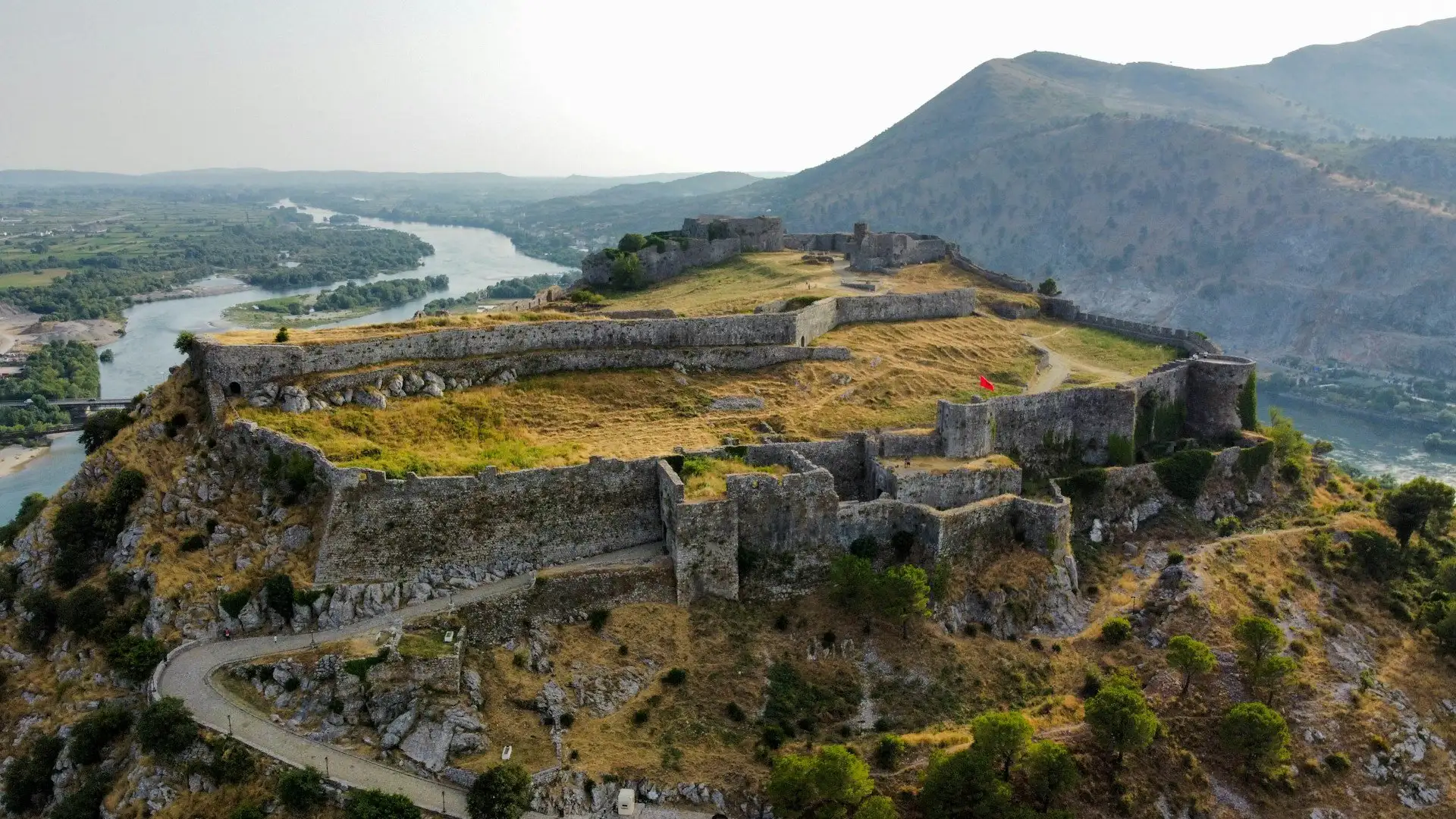
Shkodër, on the lake bordering Montenegro, is the cultural capital of northern Albania and the gateway to the mountains. Rozafa Castle has views over the confluence of two rivers and the lake toward Montenegro that rank among the best in the Balkans. The old bazaar and Rruga Kolë Idromeno have good cafes, and the town is the base for boat trips on the lake.
Butrint
Butrint is one of the least-known major archaeological sites in the Mediterranean, a UNESCO World Heritage Site on a peninsula in a lagoon near Sarandë, with ruins spanning Greek, Roman, Byzantine and Venetian occupation from the 7th century BCE onward. A Greek theater, Roman baths, an early Christian baptistery with exceptional mosaic floors, and Venetian towers sit in a forested setting on the water. Visit in the morning before the Corfu day-trippers arrive.
Vlorë & Apollonia
Vlorë, where independence was declared in 1912, is a functional port town and the gateway to the Riviera. More compelling is Apollonia, 12 kilometers inland: a Greek colonial city from the 6th century BCE whose ruins sit in olive-grove-covered hills largely to themselves, with the still-active monastery of Shen Mëri at their center.
Hidden gems beyond the main circuit
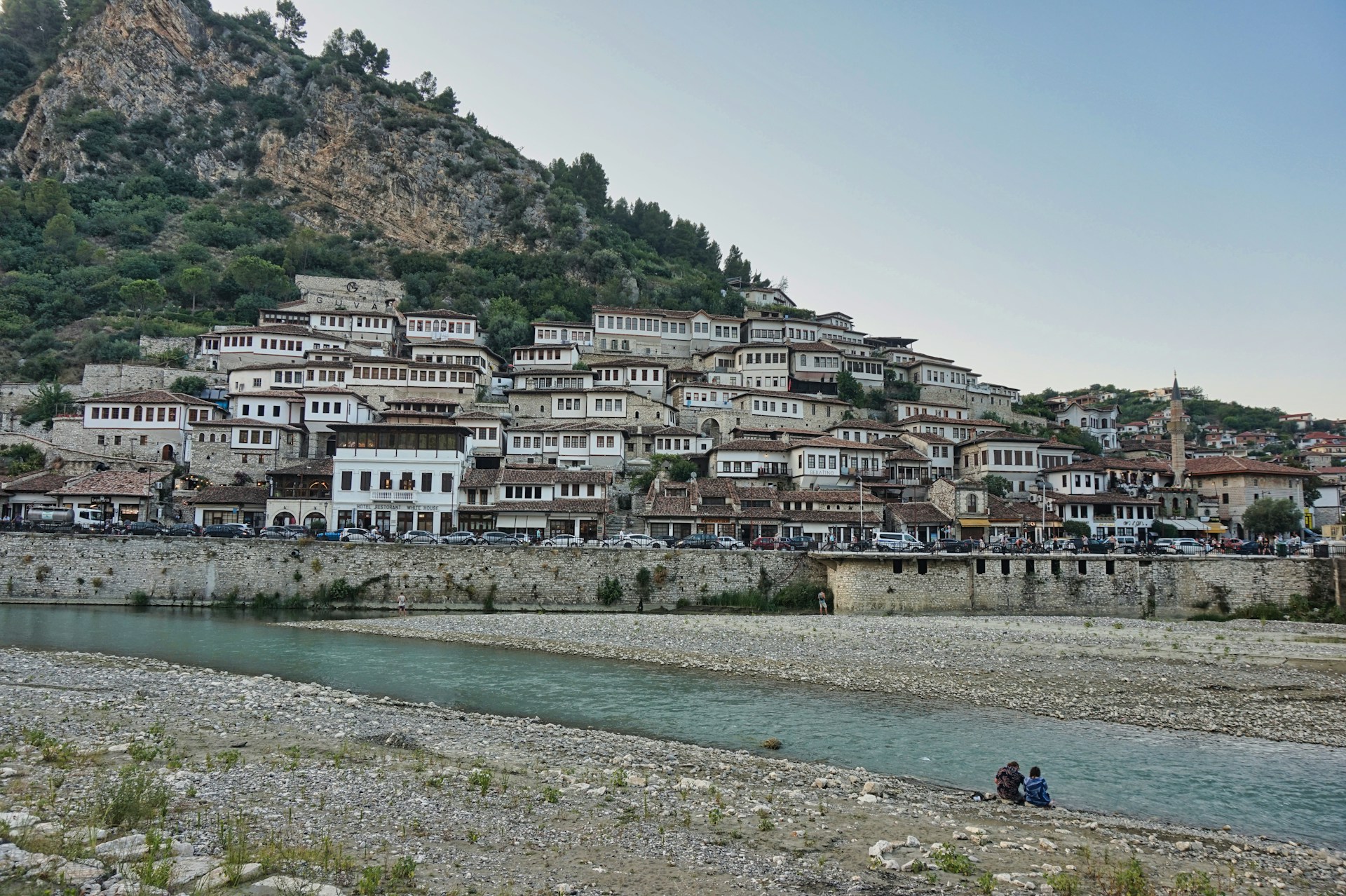
The zones above cover a first or second trip well. With extra days, these are the spots that rarely make the standard guides but reward the detour.
Gjipe Beach
A cove reachable only by a 20-minute footpath down a canyon or by boat: no road access, a handful of small beach bars, none of the sunbed rows of the main beaches. Bring cash and water shoes.
Blue Eye Spring
A freshwater spring of improbable, saturated blue that wells up from underground and feeds a river through beech forest. Developed enough for a cafe, undeveloped enough that the color still stops people mid-sentence.
Osumi Canyon
A limestone gorge near Çorovodë carved by the Osumi river, sheer walls up to 100 meters and a small waterfall at Bogova. Rafting trips run May to October and require no experience.
Përmet & the Thermal Springs
A quiet town on the Vjosa river known for its wine, its raki, and the Bënjë thermal springs nearby: natural hot pools beside an Ottoman stone bridge. Far less visited than the Riviera and correspondingly cheaper.
Lake Ohrid, Albanian shore
The Albanian side of Lake Ohrid is quieter than the North Macedonian town across the water. The Ohrid trout, a species unique to the lake, is the thing to order at the waterfront restaurants.
Llogara Pass viewpoint
Where the coast road crests at 1,000 meters before plunging to the sea. Stop at the top: the view down to Dhërmi is one of the best in the Balkans and most drivers sail past it.
Culture & Etiquette
Albanian culture has a specific concept, besa, that is central to how the country relates to guests: a code of honor that includes the absolute duty to protect and provide for a guest. Ancient, codified in the Kanun of the northern highlands, and still a genuine cultural value rather than a tourist-industry performance. Albania is majority-Muslim but notably moderate and secular in practice: churches, mosques and Bektashi tekkes coexist in most towns, with tolerance of all and strict adherence to none.
Do
- Accept hospitality. If an Albanian invites you to their home or to share their raki, accept. Besa means your presence as a guest creates obligations for the host that are genuinely felt; declining repeatedly is rude in a way that transcends the usual tourist-local interaction.
- Know the head-nod reversal. Albanians nod downward for yes, and upward with a clicking sound for no, the opposite of most European conventions.
- Dress appropriately for mosques and churches. Cover shoulders and knees; women should carry a scarf for mosques.
- Learn a few Albanian words. Faleminderit (thank you), Mirëdita (good day), Po (yes), Jo (no). Attempting Albanian produces warmth out of all proportion to the effort.
- Carry cash (lek). Albania is largely a cash economy outside Tirana hotels. Use ATMs at Raiffeisen Bank or BKT rather than exchange bureaus.
Don't
- Drive aggressively. Albanian road culture is assertive in a way that requires local knowledge. Drive defensively and let local drivers do what they do.
- Photograph people without asking, particularly in the north and traditional communities. Norms are more relaxed in the tourist bazaars of Berat and Gjirokastër.
- Assume the blood feud tradition is purely historical. The gjakmarrja resurfaced in the 1990s and has declined sharply since. Not a tourist safety issue, but it explains the lock-in towers (kula) in Theth.
- Compare Albania unfavorably to Greece. The Riviera is not "like Greece but cheaper." It is Albanian, in a country with its own history and character.
- Underestimate the mountain roads. The SH8 has hairpins with significant drops, and mountain passes can hold snow into May and from October.
Deeper culture: iso-polyphony, the Kanun, the Bektashi and Kadare
Iso-polyphony. Traditional polyphonic folk singing in which multiple voices sing independent melodic lines simultaneously, the first Albanian practice added to UNESCO's Intangible Cultural Heritage list in 2005. Specific to southern Albania, heard at ceremonies, funerals and folk festivals.
The Kanun. The traditional law code of northern Albania, attributed to the 15th-century chieftain Lekë Dukagjini, governed hospitality, property, marriage and conflict resolution for centuries. The besa hospitality code is as defining as the more infamous blood-feud provisions.
The Bektashi Order. The world headquarters of the Bektashi Sufi order relocated from Turkey to Tirana in 1925 when Atatürk dissolved Sufi orders. Their syncretic tradition blends Shia Islam, Christianity and pre-Islamic Balkan traditions, with tekkes scattered through southern Albania.
Ismail Kadare. Born in Gjirokastër in 1936, the major Albanian novelist of the 20th century. "Chronicle in Stone," "The General of the Dead Army" and "The Palace of Dreams" are the starting points; reading one before visiting Gjirokastër changes the city. He died in Paris in 2024.
Food & Drink
Albanian food is Mediterranean with Ottoman and Balkan layers: fresh vegetables, olive oil, grilled meats, dairy from highland sheep and goats, and freshwater fish from the lakes. The best of it is not at tourist-facing restaurants but at family guesthouses in the mountains, market stalls in the old bazaars, and village restaurants in the south where a full lunch for two with wine costs 15 euros.
Byrek ~€1
The street food standard: flaky pastry filled with spinach and white cheese, meat and onion, or tomato, sold by the slice. A good byrek from a busy market stall is one of the best 1-euro food experiences in Europe.
Fërgesë & Tavë Kosi
Fërgesë is a Tirana specialty of tomatoes, cottage cheese and meat or peppers baked in a clay pot. Tavë kosi, lamb slow-baked with yogurt and eggs into a creamy crust, is Albania's most famous dish. Oda near Pazari i Ri does both properly.
Raki & Wine €0.50-0.80
Raki, a clear grape or mulberry spirit, is the national drink: offered as a welcome, after a meal, or instead of conversation. Albanian Kallmet red from the Shkodër area is underrated at 5 to 8 euros a bottle.
Qofte & Grilled Meats €6-8
Small spiced meatballs over charcoal, shish kebab, and highland lamb and goat. A full plate with salad, bread and a glass of local wine at a roadside restaurant costs 6 to 8 euros.
Cheese & Dairy
Djathë i bardhë, sheep's milk white cheese similar to feta, appears at every meal. Mountain guesthouses in Valbona and Theth serve fresh cheeses from their own flocks, one of the better food souvenirs.
Seafood & Lake Fish €12-18
The Riviera grills fresh fish on terraces above the water; the Ohrid trout, unique to Lake Ohrid, is found around Pogradec. A full grilled fish with salad and local wine costs 12 to 18 euros.
When to Go & Itineraries
May, June, September and October are the best months for everything simultaneously: the coast is warm without peak crowds, the mountains are passable, and the UNESCO cities are quiet enough to feel genuinely discovered. July and August are hot and crowded on the Riviera with peak prices; the mountains are the better peak-summer option. Winter is excellent for urban exploration without other tourists, though coastal accommodation partly closes.
All four seasons compared, with temperatures
| Season | Verdict | Temps | Prices & crowds |
|---|---|---|---|
| May-Jun & Sep-Oct | Best | 20-28°C coast, 15-22°C interior | Mid prices, manageable crowds |
| Jul-Aug | Good (hot) | 28-38°C coast/south | Peak coast prices, busy; mountains are the escape |
| Mar-Apr | Good | 14-22°C coast | Low prices, few tourists; passes may hold snow into April |
| Nov-Feb | Quiet | 5-14°C Tirana | Lowest prices; coast partly closed, mountain roads difficult |
Year-round city averages: Tirana 16°C, Gjirokastër 15°C, Berat 16°C, Sarandë 18°C, Shkodër 14°C, Valbona 11°C, Dhërmi 19°C, Vlorë 17°C. The Riviera reaches 32-36°C in summer; Valbona in January can hit -10°C.
Itineraries
Seven days covers Albania's main circuit adequately. Two weeks adds the second UNESCO city, the northern mountains, and a more leisurely Riviera. The constraint is not distance but wanting to stay longer than planned in the places you discover.
- Days 1–2
Tirana. Skanderbeg Square, National History Museum, Et'hem Bey mosque, both Bunk'Art museums, dinner in Blloku.
- Days 3–4
Berat. Drive or bus from Tirana (2.5 hours). Mangalem in the afternoon, Kala castle at dusk, Byzantine frescoes and the Onufri Museum next morning.
- Days 5–7
Albanian Riviera. South via Gjirokastër (half-day bazaar and citadel) to Sarandë, one morning at Butrint, then two nights at Dhërmi or Himara before returning via the SH8 coast road.
- Days 1–2
Tirana. Two full days; add the National Gallery of Arts' Socialist Realist collection.
- Days 3–5
Shkodër & Accursed Mountains. Bus to Shkodër, Rozafa Castle, then the Koman Lake ferry, Valbona, and the pass hike to Theth.
- Days 6–7
Return & Berat. Morning in Theth, transport back toward Berat, overnight for Mangalem at dusk and the castle at dawn.
- Days 8–10
Gjirokastër & Apollonia. Stop at Apollonia en route, then two full days in Gjirokastër including a day trip to the Blue Eye spring.
- Days 11–14
Albanian Riviera. Butrint on arrival, three nights across Sarandë, Himara and Dhërmi, return to Tirana along the SH8.
- Days 1–3
Tirana extended. Day trips to Krujë (Skanderbeg Castle) and Durrës (Roman Amphitheatre).
- Days 4–7
Northern mountains extended. Shkodër, the Koman ferry, Valbona, the pass, and two nights in Theth for longer hikes to the Grunas waterfall.
- Days 8–11
Central Albania. Berat, Pogradec on Lake Ohrid, and Korçë, Albania's second cultural city.
- Days 12–16
Southern Albania. Gjirokastër, the Blue Eye spring, Sarandë, Butrint, and optionally a day trip to Corfu.
- Days 17–21
Riviera slow. Five unhurried days: Dhërmi, Borsh, Palasa, and Himara for the final sunsets.
Getting there & around
Tirana International Airport (TIA) is the only international airport, with Wizz Air, Ryanair, Austrian and Turkish Airlines connecting from most European hubs (2.5 hrs from London, 1.5 from Rome, flights €40-150). A rental car (€25-40/day from TIA, standard EU or international license) is the most practical way to see the country: the bus network covers main routes but misses the coast road, the mountain villages, and combining Apollonia and Butrint in a day. Some rental contracts prohibit taking the car to Kosovo or North Macedonia, check first.
All transport options with prices: furgons, ferries, taxis
| Option | Price | Notes |
|---|---|---|
| Furgons (minibuses) | €2-8/route | Leave when full from informal parking areas near markets. Tirana to Berat: 2.5 hrs, €4. Cheap and reliable on main routes. |
| Taxis & ride apps | €3-8 (Tirana) | Uber and Bolt do not operate in Albania; local apps such as Speed Taxi and Merr Taxi work in the capital. Negotiate fares for intercity taxis outside it. |
| Koman Lake ferry | €10 one way | Daily through a dramatic limestone canyon. Departs Koman 9am, arrives Fierza around noon. |
| International ferries | €19-80 | Sarandë to Corfu (1 hr, ~€19), Vlorë to Brindisi (8 hrs overnight), Durrës to Bari or Ancona. |
Albanian driving culture: Albanians drive predominantly Mercedes-Benz cars, a legacy of the early 1990s, and the association with prestige produces a specific road dynamic. Sheep, goats and cows also appear on rural roads at any time. Read up on Albanian road signs and unmarked-intersection right of way before picking up the rental: roundabouts work differently than most Western drivers expect.
Practical prep: buy an Albanian SIM at the airport (5-8 euros for 10-15GB) or an eSIM before landing; signal is minimal in Valbona and Theth, so download offline maps first. Standard travel insurance works well, but make sure the policy covers mountain rescue. For the Valbona-Theth day: good boots, food and water, sun protection and a layer for the roughly 1,800m pass. GetTransfer offers fixed-price airport pickups from TIA.
Where to stay
Mountain guesthouses
Family-run in Valbona and Theth, dinner included and made from the family's own produce: the most specifically Albanian accommodation experience, and the cheapest. Lazer Çardaku Guesthouse and Hotel Margjeka in Valbona; Guesthouse Skender Selimaj and Molla Guest House in Theth.
UNESCO city guesthouses
Converted Ottoman stone houses positioned for early morning and late evening, before and after the day-trippers. Hotel Kalemi in Gjirokastër occupies a 250-year-old house below the citadel; Hotel Mangalemi in Berat sits at the start of the climb to the castle.
Riviera sea-view stays
From rooms above a family's house to small hotels with sea-view terraces. Gogo's Boutique Hotel in Dhërmi's old village and Aphrodite's Garden in Himara are two smaller, well-liked options. Booking directly via WhatsApp often beats Booking.com prices.
Tirana boutique hotels
Blloku and Brryli have the best options, walking distance from Oda, Era and Komiteti Kafe-Muzeum, with the airport 20 minutes north. Riviera prices double from shoulder-season rates in July-August; Tirana stays stable year-round.
Budget Planning
Albania is still among the cheapest countries in Europe, though prices have risen since 2020 as tourism has grown. Budget travelers eat and sleep well on 30 to 40 euros a day. The only segment approaching Western European prices is peak-season Riviera accommodation in July and August.
- Mountain guesthouse incl. dinner €20-30
- Byrek and market meals €3-6
- Furgon minibuses between cities
- Free beaches and UNESCO sites
- Boutique hotel or sea-view guesthouse
- Restaurant dinners €10-20/person
- Rental car €25-40/day
- Riviera boat trips €15-25
- Best available hotels in Tirana
- Fine dining with premium Albanian wine
- Private tours and guides
- Peak Riviera accommodation
Quick reference prices: coffee, ferries, entry fees
| Byrek from a market stall | ~€1 |
| Coffee (espresso) | ~€1 |
| Restaurant meal (mid) | €8-15 |
| Raki (local) | €0.50-0.80 |
| Tirana–Berat furgon | ~€4 |
| Koman Lake ferry | ~€10 one way |
| Mountain guesthouse incl. dinner | €20-30/night |
| Tirana boutique hotel | €60-100/night |
| Butrint site entry | ~€10 |
| Sarandë–Corfu ferry | ~€19 one way |
Prices reflect July 2026 research and drift over time, especially Riviera accommodation in peak season. Treat them as a planning baseline, not a quote.
Visa & Entry
Albania has an extremely permissive visa regime: US, EU, UK, Australian, Canadian and New Zealand citizens enter visa-free for 90 days (US citizens can stay up to a year), by passport at land borders, at TIA, or by sea at Durrës, Vlorë or Sarandë. Rules do change; the Albanian Ministry for Europe and Foreign Affairs is the authoritative source, not the third-party paid "e-visa" sites that rank well in search but charge for something that's often free.
✓ Valid passport
At least 3 months validity from date of entry. Keep a photocopy separate from the original.
✓ Return/onward ticket
May be requested at immigration for air arrivals.
✓ Accommodation address
Hotels register guests automatically; have your first night's address handy at the border.
✓ Not Schengen
Time in Albania does not count toward your Schengen 90-day allowance, which matters for longer European trips.
| Albania | Montenegro | |
|---|---|---|
| Daily budget | €30-45 gets you far; one of Europe's cheapest | Noticeably pricier, especially around Kotor and Budva |
| Coast | Ionian clarity, long Riviera, wild coves like Gjipe | Adriatic bays and the dramatic Bay of Kotor |
| Crowds | Still under-visited outside July-August | Heavier, with cruise-ship crowds in Kotor |
| Mountains | The Accursed Mountains, the Balkans' best trekking | Durmitor NP, more developed trail infrastructure |
| Schengen | No, doesn't touch your 90 days | No, same advantage |
Safety, Solo Women & Family
Albania is safe for tourists. The country has genuinely transformed from the lawless years of the 1990s: violent crime against foreign visitors is rare, main cities are fine to walk at night with normal urban awareness, and the besa tradition makes Albanians actively protective of guests. The real risks are traffic, the primary hazard for visitors, and mountain weather, not crime. Large political demonstrations have been held in central Tirana in 2026; the US rates Albania Level 2 (increased caution, mainly for organized-crime violence that rarely touches visitors) and advises avoiding protests and crowds.
Traffic
Road markings are treated as suggestions. Drive defensively, never assume an oncoming car will move back into its lane, and avoid night driving outside cities.
Mountain safety
Sudden weather changes and snow on the Valbona-Theth pass are possible in May and October. Tell your guesthouse your hiking plan, start early, and call 112 for mountain rescue (response to remote areas is slow).
Petty theft
Pickpocketing occurs in crowded markets, ferry terminals and bus stations at the level of a typical Eastern European city. Keep phones and wallets secured.
Two more things worth knowing: the rural north and old ordnance
Traditional northern villages are more conservative than tourist-facing areas. The besa code suppresses aggressive behavior toward guests, but public space is more male-oriented than coastal and urban Albania.
Historical unexploded ordnance from WWII and 1997 exists in some rural northern areas. Stay on marked mountain trails and don't touch unfamiliar metal objects: a background concern, not an active risk on established routes.
The 3 scams to actually know about
Albania is not a high-scam destination, and the besa code makes cheating a guest culturally shameful. But three patterns catch uninformed visitors, and knowing them going in avoids nearly all of it. The full country list lives on our Albania travel alerts page.
Airport taxi overcharging
Unofficial drivers approach arrivals at Tirana Airport before the official rank and name an inflated fare at the destination. Agree a price before getting in, use the official rank, or skip it entirely with a local taxi app (Speed Taxi, Merr Taxi) or a pre-booked fixed-price transfer.
Currency exchange tricks
Street exchangers offering "better rates" shortchange with sleight of hand or pass worn or counterfeit notes, and some card terminals push dynamic currency conversion at a bad rate. Use bank ATMs (Raiffeisen, BKT), always choose to pay in lek, and count change on the spot.
The menu-less bill
A few tourist-facing restaurants on the Riviera and near major sights quote no prices, then inflate the bill, especially for fish "by weight" and drinks. Only order from a priced menu, confirm the per-kilo price and weight before the fish is cooked, and check the bill line by line.
Solo women travelers
Albania rates well for solo women overall (7.8/10 on our scale), especially where most tourism happens: Tirana, the Riviera towns, Berat and Gjirokastër. Street harassment is uncommon in these areas, and the besa code means hosts and even strangers tend to step in on a guest's behalf rather than the reverse. The caveat is rural northern Albania, where the social culture is more conservative: not a safety statistic so much as a social texture, and traveling with at least one other person through the Accursed Mountains is a reasonable choice. Mountain guesthouses are used to solo female hikers forming pairs at the trailhead. Practically: dress modestly around religious sites and rural villages, keep a charged phone and offline maps on the Valbona-Theth hike, and use a local taxi app such as Speed Taxi in Tirana rather than unmarked taxis. Full detail on our Solo Woman Explorer pages.
Emergency numbers
Embassies in Tirana and mountain emergency protocol
112 is the European standard number with English-speaking operators. In Tirana, the American Hospital (+355-4-238-3359) is the main private hospital with English-speaking staff, and the tourist police unit sits at Rr. Dëshmorët e Kombit. Most embassies are in the Brryli and Qyteti Studenti neighborhoods.
- USA
- +355-4-224-7285
- Germany
- +355-4-227-4888
- UK
- +355-4-223-4973
- France
- +355-4-223-4250
- Italy
- +355-4-223-5155
- Netherlands
- +355-4-223-5534
- Australia
- via Rome, +39-06-852-721
- Canada
- via Rome, +39-06-854-442-911
Mountain emergency: for hiking emergencies in the Accursed Mountains, call 112 and your guesthouse simultaneously. Your host knows the local area and can coordinate assistance faster than any formal service in a remote environment. Always confirm your expected return time before starting a hike.
Family travel & pets
Albania is an excellent family destination (8.0/10): besa hospitality extends enthusiastically to children, families are large and multi-generational, and visiting kids receive a warmth from strangers that Northern European parents often find startling. Himara's main beach has the most family infrastructure (most beaches are pebble, water shoes help), Butrint's forested trails hold interest for 2-3 hours, the castle museums tell hero stories that land well with kids, and the Blue Eye spring produces immediate reactions.
Kids at the guesthouses, Bunk'Art age advice, and bringing pets
Mountain guesthouses with children: hosts have their own children and grandchildren, plus animals at close range. Best for kids over 8 who can manage the hike, or who are happy playing in the valley while parents cross the pass. Bunk'Art 2 suits older children (12+) who can engage with the communist history, and Tirana's painted facades are visually fascinating for kids used to normal European cities.
Pets: EU pet passport holders can enter with dogs, cats and ferrets given valid rabies vaccination and a microchip. Non-EU visitors need a veterinary health certificate issued within 10 days of travel, current rabies vaccination, and an import certificate from Albania's Food Safety and Veterinary Authority. Dogs must be leashed and muzzled in public areas in cities, enforced with variable consistency. Mountain guesthouses generally accommodate well-behaved dogs (ask when booking), and beaches are dog-friendly outside the main organized sections in peak season.
Albania FAQ
Is Albania safe to visit?
Yes. Violent crime against visitors is rare and the besa hospitality tradition makes Albanians actively protective of guests. The main risks are traffic and mountain weather, not crime.
How cheap is Albania?
One of the cheapest countries in Europe. Budget travelers manage on €30-45 a day, mid-range on €60-90. A good restaurant meal costs 6-12 euros and a coffee in Tirana costs about 1 euro.
Do I need a visa for Albania?
Citizens of the US, EU, UK, Australia, Canada and New Zealand can enter visa-free for up to 90 days. Albania is not in Schengen, so time there doesn't count against a Schengen 90-day allowance.
When is the best time to visit Albania?
May, June, September and October: warm coast, passable mountains, mid prices and manageable crowds, all at once. July and August are hot and crowded on the Riviera with peak prices.
How many days do you need in Albania?
Seven days covers the main circuit: Tirana, one UNESCO city and the Riviera. Two weeks adds the second UNESCO city and the northern Accursed Mountains.
What is the Albanian Riviera?
The stretch of Ionian coast from Vlorë south to Sarandë, with mountains dropping into turquoise water and isolated pebble coves. Best in May, June, September and October.
Is it better to rent a car in Albania?
Yes for most itineraries. The furgon network covers main routes but misses the coast road, mountain villages, and combining Apollonia and Butrint in a day. Rentals cost 25-40 euros a day from Tirana Airport.
Is Albania in the European Union?
No. Albania has been an EU candidate since 2014 with accession negotiations ongoing, but it isn't a member yet and it isn't in the Schengen Area either.
What language is spoken in Albania?
Albanian (Shqip), a linguistic isolate related to no other living language, in the same category as Basque. English is common in Tirana, on the Riviera and in tourist areas; less so in rural villages.
Is Albania safe for solo female travelers?
Generally yes, especially in cities and coastal areas where street harassment is uncommon. Rural northern villages are more conservative; traveling with at least one other person there is a reasonable choice.
Is Albania good for families with kids?
Yes. Besa hospitality extends enthusiastically to children, the Riviera beaches are manageable, and Butrint and the Blue Eye spring work well for briefed kids.
Is Albania cheaper than Greece?
Noticeably. Budget travelers spend €30-45 a day in Albania versus a comparable €60 or more in Greece for similar quality accommodation and food.
What Stays With You
Every traveler who visits Albania wants to know why nobody told them sooner. The water on the Riviera, the stone houses of Gjirokastër in the morning light, the family at the mountain guesthouse who fed you more than you could eat and refused anything more than the agreed price: none of it feels like it belongs in the Europe the rest of the continent is marketing. It belongs to something older and more specific, a country that was sealed away from the world for forty years and came out with its landscape, its hospitality, and its cultural identity largely intact.
The Albanian concept most worth taking home is besa, the pledge, the word of honor, the code that makes a guest sacred. Go before it finds out what it's worth and prices it accordingly.