
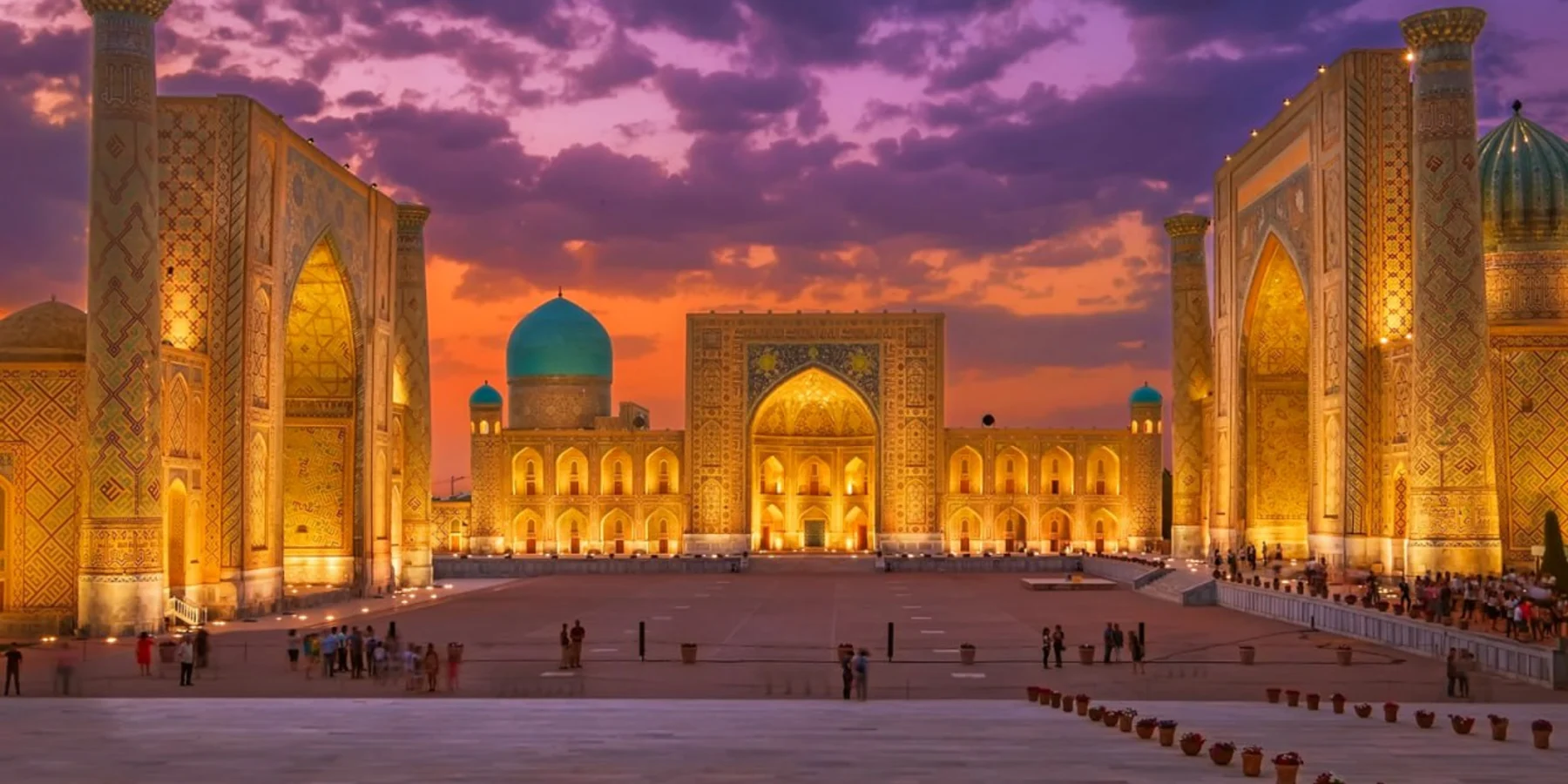
Timur's capital plays exactly the role its reputation promises
Samarkand is more than 2,750 years old, but the city visitors come to see is overwhelmingly the one Amir Timur and his Timurid successors built between the late 1300s and the mid-1400s: turquoise-tiled madrasas, ribbed azure domes, and calligraphic tilework of a precision that photographs undersell. It is genuinely one of the great architectural sights on earth, and unlike some famous monuments, it does not disappoint on arrival.
What changed in the last decade is access. Restoration and tourism investment have accelerated fast since 2016, capped by the 2022 opening of the Silk Road Samarkand resort complex on the city's edge, and by the Afrosiyob high-speed train that now makes Samarkand a comfortable half-day trip from Tashkent rather than an overland ordeal. The Registan itself still belongs to everyone: locals picnic in the square at dusk, and the crowds, while real at midday in peak season, thin out fast in early morning and evening light.
The honest complications
Midday sun on the Registan's stone paving in June through August is genuinely punishing, and the site gets its heaviest tour-bus crowds between about 10am and 4pm. Some restoration work, especially the newer sections of Bibi-Khanym Mosque, is more reconstruction than preservation and draws fair criticism from architectural historians for looking a little too new in places. English drops off noticeably once you're a few streets back from the tourist core, and unofficial "guides" occasionally approach visitors near the main sights offering tours at inflated prices, easy enough to decline politely and walk on.
A compact old city, and a resort complex on the edge
Samarkand doesn't divide into neighbourhoods the way a larger city does; it divides into the historic core around the Registan, the newer boulevards to its south and east, and the Silk Road Samarkand resort development further out. Where you base yourself comes down to whether you want to walk to the monuments or drive to them.
Around the Registan
The streets immediately around Registan Square hold the highest concentration of guesthouses, boutique hotels and tourist restaurants, and put the Registan, Gur-e-Amir and Bibi-Khanym Mosque all within a 15 to 20 minute walk of each other. This is the right base for a first visit.
University Boulevard & the new city
South and east of the old city, University Boulevard and the surrounding streets are where more of the city's actual daily life happens: government buildings, the university, and restaurants that skew local rather than tourist-priced. A 10 to 15 minute taxi from the Registan.
Siab Bazaar district
Samarkand's largest bazaar sits in the shadow of Bibi-Khanym Mosque's blue domes, a working market for produce, bread and spices as much as a tourist stop. Best visited in the morning when the stalls are fullest and the light through the entrance gates is best for photos.
Silk Road Samarkand resort
An eight-hotel, 260-hectare tourism complex on the city's outskirts, built around an "Eternal City" ethno-park of working artisan shops and a two-kilometre rowing channel. The trade-off for resort comfort is distance: expect a 15 to 20 minute taxi to the Registan rather than a walk.
From a resort complex to a family guesthouse two streets from the Registan
Samarkand's accommodation has expanded fast since the 2016 reforms, from a handful of Soviet-era hotels to a genuine range spanning international resort brands to family-run B&Bs in converted courtyard houses. These picks cover the main budgets and the two very different bases, old city versus resort complex, on offer.
At the top end, the Samarkand Regency Amir Temur and Silk Road by Minyoun, both five-star properties inside the Silk Road Samarkand resort complex, offer full resort amenities, multiple restaurants and the ethno-park on site, from around $150 a night; the four-star Savitsky Plaza and Stars of Ulugbek in the same complex bring the price down to roughly $90-130 while keeping the resort setting.
Closer to the old city, Emirkhan Hotel (from around $70) is a boutique property with vintage-styled interiors a short walk from Registan Square, a good middle option for travellers who want character and location over resort scale. At the budget end, Jahongir B&B (from around $52), five minutes on foot from the Registan, has been a long-running favourite for its home-cooked breakfast and family hospitality, and is the pick for travellers who'd rather put the savings toward the Afrosiyob's business class than a fancier room.
Plov, Samarkand non, and the country's best bread
Samarkand's food scene sits somewhere between a national showcase and a genuinely good regional cuisine in its own right: Samarkand plov and Samarkand non (bread) are both considered the country's benchmarks by Uzbeks from other regions, a point of local pride that shows up on menus everywhere in the old city.
Plov
Rice slow-cooked in a wide kazan with lamb, carrots and cumin, topped here with chickpeas and sometimes horse sausage or quail egg depending on the cook. Restaurant Samarkand on Registon Street is the most famous address for it, serving the dish from a massive communal kazan through the morning until it sells out.
Manti & lagman
Steamed lamb dumplings and hand-pulled noodle soup, both Samarkand staples with a lighter hand than some other regions. Karimbek on Gagarin Street is known specifically for its manti, made and steamed to order rather than held on a steam tray.
Shurpa
A hearty lamb and vegetable soup, closer to a stew, that Uzbeks treat as a different meal category from plov rather than a starter. Platan on University Boulevard, a longstanding local favourite with a garden terrace, does a well-regarded version alongside a broader Uzbek and international menu.
Samsa
Tandoor-baked pastries filled with spiced lamb and onion, sold hot from bakery counters across the city. Shirin Cafe on Afrosiab Street is a reliable sit-down option; the stalls inside Siab Bazaar sell them straight from the oven for less.
Six sights that justify the whole trip on their own
Samarkand's major sights are concentrated enough to cover on foot over two unhurried days, but each one rewards more time than a rushed group tour gives it. This chapter walks through them roughly in the order a good two days would.
Registan Square
Three madrasas, Ulugh Beg (built 1417-1420 by the astronomer-ruler himself), Sher-Dor ("Lion-Bearing," 1619-1636, with its unusual tiger-and-sun tympanum figures) and Tilya-Kori ("Gold-Covered," 1646-1660, whose interior mosque ceiling is genuinely gilded), face each other across one square built up over two centuries rather than one. Visit at opening for the fewest crowds and the softest light, or return after sunset when the square is illuminated and locals reclaim it for evening walks. Entry runs roughly $6-8, and climbing the Ulugh Beg minaret's interior (a separate small ticket) is worth it for the rooftop view across the square.
Gur-e-Amir Mausoleum
Amir Timur's tomb, along with those of his sons and grandson Ulugbek, under a ribbed turquoise dome and a gold-leafed interior that set the template for later Mughal tombs, including, several architectural historians argue, the Taj Mahal itself. A 10-minute walk from the Registan.
Bibi-Khanym Mosque & Siab Bazaar
Once one of the largest mosques in the Islamic world, commissioned by Timur after his India campaign and now partially reconstructed, with a scale that's still striking even in its restored state. Directly behind it, Siab Bazaar sells produce, dried fruit, spices and Samarkand's famous non bread under its blue-tiled gates; go in the morning for the fullest stalls.
Shah-i-Zinda necropolis
A street of mausoleums climbing a hillside, built up over centuries and covered almost entirely in blue and turquoise tilework, widely considered Samarkand's most photogenic single site precisely because it's a corridor rather than a square: every few steps reveals a new facade. Best in the soft light of early morning or late afternoon.
Ulugbek Observatory
The remains of the astronomer-ruler Ulugbek's 1420s observatory, including the underground arc of his giant sextant, once used to catalogue over a thousand stars with a precision not exceeded in Europe for over a century. A small museum on site explains the astronomy in more depth than the ruins alone convey.
One, two or three days, planned around the light
Two full days covers Samarkand properly; a well-planned single day hits the essentials. These routes front-load the Registan at opening and dusk, when it's at its best, and leave the heat of midday for indoor or shaded stops.
- Morning
The Registan at opening. Fewest crowds, softest light, then the short walk to Gur-e-Amir.
- Midday
Plov at Restaurant Samarkand, then Bibi-Khanym Mosque and Siab Bazaar behind it.
- Afternoon
Shah-i-Zinda necropolis, a taxi or 25-minute walk from the bazaar.
- Evening
Back to the Registan after dark for the illuminated facades and the square at its most local.
- Day 1
The one-day route: Registan, Gur-e-Amir, Bibi-Khanym, Siab Bazaar, Shah-i-Zinda, Registan at night.
- Day 2 morning
Ulugbek Observatory, then manti at Karimbek on Gagarin Street.
- Day 2 afternoon
University Boulevard for a slower look at the newer city, shurpa at Platan.
- Day 2 evening
Free evening, a last walk around the Registan or dinner at your hotel.
- Days 1-2
The two-day route above, at a gentler pace with time built in for the Ulugh Beg minaret climb.
- Day 3
Shakhrisabz. A 1.5 to 2 hour drive to Timur's birthplace, the ruined Ak-Saray Palace gate, and the Dorut Tilavat complex, back to Samarkand by evening.
An easy half-day train from Tashkent, easy to walk once you're here
The Afrosiyob high-speed train from Tashkent is the standard way in: about 2 hours 8 minutes at up to 230 km/h, with economy tickets around $15-20 and business around $25-33. Book online as early as tickets release, 45 days ahead, since peak-season dates sell out within hours. Samarkand International Airport (SKD) also has a small but growing number of direct international routes for travellers skipping Tashkent entirely.
Inside the city, the old-city sights cluster closely enough to walk between, roughly 15 to 20 minutes between the Registan and either Gur-e-Amir or Bibi-Khanym Mosque. For Shah-i-Zinda, the Ulugbek Observatory, or a hotel out at the Silk Road Samarkand resort complex, Yandex Go (the regional ride-hailing app) is cheap and reliable, typically $1-3 for most trips within the city.
Best time to visit and avoiding the midday heat
Samarkand has a continental climate: March to May and September to November bring warm days and cool evenings, the best conditions for walking the old city. June through August regularly clear 35-40°C, which makes anything past mid-morning genuinely uncomfortable for sightseeing; plan monument visits for early morning or the last two hours before sunset and rest indoors through the hottest stretch. Winter is cold but quiet, with the lowest prices and the monuments largely to yourself.
One of Asia's best-value historic cities
Samarkand is affordable even by regional standards. Budget travellers do well on guesthouses and bazaar food; the main cost to plan for deliberately is the Silk Road Samarkand resort complex, which sits in a different price bracket from everything else in the city.
- Guesthouse near the Registan $25-40
- Plov, samsa and bazaar meals $5-10
- Walking plus the occasional taxi $2-5
- Most monument entries under $8
- Boutique hotel or 4-star resort $70-130
- Restaurant meals $10-20/person
- Private driver for Shakhrisabz
- A licensed local guide for a day
- 5-star Silk Road Samarkand resort
- Private guided touring throughout
- Afrosiyob business or VIP class
- Fine dining and premium tastings
One of Central Asia's safest cities, with two things to know
Samarkand rates 8.5/10 on our safety scale. Violent crime against tourists is extremely rare, the old city is safe to walk at night, and tourism police stationed around the Registan and other major sites are quick to help with directions or problems. Samarkand is also solid for solo female travellers: harassment is uncommon in the tourist core, and modest dress away from international hotels goes a long way toward blending in.
The two things that actually catch visitors: unofficial "guides" who approach near the Registan and Gur-e-Amir offering tours at inflated, undiscussed prices, easy to decline with a polite "no thank you" and keep walking; and bazaar overcharging at Siab Bazaar, where a light, good-natured haggle over non-fixed-price items is normal and expected rather than confrontational. Emergency number is 112 from any phone, and the Unified Safe Tourism Call Center, aimed specifically at visitors, is 1173 within Uzbekistan.
Shakhrisabz alone justifies a third day
Samarkand's position at the center of the Silk Road corridor makes it a natural base for one more day beyond the city itself, or a launch point for onward travel to Bukhara.
Shakhrisabz
Amir Timur was born here, and the town's monuments, though smaller in number than Samarkand's, hold their own: the towering ruined gate of the Ak-Saray Palace, once one of the largest structures in Central Asia; the Dorut Tilavat religious complex; and Timur's own intended (but ultimately unused) mausoleum, the Dorus Saodat. A UNESCO World Heritage town in its own right, and quiet enough that a day trip rarely feels crowded.
Bukhara
Technically reachable in a very long day via the Afrosiyob, Bukhara rewards an overnight stay far more than a rushed return trip. Most itineraries treat it as the next stop after Samarkand rather than a day trip from it; see our Uzbekistan country guide for the full multi-city itinerary.
Samarkand FAQ
Is Samarkand safe for tourists?
Yes, Samarkand is one of the safest cities in Central Asia for visitors. Violent crime against tourists is extremely rare; the main concerns are bazaar overcharging and traffic. Standard city awareness is all you need.
How many days do I need in Samarkand?
Two full days covers the essentials well: one for the Registan, Gur-e-Amir and Bibi-Khanym Mosque, one for Shah-i-Zinda, the Ulugbek Observatory and Siab Bazaar. A third day fits the Shakhrisabz day trip and is worth adding.
How much does Samarkand cost per day?
Budget travellers manage on $35-45 a day with guesthouses and bazaar meals; mid-range runs $75-130. Samarkand is noticeably cheaper than most Western or even Southeast Asian city breaks.
When is the best time to visit Samarkand?
March-May and September-November: warm days, cool evenings, manageable crowds. July and August regularly clear 38-40°C and make midday sightseeing genuinely difficult.
How do I get from Tashkent to Samarkand?
The Afrosiyob high-speed train covers it in about 2 hours 8 minutes for roughly $15-33 depending on class. It's faster, more comfortable and cheaper than a private transfer, and tickets should be booked online as early as they release, 45 days ahead.
What is the best area to stay in Samarkand?
Within walking distance of the Registan for first-timers: it puts every major sight in reach on foot. The Silk Road Samarkand resort complex on the edge of the city is the pick for travellers who want a resort experience over old-city atmosphere.
Do I need to speak Uzbek in Samarkand?
No. Russian is widely understood and English is increasingly spoken in hotels, restaurants and at the main sights. A few Uzbek words, rahmat (thank you), go a long way with older residents and at the bazaar.
Is Samarkand walkable?
Yes. The Registan, Gur-e-Amir, Bibi-Khanym Mosque and Siab Bazaar all sit within about a 20-minute walk of each other. Shah-i-Zinda and the Ulugbek Observatory are a short taxi or long walk further out.
What is Samarkand famous for?
The Registan, three Timurid-era madrasas covered in turquoise and cobalt tilework facing each other across one square, widely considered the single most spectacular sight on the historic Silk Road.
What Stays With You
Samarkand does not need to work for the reaction it gets. The Registan at dusk, the call to prayer drifting across Shah-i-Zinda's blue corridor of tombs, the first bite of non bread still warm from a Siab Bazaar tandoor: none of it needed six hundred years of hype to earn its reputation, and none of it feels diminished by finally seeing it in person. That's rare enough in travel to be worth naming.
Go back to the Registan one last time after dark before you leave, when the tour groups are gone and it belongs to the city again, and understand why Timur chose this square to be remembered by.