
Uzbekistan Travel Scams
A man near the Registan gate offers a photography permit for 100,000 som. No such permit exists. A taxi driver at Tashkent airport names a price, then doubles it at your destination claiming it was per person. A money changer counts out your bundle of som so fast you can't follow the math. Uzbekistan is one of the safest countries in Central Asia and one of the most beautiful on earth. Its tourist traps are specific, economic, and entirely avoidable. This page names every one.
Uzbekistan Scam Overview 2026
Uzbekistan is the jewel of the Silk Road. The Registan in Samarkand is one of the most architecturally extraordinary squares in the world. Bukhara's old city is a living museum of Islamic architecture spanning more than a thousand years. Khiva's walled inner city, Ichan-Kala, is one of Central Asia's most perfectly preserved medieval urban environments. Tashkent has the finest metro system in Central Asia and a food scene that increasingly draws visitors in its own right. Tourism grew 16% in 2025, and the trajectory is upward.
The scam environment has developed in proportion to tourism growth. The most commonly reported issues cluster around three patterns: taxis that overcharge tourists who don't know local rates; currency exchange that exploits the large denomination of the som; and unofficial individuals near historic monuments who sell services that either don't exist (fake photography permits) or are available for far less from official channels (guide overcharging). None involve violence. All are avoidable.
One Uzbekistan-specific context worth understanding upfront: the registration system. Uzbekistan requires all foreign visitors to register their accommodation within 72 hours of arrival. Hotels do this automatically. The confusion this creates is exploited by fake officials who claim tourists owe fines for registration violations. The registration section in this guide explains exactly how the system works and what a genuine enforcement situation looks like versus a scam.
Uzbekistan has strong law enforcement visibility in tourist areas. Tourist police patrol Tashkent, Samarkand, Bukhara, and Khiva with multilingual staff. Violent crime against tourists is exceptionally rare.
Taxi overcharging, currency exchange fraud, and fake permit sellers near monuments are the primary economic risks. Medium frequency but low financial impact compared to global average. Entirely avoidable with standard knowledge.
Concentrated in Chorsu Bazaar in Tashkent, major bazaars in Samarkand and Bukhara, and at busy train stations. Below European average. Standard awareness is sufficient.
Corruption in the business sector exists but rarely touches tourists. Fake officials exploiting registration confusion and border zone issues are the main tourist-relevant expressions of this pattern.
Uzbekistan Safety at a Glance
Tashkent Scams
Tashkent is Central Asia's largest city and the gateway for most international arrivals to Uzbekistan. Its combination of Soviet-era boulevards, magnificent Islamic monuments around the Khast Imam complex, and an increasingly modern food and art scene makes it more than a transit stop. The scam concentration is highest around the airport, Chorsu Bazaar, and the Broadway pedestrian street area. Tourist police patrol major sights and response times average 15-20 minutes in urban areas.
🚗 Tashkent Airport Taxi Overcharging
Unofficial taxi drivers swarm the arrivals hall at Tashkent's airport and quote prices 3 to 5 times the local rate for the journey into the city. A ride that costs 40,000-70,000 UZS (USD 3-5) on Yandex Go is quoted at 200,000-400,000 UZS verbally. Some drivers agree a price and then claim at the destination it was "per person" rather than for the whole vehicle. Others take significantly longer routes or claim traffic requires an alternative route that adds time and fare. A documented variant at Tashkent involves individuals posing as Yandex drivers near metro stations who charge 100,000 UZS for trips a real Yandex ride would do for 20,000 UZS.
Download Yandex Go before your flight and use it from the airport. It shows the price before you book, tracks the route, and shows the driver's photo and rating. Uber does not operate in Uzbekistan. If you cannot use Yandex Go on arrival, go to the official airport taxi desk inside the terminal, which has posted fixed rates. Do not accept any approach from drivers inside the terminal building. When using any taxi, explicitly confirm: "Is this the total price for the whole vehicle, not per person?" before entering.
💰 Chorsu Bazaar Currency and Market Overcharging
Chorsu Bazaar is one of Central Asia's great markets, a genuine working bazaar with spectacular architecture and remarkable produce. It is also where the highest concentration of tourist-facing scams in Tashkent occur. Informal money changers operate near the bazaar and along Broadway (the pedestrian street nearby), offering to exchange USD for som at rates that appear marginally better than banks. In practice, they short-count the bundle during the handover or switch notes. The large denomination of the som makes this easy: handing over a bundle of 1,290,000 UZS (for USD 100) is physically difficult to count quickly and distractions during counting are a standard technique.
Restaurant overcharging near Khast Imam: vendors around the Khast Imam mosque complex charge tourists 2-3 times the normal price for food and drinks and have been documented swapping the menu between ordering and billing, presenting a different (more expensive) menu when the bill arrives.
Never exchange money with individuals at Chorsu Bazaar or on Broadway. Use ATMs (Kapital Bank and Ipak Yoli Bank ATMs accept international cards reliably in Tashkent) or official bank exchange desks. Since Uzbekistan liberalized its currency in 2017, bank rates and informal rates are nearly identical, so there is no financial benefit to informal exchange, only risk. At restaurants near Khast Imam, ask to see the current menu before ordering and check that the bill matches what was shown. If there is a discrepancy, politely request the original menu.
👴 Fake Registration Officials
Uzbekistan's registration system (a Soviet-era requirement that foreigners register their accommodation with authorities within 72 hours) creates confusion that scammers exploit. Individuals posing as police or officials approach tourists and claim their registration is incomplete or invalid, demanding an on-the-spot fine paid directly in cash. The registration system is genuine: hotels handle it automatically, and genuine police can ask to see your registration slips. The scam is the demand for immediate cash payment from an unofficial individual, which is not how genuine enforcement works.
Genuine registration enforcement by police: the officer checks your hotel registration slips and, if there is a genuine issue, processes it formally through official channels. Fines are not paid in cash to an individual on the street.
Stay at registered hotels and keep all your hotel-issued registration slips in your bag for the entire trip. If approached by someone claiming to be an official, ask to see their credentials and badge number. Say clearly that you want to go to the nearest police station to address the matter formally. Genuine police will cooperate. Scammers generally back down at this point. Do not pay any "fine" in cash to an individual on the street. Registered accommodation handles registration automatically, so this issue simply does not arise if you stay at recognized hotels, hostels, or guesthouses.
🎅 Tashkent Bar and Nightlife Overcharging
Some bars and entertainment venues in Tashkent's nightlife area operate a "bar trap" pattern: a local person (sometimes an attractive woman or friendly man) approaches a tourist in a public space, befriends them, and steers them to a specific bar. At the bar, drinks and food are charged at inflated prices or the bill includes items that were never ordered. When the tourist refuses or is unable to pay, pressure or intimidation follows. The amounts involved are rarely large by Western standards but the confrontation is unpleasant.
Choose your own bar rather than following someone you met in the street to their "recommendation." Check that a menu with prices in som is available before ordering. Ask for an itemized bill at the end and compare it against what was ordered. Tashkent has a genuinely good bar and restaurant scene: recommendations from your hotel or from local travel communities will point you toward honest establishments. The risk is almost exclusively at venues where you were led by a stranger.
Samarkand Scams
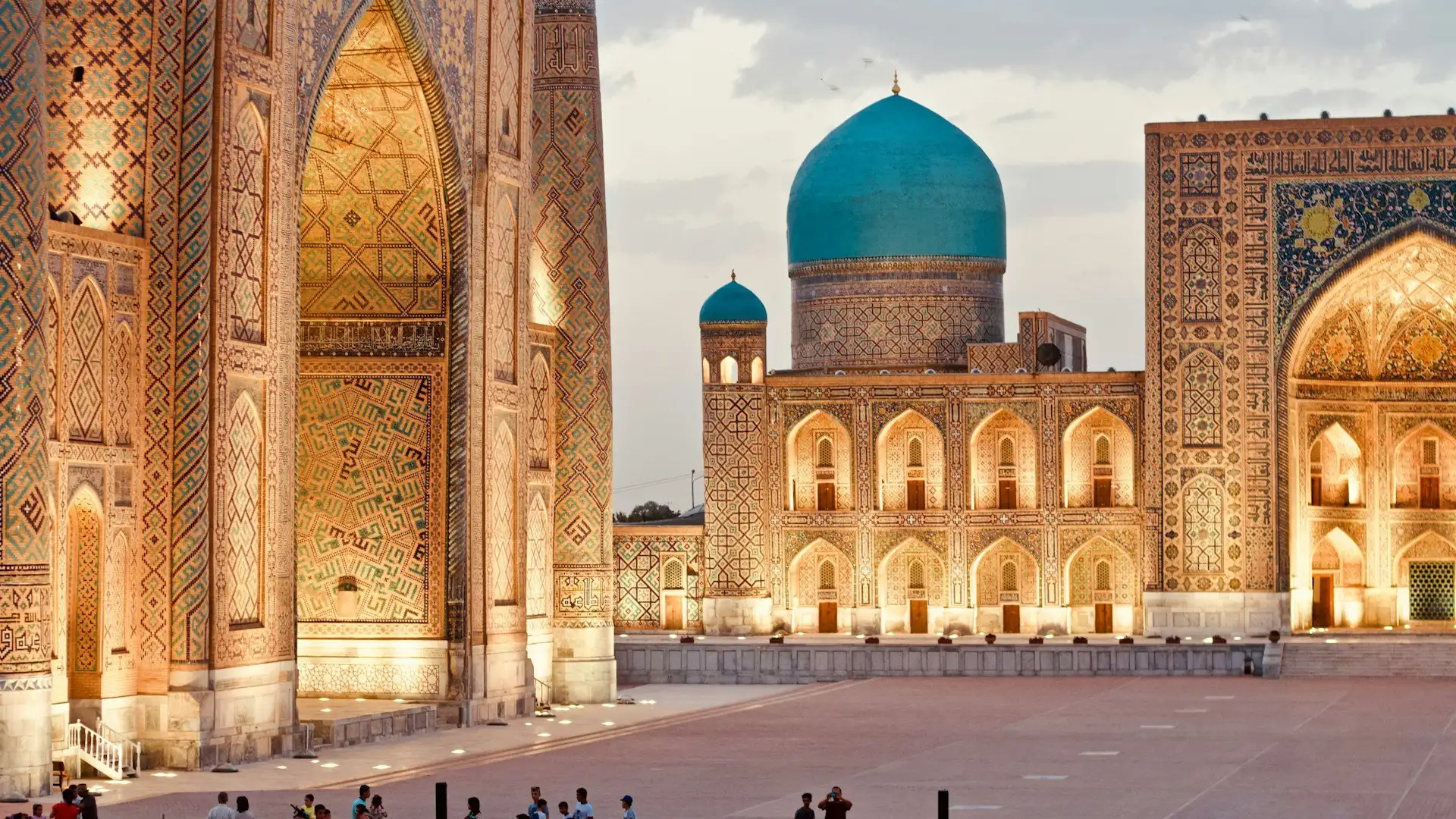
Samarkand receives more international tourists than any other Uzbek city and has developed the most sophisticated tourist-trap ecosystem as a result. The Registan, Shah-i-Zinda necropolis, Gur-e-Amir mausoleum, and Bibi-Khanym mosque are among the finest Islamic monuments in the world and they attract the concentration of unofficial operators that follows serious heritage tourism everywhere. The Registan square is the center of gravity for most of Samarkand's scam activity.
📷 Fake Registan Photography Permits
Individuals position themselves near the Registan ticket gates and approach tourists who are carrying cameras or camera bags. They claim to be official representatives of the tourism authority or the monument and offer to sell a "photography permit" required to take photos inside the complex. The permits they sell look official and are priced at 50,000-200,000 UZS. No such separate photography permit is required. Standard photography inside the Registan complex is included in the entry ticket. The scammers know that tourists are anxious not to violate rules at an important UNESCO site and exploit this anxiety specifically.
There is a legitimate exception: tripods and professional video equipment (broadcast cameras, drones, large rigs) do require a separate permit. This permit is obtained at the official ticket office inside the complex, not from individuals outside. A tourist photographing with a DSLR, mirrorless camera, or smartphone needs no permit beyond their entry ticket.
Buy your Registan entry ticket only at the official ticket kiosk and confirm the total price you've paid includes photography. Do not pay anything to anyone outside the official kiosk. If someone approaches claiming you need an additional permit, say "I was told photography is included in the entry ticket" and walk on. If you're uncertain, go to the official ticket office inside the complex and ask the staff directly. They will confirm photography with personal equipment is included.
👁 Unofficial Guide Overcharging
Unlicensed guides approach tourists near monument entrances offering tours at an upfront price of "free" or a small nominal amount, then demand 200,000-500,000 UZS at the end of the tour, claiming this was the agreed price or that the service was so exceptional it deserved more. A related variant: guides approach with an apparently low quoted price and add extras during the tour ("I'll also show you the hidden courtyard, only 50,000 extra") that accumulate to a large final bill. Some provide genuinely poor information including fabricated historical "facts" and stories designed to seem impressive.
Licensed guides in Samarkand charge a regulated rate of approximately 50,000-80,000 UZS per hour and carry Ministry of Tourism-issued badge. A 2-hour Registan tour from a licensed guide should cost 100,000-160,000 UZS total. Any quote significantly below this is either an unofficial guide setting up a future demand or a very short tour.
Book guides through your hotel, through the official Samarkand tourism office (on Registan Square), or through licensed platforms like TourFixer. Look for guides with a Ministry of Tourism badge (small metal badge worn on the chest). Agree the total price, duration, and exactly which sites are included in writing (WhatsApp message is sufficient) before starting. Never accept a guide who offers a "free" tour. The sites are excellent without a guide; official signage and audio guides are available at the ticket offices.
🏊 Shah-i-Zinda and Bibi-Khanym Dress Code Enforcement Scam
Both Shah-i-Zinda necropolis and the Bibi-Khanym Mosque require modest dress (covered shoulders and knees for women, generally respectful dress for men). Headscarves are recommended but not enforced at these sites for tourists. Unofficial individuals position themselves at or near the entrance and offer to "rent" scarves or wraps to tourists who they claim are improperly dressed, even when the tourist's clothing is entirely appropriate. The rental fee is quoted at 20,000-50,000 UZS for something worth a few thousand. Official scarf rental, where it exists, is arranged at the legitimate entrance kiosk at a very small fee.
Bring your own lightweight scarf or shawl and wear or carry covered-knee clothing to all mosque and mausoleum sites. This eliminates the rental opportunity entirely. If someone approaches you about dress code away from the official entrance, they are not an official of the site. Official dress code guidance is provided at the entrance gate only.
🔣 Currency Exchange Manipulation
Informal money changers in Samarkand use the same tactics as in Tashkent but the environment around tourist monuments creates more opportunities. A documented variant specific to Samarkand involves an exchanger agreeing a rate, then providing only 1,100,000 UZS for USD 100 instead of the correct approximate 1,290,000 UZS, exploiting tourists' unfamiliarity with large denomination som bundles. The counting is done quickly and with distractions (a companion chatting, a dramatic display of counting) while the short-count happens in the middle of the bundle where it is hardest to spot. A second documented variant: the exchanger shows the rate as favorable but then produces a calculator with the decimals positioned to make a worse rate look like a better one.
See the full currency section below for complete guidance. The essential point: exchange only at banks or official hotel exchange desks. Bank rates since 2017 are essentially market rates. There is no benefit to informal exchange and the risk is documented and real. Count your som immediately in front of the exchanger before putting it away.
💰 Handicraft Price Pressure Near the Registan
Vendors around Registan sell silk textiles, miniature mosques, blue ceramics, suzani embroideries, and decorative items at prices 3-5 times what the same items cost at Siyob Bazaar (Samarkand's main local market) or at workshops further from the monument. Some vendors physically block exit paths or follow tourists persistently after a piece of eye contact. Others use guilt tactics ("I made this myself, I have children") to pressure purchases. The items are not fake in most cases, just priced for the captive tourist audience at the most visited site in Uzbekistan.
For genuine Uzbek handicrafts at honest prices: visit Siyob Bazaar, the artisan workshops on the streets around Khoja Akhrar Vali, and the ceramic workshops in the Konigil district. The silk workshops at Margilan (reachable by taxi from Samarkand) sell directly from the source at the best prices. A first-quote price of 150,000 UZS for a ceramic piece that costs 30,000 UZS at Siyob should tell you everything about the monument-adjacent markup. Walking away is the most effective counter to persistent pressure.
Bukhara Scams
Bukhara is often described as the most relaxed of Uzbekistan's three main Silk Road cities. The old city is compact, walkable, and genuinely beautiful at every time of day. Lyabi-Hauz, the historic pool surrounded by mulberry trees and outdoor restaurants, is one of Central Asia's most pleasant public squares. Bukhara has 8 documented tourist scam types in regional databases, fewer than Samarkand but with specific patterns worth knowing.
🚗 Bukhara Train Station Taxi Overcharging
Bukhara's main train station is at Kagan, about 12km from the old city. Unofficial taxi drivers at the station approach arriving passengers and quote fares of 100,000-200,000 UZS for the journey to central Bukhara. The Yandex Go price for the same journey is approximately 25,000-40,000 UZS. The gap is significant and arrives at the start of every visitor's Bukhara experience. Within the old city, shared taxis to outlying areas (the Bakhauddin Naqshband complex 12km outside town, for example) are similarly overpriced by drivers who know tourists unfamiliar with local rates will be reluctant to negotiate.
Yandex Go operates in Bukhara and covers the Kagan station-to-city route. Book it from the platform while the train arrives and walk past the drivers to your pre-confirmed vehicle. Alternatively, your hotel can arrange a transfer with a confirmed price in advance. For day trips outside Bukhara to the Naqshband shrine or other outlying sites, ask your hotel what a reasonable round-trip price is before negotiating with any driver.
🍽 Lyabi-Hauz Restaurant Overcharging
The restaurants around Lyabi-Hauz are Bukhara's most atmospheric and most tourist-priced. The gap between what foreigners pay and what locals pay for similar food is consistently reported. More specifically: some restaurants around the square charge for bread and small appetizers (non, pickle plates, fresh herbs) that are brought automatically to the table without being ordered. These charges appear on the bill as separate items. A full non (flatbread) costs 1,500-3,000 UZS at a local bakery; it sometimes appears on tourist restaurant bills as 8,000-15,000 UZS, three or four times appearing on a table of four.
Check that menu prices are posted and visible before sitting at any Lyabi-Hauz restaurant. When bread or appetizers arrive without being ordered, ask immediately: "Is this charged?" If yes and you don't want to pay for it, decline it. The view from Lyabi-Hauz is worth a premium; just know what the premium is before you commit to it. Restaurants one or two streets away from the square, toward the Kalon Minaret area, are consistently better value for identical quality of plov, shashlik, and lagman.
🧡 Silk and Suzani Quality Misrepresentation
Bukhara's historic trading domes (Toqi Sarrofon, Toqi Telpakfurushon, Toqi Zargaron) have been selling textiles since the 16th century and the tradition continues. The quality issue: suzani embroideries and silk items sold as "hand-embroidered" or "pure silk" are sometimes machine-made or synthetic. Hand-embroidered suzani takes months to produce and costs substantially more than machine copies. Sellers in tourist-facing dome shops do not always distinguish clearly between the two. Pure silk burns with a protein smell and self-extinguishes; synthetics burn with an acrid plastic smell and melt.
For genuine hand-embroidered suzani, visit the women's workshops on Hakikat Street and other streets in the old residential quarter where you can watch artisans working. The provenance is visible. For silk: ask the seller directly whether the item is pure silk or mixed with synthetic, and ask to see the flame test (they will know what you mean). Reputable Bukhara textile dealers welcome the question. For carpets: the Bukhara State Carpet Museum is an excellent reference point before shopping to calibrate what genuine Bukhara carpets look like.
Khiva Scams
Khiva's Ichan-Kala (walled inner city) is one of Uzbekistan's most extraordinary places and one of its safest. The inner city is essentially a living museum enclosed by medieval walls, with a population of just a few thousand people within. Crime here is minimal even by Uzbekistan's already low standards. The scams that occur are mild and follow the same patterns as Samarkand: taxi overcharging at Urgench Airport (the nearest airport, 35km away) and unofficial guide overcharging near the main monuments. Khiva does not have the same density of tourist-facing scams as Samarkand.
✈️ Urgench Airport Taxi Overcharging to Khiva
Urgench airport serves Khiva and is 35km from the Ichan-Kala. Unofficial drivers at arrivals quote 200,000-400,000 UZS for the taxi journey. The fair price on Yandex Go (which now operates in Urgench and Khiva) is approximately 60,000-100,000 UZS for the same trip. Many visitors to Khiva also arrive by overnight train from Tashkent to Urgench station, where the same taxi overcharging pattern applies from the station.
Yandex Go now operates in Urgench and Khiva as of 2025. Book from the arrivals hall before exiting. Pre-arrange a hotel transfer if you prefer not to use the app. For the overnight train from Tashkent to Urgench, confirm the transfer with your Khiva accommodation before departure so a trusted driver is waiting when you arrive.
💸 Ichan-Kala Multiple Entry Ticket Confusion
Khiva's Ichan-Kala operates a combined entry system: a single ticket covers entry to the walled city and access to most of the included monuments. The ticket is sold at the main gates and is the only entry payment required for standard tourist access. Some visitors are told by individuals at secondary monument entrances within the complex that additional separate tickets are required for specific madrasas or towers that are in fact included in the combined ticket. This causes confusion particularly at the Juma Mosque, the Islom-Hoja Minaret, and the Pahlavon Mahmoud Mausoleum.
Buy your Khiva combined ticket at the official gate and keep it with you. Before paying anything at any secondary monument entrance within the complex, ask: "Is this included in the combined Ichan-Kala ticket?" Most monuments are included. A small number have a separate entry fee (the Kalta Minor exterior photography spot used to; the rules change periodically). Your hotel can tell you the current included and excluded list before you enter.
Currency Scams & What Things Cost
The Uzbekistani som (UZS) has a denomination structure that is genuinely unusual for visitors from countries with lower-denomination currencies. USD 1 is approximately 12,900 UZS as of 2026, meaning USD 100 produces a thick bundle of notes worth 1,290,000 UZS. The notes come in denominations of 100,000, 50,000, 10,000, and smaller. Counting a large exchange quickly is difficult and this is the specific vulnerability that currency exchange scams in Uzbekistan target. The good news is that since the currency was liberalized in September 2017, official exchange rates and informal rates are nearly identical, so there is absolutely no reason to use informal changers: the risk is real and the benefit is zero.
🔣 Informal Money Changer Short-Counting
The standard technique: the exchanger counts out your som bundle rapidly while maintaining eye contact and conversation. The bundle contains less than the agreed amount, either by miscounting or by palming notes during the display. Because the individual notes are 100,000 UZS each and a USD 100 exchange produces 13 of these plus smaller denomination notes, missing one or two notes in a fast count represents a significant theft. A second technique: using a calculator to show the exchange rate but positioning the decimal point to make a worse rate look better. USD 100 at 12.9 (actually 12,900 per dollar) versus 129 (which would be 129 per dollar) reads very differently on a calculator screen.
Exchange only at banks (Kapital Bank, Ipak Yoli Bank, and Asaka Bank are the most reliable for international visitors with transparent rates) or at hotel exchange desks. ATMs dispense UZS directly in Tashkent, Samarkand, and Bukhara: Kapital Bank and IPAK YOLI ATMs accept Visa and Mastercard reliably. If you must exchange cash, do so at a bank window where the transaction is documented. If you ever use an informal exchanger despite this advice: count every note yourself before handing over your foreign currency, in a calm and unhurried way, and do not let the exchanger rush you.
📄 Counterfeit Note Claims
A vendor in a bazaar or small shop accepts your UZS note and then claims it is counterfeit, refusing to return it and asking you to pay again with a different note. In some cases the vendor pockets the original genuine note and returns a actually counterfeit note, then claims that one is also fake when you present it. This exploits visitors' unfamiliarity with how genuine UZS notes look and feel. A variant: vendors claim a genuine note is "old series" and no longer valid, which may not be true.
Withdraw UZS from bank ATMs, which dispense genuine notes. If a vendor claims your ATM-withdrawn note is counterfeit, ask them to show you the specific issue and compare against other notes in your possession. Genuine Uzbek som notes have visible security features: a metallic security thread, UV-reactive elements, and a specific texture. If a dispute occurs, walk away and use a different vendor rather than escalating: the amounts involved are rarely significant.
What Things Actually Cost in Uzbekistan 2026
Use a Wise card or Revolut at Kapital Bank or IPAK YOLI ATMs in Tashkent, Samarkand, and Bukhara for real mid-market rate UZS withdrawals. Both send instant transaction notifications so you catch any unauthorized charge immediately. Withdraw enough UZS in major cities to cover your stay in smaller towns and outer areas where ATM coverage is limited.
Transport Scams & The Registration System
🚎 Unofficial Afrosiyob Train Ticket Agents
The Afrosiyob high-speed train connecting Tashkent, Samarkand, and Bukhara is genuinely excellent: comfortable, reliable, and the best way to travel between these cities. Tickets sometimes sell out in advance, especially in peak season (April-May, September-October). Unofficial "ticket agents" outside stations and near tourist accommodation offer to obtain tickets for you at a "small premium," claiming the official booking system is complicated or that their service saves you the queue. The premium is rarely small. Some agents provide genuine tickets at 200-300% of face value. Others provide counterfeit tickets that are not accepted at the platform.
Book Afrosiyob tickets directly on the official railway.uz website (available in English) or at station ticket windows. If the specific train you want is sold out, the website shows all available trains on that route. Book at least 2-3 weeks ahead for travel in April-May and September-October. Your hotel or a licensed tour operator can also book official tickets on your behalf with no markup beyond a small service fee that they should state upfront.
📄 The Registration System: What's Real, What's a Scam
Uzbekistan requires all foreign visitors to register their place of stay with authorities within 72 hours of arrival. Hotels, hostels, and registered guesthouses do this automatically when you check in and give you a small slip of paper as confirmation. Keep all these slips throughout your trip. On a train night, the train ticket serves as registration for that night. Day trips without overnight stays do not require separate registration. Genuine police officers may ask to see your slips, though this is rare for tourists in practice.
The scam: individuals posing as police or migration officials approach tourists, claim their registration is incomplete or their slips are insufficient, and demand an immediate on-the-spot cash fine. Genuine fines are processed formally and officially, never as cash-to-an-individual on the street.
Stay at registered accommodation throughout your trip. Collect and keep all hotel registration slips in a safe pocket or envelope. If stopped by someone claiming to be an official, ask for their badge number and identification, and state you would like to address any issues at the nearest police station. Do not pay cash to any individual on the street for any registration-related demand. The system itself is manageable: tourists who stick to registered hotels never have genuine registration problems.
Digital Scams
🌐 Fake Tour Operator Websites and Telegram Channels
Uzbekistan saw a 34% surge in fraud cases in 2024 including a documented wave targeting online travel bookings. Fraudulent websites and Telegram channels impersonate licensed Uzbek tour operators, advertising Silk Road packages, private Registan tours, Aral Sea expeditions, and airport transfers at below-market rates. Some operations clone the branding, website design, and even client testimonials of legitimate operators. Victims pay deposits or full amounts and either find no booking exists on arrival or receive a service dramatically inferior to what was described. Telegram has become a particular vector because it is widely used for legitimate travel bookings in Central Asia, making fake channels harder to identify.
Book Uzbekistan tours through operators with verifiable physical offices, multilingual websites with genuine review histories, and registration with the State Committee for Tourism Development of Uzbekistan (uzbektourism.uz). Reputable operators include Advantour, Stantours, and Zaman Tour, all of which have substantial verified review records. Pay by credit card rather than bank transfer for all deposits: fraud protection allows disputes. Never make full pre-payment to an operator you cannot independently verify. Check recent TripAdvisor and Google reviews with dates to confirm the operator is active and genuine.
📱 SIM Cards and Connectivity
SIM cards from unofficial sellers at the airport cost significantly more than the same cards from official telecom shops in the city. Ucell, Beeline, and UMS are the three main providers in Uzbekistan. Official tourist SIM cards provide excellent 4G coverage in all major cities and tourist areas. Overpriced SIM cards from airport touts can be 2-3 times more expensive than official retail prices. Card use is generally required for Yandex Go, which makes having a functional local number or a data connection important from arrival.
An eSIM for Uzbekistan activates before you land and connects to Ucell or Beeline networks, giving you Yandex Go capability immediately from the airport. It completely bypasses the SIM card sellers. If you prefer a physical SIM, buy from official Ucell or Beeline shops in the city center, not from airport touts. Coverage is excellent in Tashkent, Samarkand, Bukhara, and Khiva, and reasonable in the Fergana Valley. Remote areas like the Aral Sea region have limited coverage.
An eSIM for Uzbekistan or a Central Asia regional plan activates on Ucell or Beeline networks before arrival, bypassing airport SIM sellers entirely. Essential for Yandex Go app taxis from the first minute at Tashkent airport. Coverage is strong across all four Silk Road cities. Setup takes 5 minutes before you travel.
Universal Prevention Guide
Uzbekistan's scam environment is specific and the prevention measures are specific. Three practices eliminate the vast majority of tourist fraud risk in the country.
Use Yandex Go for Every Taxi
Yandex Go operates in Tashkent, Samarkand, Bukhara, Khiva, Urgench, and all major Uzbek cities. It shows the price before you book, shows the driver's photo and rating, and tracks the route. Taxi overcharging is the single most commonly reported tourist scam in Uzbekistan. Yandex Go eliminates it entirely. Uber does not operate in Uzbekistan. Download Yandex Go before your flight.
Exchange Money Only at Banks or ATMs
Since Uzbekistan's 2017 currency liberalization, bank exchange rates and informal rates are essentially identical. There is no financial benefit to using informal changers. The short-counting risk is real and documented. Exchange at Kapital Bank, IPAK YOLI Bank, or Asaka Bank windows, or withdraw directly from ATMs. Count your UZS immediately on receipt. Never let someone rush the count.
Know What's Included in Your Entry Tickets
The fake photography permit at the Registan, the dress code rental at Shah-i-Zinda, and the additional "monument fee" at Khiva all rely on visitors not knowing what their entry ticket covers. Ask your hotel before visiting each major site: "What fees are required and what is included?" This two-minute conversation eliminates all the monument-adjacent payment scams.
Keep Hotel Registration Slips
Collect and keep every hotel registration slip from every accommodation throughout your trip. Store them in a consistent place (an envelope in your bag works well). This document trail means any fake official who claims your registration is invalid can be shown evidence to the contrary. The scam relies on tourists who cannot demonstrate valid registration.
Book the Afrosiyob Train Officially and Early
The Afrosiyob is genuinely one of the best ways to travel in Central Asia. It takes 2.5 hours from Tashkent to Samarkand and 1.5 hours from Samarkand to Bukhara. Book at railway.uz at least 2-3 weeks ahead in peak season. Official booking is straightforward and available in English. Unofficial "agents" who offer to book for you at a premium provide no value and sometimes provide counterfeit tickets.
Respect Local Customs to Reduce Risk
Uzbekistan is a predominantly Muslim country with conservative social norms. Dress modestly at mosques and mausoleums (covered shoulders and knees for women; respectful dress for men). Photographing religious ceremonies or private spaces without permission is inappropriate. Asking permission before photographing individuals, particularly older local people, is both respectful and reduces the risk of confrontation that some individuals exploit for demands.
GetYourGuide lists verified operators for Registan tours, Samarkand day trips, Bukhara walking tours, Khiva city experiences, and Tashkent food tours. All operators are vetted, prices are all-inclusive with no hidden guide fees, and you have consumer protection if a booking goes wrong. A direct alternative to the unofficial guide approaches near every major monument.
Solo Women Travelers
Uzbekistan ranked number one in the Solo Female Travel Safety Index as of 2026. This reflects a genuine reality: violent crime against women travelers is rare, harassment is low by global and regional standards, and the country's conservative culture often translates into respectful rather than predatory behavior toward foreign visitors. Solo women travelers consistently report positive experiences in Samarkand, Bukhara, and Khiva.
Practical notes: modest dress is appropriate and practically beneficial across Uzbekistan. Covered shoulders and knees when visiting mosques and mausoleums, and generally conservative clothing choices in public, both respect local culture and reduce unwanted attention. A loose headscarf that can be pulled up quickly for religious sites is a useful item to carry.
Tashkent's nightlife area is worth a specific note: the bar trap scam described in the Tashkent section targets women travelers specifically, using friendly local men as the initial point of contact. Solo women going out in Tashkent benefit from choosing their own venues rather than following recommendations from people they've just met. The rest of Uzbekistan's tourist circuit has no specific solo women concerns beyond those that apply to all travelers.
The Fergana Valley and border regions near Tajikistan, Afghanistan, and Kyrgyzstan are politically sensitive and require checking current conditions before visiting. These areas are not standard tourist itinerary inclusions but are sought out by some travelers for the textile towns of Margilan and Rishtan. They are generally safe but the occasional police checkpoint and the border region context means additional awareness is appropriate.
Reporting Scams in Uzbekistan
If you are the victim of a scam or crime in Uzbekistan, reporting it to local police creates the documentation needed for insurance claims. Tourist police operate in Tashkent, Samarkand, Bukhara, and Khiva with multilingual staff and specifically handle foreign visitor incidents. The response is generally helpful for tourist-related crimes.
Step-by-step: What to Do if You're Scammed
Uzbekistan is the Silk Road, Still Intact. Go.
Twelve million people visited Uzbekistan in 2025 and the overwhelming majority came home describing it as one of the most beautiful travel experiences of their lives. The Registan at sunset, the blue-tiled madrasas of Bukhara, the perfectly preserved medieval streets of Khiva, the hospitality of people who have been receiving Silk Road travelers for two thousand years. These things are real and fully accessible.
The scams on this page are real too. They are economic, mild by global standards, and predictable. A tourist who uses Yandex Go for every taxi, exchanges money only at banks, knows that the Registan photography permit is fake, and keeps hotel registration slips will move through the entire Silk Road circuit without losing a single dollar to any of them. Go. It is worth every kilometer of the journey here.