
What You're Actually Dealing With
The Risks That Actually Catch People
Iran's risk profile is unusual: the political and institutional risks are more serious than the tourist scam risks. The financial tricks here are real but minor compared to what to know institutionally.
The Iranian government has detained foreign nationals -- including tourists, academics, journalists, and dual citizens -- on charges that international observers widely consider politically motivated. British-Iranian, American-Iranian, Canadian-Iranian, and other dual nationals face significantly elevated risk. Being near any protest activity, photographing security installations, or conducting journalism without official accreditation can trigger detention. This risk is unpredictable and does not follow obviously identifiable rules.
- Register your visit with your embassy before arriving -- the UK's LOCATE system, the US STEP program (note: the US has no embassy in Iran so consular help is limited), and equivalent services for other nationalities.
- Avoid photographing government buildings, military installations, checkpoints, or any security infrastructure. In Iran, the definition of a sensitive installation is broader than in most countries.
- Do not engage with or get near any protest activity. Leave the area immediately if demonstrations develop around you.
- Dual nationals face the highest risk. If you hold Iranian citizenship in addition to another nationality, Iranian authorities may refuse to recognise your foreign citizenship.
Currency exchange in Iran is complicated by the existence of multiple exchange rates (official, unofficial, and tourist rates) that differ significantly. The airport counter gives the worst rate. Licensed sarrafis in the bazaar districts of Tehran, Isfahan, and Shiraz give substantially better rates. Street changers occasionally offer even higher rates but carry fraud risk -- counterfeit rials, short-counting, and the fact that if you're defrauded you have no recourse. The confusion between "rials" and "tomans" (1 toman = 10 rials) is genuine and actively exploited by some vendors who quote in one and charge in another.
- Use licensed sarrafis rather than airport counters or street changers -- your hotel or guide can direct you to trusted ones with current rates.
- Always confirm whether a quoted price is in rials or tomans before any transaction. When in doubt, ask: "Toman ya rial?" (Toman or rial?)
- Count all received currency carefully. Bills in large denomination stacks are the environment where short-counting happens.
- Bring more cash than you think you need. There is no way to access more once you've spent what you brought.
Snap (Iran's equivalent of Uber) and Tapsi operate in Tehran and major cities and have transformed the taxi experience for those who can navigate a Farsi-language interface or get local help. Without an app, tourists in airport queues are quoted rates two to five times higher than what locals pay. In Isfahan and Shiraz, which have more tourist traffic, overcharging at popular sites is routine. Metered taxis exist but many drivers prefer negotiation.
- Ask your hotel or guide to set up Snap on your phone and add credit through them -- it requires an Iranian phone number which your local SIM provides.
- For airport arrivals, the official airport taxi desk inside the terminal charges set rates that are expensive but transparent -- use it over random approaches in the car park.
- Ask your accommodation what specific journeys should cost before you need to take them. Stating a price as a fact rather than asking for one shifts the negotiating dynamic.
Persian carpet shops use some of the most sophisticated sales techniques in the world -- tea is offered, family history is shared, hours are pleasantly spent, and it becomes genuinely difficult to leave without feeling obligated to buy. The carpets are often genuinely beautiful and legitimately valuable. The price is always negotiable and the opening price is always substantially more than the real price. A separate issue: antique or "antique-style" items sold as genuine antiquities may be reproductions. Genuine pre-1979 antiques cannot legally be exported from Iran.
- Drink the tea. Enjoy the conversation. You're allowed to leave without buying. Iranian hospitality is genuine even in commercial contexts, and "no thank you" is understood and accepted.
- If you genuinely want to buy a carpet, negotiate from about 40-50% of the opening price. The final price will land somewhere between your opening offer and theirs.
- For genuine antiques: anything over 50 years old requires an export permit from Iran's Cultural Heritage Organisation. Shops sometimes offer to ship internationally, bypassing customs -- do not accept this arrangement, as it exposes you to smuggling charges.
Iran's dress code requirements for women -- hijab and covering of arms and legs in public -- apply to foreign tourists. Enforcement has fluctuated significantly and has sometimes been strict and sometimes very loosely applied. Since the 2022 Mahsa Amini protests, the situation around dress code enforcement has been complex and sometimes tense. Visiting religious sites (mosques, shrines, imamzadehs) always requires full covering regardless of general enforcement climate. Violation in a public context can result in verbal warnings, fines, or in strict periods, detention.
- Women: bring a lightweight, loose-fitting long-sleeved top (manteau) and a scarf long enough to cover your hair fully. These can be purchased cheaply in Iranian bazaars if you haven't brought appropriate clothing.
- At mosques and shrines, a chador (full-body covering) is often required or loaned at the entrance -- many major sites loan these to visiting women at the door.
- Follow local cues for the current enforcement climate -- your guide or hotel staff will know immediately what's being enforced the week of your visit.
Photography restrictions in Iran are broader than in most countries and inconsistently communicated. Government buildings, military facilities, airports, bridges, dams, and some public squares have photography restrictions. Street photography of Iranians without permission can cause offence and occasionally official attention. The extraordinary architectural photography that Iran offers -- tile domes, bazaar ceilings, garden pavilions -- is entirely possible and produces some of the best photography available anywhere in the Middle East. Know where the lines are.
- Do not photograph military installations, checkpoints, or government facilities. When uncertain whether something is sensitive, don't photograph it.
- For street portraits, ask permission first ("Ax migeram?" -- Can I take a photo?) -- Iranians are often delighted to be photographed and the interaction itself becomes part of the experience.
- Inside mosques and shrines, check the specific rules -- most allow photography of the architecture but not of worshippers during prayer.
The Destinations — Honest Takes
Iran's tourist circuit runs between its ancient cities. Each one deserves more time than most itineraries allow. A week that rushes Tehran, Isfahan, Shiraz, and Yazd sees the highlights without understanding any of them.
Tehran is not what most visitors expect. It's a sprawling, traffic-choked, mountain-backed city of 15 million people that functions like every other contemporary megalopolis -- cafés, galleries, malls, traffic jams -- while being home to some of the most significant collections of Iranian history and art in the world. The National Museum of Iran on Seyyed Khandan Avenue has two buildings: one covering pre-Islamic Persia from the Stone Age through the Sassanid Empire, the other Islamic-period art. Together they document more than 7,000 years of continuous civilisation in a city that feels contemporary enough to make that timeline genuinely disorienting. The Golestan Palace in Tehran's old city is a Qajar-era complex of 17 structures with mirrored halls that collapse your sense of geometry. The Grand Bazaar south of Imam Khomeini Square is a 10km covered market where the tea houses have been operating since the 15th century.
- The National Jewels Museum in the Central Bank of Iran building on Ferdowsi Street holds the world's largest pink diamond (the Daria-i-Noor, 182 carats), the jewelled Peacock Throne, and enough concentrated imperial excess to make Versailles look restrained -- visit on Sunday to Thursday mornings when it's open
- Snap (ride-hailing app) requires an Iranian phone number -- have your hotel set it up with a local SIM on your first day
- The Alborz mountains behind north Tehran have ski resorts at Shemshak and Dizin that operate in winter -- a genuinely surreal contrast to the desert city below
- Stay in north Tehran (Elahieh, Zafaraniyeh, or Tajrish neighbourhoods) for the closest thing to relaxed urban walking in the capital
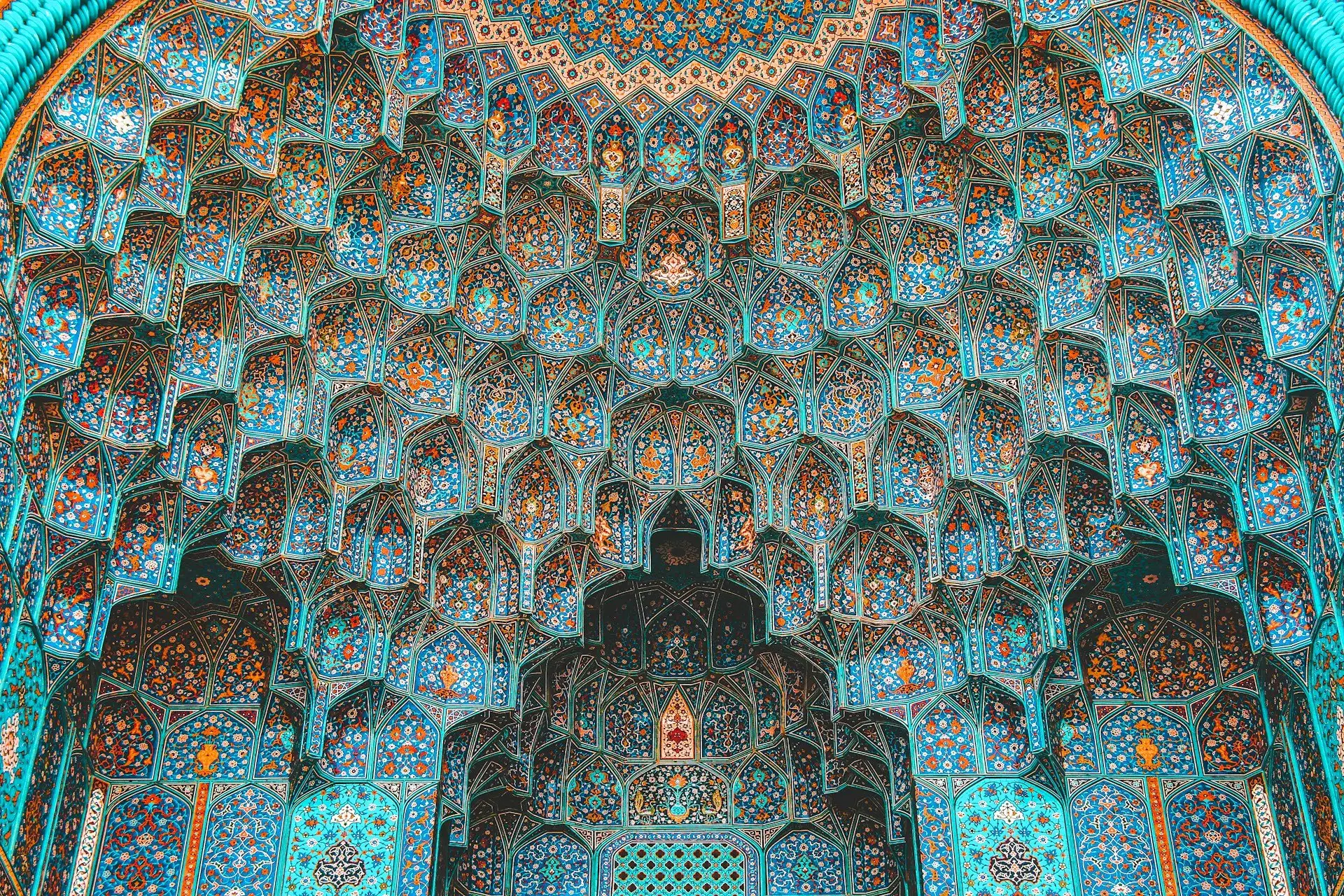
Isfahan is the city that Chardin called "half the world" (esfahan nesf-e jahan -- an old Persian saying that Isfahan in its glory was half the world) and it makes the claim intelligibly. The Naqsh-e Jahan Square -- 500 metres long, 160 metres wide, the second-largest public square on earth after Tiananmen -- has the Imam Mosque at one end (its entrance portal tilted 45 degrees to face Mecca while the main dome aligns east), the Sheikh Lotfollah Mosque on the east side whose interior dome is covered in cream and amber arabesque tilework that changes colour as sunlight moves through the day, and the Ali Qapu palace on the west with its music room whose plaster alcoves are shaped to improve acoustics. This is all on one square. Walk to the Khaju Bridge at 5pm when the Zayandeh River is running (it runs periodically, not year-round) and Isfahanis gather on the lower arcade to sing. The sound bounces off the arches in ways the Safavid engineers designed for specifically.
- The Sheikh Lotfollah Mosque dome interior is best photographed between 10am and noon when sunlight enters through the oculus at the peak -- the colours shift from cream to gold to amber within 20 minutes
- The Grand Bazaar connecting from the northern side of the square has carpet and textile dealers who will serve you tea with genuine hospitality -- this is an invitation to browse, not an obligation to buy
- The Armenian Christian quarter of Jolfa, south of the river, has the Vank Cathedral (founded 1606) with extraordinary painted interiors and a small museum documenting the Armenian genocide connection to Iranian Armenians -- free entry with a small donation
- Isfahan's gaz (nougat with pistachios and rosewater) sold on Chahar Bagh Abbas Street costs 200,000-300,000 rials per 250g and is the most specifically Isfahani thing you can eat
Shiraz is the city of wine (historically), poetry (currently), and gardens (persistently). The poet Hafez, whose 14th-century ghazals Iranians still recite from memory the way English speakers quote Shakespeare, is buried in the Hafezieh garden in north Shiraz -- a white marble tomb pavilion under orange trees where Iranians come to sit, read, and perform the practice of fal-e hafez: opening the Divan randomly to a page and reading whatever the poem says as prophecy. The Nasir al-Mulk Mosque (the "Pink Mosque") on Lotf Ali Khan Zand Boulevard has stained glass windows whose coloured light falls across the floor at dawn in patterns that feel explicitly designed for photography and were not -- they predate cameras by three centuries. Persepolis is 60km northeast: the ceremonial capital of the Achaemenid Persian Empire built by Darius the Great in 518 BC, burned by Alexander the Great in 330 BC, and still standing in towering relief-carved grandeur on its terrace above the Marvdasht plain.
- The Nasir al-Mulk Mosque is best at 8-9am on a sunny morning when the stained glass light is at maximum intensity -- by 10am the angle has shifted and the effect is much reduced
- Persepolis (60km from Shiraz, entrance 500,000 rials) warrants arriving at opening time and spending at least 3 hours -- the Apadana Palace relief carvings of delegations from 23 nations bringing tribute to Darius are the most specifically extraordinary thing in the complex
- The Qavam House (Narenjestan-e Ghavam) is a 19th-century private residence with a formal Persian garden that most visitors skip while queuing for the Pink Mosque -- go here instead or after, as it's a better experience of Iranian domestic architecture than any palace
- Sit at Hafez's tomb on a Thursday evening when Shirazi families come to recite and the garden fills with the sound of poetry in the dark -- this is not a tourist experience, it's a real one
Yazd is the world's oldest continuously inhabited desert city -- some estimates put it at 7,000 years -- and the global centre of Zoroastrianism, the pre-Islamic Persian religion that predates both Christianity and Islam. The old city is a UNESCO World Heritage maze of mud-brick lanes, windcatchers (badgirs, the tall towers that pull cool air from above and funnel it into rooms below -- the world's first passive air conditioning system), and underground water channels (qanats) that have kept the city alive in the desert for millennia. The Tower of Silence (Dakhme-ye Zartoshtian) on a low hill outside the city is where Zoroastrians left their dead for birds to consume until the practice was stopped in the 1960s -- the views from the top across the desert and back to the city's forest of badgirs are the most specifically Iranian landscape you'll see anywhere.
- The Atash Behram fire temple on Ayatollah Kashani Street has a sacred flame that Zoroastrian priests claim has burned continuously since 470 AD -- non-Zoroastrians can view it through glass
- Yazd's old city requires getting genuinely lost -- give yourself a full afternoon with no plan and follow any lane that looks interesting, there's no dead end that doesn't eventually connect to something worthwhile
- The badgir system in the Dowlat Abad Garden produces a temperature 10-15°C cooler than outside in summer -- sit in the pavilion for 15 minutes and you'll understand why Persian engineers were solving climate control problems 2,500 years ago
- Yazd's special pastry is qottab (almond-filled deep-fried pastry dusted with icing sugar from Haj Khalifeh Ali Rahbar confectionery near the Amir Chakhmaq Square) -- the shop has been selling them since 1911
Kashan sits between Tehran and Isfahan on the edge of the Dasht-e Kavir desert, and most visitors pass through it on the overnight train without stopping. Don't. The Tabatabaei and Borujerdi Houses are 19th-century merchant mansions whose interiors are among the finest examples of Qajar domestic architecture in Iran -- rooms stacked with stucco ceilings, mirrored alcoves, wind towers, and central courtyards with reflecting pools. The Fin Garden outside town is the oldest surviving Persian formal garden in Iran, where the prime minister Amir Kabir was assassinated in his bath in 1852 by order of the Shah. The water for the garden comes from a qanat system that has been running continuously since the 16th century. Kashan also produces most of Iran's rose water -- the annual rosewater festival in May fills the air with something that smells like an old Persian love poem made literal.
- Very low tourist pressure and almost no scam presence -- Kashan is a working city that happens to have extraordinary architecture
- The overnight train from Tehran to Kashan and continuing to Isfahan costs about 800,000 rials in a 4-berth sleeper and is a perfectly functional way to combine the three cities
- The Sultan Amir Ahmad Bathhouse (hammam) near the Agha Bozorg Mosque has been restored and open as a museum since the 1990s -- its octagonal pool and painted plasterwork dome are the most beautiful of the historic hammams accessible to tourists in Iran
Persepolis is worth its own entry because it earns it. Built by Darius the Great in 518 BC as the ceremonial capital of the Achaemenid Empire -- the largest empire the world had seen to that point, stretching from Greece to India -- it was burned by Alexander in 330 BC and left to the desert. The relief carvings on the Apadana staircase show delegations from 23 subject nations bringing tribute: Armenians with a horse, Lydians with bracelets, Ethiopians with an okapi, Scythians with trousers. The detail is so fine you can read facial expressions across 2,500 years. The Throne Hall (Hall of 100 Columns) had a cedar roof supported by 100 columns, 36 of which are still standing. The Gate of All Nations has double-bull capitals 10 metres high and cuneiform inscriptions in three languages. No photograph prepares you for the scale. Go in the late afternoon when the light is warm and the crowds thin and the shadows fall across the carvings the way Darius probably intended.
- Tour guides are available at the entrance and add genuine archaeological depth -- agree the fee before starting and choose guides with English competence rather than just accepting the first offer
- The Persepolis Museum at the site has small objects recovered during excavations including cylinder seals, tablets, and jewellery -- often missed in the rush toward the main terrace
- Naqsh-e Rostam, 5km north, has four Achaemenid royal tombs cut directly into a cliff face and a later Sassanid relief showing a Roman emperor kneeling before a Persian king -- worth 45 minutes combined with the Persepolis visit
Before You Go — The Checklist
- ✓ Check your government's current Iran advisory the week before departure. The situation is genuinely volatile and changes faster than any guide can track.
- ✓ Bring your entire trip budget in cash (EUR or USD). There is no backup. No ATMs, no card payments, no money transfers in.
- ✓ Download and configure a VPN before you land. Download it at home -- VPN app stores are sometimes restricted inside Iran.
- ✓ Register your visit with your embassy before arriving. In Iran, consular access for foreign nationals in detention can be delayed significantly.
- ✓ Women: bring a lightweight long-sleeved manteau and a scarf. You'll need it from the moment you exit the airport terminal.
- ✓ Do not photograph military installations, government buildings, airports, bridges, or demonstrations -- Iran's definition of sensitive infrastructure is broad.
- ✓ Americans, British, and Canadians must travel with a government-approved licensed guide. Arrange this before applying for your visa.