
What You're Actually Dealing With
The Scams That Actually Catch People
Georgia's scam profile is modest. Most of what catches visitors involves taxi pricing, tour operator quality gaps, and occasional currency handling tricks. None of it is aggressive or dangerous.
No meters in most Georgian taxis. The airport to central Tbilisi should cost 30-40 GEL; drivers quote 60-100 GEL to arrivals who don't know. Within the city, short rides costing 5-10 GEL locally are quoted at 20-30 GEL to foreigners. Since Bolt arrived in Georgia it has changed the market significantly — the app shows the price before confirmation and the vast majority of visitors use it exclusively.
- Use Bolt for every taxi journey in Tbilisi — it's reliable, priced before confirmation, and has largely resolved the taxi overcharging problem for visitors who use it.
- For the airport, Bolt picks up at the designated app taxi area; book before leaving the terminal.
- If using a street taxi, agree the fare before getting in and state it as a fact: "Rustaveli, 10 lari" — the question form invites a high opening bid.
Kakheti wine tours from Tbilisi range from genuinely excellent (small family wineries, qvevri access, real cultural engagement) to perfunctory box-ticking at commercial operations that could be anywhere. Budget tours sometimes go to the same large commercial winery twice with a 20-minute stop each time, call it a full-day wine tour, and return to Tbilisi by mid-afternoon. The price gap between cheap and quality tours is real and reflects genuine differences.
- Ask specifically: which wineries do you visit, are any of them small family operations with qvevri production, how long do you spend at each? A good tour gives real answers; a box-ticking one can't.
- Gvino Underground, Wine Travel Georgia, and several small Tbilisi-based operators with strong TripAdvisor records in the past 12 months are reliable benchmarks.
- Hiring a private driver for the day and visiting specific wineries you've researched independently gives more control and often better value than group tours.
Some exchange bureaus apply different rates to what's displayed on the board, relying on visitors not checking the arithmetic. Street changers occasionally short-count the lari handed over. The official savaluto exchange bureaus on and around Rustaveli Avenue and in the Old Town are legitimate and competitive — use these rather than anything off the beaten path.
- Confirm the exchange rate verbally before handing over your currency, then calculate the expected amount yourself before counting what you receive.
- Count every note before leaving the window — errors are most easily resolved immediately, not after you've left.
- ATMs in Tbilisi give a reliable official rate with a modest fee; for most visitors this is simpler than exchange bureaus and equally good value.
The Kazbegi day trip (Gergeti Trinity Church above Stepantsminda, Mount Kazbek views) is Georgia's most popular excursion and the tour market around it has developed accordingly. Some operators oversell what the day delivers — the Gergeti church viewpoint is genuinely extraordinary but requires the right weather and the hike takes 3-4 hours round trip that a rushed tour schedule doesn't always allow for. Accommodation at Kazbegi guesthouses is also inconsistently represented online.
- Stay overnight in Stepantsminda rather than doing Kazbegi as a day trip — the morning light on Kazbek and the church without day-trip crowds is the experience worth having.
- Hiring a driver from Tbilisi for the day (150-200 GEL) and setting your own schedule gives more flexibility than a group tour that controls timing.
- Check guesthouse photos and reviews from the past 12 months specifically — some listings use outdated photos.
A small number of tourist-facing restaurants in Tbilisi's Old Town inflate bills with items not ordered, double-charged dishes, or cover charges not mentioned when seated. This is uncommon by regional standards but documented. Georgian hospitality culture makes most restaurant interactions genuinely honest; the minority of venues doing this are specifically targeting tourists who don't check.
- Check the bill before paying — cross-reference each item against what was ordered.
- The restaurants in the Old Town one or two streets off the main tourist thoroughfare are usually better and more honestly priced than those on the postcard-facing stretch.
- Georgian restaurant prices are low by any European standard — even at tourist prices, a meal with wine is remarkably affordable.
Pickpocketing in Georgia is low by Eastern European standards but present in the busiest tourist areas of the Old Town and at the Dry Bridge flea market on weekends. Phone theft from café tables is the most common form. Neither requires significant concern — standard urban awareness is sufficient.
- Keep phones in pockets rather than on café tables in the Old Town.
- The Dry Bridge market is worth a Sunday morning visit — just maintain normal bag awareness in the crowd.
- Georgia has a far lower pickpocket rate than most Western European tourist cities.
The Destinations — Honest Takes
Georgia is compact enough to cover a surprising amount in two weeks. Tbilisi as the base, Kazbegi for the Caucasus mountains, Kakheti for wine, Svaneti for medieval towers.
Tbilisi is one of the great cities of the former Soviet sphere — a tangle of wooden balconied houses above the Mtkvari gorge, sulphurous bathhouses in the Abanotubani district, Orthodox churches on every other corner, a fortress above the old city, and a nightlife scene that has become one of the most talked-about in Europe. The Georgian script on every sign is one of only fourteen independent writing systems in the world. Walk from the Old Town uphill to the Narikala fortress at dusk, down through the narrow streets to the bathhouses, and then across the Bridge of Peace to the newer city — three hours that give you the essential Tbilisi.
- Use Bolt for all taxi journeys — it has transformed the taxi experience in the city
- Check restaurant bills in the Old Town tourist strip before paying
- The sulphur bathhouses in Abanotubani are the specific Tbilisi experience — private rooms cost 15-30 GEL per hour; the public sections are cheaper but require a towel
- Political demonstrations have been frequent in Tbilisi since late 2024 — check current conditions and avoid any protests you encounter
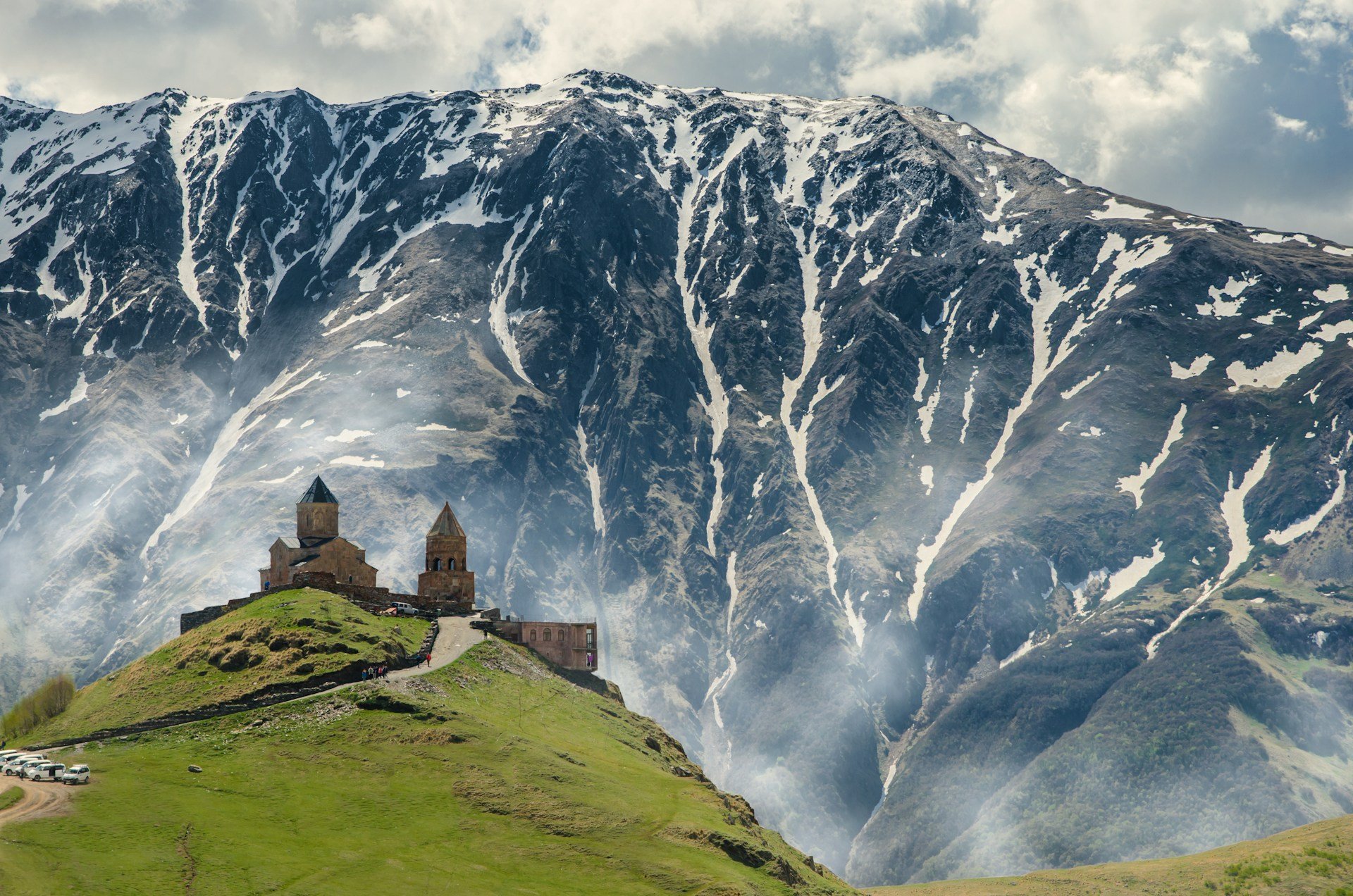
Stepantsminda sits at 1,700 metres in the Greater Caucasus, three hours north of Tbilisi on the Georgian Military Highway — one of the great mountain drives in the Caucasus. The Gergeti Trinity Church at 2,170 metres above the village, with Mount Kazbek's 5,047-metre peak behind it, is the most photographed image in Georgia and justifies every photograph. The hike to the church takes 2-3 hours and is steep but requires no technical skill. Stay overnight to see the mountain at sunrise before the day-trippers arrive.
- Overnight stay strongly preferred over a day trip — morning light on Kazbek is worth the extra night
- Guesthouses in Stepantsminda vary in quality; check photos from the past 12 months and book through verified recent reviews
- The road is open roughly May to October; check conditions before travelling in shoulder months
- 4WD vehicles are available for hire in the village for the drive up to the church trailhead — saves 45 minutes of uphill road walking each way
Kakheti in eastern Georgia is where 70% of Georgian wine is made and where the qvevri winemaking tradition is most alive. The Alazani Valley between the Caucasus and the Gombori range is planted with vines as far as you can see in autumn, when the harvest (rtveli) brings the whole region into communal activity. Signagi is the most picturesque town — a walled hilltop with views over the valley — and makes a good base. The Bodbe Monastery just outside town and the Davit Gareja cave monastery complex on the Azerbaijani border are the significant historical sites in the region.
- Ask tour operators specifically which wineries they visit and whether any are small qvevri producers — this distinguishes quality tours from commercial box-ticking
- October harvest season (rtveli) is the best time to visit — arrive with a flexible schedule as timing varies by vineyard and year
- The Davit Gareja monastery complex sits on the Azerbaijani border; check current access conditions before visiting as the border situation has been sensitive
Svaneti is a highland region in the northwestern Caucasus where medieval stone defensive towers still stand in every village, unchanged since the 12th century. Mestia is the main town and base; the village of Ushguli at 2,200 metres, with its cluster of towers and the Shkhara glacier behind it, is the highest permanently inhabited settlement in Europe. Getting there requires a flight from Tbilisi to Mestia (45 minutes) or a 10-hour marshrutka — the flight wins easily. The trekking routes between Svaneti villages, including the multi-day Mestia to Ushguli trail, are among the finest in the Caucasus.
- The Tbilisi to Mestia flight is worth the cost — the marshrutka is an ordeal and the flight has dramatic views of the Caucasus
- Book guesthouses in Mestia and Ushguli in advance for summer — the region is increasingly popular and accommodation fills in July and August
- Svaneti Museum in Mestia has one of the finest collections of medieval Georgian icons and gold work in the country — genuinely worth a morning
Batumi is Georgia's Black Sea resort city in the subtropical Adjara region — palm trees, Soviet-era promenade culture, a glitzy new waterfront of casinos and towers, and a dense Adjarian old town of Ottoman-influenced wooden houses behind it. The Botanical Garden above the city is genuinely excellent and the drive up to Makhuntseti waterfall through tea plantations and hazelnut groves is better than the waterfall itself. Batumi in summer is the Georgian seaside — crowded, lively, and fun if you accept it on those terms.
- Very low scam presence — the city's visitor mix is mostly domestic Georgian tourists and regional visitors rather than Western tourists, which changes the dynamic
- The casino industry in Batumi is legitimate and regulated; exercise normal gambling discretion
- The coastal road from Batumi north toward Poti has some of the most dramatic Black Sea scenery in the Caucasus — worth a half-day drive
Mtskheta was Georgia's ancient capital and is 20km from Tbilisi — an easy half-day trip that covers the Jvari church on the hill above the river confluence (the view that opens Mikhail Lermontov's poem Mtsyri) and the Svetitskhoveli cathedral below, the spiritual heart of Georgian Orthodoxy since the 4th century. Uplistsikhe, another 60km west, is a cave city carved from volcanic rock above the Mtkvari river — inhabited from the Iron Age through the medieval period, partially excavated, and entirely atmospheric especially in late afternoon light.
- No scam presence at either site — both are well-managed UNESCO sites with official ticket offices
- Combine Mtskheta and Uplistsikhe in a single day trip west from Tbilisi with a hired driver — efficient and gives enough time at each
- The Gori Stalin Museum nearby is worth factoring into an Uplistsikhe day if Soviet history interests you — it is one of the most peculiar museum experiences in the Caucasus
Before You Go — The Checklist
- ✓ Install Bolt before landing — it eliminates the Tbilisi taxi overcharging problem almost entirely and is the default transport solution for most visitors.
- ✓ Do not approach the administrative boundary lines of South Ossetia or Abkhazia under any circumstances.
- ✓ For Kakheti wine tours, ask specifically which wineries are visited and whether any are small family qvevri producers — this is how you distinguish a genuine tour from a commercial box-tick.
- ✓ Stay overnight in Stepantsminda for Kazbegi rather than doing it as a day trip — the morning mountain light is the experience worth having.
- ✓ Confirm the exchange rate before handing over money at any exchange bureau and count all received lari before leaving the window.
- ✓ Check the political situation in Tbilisi before arrival — demonstrations have been frequent since late 2024 and occasionally involve police response.
- ✓ Always pay in lari and decline dynamic currency conversion at ATMs and card terminals.