
What You're Actually Getting Into
Uzbekistan is the country the rest of Central Asia gets compared to. For most of the 20th century it was closed to independent travel, first as a Soviet republic with a heavily controlled tourism apparatus, then, after 1991, under a government that kept the visa process deliberately difficult. That changed hard after 2016, when a new president dismantled the currency black market, scrapped exit visas, opened an e-visa system, and started pouring money into restoring the Silk Road cities. As of 1 January 2026, US citizens can enter without a visa at all for stays up to 30 days, the clearest signal yet that the country wants visitors and has built the infrastructure to receive them.
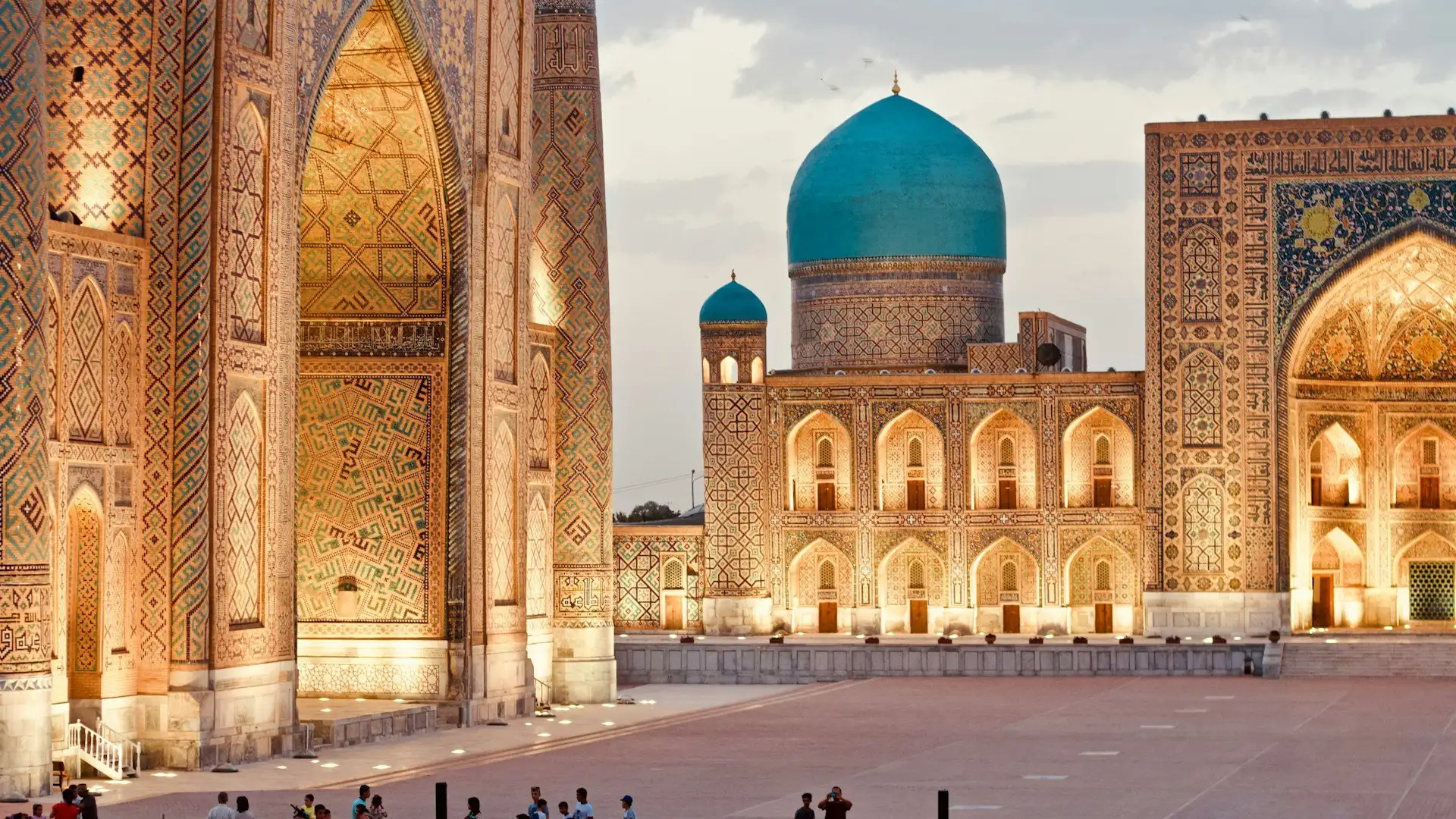
What you get for the trouble: three UNESCO-listed Silk Road cities within a few hours of each other by train, turquoise-tiled Timurid architecture that has no real equivalent anywhere else on earth, bazaars that still function as working markets rather than tourist sets, and prices that make the whole trip startlingly affordable. Uzbekistan is also, by a wide margin, the easiest Central Asian country to visit independently: the Afrosiyob high-speed train connects the big three cities, English is increasingly spoken in tourist businesses, and the tourism infrastructure, hotels, guides, ticketing, is the most developed in the region.
The honest complications
Registration with local authorities within three days of arrival is still technically required, though hotels handle it automatically at check-in and independent travelers staying with locals need to be more careful about it. Distances between Tashkent, Samarkand, Bukhara and Khiva are real: the country is larger than it looks on a map, and Khiva in particular sits far out in the west, a long train or flight from the other three. Outside Tashkent, Samarkand and Bukhara, English drops off fast and Russian becomes more useful than Uzbek phrasebook basics. And summer here is genuinely brutal, Bukhara and Khiva both regularly clear 40°C in July and August, a detail that catches travelers who assume "Central Asia" means mountain cool everywhere.
A History Worth Knowing
Uzbekistan's cities were major stops on the Silk Road for more than a thousand years before the word "Uzbek" meant anything close to what it does today. Samarkand and Bukhara were flourishing centers of trade, scholarship and Islamic architecture under a rotating cast of empires, but it was Amir Timur, known in the West as Tamerlane, who turned Samarkand into an imperial capital in the late 14th century and left it covered in the turquoise-domed monuments that define the country's image today. Russian conquest in the 19th century, Soviet rule through the 20th, and a difficult first quarter-century of independence bring the story up to the present reform era.
- 8th-13th c.
Silk Road golden age. Samarkand and Bukhara flourish as centers of trade and Islamic scholarship under successive Persianate and Turkic dynasties, until the Mongol invasion devastates the region in 1220.
- 1370-1405
Amir Timur. Tamerlane builds an empire stretching from India to Anatolia and makes Samarkand his capital, commissioning the monuments that still define the city. His grandson Ulugbek later builds one of the era's finest astronomical observatories there.
- 1860s-1920s
Russian conquest. The Russian Empire annexes the Central Asian khanates through the 19th century; the Soviet Union absorbs the region after 1917 and creates the Uzbek SSR in 1924.
- 1991
Independence. Uzbekistan becomes independent as the USSR dissolves, but keeps a heavily controlled, closed political and economic system for the next 25 years.
- 2016-present
Reform era. A new government scraps exit visas, unifies the currency exchange rate, opens e-visas and, from January 2026, visa-free entry for US citizens, driving a rapid rise in tourism.
Read the full history: the Silk Road, Timur, the Soviets and the 2016 reforms
Samarkand and Bukhara are both older than most European capitals, with continuous urban history stretching back well over two thousand years. Their position on the routes connecting China, Persia, India and the Mediterranean made them wealthy and cosmopolitan long before Timur arrived, but it was Timur's empire that produced the specific architectural language, turquoise and cobalt tilework, soaring iwans, ribbed domes, that visitors now travel across the world to see. Timur was not, by most accounts, a gentle ruler; his military campaigns were extraordinarily bloody. But the monuments he and his successors built, above all his grandson Ulugbek, a serious astronomer as well as a ruler, whose observatory at Samarkand catalogued over a thousand stars in the 1420s, remain the single reason most people visit the country today.
The 19th-century "Great Game" between Russia and Britain ended with the Russian Empire absorbing the Central Asian khanates of Bukhara, Khiva and Kokand as protectorates, then outright annexation. Soviet rule from the 1920s brought forced collectivization, the conversion of huge areas to cotton monoculture (a policy directly responsible for the near-destruction of the Aral Sea, a slower-moving environmental disaster whose effects are still visible today), and decades of tightly managed, low-volume Intourist-style tourism to a handful of approved sites.
Independence in 1991 did not bring the opening many expected. President Islam Karimov's government maintained a closed currency system with a black-market exchange rate several times the official one, mandatory exit visas for citizens, and a tourism sector that remained small and bureaucratic. The turning point came after Karimov's death in 2016, when President Shavkat Mirziyoyev unified the currency, abolished exit visas, opened e-visas to dozens of countries, and began an aggressive restoration and marketing push around the Silk Road cities. Visa-free entry for US citizens from January 2026 is the latest step in that trajectory, and tourist numbers have risen sharply through the late 2020s as a result.
Top Destinations
Uzbekistan's tourism geography is unusually linear: almost everything worth seeing sits along or near the historic Silk Road corridor running from Tashkent southwest through Samarkand to Bukhara, then further west to Khiva. The Afrosiyob high-speed train covers the first three in comfort; Khiva and the Fergana Valley require more planning. A week covers the core triangle; two weeks does the whole country properly.
Samarkand, the Silk Road's capital
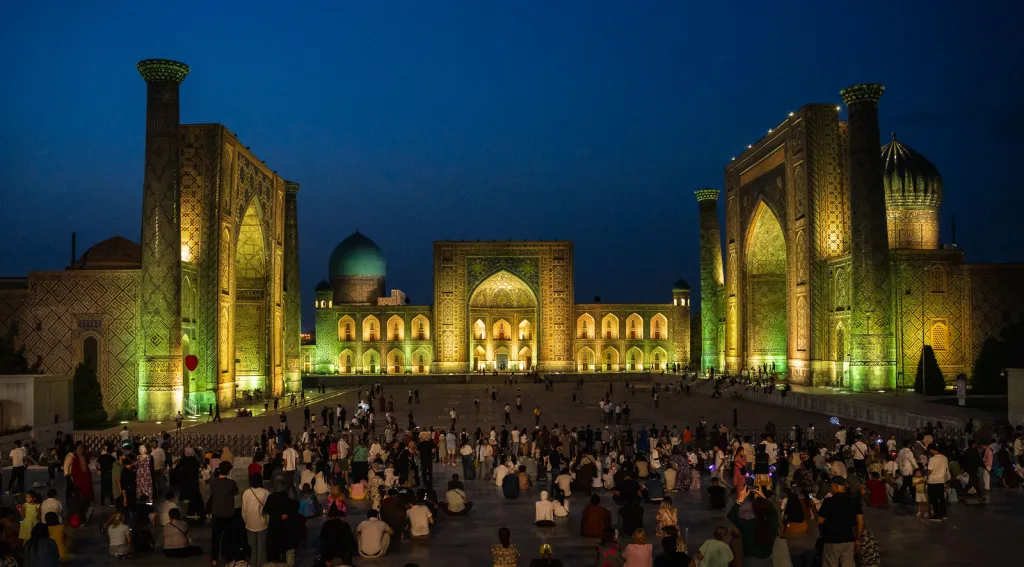
Samarkand is the single best tourist city in Uzbekistan and the country's most-photographed destination. The Registan, three monumental madrasas facing each other across one square, anchors the city; the Gur-e-Amir Mausoleum, Bibi-Khanym Mosque and the Shah-i-Zinda necropolis fill out a list of sights that rivals anywhere on the historic Silk Road. Full guide on our dedicated Samarkand city page. Budget two full days.
Bukhara, the living museum
Bukhara is more than 2,000 years old and, unlike Samarkand's more monumental spread, has an intact historic core compact enough to wander on foot for days. The Poi Kalyan complex, with its 12th-century minaret that reportedly stopped even Genghis Khan from destroying the city, the Ark fortress, and the Lyabi-Hauz pool plaza ringed with mulberry trees and teahouses are the anchors. Bukhara feels lived-in in a way Samarkand's more spread-out monuments sometimes don't: artisans still work in the domed trading bazaars (Toki Zargaron, Toki Sarrafon) that have functioned continuously for centuries.
Khiva, the walled desert city
Khiva sits far out toward the Turkmenistan border, a historic resting point on the caravan route across the Kyzylkum desert, and its remoteness is exactly what kept its walled old town, Itchan Kala, so well preserved. Inside the walls: the unfinished Kalta Minor minaret, wrapped entirely in turquoise tile; the Tosh-Hovli Palace; the Kuhna Ark fortress; and the Pahlavon Mahmud Mausoleum. Khiva rewards an overnight stay inside the walls, when the day-trip crowds leave and the lit monuments have the old town to themselves.
Tashkent, the modern gateway
Tashkent is Central Asia's largest city and the country's political and economic center, rebuilt largely in Soviet modernist style after a devastating 1966 earthquake, so it looks and feels different from the Silk Road cities to its south. Most visitors use it as an arrival and departure point rather than a highlight, but it's worth a day: the Chorsu Bazaar under its blue-domed roof, the ornately tiled Tashkent Metro stations (long a photography subject in their own right, now officially permitted to photograph), and the Khast Imam complex with one of the world's oldest Qurans, the Uthman Quran, dated to the 7th century.
Fergana Valley
East of Tashkent over a mountain pass, the Fergana Valley is Uzbekistan's most traditional and least-visited region, dense with craft towns rather than monuments: Rishtan for centuries-old blue-and-white ceramics, Margilan for the Yodgorlik silk factory and its handmade ikat weaving, and Kokand for the 19th-century Khan's Palace. Far fewer tourists make it out here, which is exactly the appeal for a second-trip itinerary.
Culture & Etiquette
Uzbek hospitality (mehmondo'stlik, roughly "guest-friendliness") is a real cultural value, not a tourism-brochure phrase: being invited to share tea and bread with a family is a common and genuine experience for visitors who spend any time outside the main tourist sites. Uzbekistan is a majority-Muslim country but practices a notably secular, moderate form of Islam, a legacy of both Soviet-era secularization and the Timurid tradition of scholarship over strict orthodoxy.
Do
- Accept bread and tea if offered. Non (bread) is treated with particular respect: it's never placed upside down and never thrown away.
- Dress modestly, especially at religious sites and outside Tashkent: shoulders and knees covered is a safe baseline for both men and women.
- Carry your passport or a copy. Hotels handle the 3-day registration requirement automatically at check-in; keep the registration slips they give you until departure.
- Learn a few Uzbek or Russian words. Rahmat (thank you in Uzbek) or spasibo (Russian) go further than English alone outside the big three cities.
- Carry cash (som). Cards work in Tashkent, Samarkand and Bukhara hotels and nicer restaurants; bazaars, taxis and smaller towns are cash-only.
Don't
- Photograph military, government or airport facilities. Restrictions have loosened significantly since 2016 but some sensitivity remains around official buildings.
- Assume Uzbek and Russian are interchangeable. Both are widely understood but Uzbek is the national language and attempting it is appreciated, particularly with older residents in smaller towns.
- Skip the registration paperwork if not staying in hotels. Independent travelers staying with local hosts should confirm registration is being filed; overstaying without it can complicate departure.
- Expect card payment everywhere. Even some mid-range restaurants and most bazaar vendors are cash-only.
- Rush the Silk Road cities. The distances on a map look small; the sites deserve unhurried time, and the summer heat punishes anyone trying to see too much in one day.
Deeper culture: dastarkhan, Sufism, and the Uzbek tea ceremony
The dastarkhan. The spread table, a low table or floor cloth covered in bread, dried fruit, nuts and sweets, that's laid out before and alongside a meal, and never allowed to sit empty even between courses. It functions as a display of hospitality as much as a meal itself.
Sufism's legacy. Bukhara in particular was historically a major center of Sufi Islam, with the Naqshbandi order founded near the city; the moderate, mystically inflected form of Islam practiced across much of Central Asia owes a lot to this tradition rather than to the stricter schools more associated with the Arabian Peninsula.
Green tea culture. Ko'k choy (green tea) is the default drink at every meal and every social occasion, served in small bowls rather than cups, traditionally poured only a third full so the host has an excuse to keep refilling it, a small hospitality ritual worth recognizing rather than a serving error.
Food & Drink
Uzbek food is built around rice, bread, noodles and grilled or slow-cooked meat, shaped by the country's position on Silk Road trade routes and its historically nomadic and settled populations both. It is heavier and less spiced than South or Southeast Asian food, closer in spirit to Persian and Turkic cooking, and it is cheap: a full plov lunch rarely runs past $3-4.
Plov ~$2-4
The national dish: rice cooked in a wide kazan cauldron with lamb, carrots, onions and cumin, often topped with chickpeas, raisins or quail eggs depending on the region. Every city has its own version and its own claim to the best one.
Non ~$0.30-0.50
Round tandoor-baked flatbread, stamped with a decorative pattern and studded with sesame or nigella seed. Samarkand non is considered the country's best and is treated with a level of respect verging on reverence.
Samsa ~$0.50-1
Savory pastries filled with spiced meat and onion, baked against the wall of a tandoor oven rather than fried. Sold hot from bazaar stalls across the country; Bukhara and Samarkand both do excellent versions.
Lagman ~$2-3
Hand-pulled noodles in a stewed meat, pepper and tomato broth, a dish with clear Central Asian Dungan (Hui Chinese Muslim) roots. Served brothy or stir-fried depending on the kitchen.
Manti ~$2-3
Large steamed dumplings filled with minced lamb or beef and onion, served with yogurt or a vinegar-chili sauce. Heartier and larger than their Chinese or Turkish cousins.
Shashlik ~$3-6
Skewered, charcoal-grilled meat, usually lamb, sold at bazaar grills and restaurant terraces alike. Order it with fresh non and a plate of sliced tomato and onion.
When to Go & Itineraries
March to May and September to November are Uzbekistan's sweet spots: warm days, cool evenings, and none of the extreme heat that makes midday sightseeing genuinely difficult in July and August, when Bukhara and Khiva regularly clear 40°C. Winter is cold but manageable for city sightseeing, with the bonus of empty monuments and the lowest prices of the year.
All four seasons compared, with temperatures
| Season | Verdict | Temps | Prices & crowds |
|---|---|---|---|
| Mar-May & Sep-Nov | Best | 15-28°C | Mid prices, manageable crowds |
| Jun-Aug | Hot | 32-42°C (Bukhara/Khiva) | Lower crowds but midday heat is punishing |
| Dec-Feb | Cold but workable | -2-10°C | Lowest prices, empty sites, some fog in Tashkent |
Tashkent and Samarkand run slightly cooler than Bukhara and Khiva year-round; the western desert cities see the most extreme summer heat.
Itineraries
Seven days covers the essential Silk Road triangle. Two weeks adds Khiva and a slower pace through the Fergana Valley for a genuinely complete trip.
- Days 1-2
Tashkent. Arrival, Chorsu Bazaar, the tiled metro stations, Khast Imam and the Uthman Quran, then the Afrosiyob train south.
- Days 3-4
Samarkand. The Registan, Gur-e-Amir, Bibi-Khanym Mosque, Shah-i-Zinda and the Ulugbek Observatory.
- Days 5-7
Bukhara. Afrosiyob train onward, the Poi Kalyan complex, the Ark fortress, Lyabi-Hauz, and the domed trading bazaars, then fly out of Bukhara or return to Tashkent.
- Days 1-2
Tashkent, as above, at a slower pace with a day trip option to the Chimgan mountains.
- Days 3-5
Samarkand, including a half-day trip to Shakhrisabz, Timur's birthplace.
- Days 6-8
Bukhara, at an unhurried pace with time in the domed bazaars and a visit to the Sitorai Mokhi Khosa summer palace.
- Days 9-11
Khiva. Overland or fly from Bukhara; stay inside the Itchan Kala walls overnight for the empty-city evening.
- Days 12-14
Fergana Valley. Fly back to Tashkent, then overland through the mountains to Rishtan, Margilan and Kokand.
Getting there & around
Tashkent International Airport (TAS) is the main international gateway, with growing direct connections from Europe, the Gulf and Asia; Samarkand (SKD) and Bukhara (BHK) also have smaller international airports. Inside the country, the Afrosiyob high-speed train is the single best transport decision available: Tashkent to Samarkand takes about 2 hours 8 minutes at up to 230 km/h (economy ~$15-20, business ~$25-33), and Tashkent to Bukhara runs 3.5 to 4 hours. Book tickets online as early as they release, 45 days ahead, since popular dates sell out within hours in peak season.
All transport options with prices: trains, flights, taxis, e-visas
| Option | Price | Notes |
|---|---|---|
| Afrosiyob (Tashkent-Samarkand) | $15-33 | 2h8m, economy to VIP class, book 45 days ahead online. |
| Afrosiyob (Tashkent-Bukhara) | $18-35 | ~3.5-4 hrs, restaurant car on board. |
| Domestic flights | $30-80 | Fastest option to reach Khiva from Tashkent or Bukhara. |
| Taxis & ride apps | $1-4 (city) | Yandex Go works in Tashkent, Samarkand and Bukhara; agree fares with unmarked taxis before getting in. |
Visa note: US citizens enter visa-free for 30 days as of January 2026; many EU, UK and other nationalities can use an e-visa or existing visa-free arrangements. Registration within 3 days of arrival applies to all visitors and hotels handle it automatically.
Practical prep: buy a local SIM at the airport (a few dollars for several GB) or an eSIM before landing. Card acceptance is improving fast in the big three cities but bazaars and smaller towns are cash-only, so budget for ATM runs.
Where to stay
Budget guesthouses & hostels
Family-run B&Bs near the old cities are the most common budget option in Samarkand and Bukhara, often with a courtyard and a home-cooked breakfast included.
Boutique & mid-range hotels
Converted historic houses near the Registan in Samarkand and around Lyabi-Hauz in Bukhara offer character and location that chain hotels in Tashkent can't match.
International & resort-standard
The Silk Road Samarkand tourist complex, an 8-hotel resort development outside Samarkand, and international chains in Tashkent cover the top end.
Inside the Khiva walls
Staying inside Itchan Kala itself, rather than in the new town outside, is worth the small premium for the after-hours atmosphere once the day-trip crowds leave.
Budget Planning
Uzbekistan is one of the more affordable countries in Asia to travel, and the value has held up even as tourist numbers have grown since the 2016 reforms. Budget travelers eat and sleep well on $35-45 a day; the main cost to plan around is the Afrosiyob train, which is inexpensive by Western standards but adds up across a multi-city itinerary if you book last minute.
- Guesthouse or hostel bed $10-20
- Bazaar meals and street food $3-6
- Afrosiyob economy class
- Most monument entries under $5
- Boutique hotel or B&B $50-120
- Restaurant meals $8-15/person
- Afrosiyob business class
- Private guide for one city
- Resort-standard hotels
- Private driver between cities
- Fine dining and premium tastings
- Domestic flights over overland transfers
Quick reference prices: food, transport, entry fees
| Plov at a local kitchen | ~$2-4 |
| Samsa from a bazaar stall | ~$0.50-1 |
| Restaurant meal (mid) | $8-15 |
| Afrosiyob Tashkent-Samarkand | $15-33 |
| Registan entry | ~$6-8 |
| Guesthouse incl. breakfast | $15-30/night |
| City taxi ride | $1-4 |
Prices reflect August 2026 research and drift over time. Treat them as a planning baseline, not a quote.
Visa & Entry
Uzbekistan's visa regime has transformed since 2016. Since 1 January 2026, US citizens can enter visa-free for stays up to 30 days, part of a broader push that already covered dozens of other nationalities with e-visas or existing visa-free access. Rules do change; the official Uzbekistan e-visa portal is the authoritative source, not third-party sites that charge for something that may now be free.
✓ Valid passport
At least 6 months validity from date of entry is the commonly advised standard; keep a photocopy separate from the original.
✓ Registration within 3 days
Required for all visitors. Hotels file this automatically at check-in; independent travelers staying with locals should confirm it's being handled.
✓ Return/onward ticket
May be requested at immigration, particularly for longer stays.
✓ 30-day visa-free (US)
No e-visa or application needed for US citizens as of January 2026; other nationalities should check current e-visa or visa-free status before booking.
| Uzbekistan | Kyrgyzstan | |
|---|---|---|
| Main draw | Silk Road cities, Timurid architecture | Mountains, alpine lakes, nomadic culture |
| Getting around | Easy: high-speed Afrosiyob train | Harder: shared taxis and rougher mountain roads |
| Daily budget | $35-45 covers most of it | Similar range, gear and trekking add cost |
| Best for | History, architecture, first-time Central Asia trips | Trekking, yurt stays, outdoor adventure |
| Visa (US) | Visa-free, 30 days, since Jan 2026 | Visa-free, 60 days |
Safety, Solo Women & Family
Uzbekistan is safe for tourists and carries a Level 1 rating, Exercise Normal Precautions, the US State Department's lowest tier. Violent crime against visitors is rare, tourism police are stationed at major sites in Samarkand, Bukhara and Khiva, and Uzbek hospitality culture makes overt hostility toward guests genuinely uncommon. The real risks are minor: bazaar overcharging, traffic, and the summer heat.
Bazaar overcharging
Vendors sometimes quote foreigners a higher opening price. Light, good-natured bargaining is normal and expected; a fixed price sign means exactly that.
Traffic
Drivers don't always yield to pedestrians and crosswalks are treated loosely. Cross at marked points and make eye contact with drivers before stepping out.
Summer heat
40°C-plus days in Bukhara and Khiva in July-August are a genuine health risk for sightseeing. Front-load the day early, rest at midday, and carry water constantly.
Two more things worth knowing: unmarked taxis and photography restrictions
Unmarked taxis operate informally and are generally fine in daylight with an agreed fare, but ride apps like Yandex Go, available in Tashkent, Samarkand and Bukhara, are safer and cheaper after dark.
Photography of military sites, government buildings, airports and border areas is still restricted, a holdover from Soviet-era rules that has loosened substantially but not disappeared. Monuments, bazaars and street photography are unrestricted and welcomed.
Solo women travelers
Uzbekistan rates well for solo women and consistently ranks among the safer countries in Asia for independent female travel. Street harassment is uncommon in tourist areas, and the hospitality culture means locals, including strangers, tend to look out for guests rather than the reverse. Modest dress, shoulders and knees covered, is appreciated outside international hotels and helps avoid unwanted attention, especially in smaller towns and the Fergana Valley. Practically: use Yandex Go rather than unmarked taxis at night, and dress a little more conservatively outside Tashkent's more cosmopolitan center. Full detail on our Solo Woman Explorer pages.
Emergency numbers
Embassies in Tashkent and the tourist hotline
112 connects to general emergency services, though operators rarely speak English outside Tashkent; hotels and tour operators can help communicate during an emergency. The Unified Safe Tourism Call Center at 1173 (within Uzbekistan) is aimed specifically at visitors. Most foreign embassies are located in Tashkent's Yunusabad and Mirzo Ulugbek districts.
- USA
- +998-71-120-5450
- UK
- +998-71-120-1500
- Germany
- +998-71-120-8444
- France
- +998-71-120-3325
Family travel & pets
Uzbekistan works well for families (7.5/10): the monuments are visually striking enough to hold kids' attention, bazaars are an easy sensory experience, and the Afrosiyob train is comfortable and fast enough to avoid the long-drive fatigue that can otherwise sink a Central Asia trip with children. Heat management in summer is the main planning factor, not safety.
Kids at the monuments and bringing pets
Kids at the sites: the Registan and Bukhara's bazaars work well for most ages; younger children may find repeated madrasa visits repetitive after the first day or two, so pace the itinerary with bazaar and train-ride variety rather than monument after monument.
Pets: entry requires a veterinary health certificate and current rabies vaccination; requirements can change, so confirm with the nearest Uzbekistan embassy or consulate well before travel rather than assuming EU-style pet passport rules apply.
Uzbekistan FAQ
Is Uzbekistan safe to visit?
Yes. Uzbekistan is rated Level 1, Exercise Normal Precautions, by the US State Department, and violent crime against visitors is rare. Tourism police are present at major sites and hospitality toward guests is a genuine cultural value.
Do Americans need a visa for Uzbekistan?
No, since 1 January 2026 US citizens can enter Uzbekistan visa-free for up to 30 days. Registration with local authorities within 3 days of arrival is still required, and hotels normally handle this automatically.
How many days do you need in Uzbekistan?
Seven days covers Tashkent, Samarkand and Bukhara at a reasonable pace. Two weeks adds Khiva and the Fergana Valley without feeling rushed.
How much does Uzbekistan cost to visit?
Budget travelers manage on $35-45 a day, mid-range on $75-130. Accommodation runs from $15 for a hostel bed to $120 or more for an international-standard hotel.
What is the best time to visit Uzbekistan?
March to May and September to November: warm days, cool evenings, and none of the extreme summer heat that pushes past 40°C in the Kyzylkum desert cities in July and August.
What is the Afrosiyob train?
Uzbekistan's high-speed rail line linking Tashkent, Samarkand and Bukhara at up to 230 km/h. Tashkent to Samarkand takes about 2 hours 8 minutes and costs roughly $15-33 depending on class.
What currency does Uzbekistan use?
The Uzbek som (UZS). Cards are increasingly accepted in Tashkent, Samarkand and Bukhara hotels and restaurants, but cash still dominates bazaars, taxis and smaller towns.
Is Uzbekistan good for first-time Central Asia travelers?
Yes, arguably the best entry point. Tourist infrastructure is the most developed in Central Asia, the Silk Road cities are visually spectacular, and the high-speed train removes most of the logistics headaches other Central Asian trips involve.
Is Uzbekistan safe for solo female travelers?
Generally yes, and it consistently rates among the safer countries in Asia for solo women. Modest dress is appreciated outside international hotels, and unmarked taxis are best avoided at night in favor of ride apps or hotel-arranged transport.
What language is spoken in Uzbekistan?
Uzbek, a Turkic language, is the official language. Russian remains widely spoken and understood, especially in Tashkent and among older generations, and English is increasingly common in tourist-facing businesses.
Is Uzbekistan part of the Silk Road?
Yes, it sits at the historical heart of it. Samarkand, Bukhara and Khiva were three of the most important trading cities on the routes connecting China, Persia and Europe, and their Timurid-era architecture survives largely intact.
What Stays With You
Every traveler who reaches the Registan for the first time has roughly the same reaction: a long pause, then some version of "why isn't this more famous." Three madrasas built two centuries apart, facing each other across one square, covered in tilework that still looks impossibly precise up close, none of it feels like it belongs in the same category as the rest of the world's famous monuments. It belongs to something older and stranger, a Silk Road capital that spent decades closed off and is only now letting the rest of the world back in.
Go while the trains are new, the crowds are still thin outside the Registan itself, and the country is still finding out what it's worth.