

What You're Actually Getting Into
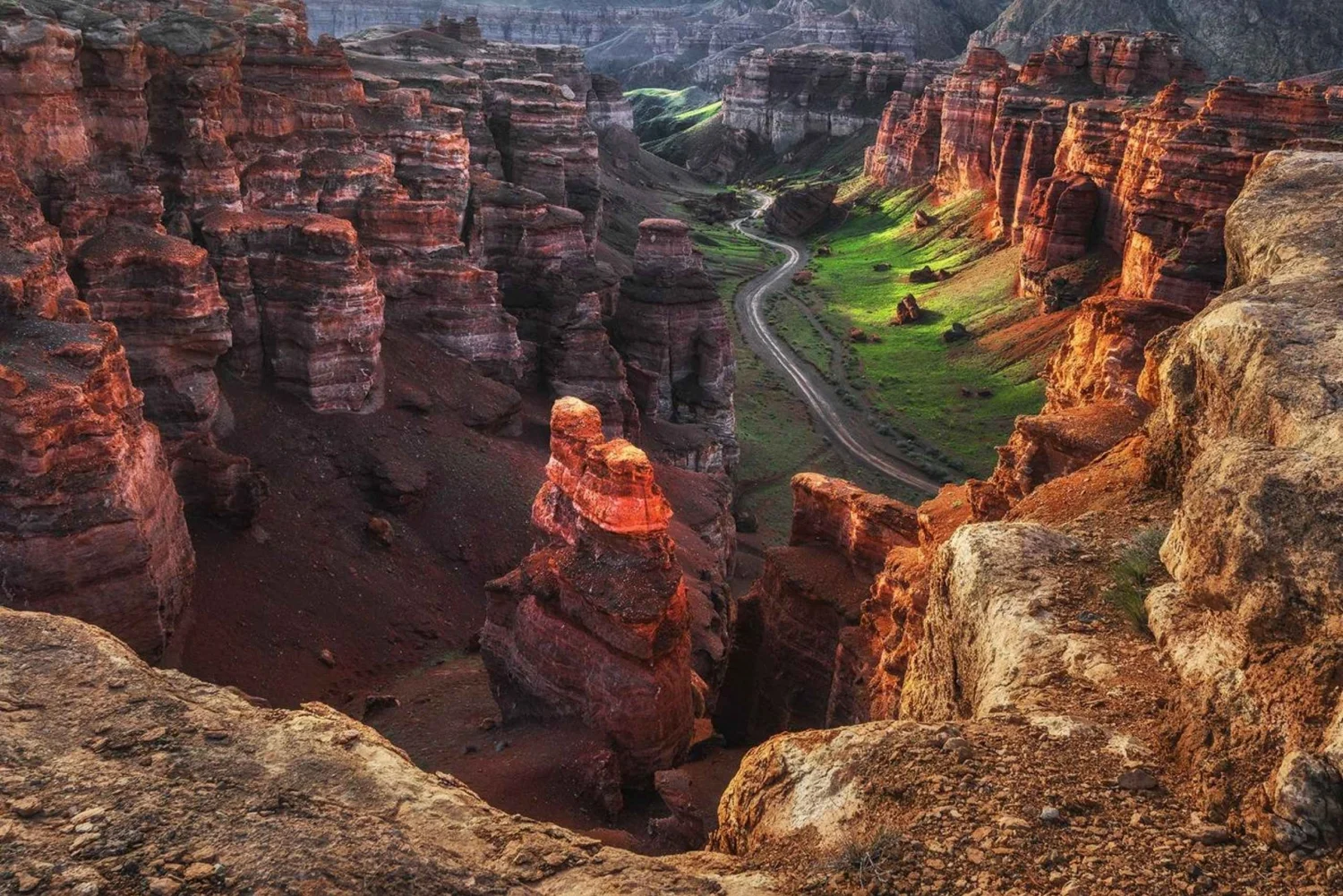
Kazakhstan is the ninth-largest country on earth and the largest with no coastline, a territory bigger than Western Europe stretched between the Caspian Sea and the Chinese border. Almost nobody visits for the size alone; they visit because the one corner that concentrates the country's appeal, the southeast, packs snow-capped Tian Shan peaks, a red-rock canyon that draws inevitable Grand Canyon comparisons, and alpine lakes into day-trip range of Almaty, a genuinely livable city of two million with the best restaurant scene in Central Asia. The rest of the country is steppe: flat, enormous, and dotted with Soviet-era infrastructure, Silk Road ruins, and one of the strangest planned capitals on the planet.
Kazakhstan is also the easiest way into Central Asia. Visa-free entry for most Western passport holders, direct flights from Istanbul, Dubai, Frankfurt and other major hubs into Almaty, and a tourism infrastructure well ahead of Kyrgyzstan, Tajikistan or Uzbekistan in terms of hotels, tour operators and English-speaking guides, even though English itself is not widely spoken outside that infrastructure. It remains, relative to what it offers, one of the least-visited countries its size in the world.
The honest complications
Kazakhstan is not a compact country and it does not reward trying to see everything in one trip: Almaty to Astana is a two-hour flight, and the Silk Road cities of the south, plus the practically restricted Baikonur Cosmodrome, sit further out still. Russian, not English, is the practical second language, and outside hotel staff, tour guides and younger people in Almaty, English drops off fast. Some of the country's most talked-about sights, Big Almaty Lake among them, sit inside a border zone near Kyrgyzstan where the passport-and-permit situation has changed more than once in recent years and is worth confirming locally rather than assuming. And the country's politics are genuinely still settling: the violent unrest of January 2022, centered in Almaty itself, is recent enough that older guidebooks describe a different security picture than the stable one that has held since.
A History Worth Knowing
Kazakhstan's steppe was a highway for Turkic nomadic tribes and a corridor of the Silk Road for two thousand years before Russian Tsarist expansion absorbed it through the 18th and 19th centuries. Soviet rule brought forced collectivization, the Virgin Lands agricultural campaign, a notorious nuclear test site, and a demographic upheaval that left ethnic Kazakhs a minority in their own republic by the 1960s. Independence came in December 1991, the last Soviet republic to declare it, followed by nearly three decades under one president, a snap decision to move the capital, and a violent reckoning with that legacy in January 2022 that the country is still processing.
- Antiquity–15th c.
Nomadic crossroads. Turkic tribes and Silk Road trade routes cross the steppe for two millennia; Turkistan and Otrar become significant caravan and religious centers.
- 1730s–1860s
Russian expansion. Kazakh khanates gradually accept then lose autonomy to the expanding Russian Empire, completing full annexation by the 1860s.
- 1920s–1950s
Soviet rule. Forced collectivization causes a devastating famine in the 1930s; the Virgin Lands Campaign of the 1950s resettles millions of non-Kazakhs onto the steppe; the Semipalatinsk site hosts Soviet nuclear testing from 1949 until 1991.
- 1991
Independence. Declared 16 December, the last Soviet republic to do so. Nursultan Nazarbayev becomes the first president.
- 1997–1998
The capital moves. The government relocates from Almaty to the small northern city of Akmola, renamed Astana in 1998.
- 2022
Bloody January. Fuel-price protests escalate into the worst unrest in the country's independent history, centered in Almaty; over 200 people die. President Tokayev, in power since 2019, consolidates control and begins political reforms.
Read the full history: nomads, Nazarbayev and a capital with four names
Before Russian expansion, the Kazakh steppe was organized into three tribal confederations known as zhuzes, whose nomadic pastoralist way of life shaped everything from cuisine to the yurt-based hospitality traditions still visible in rural Kazakhstan today. Russian annexation, completed in stages through the 18th and 19th centuries, was followed by waves of Slavic settlement that accelerated dramatically under Soviet rule.
The 1930s collectivization famine, part of the broader Soviet famine of that decade, killed an estimated 1.5 million ethnic Kazakhs, roughly 38 percent of the Kazakh population at the time, one of the most devastating demographic catastrophes of the 20th century relative to population size. Nikita Khrushchev's Virgin Lands Campaign in the 1950s resettled millions more non-Kazakh Soviet citizens onto the northern steppe to farm it, a policy with lasting demographic consequences: ethnic Kazakhs did not become a majority in their own republic again until after independence. The Semipalatinsk Test Site in the northeast hosted the Soviet Union's primary nuclear weapons testing program from 1949 to 1991, exposing surrounding populations to fallout whose health effects are still studied; it was formally closed by Nazarbayev's decree the same year Kazakhstan became independent.
Nazarbayev's Kazakhstan. Nursultan Nazarbayev led the country from independence in 1991 until his resignation in 2019, pursuing an "economics first, politics later" model that delivered real growth, largely from oil and mineral wealth, alongside a tightly controlled political system built around his family and allies. His most visible legacy is physical: in 1997 he moved the capital from Almaty, in the earthquake-prone southeast, to the small northern city of Akmola, renamed Astana ("the capital" in Kazakh) the following year. In 2019, shortly after Nazarbayev stepped down, his successor renamed the capital Nur-Sultan in his honor; it reverted to Astana in September 2022, a rare capital-city name change undone within three years.
Bloody January, 2022. What began as protests over a doubled liquefied petroleum gas price in the western town of Zhanaozen spread nationwide within days and turned violent fastest in Almaty, where crowds stormed the mayor's office, the airport and a presidential residence. President Kassym-Jomart Tokayev declared a state of emergency, requested Russian-led CSTO troops, and authorized security forces to fire without warning; more than 200 people died. Tokayev used the crisis to sideline the remaining Nazarbayev-era power structure and has since pursued constitutional and political reforms, though independent investigation into the January violence itself remains, by most outside accounts, incomplete. Kazakhstan has been calm and stable since, reflected in the US State Department's current Level 1 rating, but the events are recent enough to be worth understanding rather than glossing over.
Top Destinations
Kazakhstan divides into four practical travel zones: Almaty and its Tian Shan hinterland, the purpose-built capital Astana, the Silk Road cities of the south, and the far-flung outliers, Baikonur Cosmodrome and the deep steppe, that reward only travelers with real time to spend. Almaty covers a week well on its own; a proper two-country-in-one trip through Almaty, Astana and the south needs closer to two weeks given the internal flight or long-haul-train distances involved.
Almaty, the mountain city
Kazakhstan's former capital and largest city sits directly beneath the Tian Shan range, close enough that snow-capped peaks are visible from downtown streets on a clear day. It has the country's best restaurants, its liveliest street life, and, within an hour or two, some of Central Asia's best hiking and canyon scenery. Our full Almaty city guide covers neighborhoods, hotels, food and day trips in detail; treat Almaty as the base for the whole southeast region, not just a city stop.
Astana, the capital that keeps changing its name
Built essentially from scratch on the northern steppe after Nazarbayev moved the government here in 1997, Astana is Central Asia's most deliberately futuristic city: the golden-orbed Bayterek Tower, the tent-shaped Khan Shatyr entertainment center, and the Hazrat Sultan Mosque line up along a single monumental axis that feels closer to a world's fair than an organic capital, because in large part it was built as one. It is compact and covered in one to two days: climb Bayterek Tower for the skyline view and the gold handprint of Nazarbayev himself at the top, walk Khan Shatyr's climate-controlled interior, and see the Palace of Peace and Reconciliation, Norman Foster's glass pyramid built for interfaith congresses. Winters here are brutally cold, some of the coldest of any national capital on earth; the shoulder seasons and summer are far more comfortable for walking the wide, deliberately grand boulevards.
Turkistan, Shymkent & the Silk Road cities
Southern Kazakhstan holds the country's deepest history. Turkistan's Mausoleum of Khoja Ahmed Yasawi, a UNESCO World Heritage Site commissioned by Timur (Tamerlane) in the late 14th century for a revered Sufi poet and mystic, is one of Central Asia's great works of Timurid architecture and still an active pilgrimage site, its unfinished main portal a deliberate reminder of Timur's death before construction completed. Shymkent, Kazakhstan's third-largest city and the practical gateway to the region, has a growing restaurant and nightlife scene of its own. Further sites, the ancient settlement mounds of Otrar and Sauran among them, are nominated for UNESCO status as part of the wider Silk Road network but see relatively few Western visitors, making the whole region feel considerably less discovered than the Silk Road cities of neighboring Uzbekistan.
Baikonur Cosmodrome & Altyn-Emel
Baikonur Cosmodrome, the launch site of Sputnik 1 in 1957 and still the world's oldest and largest operational spaceport, sits on land leased to Russia deep in the central steppe. It is not independently visitable: access runs through licensed tour operators who arrange the necessary permits, typically timed around an actual crewed launch, and the whole undertaking is a specialist multi-day trip rather than a casual add-on. Altyn-Emel National Park, roughly a half-day's drive from Almaty and best combined with an overnight, holds the Singing Dune, a 150-meter sand dune that produces a low humming roar when the sand shifts underfoot in dry conditions, alongside striped rock formations at the aptly named Aktau Mountains.
Culture & Etiquette
Kazakh culture carries its nomadic pastoralist roots even in a country now overwhelmingly urban: hospitality obligations toward guests, respect for elders, and a strong oral and musical tradition tied to the dombra, a two-stringed lute, all trace back to steppe life. Kazakhstan is officially secular and religiously mixed, majority Muslim (largely Sunni, historically moderate and syncretic) with a significant Russian Orthodox Christian minority, and the two communities coexist without much friction in daily life. Russian is the practical lingua franca in Almaty and other large cities; Kazakh dominates in rural areas and is gaining ground in official life as part of a deliberate post-independence language policy.
Do
- Accept hospitality. Being offered tea, bread or a meal in a Kazakh home carries real weight; declining outright can read as rude. A polite partial acceptance is always fine if you can't stay long.
- Greet with a handshake between men; wait for a woman to extend her hand first, and a nod or hand-on-heart greeting is a safe default in mixed or uncertain settings.
- Learn a few Russian phrases. Spasibo (thank you), Zdravstvuyte (hello, formal), Pozhaluysta (please). Russian will get you further day to day than Kazakh in Almaty specifically.
- Carry cash for markets and rural areas, though cards and the Kaspi Pay QR system are near-universal in Almaty's restaurants, hotels and shops.
- Dress modestly at religious sites. Cover shoulders and knees at mosques; headscarves for women are appreciated though not always strictly required outside prayer areas.
Don't
- Bring up the 2022 unrest casually. January 2022 remains a sensitive, still-processed subject for many Kazakhs; let locals raise it if they want to discuss it.
- Assume Kazakhstan is "basically Russia." It is a distinct country with its own language, history and post-Soviet identity that many Kazakhs are actively reasserting; treat the distinction as real, because it is.
- Photograph military, government or border-zone infrastructure without clear permission, including around sensitive checkpoints near the Kyrgyzstan border.
- Expect much English outside tourism infrastructure. A translation app or a guide fluent in Russian and English is genuinely useful outside Almaty's hotel and tour bubble.
- Refuse the first cup of tea or kumis (fermented mare's milk) offered in a rural or nomadic-hospitality setting without a polite reason; a small sip is usually enough if you don't want more.
Deeper culture: the dombra, Nauryz, and Kazakh-Russian bilingualism
The dombra. A two-stringed, pear-shaped lute central to Kazakh musical tradition, used for both instrumental küy pieces and epic sung storytelling. Live dombra performances turn up at cultural centers, some restaurants, and increasingly at Almaty's music venues blending traditional and contemporary styles.
Nauryz. The Persian-rooted spring equinox new year, celebrated on 22 March with communal meals, traditional games and dombra music, is Kazakhstan's most important secular-cultural holiday and a genuinely good time to see traditional culture performed publicly rather than staged for tourists.
Kazakh and Russian. Kazakh became the sole state language at independence, but Russian retains official status for interethnic communication and remains the dominant everyday language in Almaty and other major cities, a legacy of Soviet-era demographic policy. Government policy has pushed Kazakh-language education and a switch from Cyrillic to Latin script for Kazakh, a transition still in progress and worth expecting to see both scripts in use during a visit.
Food & Drink
Kazakh food reflects its nomadic pastoralist roots: mutton and horse meat, dairy in forms unfamiliar to most Western palates, hand-pulled noodles, and bread, all built for a diet that needed to travel with herds across the steppe. Almaty's restaurant scene, easily the best in Central Asia, ranges from serious modern interpretations of Kazakh cuisine to no-frills canteens inside the Green Bazaar where a full meal costs a few dollars.
Beshbarmak
The national dish: boiled mutton or horse meat served over wide hand-pulled noodles with an onion broth, traditionally eaten by hand and shared from a large communal platter at celebrations. The name literally means "five fingers."
Kazy & Horse Meat
Kazy is a seasoned horse-meat sausage, a delicacy at Kazakh celebrations and a common addition to a beshbarmak platter. Horse meat in general is far more central to everyday Kazakh cuisine than most first-time visitors expect.
Kumis & Shubat
Fermented mare's milk (kumis) and fermented camel's milk (shubat) are traditional steppe drinks, mildly alcoholic and something of an acquired taste; offered as a hospitality gesture in rural areas and worth trying at least once.
Baursak
Small pillowy fried dough pieces, savory rather than sweet, served at nearly every meal and celebration as a bread substitute. Baursak City in Almaty specializes in it.
Laghman & Plov
Hand-pulled Dungan-Uyghur noodles in a spiced meat and vegetable sauce (laghman), and the rice pilaf plov shared across Central Asia, both widely available at Almaty's Green Bazaar food stalls.
Tea culture
Black tea, often with milk, is drunk constantly and offered as a default hospitality gesture; refusing it outright in a home setting is unusual.
When to Go & Itineraries
June through September is the clear window for the mountains: warm, dry, and the season when Charyn Canyon, the Kolsai and Kaindy lakes, and Almaty's hiking trails are all fully open and accessible. Winter, especially December through February, flips the calculation entirely: Shymbulak above Almaty becomes a legitimate ski destination while the canyon and lake trips become impractical or closed. April-May and September-October are workable shoulder windows with fewer crowds, though May brings the year's heaviest rainfall.
All four seasons compared, with temperatures
| Season | Verdict | Temps (Almaty) | Notes |
|---|---|---|---|
| Jun-Sep | Best for mountains | 25-30°C day | Canyon, lakes and hiking all fully open; peak tourist season |
| Dec-Feb | Best for skiing | -3 to -13°C | Shymbulak in full operation; mountain day trips largely off the table |
| Apr-May | Good, wetter | 15-22°C | Shoulder season; May is the wettest month of the year |
| Sep-Oct | Good | 10-20°C | Driest months, good light, fewer crowds than summer |
Astana runs colder than Almaty year-round and is among the coldest national capitals on earth in January; the south (Turkistan, Shymkent) is noticeably warmer than Almaty in every season.
Itineraries
Seven days covers Almaty and its mountains at a comfortable pace. Two weeks adds Astana and a proper pass through the Silk Road south. Three weeks lets the Baikonur Cosmodrome or a deeper steppe detour into the itinerary without rushing everything else.
- Days 1-2
Almaty. Panfilov Park and Zenkov Cathedral, the Green Bazaar, Kok-Tobe by cable car, dinner in the Golden Rectangle.
- Day 3
Charyn Canyon. Full-day trip east to the Valley of Castles formation.
- Day 4
Kolsai & Kaindy Lakes. Full-day trip in the opposite direction; the submerged forest at Kaindy needs a UAZ van transfer.
- Days 5-7
Medeu & Shymbulak, then slow down. The high-altitude rink and the cable car up to the ski resort, then a flexible day or two for the museums, cafes and neighborhoods you skipped.
- Days 1-5
Almaty and its mountains, as the 7-day plan above, at a slightly more relaxed pace.
- Days 6-7
Astana. Fly north; Bayterek Tower, Khan Shatyr, the Hazrat Sultan Mosque and the Palace of Peace and Reconciliation.
- Days 8-11
Turkistan & Shymkent. Fly or take the high-speed train south; the Yasawi Mausoleum, Shymkent's restaurant scene, and a day for Otrar or Sauran if the timing works.
- Days 12-14
Return to Almaty. A buffer for weather delays, plus Altyn-Emel National Park and the Singing Dune as a final overnight if time allows.
- Days 1-7
Almaty extended, adding Altyn-Emel National Park as a full overnight rather than a rushed add-on.
- Days 8-9
Astana, as above.
- Days 10-15
The Silk Road south, extended. Turkistan, Shymkent, Taraz, and time for the lesser-visited Otrar and Sauran archaeological sites.
- Days 16-21
Baikonur Cosmodrome, booked well in advance through a licensed operator and ideally timed around a launch, plus a return buffer through Almaty.
Getting there & around
Almaty International Airport (ALA) is Kazakhstan's main international gateway, with direct flights from Istanbul, Dubai, Frankfurt, Moscow and other regional hubs; Astana's Nursultan Nazarbayev International Airport (NQZ) also handles a growing number of direct international routes. Domestic flights between Almaty and Astana take about two hours and run frequently on Air Astana and other local carriers; the alternative overnight train covers the same route in roughly 12-16 hours, comfortable but slow. Rental cars are workable for self-driving around Almaty's immediate region but most visitors book mountain day trips through a tour operator, since several routes (Kaindy Lake in particular) require high-clearance vehicles and local route knowledge.
All transport options with prices: flights, trains, mountain tours
| Option | Price | Notes |
|---|---|---|
| Almaty-Astana flight | $40-100 | About 2 hours; Air Astana and other domestic carriers, book ahead for better fares. |
| Almaty-Astana overnight train | $25-60 | 12-16 hours depending on service; sleeper compartments available. |
| Charyn Canyon or Kolsai/Kaindy day tour | ~$120-200 | Group tours from about $120/person with a yurt stay option; private cars for up to 4 run roughly $200 total. |
| Almaty airport to city center | ~$5-8 by app | Official Yandex Go or pre-arranged transfer; airport-arrivals touts often quote several times the fair price. |
Practical prep: an eSIM before landing covers connectivity from arrival; signal drops out fast once you're in the mountains, so download offline maps for any day trip. Kazakhstan launched the QazETA app in mid-2025, which bundles e-visa and electronic travel authorization services; as of this writing it was recommended but not mandatory for visa-exempt travelers, though checking the current requirement before departure is worth the five minutes it takes. Standard travel insurance covering high-altitude hiking is sensible for the Tian Shan day trips.
Where to stay
The country's real hotel scene
Nearly every visitor bases their entire trip in Almaty, which has Kazakhstan's widest range of accommodation, from international luxury chains to solid mid-range and hostel options. Full picks and neighborhood advice are in the Almaty city guide.
International chains near the axis
Astana's hotel scene is smaller and skews toward international business chains clustered near the Bayterek Tower and Khan Shatyr axis; book ahead around major conferences, which can fill the city's limited inventory fast.
Fewer options, book ahead
Turkistan's hotel scene has grown alongside its pilgrimage and tourism traffic but remains limited; Shymkent, the larger city, is the more comfortable base with more choice if you're splitting the region across two nights.
Mountain and steppe camps
Some Kolsai Lakes and Altyn-Emel tour packages include an overnight yurt stay, a genuinely good way to experience the nomadic hospitality tradition rather than a novelty add-on; book these as part of an organized tour rather than trying to arrange independently.
Budget Planning
Kazakhstan is good value by Western standards, cheaper than Western Europe and China, though pricier day to day than Kyrgyzstan or Uzbekistan next door. The main costs that add up quickly are organized multi-day tours to remote sites, Baikonur and deep Altyn-Emel trips especially, not daily food and lodging in Almaty.
- Hostel bed or budget guesthouse
- Green Bazaar meals & canteens
- Public transport & shared tours
- Free parks & the cable car up Kok-Tobe
- Mid-range hotel in Almaty
- Restaurant meals $6-12/person
- Shared mountain day tours
- Domestic flight to Astana
- Almaty's top hotels
- Private guided mountain tours
- Baikonur or Altyn-Emel specialist trips
- Domestic flights over overland travel
Quick reference prices: food, tours, entrance fees
| Green Bazaar meal | $2-4 |
| Mid-range restaurant meal | $6-12 |
| Kok-Tobe cable car | ~$6 (3,000 KZT) |
| Shymbulak cable car round trip | ~$12-17 (6,000-8,500 KZT) |
| Medeu ice rink entry | ~$3 |
| Almaty-Astana domestic flight | $40-100 |
| Charyn Canyon/Kolsai group day tour | ~$120-200 |
Prices reflect August 2026 research and drift over time, especially tour and flight pricing. Treat them as a planning baseline, not a quote, and double-check current tenge exchange rates before budgeting.
Visa & Entry
Kazakhstan has an unusually permissive visa regime for a country its size: citizens of the US, UK, Canada, the EU, EEA, Schengen area and roughly 50 other countries can enter visa-free for up to 30 days per visit, capped at 90 days within any rolling 180-day period. Kazakhstan launched the QazETA mobile app in mid-2025, bundling e-visa applications and an Electronic Travel Authorization for visa-exempt travelers; during its 2026 pilot period it was recommended but not enforced as mandatory, though the rule could tighten, so it's worth checking the current status close to departure rather than assuming.
✓ Valid passport
At least 6 months validity from date of entry is the commonly cited standard; carry a photocopy separate from the original.
✓ Onward or return ticket
May be requested at immigration, particularly for air arrivals.
✓ Accommodation address
Hotels handle guest registration automatically; keep your first night's address handy for the arrival card if one is required.
✓ Not Schengen or CIS-only
Kazakhstan's visa-free allowance is entirely separate from the Schengen 90-day clock, useful if this trip is part of a longer multi-region itinerary.
| Kazakhstan | Kyrgyzstan | |
|---|---|---|
| Daily budget | $30-40 gets a comfortable trip; better infrastructure, higher prices | Noticeably cheaper; more basic infrastructure outside Bishkek |
| Mountains | Tian Shan day trips from a major city, Charyn Canyon's dramatic rock | Deeper, more remote Tian Shan and Pamir-Alay trekking culture |
| Cities | Almaty's real restaurant and hotel scene, plus futuristic Astana | Bishkek is smaller and more low-key; less to do beyond the mountains |
| Visa | Visa-free 30 days for most Western passports | Visa-free for most Western passports, similarly easy |
| Silk Road heritage | Turkistan's Yasawi Mausoleum, less-visited than Uzbekistan's cities | Lighter on monumental Silk Road architecture |
Safety, Solo Women & Family
Kazakhstan is safe for tourists. The US State Department rates it Level 1, Exercise Normal Precautions, its lowest advisory tier, and violent crime against foreign visitors is genuinely rare. The country's recent political history includes the January 2022 unrest, centered in Almaty and serious while it lasted, but the security situation has been stable since and the current advisory reflects that. The realistic day-to-day risks for visitors are petty theft and standard mountain-travel hazards, not crime against tourists specifically.
Petty theft
Pickpocketing occurs in crowded markets, on public transport and around tourist sites, at the level of most large Central Asian or Eastern European cities. Keep bags closed and in front of you.
Drink spiking
Reported occasionally around Almaty's nightlife and club scene. Watch your drink, stick with people you trust, and treat late-night solo bar-hopping with the same caution you would in any large unfamiliar city.
Mountain safety
Weather in the Tian Shan changes fast and cell signal drops out quickly past Almaty's outskirts. Tell someone your day-trip plan, download offline maps first, and don't hike alone into the high country without local knowledge.
Two more things worth knowing: taxis and unofficial checkpoints
Unofficial taxis. Drivers who approach arriving passengers directly at Almaty Airport routinely quote several times the fair fare. Use the Yandex Go app or a pre-arranged transfer instead, both cheap and reliable.
Border-zone checkpoints. Routes near the Kyrgyzstan border, including the road to Big Almaty Lake, pass through military checkpoints where a passport check is normal and not a cause for concern; cooperate calmly and it's typically a brief formality.
Solo women travelers
Almaty rates reasonably well for solo women travelers by regional standards: street harassment happens but is not constant, and the city's cafe and tour culture makes it easy to meet other travelers. The main practical caution is nightlife, where unwanted attention and the drink-spiking reports noted above are concentrated; sticking to well-reviewed venues and using official transport home covers most of the real risk. Outside Almaty, particularly in rural and steppe areas, conservative social norms are more pronounced and modest dress draws less attention. Full detail on our Solo Woman Explorer pages.
Emergency numbers
Embassies and mountain rescue protocol
112 connects to Kazakhstan's unified emergency dispatch and can route to police, fire or ambulance as needed; calls from any phone, including without a local SIM, are free. Most Western embassies maintain missions in Astana, the capital, with some consular services also available through honorary consuls or representative offices in Almaty; check your embassy's website for the current setup before you travel, since consular presence has shifted since the capital moved.
Mountain emergencies: for a problem on a Charyn Canyon, Kolsai Lakes or Tian Shan day trip, contact your tour operator immediately alongside 112; organized tours typically have the fastest route to local rescue resources in genuinely remote terrain. Confirm your expected return time with your guesthouse or hotel before any independent hike.
Family travel & pets
Kazakhstan works well for families with older children: the mountain day trips are physically engaging without being extreme, Almaty's parks and the Kok-Tobe hilltop park (which has a small amusement area) give younger kids somewhere to burn energy, and several Almaty restaurants, Navat among them, have dedicated play areas. The long drive times to Charyn Canyon and the Kolsai Lakes (each roughly three hours each way) are the main constraint for very young children; consider an overnight rather than a rushed round trip.
Pets and traveling with children in the mountains
Pets: Kazakhstan requires a valid rabies vaccination and an international veterinary health certificate for dogs and cats entering the country; requirements are broadly similar to other CIS-region entry rules but worth confirming with a Kazakh consulate ahead of travel, since pet import rules are not consistently documented for tourist-length stays.
Kids on mountain day trips: Charyn Canyon's main walking trail (the Valley of Castles) is manageable for most school-age children; the Kaindy Lake leg, which requires a rough UAZ van transfer, is more physically jarring and better suited to kids over about 8.
Kazakhstan FAQ
Is Kazakhstan safe to visit?
Yes. The US State Department rates Kazakhstan Level 1, Exercise Normal Precautions, its lowest advisory tier. Violent crime against visitors is rare; the main risks are petty theft in crowded markets and transport, and standard urban awareness handles it.
Do I need a visa for Kazakhstan?
Citizens of the US, UK, Canada, the EU and around 50 other countries can enter visa-free for up to 30 days per visit, capped at 90 days in any 180-day period. A new QazETA travel authorization exists but was not mandatory for visa-exempt travelers as of mid-2026.
How much does Kazakhstan cost per day?
Budget travelers manage on $30-40 a day, mid-range on $60-90. It is noticeably cheaper than Western Europe and generally cheaper than neighboring China, though pricier than Kyrgyzstan or Uzbekistan.
Should I visit Almaty or Astana first?
Almaty for a first trip. It has the mountains, the food scene, and the most tourism infrastructure. Astana is a striking one-to-two-day architectural detour, best added if you have a week or more.
When is the best time to visit Kazakhstan?
June through September for hiking, the mountain lakes and Charyn Canyon. Winter, especially December through February, is excellent if the goal is skiing at Shymbulak above Almaty.
How many days do you need in Kazakhstan?
Seven days covers Almaty and its mountain day trips well. Two weeks adds Astana and the Silk Road cities of the south, Turkistan and Shymkent.
What is the capital of Kazakhstan?
Astana. The capital moved here from Almaty in December 1997. The city itself has been renamed twice since, briefly as Nur-Sultan from 2019 to 2022, before reverting to Astana.
Is Kazakhstan part of Russia?
No. Kazakhstan has been fully independent since December 1991, the last Soviet republic to declare it. Russian is widely spoken and the two countries share deep ties, but Kazakhstan is its own sovereign state with its own visa regime and currency.
What language is spoken in Kazakhstan?
Kazakh is the state language and Russian is the official language of interethnic communication, spoken by nearly everyone, especially in Almaty and other large cities. English is limited outside hotels and tour operators.
Is Kazakhstan expensive?
No, it's good value by Western standards. Budget travelers spend $30-40 a day and a restaurant meal in Almaty typically costs $6-12, though organized multi-day tours to remote sites like Baikonur or Altyn-Emel add up quickly.
Is Kazakhstan good for a first trip to Central Asia?
Yes. It has the region's best tourism infrastructure, an easy visa-free entry for most Western passports, and Almaty works well as a base for both mountains and city life.
What Stays With You
Most travelers arrive in Kazakhstan with almost no expectations, because almost nothing about the country gets discussed outside its own headlines: an oil economy, an authoritarian past, a capital that renamed itself twice in three years. What they leave with is a mountain range visible from a downtown cafe table, a red-rock canyon that looks unreasonable in a two-hour drive, and a sense that Central Asia has been quietly underselling itself to the rest of the world for decades.
Go for Almaty and the Tian Shan first. Everything else, the Silk Road cities, the strange gleaming capital, the steppe itself, will still be there once the mountains have made their case.