
What You're Actually Getting Into
Morocco sits close enough to Europe that budget airlines treat it like a long weekend, and different enough that first-time visitors regularly call the first hour inside a medina the most disorienting hour of any trip they have taken. Marrakech's Jemaa el-Fnaa square has run as a market, meeting point and open-air stage since the 11th century, and it still works on the same principle every evening: snake charmers, storytellers and food stalls setting up as the sun drops, with no sign it plans to modernize into something calmer.
The country's geographic range is the real draw: Atlantic beaches, a Mediterranean coast, two mountain ranges, and the edge of the Sahara, all reachable inside one or two weeks. Prices are still low by Western European standards, a legacy of the dirham's weakness against the euro and dollar, though Marrakech and the tourist circuit have gotten noticeably more expensive over the last decade as demand has grown.
The honest complications
Medina hassle is real and constant in Marrakech and Fes: unsolicited "guides" who attach themselves to you near the souk entrances, high-pressure sales in the carpet and leather shops, and a baseline assumption that any foreigner is a walking commission. None of it is dangerous, but it is tiring, and it catches first-timers off guard. The September 2023 High Atlas earthquake killed nearly 3,000 people and was centered about 71km southwest of Marrakech; the tourist circuit itself was not devastated and has fully recovered, but some rural mountain villages on the Toubkal and Imlil routes are still rebuilding, worth a direct question to your guide or operator before booking a specific village stay. City driving is chaotic by design, lane markings are treated as suggestions, and the Level 2 US travel advisory, covered honestly in the Safety chapter below, is a real if low-probability consideration rather than background noise to ignore.
A History Worth Knowing
Morocco's population descends primarily from the Amazigh (Berber) peoples who inhabited the mountains, plains and oases long before Arab armies arrived in the 7th century. What followed is a run of dynasties, Idrisid, Almoravid, Almohad, Marinid, Saadian and finally Alaouite, each leaving an architectural and political layer still visible today. The current king, Mohammed VI, is a direct descendant of the Alaouite line that has ruled continuously since 1666, which makes Morocco's monarchy one of the oldest unbroken ruling houses in the world.
- 788 CE
The Idrisid dynasty. Idris I founds Morocco's first Islamic state; his son Idris II expands it and establishes Fes as a religious and political capital.
- 1062
Marrakech founded. The Almoravid dynasty, risen from the Sahara and Amazigh world, builds Marrakech as its imperial capital, connecting Morocco to West Africa and al-Andalus.
- 1147
The Almohads. A Berber religious reform movement from the High Atlas captures Marrakech and builds an empire stretching across the Maghreb and into Spain.
- 1666
The Alaouite dynasty. The ruling family founded in 1666 continues unbroken to King Mohammed VI today, the longest-reigning royal line in the modern Arab world.
- 1912–1956
French Protectorate. France administers most of Morocco with a Spanish zone in the north; French remains a dominant second language today as a direct legacy.
- 1956
Independence. Morocco regains sovereignty; Mohammed V returns from exile as king and begins the modern state.
- 1999–present
Mohammed VI. A modernization and infrastructure era: high-speed rail, expanded tourism, and Morocco's confirmed co-hosting of the 2030 FIFA World Cup with Spain and Portugal.
Read the full history: Almoravids, Almohads, Saadians and the protectorate
The Almoravid and Almohad dynasties, both built on Amazigh military and religious movements from the Sahara and the High Atlas, gave Morocco its first experience as the center of a trans-Mediterranean empire, ruling territory stretching from West Africa into Muslim Spain. The distinctive horseshoe arches, geometric zellige tilework and towering minarets seen across Marrakech, Fes and Seville today trace back to Almohad-era architecture; the Koutoubia Mosque's minaret in Marrakech served as the design template for Seville's Giralda.
The Marinid dynasty that followed the Almohads shifted the political center toward Fes, and the Saadian dynasty of the 16th century, based again in Marrakech, left the El Badi Palace ruins and the rediscovered Saadian Tombs, sealed up for two centuries and only found again in 1917. The Alaouite dynasty that has ruled since 1666 claims descent from the Prophet Muhammad, a sharifian legitimacy that has underpinned Moroccan monarchy ever since.
France established a protectorate over most of Morocco in 1912, with Spain administering a northern strip and Tangier run as an international zone; the two colonial administrations left different architectural and linguistic fingerprints still visible in Rabat and Casablanca's Art Deco quarters versus the Spanish-influenced north. France exiled Sultan Mohammed V in 1953 over his support for independence, then restored him in 1956 when Morocco regained sovereignty. His son Hassan II ruled through a tense and often repressive period remembered as the Years of Lead, and organized the 1975 Green March, in which hundreds of thousands of Moroccan civilians marched into Western Sahara to press Morocco's claim over the territory, a dispute that remains unresolved and is best avoided as a topic of political debate with locals rather than raised casually.
Looking ahead: Mohammed VI, king since 1999, has overseen a modernization drive that includes the Al Boraq high-speed rail line between Tangier and Casablanca, Africa's first, and Morocco's confirmed role co-hosting the 2030 FIFA World Cup alongside Spain and Portugal, with Rabat, Casablanca, Fes, Tangier, Marrakech and Agadir named as host cities. Expect visible construction and stadium upgrades in these cities through the rest of the decade.
Top Destinations
Morocco divides naturally into five travel zones: Marrakech and the south, the Imperial Cities of the north-center, the blue town of Chefchaouen and the Rif, the Sahara's edge around Merzouga, and the Atlantic coast. A two-week trip covers most of it; a week does Marrakech and one other zone well. Distances are bigger than Morocco looks on a map, the Marrakech-to-Sahara drive alone is a full day, so budget transit time honestly rather than cramming zones together.
Marrakech, the Red City
Marrakech is Morocco's most-visited city and, for most first-time visitors, the natural base: a medina built around Jemaa el-Fnaa square, the Koutoubia Mosque's 69-meter minaret, and souks that sprawl for kilometers in every direction. Its full field guide, with neighborhoods, hotels, restaurants and a day-by-day itinerary, lives on our Marrakech city guide. Budget a minimum of three days, ideally paired with a High Atlas or Sahara add-on, since Marrakech itself is compact but the region around it is where the trip opens up.
Fes, the spiritual capital
Fes el-Bali, the old medina, is the largest car-free urban area in the world and Morocco's most intact medieval Islamic city: over 9,000 alleys, working tanneries whose leather-dyeing pits have barely changed since the 11th century, and the Al-Qarawiyyin, founded in 859 and recognized by UNESCO and Guinness World Records as the oldest continuously operating university on earth. It is denser and more disorienting than Marrakech's medina, and correspondingly more rewarding for travelers willing to get lost in it. Budget at least two days.
Meknes & Volubilis
Meknes, an under-visited Imperial City with monumental Alaouite-era gates, pairs naturally with Volubilis, the best-preserved Roman ruins in Morocco, mosaics and standing columns in a wheat-field setting an hour's drive away. Both see a fraction of Fes's crowds.
Chefchaouen, the blue town
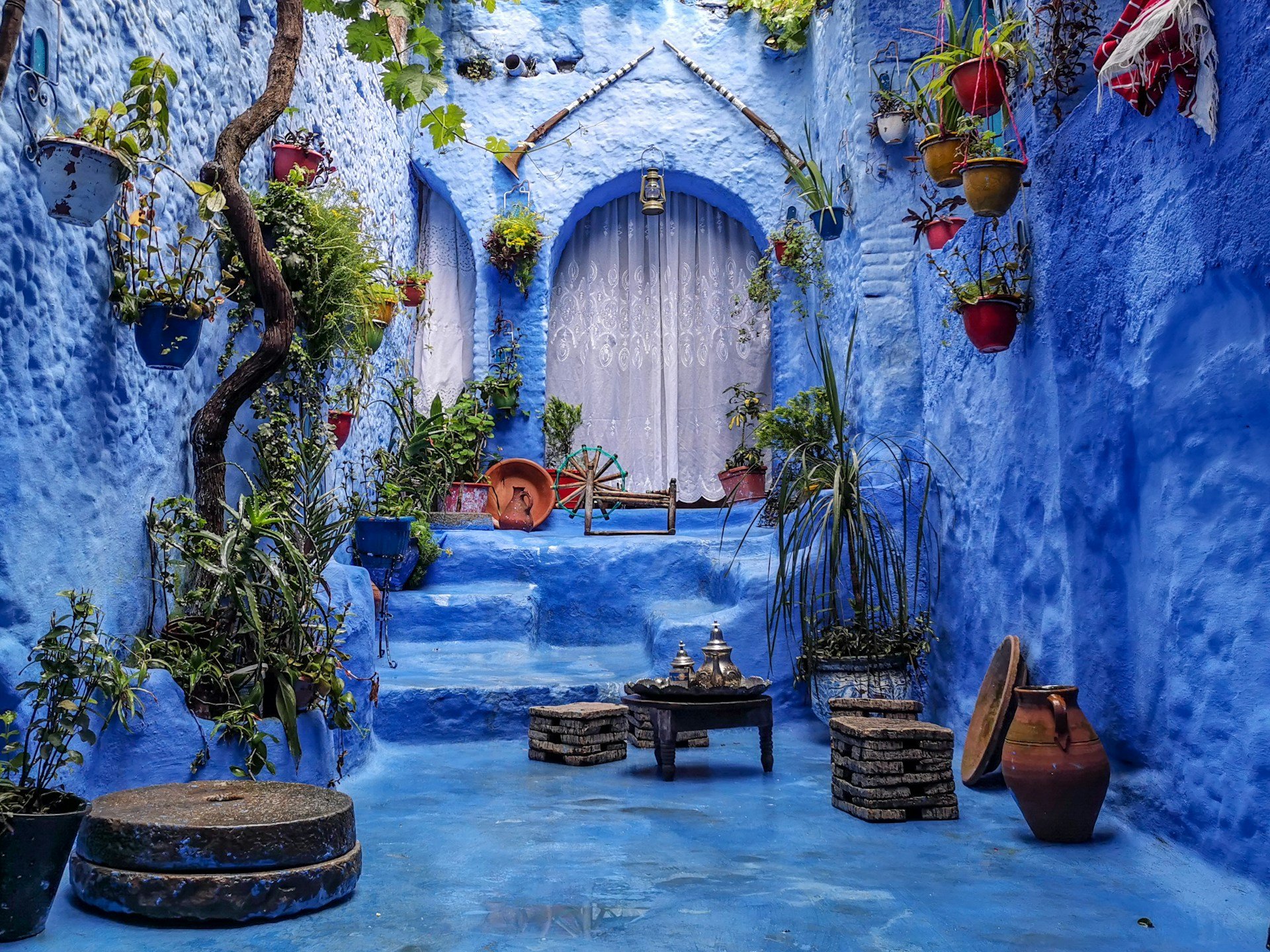
Chefchaouen's old medina, painted almost entirely in shades of blue since the 15th century, sits in the Rif Mountains and has become one of the most photographed places in Morocco without losing its slow, mountain-town pace. The explanations for the blue vary, Jewish refugee tradition, mosquito deterrent, cooling effect, and probably all three contributed over time. It is a genuinely relaxed counterpoint to Marrakech and Fes: fewer touts, cooler air, and hiking access to the Rif's Talassemtane National Park.
Merzouga & Erg Chebbi
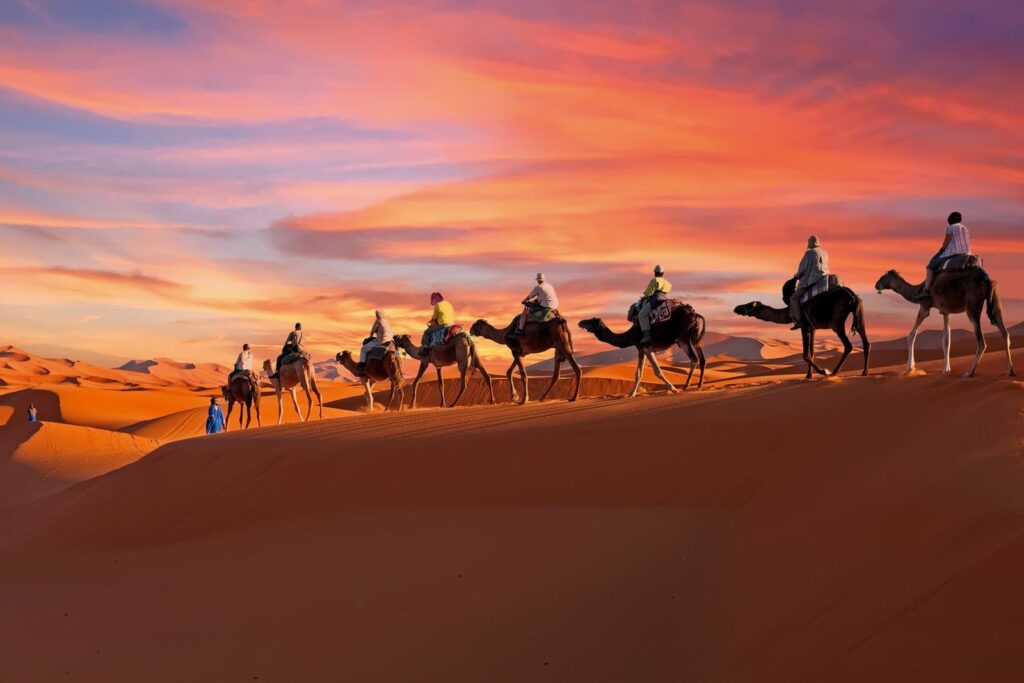
Merzouga, a small village on the edge of the Erg Chebbi dune sea, is the standard gateway for a Sahara overnight: camel trek out to a desert camp before sunset, a night under genuinely dark skies, and a sunrise camel ride back. It is a full day's drive from Marrakech (roughly 9-10 hours, usually broken into a two or three-day loop through the Atlas, Dades and Todra Gorges, and Ouarzazate's kasbahs and film studios) rather than a quick side trip, so build the transit days into your itinerary rather than treating it as an afternoon excursion.
Essaouira
Essaouira, an 18th-century walled port about three hours from Marrakech, trades the interior's heat for Atlantic wind, a working fishing harbor, and a laid-back medina with far less hassle than Marrakech's. It is Morocco's best coastal add-on for travelers who want one slower, cooler day away from the interior circuit.
Casablanca
Morocco's largest city and economic capital is less a sightseeing destination than a transit hub, most travelers pass through its airport, but the Hassan II Mosque, one of the largest mosques in the world with a minaret over 200 meters tall and one of the only mosques in Morocco that admits non-Muslim visitors on guided tours, is worth a half-day detour if you're routing through.
Hidden gems beyond the main circuit
The zones above cover a first or second trip well. With extra days, these reward the detour.
Ourika Valley
A green Atlas foothill valley with the Setti Fatma waterfalls, riverside cafes on wooden platforms, and Berber villages where argan oil is still pressed by hand. The easiest half-day escape from Marrakech's heat.
Todra Gorge
A limestone canyon with 300-meter sheer walls narrowing to a few meters at its base, a genuine rock-climbing destination as well as a dramatic photo stop on the Marrakech-Merzouga loop.
Aït Benhaddou
A UNESCO-listed fortified kasbah village of red earthen architecture, still partly inhabited, and a working film set used for Gladiator, Game of Thrones and dozens of other productions.
Culture & Etiquette
Morocco is a majority-Muslim country where Arab, Amazigh, Andalusian, Saharan and French influences layer visibly on top of each other, in architecture, food and daily rhythm alike. Hospitality is a genuine cultural value: being offered mint tea, sometimes called "Moroccan whisky," is a normal social ritual, not an upsell. Friday is the main day of communal prayer, and non-Muslims cannot enter most working mosques, the Hassan II Mosque in Casablanca is the main exception that offers guided tours.
Do
- Dress modestly in medinas and rural areas. Shoulders and knees covered works for both men and women; beach resorts and modern Gueliz-style neighborhoods are more relaxed.
- Negotiate in souks. Haggling is expected and the opening price is routinely several times the realistic one; a friendly, unhurried back-and-forth is the norm, not a confrontation.
- Use your right hand for eating, greeting and handing over money; the left hand carries different cultural associations.
- Ask before photographing people, particularly in rural villages, and expect a small tip may be requested in return, especially from performers and snake charmers in Jemaa el-Fnaa.
- Learn a few words. Shukran (thank you), salam (hello), la shukran (no thank you, useful for declining touts) go a long way and are genuinely appreciated.
Don't
- Accept unsolicited "guide" help near medina entrances. It is rarely free, and politely but firmly declining early avoids most of the hassle.
- Eat, drink or smoke visibly in public during Ramadan daylight hours, even as a non-Muslim; restaurants catering to tourists generally stay open but keep a low profile about it.
- Raise Western Sahara as casual conversation. It's a live, sensitive political topic for many Moroccans; treat it the way you would treat a genuinely contested territorial dispute anywhere.
- Assume a hammam is co-ed. Public hammams are segregated by sex or run alternating days for men and women; private hotel spas are usually mixed-friendly but check first.
- Let your guard down on "free" gifts. Unsolicited henna application or "free" mint tea in a shop routinely precedes a payment demand; agree a price or decline before anything touches your hand.
Deeper culture: Darija, the hammam ritual, and riad architecture
Darija. The Moroccan Arabic dialect, heavily inflected with Amazigh, French and Spanish loanwords, is what most Moroccans actually speak day to day; it differs enough from Modern Standard Arabic that visitors who know Gulf or Egyptian Arabic will still find it a stretch. Tamazight (Berber), spoken by roughly a third of the population, became a co-official language alongside Arabic in 2011.
The hammam. A traditional steam bath and full-body scrub with a coarse mitt (kessa), a centuries-old ritual rather than a spa gimmick. Public neighborhood hammams are inexpensive, functional and mostly used by locals; private hotel and riad hammams offer a gentler, more tourist-comfortable version at a higher price. First-timers should wear dark swimwear or underwear if self-conscious and expect to be quite thoroughly scrubbed.
Riad architecture. A riad is a traditional house built around an interior courtyard garden or fountain, windows facing inward rather than onto the street, a design that keeps interiors cool and private in a dense medina. Most riad hotels are converted historic homes, which is why room layouts and staircases are often irregular and charmingly inconsistent from room to room.
Food & Drink
Moroccan food layers Berber, Arab, Andalusian and French influences into some of the best-value eating in North Africa: warm spices rather than chili heat, slow-cooked meat and vegetables, and bread with almost every meal. The best of it is often at unmarked neighborhood spots and market stalls rather than the tourist-facing restaurants ringing Jemaa el-Fnaa, where prices run two to three times a local equivalent for a similar plate.
Tagine $4-10
Meat, vegetables and dried fruit slow-cooked in the cone-lidded clay pot that gives the dish its name. Chicken with preserved lemon and olives, and lamb with prunes and almonds, are the two classics worth ordering first.
Couscous $4-9
Steamed semolina with seven vegetables and meat, traditionally served as the Friday family meal after prayers. Restaurants that skip it on other days and feature it prominently on Fridays are doing it the honest, traditional way.
Mint tea $1-2
Green tea, fresh mint and a startling amount of sugar, poured from height to build a foam on top. Offered as a welcome ritual constantly; declining is fine, but accepting once is a good way into a conversation.
Tanjia $5-10
A Marrakech specialty: seasoned meat sealed in an urn-shaped clay pot and slow-cooked for hours in the embers of a hammam furnace, traditionally a bachelor's or workers' dish rather than home cooking.
Pastilla $8-15
A savory-sweet pie of shredded pigeon or chicken, almonds, cinnamon and sugar wrapped in crisp warqa pastry, a Fes specialty that reads strange on paper and works completely in practice.
Harira $1-3
A tomato-based soup with lentils, chickpeas and often lamb, the traditional dish for breaking the fast during Ramadan and a cheap, filling street-stall staple year-round.
When to Go & Itineraries
March-May and September-November are the sweet spots: warm, comfortable days across the interior with cool enough nights that the Sahara overnight is pleasant rather than punishing. June through August pushes past 40°C in Marrakech, Fes and the desert, tolerable on the coast but genuinely brutal inland. Winter brings mild coastal days but cold nights in the Atlas and Sahara, snow is common on the High Atlas passes from December through February.
All four seasons compared, with temperatures
| Season | Verdict | Temps | Prices & crowds |
|---|---|---|---|
| Mar-May & Sep-Nov | Best | 20-28°C Marrakech/Fes, cooler nights in the Sahara | Mid prices, manageable crowds |
| Jun-Aug | Hot inland | 35-42°C+ Marrakech/Sahara, milder on the coast | Busy on the coast, quieter inland; desert daytime is extreme |
| Dec-Feb | Good, cold nights | 12-18°C days, near or below freezing in the Atlas/Sahara at night | Lowest prices; snow possible on Atlas passes |
Year-round rough averages: Marrakech 19°C, Fes 17°C, Chefchaouen 17°C, Essaouira 18°C (mild, windy, little seasonal swing), Merzouga/Sahara 21°C but with the widest day-night swing in the country. Coastal cities stay far more moderate than the interior in every season.
Itineraries
A week covers Marrakech plus one add-on adequately. Two weeks adds the Imperial Cities, Chefchaouen and a proper Sahara loop without rushing the long desert drives.
- Days 1–3
Marrakech. Jemaa el-Fnaa, the souks, Bahia Palace, Majorelle Garden, an evening hammam.
- Day 4
Atlas Mountains day trip. Imlil and a Berber village, or the Ourika Valley waterfalls if you'd rather stay lower and closer.
- Days 5–7
Essaouira or Agafay. Three coastal days in Essaouira for a slower finish, or an Agafay desert overnight for a compressed Sahara-style experience without the full drive east.
- Days 1–3
Marrakech. The full city guide's three-day route.
- Days 4–6
Marrakech to Merzouga. Over the Tizi n'Tichka pass, Aït Benhaddou, Dades and Todra Gorges, arriving Merzouga for a Sahara camel trek and desert camp overnight.
- Days 7–8
Merzouga to Fes. A long transit day via the Middle Atlas, cedar forests and Ifrane's alpine architecture, arriving Fes for two full days in the medina.
- Days 9–10
Chefchaouen. A scenic drive north through the Rif; two slow days in the blue medina.
- Days 11–14
Casablanca & coast. Hassan II Mosque en route, then either Rabat's calmer capital medina or a final coastal stretch before departure.
- Days 1–4
Marrakech extended, plus a full Atlas Mountains day and an Agafay evening.
- Days 5–9
The Sahara loop, unhurried: Aït Benhaddou, Dades Gorge overnight, Todra Gorge, two nights in Merzouga including a second desert evening.
- Days 10–13
Fes & Meknes, with a half-day at Volubilis and Ifrane's cedar forests in between.
- Days 14–16
Chefchaouen & the Rif, with a hike into Talassemtane National Park.
- Days 17–21
The coast, slow: Essaouira for several days, Casablanca on the way out, or Rabat for a calmer capital finish.
Getting there & around
Casablanca's Mohammed V Airport (CMN) is Morocco's main international hub; Marrakech Menara (RAK), Fes-Saïss (FEZ) and Rabat-Salé (RBA) all take direct flights from major European cities too, often the smarter choice if your trip centers on one region. The Al Boraq high-speed train covers Tangier to Casablanca via Rabat in about 2 hours, and the wider ONCF network connects Casablanca, Rabat, Fes and Marrakech comfortably. For the Atlas, Sahara and mountain routes, a private driver or organized multi-day tour is the practical choice over self-driving or public transport; CTM and Supratours long-distance buses cover the same routes cheaper but slower.
All transport options with prices: trains, buses, grand taxis, driving
| Option | Price | Notes |
|---|---|---|
| ONCF trains | $8-30/route | Casablanca-Rabat-Fes-Marrakech corridor; comfortable, book 1st class for long routes. |
| Al Boraq high-speed rail | ~$20-35 | Tangier-Casablanca via Rabat in about 2 hours. |
| CTM / Supratours buses | $5-20/route | Reach towns trains don't, including Chefchaouen and Essaouira; reserve seats for long routes. |
| Grand taxis (shared) | $2-8/route | Shared Mercedes taxis for short intercity hops; leave when full from designated stands. |
| Petit taxis (city) | $1-4 | Metered in theory; confirm the meter is running or agree a price before the ride starts. |
| Private driver / multi-day tour | $60-120/day | The standard way to do the Atlas-Sahara loop; shared costs down if traveling in a small group. |
Driving yourself: rental cars (from about $25-40/day) work well for the coast and open highway but are genuinely stressful in Marrakech, Fes and Casablanca traffic, and mountain and desert routes are better left to a local driver who knows the roads, checkpoints and weather. Morocco drives on the right.
Practical prep: buy a Moroccan SIM at the airport (roughly $5-10 for several GB) or an eSIM before landing; connectivity is good in cities and patchy in the Atlas and Sahara. GetTransfer offers fixed-price airport pickups if you'd rather not negotiate a taxi on arrival.
Where to stay
Budget riads & hostels
Private rooms in a budget riad or hostel dorm bed, concentrated in Marrakech and Fes medinas. Full details and named picks are in the Marrakech city guide's Stay chapter.
Mid-range riads
Converted historic courtyard houses with a rooftop terrace, breakfast and genuine character, the sweet spot for most travelers in Marrakech, Fes and Chefchaouen alike.
Sahara desert camps
Shared or private tents at Erg Chebbi near Merzouga, dinner and breakfast typically included, booked through your Merzouga guesthouse or a Marrakech-based multi-day tour.
Luxury riads & palace hotels
Marrakech's top tier, La Mamounia and Royal Mansour among the best known, delivers genuinely exceptional gardens, spas and service at a price that rivals any luxury hotel in Europe.
Budget Planning
Morocco is still one of the more affordable serious travel destinations within reach of Europe, though Marrakech's tourist zones have gotten noticeably pricier over the last decade. Step outside the main squares and souks and prices drop fast.
- Hostel dorm or budget riad room $10-25
- Street food & local restaurants $3-8
- CTM buses and grand taxis
- Free souks and squares, one paid site
- Private riad with breakfast $40-100
- Restaurant meals $8-20/person
- Private driver or multi-day tour share
- Hammam, cooking class, guided sites
- 4 and 5-star riads and hotels
- Fine dining and private guides
- Private driver throughout
- Desert camp upgrades, spa days
Quick reference prices: tea, taxis, hammams, entry fees
| Mint tea at a cafe | $1-2 |
| Street-food tagine or grilled skewers | $3-6 |
| Restaurant meal (mid-range) | $8-20 |
| Petit taxi, short city ride | $1-4 |
| Public hammam entry | $2-5 |
| Private riad hammam & massage | $25-60 |
| Marrakech-Fes train (2nd class) | ~$12-18 |
| Palace or museum entry | $5-12 |
| Sahara overnight camel trek & camp | $30-80/person |
Prices reflect August 2026 research and drift over time, especially Marrakech accommodation in peak season. Treat them as a planning baseline, not a quote.
Visa & Entry
Morocco has a permissive visa regime for most Western passports: US, EU, UK, Canadian and Australian citizens enter visa-free for up to 90 days with no advance eVisa needed, just a passport valid at least 6 months beyond arrival and a completed arrival card, usually handed out on the plane or at the border. Rules do change; the official Moroccan Ministry of Foreign Affairs is the authoritative source, not the third-party paid "e-visa" sites that rank well in search but charge for something that's often unnecessary for these nationalities.
✓ Valid passport
At least 6 months validity from date of entry. Keep a photocopy separate from the original.
✓ Return/onward ticket
May be requested at immigration, particularly for air arrivals without an onward booking.
✓ Arrival card
A short customs and immigration form completed on the plane or at passport control; keep the stamped copy until departure.
✓ Currency limits
Up to 2,000 MAD in cash may be brought in or taken out per person; the dirham cannot be exchanged back once you've left Morocco.
| Morocco | Tunisia | |
|---|---|---|
| Landscape range | Atlantic coast, two mountain ranges, the Sahara, all in one trip | Mediterranean coast and a smaller slice of Sahara near Douz |
| Medinas | Marrakech and Fes: larger, more intense, more hassle | Tunis and Sousse: smaller-scale, generally calmer |
| Budget | $30-60/day gets you far | Similarly affordable, often slightly cheaper outside Djerba |
| Visa | Free, 90 days for US/EU/UK/CAN/AUS | Free, 90 days for most Western passports too |
| Getting there from Europe | Direct flights from most major hubs, ~3 hrs from Madrid | Direct flights from Southern Europe, ~2 hrs from Rome |
Safety, Solo Women & Family
The US State Department rates Morocco Level 2, Exercise Increased Caution, citing ongoing terrorism concerns: the advisory, last reissued in April 2025, notes that terrorist groups continue plotting possible attacks and have historically targeted tourist locations, transportation hubs, markets, malls and government facilities. This is the same tier as France, Germany or the UK, not a reason to avoid Morocco, but a reason to stay genuinely alert in crowded, high-profile spots rather than treat the advisory as background noise. In practice, the far more common problems for visitors are petty scams and persistent medina hassle, not violence.
Petty theft & pickpocketing
Occurs in crowded souks, Jemaa el-Fnaa and bus and train stations at the level of any busy tourist city. Keep bags zipped and in front of you in dense crowds.
Traffic
Chaotic city driving and mopeds weaving through medina alleys are a bigger everyday risk than crime. Look both ways repeatedly, even on pedestrian streets.
Medina disorientation
Getting lost in Marrakech's or Fes's medina is normal and part of the experience, but it's also how unsolicited "guides" find their targets. Download offline maps and expect a wrong turn or two.
Two more things worth knowing: the 2023 earthquake zone and border areas
The High Atlas earthquake zone. The September 2023 quake killed nearly 3,000 people in the High Atlas villages southwest of Marrakech. Central Marrakech and the standard tourist circuit were not structurally devastated and have fully recovered, but some rural mountain villages on trekking routes are still rebuilding two years on; ask a local trekking operator directly about the current status of any specific village before booking.
Western Sahara & the Algeria border. Morocco's land border with Algeria has been closed for years and is not a tourist route in any case. Western Sahara, south of Agadir, sees far less tourism infrastructure than the rest of the country and is best visited, if at all, with a Morocco-based operator experienced in the region rather than independently.
The 3 scams to actually know about
Morocco is not a high-violence destination for tourists, but it is a high-hassle one in the main medinas, and three patterns account for most bad experiences. The full country list lives on our Morocco travel alerts page.
Unofficial "guides"
Someone offers unsolicited directions or a "free" tour near a medina entrance, then leads you into shops paying them commission and eventually demands payment for their time. Politely decline before it starts, or state a firm "la, shukran" and keep walking.
The henna scam
Women in tourist squares grab a hand and apply henna uninvited, calling it "a gift," then demand 200-500 MAD once it's on. Keep your hands to yourself and decline clearly before any contact is made.
Overcharging
Souk opening prices routinely run several times the realistic final price, and some taxi drivers avoid the meter and quote inflated flat fares. Haggle unhurriedly in shops, and insist on the meter or agree a price with taxis before the ride starts.
Solo women travelers
Morocco is broadly manageable for solo women, but street harassment, persistent comments, unwanted attention and occasional following in medina alleys, is a real and commonly reported experience rather than a rare exception. It is overwhelmingly verbal rather than physical, and concentrated in the busiest tourist medinas. Dressing modestly (shoulders and knees covered), walking with visible purpose, avoiding empty alleys after dark, and using a registered taxi rather than walking alone at night meaningfully reduce the hassle without eliminating it entirely. Riad and hostel staff are generally happy to walk or arrange transport for solo female guests after dark if asked. Full detail on our Solo Woman Explorer pages.
Emergency numbers
Fire service, embassies and practical prep
Call 15 for fire and civil protection. 112 works from any mobile phone and connects to the nearest dispatch center, a useful fallback if you're unsure which number applies. The US maintains its main consular presence in Casablanca; most other Western embassies are based in Rabat, the political capital.
- USA (Casablanca)
- +212-522-642-000
- UK (Rabat)
- +212-537-633-333
- France (Rabat)
- +212-537-689-700
- Germany (Rabat)
- +212-537-219-500
- Canada (Rabat)
- +212-537-544-949
- Australia (via Paris)
- +33-1-4059-3300
Health prep: tap water is treated but travelers generally stick to bottled or filtered water, especially outside major cities; standard travel insurance with medical evacuation coverage is worth having for the Atlas and Sahara legs, where the nearest hospital can be hours away.
Family travel & pets
Morocco works well for families with some planning: riads with rooftop pools, camel rides, and the sensory overload of the souks generally land well with kids, and Moroccan culture is warmly welcoming toward children. The main practical challenges are medina traffic (mopeds in narrow alleys require close supervision), uneven cobbled ground, and heat in summer; the Sahara overnight is more comfortable for children over 7 or 8 who can manage a camel ride and a night in a desert camp.
Pets, food safety for kids, and desert-trip age advice
Pets: EU pet passport holders can generally enter with dogs and cats given valid rabies vaccination and microchipping; non-EU visitors typically need a veterinary health certificate and current rabies vaccination, requirements are stricter and less standardized than in the EU, so confirm directly with a Moroccan consulate well ahead of travel.
With younger kids: stick to bottled water, peeled fruit and freshly cooked food from busy stalls; the Marrakech medina's density and traffic mean a stroller is impractical, a baby carrier works far better. The multi-day Sahara loop's long driving days are the main stamina test for younger children rather than any single stop.
Morocco FAQ
Is Morocco safe to visit?
Mostly yes, with current information rather than old assumptions. The US State Department rates Morocco Level 2, Exercise Increased Caution, over terrorism concerns, the same tier as France, Germany or the UK, not a reason to avoid the country but a reason to stay alert in crowded tourist spots. The more common problems are petty scams and medina hassle, not violent crime.
Do I need a visa for Morocco?
Citizens of the US, EU, UK, Canada and Australia can enter visa-free for up to 90 days with a passport valid at least 6 months beyond arrival. An arrival card is completed on the plane or at the border, and there is no advance eVisa requirement for these nationalities.
How much does Morocco cost per day?
Budget travelers manage on $30-60 a day using hostels, riad budget rooms and street food; mid-range with private riads, restaurant meals and guided day trips runs $80-150; comfortable trips with 4 and 5-star hotels and private drivers push $200-400 or more.
When is the best time to visit Morocco?
March-May and September-November: warm days, cool enough nights, and the Sahara is bearable rather than brutal. July and August exceed 40°C in Marrakech, Fes and the desert; winter brings cold nights in the Atlas and Sahara despite mild coastal days.
How many days do you need in Morocco?
A week covers Marrakech, an Atlas Mountains day and a Sahara overnight. Ten to fourteen days adds Fes, Chefchaouen and the coast without feeling rushed on the long desert drives.
What language is spoken in Morocco?
Arabic and Tamazight (Berber) are both official languages; most Moroccans speak Darija, the local Arabic dialect, at home. French is widely used in business, government and education, and English is increasingly common in tourist areas, especially with younger Moroccans.
Is Marrakech safe after the 2023 earthquake?
Yes. The September 2023 earthquake was centered in the High Atlas about 71km southwest of Marrakech; central Marrakech's tourist circuit was not structurally devastated and has fully recovered, with tourism revenue now above pre-earthquake levels. Some rural High Atlas villages are still rebuilding, so ask a local operator about the current status of any specific mountain village on your route.
Is Morocco safe for solo female travelers?
Generally yes, but street harassment in the form of persistent comments and unwanted attention is a real and common experience, especially in medina alleys. Dressing modestly, walking with confidence, and using registered taxis at night meaningfully reduce hassle without eliminating it.
Can you drink alcohol in Morocco?
Yes, Morocco is not dry. Alcohol is sold in most hotels, tourist restaurants, and licensed bars and supermarkets outside the medina, though it is not sold or consumed openly during Ramadan daylight hours or in more conservative rural areas.
What currency does Morocco use, and can I get dirhams before I arrive?
The Moroccan dirham (MAD), a closed currency that cannot be bought in meaningful quantity outside Morocco or exchanged back once you leave. Withdraw or exchange cash after arrival at the airport, a bank or an exchange office, and keep receipts if you want to convert leftover dirhams back before departure.
Is Morocco good for families with kids?
Yes, with some planning. Riads with rooftop pools, camel rides, and the sensory overload of the souks land well with kids, but the medina's traffic, uneven ground and heat require close supervision, and the Sahara overnight is better suited to children over 7 or 8.
What Stays With You
Every traveler who visits Morocco comes home with a version of the same story: the moment the medina stopped being confusing and started being wonderful, the tea that appeared before anyone asked, the dunes turning from gold to pink to grey as the sun dropped. None of it is staged for tourists, it is simply how the place runs, and it has been running roughly that way since dynasties that no longer exist anywhere else were building the walls you're walking through.
Go with a little patience for the hassle and a genuine willingness to get lost, literally, in the souks. That's where Morocco actually happens.