
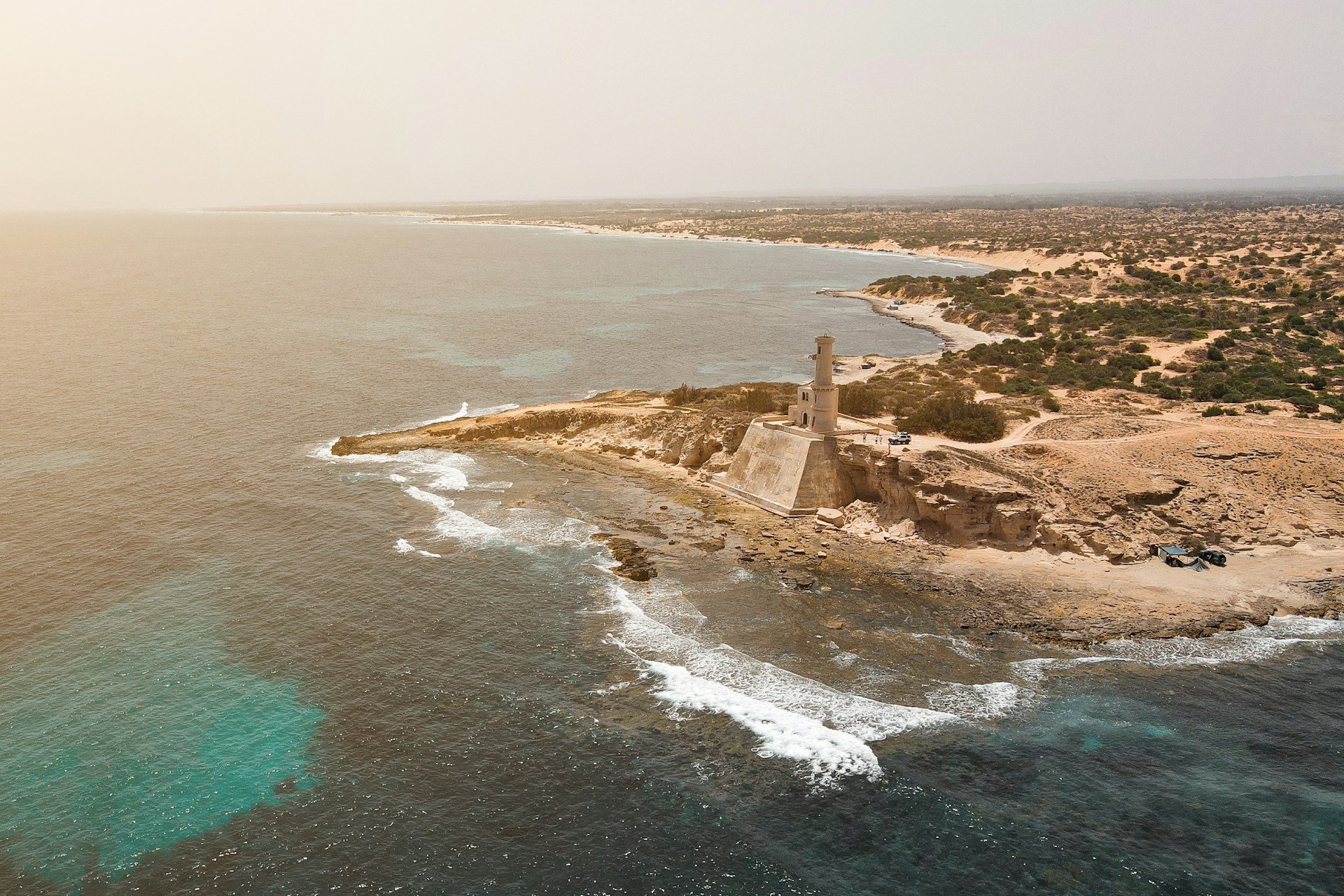
A Country of Extraordinary Ruins and an Unresolved War
Libya holds some of the finest Roman archaeological sites left standing anywhere, preserved in large part because almost nobody has been able to visit them for over a decade. Leptis Magna and Sabratha, both UNESCO World Heritage Sites on the Mediterranean coast near Tripoli, rank among the best-preserved Roman cities in the world: full theatres, basilicas, forums and bathhouses that draw comparisons to Pompeii, without the crowds, because there are essentially no crowds.
That absence of visitors is not an accident of obscurity. Libya has been politically divided since 2014, currently split between the Tripoli-based Government of National Unity, internationally recognized and led by Prime Minister Abdul Hamid Dbeibah, and an eastern administration under Prime Minister Osama Hammad backed militarily by Field Marshal Khalifa Haftar's Libyan National Army. A planned 2026 election meant to reunify the country's institutions failed to take place in April as the two sides remained deadlocked, and the political process, while showing intermittent momentum, has not produced a resolution.
The honest complications
This is not a guide written to encourage a visit. Libya carries a Level 4, Do Not Travel advisory from the US State Department, the same tier as Afghanistan, Syria and Yemen, and equivalent advisories from the UK Foreign, Commonwealth and Development Office, Global Affairs Canada and Australia's Smartraveller. The US Embassy in Tripoli has been suspended since July 2014 and cannot help American citizens in the country. Independent tourism does not exist: every foreign visitor enters through a licensed Libyan tour operator, who sponsors the visa, provides a Letter of Invitation, and runs a pre-arranged itinerary, typically with security coordination at sites and checkpoints. A small number of specialist operators do run such trips, mostly focused on Tripoli, Leptis Magna and Sabratha, and this guide describes what that kind of trip involves, honestly and without romanticizing a country that remains, in the plainest terms, at war with itself.
What the Advisory Actually Says
On 11 January 2026, the US State Department placed Libya under Level 4, Do Not Travel, its highest-severity advisory, citing crime, terrorism, civil unrest, armed conflict, kidnapping and unexploded landmines across the country. The UK FCDO advises against all travel to Libya except for Benghazi, Al-Bayda, Derna and the Jebel Akhdar region in the east: Tripoli itself is not part of that limited exception and sits under a full advise-against-all-travel rating. Global Affairs Canada and Australia's Smartraveller maintain equivalent top-tier warnings.
No US consular help
The US Embassy in Tripoli has suspended operations since July 2014 and cannot provide emergency or routine assistance. American citizens needing help must contact the US Embassy in Tunis, Tunisia, a different country, by phone or in person.
Kidnapping
Kidnapping of foreign nationals for ransom or political leverage has occurred repeatedly since 2011 and is cited by name in the US advisory. It is the reason independent travel and unescorted movement are not viable options for visitors.
Landmines & UXO
Thousands of unexploded landmines and improvised explosive devices remain from successive rounds of conflict, concentrated near former frontlines and in southern desert areas. Stay strictly within areas cleared and used by your licensed guide.
Two more things worth knowing: the political split and checkpoints
A country still split in two. Since 2014, Libya has had two competing seats of power: the Tripoli-based Government of National Unity, which controls the capital and most of the west, and an eastern administration backed by Khalifa Haftar's Libyan National Army. A UN-backed roadmap and a US-proposed four-pillar plan, covering a unified budget, unified military institutions, a unified government and elections, were both under discussion in 2026, but a planned April election did not happen and the country remains administratively divided.
Checkpoints and militia presence. Armed checkpoints operated by a range of state and non-state armed groups are a normal feature of movement around Tripoli and between cities. Licensed tour operators route around known friction points and handle checkpoint interactions directly; this is a core part of what their fee covers, not an optional extra.
Emergency numbers
Sources disagree on Libya's emergency numbers, with some listing 1515 (general), 1516 (ambulance), 1517 (fire) and 1518 (police), and others citing different combinations entirely. Treat none of these as reliable and lean on your licensed tour operator, who maintains direct contacts for exactly this reason, rather than a hotline.
If something goes wrong: your tour operator, not an embassy
With the US Embassy in Tripoli suspended and most other Western missions operating on a reduced or fly-in basis, your licensed tour operator is, in practice, the primary point of contact for any problem during a Libya trip, from a medical issue to a checkpoint delay. Confirm their emergency contact procedure before you travel, and keep the contact details for your home country's nearest functioning embassy (for US citizens, the Embassy in Tunis, Tunisia) with you separately.
A History Worth Knowing
Libya's coast was Roman Africa's western breadbasket for centuries before Ottoman rule from 1551, a brutal Italian colonization from 1911 to 1943, and independence in 1951 as a kingdom under King Idris I, the first country to gain independence through the United Nations. A 1969 coup brought Muammar Gaddafi to power for 42 years, ended by the 2011 revolution and the civil war and fragmentation that has followed ever since.
- 1551
Ottoman rule begins. The Ottoman Empire takes Tripoli from Spanish and Knights of Malta control, governing the region for over three centuries.
- 1911-1943
Italian colonization. Italy invades following the Italo-Turkish War, later merging Tripolitania and Cyrenaica into a single colony in 1934. Colonial rule is widely documented as brutal, including mass internment of Libyans in concentration camps in the 1930s.
- 1951
Independence. The United Kingdom of Libya becomes independent under King Idris I, the first state to gain independence via a United Nations resolution.
- 1969
Gaddafi's coup. A group of young military officers led by Muammar Gaddafi overthrows the monarchy on 1 September, beginning 42 years of single-party rule.
- 2011
Revolution and civil war. Protests beginning 17 February spread nationwide within days; Gaddafi's government falls on 20 October after a NATO-backed intervention, with estimates of over 30,000 killed in the fighting.
- 2014-present
Split governance. Rival parliaments and governments emerge in Tripoli and the east from 2014 onward; the US Embassy suspends Tripoli operations that July. A 2020 ceasefire holds without producing unification, and a planned 2026 election fails to take place in April amid continued deadlock.
Read the full history: colonization, Gaddafi and the post-2011 fragmentation
Libya's Roman-era prosperity, visible today at Leptis Magna, Sabratha and Cyrene, gave way over the centuries to Ottoman provincial rule, then to one of the more severe colonial occupations in North Africa: Italy's campaign against Libyan resistance in the 1920s and 1930s, associated with figures like the executed resistance leader Omar Mukhtar, involved forced displacement and internment on a scale that left a lasting imprint on Libyan national memory.
King Idris I's kingdom, built on federated Tripolitania, Cyrenaica and Fezzan provinces, was overturned in a bloodless 1969 coup by Muammar Gaddafi, then 27, who ruled through his idiosyncratic Jamahiriya system and the political philosophy set out in his Green Book until the 2011 uprising, part of the wider Arab Spring, ended his 42-year rule and his life.
What followed 2011 was not stabilization but fragmentation: competing parliaments, militias aligned with different regions and patrons, and, from 2014, two parallel seats of government that persist in modified form today, the Tripoli-based Government of National Unity and an eastern administration backed by the Libyan National Army under Khalifa Haftar. International mediation, most recently a UN-backed roadmap and a US-proposed plan covering a unified budget, military and government ahead of elections, has produced periods of calm without a durable political settlement, and the country remains, as of this guide, administratively split.
Tripoli, Leptis Magna & Sabratha
Libya has five UNESCO World Heritage Sites, all inscribed for their Greek, Roman and pre-Saharan heritage, and all five were added to UNESCO's List of World Heritage in Danger in 2016 because of the conflict. In practice, current licensed itineraries from Tripoli concentrate on the capital and the two closest Roman sites; Cyrene, in the contested east, and the desert oasis town of Ghadames near the Algerian and Tunisian borders, are far harder to reach safely and sit outside most standard Tripoli-based trips today.
Tripoli, the only practical base
Tripoli is Libya's capital, largest city and the seat of the Government of National Unity, and it is the only city with functioning international flights, hotel infrastructure and licensed tour operators, which makes it the base for essentially every visit that happens at all. The Old Medina holds the Arch of Marcus Aurelius, the only standing structure of Roman Oea, built in 163 AD, and the Red Castle (As-Saraya al-Hamra), a fortress overlooking Martyrs' Square that today houses Libya's National Museum and Antiquities Department. Read the full Tripoli city guide for what a licensed visit to the capital actually covers.
Leptis Magna, one of Rome's best-preserved cities
Leptis Magna sits on the coast around 120 km east of Tripoli, roughly a two-hour drive on a licensed day tour. Founded by Phoenicians and expanded dramatically under Emperor Septimius Severus, who was born there, it preserves a triumphal arch, a market, a theatre, basilicas and an entire bath complex at a scale and level of preservation that draws comparisons to Pompeii. It was inscribed as a UNESCO World Heritage Site in 1982 and, along with Libya's four other sites, added to the List of World Heritage in Danger in 2016.
Sabratha, the coastal counterpart to the west
Sabratha lies roughly 70-80 km west of Tripoli, about an hour to ninety minutes by road on a licensed tour. Originally a Phoenician trading post before becoming a Roman city, its sea-facing theatre, one of the best-preserved in the Roman world, and its temple ruins and mosaics make it a natural pairing with Leptis Magna on a multi-day western Libya itinerary, and some operators combine both sites with Tripoli in a single three-day package.
Culture & Etiquette
Libya is an overwhelmingly Sunni Muslim, Arabic-speaking country, with a Berber (Amazigh) minority concentrated in the Nafusa Mountains and a few other regions who maintain their own Tamazight languages and cultural traditions alongside Arabic. Libyan hospitality is genuine and deeply rooted, and the licensed guides and drivers who accompany visitors are typically the primary point of cultural contact on an organized trip.
Do
- Dress conservatively. Cover shoulders and knees for both men and women; women should carry a headscarf for mosque visits, and modest dress is expected in all public settings, not just religious sites.
- Follow your guide's instructions on photography. Ask before photographing people, and never photograph checkpoints, military or government buildings, ports or airports; this is enforced strictly and inconsistently.
- Expect Ramadan to change daily rhythms. Many restaurants and shops adjust hours during the fasting month; eating or drinking in public during daylight hours is best avoided out of respect.
- Learn a few Arabic phrases. Shukran (thank you) and salam alaikum (a greeting) go a long way with guides, drivers and hotel staff.
Don't
- Bring or seek out alcohol. Production, sale and consumption of alcohol is illegal throughout Libya and enforced with real penalties.
- Discuss politics casually. The Tripoli-east divide, Gaddafi-era nostalgia and current militia affiliations are sensitive subjects; let local contacts raise them if they choose to, rather than asking directly.
- Stray from your licensed itinerary. Unescorted exploration, including in Tripoli itself, defeats the entire safety rationale of traveling through a licensed operator in the first place.
- Assume any passport with Israeli stamps or evidence of Israeli travel will be accepted. Entry restrictions apply and can result in denial of entry.
Food & Drink
Libyan cuisine layers Berber, Arab, Mediterranean, Ottoman and Italian influences, built around couscous, bread and richly spiced tomato-based sauces flavored with cumin, coriander, caraway and mint. Meals on a licensed tour are typically eaten at the hotel or at restaurants the operator has already vetted, since independent restaurant-hopping is not part of how a Libya trip works.
Couscous
Widely considered Libya's national dish, made from semolina wheat and served with lamb, chicken or vegetable stew. Couscous bil bosla, layered with chickpeas, potatoes and lamb, is a common festive version and turns up at hotel restaurants across Tripoli.
Bazin
An unleavened barley dough, boiled and then beaten into shape with a stick called a magraf, traditionally served in a communal dome shape with lamb and a spicy tomato sauce poured over the top.
Shakshuka
Libya's version simmers tomatoes, onions and peppers with cumin and coriander, topped with a fried egg and scooped up with bread. Common at breakfast in Tripoli hotels and restaurants alike.
When to Go, Getting There & Getting Around
March to May and October to November bring the mildest Mediterranean coastal weather, with daytime temperatures around 19-26°C. Summer (June to August) is hot, with Tripoli highs regularly near 30-32°C, and the Ghibli, a hot, dust-laden desert wind, can arrive anywhere from March to June and make conditions genuinely unpleasant for a day or two at a time. None of this changes the underlying Do Not Travel advisory: seasonal comfort is a secondary consideration to the security situation.
Climate detail and the Ghibli wind
| Season | Verdict | Temps (Tripoli) | Notes |
|---|---|---|---|
| Mar-May & Oct-Nov | Mildest | 19-26°C | Best coastal weather; Ghibli wind risk March-June |
| Jun-Aug | Hot | 28-32°C | Dry, minimal rainfall |
| Dec-Feb | Mild, wet | 16-22°C | January is the wettest month |
Tripoli has a Mediterranean climate: hot, dry summers and mild, wetter winters, with around 289mm of annual rainfall concentrated between November and February.
Getting there & around
Mitiga International Airport (MJI), on the eastern edge of Tripoli, is the country's main functioning international gateway. Libyan Airlines, Afriqiyah Airways, Buraq Air, Turkish Airlines, EgyptAir, Royal Jordanian and ITA Airways serve it, with routes to Istanbul, Cairo, Rome, Tunis, Amman, Doha and Dubai among others, and bmi Regional runs seasonal European routes from the UK. There is no independent car rental or public transport system set up for foreign tourists: getting around Libya, including within Tripoli, happens in a vehicle arranged by your licensed tour operator, with a driver and typically an English-speaking guide.
Budget Planning
Libya does not have a conventional per-day traveler budget, because independent travel is not possible. Costs are structured around all-inclusive packages from licensed operators such as RJ Travel Agency and IntoLibya, which bundle the visa sponsorship, Letter of Invitation, hotels, transport, English-speaking guides and site entry into a single price for a fixed itinerary, typically three to thirteen days.
Visa & entry costs
The eVisa fee is 63 USD, and every visitor must carry at least 1,000 USD (or the equivalent in another major currency) in cash on arrival, a requirement checked at entry. Extensions of the 30-day stay cost an additional fee at the Passports & Nationality Authority.
Package-based, not daily
Licensed operators quote fixed package prices covering the whole trip rather than a per-day rate; RJ Travel Agency runs monthly guaranteed group departures through 2027, alongside private itineraries. Confirm exactly what's included (visa, transfers, hotels, meals, guide) before booking, since packages vary in scope.
Visa & Entry
Libya launched an eVisa system in March 2024, but it cannot be used independently: every application requires sponsorship by a licensed Libyan tour operator, who issues a Letter of Invitation certified by Libya's Passports and Nationality Authority. The eVisa costs 63 USD, allows a single entry valid for 90 days, and permits a stay of up to 30 days, extendable once for a further 30 days with a sponsor letter.
✓ Licensed tour operator sponsorship
Mandatory. Operators such as RJ Travel Agency and IntoLibya handle the Letter of Invitation and visa application as part of booking a trip; there is no route to a Libyan tourist visa without one.
✓ Passport valid 6 months
Required from date of entry, plus two passport photos and a return or onward ticket.
✓ Minimum $1,000 cash
Checked on arrival. Bring the required amount in USD, EUR or another major currency in good physical condition.
✓ Yellow fever certificate
Required only if arriving from a country with risk of yellow fever transmission; not required for most Western passport holders arriving direct from home.
| Libya | Algeria | |
|---|---|---|
| Travel advisory | Level 4, Do Not Travel | Lower-tier caution advisories in most regions |
| Access | Licensed tour operator only, no independent travel | Independent travel possible with standard visa process |
| Roman & ancient ruins | Leptis Magna, Sabratha: exceptional, near-empty | Djemila, Timgad: comparably exceptional, also lightly visited |
| US embassy presence | Suspended since 2014 | Operating normally |
| Political situation | Split between rival governments since 2014 | Single national government |
Libya FAQ
Is Libya safe to visit?
No. The US State Department rates Libya Level 4, Do Not Travel, its most severe rating, citing crime, terrorism, civil unrest, armed conflict, kidnapping and landmines. The UK, Canada and Australia maintain equivalent advisories. This guide describes what an organized, licensed-tour visit involves, not a recommendation to go.
Do I need a visa for Libya?
Yes, and it cannot be arranged independently. Libya's eVisa requires sponsorship by a licensed Libyan tour operator, who provides a Letter of Invitation. It costs 63 USD, allows a single entry valid 90 days, and permits a stay of up to 30 days, extendable once.
Can I travel around Libya independently?
No. Independent tourism is not permitted. All foreign visitors travel through a licensed tour operator, who arranges the visa sponsorship, itinerary, drivers, guides and, in practice, coordination with security escorts at sites and checkpoints.
Is Libya currently in a civil war?
Libya has been divided since 2014 between the Tripoli-based, internationally recognized Government of National Unity and an eastern administration backed by the Libyan National Army. A planned 2026 election failed to take place in April, and the political and security situation remains unresolved.
Does the US have an embassy in Libya?
No. The US Embassy in Tripoli has suspended operations since July 2014 and cannot provide emergency or routine consular assistance inside the country. US citizens needing help must contact the US Embassy in Tunis, Tunisia.
What is the currency in Libya?
The Libyan dinar (LYD), subdivided into 100 dirhams. Licensed tour operators typically handle currency logistics as part of a package; visitors are required to carry at least 1,000 USD or the equivalent in cash on arrival.
What are Libya's main historical sites?
Leptis Magna and Sabratha, two of the best-preserved Roman cities on the Mediterranean, both reachable on a licensed day tour from Tripoli. Cyrene and the desert oasis town of Ghadames are also UNESCO World Heritage Sites but sit outside most current Tripoli-based itineraries.
Is alcohol allowed in Libya?
No. The production, sale and consumption of alcohol is illegal throughout Libya, with strict enforcement. Visitors should not bring or attempt to obtain alcohol.
What language is spoken in Libya?
Arabic is the official language. A Berber (Amazigh) minority in the Nafusa Mountains and elsewhere speaks Tamazight languages alongside Arabic. English is understood in tourism and hotel contexts in Tripoli, especially through licensed guides.
When is the best time to visit Libya?
March to May and October to November, when temperatures on the Mediterranean coast are mild. Summer (June to August) is hot, and March to June can bring the Ghibli, a hot, dust-laden desert wind. None of this changes the underlying Do Not Travel advisory.
What This Guide Is Really For
Libya is not a place this guide can responsibly recommend visiting, and it hasn't tried to. It exists for the small number of people who are going anyway, through a licensed operator, with their eyes open, and for everyone else who wants an honest answer about what Leptis Magna, Sabratha and Tripoli actually involve right now rather than a vague sense of danger or an equally vague sense of hidden-gem adventure. Both instincts miss the specific, current reality: a divided country, a genuinely severe travel advisory, and ruins that will still be extraordinary whenever the situation changes enough for more people to see them safely.
If that day comes, the two-hour drive out to Leptis Magna's Severan Arch will be waiting exactly as it is now. There is no reason to rush it.