
What You're Actually Getting Into
Chad is the fifth-largest country in Africa, straddling the line between the Sahara in the north, the semi-arid Sahel through the center, and greener savanna in the south, with a population of roughly 19 to 20 million spread thinly across it. It holds Zakouma National Park, a genuine conservation success story with more elephants than anywhere else in Central Africa, and the Ennedi Plateau, a UNESCO World Heritage desert landscape that very few outsiders have photographed. It also holds decades of coups, civil war and, most recently, a rating from the US State Department as one of a small handful of countries the government tells its own citizens not to visit at all.
This guide exists because people do still travel here, mostly on organized wildlife or Saharan expeditions run by specialist operators, mostly through N'Djamena, and mostly outside the areas the advisories specifically flag. It is written for that traveler, not as an invitation to anyone weighing whether Chad is a reasonable spontaneous trip. It is not. Read the safety chapter before anything else on this page.
Why this guide is different from most Atlas Guide country pages
Most of the destinations on this site are places we can recommend without much qualification. Chad is not one of them. The advisory chapter comes second on this page instead of ninth, the itinerary and budget chapters are shorter than usual because ordinary independent travel is not realistic here, and every venue or price named in this guide has been checked against current sources rather than carried over from an older edit. Where we could not verify something, we left it out rather than guess, and we say so where it's relevant.
The Advisory, in Plain Language
The US State Department rates Chad Level 4, Do Not Travel, the same category as Afghanistan, Syria and North Korea, in an advisory last renewed in April 2026. The stated reasons are crime, terrorism, unrest, kidnapping, landmines and inadequate health infrastructure. Outside N'Djamena, the US government's ability to provide emergency assistance to its own citizens is extremely limited, and its own employees need special authorization to travel beyond the capital.
Crime
Both violent and petty crime occur, including armed robbery, carjacking and home invasion. Risk is highest after dark and outside the capital.
Kidnapping
Kidnapping for ransom is a documented risk, particularly in border areas and the Lake Chad basin, where instability spills over from neighboring Nigeria and Niger.
Unrest & healthcare
Protests can turn violent with little warning, and medical care is extremely limited even in N'Djamena. Comprehensive evacuation insurance is not optional here, it's the baseline.
What this means in practice for the trips this guide covers
The organized trips that do run, Zakouma safaris and Ennedi expeditions, operate through specialist operators who manage local logistics, vetted drivers and guides, and often coordinate directly with regional authorities. They are not a workaround for the advisory, they are the version of Chad travel that currently exists at all, and even these are for experienced, well-prepared travelers rather than a first African trip. Independent backpacking, self-drive touring or spontaneous travel outside N'Djamena is not something this guide can responsibly walk you through.
Landmines are a residual risk from decades of conflict in specific, generally well-marked rural areas, mostly in the east and north; stay on established roads and tracks and never touch unfamiliar ordnance. Registering with your embassy before travel, and confirming your operator's current security guidance immediately before departure rather than relying on this page alone, are both essential: advisories and on-the-ground conditions in Chad change faster than an annually updated guide can track.
Emergency numbers
US Embassy N'Djamena contact information
The US Embassy in N'Djamena's main line is +235 22 51 50 17 (Monday-Thursday 7:30am-5pm, Friday 7:30am-12:30pm), with an after-hours emergency number at +235 63 51 78 00 for US citizens. From outside Chad, the State Department's 24/7 citizen services line is +1-202-501-4444.
Solo travelers & women
This is not a country this guide can recommend for solo or first-time African travel under current conditions, regardless of gender. Every organized trip currently operating routes travelers through a specialist operator with a driver, guide and fixed itinerary rather than independent movement, and that structure is itself part of what makes travel here survivable rather than reckless. If Chad is genuinely the trip, book through an operator with verifiable, current experience in the specific region you're visiting, and do not deviate from their plan.
A History Worth Knowing
Chad's human story is older than almost anywhere else on Earth: Sahelanthropus tchadensis, nicknamed Toumaï, was found in the Djurab Desert in 2001 and dated to roughly 7 million years old, among the earliest hominid remains ever discovered. Millennia later, the Sao people built settlements along the Chari River, absorbed in turn by the Kanem-Bornu Empire, which controlled trans-Saharan trade around Lake Chad from around the 9th century into the 19th. French colonization folded the territory into French Equatorial Africa; independence came on 11 August 1960 under François Tombalbaye, followed by decades of coups, civil war and instability that outside visitors are still, in effect, navigating around today.
- c. 7 million years ago
Toumaï. Sahelanthropus tchadensis, among the oldest hominid fossils known, discovered in the Djurab Desert in 2001.
- 9th-19th century
Kanem-Bornu Empire. A major trans-Saharan trading power centered on Lake Chad, exchanging salt, ivory and slaves with North Africa.
- 1960
Independence. Declared 11 August under first president François Tombalbaye, following decades as part of French Equatorial Africa.
- 1982-1990
Hissène Habré. An authoritarian presidency later found, by an African Union-backed court in Senegal in 2016, responsible for crimes against humanity.
- 1990-2021
Idriss Déby. Ruled for three decades after seizing power in a coup, until his death in April 2021 while visiting troops fighting rebel forces in the north.
- 2024
Mahamat Idriss Déby elected. His son won a May 2024 presidential election with just over 61% of the vote, extending the family's hold on power that began in 1990.
Read more: the Sao, Kanem-Bornu, colonization and the civil war decades
The Sao civilization, whose earthenware and bronze work turns up along the Chari and Logone rivers, is the deepest well-documented culture in the region before Kanem-Bornu absorbed its remaining communities. Kanem-Bornu itself was one of the longest-lived states in African history, built on control of the trans-Saharan trade routes that ran north from Lake Chad toward the Mediterranean, and its influence over the region's Islamic and trading culture is still visible in the north and center of the country today.
French colonization from the late 19th century brought Chad into French Equatorial Africa as its least-developed, most neglected territory, a status that shaped the fragile institutions the country inherited at independence in 1960. The decades that followed were dominated by conflict: a civil war through the 1970s and 80s between the largely Muslim north and Christian and animist south, Libyan intervention and border disputes, and Hissène Habré's brutal 1982-1990 presidency, for which a Senegal-based, African Union-backed tribunal convicted him of crimes against humanity in 2016, a rare instance of an African court holding a former head of state accountable on African soil.
Idriss Déby took power in a 1990 coup and held it for 31 years, surviving multiple rebellions and coup attempts before dying in April 2021 while visiting the front line against rebel forces advancing from the north, a death that itself signals how much low-level conflict has continued to shape the country outside its capital. His son Mahamat led a transitional military council before winning a contested 2024 election, and the family's 34-year hold on power is now a fixture of how outside governments assess the country's stability, and by extension its travel risk.
The Places Behind the Advisory
Only a handful of places in Chad currently function as organized destinations, and every one of them is reached through a specialist tour operator rather than independent travel. This chapter covers what they actually offer, not a wish list of everywhere in the country.
The capital, and everyone's actual gateway
N'Djamena is where every trip to Chad starts and ends: the only international airport, the only city with reliable hotels, and the base every safari or expedition operator works out of. It is not, on its own, a reason to visit Chad, but it is unavoidable, and it holds enough, the National Museum's Toumaï skull, the Grand Mosque, the riverside Grand Marché, to fill the day or two most visitors spend there before or after their real trip. The full N'Djamena guide covers it in detail.
Zakouma National Park
Zakouma, in southeastern Chad, is managed by African Parks and holds the largest elephant herd left in Central Africa along with a stronghold population of the endangered Kordofan giraffe, both recovering from severe poaching in the 2000s and 2010s under one of the continent's genuine conservation turnaround stories. The Salamat River feeds permanent pools that draw hippos and huge concentrations of birdlife in the dry season, when guided game drives, walking safaris and night drives run from Tinga Camp, the park's main lodge, roughly 20 minutes from the airstrip. The park is open from mid-November to mid-May and closed the rest of the year for the rains; getting there means a charter flight from N'Djamena or a drive that runs 13 to 18 hours depending on the season and road conditions, and both entrance fees and guiding are mandatory and not cheap. This is Chad functioning as an organized, guided destination in a way almost nowhere else in the country does.
The Ennedi Plateau
The Ennedi Massif, a roughly 50,000 km² sandstone plateau in Chad's remote northeast, was inscribed as a UNESCO World Heritage Site in 2016 for a landscape of arches, towers and canyons carved by wind and water, alongside rock art recording human presence back to the Neolithic. Its best-known single feature is the Guelta d'Archei, a permanent desert pool that still shelters a small, isolated population of Nile crocodiles, a genuine ecological curiosity this deep in the Sahara. There is no infrastructure here: visits run as multi-day 4x4 expeditions with specialist Saharan operators, camping in the desert, and the region's remoteness is itself both the appeal and the reason it is not a trip to arrange casually.
Lake Chad
Once one of Africa's largest lakes, Lake Chad has shrunk dramatically over recent decades from drought and upstream water use, and today it functions more as an environmental and humanitarian story than a travel destination. The lake basin also carries its own elevated security risk from instability spilling over from neighboring Nigeria and Niger, and this guide does not treat it as a place to visit.
Tibesti Mountains
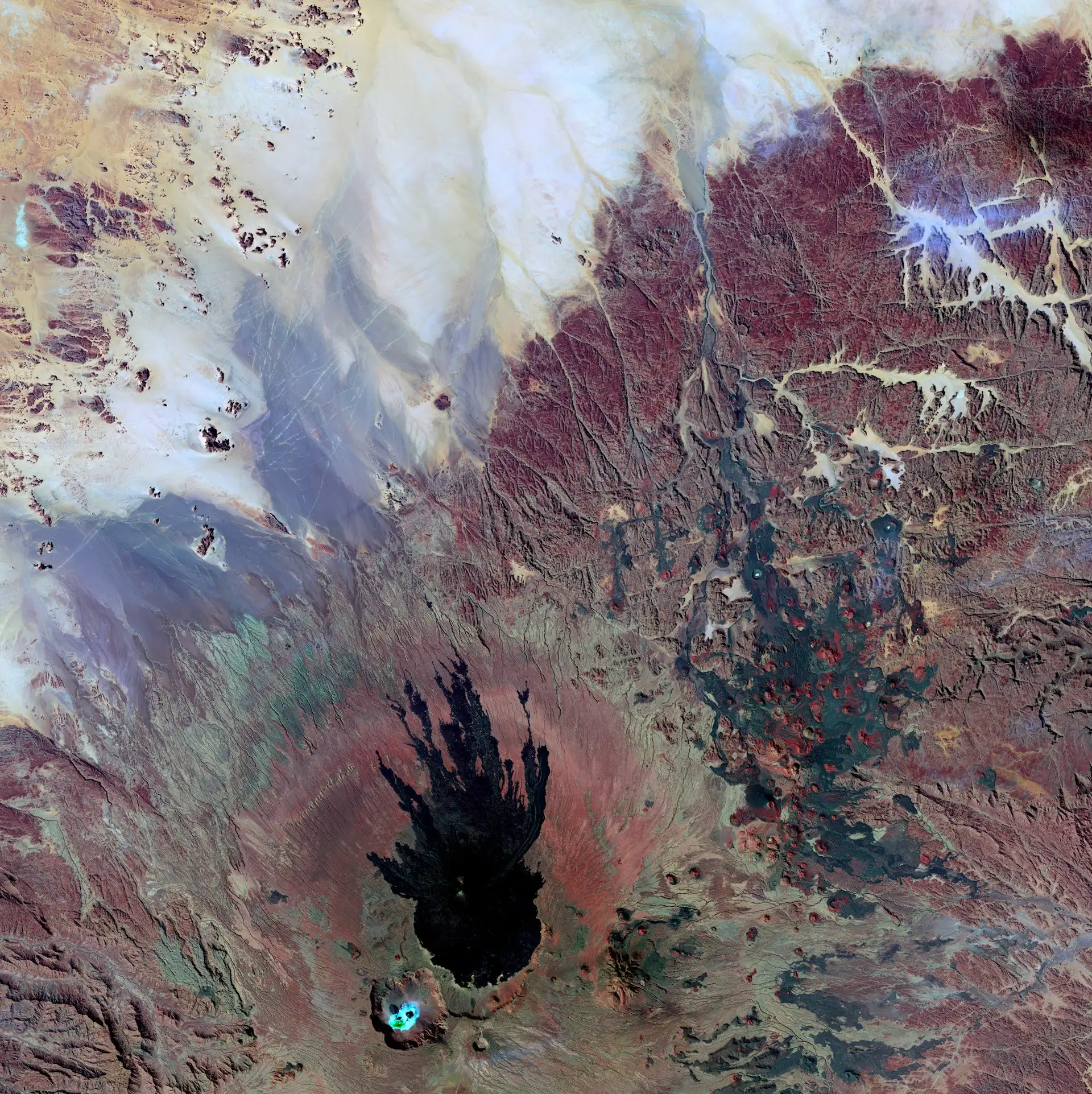
The Tibesti range in Chad's far north holds Emi Koussi, the Sahara's highest point at roughly 3,415 meters, and some of the most dramatic volcanic desert scenery on the continent. It is also essentially closed to ordinary travel by both extreme remoteness and security conditions specific to the region; this guide mentions it for geographic completeness, not as a destination to plan toward.
Culture & Etiquette
Chad is home to well over 100 ethnic groups, with the broadest divide running between a largely Muslim north and center, historically tied into Sahelian and trans-Saharan Arab trading culture, and a south with a larger Christian and traditional-belief population and closer ties to Central African neighbors. French and Arabic are both official; French dominates government, education and the south, while Chadian Arabic is the everyday language of N'Djamena and the north. Hospitality norms run deep and formal: greetings are unhurried, and skipping them to get straight to business reads as rude.
Do
- Dress conservatively. Cover shoulders and knees for both men and women, more so in the Muslim north and center than in N'Djamena's hotel districts.
- Greet properly before any request. A greeting exchange, however brief your French or Arabic, before asking for anything is expected and genuinely appreciated.
- Ask before photographing people, and never photograph military, police, government buildings, bridges or the airport; this is enforced and taken seriously.
- Carry your passport and, since May 2026, your e-visa confirmation at all times; document checks at checkpoints are routine, including inside N'Djamena.
- Use your right hand for eating, greeting and passing objects, as in much of the Sahel and North Africa.
Don't
- Discuss politics or the Déby family with strangers. This is not idle caution, it can carry real consequences in a country still under a family's three-decade hold on power.
- Travel after dark outside N'Djamena, or wander far from your accommodation after dark within it.
- Drink tap water anywhere in the country. Bottled or properly treated water only, including for brushing teeth.
- Assume mobile data or ATMs will work outside the capital. Cash in CFA francs, carried discreetly, is the only reliable option beyond N'Djamena.
- Go off-plan from an organized itinerary in Zakouma, the Ennedi or anywhere outside the capital; the guided structure is part of what makes these trips currently viable at all.
Food & Drink
Chadian food is built around grain, not rice or bread: boule, a thick porridge of pounded millet or sorghum, is the everyday staple across the country, eaten by hand and dipped into a sauce rather than served as a side. What sits on top varies by region and season, but a short list of dishes covers most of what a visitor will actually be served.
Boule & moulah
Millet or sorghum porridge, pounded smooth and firm, eaten with moulah, an okra, tomato and sometimes fish or meat sauce. The default Chadian meal, everywhere in the country.
Daraba
A stew of chopped okra and vegetables in a smooth peanut sauce, usually served over rice, boiled cassava or plantain. Common in the south.
Capitaine grillé
Nile perch pulled from the Chari or Logone rivers, grilled whole over charcoal with a chili-oil marinade and served with lime. The best fish dish in the country when you can get it fresh.
When to Go & Getting There
Chad has three rough climate zones: a hyper-arid Sahara in the north year-round, a semi-arid Sahel center with rain roughly July to September and temperatures regularly above 40°C before it breaks, and a wetter southern savanna with rain from around May to October. The dry season, November through April, is the only realistic window for organized travel: roads are passable, Zakouma is open, and Ennedi expeditions are feasible. Outside that window, unpaved roads that make up most of the country's network become impassable and much of Chad is effectively cut off.
Getting to and around Chad
By air: N'Djamena International Airport (NDJ) is Chad's only international airport, connecting via Paris (Air France), Addis Ababa (Ethiopian Airlines), Istanbul (Turkish Airlines), Cairo (EGYPTAIR) and Casablanca (Royal Air Maroc). There are no direct flights from North America; expect a connection through one of those hubs.
Overland: land border crossings are not something this guide can recommend given instability in several neighboring border regions; fly in and out of N'Djamena.
Within the country: outside N'Djamena, independent driving is not realistic. Zakouma and the Ennedi are reached by charter flight or as part of an organized expedition's own vehicles and drivers; there is no functioning public long-distance transport network a visitor should rely on.
Budget Planning
Chad is not a cheap country to visit despite its low profile: the near-total absence of independent tourism infrastructure means almost everything beyond a night in N'Djamena runs through specialist operators, charter flights and mandatory guiding, all of which cost accordingly. There isn't a meaningful backpacker tier here the way there is in most Atlas Guide destinations.
- Mid-range to upper hotel (Ledger Plaza to Radisson Blu/Kempinski)
- Hotel restaurant meals, taxis, a guide for the day
- No independent onward travel included
- All-inclusive specialist operator package
- Charter flights or 4x4 expedition logistics
- Park fees, mandatory guiding, camp or lodge stay
Visa & Entry
Since 11 May 2026, Chad requires every foreign visitor to hold an e-visa obtained in advance through the official evisa.td portal; visas issued outside that system stopped being valid on 21 May 2026. Apply at least 7 days and no more than 90 days before your planned entry date, using a passport valid at least 6 months beyond your return date with two blank pages, a recent digital passport photo, proof of onward travel and accommodation, and a valid yellow fever vaccination certificate, which remains a hard entry requirement regardless of visa status.
✓ Valid passport
At least 6 months validity beyond your return date, with two blank visa pages.
✓ E-visa via evisa.td
Mandatory since 11 May 2026 for all tourist entries; apply online, never through a third-party site claiming to issue Chad visas on arrival.
✓ Yellow fever certificate
Required for entry regardless of where you're arriving from; carry the physical certificate.
✓ Onward ticket & accommodation
A round-trip ticket and hotel booking or invitation letter are required as part of the e-visa application itself.
| Chad | Cameroon | |
|---|---|---|
| US advisory | Level 4, Do Not Travel, countrywide | Level 2, Increased Caution, with Level 4 in specific regions only |
| Wildlife draw | Zakouma: Central Africa's largest elephant herd | Waza National Park, though it sits inside a Do Not Travel region |
| Landscape | Ennedi Plateau's Sahara arches, UNESCO-listed | Rainforest, volcanic highlands and a longer Atlantic coast |
| Ease of travel | Specialist operator required for anything beyond N'Djamena | Independent travel realistic in the safer southern and coastal regions |
| Direct neighbor | Shares a southern border with Cameroon | Shares a border with Chad, and its own Do Not Travel zone sits along it |
Chad FAQ
Is it safe to travel to Chad?
No, not by the standard travel-advisory definition. The US State Department rates Chad Level 4, Do Not Travel, its highest risk category, citing crime, terrorism, kidnapping, unrest and landmines, and outside N'Djamena the US government's ability to help its own citizens is extremely limited. Anyone going should treat this as essential or specialist travel, not a leisure trip.
Do I need a visa for Chad?
Yes, and since May 2026 it must be an e-visa applied for online through the official evisa.td portal before you travel; paper visas issued outside that system are no longer valid. You also need a valid yellow fever vaccination certificate to enter.
What is N'Djamena and do I need to go there?
N'Djamena is Chad's capital and its only city with international flights, functioning hotels and any tourism infrastructure at all. Every visit to Chad, whatever the reason, routes through it.
What is Zakouma National Park?
A wildlife park in southeastern Chad managed by African Parks, holding the largest elephant herd in Central Africa and a stronghold population of Kordofan giraffe. It is open November to mid-May, requires a guide and either a charter flight or a very long drive from N'Djamena, and is the one part of Chad that functions like an organized safari destination.
What is the Ennedi Plateau?
A UNESCO World Heritage sandstone plateau in northeastern Chad, carved by wind and water into arches and towers, with ancient rock art and the Guelta d'Archei, a permanent desert pool that still holds Nile crocodiles. It is reached only by multi-day 4x4 expedition with a specialist operator.
What currency does Chad use?
The Central African CFA franc (XAF), pegged to the euro at a fixed rate of 655.957 XAF. Chad is a cash economy outside a handful of N'Djamena hotels; bring euros or dollars to change on arrival.
What language is spoken in Chad?
French and Arabic are the official languages, alongside more than 120 local languages, Sara and Fula among the largest. French dominates government and the south; Chadian Arabic is the everyday lingua franca in N'Djamena and the north and center. English is rare outside a few hotels.
When is the best time to visit Chad?
The dry season, November to April, when roads are passable, Zakouma is open, and Saharan expeditions to the Ennedi are feasible. The rainy season, roughly May to October in the south, turns unpaved roads to mud and cuts off much of the country.
How do you get to Chad?
By air into N'Djamena International Airport (NDJ), the country's only international airport, connecting via Paris, Addis Ababa, Istanbul, Cairo or Casablanca. There are no direct flights from North America. Land borders are not recommended given instability in neighboring regions.
Is Chad in West Africa or Central Africa?
Central Africa, by the standard UN geoscheme, though it also sits within the Sahel belt and borders both West and North Africa. It shares borders with Libya, Sudan, the Central African Republic, Cameroon, Nigeria and Niger.
What Stays With You
The people who do travel to Chad, mostly through Zakouma or the Ennedi, tend to come back describing landscapes and wildlife encounters unlike anywhere else they have been: an elephant herd that conservationists spent two decades rebuilding, a desert pool holding crocodiles that have somehow survived in the middle of the Sahara. None of that changes what the advisory says, and this guide is not going to soften it to make a better story.
If you go, go through a specialist operator, go in the dry season, and go with your eyes open about what Level 4 actually means. If you don't, that is very likely the right call for most travelers right now, and Chad will still be there, hopefully under calmer circumstances, when it might make sense to reconsider.