
Libya's Capital, and Its Only Practical Gateway
Tripoli sits on the Mediterranean coast, a city of roughly 1 to 1.5 million people built up in layers: a Roman-era arch, an Ottoman-era fortress, Italian colonial-era boulevards, and the concrete sprawl of the Gaddafi decades and the years since. It is the seat of Libya's Tripoli-based Government of National Unity, the country's largest city, and, practically speaking, the only place a foreign visitor can start a trip to Libya at all, since it holds the only functioning international airport, the only established hotels, and every licensed tour operator that can sponsor a visa.
What draws the small number of people who do come is largely what sits outside the city rather than in it: Leptis Magna and Sabratha, two of the best-preserved Roman cities anywhere on the Mediterranean, are each within a two-hour drive. Tripoli itself holds real sights, the Arch of Marcus Aurelius and the Red Castle chief among them, but functions here primarily as the base, the flight connection and the security coordination point that makes the rest of the trip possible.
The honest complications
This is not a guide encouraging a visit. Tripoli sits inside Libya's Level 4, Do Not Travel advisory from the US State Department, and it is explicitly outside the UK FCDO's narrow exception for parts of eastern Libya. The US Embassy here has been suspended since July 2014 and offers no consular assistance. Every visit happens through a licensed tour operator who sponsors the visa, plans the itinerary and manages movement through the city's checkpoints; there is no version of an independent Tripoli city break. Read the safety chapter, next, before anything else in this guide.
What Visiting Tripoli Specifically Involves
Tripoli sits inside Libya's nationwide Level 4, Do Not Travel advisory from the US State Department, issued 11 January 2026, which cites crime, terrorism, civil unrest, armed conflict, kidnapping and landmines. The UK FCDO's advisory carves out a narrow exception for Benghazi, Al-Bayda, Derna and the Jebel Akhdar region in the east; Tripoli is not part of that exception and sits under a full advise-against-all-travel rating from the FCDO as well.
No US consular help
The US Embassy in Tripoli has suspended operations since July 2014. Americans needing emergency or routine consular assistance must contact the US Embassy in Tunis, Tunisia, a different country, instead.
Checkpoints & militia presence
Armed checkpoints run by a range of state and non-state groups are routine within Tripoli and on roads out of it. Licensed guides and drivers handle these directly; this is a core part of what an organized trip provides, not a background detail.
Photography restrictions
Photographing checkpoints, military or government buildings, ports and the airport is illegal and enforced. Ask your guide before photographing anything that isn't obviously a tourist sight.
Emergency numbers, and why your operator matters more than a hotline
Sources disagree on Libya's emergency numbers, with some citing 1515, 1516, 1517 and 1518 for general, ambulance, fire and police respectively, and others giving different figures entirely. Treat none of these as reliable. With the US Embassy suspended and most other Western missions operating on a limited or fly-in basis, your licensed tour operator is, in practice, the first call for any problem in Tripoli, from a medical issue to a delay at a checkpoint. Confirm their emergency procedure and after-hours contact before you land, and keep the number for your home country's nearest functioning embassy (for US citizens, the Embassy in Tunis) separately.
Solo travelers, families and anyone else considering Tripoli should treat the licensed-tour requirement as the actual safety mechanism, not a bureaucratic formality: a reputable operator's value is entirely in the route-planning, checkpoint knowledge and local relationships that an independent visitor simply cannot replicate.
A Small City by the Standards of a Trip This Coordinated
Because movement in Tripoli happens by arranged vehicle rather than on foot or by transit, "neighbourhoods" here means less about where to wander and more about where your itinerary will actually take you.
Old Medina
Tripoli's old walled city holds the bulk of what a licensed itinerary covers within the capital: the Arch of Marcus Aurelius, the Red Castle and National Museum overlooking Martyrs' Square, and narrow souk streets that predate the Ottoman period. This is the area most tours front-load early in a trip, with guide and driver throughout.
Martyrs' Square
The square at the edge of the Old Medina has been Piazza Italia under Italian rule, Independence Square under the monarchy, Green Square under Gaddafi, and Martyrs' Square since the 2011 revolution, a naming history that is itself a shorthand for the last century of Libyan politics. The Red Castle sits directly alongside it.
Gargaresh
West of the center along the coast, Gargaresh Street is Tripoli's main strip for international-standard hotels and restaurants, including the Four Points By Sheraton and the Golden Tulip, with Al-Bawardy Restaurant for traditional Libyan couscous and tagine and, nearer the corniche, the cafes O2 and Lamma for breakfast and a sea view. Most licensed itineraries base visitors here or at a comparable hotel elsewhere in the city.
Two International Hotels, and a Handful of Others
Tripoli's hotel market is small by the standards of most capital cities, a direct consequence of over a decade of limited international arrivals. Your licensed tour operator typically books the hotel as part of the package, but knowing the options helps you understand what you're being offered.
The Corinthia Tripoli is the city's flagship five-star property, on the coast with Mediterranean or city views, a pool and gym, and the most consistent international-standard service in Libya. The Radisson Blu Al Mahary Hotel is the other established international chain option, also on the waterfront. Along Gargaresh Street, the Four Points By Sheraton and the Golden Tulip offer a step down in price while remaining within the international-chain tier that most licensed operators default to for foreign visitors.
Couscous, Bazin and a Coastline of Seafood
Tripoli's food draws on Berber, Arab, Mediterranean, Ottoman and Italian layers, built around couscous, bread and richly spiced tomato sauces. Alcohol is illegal throughout Libya and unavailable anywhere in the city, including hotels.
For traditional Libyan cooking, licensed guides commonly route dinners to La Rambla and Athar Restaurant in the Old City, both serving couscous, bazin and Libyan-style shakshuka, and to Al-Bawardy Restaurant in Gargaresh for a similar traditional menu closer to the main hotel strip. For seafood, drawing on Tripoli's position on the Mediterranean, Rubian Restaurant is the name that comes up repeatedly, and along the Gargaresh corniche, O2 and Lamma cover breakfast and casual lunches with a sea view.
A Roman Arch, an Ottoman Fortress, and a Living Souk
Tripoli's own sights are concentrated enough to see properly in a day or two before or after the day trips to Leptis Magna and Sabratha that are the real reason most visitors come to Libya at all.
The Old Medina
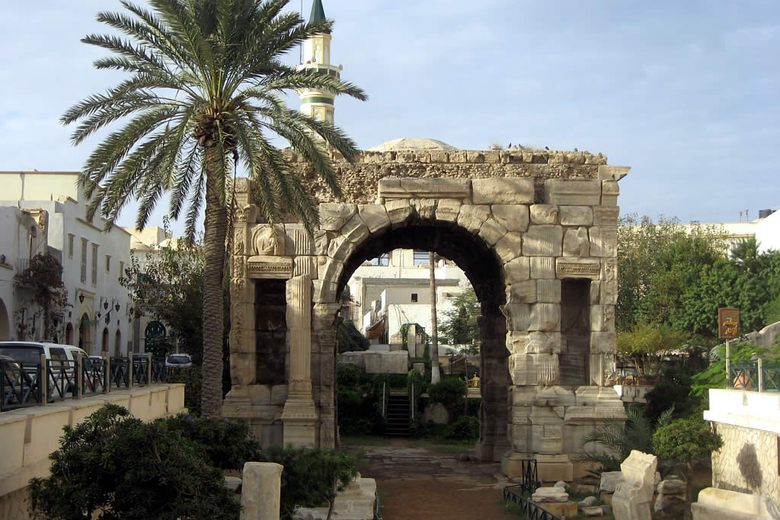
The Arch of Marcus Aurelius, erected in 163 AD, is the only standing structure from Roman Oea, the settlement that predates Tripoli, carved with depictions of Apollo and Minerva. A short walk away, the Red Castle (As-Saraya al-Hamra), a red-ochre fortress that has anchored the city's skyline for centuries, now houses Libya's National Museum and Antiquities Department, with collections spanning the prehistoric era through classical statuary, textiles and Islamic manuscripts. The souks threading through the Old Medina between the two sites are still a working market, not a recreated one, though what you can browse and photograph is set by your guide.
Martyrs' Square
The square beside the Red Castle has carried four different names across a century of Libyan history, from Piazza Italia to Green Square to its current name since 2011, and walking it with a guide who can explain that progression does more to explain modern Libya than any single museum exhibit.
One Airport, One Vehicle, One Itinerary
Mitiga International Airport (MJI), on Tripoli's eastern edge, is the country's main functioning international gateway. Libyan Airlines, Afriqiyah Airways, Buraq Air, Turkish Airlines, EgyptAir, Royal Jordanian and ITA Airways all serve it, with routes to Istanbul, Cairo, Rome, Tunis, Amman, Doha and Dubai, and bmi Regional runs seasonal flights from the UK. Your licensed tour operator arranges the pickup; there is no independent airport transfer market set up for foreign tourists the way there is in most capital cities.
Getting around Tripoli itself, and out to Leptis Magna or Sabratha, happens in a vehicle arranged by your operator, typically with a driver and an English-speaking guide for the whole day. There is no functioning rental car market or public transport system oriented toward foreign visitors, and this isn't a gap worth trying to work around: it's the mechanism that makes the trip's security coordination possible.
Best time to visit and the Ghibli wind
Tripoli has a Mediterranean climate: hot, dry summers and mild, wetter winters. March to May and October to November bring the most comfortable temperatures, roughly 19-26°C. Summer (June to August) is hot, with highs near 30-32°C, and anywhere from March to June a hot, dust-laden desert wind called the Ghibli can move through and make conditions unpleasant for a day or two. None of this affects the underlying security situation, which is the primary planning consideration regardless of season.
Priced as a Package, Not a Daily Rate
A Tripoli trip is priced the way a licensed operator packages it, not the way most city guides break down a daily budget, because independent spending (a hostel here, a street meal there) isn't how a visit works. Licensed operators such as RJ Travel Agency and IntoLibya bundle visa sponsorship, the Letter of Invitation, hotel, transport, English-speaking guides and site entry fees into one price for a fixed multi-day itinerary.
Fixed costs before the trip
The Libya eVisa costs 63 USD, sponsored through your operator. Every visitor must also carry at least 1,000 USD, or the equivalent in another major currency, in cash on arrival; this is checked at entry.
The package itself
RJ Travel Agency runs guaranteed monthly group departures through 2027 alongside private itineraries from three to thirteen days; confirm exactly what's bundled (hotel tier, meals, entry fees) before booking, since scope varies by operator and package.
Leptis Magna and Sabratha Are the Reason to Come
Tripoli's role for most visitors is logistical: the flight, the hotel, the fixer. The actual highlight of a Libya trip is almost always one or both of the Roman sites within a two-hour radius, and licensed operators build day trips or short multi-day combinations around them.
Leptis Magna
Founded by Phoenicians and expanded to imperial scale under Septimius Severus, who was born there, Leptis Magna preserves a triumphal arch, market, theatre, basilicas and a full bath complex at a level of completeness that draws genuine comparisons to Pompeii, without Pompeii's crowds, because there effectively are none. Along with Libya's four other UNESCO sites, it was added to the List of World Heritage in Danger in 2016 due to the conflict.
Sabratha
Originally a Phoenician trading post before becoming a Roman city, Sabratha's sea-facing theatre is one of the best-preserved in the Roman world, backed by temple ruins and mosaics. Some operators pair it with Leptis Magna and Tripoli itself in a single three-day western Libya package.
Tripoli FAQ
Is Tripoli safe for tourists?
No, not by conventional standards. Tripoli sits inside Libya's Level 4, Do Not Travel advisory from the US State Department, and it is not part of the UK FCDO's limited eastern-Libya exception. Visits happen only through licensed tour operators with pre-arranged itineraries and security coordination.
How do I get to Tripoli?
Through Mitiga International Airport (MJI), the city's functioning international gateway, served by Libyan Airlines, Afriqiyah Airways, Turkish Airlines, EgyptAir and others. Your licensed tour operator arranges the airport pickup as part of the package.
Can I visit Tripoli without a tour operator?
No. Libya's eVisa requires sponsorship by a licensed Libyan tour operator, who provides the Letter of Invitation and arranges the itinerary. Independent tourism is not possible.
What is there to see in Tripoli's Old Medina?
The Arch of Marcus Aurelius, the only standing structure of Roman Oea, built in 163 AD, and the Red Castle (As-Saraya al-Hamra), a fortress overlooking Martyrs' Square that now houses Libya's National Museum and its Antiquities Department.
Can I day trip to Leptis Magna and Sabratha from Tripoli?
Yes, both are reachable as licensed day trips: Leptis Magna is about 120 km and a two-hour drive east, and Sabratha is roughly 70-80 km and about an hour to ninety minutes west. Some operators combine both with Tripoli in a single multi-day package.
What hotels are available in Tripoli?
The Corinthia Tripoli and the Radisson Blu Al Mahary Hotel are the two established international-chain hotels, alongside properties like the Four Points By Sheraton and the Golden Tulip on Gargaresh Street, the city's main hotel and restaurant strip.
Is alcohol available in Tripoli?
No. Alcohol production, sale and consumption is illegal throughout Libya, including Tripoli, and is strictly enforced.
Does the US Embassy operate in Tripoli?
No. The US Embassy in Tripoli has suspended operations since July 2014. American citizens needing consular help must contact the US Embassy in Tunis, Tunisia instead.
What This City Is Really Offering Right Now
Tripoli is not, at this point, a city break in any conventional sense. It is a fixed itinerary, a licensed guide, a driver who knows which checkpoints to route around, and, if all of that holds up, an afternoon standing under a 1,900-year-old Roman arch that almost nobody else gets to see this decade. That scarcity is not a marketing angle: it is the direct result of a country still fighting over who runs it.
Go only through a licensed operator, only with clear eyes about what the advisory says, and only if the specific, current reality of a divided, Level 4 country is one you have genuinely weighed rather than waved off.