Atlas Guide

Explore the World

Complete Travel Guide 2026

Madagascar

The fourth-largest island on earth, separated from Africa for 165 million years, home to 90% of wildlife found nowhere else on earth, and the closest thing the planet has to a parallel evolutionary history. Lemurs, baobab alleys, needle-sharp limestone forests, and the specific feeling of having arrived somewhere genuinely unlike anywhere you have ever been.

🌎 Indian Ocean / Africa ✈️ Via Antananarivo (TNR) 💵 Malagasy Ariary (MGA) 🌿 90% endemic wildlife 🐰 100+ lemur species

What You're Actually Getting Into

Madagascar is the fourth-largest island in the world, sitting in the Indian Ocean off the east coast of Africa, and it is a destination that demands honesty about what it offers and what it costs to get there. The wildlife is genuinely extraordinary: approximately 90% of the species found in Madagascar are endemic, meaning they evolved here and exist nowhere else on earth. The lemurs, the baobabs, the chameleons, the fossas, the specific micro-climates that produce entirely different ecosystems within a few hundred kilometers of each other, these are not the Africa you see on wildlife documentaries. Madagascar branched off from the evolutionary tree at an entirely different point. What resulted is less a country than a parallel biological world. Before you travel, read our Madagascar travel scams guide covering the situations most commonly encountered by tourists in Antananarivo and the main national parks.

The honest cost of access is significant. Getting to Madagascar typically means a long international connection through Nairobi, Johannesburg, Reunion, or Paris. Internal travel is slow: most roads outside the capital are unpaved red laterite tracks that can take a full day to cover 200 kilometers. The tourism infrastructure outside the main circuits is minimal. Medical facilities outside Antananarivo are extremely limited. The cyclone season from December to March makes the east coast genuinely dangerous and renders major overland routes impassable for weeks. Madagascar asks something of its visitors, in time, in preparation, and in tolerance for difficulty, that most popular destinations do not.

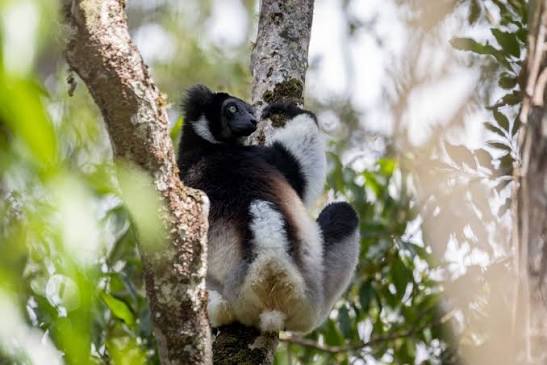
What it returns in exchange is unlike anything else available. Walking behind a guide through Ranomafana rainforest at dawn, pausing while an indri's call, a sound somewhere between a foghorn and a whale song, echoes across the valley. Standing at the Avenue of the Baobabs near Morondava at sunset, when the hundred-meter-tall bottle-shaped trees turn orange against a red sky and the dust settles on the laterite road. Finding a leaf-tailed gecko, invisible until it moves, against the bark of a tree exactly the same color and texture as its body. These are not experiences manufactured for tourists. They are the island showing you what 165 million years of isolation produces when you stop to look at it properly.

The key practical insight: most visitors to Madagascar do far too little in too short a time. The country is 587,000 square kilometers, one and a half times the size of France. A week covers one circuit badly. Two weeks covers one circuit properly or two circuits briefly. Plan for at least two weeks, ideally three, and accept that you will not see all of it. The parts you do see will stay with you permanently.

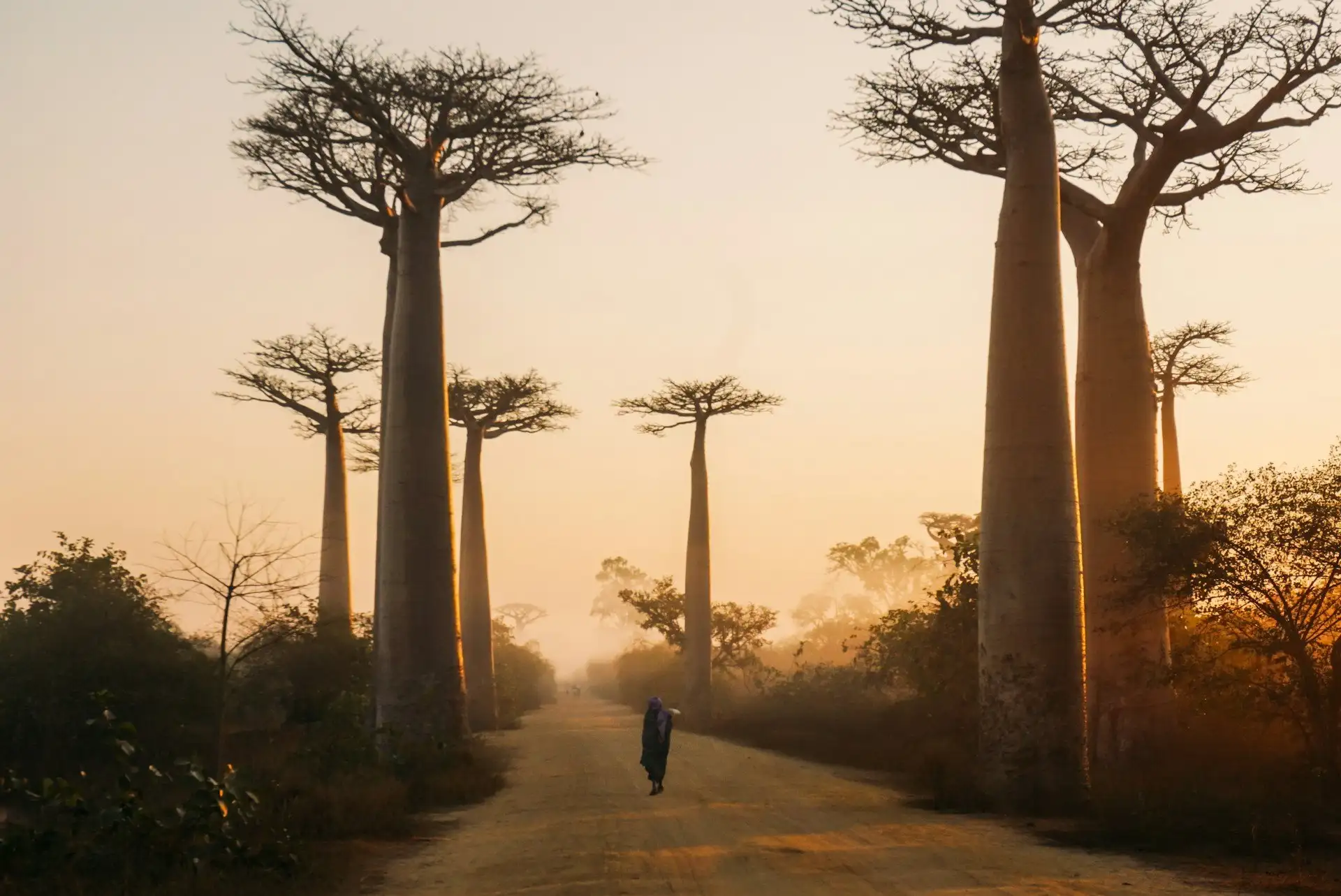
Avenue of the Baobabs near Morondava Madagascar at sunset, ancient baobab trees 30 meters tall lining a red dirt road with orange and gold sky
The Avenue of the Baobabs near Morondava: these trees are between 800 and 2,800 years old. The road between them is a recent intrusion.
🐰
100+ lemur species, all endemicEvery lemur species on earth exists only in Madagascar. They are the world's most threatened group of mammals. Seeing them in the wild in their own forest is one of the most specific experiences in travel.
🌿
90% endemic wildlifeHalf the world's chameleons. 60% of bird species endemic. The fossa. The aye-aye. Ecosystems that don't exist anywhere else. Evolution ran a separate experiment here for 165 million years.
🌲
Landscapes unlike anywhereTsingy limestone needle forests. Baobab avenues. Spiny forest desert. Rainforest canyons. Red laterite highlands. Madagascar contains six distinct ecosystems within a single island.
🏈
Indian Ocean beaches without crowdsNosy Be and the northern coast offer genuinely excellent beaches, clear water, and whale sharks. Without the package-tourism infrastructure of Zanzibar or the Maldives.

Madagascar vs Tanzania vs Kenya: Which African Wildlife Destination?

1
The wildlife is not comparable, it is different

Kenya and Tanzania offer the Big Five, the Great Migration, predator-prey savanna drama on a scale no other place matches. Madagascar has none of that. What it has instead is wildlife that evolved in isolation for so long that the entire framework of comparison breaks down: lemurs (no other primates), the fossa (no big cats but an apex predator unlike any other), half the world's chameleons, leaf-tailed geckos with camouflage that defies belief. Choose Kenya or Tanzania for the Africa you've seen in documentaries. Choose Madagascar to see something evolution produced on an entirely separate track.

2
Difficulty and reward scale together

Kenya has excellent tourist infrastructure, safari lodges, well-maintained game parks, and short internal flights that make it accessible even on a week's trip. Tanzania requires slightly more effort. Madagascar requires considerably more of both: slow roads, medical preparation, cyclone season awareness, significant internal flight cost. The reward scales with the effort: the wildlife encounters in Madagascar's national parks are frequently more intimate and less mediated by vehicle and crowd than the classic East Africa safari experience.

3
Cost and time commitment

Kenya and Tanzania can be meaningfully experienced in 7 to 10 days. Madagascar requires at minimum two weeks and ideally three to do justice to even one circuit. Kenya and Tanzania are significantly cheaper for accommodation and safari once in-country. Madagascar's internal flights add real cost. If time is the constraint, Kenya or Tanzania are the pragmatic choice. If experiencing something singular on earth is the goal and two weeks minimum is available, Madagascar justifies everything the preparation costs.

Madagascar at a Glance

CapitalAntananarivo (Tana)
CurrencyMalagasy Ariary (MGA)
LanguagesMalagasy, French
Time ZoneEAT (UTC+3)
Power220V, Type C/E
Dialing Code+261
VisaVisa on arrival (most nationalities)
DrivingRight side
Population~29 million
Area587,041 km²
👩 Solo Women
7.2
👪 Families
7.5
💰 Budget
5.5
🍽️ Food
7.0
🚈 Transport
4.2
🌿 Wildlife
9.8

A History Worth Knowing

Madagascar's human history is strikingly short compared to its biological one. The island, which broke off from the African mainland approximately 165 million years ago and from the Indian subcontinent around 88 million years ago, was one of the last large landmasses on earth to be settled by humans. Archaeological evidence suggests the first settlers arrived from the Indonesian archipelago, specifically the Borneo region, somewhere between 350 BCE and 550 CE. This is one of the most extraordinary facts in the story of human migration: the ancestors of the Malagasy people did not cross from Africa, 400 kilometers to the west, but from Southeast Asia, more than 6,000 kilometers away across the Indian Ocean, in outrigger canoes. The genetic, linguistic, and cultural evidence for this Southeast Asian origin is unambiguous: Malagasy is an Austronesian language related to the languages of Borneo and the Malay world, the rice agriculture, the outrigger canoes, and many cultural practices trace directly to the Indonesian origin.

Subsequent waves of Bantu-speaking Africans, Arab traders, and later Indian and European settlers added layers to the Malagasy population, but the Austronesian foundation remains dominant, particularly in the highlands around Antananarivo where the Merina people, the politically dominant highland group, most clearly preserve the Southeast Asian physical and cultural heritage. The linguistic unity of Madagascar is remarkable: despite the island's size and ecological diversity, a single language family with regional dialects is spoken everywhere, which facilitated the political unity that the Merina Kingdom achieved across most of the island by the 19th century.

The Merina Kingdom, under a succession of monarchs including the formidable Queen Ranavalona I (ruled 1828 to 1861) and her successors, developed a sophisticated court culture in Antananarivo and maintained Malagasy independence through a period when much of Africa was being absorbed by European powers. Ranavalona I expelled European missionaries and traders, restricted foreign influence, and executed Malagasy Christians in a series of persecutions that made her internationally notorious but successfully preserved Malagasy sovereignty during her reign. Her successors were more open to European influence, and the tension between conservative and modernizing factions at court weakened the kingdom's resistance to French pressure.

France formally colonized Madagascar in 1896 after a brief war, abolishing the monarchy and exiling the last Merina queen, Ranavalona III, to Algeria. The colonial period lasted until independence in 1960, interrupted by a significant uprising in 1947, the Malagasy Uprising, in which an estimated 11,000 to 90,000 Malagasy people (estimates vary widely) were killed by French forces in suppressing the rebellion. The uprising is little-known internationally but is a central event in Malagasy national consciousness.

The post-independence period has been marked by political instability, a series of coups and contested elections, and persistent economic underdevelopment despite the island's extraordinary natural resources. Madagascar consistently ranks among the world's poorest countries by per-capita income, with the majority of the population dependent on subsistence agriculture. The gap between the island's biological wealth, the subject of international scientific fascination and conservation investment, and the material poverty of most of its people is one of the central tensions of contemporary Madagascar and the context within which all conservation efforts operate.

Deforestation is the most urgent environmental crisis. Madagascar has lost approximately 90% of its original forest cover since human settlement, accelerating sharply in the post-independence period as population growth and charcoal production for fuel drove slash-and-burn agriculture into protected areas. The remaining forest is fragmented and under continuous pressure. The national parks and reserve system, supported by international conservation organizations, is the primary mechanism for protecting what remains. Visiting Madagascar and paying park fees and using licensed guides directly funds the conservation infrastructure that keeps the remaining wildlife habitat intact.

Ring-tailed lemur with distinctive black-and-white striped tail perched in Berenty private reserve forest Madagascar, looking directly at camera
A ring-tailed lemur at Berenty: all 100+ lemur species are endemic to Madagascar. They are the world's most threatened group of mammals, with over 30% critically endangered.
165 million BCE
Madagascar Separates from Africa

The island breaks off from the African mainland, beginning the 165-million-year isolation that produces one of the most extraordinary concentrations of endemic species on earth.

350 BCE to 550 CE
First Human Settlers Arrive

Austronesian peoples from the Borneo region cross the Indian Ocean to settle Madagascar. One of the most extraordinary long-distance migrations in human prehistory. The Malagasy language is an Austronesian language related to Borneo.

800 to 1000 CE
Bantu and Arab Settlers

Bantu-speaking Africans arrive from the mainland, bringing cattle culture and adding genetic and cultural layers to the founding Austronesian population. Arab traders establish coastal settlements and introduce Islam in the northwest.

1540 to 1896
Merina Kingdom

The highland Merina people progressively unify most of Madagascar under their authority. The kingdom reaches its peak under Radama I and Ranavalona I. France colonizes the island in 1896, abolishing the monarchy and exiling Queen Ranavalona III.

1947
Malagasy Uprising

A major anti-colonial uprising is violently suppressed by French forces. Tens of thousands of Malagasy people are killed. The event is central to Malagasy national memory and little-known outside the island.

1960
Independence

Madagascar achieves independence from France. Subsequent decades bring political instability, multiple coups, and persistent poverty despite the island's extraordinary ecological wealth.

Today
Conservation vs Deforestation

Madagascar has lost 90% of its original forest cover. The remaining parks and reserves protect some of the world's most threatened wildlife. International conservation investment and park fees from tourism are among the primary funding mechanisms.

💡
On paying park fees: Madagascar's national park entry fees, administered by Madagascar National Parks (MNP), go directly to park maintenance, ranger salaries, and the local community funds that give people living around parks a financial stake in conservation rather than agriculture. Paying full fees without bargaining is not only legal practice but direct conservation funding. A single day's Ranomafana park fee costs less than a coffee in a Western city and funds infrastructure that keeps the world's most threatened primate group alive.

Top Destinations

Madagascar divides into several distinct circuits based on geography and the road and flight network. The central highlands circuit runs south from Antananarivo through the highland agricultural landscape to the rainforest parks. The south circuit covers the spiny forest, the canyon landscapes of Isalo, and the ring-tailed lemur reserves of the deep south. The west circuit reaches the Avenue of the Baobabs and the limestone Tsingy country. The north and the Indian Ocean coast access Nosy Be and the marine parks. Most organized trips combine two of these circuits. Combining all four requires either a month or a combination of driving and internal flights.

🎼
The Indri Forest

Andasibe-Mantadia

Andasibe-Mantadia National Park, 140 kilometers east of Antananarivo and accessible in 3 to 4 hours on a reasonable road, is the easiest major national park to reach from the capital and the primary site for hearing and seeing the indri, the largest living lemur species. The indri's territorial call, a haunting, resonant foghorn sound that carries several kilometers through the forest, is one of the most extraordinary animal sounds in the world. The park comprises two sections: Analamazaotra Special Reserve (Andasibe), smaller and closer to the village, and the much larger Mantadia National Park further north. Visitors who walk both have the best chance of encountering the full range of species.

🔊 Indri calls at dawn (arrive early) 🐰 Most accessible park from Antananarivo 🌒 Night walk for chameleons and tree frogs
🌲
The Baobab Avenue

Avenue of the Baobabs, Morondava

The Avenue of the Baobabs is a stretch of rural road near Morondava on the west coast where a double row of Adansonia grandidieri baobabs, the largest of Madagascar's seven endemic baobab species, lines approximately 260 meters of laterite track. The individual trees are between 800 and 2,800 years old, up to 30 meters tall with bottle-shaped trunks 3 to 4 meters in diameter. They were once surrounded by dense forest; the surrounding forest has been cleared but the trees themselves were spared because of their sacred status in Malagasy culture. The sunrise and sunset light on the trees, when the golden hour illuminates the smooth grey bark and the flat umbrella crowns against a clear sky, is one of the most photographed images in African travel. The baobabs are not in a national park; they are protected as a natural monument.

🌅 Arrive 1 hour before sunset or sunrise 🌳 Trees are 800 to 2,800 years old 🚗 90-minute drive from Morondava town
The Stone Forest

Tsingy de Bemaraha

Tsingy de Bemaraha, a UNESCO World Heritage Site in western Madagascar, is one of the world's most extraordinary and disorienting landscapes: an elevated limestone plateau eroded by rainwater over millions of years into a forest of needle-sharp karst pinnacles (tsingy means "where one cannot walk barefoot" in Malagasy) rising 30 to 50 meters, connected by via ferrata cables, suspension bridges, and ladders for visitors. The landscape looks like nowhere else on earth and the wildlife within it, adapted to life on and between the sharp limestone surfaces, includes several lemur species, the Decken's sifaka, and extraordinary examples of convergent evolution as animals solved the problem of moving through a needle forest. The Petit Tsingy is accessible without specialist equipment; the Grand Tsingy requires the full via ferrata experience.

⛏ Via ferrata through the needle forest 🐰 Decken's sifaka on the limestone 🎗 Suspension bridges and abseil sections
🏈
The Canyon Landscape

Isalo National Park

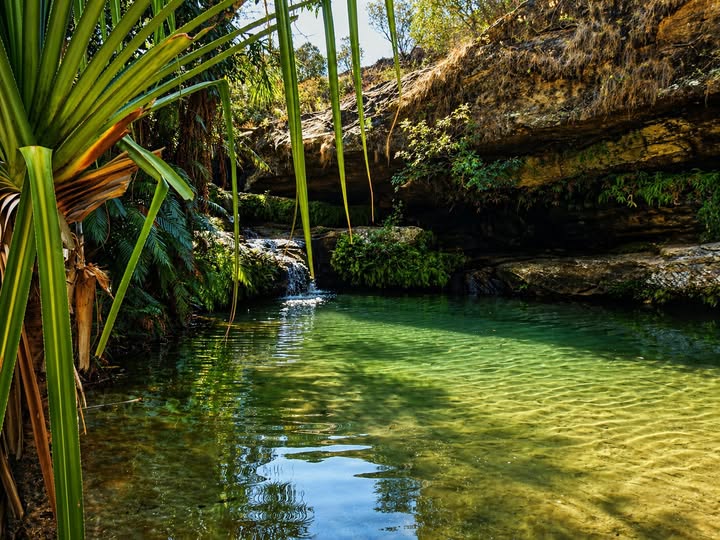
Isalo, in the south-central highlands, is the most visually dramatic hiking landscape in Madagascar: a massif of eroded sandstone ridges, canyons, and natural swimming pools fed by streams running through palm-lined gorges, set against a semi-arid highland landscape of pale grass and rocky outcrops. The park is large (815 square kilometers) and the trails range from gentle canyon walks to multi-day ridge traverses. The swimming canyons, reached by guided half-day hikes from the park entrance, are among the most rewarding experiences in Madagascar: natural pools of clear water in sandstone gorges with neon day geckos on the walls and sifaka lemurs moving through the riverside vegetation. Isalo is relatively accessible by Madagascar standards, 90 minutes from the town of Ranohira on the RN7.

🚣 Natural swimming pools in the canyon 🐰 Ringtail and sifaka lemurs 🏔 Multi-day ridge treks available
🌎
The Island Beach

Nosy Be

Nosy Be, the main island of the northwest Madagascar coast, is the country's primary beach and marine tourism destination: clear Indian Ocean water, coral reefs, whale shark and humpback whale seasonal aggregations (July to September), diving across a network of offshore islands and dive sites, and a more developed tourism infrastructure than anywhere else in Madagascar. The island itself is small, ringed by beaches of varying quality, with Andilana on the northwest coast the most reliably excellent. Day trips to the surrounding islands, particularly Nosy Komba (black lemurs and crafts), Nosy Tanikely (marine reserve, excellent snorkelling), and Nosy Iranja (twin islands connected by a sandbar at low tide) are the main activities. Nosy Be has direct flights from Antananarivo (1 hour) and is the easiest part of Madagascar to access for a short visit.

🦋 Whale shark snorkelling (Jul to Sep) 🌊 Nosy Tanikely marine reserve 🐰 Black lemurs on Nosy Komba
🏯️
The Lemur Reserve

Berenty Private Reserve

Berenty, in the deep south near Fort Dauphin, is a private reserve maintained by the De Heaulme family since 1936, and is the most accessible location in Madagascar for observing ring-tailed lemurs, white sifaka, and the remarkable endemic spiny forest ecosystem that covers most of southern Madagascar. Ring-tailed lemurs here are habituated to human presence and will walk through the camp, steal fruit from breakfast tables, and perform the afternoon sunning ritual (sitting upright with arms outstretched like a cruciform to warm themselves) within arm's length of visitors. The reserve also protects a small area of gallery forest that contrasts starkly with the surrounding spiny desert. The remoteness of Fort Dauphin makes Berenty an add-on to a southern circuit rather than a standalone destination for most visitors.

🐰 Habituated ring-tailed lemurs in camp 🌿 Spiny desert ecosystem 🌅 Sifaka morning dance in the gallery forest
Tsingy de Bemaraha UNESCO World Heritage Site Madagascar, needle-sharp grey limestone karst pinnacles rising 40 meters with suspension bridge visible between the stone needles
Tsingy de Bemaraha: the name means "where one cannot walk barefoot" in Malagasy. The via ferrata cables and suspension bridges are the only way through.
Nosy Be beach Madagascar with turquoise Indian Ocean water, white sand, fishing pirogue boat and tropical vegetation, Andilana northwest coast
Andilana beach on Nosy Be's northwest coast: whale sharks, humpback whales, and coral reefs, without the package tourism infrastructure of Zanzibar
💡
Locals know: The best lemur encounters in Madagascar are almost never at the most-visited sites. The habituated lemur groups at smaller community-run reserves around Ranomafana, such as the Vohiparara community forest and the Anja Community Reserve near Ambalavao (ring-tailed lemurs on granite boulders, free access, community-run, less than 3 hours from Ranomafana), offer wildlife encounters of equal quality to the big national parks for a fraction of the entrance cost and with none of the crowds. The park fees at MNP reserves are fair and go to conservation; the community reserves direct money to villages that would otherwise benefit from deforestation. Use both.

Culture & Etiquette

Malagasy culture is shaped by a complex set of social values and traditional practices (fomba) that vary by region and ethnic group (Madagascar has 18 officially recognized ethnic groups) but share certain common elements that visitors need to understand. The most significant of these is fady, the system of local taboos that prohibit specific behaviors, foods, or actions in particular places or times. Fady vary between communities and regions and are not always legible to outsiders: in some areas it is forbidden to point at a sacred site, in others to eat specific foods, in others to wash clothes on certain days of the week. The correct approach is to ask your guide about local fady before arriving in any new area and to follow them without comment. Violating fady is not a minor social faux pas in the villages where they are observed; it is a serious matter that can affect relationships between the community and future tourist groups.

The broader social framework emphasizes fihavanana, the value of kinship, social solidarity, and maintaining harmonious relationships. Direct confrontation, public displays of anger, and aggressive bargaining are all disruptive to fihavanana and make Malagasy people uncomfortable. Patience, warmth, and a willingness to engage at Malagasy pace rather than tourist pace will produce dramatically better experiences than pushing for speed or efficiency.

DO
Learn and observe local fady

Ask your guide about specific taboos in each area you visit. Fady are not superstitions from a Western tourist perspective: they are the living cultural framework that organizes community life in rural Madagascar. Respecting them, however unfamiliar they may seem, is both appropriate and practically important for relations between your guide and the local community.

Greet people properly

"Manao ahoana" (how are you, formal) or "Salama" (hello, informal) in Malagasy, delivered with genuine warmth, opens doors that staying in French or English closes. Malagasy people are consistently described by travelers as warm and curious about visitors, particularly outside the capital. The greeting is the beginning of that exchange.

Use licensed guides in national parks

A guide is mandatory in all Madagascar National Parks, both for legal compliance and for actually seeing anything. Guides know the specific forest sections where habituated lemur groups feed, where the chameleons are that morning, and where to position for the best light. Tip well: guide salaries are low and tips are a significant portion of income. MGA 30,000 to 50,000 per day (USD 6 to 10) per visitor is appropriate.

Dress modestly in villages

Rural Madagascar is conservative. Shorts and sleeveless tops are fine at national parks and beaches but are conspicuous and sometimes disrespectful in village contexts. Carrying a lightweight wrap or shirt for village visits requires minimal effort and communicates significant respect.

Carry small denomination ariary

The ariary denominations in common circulation are 100, 200, 500, 1,000, 2,000, 5,000, and 10,000. Small markets, bush taxis, and community reserves often cannot break large notes. Changing USD 20 bills into small ariary at a bank in Tana before leaving the capital saves repeated problems on the road.

DON'T
Touch, feed, or disturb lemurs

Direct contact with wild lemurs is unethical and illegal in national parks. Feeding wild animals habituates them to human food, disrupts natural behavior, and increases conflict with humans and susceptibility to disease. Any operator offering to let you hold a wild lemur is operating outside legal and ethical guidelines. The correct experience is observation: lemurs in their natural behavior, at whatever distance the animal chooses, are far more interesting than a stressed animal being held for a photograph.

Photograph sacred sites without permission

Many Malagasy sacred sites, ancestor tombs (fasana), and certain trees and geographic features are places where photography is fady. Ask before raising a camera in any site that appears to have cultural or religious significance. Ancestor veneration is central to Malagasy spiritual life and the tombs that appear throughout the countryside are active spiritual sites, not historical monuments.

Rush or show impatience

Madagascar operates at its own pace, which is considerably slower than what most Western visitors expect from a journey of this ambition and cost. Taxis-brousse depart when full, roads add unexpected hours to journeys, park guides proceed at the pace the wildlife dictates. Expressing impatience about Madagascar's pace is like expressing impatience about the weather: it changes nothing and makes every interaction more difficult.

Give money or sweets to children

The practice of handing out gifts to children along roadsides has created a dependency culture in some tourist corridors where children beg rather than attend school. The organizations working in Madagascar consistently advise against direct giving to children. If you want to contribute, pay park fees in full, tip guides and lodge staff generously, and buy local crafts directly from artisans.

Travel without preparing for medical contingencies

Madagascar outside Antananarivo has extremely limited medical facilities. Malaria prophylaxis is essential for all regions below 2,000 meters. A personal medical kit covering antibiotics, antimalarial treatment, rehydration salts, wound care, and at minimum a week's supply of any personal medications is mandatory. Travel insurance with medical evacuation coverage to Tana or Reunion is not optional: it is the single most important practical preparation for the trip.

🥷

Famadihana: the Turning of the Bones

Famadihana is the Malagasy ancestral ceremony in which the bones of deceased relatives are exhumed from family tombs, rewrapped in fresh silk cloth, carried in procession to music and dancing, and reinterred after a day of celebration, food, and family gathering. Practiced primarily by highland Malagasy peoples, particularly the Merina, it is one of the most striking expressions of the central role ancestor veneration plays in Malagasy culture. The living and the dead are understood as continuing members of the same family community, and famadihana is the occasion for reinforcing those bonds. Foreigners are sometimes invited to observe; if invited, accepting respectfully and following the lead of your host throughout is the appropriate response. Photography should be asked about specifically before being assumed permissible.

🎻

Music: Salegy and Accordion Culture

Malagasy music is remarkably diverse by a country of this size, with distinct regional traditions across the 18 ethnic groups. The most internationally known form is salegy, the fast, hypnotic guitar-and-voice music of the northwest coast, associated particularly with the Sakalava people and with Nosy Be. The coastal areas also have a strong accordion tradition derived from French colonial contact that has been thoroughly Malagasified into distinctive local styles. Live music in the small bars and restaurants of Antananarivo and Nosy Be is frequently excellent and entirely unperformed for tourists.

🔧

Crafts and Artisanal Work

Madagascar produces genuinely fine craft work in several traditions: raffia weaving from the Betsileo highlands (bags, baskets, hats of remarkable fineness), intarsia wood inlay work (boxes, frames, furniture using endemic rosewood and ebony, though purchasing items made of protected wood species is illegal), embroidery and lace from the highland communities, and the distinctive Malagasy carved wooden combs and funerary sculptures. The Marche Artisanal in Antananarivo and the craft markets around the major national parks are the correct places to buy. Prices are low by any global standard; paying the asking price without aggressive bargaining for goods that cost two days of a guide's salary to produce is both appropriate and negligibly consequential to most visitors.

⚍️

Zebu Cattle Culture

Zebu cattle, the humped cattle of Southeast Asian origin that arrived with the Austronesian settlers, are a central indicator of wealth and social status throughout Madagascar. You will see zebu everywhere: pulling wooden carts on highland roads, being herded along the routes nationales, offered as sacrifices at significant social occasions, and counted as the primary measure of a family's prosperity. Zebu rustling is a persistent social problem in the south and west and has been a driver of regional conflict for generations. The zebu herds visible on any road journey in Madagascar are not farming infrastructure: they are the primary form of savings and social capital for many rural families.

Food & Drink

Malagasy cuisine reflects the island's mixed heritage: the rice culture of the Austronesian settlers is the absolute foundation, with the typical Malagasy meal consisting of rice (vary) accompanied by a small portion of accompaniment (laoka), whether meat, fish, vegetables, or beans. The spice influences of the Arab trading era and the French colonial period added additional dimensions to a food culture that was already diverse across the island's six ecological zones. The food is generally mild by Southeast Asian or African standards, with heat coming from the small dried chilies served on the side that diners add to their own taste. The phrase vary be laoka (rice with many accompaniments) describes the ideal meal and the social expectation of abundance.

The street food in Tana and the provincial towns is cheap, good, and worth engaging with: mofo gasy (rice flour pancakes, eaten for breakfast with local honey), grilled zebu skewers from roadside charcoal grills, and the Chinese-influenced soup and noodle dishes introduced by the substantial Chinese-Malagasy community are all available at prices that make eating adventurously at every meal cost almost nothing. Bottled water is essential; tap water is not safe to drink anywhere.

Romazava Madagascar national dish, beef broth with mixed greens and ginger served over white rice in a clay pot at a Antananarivo restaurant Romazava
Koba Madagascar rice cake with peanuts wrapped in banana leaf, sold by street vendors in Antananarivo and on highland roads Koba rice cake
Ravitoto Madagascar pork dish with shredded cassava leaves and peanuts served over white rice, traditional Malagasy home cooking Ravitoto
🍲

Romazava

The national dish: a broth of beef (ideally with zebu bones for richness), simmered with a specific mix of leafy greens including brèdes mafanes (a local plant with a mild electric tingling sensation on the tongue), ginger, and garlic. The broth is light but deeply flavored, served over a large mound of rice with the greens and meat alongside. Romazava quality varies enormously: the best versions are made with proper zebu beef and fresh brèdes from the morning market; the worst are thin and oversalted. In a good Malagasy family home or a restaurant that takes the dish seriously, it is one of the finest broths in African cooking.

🍟

Ravitoto sy Henakisoa

Pork braised with shredded cassava leaves and coconut milk or peanuts, served over rice. Ravitoto is one of the most deeply satisfying dishes in Malagasy cooking: the cassava leaves, which require extended cooking to remove bitterness, take on the richness of the pork fat and develop a silky, intensely savory quality. The peanut version is common in the east; the coconut version in the coastal regions. The dish is eaten for major celebrations and at home on weekends when there is time to prepare it properly. At restaurants serving genuine Malagasy food (not the tourist-facing French-Malagasy hybrid menus), ordering this dish is always the right choice.

🍏

Koba

The most distinctive Malagasy street food: a dense rectangle of ground peanuts, raw honey, and black rice flour, steamed inside a banana leaf package. Sold from baskets by vendors at bus stations, markets, and roadsides throughout the highlands, koba is the correct road-trip snack: dense, sustaining, sweet, slightly smoky from the banana leaf, and available for a few hundred ariary at any stop. The texture is unlike anything in Western cooking, somewhere between a firm paste and a very dense cake. It is the food most visitors to Madagascar describe as the one they miss most after leaving.

🥩

Zebu Steak & Brochettes

Zebu beef, the humped cattle indigenous to the island, has a distinctive flavor: leaner than European cattle beef, with a slightly gamey note and excellent texture when cooked on charcoal. The roadside zebu brochette, skewers of marinated zebu meat grilled over charcoal and served with rice and a green chili sauce, is the Malagasy equivalent of a street grill and one of the most reliably satisfying cheap meals on any road trip. In Antananarivo, the restaurants around Analakely market and in the Isoraka neighborhood serve proper zebu steak at prices that are extremely reasonable by any international comparison.

🌎

Coastal Seafood

The coast, particularly the west coast around Morondava and Nosy Be, produces excellent fresh seafood: crab, lobster, squid, and fresh reef fish that arrive at the beach restaurants the same day. The Malagasy preparation is simple, grilled or fried with lime and a light chili sauce, which is exactly right given the freshness of the ingredients. Lobster on Nosy Be costs a fraction of what it would in Europe; ordering it for lunch without guilt is one of the genuine pleasures of being there. The zebu-and-lobster combination at a Nosy Be beach restaurant, both local, both excellent, both cheap, is a useful summary of what Madagascar's food offers at its best.

Three Horses Beer & Drinks

Three Horses Beer (THB), the national lager brewed in Antananarivo, is reliably available everywhere in Madagascar and is the correct accompaniment to a zebu brochette or a plate of fresh seafood. It is a clean, light lager that does what light lager does well in tropical heat. Local rum, particularly the artisanal rums produced in the sugarcane regions of the east and the northwest, is worth seeking out: the rhum arrangΓ© tradition of macerating rum with local spices, vanilla, and fruit produces some genuinely distinctive bottles. Madagascar vanilla is among the finest in the world and appears in both the rum and the excellent local coffee, which is grown in the eastern highlands and is very good indeed when fresh-roasted.

💡
Eating on the road: The hotely (from the French hotel, but meaning a roadside eating house) is the backbone of Malagasy road-trip eating: small wooden buildings with plastic chairs, a rice cooker and a pot of laoka simmering on charcoal, and a hand-painted menu on the wall. A full meal costs MGA 3,000 to 6,000 (under USD 1). The hygiene is variable: choose places where the food is hot and freshly cooked rather than sitting in pots. This is where real Malagasy food is eaten. The tourist-facing restaurants at national park lodges are fine but homogeneous; the hotely two kilometers down the road is where the cooks are actually using their grandmother's recipes.
Book Madagascar wildlife & food experiencesGetYourGuide has lemur night walks, Antananarivo food tours, Tsingy trekking packages, and guided baobab sunset experiences.
Browse Experiences →

When to Go

Madagascar's geography spans enough latitude and altitude variation that no single seasonal advice covers the whole island. The general framework: the dry season from April to October is the best period for most circuits. The cyclone season from December to March is the most dangerous period, particularly on the east coast. But within this framework there are important regional variations that determine which parts of the island are accessible and at their best at any given time.

Best

Dry Season

Apr to Oct

The best period for most of Madagascar. The west coast (Morondava, Tsingy, Avenue of the Baobabs) is accessible on its laterite roads. The south (Isalo, Berenty) is at its driest and most comfortable. The highlands around Ranomafana and Andasibe are walkable. July to September is whale shark and humpback whale season at Nosy Be. The baobabs are leafless April to October, which maximizes the visual drama of the Avenue.

🌡️ 20 to 30°C depending on zone💰 Peak season prices👥 Most visitors
Good

Green Season

Nov to Mar (exc. cyclones)

November and early December, before the cyclone season intensifies, offer lush green landscapes and lower prices. The east coast rainforests are at their most active and chameleons are everywhere. Some west coast roads become difficult in November. January to March: cyclone risk on the east coast is real and road travel can be cut off for days or weeks. The highlands and west are generally safer but rain is significant. Not recommended for first-time visitors.

🌡️ 25 to 35°C💰 Lower prices👥 Fewer visitors
Avoid

Cyclone Season

Dec to Mar

Madagascar sits in one of the most active cyclone tracks in the Indian Ocean. Cyclones directly hit the east coast most years and occasionally the north. They cause flooding, road closures, bridge collapses, and in some years significant casualties. East coast roads can be impassable for weeks after a major cyclone. Travel insurance that covers cyclone-related disruption and a flexible itinerary are essential if travelling in this window.

🌡️ Hot and wet💰 Low prices⛈ Cyclone risk
Best for Marine

Whale Season

Jul to Sep

Humpback whales migrate to the warm waters around Madagascar to breed from July to September, with Nosy Be and the Baye de Sainte Luce in the south offering the best encounters. Whale sharks are present off Nosy Be during the same window. The ocean is calm and visibility is good for diving and snorkelling. July to September overlaps with the dry season, making this the peak period for both marine and land activities simultaneously.

🌡️ 22 to 28°C💰 Peak prices (book ahead)🦔 Whale sharks and humpbacks
💡
Lemur timing: Most lemur species are visible year-round, but different times of year produce different behaviors. October and November are the birth season for many species, when infant lemurs are visible clinging to mothers. The bamboo lemurs in Ranomafana are most active in the early morning from April to September when temperatures are lower. Ring-tailed lemurs at Isalo and Berenty perform their morning sunning ritual (standing upright with arms outstretched) most reliably from April to August when nights are cooler. Ask your guide about current seasonal behavior when you arrive at any park.

Antananarivo Average Temperatures

Jan19°C
Feb20°C
Mar20°C
Apr18°C
May16°C
Jun13°C
Jul13°C
Aug14°C
Sep16°C
Oct19°C
Nov20°C
Dec20°C

Antananarivo is at 1,400m and significantly cooler than lowland Madagascar. June and July nights require a jacket. Coastal Madagascar (Nosy Be, Morondava) is 8 to 12°C warmer year-round.

Trip Planning

Madagascar requires more pre-trip planning than almost any other destination in this guide. The key decisions: Which circuit or circuits? What combination of internal flights and road travel? What medical preparation? Which tour operator or self-drive arrangement? Answering these early determines whether the trip is a frustrating experience of slow roads and missed connections or an extraordinary encounter with one of the world's most remarkable places.

The most important planning decision is time. Underestimating time is the single most common mistake. A week is not enough. Ten days is the minimum for one circuit done well. Two weeks allows two circuits or one circuit done thoroughly. Three weeks is the sweet spot for a comprehensive Madagascar experience. Build buffer into every road-based junction: roads that maps suggest are 4 hours frequently take 8 in the rainy season or after any significant rain.

Days 1 to 2

Antananarivo

Arrive at Ivato International Airport. Day one: adjust to altitude (1,400m), explore the upper city around the Rova and Andohalo, dinner in Isoraka neighborhood. Day two: Analakely market and Zoma-Zoma (Friday), Andafiavaratra Palace, arrange final preparations for south circuit. Overnight in Tana.

Days 3 to 5

Andasibe-Mantadia

Drive east from Tana (3.5 hours, reasonable road for Madagascar). Afternoon arrival: afternoon walk in Analamazaotra Special Reserve for indri and other lemurs. Day four: early dawn walk for indri calls, Mantadia section for Diademed sifaka. Day five: night walk for chameleons and tree frogs. Return to Tana or continue south.

Days 6 to 8

Ranomafana National Park

Drive south from Tana or Andasibe (5 to 6 hours from Tana via Ambositra, which adds craft market stop opportunity). Two full days in Ranomafana: morning and afternoon guided walks for bamboo lemurs, red-bellied lemurs, and Milne-Edwards' sifaka. Night walk for chameleons and mouse lemurs. The evening is genuinely extraordinary.

Days 9 to 10

Isalo National Park

Drive southwest from Ranomafana (4 to 5 hours via Fianarantsoa). Full day at Isalo: morning guided walk to the natural swimming pools and canyon gorges, afternoon return. The ring-tailed lemurs at Isalo are reliable sightings. Fly back to Tana from Fianarantsoa or continue by road. This itinerary covers the essential highland rainforest circuit adequately.

Days 1 to 2

Antananarivo

Arrive, settle in, explore Tana over two full days. The Tsimbazaza Zoo has all major lemur species for a guaranteed-viewing introduction to what to look for in the parks. The botanical garden has chameleons. The city is worth more time than most visitors give it before rushing to the parks.

Days 3 to 5

Andasibe-Mantadia

Full three-day circuit at Andasibe and Mantadia as above. The extra day allows for a community forest visit at Torotorofotsy (black-and-white ruffed lemur) and a morning at the orchid garden adjacent to the reserve.

Days 6 to 9

Ranomafana and Anja Community Reserve

Three nights at Ranomafana with the full park program. On the drive south, stop at Ambositra for the Zafimaniry woodcarvers and the craft cooperative. After Ranomafana, half-day at Anja Community Reserve near Ambalavao: ring-tailed lemurs in a granite boulder landscape that is entirely different from the rainforest parks, community-run, and exceptionally good value.

Days 10 to 14

Isalo and Fly to Nosy Be

Two days at Isalo (full canyon and swimming pool circuit, sunset viewpoint). Fly from Tana to Nosy Be (1 hour). Three days on Nosy Be: Andilana beach, day trip to Nosy Tanikely marine reserve for snorkelling, day trip to Nosy Komba for black lemurs and market. Return to Tana for overnight flight home.

Days 1 to 3

Antananarivo and Surroundings

Three days: full Tana, day trip to Ambohimanga (UNESCO-listed royal city of the Merina kingdom, 22km from Tana), Lemur Island at Manambato (half-day trip from Tana). Prepare and provision for the western circuit.

Days 4 to 7

Eastern Circuit: Andasibe and Ranomafana

Full Andasibe-Mantadia experience (3 nights) then Ranomafana (3 nights). This is the classic eastern rainforest circuit. Allow for flexibility: roads between parks take longer than maps suggest and the best wildlife encounters happen when you slow down and let the guide work.

Days 8 to 12

Southern Circuit: Isalo, Ifaty, and Berenty

Drive south from Ranomafana through Fianarantsoa to Isalo (two days), then continue to the coast at Ifaty near Toliara for the spiny desert and octopus tree baobabs. Fly to Fort Dauphin (TΓ΄lanaro) for Berenty Reserve (two days of ring-tailed lemurs and spiny forest) before flying back to Tana.

Days 13 to 17

Western Circuit: Morondava and Tsingy

Fly Tana to Morondava. Two days for the Avenue of the Baobabs (dawn and sunset both, they are different experiences) and the Kirindy Forest (fossa sightings, giant jumping rat). Drive or fly north to Bekopaka for two days at Tsingy de Bemaraha (Grand and Petit Tsingy). Fly back to Tana.

Days 18 to 21

Nosy Be and the North

Fly Tana to Nosy Be. Four days: beach rest after three weeks of roads, whale shark snorkelling (July to September), dive or snorkel Nosy Tanikely, sunset cruise. Return to Tana and fly home. This three-week circuit covers the four main Madagascar regions and is the most comprehensive standard itinerary available in the time.

💉

Vaccinations & Health

Malaria prophylaxis is essential for all regions below 2,000 meters, which is most of Madagascar outside central Antananarivo. Consult a travel medicine clinic at least 4 to 6 weeks before departure to determine the correct prophylactic for your itinerary. Yellow fever vaccination is required if arriving from a yellow fever-endemic country. Hepatitis A, Typhoid, and Tetanus are recommended. Rabies vaccination is advisable for longer trips given that medical evacuation may take time. Dengue fever is present year-round.

Full vaccine info →
📱

Connectivity

Telma, Airtel, and Orange Madagascar are the main operators. Coverage in Tana and along major routes is 3G to 4G. National parks and remote areas have no coverage; download offline maps before leaving any town with connectivity. Local SIMs are cheap and available at the airport. An Airalo eSIM is available for prepaid data on arrival.

Get Madagascar eSIM →
🛡️

Travel Insurance

Medical evacuation insurance is not optional. Healthcare outside Antananarivo is extremely limited. A serious medical emergency in a remote area requires evacuation to Tana (for the private clinic network) or Reunion (for complex cases). Evacuation costs without insurance can reach tens of thousands of dollars. Confirm your policy covers medical evacuation, cyclone-related delays, and any adventure activities (via ferrata, trekking, diving).

🔌

Power & Plugs

Madagascar uses Type C and E plugs at 220V. Power cuts are common throughout the country and frequent in Antananarivo. Most lodges outside the capital have generator backup that operates for limited hours. A power bank for cameras and phones is essential. Lodges in remote areas may charge a fee for electronic charging from their generators.

🗣️

Language

Malagasy and French are the official languages. French is widely spoken in Tana and by educated Malagasy throughout the country. English is spoken by guides at major tourist parks and by staff at higher-end lodges. Outside these contexts, French is the primary foreign language. Basic French significantly improves interactions across Madagascar. Malagasy greetings are received with genuine pleasure.

💊

Medical Kit

Pack: malaria prophylaxis and standby treatment, oral rehydration salts, broad-spectrum antibiotic (with prescription), ibuprofen and paracetamol, antihistamine for insect reactions, wound care (antiseptic, bandages), antidiarrheal, personal prescription medications for the full trip duration plus one week. Madagascar is not a place to rely on local pharmacies for anything beyond basic supplies.

The most useful thing most people forget: a headlamp with fresh batteries and a spare set. Night walks in Madagascar's national parks are among the best wildlife experiences available, and they happen in complete darkness on uneven forest paths. A phone torch is not adequate for a serious night walk. A headlamp keeps your hands free and your guide's hands free and means you can follow a chameleon three meters off the path without falling. Every guide in every park will have a torch; having your own means you can look independently and not compete for the single beam.
Search flights to MadagascarKiwi.com finds routing to Antananarivo Ivato (TNR) via Nairobi, Johannesburg, Addis Ababa, Paris, and Reunion, often combining airlines for better prices than direct booking.
Search Flights →

Transport in Madagascar

Transport is the central practical challenge of visiting Madagascar. The road network is largely unpaved laterite outside the main national highway (RN7 from Tana to Toliara is the best road in the country). Internal flights exist but require advance booking and add significant cost. Taxis-brousse (bush taxis) cover all routes but are slow, overcrowded, and the primary cause of road accidents in the country. The standard approach for independent tourists: rent a 4x4 with driver-guide for the land portions of the itinerary, supplement with internal flights for long distances.

✈️

Internal Flights

$80 to 200/route

Air Madagascar and Tsaradia (the domestic subsidiary) connect Antananarivo to Nosy Be, Morondava, Toliara, Fort Dauphin, Mahajanga, and other hubs. Internal flights save enormous amounts of time for routes that would take 1 to 3 days overland. Book well in advance for peak season (July to September); flights are frequently full and schedules can change. Budget for last-minute flight changes: this happens regularly.

🚗

4x4 with Driver-Guide

$60 to 100/day

Hiring a 4x4 with a driver who doubles as a guide is the standard approach for most tourist circuits. The driver knows the roads (knowing which laterite tracks are currently passable is not trivial), can communicate with local people, and provides continuity across the itinerary. Most tour operators in Madagascar offer this service with a fixed daily rate covering vehicle, fuel, driver accommodation, and sometimes guide fees. Book through a reputable Tana-based operator before arrival.

🚌

Taxi-Brousse (Bush Taxi)

Very cheap, $1 to 5/route

Shared minibuses and pickup trucks cover all routes and are how most Malagasy people travel. They are extremely cheap, extremely slow, very overcrowded, and depart only when full. A 200-kilometer journey on a major route can take 8 to 12 hours. They are a genuine cultural experience and entirely appropriate for budget travelers with flexible schedules. The safety record is poor: taxi-brousse accidents are a significant cause of tourist injury in Madagascar. Sit near the front, wear your seatbelt if there is one, and accept the pace.

🚕

Taxis in Antananarivo

MGA 5,000 to 20,000/trip

Tana taxis are shared or private. Private taxis negotiate before boarding: agree the price before getting in. The city traffic is significant and journey times within the capital are unpredictable. For the airport transfer, pre-arrange a vehicle through your hotel or use a known operator: the airport road at night warrants a trusted driver rather than flagging down a passing car. Booking apps have limited penetration in Tana; WhatsApp-connected taxi drivers are the equivalent.

Boat & Ferry

Varies by route

Sea transport connects the mainland to Nosy Be and other offshore islands. The ferry from Ankify on the mainland to Nosy Be takes about 30 minutes. For remote coastal areas and the offshore island day trips around Nosy Be, boat travel is the primary mode. Sea conditions can be rough between May and September; confirm conditions with local operators before booking open-water crossings.

🏘️

Road Conditions

Plan 2x stated journey times

The RN7 from Tana south to Toliara is the best-maintained road in Madagascar. Roads west and east of the central spine are laterite (red dirt, graded but unpaved), which turns to mud in the rainy season and generates thick dust in the dry. There is no reliable mapping of road conditions: a road that was fine a week ago may be impassable after rain. Always ask locally before committing to a route. Build at least 50% extra time into every road-based journey estimate.

💡
The RN7 road trip: The Route Nationale 7 from Antananarivo south to Toliara (950 kilometers) passes through every major highland landscape and the best-serviced tourist circuit on the island. Antsirabe (thermal baths, rick-shaw culture), Ambositra (Zafimaniry woodcarvers), Fianarantsoa (wine region, old quarter), Ranomafana, Anja Community Reserve, Ambalavao (Antaimoro paper village), Isalo, and Toliara (spiny forest, beach). Driven over 10 to 14 days with the right stops, the RN7 is one of the finest road trips in Africa. It's also the one route in Madagascar where a rented 4x4 without a local driver is theoretically manageable, though a driver is still strongly recommended for navigation, local knowledge, and emergencies.
Madagascar airport transfersGetTransfer offers fixed-price pickups from Ivato Airport to Antananarivo hotels, avoiding the variable taxi negotiation on arrival at an unfamiliar airport.
Book Transfer →

Accommodation in Madagascar

Madagascar's accommodation sector ranges from genuinely excellent eco-lodges and small boutique hotels at the national parks to basic guesthouses in provincial towns and very limited budget options in remote areas. The standard outside major tourist circuits is modest: a clean room with basic facilities is the realistic expectation. This is not the Africa of high-end safari lodges; it is a developing country where accommodation reflects the economic reality of the destination. The eco-lodges adjacent to the major national parks are the best accommodation in Madagascar: they are designed for wildlife access, staffed by knowledgeable guides, and the park-adjacent location means early morning and late evening game walks without transportation. Book these well in advance for the July to September peak season.

Rova of Antananarivo Malagasy royal palace complex on the highest hill above the capital city, with red brick walls and blue sky, Antananarivo Madagascar
The Rova palace complex above Antananarivo: the political and spiritual center of the Merina Kingdom, visible from anywhere in the capital
🌿

Eco-Lodge (National Parks)

$80 to 250/night

The best accommodation in Madagascar: lodges adjacent to or inside the national parks built on the model of wildlife access rather than luxury. Vakona Forest Lodge near Andasibe (private island with habituated lemurs), Setam Lodge at Ranomafana, Isalo Rock Lodge above the Isalo massif. Facilities are comfortable rather than luxurious. The value is in location, expert guiding, and evening talks from resident naturalists.

🏠

Antananarivo Hotels

$50 to 200/night

The capital has the country's widest range: from the grand Colbert Hotel in the upper town (the best address in Tana) to mid-range business hotels in the lower city and a small number of boutique guesthouses in Isoraka. The Highlands Hotel and Tamboho Hotel are reliable mid-range options with good restaurants. Staying in the upper city is preferable for safety and access to the main sights.

🏈

Nosy Be Resorts

$60 to 350/night

Nosy Be has Madagascar's most developed beach accommodation: small boutique beach resorts, bungalow operations on Andilana and Madirokely beaches, and a small number of proper resort hotels. Le Grand Bleu, Vanila Hotel, and La Isla Bonita are the most consistently recommended. All include boat trip arrangements and dive access. Book directly with the resort for the best rates.

🏫

Provincial Guesthouses

$15 to 50/night

On the RN7 and other main routes, the provincial capitals (Fianarantsoa, Antsirabe, Toliara) have a reasonable range of small hotels and guesthouses offering clean rooms, basic meals, and hot water in most cases. These are functional stopover accommodations rather than destinations in themselves. The Alliance Francaise networks in several towns maintain lists of reliable local options and are worth contacting in advance.

Hotels & eco-lodges in MadagascarBooking.com has the widest selection of listed accommodation in Madagascar including national park lodges and Nosy Be resorts.
Search Hotels →
Africa & Indian Ocean specialistAgoda lists many smaller Malagasy properties and eco-lodges not found on other platforms at competitive rates.
Search Agoda →

Budget Planning

Madagascar is significantly cheaper than most popular African safari destinations once in-country, but the getting there, the internal flights, and the 4x4 hire add costs that push the total trip budget higher than the daily rate suggests. The daily in-country costs can be very low for budget travelers using taxis-brousse and provincial guesthouses, or moderate for mid-range eco-lodge and 4x4 travel, or substantial if combining multiple internal flights and high-end lodges. The national park entrance fees, guide fees, and permits add a consistent overhead of $15 to 30 per park per day that should be budgeted for every park in the itinerary.

Budget
$40 to 70/day
  • Provincial guesthouses or camping
  • Hotely and street food meals
  • Taxi-brousse for transport
  • National park fees (not avoidable)
  • Guide fees at minimum recommended level
Mid-Range
$120 to 220/day
  • Eco-lodge or good guesthouse
  • Restaurant meals at lodge or town
  • 4x4 with driver shared among travelers
  • Park fees and specialist guides
  • Internal flight for longest routes
Comfortable
$300 to 600/day
  • Premium eco-lodge (Vakona, Isalo Rock)
  • Private 4x4 with dedicated naturalist guide
  • Internal flights throughout
  • Private guided park walks
  • Nosy Be resort with dive packages

Quick Reference Prices

Hotely meal (rice + laoka)MGA 3,000 to 6,000 (~$0.60 to 1.20)
Restaurant meal (mid-range)$5 to 15
Three Horses BeerMGA 4,000 to 8,000
National park entry (MNP)$13 to 25/day
Park guide feeMGA 30,000 to 50,000/day
Internal flight (e.g. Tana to Nosy Be)$80 to 160
4x4 with driver (per day)$60 to 100
Eco-lodge per night$60 to 200
Koba (street snack)MGA 500 to 1,000
Lobster at Nosy Be$10 to 20
💡
Currency tips: The Malagasy Ariary (MGA) is not easily converted outside Madagascar. Bring USD or Euros as your hard currency and change at banks in Antananarivo or at ATMs in larger towns. USD and Euros are accepted at lodges and tour operators throughout the country. Small ariary for daily expenses, USD for larger transactions. ATMs exist in Tana and provincial capitals but can run out of cash on busy weekends; withdraw enough for a few days before entering remote areas.
Fee-free foreign spendingRevolut gives real exchange rates with no hidden fees on every Ariary transaction in Madagascar.
Get Revolut →
Low-fee transfersWise converts at the real rate with transparent fees for withdrawals and transfers in Madagascar.
Get Wise →

Visa & Entry

Most nationalities including EU citizens, UK, US, Canadian, and Australian passport holders can obtain a visa on arrival at Antananarivo Ivato International Airport and other official points of entry. The visa on arrival for 30-day stays costs approximately 115,000 MGA (around USD 25). Extensions to 60 or 90 days are available through the immigration office in Antananarivo. The process is generally straightforward; have USD or Euros in cash for the fee and a completed arrival form.

Some nationalities are required to obtain a visa in advance from the nearest Malagasy Embassy or High Commission. Check the current requirements at the official Malagasy immigration authority website or through your country's foreign affairs department before booking flights, as the exemption list has changed periodically.

Visa on arrival for most nationalities

30-day visa on arrival available to EU, US, UK, Canada, Australia, and most other Western passport holders. Approximately USD 25. Bring cash (USD or Euros). Extensions available through Tana immigration for stays up to 90 days.

Valid passportAt least 6 months validity beyond your intended departure date. One blank page for the entry stamp.
Return or onward ticketImmigration requires confirmation that you are leaving. Have your return or onward flight accessible.
Visa fee in cashApproximately USD 25 for 30 days. Bring USD or Euros in cash; card payment may not be available at the visa-on-arrival window.
Accommodation confirmationFirst night's hotel address for the arrival form. Have this printed or accessible on your phone.
Yellow fever certificateRequired if arriving from a yellow fever-endemic country. Check the current list before travel; enforcement is inconsistent but the requirement is real.
Protected species regulationsExporting endemic Malagasy species, including plants, shells, animal products, and items made from protected wood species (rosewood, ebony) is illegal. Customs inspection at departure from Madagascar is real. Do not purchase or carry items that may fall under CITES protection.

Family Travel & Pets

Madagascar is an extraordinary family destination for the right kind of family. The wildlife encounters, particularly the lemurs at Berenty and the night walks at Ranomafana, are experiences that children of any age process as genuinely extraordinary. The landscapes, the Tsingy via ferrata, the Isalo swimming canyons, the Nosy Be beaches, offer physical adventure appropriate to a wide range of ages. The practical challenges are real: roads are slow and rough, medical facilities outside the capital are limited, malaria prophylaxis must be managed for all ages, and the heat and humidity in coastal areas is challenging for young children. Madagascar is not a holiday in the sense of comfortable convenience; it is an adventure in the truest meaning of the word, and families who approach it as such will have one of the most memorable experiences available to them.

🐰

Lemurs for Kids

The ring-tailed lemurs at Berenty and the Anja Community Reserve will walk past within arm's reach of children who sit quietly on a rock. The indri call at Andasibe, heard before the animal is seen, is a sound children do not forget. The habituated lemur island at Vakona Forest Lodge near Andasibe has several lemur species that will climb onto visitors for fruit, a carefully managed experience that is genuinely magical for children under 12. Explain before each park that the lemurs are wild animals that choose to approach: this framing produces better behavior and better encounters than treating it as a petting zoo.

Tsingy via Ferrata (Older Kids)

The Petit Tsingy circuit at Tsingy de Bemaraha is manageable for confident children aged 10 and above who are comfortable with heights. The suspension bridges, cable-assisted sections, and views across the limestone needle forest are experiences that teenagers particularly describe as formative. The Grand Tsingy is more technically demanding and more appropriate for children 14 and above with some climbing or via ferrata experience. The operator will assess suitability on arrival; don't oversell a child's capability beforehand.

🚣

Isalo Swimming Canyons

The natural swimming pools at Isalo, reached by a 2.5-hour guided walk through the sandstone canyons, are universally loved by children old enough to walk the distance (approximately age 7 and above, depending on fitness). The pools are clear, cool, and safe. The canyon walls support neon day geckos and the surrounding vegetation has ring-tailed lemurs. The combination of swimming, wildlife, and a landscape from another planet makes the Isalo canyon walk one of the best half-day family experiences in Africa.

🦋

Whale Sharks at Nosy Be

The whale shark snorkelling from Nosy Be (July to September) is appropriate for children aged 8 and above who are confident in open water. Whale sharks are filter feeders and entirely harmless; the experience of swimming alongside a 6 to 8 meter animal is one of the most significant wildlife encounters available in Madagascar. Operators manage group size and approach distance to minimize stress on the animals. Brief snorkel practice in calm water before the trip is advisable for children who have not snorkelled before.

🌒

Night Walks

Night walks in Madagascar's national parks, essential for chameleons, mouse lemurs, and tree frogs, are appropriate for children from about age 8 who can walk quietly on uneven paths for 90 minutes to 2 hours. The experience of finding a leaf-tailed gecko by torchlight, or watching a mouse lemur's enormous eyes catch the light in the undergrowth, is one that children consistently describe as the highlight of the Madagascar trip. The guide's expertise in finding animals that are invisible to untrained eyes produces a learning experience no classroom achieves.

💊

Health and Medical Preparation

Malaria prophylaxis is essential for all family members in malaria zones, including children. Consult a pediatric travel medicine specialist 6 to 8 weeks before departure to determine the correct prophylactic and dosage for children of different ages. DEET-based insect repellent, long sleeves and trousers at dawn and dusk, and insecticide-treated bed nets (most eco-lodges provide them) are the additional protection layers. Oral rehydration salts and a child-appropriate antibiotic (with prescription) should be in the family medical kit.

Traveling with Pets

Traveling with pets to Madagascar is not practical for tourist visits. The import requirements for dogs and cats, including health certificates, rabies vaccination, microchipping, and specific import permits from the Malagasy Directorate of Veterinary Services, take several weeks to arrange. Quarantine requirements may apply depending on the country of origin. Most accommodation outside Antananarivo does not accept pets. The practical recommendation is definitive: do not attempt to bring pets to Madagascar on a tourist trip. The documentation burden, the heat and humidity, the slow roads, and the limited veterinary facilities outside the capital make it inappropriate for animals and extremely stressful for their owners.

Book Madagascar family experiencesKlook has Andasibe lemur tours, Isalo national park day trips, Nosy Be marine excursions, and Antananarivo city experiences bookable in advance.
Book Experiences →

Safety in Madagascar

Madagascar is a moderate-risk destination where the primary dangers are medical (malaria, limited healthcare) and logistical (road conditions, cyclones) rather than criminal. Violent crime against tourists is not a dominant pattern, but petty crime in Antananarivo is real and requires standard urban precautions. The national park circuits are generally safe with a guide. The cities outside Tana carry petty crime risk in proportion to economic desperation; the deeper the poverty, the greater the precaution required. Our Madagascar travel scams guide covers the specific situations to watch for, including taxi overcharging at the airport, unofficial guides at national park entrances, and the persistent gem and mineral scams in Tana and the mining towns.

Antananarivo

Petty theft, phone snatching, and occasional bag theft in crowded areas (Analakely market, the bus station, and lower city commercial areas). Don't walk visibly wealthy through markets: keep cameras and phones out of sight when not in use. Don't walk alone at night in the lower city. The upper city and the tourist neighborhoods of Isoraka are significantly safer.

Road Safety

Road accidents are a leading cause of tourist injury in Madagascar. Taxi-brousse drivers are frequently unlicensed and vehicles poorly maintained. If hiring a 4x4 with driver, verify the vehicle condition (tires, brakes, spare) before committing to remote routes. Night driving on laterite roads outside the capital is strongly inadvisable: there are no road markings, pedestrians and cattle are on the road, and potholes are invisible.

Medical Risks

Malaria is present below 2,000m. Dengue is present year-round. The healthcare system outside Antananarivo is extremely limited. For any significant illness or injury outside the capital, the evacuation to Tana or Reunion is the treatment plan. Travel insurance with evacuation coverage is not optional. Personal medical kit with antibiotics, antimalarials, and rehydration salts is essential.

Wildlife Safety

Madagascar's wildlife poses minimal direct danger. There are no large predators that threaten humans. The main wildlife safety consideration is not provoking or mishandling animals during encounters: some lemur species will bite if touched. Venomous snakes are present in most parks; following your guide's path instructions eliminates virtually all risk. Never approach a fossa, which is a powerful predator, without your guide's assessment.

Natural Hazards

Cyclones affect the east coast between December and March. The Indian Ocean waters around the coast can have strong currents and occasional large swells; local knowledge is essential before any ocean swimming outside established beach areas. Flash flooding in canyons and forest gorges during rain is a risk that your guide should monitor: if rain is building over the watershed, canyon visits should be postponed.

National Parks with Guide

The national park circuits with a licensed MNP guide are generally safe. The guide requirement is not bureaucratic obstruction; it is the correct safety and wildlife-access system for these environments. Solo entry without a guide is illegal and practically inadvisable in terms of both safety and the quality of wildlife encounters. Trust your guide's assessment of any situation: they know these parks and their specific hazards well.

Emergency Information

Your Embassy in Madagascar

Most major Western countries have diplomatic representation in Antananarivo, concentrated in the Isoraka and Ambohijatovo districts.

🇺🇸 USA: +261-20-23-480-00
🇫🇷 France: +261-20-22-398-98
🇬🇧 UK: via Mauritius: +230-202-9400
🇦🇺 Australia: via Mauritius: +230-202-0160
🇨🇦 Canada: via Nairobi: +254-20-366-3000
🇩🇪 Germany: +261-20-22-336-02
🇮🇹 Italy: +261-20-22-308-08
🇨🇳 China: +261-20-22-200-50
🚪
Medical emergency protocol for Madagascar: For any serious illness or injury: (1) Contact your tour operator or hotel immediately, they have established relationships with evacuation services. (2) Contact EVASAN (+261-20-22-235-70), the primary medical evacuation operator. (3) Contact your travel insurance emergency line, which should initiate the evacuation authorization. Do not attempt to self-transport to a hospital in a remote area without medical guidance. The Clinique Specialisee Ampefiloha in Antananarivo is the correct destination for serious cases within the capital.

Book Your Trip

Everything in one place. These are services worth actually using.

The Eighth Continent

Biologists sometimes call Madagascar the eighth continent, and the comparison is not hyperbole. The island contains more distinct evolutionary lineages than entire continents, not because it is large but because it was isolated for so long that life here solved the problems of survival with entirely different solutions than life anywhere else. The chameleon that shoots its tongue a body-length in 150 milliseconds. The aye-aye that uses its single elongated finger to tap dead wood and locate insect larvae by the echo, a primate doing what woodpeckers do. The fossa, neither cat nor mongoose nor anything else, the island's apex predator that evolved to fill a niche that a leopard fills in Africa, and did so by becoming something that looks superficially similar to a cat but is in fact a viverrid relative of the mongoose that arrived on the island 21 million years ago on a raft of vegetation and had the entire predator niche to itself for all the time since.

What is available to a visitor in Madagascar is not just the animals, though the animals are extraordinary. It is the experience of watching what happens when evolution runs a separate experiment for long enough that the result is unrecognizable. Walking through Ranomafana at dawn, with the mist in the canopy and the indri calling across the valley and a chameleon on a branch three centimeters from your face showing no intention of moving because its camouflage is so perfect it doesn't need to, is the experience of understanding at a cellular level that there is only one place on earth exactly like this. That the forest that makes this possible has already lost 90% of its original extent. That what remains is worth every hour of every difficult road and every slow bus and every medical precaution. Two weeks minimum. Go slow. Look carefully. What you see will not leave you.