
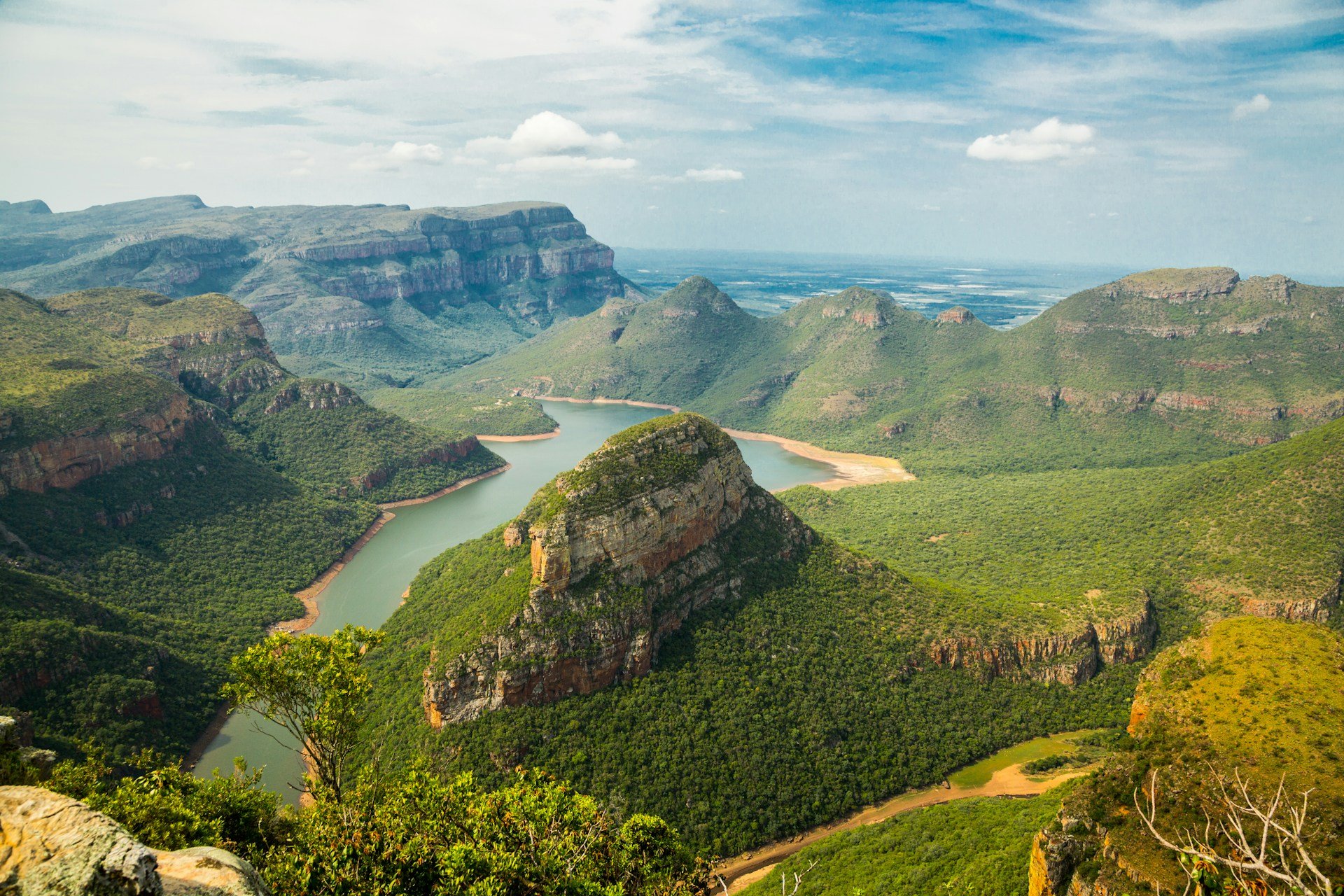
South Africa
One of the most geographically and culturally varied countries on earth. Penguins on a beach an hour from Cape Town. Lions and elephants in a national park you can drive yourself. Vineyards between mountains that rival Tuscany. And a history so recent and so significant that understanding it changes how you see everything else.
What You're Actually Getting Into
South Africa contains more distinct experiences per square kilometer than almost any other country on earth. Within a two-week trip you can watch a leopard drag a kill into a tree at dawn in Kruger, drink Chenin Blanc looking at mountains in Franschhoek, eat a braai with Cape Malay spiced sausage in Cape Town, swim with penguins at Boulders Beach, drive the most beautiful coastal road in the Southern Hemisphere, and stand in the cell on Robben Island where Nelson Mandela spent 18 years. The country is that wide. The experiences are that different from each other.
South Africa is also a country where the past is not past. Apartheid ended in 1994 — within the living memory of most of the adults you will meet. The geographic and economic segregation it created remains deeply visible: the townships adjacent to every major city, the persistent inequality in land ownership, the daily reality of a country still working out how to distribute thirty years of post-apartheid progress equitably. A visitor who arrives having read about this will understand what they're seeing. A visitor who arrives without that context will find the country beautiful, exciting, and faintly incomprehensible in ways they won't be able to articulate.
The practical reality is that South Africa requires more active safety awareness than any other country in this guide. It has a high crime rate, particularly in urban areas, and carjacking, mugging, and opportunistic theft are genuine risks. The tourist infrastructure is well-developed and millions of visitors travel safely every year, but the approach is different from Japan or Morocco — you maintain awareness, you don't walk alone in unfamiliar areas at night, you use Uber rather than street taxis, you keep valuables out of sight in parked cars. These habits become second nature within a day or two and don't diminish the experience once internalized.
What South Africa gives back for the awareness it requires is extraordinary. The rand's weakness against the dollar and euro makes it exceptional value — a world-class wine dinner in Stellenbosch, a night in a well-run safari lodge, a whale-watching boat out of Hermanus all cost fractions of what equivalent experiences would in Europe. It is, right now, one of the best value travel destinations in the world for Western visitors.
South Africa at a Glance
A History Worth Knowing
The San people — the Bushmen — have lived in southern Africa for at least 100,000 years, making them among the oldest continuously present human populations on earth. Their rock art, found in hundreds of sites across the country, depicts animals and spiritual figures with an artistic confidence that still astounds. When the Bantu-speaking peoples migrated south from central Africa beginning around 500 CE, they encountered existing San and Khoikhoi communities. The complex, layered societies that developed over the following millennium were what Dutch and Portuguese sailors encountered when they arrived on the Cape coast in the 15th and 16th centuries.
The Dutch East India Company established a resupply station at the Cape of Good Hope in 1652. Jan van Riebeeck's small fort was not intended as the beginning of a colony — it was a vegetable garden for passing ships. It became a colony anyway. Dutch settlers, later called Boers or Afrikaners, pushed inland, displacing Khoikhoi communities, importing enslaved people from Madagascar, India, and East Africa, and developing a distinct culture and language (Afrikaans) rooted in Dutch but shaped by all the communities it absorbed. The Cape Colony passed to the British in 1806, setting up a century of friction between British imperial ambitions and Afrikaner nationalist sentiment.
The discovery of diamonds near Kimberley in 1867 and gold on the Witwatersrand in 1886 transformed South Africa from a colonial backwater into the most economically significant territory in Africa. The scramble for control of these resources produced the Anglo-Boer Wars (1880–1881 and 1899–1902) — conflicts in which British forces employed concentration camps against Afrikaner civilian populations, killing an estimated 26,000 Boer women and children and a comparable number of Black Africans in separate, even worse-conditions camps that history has largely erased. The wars ended with British victory and the eventual formation of the Union of South Africa in 1910.
The African National Congress was founded in 1912 to represent Black South Africans' political interests, 36 years before apartheid was formally codified. When the National Party came to power in 1948, it systematized the racial segregation that had operated informally since colonization into a comprehensive legal framework: the Population Registration Act classified every person by race; the Group Areas Act dictated where each race could live; the Separate Amenities Act enforced segregation in public spaces; the Pass Laws controlled Black South Africans' movement. Interracial marriage and sexual relations were criminalized. Political opposition was suppressed with increasing brutality.
The ANC's shift to armed resistance after the Sharpeville massacre of 1960 — in which police killed 69 unarmed protesters — led to the arrest of Nelson Mandela and other leaders in 1963. At the Rivonia Trial, Mandela delivered one of the defining speeches of the 20th century, ending: "It is an ideal which I hope to live for and to achieve. But if needs be, it is an ideal for which I am prepared to die." He was sentenced to life imprisonment on Robben Island. He served 27 years. His release in 1990, his negotiation of the transition to democracy alongside F.W. de Klerk, and his election as South Africa's first democratically chosen president in 1994 represented one of history's more extraordinary political outcomes.
The post-apartheid decades have been complicated. The ANC governed for 30 years following 1994 but presided over rising inequality, catastrophic failures in electricity infrastructure (load shedding became a defining feature of South African daily life), persistent corruption, and unemployment that has consistently exceeded 30%. The democratic institutions held — elections have been free and fair, the judiciary has remained independent, the press has stayed free — but the material conditions for most South Africans have not improved as hoped. The 2024 elections saw the ANC lose its parliamentary majority for the first time, forming a government of national unity. Where this leads is one of the more significant political questions in Africa right now.
Among earth's oldest continuously present human populations. Rock art found across the country.
Jan van Riebeeck establishes a resupply station at the Cape. Intended as a garden. Became a colony.
Diamond discovery near Kimberley (1867), gold on the Witwatersrand (1886). South Africa becomes Africa's economic centre.
British concentration camps kill 26,000+ Boer civilians. A comparable number of Black Africans die in separate, worse-conditions camps.
National Party codifies racial segregation into comprehensive law. Population classification, forced removals, pass laws, political suppression.
Nelson Mandela sentenced to life on Robben Island. Serves 27 years. His trial speech becomes one of the 20th century's defining documents.
Mandela released. Negotiations with De Klerk. First democratic elections April 1994. Mandela elected president.
ANC loses majority in 2024. Coalition government. Ongoing challenges: inequality, unemployment, infrastructure, corruption.
Top Destinations
South Africa is large — roughly the size of Western Europe — and the distances between major destinations require either flying or committing to multi-day road trips. The classic itinerary pairs Cape Town and the Western Cape with Kruger. A longer trip adds Johannesburg, the Garden Route, or KwaZulu-Natal's Drakensberg mountains. All of these are distinct enough that rushing between them serves nobody well.
Cape Town
One of the most naturally beautiful cities on earth, and it knows it. Table Mountain looms over a city of beaches, wine bars, neighborhoods with wildly different characters, and a waterfront that manages to be touristy and genuinely functional simultaneously. The V&A Waterfront is well-designed and worth a morning despite its commercial nature. Bo-Kaap, the Cape Malay quarter, is colorful, historically significant, and best visited on foot in the early morning. Clifton and Camps Bay beaches are Atlantic-facing, cold, and spectacular. The ferry to Robben Island runs from the V&A — book ahead, the guided tour by a former political prisoner is extraordinary. Budget five days minimum. Seven is better.
Kruger National Park
One of Africa's greatest national parks and one of the few where self-drive is genuinely viable and affordable. At nearly two million hectares, Kruger is larger than Wales and contains some of the highest densities of Big Five wildlife on the continent. The southern section between Skukuza and Berg-en-Dal offers the best lion and leopard sightings; the northern section near Punda Maria is quieter and better for elephant and wild dog. Rent a car in Johannesburg or Nelspruit, book rest camp accommodation well in advance, and drive slowly — the standard road-trip pace of looking at scenery will cause you to miss most of the animals. Five to seven days gives the safari proper time.
Cape Winelands
Stellenbosch and Franschhoek sit in valleys between dramatic mountain ranges, with estates producing world-class Chenin Blanc, Pinotage, and Cabernet Sauvignon at prices that would make Burgundy blush. Franschhoek is the more photogenic of the two towns and has better restaurants. Stellenbosch has more estates within cycling distance. The Franschhoek Wine Tram is a genuinely pleasant way to visit multiple estates without driving. One to two nights each, though three days in the Winelands total is easy to fill.
Garden Route
The coastal road along the N2 from Cape Town to Port Elizabeth — about 800km — is one of the world's great drives. The Wilderness section has lagoons and beaches. Knysna's famous lagoon and oysters are essential stops. Tsitsikamma National Park has dramatic coastal forest and suspension bridge walks. Storms River mouth is where the Bloukrans Bridge bungee jump operates — 216 metres, the highest commercial jump on earth. Budget five to seven days to drive it without rushing; an entire week if you want to stop properly at each place.
Johannesburg
Johannesburg gets skipped by visitors who arrive via Cape Town and leave for Kruger, which is a mistake. The Apartheid Museum is mandatory and arguably the most important single museum visit you can make in Africa. Soweto — the township southwest of the city where both Mandela and Desmond Tutu once lived on the same street — has tours that are thoughtful, politically honest, and extraordinary. The Maboneng Precinct in the east of the city is a regenerated neighborhood with art spaces, markets, and restaurants that represents a different Joburg from the one in the security warnings. Two full days minimum.
Hermanus
The best land-based whale watching in the world, according to most people who have done it in multiple places. Southern right whales come to Walker Bay between June and December to calve, and you can watch them from the cliff path above the bay without a boat — mothers teaching calves to breach, males competing, water exploding. The town itself is pleasant and not overcrowded outside whale season. Out of season, the Hemel-en-Aarde Valley immediately outside Hermanus produces some of the Western Cape's best Pinot Noir.
Drakensberg Mountains
The Drakensberg escarpment in KwaZulu-Natal is southern Africa's most dramatic mountain landscape — a 200km wall of basalt cliffs rising to over 3,400 metres, with hiking trails, San rock art in cliff shelters (the highest concentration of rock paintings in Africa), and a scale that is genuinely humbling. The Royal Natal National Park at the northern end has the Amphitheatre — a 5km curved cliff wall that is one of the most impressive single geological features in the world. Best accessed from Durban or Joburg with a rental car.
Private Game Reserves
Adjacent to Kruger, the private reserves — Sabi Sand, Timbavati, Manyeleti — offer what self-drive Kruger cannot: off-road game drives, walking safaris with armed guides, and the ability to follow an animal off the paved roads. The Big Five all cross freely between Kruger and these unfenced reserves. The lodges range from mid-range all-inclusive operations to extraordinary luxury properties charging $1,000+ per person per night. Even a mid-range private reserve experience is qualitatively different from self-drive and worth the budget stretch for at least one or two nights.
Culture & Etiquette
South Africa has 11 official languages and more cultural groups than most continents — Zulu, Xhosa, Sotho, Tswana, Venda, Ndebele, Cape Malay, Afrikaner, English-speaking white South African, Indian South African, and Coloured (a South African census category referring to people of mixed heritage, primarily in the Western Cape). Each community has distinct cultural practices, food traditions, and social norms. What holds across most of them is a warmth and directness that visitors frequently remark on.
The concept of ubuntu — roughly, "I am because we are" — is a Nguni philosophical principle describing the communal basis of individual identity. It manifests in a social generosity that goes beyond formal hospitality: the willingness to help a stranger, the assumption that connection matters more than transaction. You'll feel it in unexpected moments throughout the country.
Visiting the Apartheid Museum, Robben Island, or Soweto is not "dark tourism" in a voyeuristic sense — it is the minimum homework for understanding the country you're in. South Africans of all backgrounds appreciate visitors who arrive with context rather than just looking for wildlife and wine.
"Sawubona" (Zulu, "I see you") and "Molo" (Xhosa, "hello") are received with genuine warmth when a visitor attempts them. South Africa's Black majority languages are rarely learned by foreign visitors and any effort is noticed. "Sawubona" in particular carries philosophical weight — the response "Ngikhona" means "I am here," affirming mutual recognition.
The South African braai (barbecue) is a cultural institution that transcends racial and cultural lines in a way few things in South Africa do. If invited to a braai, accept. Boerewors (spiced sausage), lamb chops, sosaties (marinated kebabs). The fire is managed with the seriousness normally reserved for important matters.
South Africa has a service industry with low formal wages. Tipping 10–15% at restaurants is standard and important. In safari lodges, the end-of-stay tip for guides and camp staff is significant — budget R500–1,000 per person per night stay, shared among the staff.
Uber is widely available in Cape Town, Johannesburg, Durban, and most major cities, is far safer than street taxis, and is metered and trackable. It is the correct urban transport choice for visitors and what well-traveled South Africans use themselves.
South Africa's racial categories — Black, White, Coloured, Indian/Asian — are still used in official contexts (census data, employment equity) and in everyday conversation but carry specific local meanings different from how they function elsewhere. "Coloured" in South Africa is not a slur — it refers to a specific cultural and historical community in the Western Cape. Context matters enormously.
Smash-and-grab theft from parked cars is common throughout South Africa, particularly in cities. Don't leave anything visible on a seat — bags, cameras, laptops, even empty bags that might suggest something was in them. This applies in tourist areas as much as anywhere else.
This is the most important practical safety rule in South Africa. The risk is real and consistent across cities. Use Uber, stay in well-lit and populated areas after dark, and ask locals or your accommodation for specific guidance about which areas require extra awareness at what times.
South Africa is large and distances on the map translate to long driving times, particularly on the N1 between Cape Town and Johannesburg (1,400km). Plan driving days with realistic times — South African roads are generally good but don't drive at night in rural areas due to unlit livestock on roads.
South Africa has experienced scheduled power cuts (load shedding) as an ongoing infrastructure issue, though improvements have been made in 2024–2025. Check the current status before travel — apps like EskomSePush show schedules. Your hotel and lodge will have generators, but restaurants and shops may be affected.
Braai Culture
The braai is to South Africa what the BBQ is to Australia but with more ceremony and more argument. Every household has one. Every public park has communal braai facilities. The type of wood matters (hardwoods give better coals). The management of the fire is never delegated to someone who doesn't know what they're doing. Boerewors on a braai at sunset with cold Windhoek Lager is one of South Africa's essential experiences.
Music & Kwaito
South Africa has one of Africa's richest music cultures. Kwaito emerged from Soweto in the 1990s as a post-apartheid sound that mixed house music with African rhythms and Zulu lyrics. Amapiano — a piano-led, Johannesburg-born genre — has become one of the most globally influential music styles of the 2020s, with South African producers collaborating with artists across the world. Listening to amapiano while driving through the Winelands is a perfectly coherent aesthetic choice.
Rugby & Sport
The Springboks are the most successful rugby team in World Cup history and South African rugby is a genuine national obsession. Test matches, particularly against the All Blacks, stop the country. Cricket and football (soccer) are also major — the 2010 FIFA World Cup hosted in South Africa was a turning point in how the country presented itself to the world. If any major sporting event is on during your visit, attending or watching in a bar with locals is worthwhile.
The Rainbow Nation
Desmond Tutu coined the phrase "Rainbow Nation" to describe post-apartheid South Africa's aspiration toward unity in diversity. The reality is more complicated than the slogan — the country is still deeply economically divided along largely racial lines — but the aspiration is real and the diversity is genuine. Cape Town's Bo-Kaap, Johannesburg's Chinatown, Durban's Indian quarter, the Zulu cultural villages of KwaZulu-Natal — the country's plurality is one of its most distinctive characteristics.
Food & Drink
South African food is as varied as the country. The Western Cape has arguably the best restaurant scene in Africa — Cape Town's dining culture is sophisticated, creative, and cheap by European standards, and the wine pairing at a good Stellenbosch estate is world-class. Inland and in the townships, the food becomes more utilitarian and deeply satisfying: pap (maize porridge), braai meat, umngqusho (samp and beans), vetkoek (fried dough bread). Durban's Indian community has produced a curry tradition with no equivalent anywhere else in the world. The Bunnychow — a hollowed-out loaf of bread filled with curry, eaten by hand — is the perfect street food and available in Durban for almost nothing.
Boerewors & Braai
Boerewors is a thick, coiled beef and pork sausage spiced with coriander, nutmeg, and cloves — the centerpiece of any braai. Alongside it: lamb chops, chicken pieces marinated in peri-peri, sosaties (marinated kebabs). The braai is not just a cooking method; it's a social ritual that happens at every level of South African society. Find one to attend. If there's no invitation forthcoming, most good butcheries in Cape Town and Joburg will make boerewors to take away and cook yourself.
Bunny Chow
A Durban institution: a quarter or half loaf of white bread hollowed out and filled with curry — lamb, chicken, or bean — eaten with the bread lid and the scooped-out interior on the side to dip. It was invented in the 1940s when Durban Indian workers who weren't allowed to enter restaurants received their take-away curries in bread to avoid providing vessels. It is extraordinarily good and costs almost nothing. Go to Glenwood or Grey Street in Durban and find a shop that's been operating for decades.
Braaibroodjie & Potjiekos
Braaibroodjie is a toasted sandwich cooked on the braai — buttered bread with cheese, tomato, and onion, pressed against the grill until it's crisp and smoky. Potjiekos ("small pot food") is a slow-cooked stew made in a cast-iron three-legged pot over coals — the Afrikaner version of slow cooking, with lamb or chicken, vegetables, and spices cooked for hours. Both are braai-adjacent foods that define the Afrikaner food tradition and are available at restaurants that specialize in traditional South African cooking.
Pap & Umngqusho
Pap (maize porridge) is the staple carbohydrate of most of South Africa — eaten stiff as a bread substitute, or sloppy as a breakfast porridge with milk and sugar. Umngqusho is a Xhosa dish of samp (broken dried maize kernels) and beans, slow-cooked until soft, that was Nelson Mandela's favorite food. Both are cheap, filling, and deeply embedded in South African food culture in a way that the restaurant scene around the Cape Winelands doesn't always reflect.
Seafood: Knysna & Cape
The Knysna oyster is one of South Africa's finest food products — grown in the Knysna Lagoon, eaten cold with lemon at the Waterfront in Knysna for almost nothing. Cape Town's waterfront seafood — snoek (a long, oily Atlantic fish), kingklip, West Coast crayfish (rock lobster) — is excellent at the right restaurants. The Cape has one of the world's most productive cold-water fisheries and the produce shows. Order whatever the chalkboard says is fresh today.
South African Wine
South Africa has been producing wine since 1659 and the Western Cape now produces over 600 million litres annually. Chenin Blanc (locally called Steen) is the flagship white — dry, honeyed, and complex at its best. Pinotage, a grape variety unique to South Africa (a Pinot Noir and Cinsault cross), divides opinion but at its best makes a deeply South African red. The Cabernet Sauvignons and Shiraz from Stellenbosch and Paarl are world-class. A good wine estate visit with a cellar tour and tasting costs R150–250 per person. This is extraordinary value.
When to Go
South Africa's seasons are the reverse of the Northern Hemisphere, and the country is large enough that optimal timing differs significantly by region. The Western Cape (Cape Town, Winelands, Garden Route) is best in Southern Hemisphere summer (October to April). Kruger safari is best in the dry season (May to September). If you want to do both in one trip — which most people do — the shoulder months of October/November and April are the best compromise.
Summer
Oct – AprCape Town's prime season. Warm, dry, long days. The Winelands are harvesting grapes from February to April. Whale watching peaks from June to December, but October to December overlaps with early summer and is good for both. Busy school holidays (December–January) push accommodation prices up sharply.
Dry Season
May – SepThe best time for Kruger and safari. Vegetation thins out, animals concentrate around water sources, and sightings are significantly better. Mornings are cold (can drop below 10°C in June–July) so pack layers. This is also the best time for the Drakensberg. Cape Town in winter (June–August) is cold and rainy but still manageable.
Shoulder
Oct–Nov & AprThe best compromise for combining Cape Town and Kruger in one trip. October/November: Cape Town warming up, Kruger vegetation still reasonable, pre-Christmas crowds. April: post-harvest Winelands, end of Cape summer, acceptable game viewing. Prices are mid-range and accommodation is available without far-advance booking.
Dec–Jan Peak
Dec 15 – Jan 15South African domestic school holidays. Cape Town accommodation is expensive, fully booked, and crowded. Beaches are packed. Prices double or triple at popular destinations. The weather is excellent but the crowds and costs are at their annual peak. Avoid if flexibility allows — two weeks either side is significantly more pleasant.
Trip Planning
Two weeks is the minimum for South Africa to make sense as a destination. Less than that and you're spending too much time in transit between experiences that deserve more time. Three weeks allows the classic Cape Town plus Garden Route plus Kruger triangle properly. Four weeks adds Johannesburg, Hermanus, and the Drakensberg without rushing anything.
A rental car is not optional for most South Africa itineraries. Public transport between major tourist destinations is limited, slow, and — frankly — not recommended for visitors who don't know the country. Driving is on the left (as in the UK and Australia). Roads in tourist areas are generally excellent and well-signposted. The one firm rule: don't drive in rural areas after dark due to livestock and unlit vehicles on the road.
Cape Town
Day one: recover from the flight, V&A Waterfront, Bo-Kaap walk. Day two: Table Mountain cable car at opening time before the queue builds, Camps Bay beach in the afternoon. Day three: Robben Island ferry (morning, book ahead), Cape Point drive along the peninsula in the afternoon, Boulders Beach penguins. Day four: Cape Winelands day trip to Stellenbosch and Franschhoek — hire a driver or take the wine tram.
Hermanus
Collect rental car from Cape Town, drive 1.5 hours east along the coast. Cliff path whale watching (June to December), ocean kayaking, Hemel-en-Aarde wine valley for Pinot Noir. Two nights here is the right amount — enough for two different coastal walks and a wine tasting without overstaying.
Kruger National Park
Fly from Cape Town to Kruger/Mpumalanga (KMIA) airport, collect second rental car. Check into Skukuza or Lower Sabie rest camp. Four days self-driving: dawn drives starting at gate opening, specific focus on the H4-1 road, midday rest in camp during heat, afternoon drive until gate close. Lion, elephant, and leopard sightings with this approach are not guaranteed but are likely.
Cape Town + Winelands
Five days in and around Cape Town. Table Mountain, Robben Island, Bo-Kaap, Cape Point. Two nights in Stellenbosch staying at a wine estate (wake up with vineyards outside the window). Franschhoek lunch at one of the valley's good restaurants. The drive back through Hout Bay and Chapman's Peak road at sunset.
Garden Route
Drive east from Cape Town along the N2. Stop at Hermanus for whale watching (in season). Continue to Wilderness for lagoon kayaking. Knysna for oysters and the Heads lagoon viewpoint. Tsitsikamma for forest walks and the suspension bridge. One night near Storms River if the bungee jump at Bloukrans is on the itinerary.
Kruger
Fly from George or Port Elizabeth to Nelspruit. Five days in Kruger — mix of self-drive rest camps and one or two nights in a private reserve adjacent to the park. The shift from self-drive to a private lodge with guided off-road drives is worth experiencing. Night drives in private reserves show nocturnal wildlife that Kruger's self-drive rules prohibit seeing after dark.
Johannesburg
Start in Joburg. Apartheid Museum on day one — half a day minimum. Soweto tour on day two: Vilakazi Street (Mandela and Tutu's street), Regina Mundi Church (bullet holes still in the walls from the 1976 Soweto Uprising), Hector Pieterson Memorial. Evening in Maboneng. Fly to Cape Town for day three.
Cape Town
Five full days. Table Mountain, Robben Island, Cape Point, Boulders Beach. Two days in Bo-Kaap and the city neighborhoods. One day at leisure — beach at Clifton, sunset at Signal Hill, dinner in the city bowl's better restaurants.
Cape Winelands
Stellenbosch, Franschhoek, Paarl. Cellar tours and tastings. Lunch at a wine estate. The Franschhoek Pass road between visits. Three nights staying in the valley itself.
Garden Route
Full Garden Route drive, stopping properly at each destination rather than racing through. Hermanus overnight, Wilderness overnight, Knysna two nights, Tsitsikamma overnight. Bloukrans bungee if inclined. Fly from George or Port Elizabeth.
Kruger & Private Reserve
Six days in the Kruger ecosystem. Three to four nights self-drive in Kruger rest camps (book Satara or Olifants in the central section for varied wildlife). Two nights in a Sabi Sand or Timbavati private reserve for guided drives and a walking safari. Fly home from Johannesburg (OR Tambo) after a night near the airport.
Vaccinations & Malaria
Malaria prophylaxis is recommended if visiting the Kruger/Limpopo region (Malaria zone). Consult a travel health clinic 4–6 weeks before departure. Recommended vaccines: Hepatitis A and B, Typhoid. Yellow fever vaccination required if arriving from an endemic country. No yellow fever requirement for direct flights from Europe, US, or Australia.
Full vaccine info →Power & Load Shedding
South Africa uses the Type M plug (large 3-pin) at 230V. Most European appliances work. North Americans and British visitors need a Type M adapter — not easy to find outside South Africa, so bring one from home. Check current load shedding status (scheduled power cuts) before travel via EskomSePush app. Hotels and lodges have generators.
Connectivity
South African SIMs (Vodacom, MTN, Cell C) are available at major airports. Mobile data is good in cities and along tourist routes. Coverage in Kruger is variable — most rest camps have WiFi. A South Africa eSIM through Airalo is a good alternative. Download offline maps before entering Kruger where data is unreliable.
Get SA eSIM →Car Rental
Book a rental car well in advance for peak season (October to April). An automatic is strongly recommended if you're not used to driving on the left. For Kruger, a standard sedan is sufficient — a 4x4 is only needed for private reserve dirt roads and is more expensive. Ensure your insurance covers windscreen and tyre damage (gravel roads throw stones). An international driving permit is recommended.
Travel Insurance
Essential. Medical facilities in Cape Town and Johannesburg are good but expensive without insurance. In rural areas, evacuation costs are significant. For Kruger, ensure your policy covers wildlife incidents (rare but not impossible). For the Garden Route, adventure activity coverage for bungee jumping or shark cage diving if relevant.
Kruger Specific
Book SANParks rest camp accommodation at sanparks.org months in advance — popular camps fill up, particularly in school holidays. Gate opening and closing times are strictly enforced (you will be fined for being outside camp after closing). Bring insect repellent, binoculars, and a good wildlife field guide. Wear neutral colors on game drives.
Transport in South Africa
South Africa's transport system divides clearly into two categories: excellent for cars and planes, inadequate for everything else. The roads are generally very good. Domestic flights are affordable and convenient. Public transport between cities is limited to long-distance bus services (Greyhound, Intercape, FlixBus South Africa) that are functional but slow and don't serve most tourist destinations well. Trains are almost not worth discussing for tourist travel — the famous Blue Train is a luxury experience, not a practical transport option.
Car Rental
R500–1,200/dayThe essential transport option for most South Africa trips. Avis, Budget, Hertz, and local operators all have desks at major airports. Book well in advance. All-inclusive insurance (including windscreen and tyres) is worth the premium on gravel roads. Drive on the left. Petrol (gasoline) is paid for at the pump — attendants fill it for you; a R10–20 tip is expected.
Domestic Flights
R500–2,500/routeKulula, FlySafair, and Airlink connect Cape Town, Johannesburg, Durban, George, Port Elizabeth, and Kruger/Mpumalanga (KMIA). Book in advance on the airline websites. Cape Town to Johannesburg (2 hours) is one of Africa's busiest domestic routes. Flying versus driving the 1,400km is an obvious choice unless you specifically want the Karoo road trip experience.
Uber
Fixed rate via appAvailable and reliable in Cape Town, Johannesburg, Durban, and Pretoria. The correct option for all urban transport. Far safer than street taxis. Metered, GPS-tracked, and driver-rated. InDriver is a competing app with slightly different pricing. Use one of these rather than hailing taxis from the street in any South African city.
Intercity Bus
R200–600/routeGreyhound, Intercape, and FlixBus South Africa connect major cities. Slower than flying but more scenic on routes like Cape Town to Johannesburg through the Karoo. Comfortable, air-conditioned, but road journey times are long. The Garden Route bus (Baz Bus) is a hop-on-hop-off service specifically for backpackers that runs Cape Town to Port Elizabeth.
Blue Train / Rovos Rail
$500–3,000/journeyThe Blue Train (Cape Town to Johannesburg, 27 hours) and Rovos Rail are luxury experiences, not transport. Suitable for a special occasion or as an experience in their own right. The Rovos Rail through the Karoo Desert is genuinely beautiful. If the budget allows and the romance of train travel appeals, book early — both are popular.
MyCiTi (Cape Town)
R15–30/tripCape Town's Bus Rapid Transit system covers the City Bowl, Waterfront, Sea Point, and the airport corridor. Clean, reliable, and useful for airport transfers and moving between central neighborhoods. Load a myconnect card at the airport or a station. Not useful for most tourist activities outside the central areas.
Guided Safari Vehicle
Included with lodgeAt private reserves, open-sided Land Rovers or Land Cruisers with experienced rangers and trackers. Off-road capability, night drives, the ability to follow an animal into the bush rather than watching from the road. This is what distinguishes a private reserve from self-drive Kruger and why, for at least one or two nights, it's worth the budget difference.
Ferries & Boats
R350–650Robben Island ferry from the V&A Waterfront in Cape Town — the most important boat trip in the country. Whale watching boats from Hermanus. Knysna lagoon boat tours. Shark cage diving boats from Gansbaai (great white sharks, world's best access). All bookable through the operators directly or GetYourGuide.
Accommodation in South Africa
South Africa has a sophisticated accommodation industry that ranges from backpacker hostels to some of the finest safari lodges in the world. The weak rand makes the upper end extraordinary value — a luxury wine estate guesthouse in Franschhoek or a top-tier private game reserve lodge costs a fraction of equivalent experiences in Europe or North America. The mid-range is particularly well-developed: South Africa's guesthouse culture is excellent, with well-maintained, hosted properties in every tourist area.
Safari Lodge
R1,500–15,000+/person/nightAll-inclusive lodges in private reserves adjacent to Kruger. Price includes all meals, twice-daily game drives, a ranger and tracker, and usually drinks. Budget lodges from around R1,500/person/night. Mid-range R3,000–6,000. Top-end properties like Singita, &Beyond, or MalaMala from R10,000+. All of these provide the quintessential safari experience — quality of guiding and wildlife density matters more than lodge luxury.
Guesthouse / B&B
R800–2,500/nightSouth Africa's dominant accommodation format outside safari. Hosted guesthouses with breakfast, a pool, and local knowledge that hotels don't have. The Western Cape's guesthouse standard is particularly high — staying in a converted Cape Dutch farmhouse in Stellenbosch with a pool and vineyard views is a genuine experience at around R1,200/night. Excellent value by any international comparison.
SANParks Rest Camps
R400–1,500/nightThe network of rest camps inside Kruger National Park — Skukuza, Lower Sabie, Berg-en-Dal, Satara, Olifants, and others. Options from campsites through to self-catering chalets and rondavels (circular thatched huts). All are fenced (electric), have restaurants, pools, and fuel. Book through sanparks.org months in advance. Sleeping inside the park is how you get the dawn and dusk game drives.
Boutique Hotel / Apartment
R1,500–5,000/nightCape Town has a well-developed boutique hotel and self-catering apartment sector. De Waterkant, Tamboerskloof, and the City Bowl neighborhoods have the best independent options. Sea-facing apartments in Camps Bay or Clifton are spectacular but expensive and exposed to Cape Town's famous wind (the south-easter "Cape Doctor" in summer). Airbnb works well in Cape Town for longer stays.
Budget Planning
South Africa is exceptional value for international visitors right now. The rand trades at approximately R18–20 to the US dollar and R20–22 to the euro (check current rates — the rand fluctuates). This means that a world-class restaurant meal in Cape Town that would cost €100 in a European city costs R600–800 in South Africa — roughly €30–40. A night in a good Winelands guesthouse that would cost €200 in Tuscany costs R1,200–1,500 — roughly €60–75. The main exception is safari lodge accommodation, which is priced to international buyers regardless of the rand rate.
- Hostel or basic guesthouse
- Self-catering and street food
- Kruger self-drive rest camp
- Baz Bus hop-on-hop-off
- Budget wine tastings
- Good guesthouse with breakfast
- Restaurant meals + braai
- Rental car (2–3 people sharing)
- Winelands estate tastings
- Budget safari lodge
- Boutique hotel or wine estate stay
- Fine dining, tasting menus
- Private reserve safari lodge
- Private guided tours
- Helicopter over Cape Peninsula
Quick Reference Prices
Visa & Entry
South Africa operates a visa-exempt system for most Western passport holders. Citizens of the US, UK, all EU countries, Australia, Canada, New Zealand, Japan, and many others can enter visa-free for stays of up to 90 days. No advance application is required — you receive an entry stamp on arrival. The requirements are straightforward but a few are enforced strictly enough to cause problems if not prepared.
The two requirements that catch people out: your passport must have at least two blank pages for the entry stamp (immigration will turn you away at the gate if you don't have them), and it must be valid for at least 30 days beyond your departure date from South Africa. Check both before you travel — not the day before, but when you book.
US, UK, EU, Australia, Canada, New Zealand and most Western passport holders qualify. Entry stamp on arrival. No advance application required.
Family Travel & Pets
South Africa is an extraordinary family destination for the right age group. Children old enough to understand what they're seeing on safari — roughly 6 and above — find Kruger genuinely transformative. The Cape Town combination of beaches, penguins, Table Mountain, and the aquarium covers almost any age. The Garden Route is excellent for active families. The challenge for families with very young children is the security awareness requirements in cities and the distances involved — long drives require planning with young passengers.
Note the strict documentation requirements for children entering South Africa — this is not negotiable and airlines enforce it. Read the DHA (Department of Home Affairs) requirements for minors before you book, particularly if only one parent is traveling with children.
Kruger Safari
Children from about 6 upward find Kruger genuinely exciting — the anticipation of finding a lion, the moment an elephant crosses the road in front of the car, the giraffes visible from the rest camp fence. Some private lodges have age restrictions (usually 6 or 8 minimum) for safety on game drives. Self-drive Kruger is suitable for any age.
Boulders Beach Penguins
The African penguin colony at Boulders Beach near Simon's Town, 45 minutes from Cape Town, is universally adored by children of every age. Boardwalks take you to eye level with hundreds of penguins that are completely unintimidated by human proximity. The beach itself is also swimmable — calm, warmer than the Atlantic beaches, sheltered by boulders. A full morning's activity.
Table Mountain
The cable car to the summit takes 5 minutes and works for any age. At the top, the panoramic view over Cape Town and both oceans is immediately understood by children as something extraordinary. The lower slopes also have walking trails suitable for families. Go on a clear day (which Cape Town's notorious weather can't guarantee) and go early.
Garden Route Beaches
The Indian Ocean beaches along the Garden Route — Wilderness, Victoria Bay, Jeffreys Bay — are warm (unlike Cape Town's Atlantic coast), clean, and have surf appropriate for beginner lessons. Jeffreys Bay is one of the world's top surf destinations; its breaks are for experienced surfers, but there are beginner-friendly beaches nearby. The Tsitsikamma forest walks are excellent for older children.
Shark Cage Diving
Shark cage diving with great white sharks at Gansbaai, two hours from Cape Town, is the most visceral wildlife experience in the country. Minimum age is typically 8–10 (non-diving, in the cage). The sharks in these waters are genuinely enormous. This is not for every family but for those who want it, there is nothing quite like it.
Apartheid History for Teenagers
Teenagers old enough for serious historical engagement will find Robben Island and the Apartheid Museum among the most impactful experiences available anywhere in the world. The guide on Robben Island who shows you Mandela's cell is often a former political prisoner himself. This is difficult history presented with remarkable dignity and is genuinely appropriate for teenagers with context.
Traveling with Pets
South Africa permits the import of dogs and cats with full documentation. Requirements include an ISO-standard microchip, valid rabies vaccination, an official veterinary health certificate endorsed by your national authority within 10 days of travel, and a rabies titer test (blood test confirming immunity) for animals coming from countries outside the approved list. Processing the titer test takes several weeks — start at least three months before travel.
Once in South Africa: the country has a strong pet culture and is broadly dog-friendly in ways that many African countries are not. Many guesthouses accept pets; confirm explicitly at booking. National parks and game reserves do not permit pets inside — wildlife interaction risks make this non-negotiable. Urban parks, beaches (with restrictions), and most outdoor restaurant terraces are accessible with dogs. Cape Town in particular has an active dog-walking and dog-friendly café culture.
One specific warning: wildlife is present throughout South Africa, including in suburban and coastal areas. Dogs should never be left unsupervised outdoors in areas near reserves or in coastal bush — baboons, leopards, and caracals all pose risks to domestic dogs in specific areas near Cape Town and along the Garden Route.
Safety in South Africa
South Africa has one of the highest crime rates in the world, and being honest about this is more useful than minimizing it. Violent crime — mugging, carjacking, house robbery — occurs at rates significantly above global averages, particularly in urban areas. This doesn't mean that every visitor will have a bad experience — the vast majority don't — but it means that the precautions that would be overcautious in Tokyo or Copenhagen are necessary and reasonable here. The difference between travelers who have good experiences in South Africa and those who don't is usually not luck. It's awareness.
Urban Crime
Cape Town, Johannesburg, and Durban all have areas with high crime rates. Stay in established tourist neighborhoods, use Uber rather than street taxis, don't walk alone at night in unfamiliar areas, keep valuables out of sight, and don't use your phone visibly on the street. These habits reduce risk dramatically.
Carjacking
Carjacking occurs particularly at traffic lights (robots) and in deserted areas. Lock doors when driving in cities. Keep windows up at night. Don't stop in poorly lit areas. If you're being followed, drive to the nearest police station or busy public space rather than to your accommodation. Be aware at toll booths and fuel stops.
Smash-and-Grab
Theft from parked or stationary cars by breaking a window. Never leave anything visible in a car — bags, chargers, sunglasses, empty bags that might suggest contents. In cities, this applies at any time of day, not just at night. Hire car rental companies will not pay for items stolen from inside vehicles.
Safari & National Parks
Kruger and the private reserves are very safe from crime. The wildlife risks are real — stay in your vehicle, don't get out except at designated safe areas, don't feed animals — but incidents involving tourists following these rules are extremely rare. The parks are well-managed and the rangers are excellent.
Cape Town Tourist Areas
The V&A Waterfront, De Waterkant, the City Bowl restaurant strips, and the beach suburbs (Camps Bay, Clifton, Sea Point) are well-managed and generally safe during daylight and early evenings. The Cape Flats townships should not be visited without a reputable guided tour.
Healthcare
Private hospitals in Cape Town (Netcare, Mediclinic) and Johannesburg are excellent. Public hospitals are overwhelmed and not recommended for tourist medical care. Travel insurance with private hospital coverage is essential. The Flying Doctor service covers medical emergencies in remote areas. Know your insurer's emergency number before you need it.
Emergency Information
Your Embassy in Pretoria
Most foreign embassies are in Pretoria (the administrative capital). Consulates also operate in Cape Town and Johannesburg.
Book Your South Africa Trip
Everything in one place. These are services worth actually using.
It Gets Under Your Skin
There's a specific kind of travel experience that changes your reference points permanently — where you arrive with a set of assumptions about the world and leave with those assumptions revised. South Africa is that kind of place. The history is too recent and too significant to remain abstract once you've stood in Mandela's cell on Robben Island or walked the street in Soweto where two Nobel Peace Prize winners once lived as neighbors under a system that classified them as subhuman. The wildlife is too immediate — a leopard in a tree 20 metres from your car is not a documentary moment. The beauty is too disproportionate to any reasonable expectation.
South Africa asks more of its visitors than most destinations. More awareness, more emotional engagement, more willingness to sit with things that are uncomfortable. What it gives back is a country that you carry with you afterward in a way that is difficult to explain to people who haven't been. Go. Give it time. And come back.