
Morocco's Red City earns the nickname twice over
Marrakech takes its nickname from the reddish clay walls that ring the old city, an ochre-pink that shifts with the light through the day and turns genuinely dramatic at sunset. Founded in 1062 as the Almoravid empire's capital, it has spent close to a thousand years as one of the great trading and religious centers of the Maghreb, and Jemaa el-Fnaa, the main square, has run continuously as market and gathering place for most of that span. The medina still operates on its own logic: narrow, unnamed alleys, mule carts sharing space with mopeds, and a level of sensory input, sound, spice, color, that first-time visitors consistently describe as overwhelming in the best and most exhausting sense at once.
What has changed in the last two decades is scale. Marrakech went from a niche interest for adventurous travelers to one of Africa's most-visited cities, and the tourist infrastructure, riads, restaurants, English-speaking guides, has caught up fast. That growth is also why the medina's hustle culture is more intense than it was a generation ago: more foreign money moving through the souks means more people angling for a cut of it.
The honest complications
Medina hassle is constant and unavoidable in the busiest parts of the souk: unsolicited "guides," high-pressure shop owners, and a baseline assumption that any visibly foreign visitor is a target for a sale. None of it is dangerous, but it wears on people who haven't budgeted patience for it. Summer heat is genuinely brutal, June through August regularly exceeds 40°C, and the medina's narrow alleys trap heat with little shade. The September 2023 earthquake, centered in the High Atlas about 71km southwest of the city, killed nearly 3,000 people; central Marrakech was not structurally devastated and the tourist circuit has fully recovered, but it's a real, recent event worth knowing rather than a footnote, and some rural mountain villages on Atlas trekking routes are still rebuilding.
Four districts, one very different pace each
Marrakech splits cleanly between the walled old city and the French-built new town outside it. Where you base yourself decides how much medina noise and hassle you wake up to versus how far you are from it.
Medina
The walled old city, centered on Jemaa el-Fnaa and the souks, is where most first-time visitors base themselves: riads tucked behind unmarked wooden doors, five minutes from the action in any direction, and the full sensory version of Marrakech outside your front door. It is also the loudest and most hassle-prone part of the city; a riad with a good rooftop and thick interior walls matters more here than almost anywhere.
Kasbah
The southern end of the medina, historically the royal and administrative quarter, sits within walking distance of Bahia Palace, El Badi Palace and the Saadian Tombs, with noticeably fewer touts and a calmer pace than the souk-heavy northern medina. A strong middle option for travelers who want medina atmosphere without its busiest edges.
Gueliz
Built under the French protectorate from the 1910s through 1930s, Gueliz is Marrakech's modern district: Art Deco-influenced streets, art galleries, international restaurants and reliable WiFi cafes, about a ten-minute taxi ride from the medina. A comfortable, practical base for travelers who want a break from the old city's intensity each evening.
Hivernage & Palmeraie
Hivernage's palm-lined avenues hold much of Marrakech's high-end hotel and nightlife scene, lively on weekend evenings and quiet by day. The Palmeraie, a palm grove resort belt further from the center, suits travelers prioritizing a pool and quiet over medina proximity, generally with a private driver or taxi factored into every day's plans.
From legendary palace hotels to riad hostels with a rooftop pool
Marrakech's riad culture is the accommodation draw: converted historic courtyard houses, most with a plunge pool or rooftop terrace, and a level of individual character no chain hotel can replicate. These picks cover every budget, and each earns its place.
At the top, La Mamounia, open since 1923 and set in vast historic gardens with a 2,500m² spa considered one of the finest in Africa, is Marrakech's most famous address, from roughly $700 a night. Royal Mansour, built as a cluster of private riad-style villas rather than conventional hotel rooms, is consistently ranked among the most romantic luxury stays anywhere in the world, from around $1,000 a night.
In the boutique bracket, El Fenn, an art-focused riad with an on-site gallery and one of the medina's best rooftops, blends contemporary art with traditional Moroccan architecture from about $400 a night. For a genuinely well-regarded mid-range option, Riad Bamaga offers an elegantly furnished courtyard riad experience, rooftop, breakfast and real character, from roughly $100-130 a night.
At the budget end, Equity Point Marrakech, a hostel right in the heart of the medina with an on-site pool and bar, is the city's best-known social hostel, and Dream Kasbah in the Kasbah district offers both private rooms and dorms from about $20-30 a night for travelers who want quieter medina character without the party scene.
Tanjia, rooftop tagines and mint tea poured from height
Marrakech's food scene runs from unmarked street stalls to rooftop restaurants with views over the medina, and the price gap between the two is enormous for a similar quality of cooking. Jemaa el-Fnaa's food stalls, which assemble fresh every evening, remain one of the best cheap-eating experiences in the country.
Tanjia
Marrakech's signature specialty: seasoned meat sealed into an urn-shaped clay pot and slow-cooked for hours in the dying embers of a hammam furnace, historically a workers' and bachelors' dish rather than home cooking. Worth actively seeking out rather than settling for the more widely available tagine.
Nomad
Perched above the spice souk with one of the medina's best rooftop views, Nomad serves a creative, contemporary take on Moroccan classics, the lamb tagine with seasonal vegetables and the bastilla bites among the highlights. Book ahead for a sunset table.
Le Jardin
A restored 16th-century building around a lush interior courtyard, Le Jardin pairs Moroccan and European dishes with genuine greenery and quiet, a welcome break from the medina's noise a few steps from the souks.
Café des Épices
Overlooking the Spice Square in the heart of the souks, Café des Épices serves tagine, harira and a traditional Beldi breakfast on a terrace that doubles as one of the best people-watching spots in the medina.
A city that rewards getting purposefully lost
Marrakech's sights cluster tightly enough to cover on foot, but the souks themselves are as much the experience as any single monument. A few sights benefit from advance booking or an early arrival, and this chapter walks through the city roughly the way a good three days would.
Jemaa el-Fnaa and the souks
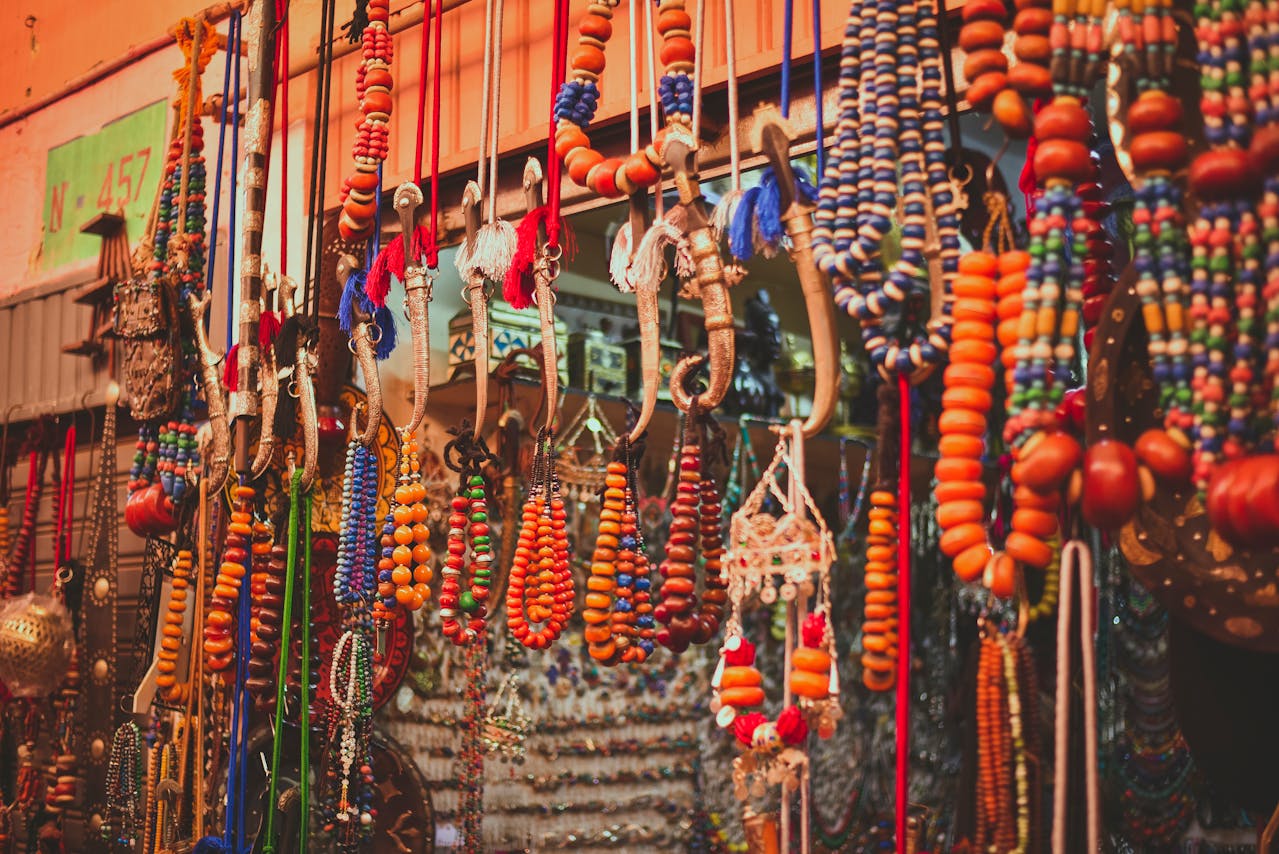
Start at Jemaa el-Fnaa, a UNESCO-recognized square that has run as market and open-air theatre since the 11th century: by day, orange juice stalls and henna sellers; by dusk, snake charmers, storytellers and musicians competing for the same patch of ground before the food stalls take over entirely. From the square, the souks fan out for kilometers, Souk Semmarine for textiles and leather, the dyers' souk for wool hung in rainbow skeins, the spice souk for the cones of ras el hanout and saffron that give the whole quarter its smell. Expect to get lost; that is normal and, eventually, part of the appeal.
The palaces and the Koutoubia
The Koutoubia Mosque's 69-meter minaret, the tallest structure in the medina and the template for Seville's Giralda, dominates the skyline; non-Muslims cannot enter but the surrounding gardens are open to everyone. Bahia Palace, a 19th-century palace of carved cedar ceilings and painted zellige tilework built for a powerful vizier, is Marrakech's most photogenic interior and gets busy by mid-morning, arrive at opening. Nearby, the Saadian Tombs, the royal necropolis of the 16th-century Saadian dynasty, sealed up for roughly two centuries and only rediscovered in 1917, and the ruined El Badi Palace, once one of the most opulent palaces in the Islamic world and now a atmospheric shell of pisé walls and storks nesting on the ramparts, round out the Kasbah district's historic core.
Majorelle Garden and Medersa Ben Youssef
In Gueliz, the Majorelle Garden, created by French painter Jacques Majorelle in the 1920s and later restored by Yves Saint Laurent and Pierre Bergé, is a cobalt-blue oasis of bamboo, cacti and palms that draws long queues by mid-morning; book a timed entry online and go early. Back in the medina, the Medersa Ben Youssef, a 16th-century Islamic college that once housed hundreds of students, is one of the finest examples of Moroccan stucco and carved cedarwork anywhere in the country, recently restored and genuinely worth the entry fee.
Hammams and evenings
A hammam is close to mandatory on a Marrakech visit: Hammam de la Rose, on Route Sidi Abdelaziz, offers a romantic, Ottoman-influenced take with black soap and full-body scrub treatments from roughly 400-600 MAD, while Les Bains de Marrakech, a well-known spa institution with two decades of history and a pool on site, runs a more refined, higher-end version from around 600-900 MAD. Evenings on the square or a rooftop with mint tea are, for most visitors, the actual highlight rather than a single paid attraction.
One, two or three days, sequenced around the heat and the crowds
Three full days covers Marrakech's core well; even a single well-planned day delivers the essentials. Mornings are for anything popular, before both the heat and the tour groups build.
- Morning
Bahia Palace and the Kasbah. Arrive at opening, then the Saadian Tombs and El Badi Palace before the heat builds.
- Midday
Into the souks. Wander from Jemaa el-Fnaa through Souk Semmarine and the spice souk; a tanjia lunch at a local spot rather than a square-facing tourist restaurant.
- Afternoon
Majorelle Garden. A taxi to Gueliz for the cobalt-blue garden, then back to the medina.
- Evening
Jemaa el-Fnaa after dark. The food stalls, storytellers and snake charmers as the square comes fully alive.
- Day 1
The one-day route: Bahia Palace, the Kasbah, the souks, Majorelle Garden, Jemaa el-Fnaa at night.
- Day 2 morning
Koutoubia Mosque gardens and Medersa Ben Youssef. Two of the medina's calmest, most architecturally rewarding stops, best before 10am.
- Day 2 afternoon
Hammam. A full scrub-and-massage session, then a slow rooftop dinner overlooking the medina.
- Days 1-2
The two-day route above, at a gentler pace, adding a Gueliz evening for restaurants and galleries.
- Day 3, option A
Atlas Mountains day trip. Imlil, a Berber village and mountain views, a full day out of the medina's heat and hassle.
- Day 3, option B
Agafay desert evening. A half-day trip for a camel ride, sunset and dinner camp in the stony desert closer to the city.
Walk the medina, taxi everything else
Marrakech Menara Airport (RAK) sits about 5km from the medina, close enough that a regulated petit taxi should run roughly 70-150 MAD by day and more after 10pm; always agree the fare before getting in, since meters are inconsistently used on the airport run. The Alsa-operated Line 19 airport bus reaches the city centre and major hotels for about 30 MAD, and Uber, relaunched in Morocco in 2025 and now operating in Marrakech, typically runs 120-220 MAD depending on demand.
Inside the medina, walking is the only real option, cars and even most taxis can't reach many riad doors, and a horse-drawn calèche (roughly 150-250 MAD per circuit) is a pleasant, touristy way to loop the ramparts rather than a practical transport option. Petit taxis (metered in theory, agree a price if the meter isn't used) cover Gueliz, Hivernage and the Palmeraie for $1-4 a ride. For day trips to the Atlas, Agafay or the Sahara loop, a private driver or organized tour is standard; self-driving is possible but genuinely stressful in city traffic.
Best time to visit and Ramadan considerations
Marrakech has a semi-desert climate: mild, pleasant days from March to May and September to November, brutally hot summers (June-August regularly exceeds 40°C), and cool to occasionally cold nights in winter despite mild daytime temperatures. Rain is rare and concentrated in the cooler months.
During Ramadan, many local restaurants close during daylight hours and reopen after sunset for iftar, while tourist-facing restaurants generally stay open but keep a lower profile about serving during the day. The city's rhythm shifts noticeably after dark, with squares and cafes busiest late into the evening.
One of the best-value city breaks within reach of Europe
Marrakech's tourist zones have gotten pricier over the last decade, but it remains cheap relative to most European city breaks, and prices drop fast a few streets back from Jemaa el-Fnaa.
- Hostel dorm or budget riad $15-30
- Street food and local restaurants $3-8
- Walking plus the odd petit taxi
- Free souks and squares, one paid site
- Private riad with breakfast $50-100
- Restaurant meals $10-25/person
- Petit taxis plus one guided day trip
- Hammam, a palace or two, a cooking class
- La Mamounia or equivalent $700+
- Fine dining and private guides
- Private driver throughout
- Spa days and a Sahara camp upgrade
Low-violence, high-hassle, and worth knowing the difference
Morocco carries a US State Department Level 2 advisory nationwide over terrorism concerns, the same tier as France or the UK; it is not Marrakech-specific and should inform general awareness in crowded, high-profile spots rather than change your plans. Day to day, the far more common issues in Marrakech itself are petty theft, medina hassle and the scams covered in the country guide's Safety chapter, not violent crime.
The three things that actually catch visitors here: unsolicited "guides" near medina entrances, who lead you toward commission shops and then demand payment, decline firmly and early; pickpocketing in the densest parts of the souks and around Jemaa el-Fnaa after dark, keep bags zipped and in front of you; and the henna scam, where a hand is grabbed and henna applied before a price is mentioned, keep your hands to yourself in the square. Central Marrakech has fully recovered from the September 2023 earthquake and carries no earthquake-specific travel restriction; the emergency numbers are 19 for police, 15 for fire, 150 for ambulance, and 112 works from any mobile phone.
Marrakech's real advantage: everything is within reach
Marrakech's position at the foot of the High Atlas makes it the best-connected base in Morocco for day and multi-day trips. Four are worth knowing, from an easy half-day to a proper multi-day Sahara loop.
Atlas Mountains & Imlil
Imlil, the gateway village to Mount Toubkal, North Africa's highest peak, is about an 8-hour door-to-door day trip: a guided walk in the Toubkal valley, a Berber village visit, and mountain views a world away from the medina's heat. Book through a licensed Atlas Mountains day tour rather than an unofficial street offer.
Ourika Valley
A greener, lower-elevation Atlas valley focused on the Setti Fatma waterfalls and riverside Berber villages, with stops to see argan oil pressed by hand along the way. The easiest half-day escape from the city.
Agafay Desert
A stony desert landscape roughly 45 minutes southwest of the city, offering a Sahara-style camel ride, lantern-lit dinner and desert camp without the multi-day drive east. The practical choice if Merzouga doesn't fit your schedule.
Essaouira & Ouzoud Waterfalls
Essaouira, an Atlantic-facing walled port about three hours away, trades the interior's heat for sea breeze and a calmer medina. In the opposite direction, the Ouzoud Waterfalls, North Africa's highest at around 110 meters and roughly 2.5 hours through the Middle Atlas, combine dramatic falls with Barbary macaques in the surrounding trees. Both work as a long full-day trip rather than a half-day.
Marrakech FAQ
Is Marrakech safe for tourists?
Mostly yes. The US rates Morocco Level 2, Exercise Increased Caution, over terrorism concerns nationwide, the same tier as France or the UK, and the far more common issues in Marrakech specifically are pickpocketing, medina hassle and scams rather than violence. Standard city awareness plus a firm "no thank you" to unsolicited guides covers most of it.
Is Marrakech safe after the 2023 earthquake?
Yes. The September 2023 earthquake was centered in the High Atlas about 71km southwest of the city; central Marrakech's medina and tourist circuit were not structurally devastated and tourism has fully recovered, with revenue now above pre-earthquake levels. Some rural High Atlas villages on trekking routes are still rebuilding, worth a direct question if your itinerary includes a specific mountain village.
How many days do I need in Marrakech?
Three full days covers the medina, Gueliz and one day trip well. A fourth or fifth day lets you add an Atlas Mountains hike or an Agafay desert evening without rushing.
How much does Marrakech cost per day?
Budget travellers manage on $35-55 a day with hostels or budget riads and street food; mid-range with a private riad and restaurant meals runs $80-140. Marrakech's top riads and palace hotels push well past $300.
When is the best time to visit Marrakech?
March-May and September-November: warm, comfortable days and cool evenings. June-August regularly exceeds 40°C, and while winter days are mild, desert and mountain day trips get genuinely cold at night.
How do I get from Marrakech airport to the medina?
Menara Airport (RAK) is about 5km from the medina. A regulated petit taxi runs roughly 70-150 MAD by day (more after 10pm), the airport bus (Line 19) costs about 30 MAD, and Uber, relaunched in Morocco in 2025, typically runs 120-220 MAD.
What is the best area to stay in Marrakech?
The Medina for first-timers who want to be steps from Jemaa el-Fnaa and the souks; the Kasbah district for a quieter medina base near Bahia Palace; Gueliz or Hivernage for modern comforts, nightlife and an easier taxi ride in from the airport.
Do I need a guide in the Marrakech souks?
Not required, but a licensed guide booked through your riad removes the hassle of unsolicited "helpers" and genuinely improves navigation on a first visit. Never accept an unsolicited offer of help right at a medina entrance.
Can I do the Sahara desert as a day trip from Marrakech?
Not properly, Merzouga and the Erg Chebbi dunes are about 9-10 hours away and usually done as a 2-3 day loop. For a Sahara-style experience in a single evening, the Agafay stony desert about 40km from Marrakech offers a camel ride and dinner camp without the long drive.
What Stays With You
Marrakech does not soften itself for visitors, and that is precisely why it works. The square keeps running its centuries-old routine every evening whether or not you're there to watch, the tea keeps arriving before you ask for it, and the walls keep turning that particular shade of red at sunset regardless of who's looking. None of it was arranged for you, which is exactly why it sticks.
Go up to a rooftop on your last evening, watch the light change over the medina, and understand why this has been the gateway city to Morocco for close to a thousand years.