
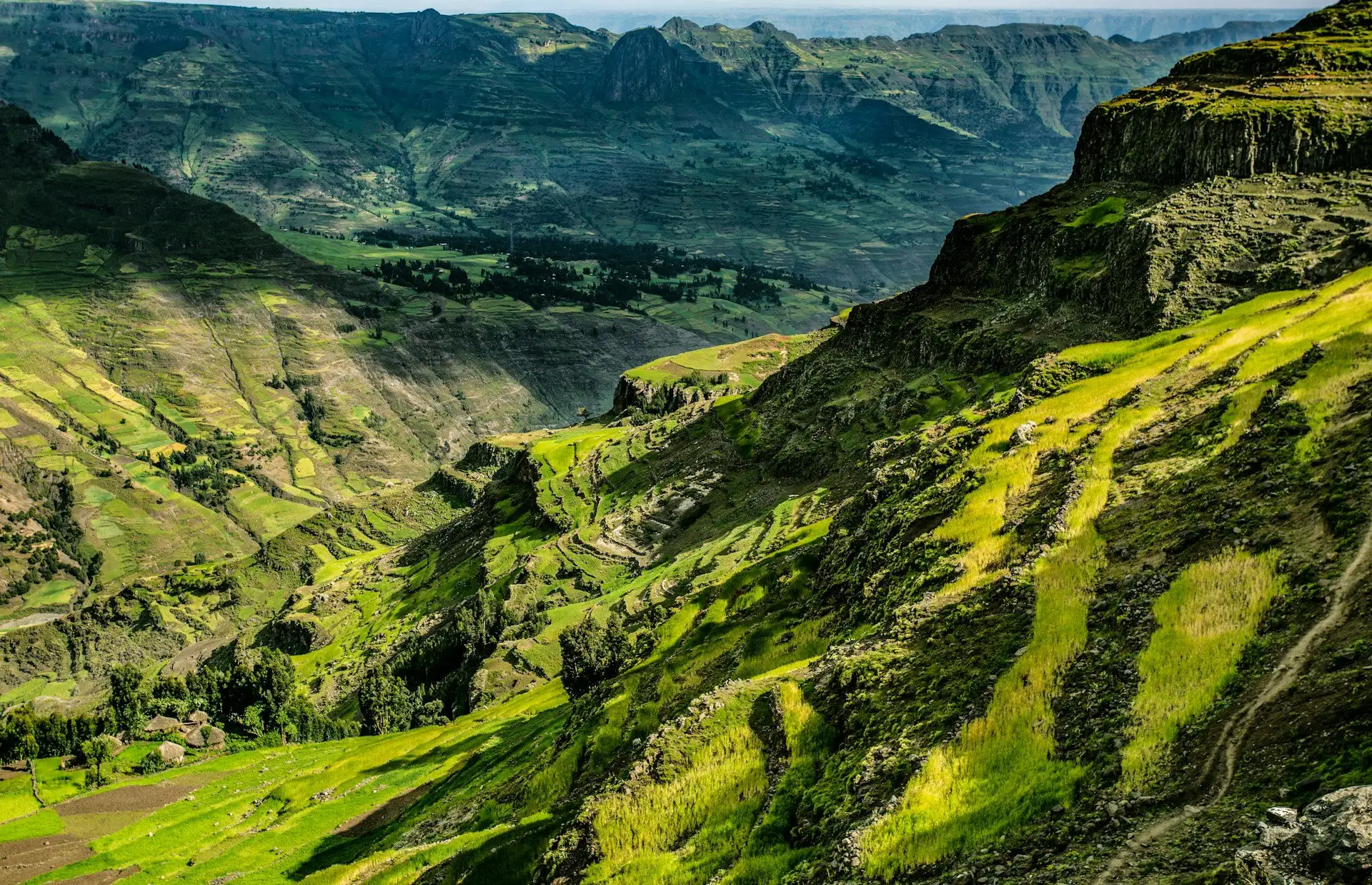
What This Guide Is, and Isn't
Ethiopia is a country of roughly 130 million people, Africa's second most populous, sitting on a highland plateau split by the Great Rift Valley and ringed by some of the deepest and hottest lowlands on the continent. It has a documented civilization stretching back to the Aksumite kingdom of the first millennium, its own Ge'ez script and calendar, and the distinction of being the only African nation to defeat a European colonial invasion outright, at the Battle of Adwa in 1896, and stay independent through the era that colonized nearly everywhere else. It is also, on the world stage, the birthplace of coffee: Kaffa, the highland region that gave the drink its name, is in the country's southwest.
None of that history changes the fact that Ethiopia is currently under sustained internal armed conflict in several regions, a legacy of the 2020-2022 Tigray war that never fully resolved and has since spread into a separate, ongoing conflict between the federal government and Amhara Fano militias. This guide covers the country's culture, food and history the way any Atlas Guide destination page would, because that history is real and worth understanding whether or not you can currently visit every place associated with it. But it is built around what is actually accessible in mid-2026, which in practice means Addis Ababa and its immediate surroundings, not the countrywide historic circuit international coverage of Ethiopia usually leads with.
The honest complications
Read the safety chapter immediately below before anything else on this page. Ethiopia's tourism identity was built almost entirely around sites, Lalibela, Gondar, Axum, the Simien Mountains, that sit inside regions currently under a Do Not Travel designation from the US State Department and equivalent advisories from the UK, Canada and Australia. That's not a footnote to this guide, it's the central fact shaping it. Addis Ababa's own situation is genuinely different and more stable, and a trip that stays there is a real, currently reasonable trip. A trip built around the historic north, under current advisories, is not something this guide can responsibly recommend, however calm specific towns are reported to be on any given week.
The Level 3 Advisory, Region by Region
The US State Department's April 2026 advisory rates Ethiopia Level 3, Reconsider Travel, citing unrest, crime, kidnapping, terrorism, landmines, communications disruptions and exit bans. Inside that overall rating, the advisory is explicit that Addis Ababa's security situation is stable, while conflict continues sporadically elsewhere. It then names a long list of Level 4, Do Not Travel regions: Tigray and the border with Eritrea, Afar, Amhara, Gambella, Benishangul Gumuz, Sidama, Central Ethiopia, South Ethiopia, Southwest Ethiopia, specific zones within Oromia (including the areas immediately north and west of Addis Ababa), and the border areas with Somalia, Sudan, South Sudan and Kenya. Between them, those regions include almost every stop on Ethiopia's traditional historic itinerary: Lalibela and Gondar sit in Amhara, Axum in Tigray, the Danakil Depression in Afar, and the Omo Valley across South and Southwest Ethiopia.
Armed conflict, not petty crime
The core risk outside Addis Ababa is active armed conflict between government forces and regional militias, principally Fano in Amhara and residual TPLF-linked tension in Tigray, not tourist-targeted crime. That distinction matters for planning: it's a reason to stay out of an area entirely, not a reason to be more careful within it.
Communications disruptions
Internet, mobile data and phone service are routinely restricted or shut down around periods of unrest, which also limits how quickly the US embassy, or anyone else, can reach Americans in the country. Don't assume you'll have connectivity to change plans on short notice outside the capital.
Exit bans
Ethiopia enforces exit bans on travelers with unresolved immigration issues, including overstays and unpaid fines, some reportedly running over $100,000. Ethiopian law doesn't recognize dual citizenship, which complicates matters further for dual nationals. Keep your visa status unambiguous and don't enter on an Ethiopian passport if you hold one.
What "Addis Ababa is stable" actually means, and the roads that connect it to the rest of the country
Addis Ababa's status. The advisory's own language separates the capital from the rest of the country: "the security situation in Addis Ababa is stable," against "sporadic violent armed conflict and civil unrest in other areas." That's a meaningfully different risk profile from a blanket Level 4 country, and it's the reason this guide treats Addis Ababa as a genuine destination rather than essential-travel-only. It is not a guarantee; the advisory also notes the situation can worsen without warning, and normal city-level crime, petty theft and after-dark risk, still applies within Addis Ababa itself. See the safety chapter of our Addis Ababa city guide for that detail.
The roads out of the capital. The zones immediately north and west of Addis Ababa, North, West and Southwest Shewa in Oromia, carry a specific "very high risk of unexpected armed conflict" warning in the current advisory, which is the direct road corridor toward Bahir Dar, Gondar and the north. Reports of armed attacks on vehicles along the Addis-Bahir Dar road, particularly before dawn, have also circulated from other governments' advisories. Any overland route out of Addis Ababa toward the historic north currently crosses this corridor.
What some tour operators are still doing. Fly-in, fly-out day and multi-day trips to Lalibela specifically continue to run through 2026, and recent traveler reports describe the town itself as calm, with hotels, guides and the church complex operating normally. That's a genuine, verifiable fact about ground conditions in one specific location. It also directly conflicts with a government advisory that says, in plain language, do not travel to the Amhara Region for any reason. Atlas Guide isn't in a position to tell readers to override their own government's advisory, so we're not recommending it, but we're not going to pretend the conflict between "the advisory says no" and "the town is reportedly fine" doesn't exist either.
Solo women travelers
Within Addis Ababa, ordinary city precautions apply and are covered in the Addis Ababa city guide's safety chapter. Beyond the capital, Atlas Guide doesn't have a meaningful solo-women assessment to layer on top of the regional conflict advisory above: the risk there is armed conflict, which doesn't discriminate by traveler profile and isn't mitigated by traveling in a group. General guidance is on our Solo Woman Explorer pages.
Emergency numbers
112 is not reliable in Ethiopia; use the local numbers above. Response outside Addis Ababa is inconsistent. Register with your embassy's traveler program before the trip and carry evacuation-inclusive travel insurance.
A History Worth Knowing
Ethiopia's recorded history runs deeper than almost anywhere else in Africa: the Aksumite kingdom traded with Rome and India, adopted Christianity in the 4th century under King Ezana, and left the obelisks that still stand in Axum. Fossils found in the Afar region, most famously the 3.2-million-year-old hominin skeleton "Lucy," place some of the earliest evidence of human ancestry here. The short version below explains how a country with that depth of history arrived at 2026.
- c. 100-940 CE
The Aksumite Kingdom. A major trading power linking the Red Sea to the Mediterranean and India, adopting Christianity under King Ezana around 330 CE, among the earliest states to do so anywhere.
- 12th-13th century
Lalibela and the Zagwe dynasty. King Lalibela commissions the eleven rock-hewn churches that bear his name, carved directly downward out of volcanic rock, intended as a "New Jerusalem" for Ethiopian Christians.
- 1896
The Battle of Adwa. Emperor Menelik II's forces defeat an invading Italian army, securing Ethiopian independence and making it the only African state to repel a European colonial conquest outright.
- 1936-1941
Italian occupation. Fascist Italy invades and occupies Ethiopia by force; Emperor Haile Selassie appeals to the League of Nations in a famous speech, and British-led forces help liberate the country in 1941.
- 1974-1991
The Derg. A military junta overthrows Haile Selassie in 1974, installs a Marxist-Leninist dictatorship under Mengistu Haile Mariam, and presides over famine and civil war until rebel forces led by the Tigray People's Liberation Front take Addis Ababa in 1991.
- 2018-2019
Abiy Ahmed and the Nobel Peace Prize. Abiy becomes prime minister in 2018 and signs a peace deal ending two decades of frozen conflict with Eritrea, winning the 2019 Nobel Peace Prize.
- 2020-2022
The Tigray war. Conflict breaks out between federal forces and the TPLF, killing an estimated several hundred thousand people before a November 2022 peace agreement in Pretoria.
- 2023-present
The Amhara conflict. Fano militias, originally allied with the federal government against Tigray, turn against Addis Ababa after a 2023 attempt to dissolve regional special forces, and fighting continues into the 2026 election period.
Read the full history: Aksum, Lalibela, Adwa and the Derg
Aksum and the Ethiopian Orthodox Church. The Aksumite kingdom's adoption of Christianity predates most of Europe's, and the Ethiopian Orthodox Tewahedo Church that grew from it remains one of the oldest continuously operating Christian institutions in the world, with its own calendar, saints and liturgical language, Ge'ez, still used in services. Ethiopian tradition also holds that the Ark of the Covenant resides in Axum's Church of St. Mary of Zion, guarded by a single monk for life, a claim central to national religious identity whether or not it can be externally verified.
Adwa's long shadow. The 1896 victory over Italy is one of the most consequential battles in African history: it kept Ethiopia off the table during the "Scramble for Africa" and made it a symbol for anti-colonial and Pan-African movements throughout the 20th century, including the Rastafari movement in Jamaica, which reveres Haile Selassie as a messianic figure. Italy returned by force in 1936 under Mussolini, occupying the country for five years before British and Ethiopian resistance forces drove them out in 1941, restoring Haile Selassie's throne.
The Derg and its aftermath. The 1974-1991 military dictatorship under Mengistu Haile Mariam presided over the 1983-1985 famine that killed hundreds of thousands and prompted Live Aid, alongside a "Red Terror" campaign against political opponents that killed tens of thousands more, documented today at Addis Ababa's Red Terror Martyrs' Memorial Museum. The EPRDF coalition, dominated by the Tigray People's Liberation Front, ruled from 1991 until Abiy Ahmed's rise in 2018 restructured it into the current Prosperity Party. Ethiopia held a general election on 1 June 2026, with Abiy's Prosperity Party winning a further term amid a fragmented opposition, ongoing conflict in several regions, and no polling in Tigray itself.
Addis Ababa, and the Rest of the Country For Context
Under normal conditions, an Ethiopia itinerary would combine Addis Ababa with the northern historic circuit and the Danakil Depression or Omo Valley further afield. Right now, only the first of those is something Atlas Guide can recommend. The rest is described below for context and because the history and culture matter regardless of current access, not as a suggested route.
Addis Ababa, the highland capital
At around 2,355 meters, Addis Ababa is one of the highest capital cities in the world, home to the African Union headquarters, Ethiopian Airlines' hub at Bole International Airport, and the National Museum where a cast of "Lucy" is displayed alongside Aksumite and imperial artifacts. It is genuinely walkable in patches, chaotic in others, and the one part of the country this guide can recommend without the caveats attached to everything else on this page. See our full Addis Ababa city guide for neighborhoods, hotels, food and a real itinerary.
Lalibela, Gondar, Axum & the Simien Mountains
This is the circuit Ethiopia is famous for: Lalibela's eleven churches carved downward into volcanic rock, Gondar's 17th-century castle complex Fasil Ghebbi, Axum's ancient obelisks and the claimed resting place of the Ark of the Covenant, and the Simien Mountains' jagged escarpments and endemic gelada baboons. All of it sits inside the Amhara Region or, for Axum, Tigray, both under a current Do Not Travel designation for armed conflict and unrest. Some specialist operators still run fly-in trips to Lalibela specifically, and the town is reported calm; that doesn't change what the advisory says for the wider region it sits in. This section exists so the history and the churches are documented, not as a route to follow this year.
Danakil Depression & the Omo Valley
The Danakil Depression, in the Afar Region, is one of the hottest and lowest places on earth, with sulfur springs, salt flats and the active Erta Ale lava lake that made it a niche but growing draw for extreme-landscape travelers. The Omo Valley, spanning the South and Southwest Ethiopia regions, is home to some of Africa's most ethnically diverse and visually distinct communities, including the Mursi and Hamar peoples, and has long attracted (and drawn criticism for) cultural tourism. Afar, South Ethiopia and Southwest Ethiopia are all currently Do Not Travel regions under the same advisory covering the north. As with the historic circuit, this is background, not an itinerary.
| Ethiopia | Kenya | |
|---|---|---|
| Current advisory | Level 3, most regions Do Not Travel; Addis Ababa stable | Level 2/3 depending on area; safari circuit and coast broadly open |
| Main draw | Ancient Christian history, coffee origin, highland culture | Safari (Maasai Mara), Indian Ocean coast, Nairobi as a hub |
| Visa | e-Visa required for nearly all nationalities | e-Visa (eTA) required for nearly all nationalities |
| Daily budget | $25-35 backpacker, $50-90 mid-range, mostly in Addis Ababa | Broadly similar city budgets, safari packages add significantly more |
| Right now | Realistically a capital-city trip | Full-country itineraries remain broadly workable |
Culture & Etiquette
Ethiopia has around 80 ethnic groups and languages; Amharic is the federal working language and is written in the unique Ge'ez script, though Oromo has more first-language speakers nationally. The country runs on its own Ge'ez calendar, roughly seven to eight years behind the Gregorian calendar and divided into 13 months, the source of the old tourism-board line "thirteen months of sunshine." Ethiopian Orthodox Christianity, one of the oldest Christian traditions anywhere, shapes daily life for much of the highland population, alongside a substantial Muslim community, particularly in the east, and older traditional belief systems in parts of the south.
Do
- Accept the coffee ceremony if offered. Buna, the multi-round coffee ceremony with roasting, grinding and brewing done in front of guests, is a genuine hospitality ritual, not a tourist show, when offered in a home or traditional setting. Declining outright can read as rude.
- Eat with your right hand from a shared plate. Injera-based meals are eaten communally by hand, using the spongy injera itself to scoop food; the left hand is considered unclean for eating.
- Dress modestly at churches and mosques. Cover shoulders and knees, and remove shoes before entering an Orthodox church.
- Learn a few Amharic words. Ameseginalehu (thank you) and selam (hello) go a long way, especially outside hotel and airline staff who speak English fluently.
- Carry cash in birr. Card acceptance is limited outside upscale hotels and restaurants in Addis Ababa; ATMs are common in the capital but withdrawal limits are low.
Don't
- Photograph people, especially in markets or rural areas, without asking first. This applies with particular force around Merkato and any traditional or religious ceremony.
- Assume the Gregorian date or a 12-hour Western clock. Ethiopian time counts from sunrise (roughly 6am), so "1 o'clock" locally can mean 7am Western time; confirm which system anyone quoting a time means.
- Point the sole of your foot at someone or step over a seated person's legs; both read as disrespectful.
- Enter an Ethiopian passport if you also hold one. Ethiopian law doesn't recognize dual citizenship, and doing so complicates exit and consular access, per the safety chapter above.
- Assume every part of the country operates like Addis Ababa. The capital's stability doesn't extend automatically to the regions covered in the safety chapter.
Deeper culture: the Ge'ez calendar, Meskel and Timkat, and Rastafari's connection to Ethiopia
The Ge'ez calendar. Ethiopia's calendar differs from the Gregorian calendar largely over a dating dispute about the Annunciation, resulting in a gap of roughly seven to eight years. It has 12 months of 30 days plus a short 13th month, Pagume, of five or six days. Enkutatash, the Ethiopian new year, falls on 11 September (Gregorian).
Meskel and Timkat. Meskel, in late September, marks the finding of the True Cross with massive bonfires (demera) topped with a cross, most spectacularly in Addis Ababa's Meskel Square. Timkat, in January, celebrates Ethiopian Orthodox Epiphany with colorful processions and ritual re-enactments of baptism, most famously in Gondar's historic pools, though as with the rest of Amhara, current travel there falls under the advisory covered above.
Rastafari. The Jamaica-born Rastafari movement reveres Emperor Haile Selassie, crowned in 1930 with the throne name Ras Tafari Makonnen, as a messianic figure connected to the Solomonic dynasty's claimed descent from King Solomon and the Queen of Sheba. Shashamane, southwest of Addis Ababa, became a Rastafari repatriation settlement after Haile Selassie granted land there in the 1940s and remains home to a small Rastafari community today.
Food & Drink
Ethiopian food centers on injera, a spongy sourdough flatbread made from teff, a tiny grain grown almost nowhere else at scale, used as both plate and utensil for the stews (wat) and grilled or minced meats served on top. Frequent Orthodox fasting days, all Wednesdays and Fridays plus extended periods like Lent, mean vegetarian and vegan combinations are a normal, well-developed part of the everyday menu rather than a special accommodation.
Injera & Doro Wat
Doro wat, chicken slow-cooked in a deeply spiced berbere sauce with a boiled egg, is often called the national dish, served over injera and traditionally eaten by hand from a shared platter.
Kitfo
Minced raw or lightly warmed beef seasoned with mitmita spice and clarified butter (niter kibbeh), served with injera or bread; a well-known dish, order it well-cooked if raw beef isn't for you.
Buna (Coffee Ceremony)
Green beans roasted, then ground and brewed in a clay jebena over three ceremonial rounds (abol, tona, baraka), performed in homes and traditional restaurants alike. Ethiopia is coffee's country of origin.
Tibs
Sauteed or grilled cubes of beef, lamb or goat with onions, peppers and rosemary, less intensely spiced than the wats and a good entry point for first-timers.
Shiro
A thick, spiced chickpea or broad-bean stew, one of the most common fasting-day dishes and, for many Ethiopians, a comfort-food staple eaten far more often than the showier meat dishes.
Tej
Honey wine flavored with gesho (a hop-like shrub), traditionally served in a rounded flask called a berele at a tej bet (honey wine house), Ethiopia's answer to a wine bar.
When to Go & What a Trip Looks Like Now
The dry season, October through May, is best for Addis Ababa's mild highland climate, with October to January especially clear right after the main rains end. June through September is the kiremt rainy season across the highlands, with frequent afternoon downpours and cooler temperatures. Addis Ababa's elevation keeps it mild year-round, generally 10-25°C, closer to a spring day than a tropical one.
Seasons compared, with temperatures
| Season | Verdict | Addis Ababa temps | Notes |
|---|---|---|---|
| Oct-Jan | Best | 10-24°C | Clear skies right after the rains, greenest landscape |
| Feb-May | Good | 12-26°C | Warming toward the short belg rains in Mar-Apr |
| Jun-Sep | Rainy | 10-20°C | Kiremt rains, frequent afternoon downpours |
Addis Ababa's ~2,355m elevation moderates temperatures year-round; pack layers for cool mornings and evenings regardless of season.
A realistic itinerary right now
Given the access picture in the destinations chapter above, this guide isn't publishing a countrywide 7/14-day itinerary the way it would for most destinations. A three to four day Addis Ababa trip, covered in full in our Addis Ababa city guide, is the itinerary this guide can stand behind: the National Museum and Lucy, Holy Trinity Cathedral, Unity Park, Merkato, and a day trip to Bishoftu's crater lakes. Anything beyond that currently means weighing the gap between official advisories and on-the-ground reports discussed in the safety chapter, a decision this guide isn't going to make for you.
Getting there & around
Bole International Airport (ADD) in Addis Ababa is Ethiopian Airlines' hub and one of Africa's busiest, with direct connections across Africa, Europe, Asia and North America; it's often the practical gateway for onward African travel as well as a destination in its own right. Within Addis Ababa, ride-hailing apps Ride and Feres are the easiest way to get around; see the Addis Ababa city guide for full transport detail.
Budget Planning
Ethiopia is inexpensive by international standards outside its better hotels and restaurants, which in Addis Ababa can approach prices comparable to a mid-tier European or North American city. Local food, transport and markets remain cheap. The birr has floated and depreciated significantly since 2024's exchange rate reform, so treat any birr figures as a snapshot rather than a fixed number, and budget in dollars where you can.
- Budget hotel or guesthouse $15-30
- Local restaurant meals $2-5
- Minibus & Ride app trips $1-5
- Free or low-cost museum entry
- Mid-range hotel with breakfast $50-100
- Restaurant meals $8-20
- Ride app across the city
- Cultural dinner show, museum entries
- Upscale hotel (Sheraton, Hyatt Regency)
- Fine dining and hotel bars
- Private drivers and guides
- Business-class domestic flights
Quick reference prices
| Coffee at a local cafe | $0.50-1 |
| Traditional restaurant meal | $3-8 |
| Ride app trip within Addis | $1.50-5 |
| Budget guesthouse | $15-30/night |
| Mid-range hotel | $50-100/night |
| National Museum entry | ~$5 |
| ATM withdrawal limit | ~3,000-4,000 birr/day |
Prices reflect July 2026 research. The birr has been volatile since the 2024 exchange rate float; USD figures are a more stable planning reference than birr amounts.
Visa & Entry
Nearly every nationality needs a visa for Ethiopia; only Kenyan and Djiboutian citizens enter visa-free. The e-visa at evisa.gov.et is the standard route for tourists, valid for entry through Bole International Airport, with approval typically taking a few business days. Visa on arrival exists but isn't guaranteed, so arriving with an approved e-visa is the safer plan.
✓ Valid passport
At least six months' validity from your entry date, with at least one blank page.
✓ Approved e-visa
Apply at evisa.gov.et before travel; keep a downloaded copy accessible without internet access at immigration.
✓ Yellow fever certificate, conditionally
Required only if arriving from, or transiting over 12 hours through, a country with yellow fever risk. Not a blanket requirement for all arrivals, but check based on your routing.
✓ No dual Ethiopian citizenship
Ethiopian law doesn't recognize dual nationality; entering on an Ethiopian passport if you hold one complicates exit, per the safety chapter above.
Ethiopia FAQ
Is Ethiopia safe to visit right now?
The US State Department rates Ethiopia Level 3, Reconsider Travel, and advises against all travel to Tigray, Afar, Amhara, Gambella, Benishangul-Gumuz and several other regions due to armed conflict. Addis Ababa itself is explicitly described as stable in the same advisory, so a trip that stays in and around the capital is a different proposition from one that tries to cover the country.
Can I still visit Lalibela?
Lalibela sits inside the Amhara Region, which multiple governments advise against traveling to for any reason as of mid-2026, even though on-the-ground reports describe the town itself as calm. Some operators still run fly-in, fly-out trips there. That's a real conflict between official guidance and local conditions, and Atlas Guide can't respectably tell you to go against your government's advisory, so we're not going to.
Do I need a visa for Ethiopia?
Yes, almost every nationality needs a visa; only Kenyan and Djiboutian citizens enter visa-free. Apply for the e-visa at evisa.gov.et before you travel, valid for entry through Bole International Airport, with approval typically taking a few business days.
Do I need a yellow fever vaccine for Ethiopia?
Only if you're arriving from, or have transited more than 12 hours through, a country with yellow fever risk, in which case you need a valid ICVP (Yellow Card). It isn't a blanket requirement for all arrivals, but airlines and immigration do check it when it applies.
What's the best time to visit Ethiopia?
The dry season from October to May is best, with October to January especially clear and green right after the main rains. June to September is the heavy rainy season across the highlands, including Addis Ababa.
How much does a trip to Ethiopia cost?
Backpackers manage on roughly $25-35 a day, mid-range travelers on $50-90, mostly driven by accommodation. Addis Ababa's better hotels and restaurants run close to international city prices; local food and transport stay cheap.
What language is spoken in Ethiopia?
Amharic is the federal working language, written in the unique Ge'ez script, but Ethiopia has around 80 languages and Oromo has more first-language speakers nationally. English is common in Addis Ababa's hotels, airlines and tourism trade.
Was Ethiopia ever colonized?
No, with one asterisk. Ethiopia defeated an invading Italian army at the Battle of Adwa in 1896 and kept its independence through the European colonial era, the only African country to do so. Italy occupied it by force from 1936 to 1941, but that was a wartime occupation Ethiopia resisted and eventually reversed, not a colonial settlement.
Why is the Ethiopian calendar different?
Ethiopia uses its own Ge'ez calendar, roughly seven to eight years behind the Gregorian calendar and with 13 months, the origin of the tourism board's old line "thirteen months of sunshine." The Ethiopian new year, Enkutatash, falls in September.
Is Addis Ababa safe for solo female travelers?
Addis Ababa is generally manageable for solo women who take normal city precautions: avoid walking alone after dark, use Ride or Feres rather than hailing taxis on the street, and keep valuables secure in crowded markets like Merkato. It's a different question from the safety of the country as a whole, which the safety chapter above covers in detail.
What Stays With You
Ethiopia's tourism identity was built on Lalibela's churches and Gondar's castles, and it's genuinely strange to write a guide to this country that spends more time explaining why you probably shouldn't go there right now than describing what to do when you arrive. But Addis Ababa on its own is not a consolation prize: a highland capital with its own coffee culture two centuries deep, a national museum holding some of the oldest human ancestors ever found, and a food tradition built around sharing one plate by hand, all of it standing on ground the rest of the continent's colonial history never quite reached.
Go for that, honestly, and watch the advisories for the rest. Ameseginalehu, thank you, is a good word to learn before you land.