
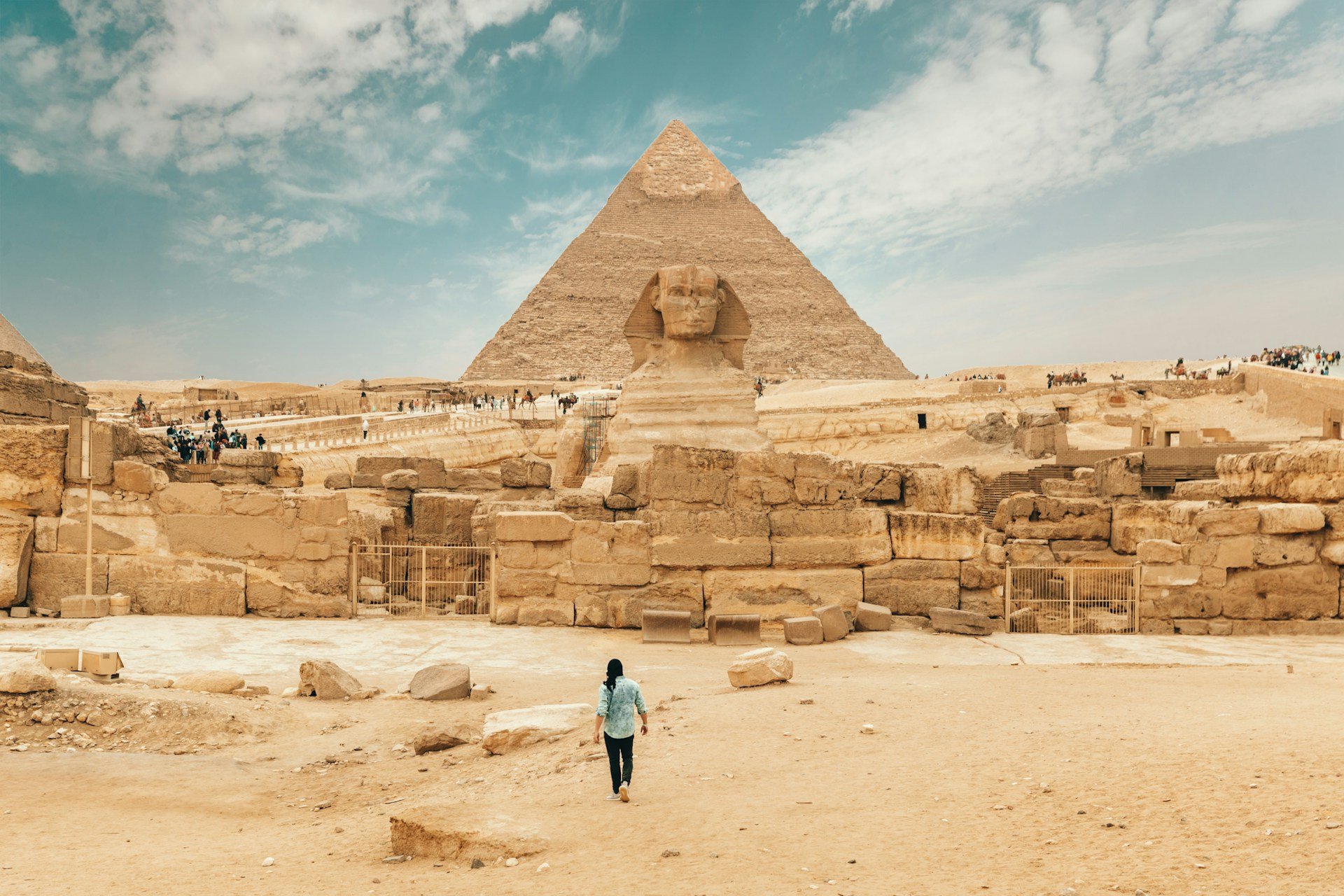
Egypt
The pyramids are older than you can actually comprehend standing next to them. The Nile has been supporting human civilization for seven thousand years. And the food is cheap, the people are warm, and there is nowhere else on earth quite like it.
What You're Actually Getting Into
There is a specific moment that happens to almost everyone who visits the Pyramids of Giza for the first time. You've seen the photographs ten thousand times. You think you know what to expect. Then you turn a corner and they are simply there — larger than makes sense, older than your mind can hold, built by hand four and a half thousand years ago — and whatever you expected is replaced by something harder to name. That feeling is the reason people have been traveling to Egypt since the ancient Greeks and Romans did the same thing.
Egypt is a country of extraordinary scale and density. The Nile Valley between Cairo and Aswan contains more significant ancient monuments than any comparable stretch of land on earth. The temples at Karnak and Luxor were already a thousand years old when Julius Caesar visited. The tomb paintings in the Valley of the Kings show people eating, playing board games, and worrying about the afterlife with an emotional familiarity that reaches across five millennia. This is what Egypt does — it collapses time in a way that no other destination manages.
The practical reality: Egypt requires patience and preparation that other countries don't. The tourist infrastructure is heavy-handed in ways that can feel exhausting — the papyrus shops you'll be guided into, the baksheesh expected at every interaction, the self-appointed guides who attach themselves to you at every major site. The heat in summer is genuinely dangerous. And Egypt's recent economic turbulence has meant rapid price changes and currency instability that require checking current rates before you go.
What it gives back is proportional. A Nile cruise watching ancient temples slide past on the riverbank. Diving in the Red Sea over coral reefs that rival anything in the world. Walking through the Egyptian Museum in Cairo past objects that were already ancient when the Roman Empire fell. Eating koshary from a street cart for the equivalent of 30 cents. The ratio of extraordinary experience to cost is unlike anything else in travel right now.
Egypt at a Glance
A History Worth Knowing
Egyptian civilization is so old that the ancient Egyptians themselves had ancient history. When Cleopatra was alive, the Great Pyramid was already 2,500 years old — closer to her in time than Cleopatra is to us. The scope of Egyptian history is almost impossible to hold in the mind at once, which is why visiting it requires abandoning the attempt and letting individual monuments communicate their own age directly.
The standard story starts around 3100 BCE with the unification of Upper and Lower Egypt under the first pharaoh, Narmer. But human activity in the Nile Valley goes back much further — farming communities along the river date to at least 5000 BCE, and the Nile's annual flood cycle, which deposited rich silt on the banks every year with clockwork regularity, made agricultural civilization here easier and more reliable than almost anywhere else on earth. Egypt didn't just happen to become a civilization. The Nile made it inevitable.
The Old Kingdom (2686–2181 BCE) is when the pyramids were built. Pharaohs including Khufu, Khafre, and Menkaure commissioned the three main pyramids at Giza during a 67-year period. The precision of their construction — using copper tools, wooden sledges, and human labour — has spawned centuries of speculation about supernatural assistance, all of which misses the more interesting point: the Egyptians built these things because they had an extraordinarily sophisticated understanding of engineering, mathematics, and logistics, and a social system capable of organizing tens of thousands of workers over decades. They didn't need alien help. They were, by any measure, extraordinary.
The Middle and New Kingdoms expanded Egyptian power deep into Nubia and the Levant. The New Kingdom (1550–1070 BCE) produced Egypt's greatest military expansion and some of its most recognizable cultural artifacts: the tombs in the Valley of the Kings across the river from Luxor, the colossal temples at Karnak and Abu Simbel commissioned by Ramesses II, and the reign of Akhenaten, who briefly tried to replace Egyptian polytheism with worship of a single sun god before his successors systematically erased him from the record. Tutankhamun, whose tomb was discovered intact in 1922 by Howard Carter, was Akhenaten's son — a minor pharaoh remembered mainly because his grave robbers never found him.
After the New Kingdom, Egypt was ruled successively by Libyans, Nubians, Assyrians, Persians, Macedonians, and finally Romans. Alexander the Great founded Alexandria in 331 BCE. The Ptolemaic dynasty that followed him created one of the ancient world's great cities: the Library of Alexandria, the Pharos lighthouse, and a cosmopolitan intellectual culture that attracted scholars from across the Mediterranean. Cleopatra VII, the last of the Ptolemaic rulers, was a brilliant politician who spoke nine languages and understood, better than anyone of her time, the dynamics of Roman power. Her deaths, and Egypt's absorption into the Roman Empire in 30 BCE, marked the end of over 3,000 years of pharaonic civilization.
What came after is equally significant but less visited: Egypt was among the earliest centers of Christianity — the Coptic Church traces its founding to Saint Mark in the 1st century CE, and Egyptian desert monasteries are among the oldest in the world. Arab conquest brought Islam in 641 CE. Egypt was governed from Cairo by the Fatimids, Mamluks, and Ottomans over the following centuries. Napoleon invaded in 1798 and his scholars discovered the Rosetta Stone, which allowed Jean-François Champollion to decode hieroglyphics in 1822. British colonial control followed, lasting until the 1952 revolution led by Gamal Abdel Nasser, who nationalized the Suez Canal in 1956 and became the defining figure of Arab nationalism for a generation. Modern Egypt has been through turbulent periods including the 2011 revolution and subsequent political upheaval, arriving at the present under President Abdel Fattah el-Sisi with an economy that struggles but a tourism sector that has largely recovered.
Pharaoh Narmer unifies Upper and Lower Egypt. Three thousand years of pharaonic civilization begin.
The Great Pyramid of Giza built around 2560 BCE. The Sphinx. The apex of pharaonic architecture.
Egypt's greatest territorial expansion. Valley of the Kings. Ramesses II. Karnak Temple. Tutankhamun.
Alexander founds Alexandria. The Library of Alexandria. Cleopatra VII — last pharaoh of Egypt.
Egypt absorbed into the Roman Empire after Cleopatra's death. End of pharaonic civilization.
Islam arrives. Cairo founded by the Fatimids in 969 CE. Egypt becomes the Arab world's most populous country.
Napoleon's invasion. Rosetta Stone discovered. British colonial rule. Revolution of 1952 under Nasser.
105 million people, the Arab world's most populous country. Tourism rebounding. The Grand Egyptian Museum open near Giza.
Top Destinations
Egypt divides neatly into three travel circuits: the Nile Valley from Cairo to Aswan (ancient monuments), the Red Sea coast (diving and beach resorts), and the Sinai Peninsula (desert trekking and Dahab's diving). Most first-time visitors do the Nile Valley with a Red Sea extension. The Western Desert oases — Siwa, Bahariya, the White Desert — are for those coming back a second time or with more than two weeks.
Cairo
Twenty million people, the most chaotic traffic in the world, and a skyline that has been accumulating architecture for a thousand years. The old city — Islamic Cairo, with its medieval mosques, the Khan el-Khalili bazaar, and the Al-Azhar University complex — is one of the most extraordinary urban environments in the world. The pyramids are technically in Giza, a 45-minute drive from central Cairo, though suburban sprawl means they now appear from certain angles with apartment blocks immediately behind them. The Grand Egyptian Museum is everything the old Tahrir Square museum should have been. Budget three days for Cairo, four if you want the GEM and the old Islamic quarter both properly.
Luxor
Luxor sits on top of ancient Thebes, the capital of Egypt during the New Kingdom, and the concentration of temples, tombs, and monuments within cycling or taxi distance of the town center is almost absurd. On the East Bank: Karnak Temple — the largest religious building ever constructed, added to by every pharaoh for 1,300 years — and the smaller but perfectly proportioned Luxor Temple, lit at night against the modern city. On the West Bank: the Valley of the Kings with over 60 royal tombs (Tutankhamun's included), Hatshepsut's dramatic cliff-face mortuary temple, and the Colossi of Memnon. You could spend a week here. Four days covers the essentials without rushing.
Aswan
The southernmost city on the main tourist circuit and the most pleasant of the Nile cities to simply be in. Slower than Cairo and Luxor, with a beautiful waterfront, Nubian culture, and the felucca sailboats that have plied this stretch of river for centuries. Philae Temple, relocated to an island after the High Dam's construction, is genuinely beautiful and best visited at sunset. Abu Simbel — Ramesses II's colossal self-monument, cut into a cliff face and later moved in its entirety to save it from the Nile reservoir — is a 3-hour drive south but not optional. Aswan is the natural endpoint of a Nile cruise.
Dahab
A former Bedouin fishing village on the Sinai coast that became a diving and backpacker hub and never lost its relaxed edge. The Blue Hole — a submarine sinkhole 130 metres deep in the coral reef — is one of the world's most famous dive sites and one of the most dangerous (for free divers attempting the arch). For recreational divers, the reef immediately offshore of Dahab has extraordinary marine life at depths accessible to beginners. The town itself is calm, cheap, and sociable in a way that the resort towns further north are not.
Hurghada & Marsa Alam
The Red Sea mainland coast has some of the world's best diving and snorkelling on reefs that remain largely intact due to Egypt's designation of large areas as protected marine parks. Hurghada is a fully developed resort town — good infrastructure, mediocre soul, world-class dive sites. Marsa Alam, 200km south, is quieter and has more pristine reefs and the chance to dive with dugongs and sea turtles. If you've come to Egypt specifically for the Red Sea, Marsa Alam is the better choice.
Alexandria
Founded by Alexander the Great in 331 BCE and once home to the greatest library in the ancient world, Alexandria is now a Mediterranean city of five million with a faded grandeur that rewards people who like finding beautiful things behind run-down facades. The Bibliotheca Alexandrina, opened in 2002 as a cultural successor to the ancient library, is an architectural landmark and worth visiting. The catacombs of Kom el-Shoqafa, an underground Roman-Egyptian burial complex dating to the 2nd century, are genuinely extraordinary. The corniche seafront is pleasant for an evening walk.
White Desert & Siwa Oasis
The White Desert in the Farafra Depression is a landscape of chalk-white rock formations shaped by wind erosion into mushrooms, camels, and abstract sculptures that glow silver-white under a full moon. Camping here overnight is one of the stranger and more beautiful experiences available in Egypt. Siwa Oasis, near the Libyan border, is a different world — Berber language, mudbrick architecture, freshwater springs, and the Oracle of Amun where Alexander the Great consulted the gods. Both require a guide and at least two days from Cairo.
Nile Cruise (Luxor to Aswan)
A cruise between Luxor and Aswan — three to four nights, roughly 200km — is one of the great travel experiences in the world. Temples appear on the riverbank exactly as they have appeared to travelers for millennia. Edfu Temple (the best-preserved temple in Egypt), Kom Ombo (a double temple to two gods, overlooking a crocodile museum), and the surrounding agricultural landscape unchanged in its essentials for thousands of years. Budget felucca, mid-range dahabiya, five-star cruise ship — all operate on the same river. All show you the same temples. The experience is the approach.
Culture & Etiquette
Egypt is a predominantly Muslim country with a significant Coptic Christian minority — roughly 10% of the population — and the culture reflects a complex layering of Islamic tradition, ancient Egyptian identity, and a Mediterranean openness shaped by centuries of international trade. Egyptians are famously warm and hospitable, with a sense of humor about their country's contradictions that tends to appear quickly once you've moved past the tourist transaction layer.
The concept of baksheesh — small payments for services, assistance, or access — runs through almost every interaction in the tourist economy. It is not corruption in the Western sense; it is a functional micro-economy of tips that supplements extremely low formal wages. Accepting it as part of the cost of travel, and building a small supply of low-denomination notes for it, makes the trip significantly smoother.
In Cairo, Luxor, Aswan, and Islamic sites, covering shoulders and knees is expected. Women particularly benefit from modest dress in terms of reduced street attention. Light, loose cotton clothing works for the heat and the cultural context simultaneously.
Egyptians invite visitors for tea frequently and the hospitality is often genuine. At a shop it may be commercial too — both things can be true simultaneously. Sitting for tea and conversation, even briefly, opens doors that paying for things doesn't.
Baksheesh is part of how Egypt works. Keep £E5, £E10, and £E20 notes available for bathroom attendants, guards who let you photograph things, drivers who help with luggage. Fumbling for change from a large note signals inexperience.
"No thank you" in Arabic, said once, firmly, and then not repeated, is the most effective tool for declining persistent approaches at tourist sites. Engage once with courtesy, then disengage entirely.
A licensed Egyptologist guide transforms Karnak from impressive ruins into a living narrative. The context — which pharaoh built which part, what the painted reliefs actually depict, why the site evolved over 1,300 years — turns a two-hour visit into something you'll remember specifically for years.
Particularly in rural areas, markets, and religious settings. People around sites may expect payment for photographs — either agree beforehand or don't take the shot. Pointing a camera at someone and assuming consent is consistently wrong here.
The five daily prayer times are not visiting hours. Wait outside until the prayer ends — typically 10–15 minutes. Remove shoes before entering any mosque. Women should cover their hair. The mosques of Cairo's Islamic quarter are extraordinary and worth the small effort of doing it correctly.
In Cairo's Khan el-Khalili, at souvenir stalls near the Pyramids, and in taxi negotiations — the first price is negotiating theatre, not a final offer. This applies to taxis, camel rides, tours, and most goods in tourist areas. If you pay the first price, everyone involved knows you're new.
The temptation to touch 4,500-year-old stone is understandable. The damage caused by millions of hands doing the same is irreversible. Don't climb on the pyramids — it's illegal and people have died doing it. The guards take this seriously.
The tap water in Egypt is not safe for visitors to drink. Bottled water is cheap and ubiquitous. Use it for drinking, brushing teeth, and washing fruit. This is non-negotiable and the reason most GI problems in Egypt happen to people who think they're being careful enough.
Ahwa (Egyptian Coffee Shop)
The Egyptian ahwa is a street-corner coffee shop serving strong, sweet Arabic coffee and black tea, with shisha (waterpipe) usually available. Men play backgammon and dominoes. The ahwa is where Egyptian social life actually happens — not in restaurants. Sitting at one, ordering tea, and watching the city for an hour is more genuinely Egyptian than most ticketed experiences.
Coptic Cairo
The oldest part of Cairo, built inside the walls of the Roman fortress of Babylon, contains some of the oldest churches in the world. The Hanging Church (Al-Muallaqah), built over a Roman gatehouse in the 4th century, is extraordinary. The Coptic Museum nearby houses ancient manuscripts and icons. Egypt's Coptic Christian community maintains continuity with the earliest centuries of Christian history in a way that few traditions anywhere can match.
Music & Muezzin
Cairo's soundscape is one of the most layered in the world: car horns, street vendors, the call to prayer from dozens of minarets in slight temporal offset creating waves of sound across the city, and from certain neighborhoods the music of Umm Kulthum — the mid-20th century singer who is still the most beloved voice in Arab history. Her recordings are played in taxis, cafes, and homes across Egypt decades after her death.
Antiquities Rules
Egypt has strict laws about antiquities export — removing any ancient artefact from Egypt without proper export documentation is a criminal offence. The souvenir market near major sites sells "ancient" objects that are almost all reproductions. Don't be tempted by anything presented as genuinely ancient and offered at a "special price." The legal consequences are not worth it and the objects are invariably fake anyway.
Food & Drink
Egyptian food is one of the best travel secrets in the world. Most visitors eat at tourist restaurants serving overpriced mediocre versions of dishes that cost a fraction of the price three streets away in the places Egyptians actually eat. The street food culture in particular is extraordinary: cheap, filling, freshly cooked, and flavored with spice combinations that have been refined over centuries. The food of Egypt is not glamorous in a Michelin-star sense. It is deeply satisfying in a way that expensive food frequently isn't.
A note on alcohol: Egypt is a Muslim-majority country but alcohol is legally available and sold in certain restaurants, hotels, and licensed shops called Drinkies (a chain of off-licences found in most cities). Drinking in public is not acceptable. Stella Beer, brewed in Egypt since 1897, is the local lager. Wine is made in the Nile Delta. Neither is remarkable. The non-alcoholic drinks — fresh sugar cane juice, karkadeh hibiscus tea served hot or cold, tamarind juice — are exceptional and what most Egyptians drink.
Koshary
Egypt's national street food and one of the most satisfying dishes in the world for its price point: rice, lentils, macaroni, and chickpeas layered in a bowl, topped with a spiced tomato sauce, crispy fried onions, and vinegar. Sold from dedicated koshary restaurants (Abu Tarek on Champollion Street in Cairo is the most famous) for the equivalent of 50 cents. You will eat it multiple times. This is inevitable.
Ful Medames & Ta'ameya
Ful medames — slow-cooked fava beans with olive oil, cumin, garlic, and lemon — is the breakfast of Egypt. Eaten with warm flatbread, sometimes with a fried egg and sliced tomato alongside. Ta'ameya, the Egyptian version of falafel made from fava beans rather than chickpeas, has a slightly greener interior and crispier exterior than the Middle Eastern version. Both sold from street carts from dawn. The entire breakfast costs about £E20–30.
Hawawshi & Kebab
Hawawshi is spiced minced beef or lamb packed into a bread pocket and baked until the bread is crisp and the meat is juicy. It is one of those foods that is difficult to stop eating. Grilled kofta (spiced minced meat on skewers) and shish kebab are available everywhere and at their best in the small local restaurants in Cairo's residential neighborhoods — Zamalek, Dokki, and Mohandessin — where the price is low and the quality is high.
Molokhia & Stews
Molokhia is a thick, slightly mucilaginous stew made from jute leaves, cooked with rabbit or chicken, and served over rice. The texture surprises people the first time; the flavor is compelling enough that most eat it twice. Bamia (okra stew), mahshi (vegetables stuffed with spiced rice), and Om Ali (Egypt's national bread pudding with milk, cream, and nuts) round out the home-cooking tradition that tourist restaurants rarely serve properly.
Fresh Juice Culture
Egyptian fresh juice stands are found on almost every street in every city, pressing sugar cane, mango, guava, pomegranate, orange, and watermelon to order. A large glass costs £E15–30. In summer heat, the sugar cane juice stand at the end of a day of temple visits is more restorative than almost anything else available. Karkadeh — dried hibiscus flower tea, bright red and tart, served cold or hot — is the more traditional drink and sold everywhere.
Sweets & Pastry
Basbousa (semolina cake soaked in sugar syrup), konafa (shredded wheat pastry with cheese or cream, soaked in syrup and served warm), and Om Ali are the three essential Egyptian desserts. Egyptian pastry shops make versions that are heavier and sweeter than Lebanese or Syrian equivalents — more of a meal than a dessert, which is why Egyptians often eat them for breakfast or as a mid-afternoon snack rather than after dinner.
When to Go
Egypt's climate is the single most important planning factor. The Nile Valley is a desert, and in summer it behaves like one. Luxor in July regularly exceeds 42°C — hot enough that extended outdoor time becomes medically inadvisable. The October-to-April window covers the comfortable visiting months for most of Egypt. The Red Sea coast and Dahab are pleasant year-round, and diving visibility on the reefs peaks in autumn.
Winter
Nov – FebThe best time to visit the Nile Valley. Temperatures in Luxor and Aswan sit at 22–28°C — warm enough to be pleasant, cool enough to spend the day outside visiting temples. Cairo is mild. The Red Sea is warm enough for comfortable diving. Peak tourist season means more people at major sites; book accommodation ahead.
Autumn
Sep – OctThe shoulder season sweet spot. Summer heat begins to ease in September, fewer tourists than winter, and the Red Sea has its best diving conditions — water clarity is exceptional and water temperature is warm. October is arguably the best single month to visit Egypt: comfortable everywhere, uncrowded, and the light for photography is extraordinary.
Spring
Mar – AprPleasant temperatures that are rising toward summer. March is excellent — comparable to winter but slightly quieter. April sees the khamsin sandstorms that blow in from the Sahara periodically (dusty, warm, disorienting but not dangerous). Red Sea is good. Luxor temples are comfortable in the morning.
Summer
May – AugInland Egypt is extremely hot. Luxor averages 40°C in July. Outdoor sightseeing is feasible only at dawn and dusk. If you must travel in summer, the Red Sea coast and Dahab remain pleasant (sea-cooled, manageable). Cairo in summer is exhausting. The Nile Valley in summer should be avoided unless you have a very specific reason to be there.
Trip Planning
Ten days to two weeks covers Egypt's main circuit well. Less than a week means rushing the Nile Valley. Three weeks allows the Red Sea extension, the Western Desert oases, and time to actually sit still in Aswan rather than racing through. The country is larger than it looks — Cairo to Aswan is 900km, and while the flight is 1 hour 15 minutes, the overland route takes a full day.
Cairo
Day one: land, get to your hotel, eat koshary within the first three hours. Day two: Grand Egyptian Museum for half a day (book online), Pyramids of Giza in the late afternoon. Day three: Islamic Cairo — Al-Azhar mosque, Khan el-Khalili bazaar, Citadel of Saladin. Eat in a residential neighborhood restaurant in the evening, not near the tourist sites.
Luxor
Morning flight from Cairo (1 hour). Day four: East Bank — Karnak at opening time, Luxor Temple in the evening when it's lit. Day five: West Bank — Valley of the Kings (three tomb ticket), Hatshepsut's temple, Colossi of Memnon. Hire a local driver for the West Bank — the sites are spread out and taxis navigate between them efficiently.
Aswan
Train or flight from Luxor (1.5 hours). Day six: Philae Temple at sunset boat trip, felucca sail, Nubian village visit across the river. Day seven: Day trip to Abu Simbel — either fly (40 minutes each way) or take the early morning convoy by road (3 hours). Abu Simbel is one of the most extraordinary things you will see on this trip. Don't skip it to save time.
Cairo
Three full days. GEM on day one. Pyramids, Sphinx, and the Memphis open-air museum on day two. Islamic Cairo — the full circuit of mosques, the Citadel, and the Coptic quarter — on day three. Eat street food every meal. Walk the Khan el-Khalili at night when it's cooler and more atmospheric.
Nile Cruise (Luxor to Aswan)
Fly to Luxor. Board a cruise boat for a four-night Nile cruise ending in Aswan. Karnak and Luxor Temple on day four. Edfu Temple (the best-preserved in Egypt) on day five. Kom Ombo double temple on day six. Arrive Aswan on day seven for Philae Temple and the felucca sunset.
Aswan + Abu Simbel
Day eight: Abu Simbel day trip — fly or drive south, two colossal temples cut into a cliff face by Ramesses II, relocated in the 1960s to save them from the Nile reservoir. Day nine: slow Aswan day — Nubian museum, spice market, felucca on the Nile at dusk.
Red Sea — Dahab or Hurghada
Fly from Aswan or overland via Cairo. Five days of diving, snorkelling, and decompress. Dahab is better value and more interesting. Hurghada is more accessible and has better resort infrastructure. The Blue Hole, the Canyon, and the house reef at any of Dahab's dive centres are all excellent for all skill levels.
Cairo in Depth
Four days to do Cairo properly. GEM and Pyramids. Islamic Cairo with a knowledgeable guide. Coptic Cairo and the Hanging Church. Day trip to Saqqara — the Step Pyramid, Egypt's oldest, and the mastaba tombs with intact painted reliefs more intimate than anything at Giza. Alexandria day trip by train (2.5 hours) for the Bibliotheca, catacombs, and seafront.
Nile Cruise
Fly to Luxor. Five-night cruise to Aswan, taking the route slowly. Karnak, Luxor Temple, Valley of the Kings, Hatshepsut, Edfu, Kom Ombo. Stop at small towns on the west bank that the larger cruise ships pass. This is the trip that people remember most specifically.
Aswan + Abu Simbel
Abu Simbel day trip. Nubian Museum. Slow days in what is genuinely the most pleasant city on the Nile circuit.
Red Sea — Dahab
Fly from Aswan to Sharm el-Sheikh, transfer to Dahab. Four days diving. Blue Hole, Canyon, Eel Garden, Island. Day trip to Mount Sinai for the sunrise hike if inclined — three to four hours up, stunning dawn, the Monastery of Saint Catherine at the base.
White Desert
Return to Cairo. Drive to the Bahariya Oasis (4 hours west). Two nights camping in the White Desert with a guide — chalk formations, black desert, Crystal Mountain, the hot springs at Bir Wahed. This is the trip within the trip.
Cairo Final Days
Return to Cairo for departure. Final afternoon in Islamic Cairo for anything missed. Rooftop cafe in Zamalek at sunset. Good dinner at one of Cairo's excellent restaurants in the Zamalek or Maadi neighborhoods. Fly home having seen more of Egypt than most people see in two trips.
Vaccinations
No mandatory vaccinations for most nationalities. Recommended: Hepatitis A and B, Typhoid, and routine vaccines current. Yellow fever vaccination required if arriving from a yellow fever endemic country. Check requirements with your doctor 6–8 weeks before departure.
Full vaccine info →Connectivity
Egyptian SIMs (Vodafone Egypt, Orange, Etisalat) are cheap and available at the airport on arrival. Mobile data coverage is good in cities and along the Nile Valley. Desert areas and remote sites have limited coverage. An eSIM through Airalo is a good alternative if you prefer not to swap cards.
Get Egypt eSIM →Power & Plugs
220V, Type C and F plugs. European appliances and chargers work without adapter. North Americans and British visitors need a Type C adapter. Voltage fluctuations occur — use a surge protector for sensitive electronics. Most hotels have European sockets.
Currency & Cash
The Egyptian pound (EGP) has been through significant devaluation. Check the current rate before departure — it affects your entire budget calculation. Carry USD or EUR as backup; both are widely accepted. ATMs at airports and major banks are reliable. Always carry small denomination EGP notes for baksheesh and street food.
Travel Insurance
Strongly recommended. Private hospitals in Cairo are good but expensive. Emergency evacuation from remote areas (White Desert, Sinai) is costly without insurance. Medical coverage of at least $100,000 USD is advisable. Check that your policy covers diving if you're going to the Red Sea.
Entry Cards & Permits
Fill in the arrival card on the plane before landing — it saves time at immigration. Photography permits for cameras (as opposed to phones) are sometimes required at specific sites — check at the ticket office on arrival. The Valley of the Kings charges separately per tomb beyond the standard three-tomb ticket.
Transport in Egypt
Egypt's internal transport is functional but requires adjustment. Flying between Cairo, Luxor, Aswan, Hurghada, and Sharm el-Sheikh is fast and cheap — EgyptAir and budget carriers cover these routes multiple times daily for prices that often beat the train once you factor in travel time. The overnight sleeper train from Cairo to Luxor and Aswan is a genuine experience and worth doing once. Taxis and Uber/Careem (the regional equivalent) are the default for getting around cities.
Cairo traffic deserves specific mention. It is genuinely one of the most chaotic urban traffic environments on earth and the Metro is often the only sane option for certain cross-city journeys. The Cairo Metro is cheap, fast, and has women-only carriages on each train — useful context for solo women navigating the city.
Domestic Flights
$30–80/routeThe fastest and most practical way to cover Egypt's distances. Cairo to Luxor is 1h15m, Cairo to Aswan 1h45m. EgyptAir, Air Cairo, and Nile Air cover most routes. Book through the airline websites or Kiwi.com. Often the time saving versus the train is worth the price difference.
Sleeper Train
$60–80/personThe overnight sleeper train from Cairo to Luxor (10 hours) and Aswan (13 hours) is operated by Abela Egypt and is the most atmospheric way to travel the Nile corridor. Book far in advance for the tourist sleeper (foreigners are charged more than Egyptians — this is official policy). Comfortable cabins with beds, dinner, and breakfast included.
Cairo Metro
£E5–8/tripThree lines covering central Cairo and the suburbs. The only way to cross the city predictably in traffic. Women-only carriages at the front of each train. Incredibly cheap. Lines 1, 2, and 3 cover the main tourist areas including Tahrir Square, Giza, and Heliopolis. Get a multi-journey ticket.
Uber / Careem
Fixed rate via appUber and Careem (the regional ride-hailing equivalent) both operate in Cairo and are significantly preferable to negotiating with street taxis. Prices are fixed, routes are tracked, and the driver doesn't know you don't know where you're going. Available in Luxor and Aswan to a lesser extent. Use them for airport transfers especially.
Yellow Taxi
NegotiateStreet taxis in Cairo and Luxor. Never use the meter (it hasn't been accurate in decades) — agree a price before getting in. As a rough guide: airport to central Cairo £E80–150, Luxor West Bank temple circuit £E200–300 for the day. Drivers who speak English are worth more for this reason — you can communicate where you actually want to go.
Felucca
£E50–150/hourThe traditional Nile sailboat, unchanged in its essentials for millennia. Hire one in Aswan or Luxor for a sunset sail on the Nile — an hour is enough to understand why people have been writing about this river for 3,000 years. Negotiate the price at the dock before boarding. Overnight felucca trips between Aswan and Luxor are possible for the adventurous.
Nile Cruise Boat
$100–400/nightFrom budget felucca to five-star cruise ship, all operating between Luxor and Aswan. The dahabiya — a traditional Egyptian wooden sailing vessel — is the most atmospheric option for small groups. Book through a reputable operator rather than street touts. Most include temple entry tickets and a guide.
Go Bus
£E80–250Go Bus (goBus.com) is Egypt's best intercity bus service — clean, modern, air-conditioned, and reliable. Covers Cairo to Hurghada (6 hours), Cairo to Alexandria (3 hours), and other major routes. Book online. Significantly more comfortable than the cheaper minibus options that stop frequently and depart when full.
Accommodation in Egypt
Egypt's accommodation ranges from extraordinary five-star properties — the Winter Palace in Luxor, the Old Cataract in Aswan, the Mena House at the foot of the Pyramids — to basic guesthouses where a room costs the equivalent of $8. The mid-range is less well-developed than in Asia or Europe. In Luxor and Aswan, staying on the West Bank (the side with the ancient tombs) rather than the East Bank (the town side) means a quieter, more atmospheric base, though you'll need to ferry across the Nile for restaurants.
In Cairo, the Zamalek neighborhood on Gezira Island is the best balance of location, safety, and atmosphere — quieter than downtown, walkable, and home to many of Cairo's better restaurants. Downtown Cairo is central but noisy and more intense. Giza, near the Pyramids, is convenient for a very early morning start but offers less in the evenings.
Historic Grand Hotels
$200–600/nightEgypt has a handful of genuinely legendary hotels that are worth the price at least once: the Winter Palace in Luxor (opened 1907, Agatha Christie wrote Death on the Nile here), the Old Cataract in Aswan (Agatha Christie's Murder in Mesopotamia, Churchill's honeymoon), and the Mena House at the foot of the Pyramids. These are not just hotels — they are part of the destination.
Mid-Range Hotel
$50–150/nightInternational chains (Hilton, Sheraton, Marriott) operate throughout Egypt at prices significantly lower than their Western equivalents. Independent boutique hotels are growing, particularly in Luxor and Aswan. Clean, reliable, usually with pools — particularly important if you're visiting in summer.
Nile Cruise Boat
$100–400/night all-inFor the Luxor–Aswan stretch, sleeping on the river is the correct accommodation choice. From budget felucca boats with mattresses on deck to five-star Oberoi cruise ships with full restaurants and spas. Most include all meals, a guide, and temple entry. Book through reputable operators like Abercrombie & Kent or independently through comparison sites.
Desert Camp / Budget
$10–50/nightThe White Desert camping experience — one or two nights in the desert with a guide, sleeping under extraordinary star cover — costs very little through local operators in Bahariya. In Dahab, beachside budget guesthouses with dive shops attached are plentiful and cheap. Egypt has a genuine budget traveler circuit that has been operating for decades.
Budget Planning
Egypt is exceptional value for international visitors right now. The Egyptian pound has devalued significantly over the past few years, which for visitors means that the cost of accommodation, food, and domestic transport in USD or EUR terms is remarkably low. The main expenses are the tourist-tier entry fees at major sites (set in USD and paid at the official rate, so these haven't changed) and Nile cruise costs if you're doing one. Street food and local restaurants are extraordinary value.
- Hostel or basic guesthouse
- Street food: koshary, ful, ta'ameya
- Metro and local taxis
- Self-guided temple visits
- Fresh juice over restaurant drinks
- Mid-range hotel with AC and pool
- Mix of restaurants and street food
- Nile cruise (budget-mid tier)
- Licensed Egyptologist guide half-day
- Domestic flights between cities
- Historic hotel or five-star cruise
- Private guide and vehicle
- Fine dining restaurants
- Helicopter over Abu Simbel or Giza
- Private dahabiya Nile boat
Quick Reference Prices
Visa & Entry
Most visitors to Egypt require a visa. The options are: an e-Visa applied for online in advance (recommended), or a visa on arrival at Cairo, Luxor, Aswan, Hurghada, Sharm el-Sheikh, and Alexandria airports. The e-Visa is issued through the official portal at visa2egypt.gov.eg, costs $25 USD for single entry or $60 for multiple entry, and takes 3–7 business days to process. Applying before departure avoids queuing at the visa-on-arrival desk.
Citizens of a small number of countries (currently including Israel, Jordan, some others) can enter Egypt without a visa or under different arrangements — check your specific situation before assuming you need one. Citizens of certain nationalities may be required to have a visa issued in advance from an Egyptian embassy rather than on arrival — verify your country's status at the Egypt e-Visa portal.
E-Visa recommended ($25 single, $60 multiple entry). Apply at visa2egypt.gov.eg at least one week before departure. Visa on arrival also available at major airports for $25 USD cash.
Family Travel & Pets
Egypt with children is extraordinary for the right age group. Children old enough to process the scale of ancient history — roughly 8 and up — tend to find Egypt genuinely thrilling: the Pyramids are unambiguously impressive to any mind capable of grasping their size, the Valley of the Kings tomb paintings are vivid and strange, and the Nile cruise provides a structured, comfortable base from which everything unfolds. For very young children, the heat and the intensity of Cairo medina make the trip harder work than the reward justifies.
The Red Sea coast — Hurghada, Dahab, and Marsa Alam — is excellent for families at any age. Clean beaches, calm water inside the reef, resort infrastructure, and snorkelling that genuinely rewards children from about 6 upward.
Pyramids & Sphinx
The Pyramids require no qualification — they are extraordinary at any age. The sphinx at eye level is surprisingly large and weathered in a way the photographs don't capture. Go at opening time (8am) before the heat and the crowds. The Sound and Light Show in the evening is theatrical and enjoyed by children who've seen them in daylight first.
Tomb Paintings
The painted walls of the Valley of the Kings tombs show ancient Egyptians hunting, feasting, playing games, and making music — immediately recognizable activities despite being 3,300 years old. Children who've read anything about ancient Egypt will find the tombs unexpectedly intimate. The GEM's Tutankhamun collection is the best-presented ancient Egyptian display in the world.
Nile Cruise
A Nile cruise between Luxor and Aswan is excellent for families — contained, structured, with guides explaining things at each temple stop. Children get the temples in narrative sequence rather than as random monuments. The felucca sunset sails are universally enjoyed. A mid-range cruise with air conditioning is strongly advisable with children under 12.
Red Sea Snorkelling
The Red Sea coral reefs are accessible from the beach in Hurghada and Dahab at very shallow depths. Children from about 6 can snorkel over reef fish, coral gardens, and occasional reef sharks with a guide. Introductory dive courses start at 10 years old with most Red Sea dive centres. The marine life is extraordinary enough that no previous interest in diving is necessary.
Camel Rides
Short camel rides around the Pyramids plateau are a universally enjoyed activity for children and the camels are genuinely patient. Agree on the price including the dismount before getting on — there are reports of drivers demanding additional payment to help you down. Budget £E100–200 for a 20-minute circuit.
Karnak Sound & Light
The Sound and Light Show at Karnak Temple runs at night, walking visitors through the hypostyle hall and the sacred lake while narration explains what they're seeing. Atmospheric, manageable for children, and transforms the day-visit experience into something different. Book through your hotel or the site directly.
Traveling with Pets
Egypt permits the import of cats and dogs with proper documentation. Requirements include an ISO-standard microchip, a valid rabies vaccination administered at least 30 days before arrival, a health certificate issued by an accredited vet within 10 days of departure, and a certificate of health signed by your national veterinary authority. Dogs additionally require a tapeworm treatment documented within 5 days of entry.
Once in Egypt: attitudes toward dogs are similar to Morocco — Islamic tradition considers dogs ritually unclean, and public spaces, accommodation, and restaurants are generally not pet-friendly. Cats are treated more tolerantly throughout the country. Street cats in Egypt are a feature of every city and generally well-fed by residents. Pet-friendly accommodation is very limited; confirm explicitly before booking. Bringing a dog to Egypt is legally possible but practically challenging for a tourist visit.
Safety in Egypt
The main tourist circuit — Cairo, Luxor, Aswan, the Red Sea coast — is broadly safe for foreign visitors. Egypt's tourism industry is a major source of national income and the government takes seriously the security of tourist areas. The security presence at major sites is significant. The main safety issues for most visitors are the low-level commercial friction of touts and scams rather than physical danger.
Major Tourist Sites
Cairo, Luxor, Aswan, and the Red Sea resorts are well-secured. Tourist police operate at all major monuments. Violent incidents targeting tourists at these locations are extremely rare and security has been reinforced since the 2015–2016 period.
Solo Women
Street harassment is common in Cairo and tourist areas. Verbal comments, persistent following, and unwanted touching are reported by solo female travelers at rates significantly higher than in Asia or Europe. Dressing modestly, avoiding eye contact, and moving purposefully reduces but does not eliminate this. Traveling with companions makes a significant difference. Cairo Metro women's carriages are worth using.
Scams
Well-documented scams include: the "museum is closed today but I know a special one," the carpet shop misdirection, the friendly stranger who leads you somewhere commercial, and taxi drivers who take you to a shop before your destination. Know the common ones before arrival. Booking tours through reputable operators eliminates most of them.
Sinai & Border Regions
The Sinai Peninsula outside Sharm el-Sheikh and Dahab, and the Western Desert border areas near Libya, have elevated security risks. Check your government's current travel advisory before visiting these areas. The established tourist sites in these regions are managed differently from remote desert areas.
Heat & Dehydration
A genuine physical safety risk. Luxor in July averages 40°C. Dehydration and heat exhaustion are real dangers at these temperatures, particularly at exposed archaeological sites with no shade. Carry water at all times, take midday breaks indoors, and don't underestimate the cumulative effect of spending hours in direct sun.
Healthcare
Private hospitals in Cairo (Dar Al Fouad, As-Salam International) are good. Outside Cairo, medical facilities are more limited. For diving-related emergencies, there are hyperbaric chambers in Hurghada and Sharm el-Sheikh. Travel insurance with medical evacuation is essential for anyone going to remote areas or diving.
Emergency Information
Your Embassy in Cairo
Most foreign embassies are located in the Zamalek, Garden City, and Maadi neighborhoods of Cairo.
Book Your Egypt Trip
Everything in one place. These are services worth actually using.
The Scale of It Never Leaves You
You stand in front of the Great Pyramid and understand, in a way that photographs never communicate, that you are looking at something built 4,500 years ago by people who had no iron tools, no wheels, and no writing system that has been fully decoded — and they built something so precisely aligned to true north that modern GPS can barely improve on it. That feeling doesn't leave you. It changes the way you think about what human beings are capable of.
Egypt does this repeatedly. In the Valley of the Kings, in the hypostyle hall at Karnak where 134 columns painted with hieroglyphs stretch 20 metres into the air. On a felucca on the Nile at dusk watching the same light fall on the same water that it has fallen on for seven thousand years of human civilization. You came to see ancient history. What you find is that ancient history is not remote — it is immediate, and it is everywhere, and it is yours.