
What You're Actually Getting Into
Slovenia has spent the last fifteen years quietly becoming one of Europe's most consistently recommended small countries, and it earns the reputation without much of the marketing bluster that usually comes attached. It is around 2.1 million people in a country a little smaller than New Jersey, wedged between Italy, Austria, Hungary and Croatia, and it uses that geography efficiently: alpine peaks, karst caves, vineyards, and forty-six kilometers of Adriatic coast, all reachable from the capital in under two hours. Ljubljana itself is small enough to walk end to end and car-free enough at its center that the loudest thing on the main square is usually a street musician.
The country has also converted its post-Yugoslav transition into one of the smoothest in the region. Slovenia was the first former Yugoslav republic to join the EU and NATO in 2004, adopted the euro and joined Schengen in 2007, and in 2026 was ranked the 4th safest country in the world by the Global Peace Index, behind only Iceland, New Zealand and Switzerland. None of that shows up as a museum exhibit; it shows up as a country where trains run on time, tap water comes from a public fountain, and nobody is trying particularly hard to impress you.
The honest complications
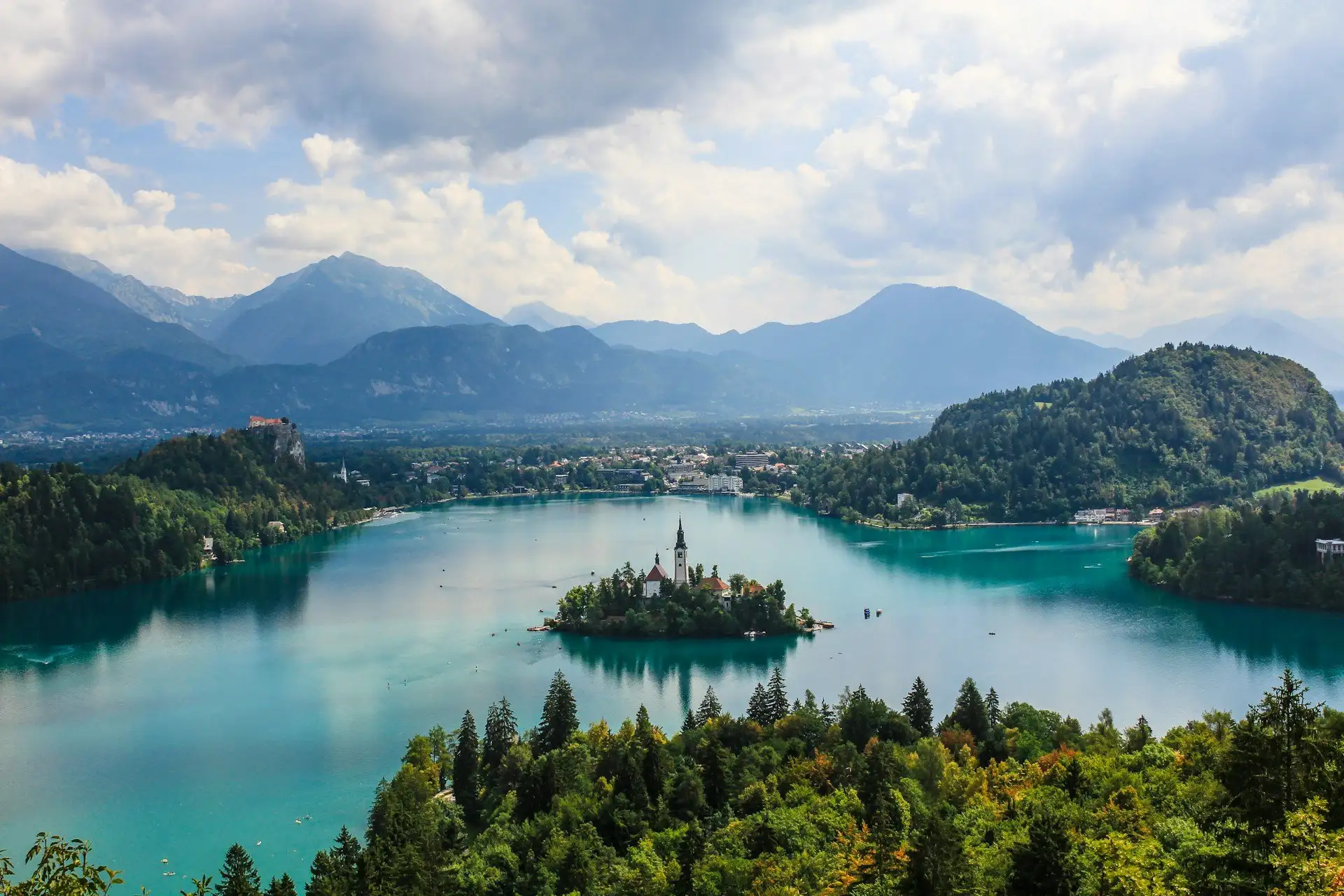
Lake Bled's photogenic island can mean genuine crowding at the classic viewpoints in July and August, and the pletna boat monopoly (only licensed local boatmen may operate them) keeps prices fixed regardless of season. Slovenia is not a budget destination in the way its Balkan neighbors are: prices sit closer to Austria than to Croatia's inland regions, particularly for lakeside accommodation. The road network is excellent but the country's small size means everything, Ljubljana, Bled, the coast, the Soča Valley, tempts you into cramming too much into too few days; slowing down is usually the better call. And English is close to universal in tourist areas but noticeably less so in smaller towns and among older residents, which is a minor friction rather than a real obstacle.
A History Worth Knowing
Slavic tribes settled the eastern Alps in the 6th century and formed Carantania, one of the earliest Slavic political entities and a place Slovenian historians still point to as the cradle of the nation's statehood. Centuries of Habsburg rule as the Duchy of Carniola followed, then a 20th century that moved Slovenia through the Kingdom of Yugoslavia, wartime occupation, socialist Yugoslavia under Tito, and finally a ten-day war of independence in 1991 that was over almost before the rest of the world had registered it had started.
- 6th century
Carantania. Alpine Slavs form one of the earliest Slavic principalities, later absorbed into the Frankish and then Holy Roman Empire.
- 14th-19th century
Habsburg Carniola. Centuries under Austrian rule as the Duchy of Carniola, interrupted briefly by Napoleon's Illyrian Provinces (1809-1813), which made Ljubljana a provincial capital for the first time.
- 1918
Kingdom of Serbs, Croats and Slovenes. After Austria-Hungary's collapse, Slovenia joins the new South Slav kingdom, later renamed Yugoslavia.
- 1941-1945
Occupation. Slovenia is partitioned between Nazi Germany, Fascist Italy and Hungary; a significant partisan resistance movement operates throughout.
- 1945-1991
Socialist Yugoslavia. As the most industrialized and prosperous of the six Yugoslav republics under Tito, Slovenia builds an economic head start that outlasts the federation itself.
- 1991
The Ten-Day War. Independence declared 25 June; a brief, low-casualty war (44 Yugoslav and 19 Slovenian deaths) against the Yugoslav federal army ends with the Brioni Accords on 7 July, and Slovenia is free of the conflicts that would consume the rest of Yugoslavia through the 1990s.
- 2004-2007
EU, NATO, euro, Schengen. First former Yugoslav republic into the EU and NATO (2004), then the eurozone and full Schengen membership (2007), completing one of the fastest and smoothest post-communist transitions in the region.
Read the full history: Carantania, the Habsburgs, and the Ten-Day War
Carantania's significance to Slovenian national identity is partly ceremonial and partly real: the early Slavic principality's installation ritual for its dukes, conducted in the Slovene language on a stone throne near Klagenfurt, is cited by historians as one of Europe's oldest continuous democratic traditions, predating the Magna Carta by centuries. Whether or not the direct political lineage holds up to modern scrutiny, the symbolism carried real weight during the national revival of the 19th century.
Habsburg rule, running from roughly the 14th century until 1918, folded Slovene-speaking lands into the Duchy of Carniola and neighboring Austrian crown lands. The Slovene language survived largely as a peasant and rural vernacular for centuries while German dominated administration, church and city life, which is part of why the 19th century national awakening, and its central figure, the Romantic poet France Prešeren, focused so heavily on establishing Slovene as a serious literary language. Napoleon's short-lived Illyrian Provinces (1809-1813) briefly made Ljubljana a provincial capital and introduced French administrative reforms and public education in Slovene, a formative memory for the national movement even though French control lasted only four years.
The 20th century took Slovenia through the Kingdom of Serbs, Croats and Slovenes after 1918, renamed Yugoslavia in 1929, then wartime partition among Nazi Germany, Fascist Italy and Hungary from 1941, with a significant Slovene partisan resistance. Post-war socialist Yugoslavia under Tito made Slovenia the federation's most industrialized and prosperous republic, a status that gave it both the economic confidence and the practical infrastructure to make a fast, comparatively painless exit when Yugoslavia began to fracture in 1991.
The Ten-Day War. When Slovenia declared independence on 25 June 1991, the Yugoslav People's Army, roughly 32,000 strong, moved to retake control of the republic's borders. Slovenia's lightly armed territorial defense force resisted for ten days; the decisive engagement at Krakovski Gozd forced a major Yugoslav surrender, a ceasefire followed on 4 July, and the Brioni Accords, brokered by the European Community, formalized the end of hostilities on 7 July. The toll, 44 Yugoslav soldiers and 19 Slovenes killed, was tragic but small by the standards of the wars that followed elsewhere in Yugoslavia through the 1990s, and Slovenia's relative ethnic homogeneity meant it avoided the drawn-out conflicts that devastated Croatia and Bosnia. The country marks the declaration each year as Statehood Day on 25 June.
Top Destinations
Slovenia divides naturally into five zones: the capital, the alpine lakes, the karst and coast, the adventure-sports Soča Valley, and Maribor and the eastern wine country. Distance is rarely the obstacle here, the whole country fits inside a three-hour drive, so the real planning question is how many zones to fit into how many days.
Ljubljana, the green capital
Slovenia's capital is small enough to see on foot in a weekend and interesting enough to hold your attention the whole time. The Ljubljanica River, lined with cafe terraces and crossed by Jože Plečnik's Triple Bridge, runs straight through a car-free center that most visitors underestimate before arriving. Ljubljana Castle sits on a hill above it all, reachable by funicular, and the Central Market's riverside colonnade, also Plečnik's design, is a UNESCO-listed piece of everyday architecture rather than a monument roped off from use. Our full Ljubljana city guide covers neighborhoods, hotels, restaurants and a full day-trip plan to Lake Bled.
Lake Bled, the postcard lake
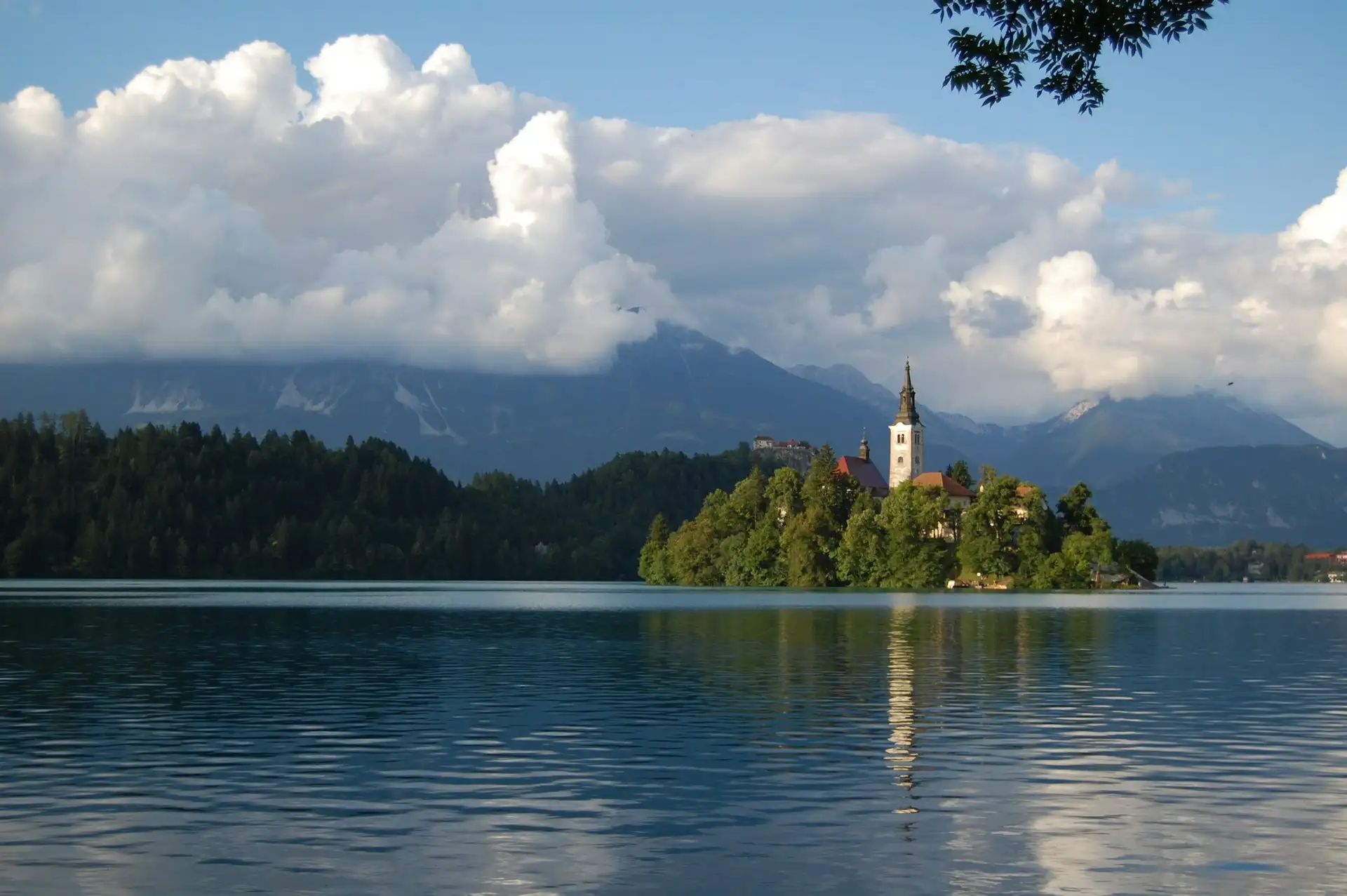
Lake Bled is Slovenia's most photographed sight for a reason: a pilgrimage church sits on a small island at its center, a medieval castle perches on a cliff above the water, and the Julian Alps rise behind both. Traditional flat-bottomed pletna boats, rowed by licensed local boatmen, ferry visitors to the island for around €18-20 return; ring the church bell once you're there, tradition holds it grants a wish. Bled Castle, Slovenia's oldest, charges around €15 entry for views that stretch across the whole basin. The town's signature dessert, kremna rezina (Bled cream cake), a layered custard-and-cream slice invented at Hotel Park in 1953, is worth the calories at Café Belvedere inside Vila Bled, a former royal and Tito-era retreat with a Plečnik-designed terrace over the lake.
Lake Bohinj & Vintgar Gorge
Lake Bohinj, an hour beyond Bled inside Triglav National Park, is larger, undeveloped and considerably quieter: no island, no castle, just clear alpine water ringed by mountains and genuinely good hiking and swimming without the crowds. Vintgar Gorge, close to Bled, threads wooden walkways along the Radovna River through a narrow limestone canyon and makes an easy half-day walk from town.
Postojna & Škocjan Caves
Slovenia's karst region holds two of Europe's most significant cave systems, and they reward different amounts of time. Postojna Cave, the more visited of the two, runs an electric train more than a kilometer into a 24-kilometer network of tunnels and galleries before you continue on foot. Škocjan Caves, a UNESCO World Heritage Site, trade the train ride for scale: one of the largest known underground canyons on Earth, walked on foot bridges suspended above a river gorge deep underground. Predjama Castle, built directly into a cave mouth halfway up a cliff face near Postojna, is worth combining with either cave visit.
Piran, the Adriatic town
Piran sits on a narrow peninsula on Slovenia's short Adriatic coastline, its Venetian-era architecture and warren of stone streets making it the most photogenic town on Slovenia's 46 kilometers of coast. Tartini Square, named for the Piran-born violinist and composer, anchors the old town, and the walk out to the tip of the peninsula for sunset is a local ritual as much as a tourist one. Portorož, the more built-up beach resort next door, covers the sun-and-sand side that Piran's stone streets don't.
The Soča Valley, Slovenia's adventure corridor
The Soča River runs an improbable, saturated emerald green through a valley the Slovenes call the capital of adrenaline sports. Bovec is the activity hub: whitewater rafting and kayaking on the Soča itself, canyoning in the side gorges, and paragliding off the surrounding peaks, all inside Triglav National Park. The valley has a second, gentler activity peak in early autumn as river levels rise again after summer, though it's also one of the wetter corners of the country, with rainfall peaking in October and November.
Maribor & the wine country
Maribor, Slovenia's second city, sits on the Drava River in the country's eastern wine region and is easy to underrate. Its riverside Lent district holds the Žametovka vine, recognized by Guinness World Records as the world's oldest noble vine still bearing fruit at more than 400 years old, growing against the wall of a building that has its own small dedicated museum. The city's Old Vine Festival each September is the region's biggest wine and culture event, timed to the harvest. The surrounding hills toward Ptuj, Slovenia's oldest town, and the Styrian wine roads are a slower, less-visited add-on for travelers with an extra day or two.

Hidden gems beyond the main circuit
The zones above cover a first or second trip well. With extra days, these are the spots that rarely make the standard itinerary and reward the detour.
Predjama Castle
A Renaissance castle built directly into the mouth of a cave halfway up a 123-meter cliff face, with secret tunnels connecting it to the cave system behind. Genuinely unlike any other castle in Europe, and almost always paired with a Postojna Cave visit.
Vintgar Gorge
Wooden walkways cling to the canyon walls above the turquoise Radovna River for 1.6 kilometers, ending at a waterfall. Easy, dramatic, and an entirely different pace from Bled's lakeside crowds twenty minutes away.
Mount Triglav
Slovenia's highest peak and national symbol, appearing on the flag and coat of arms. Climbing it is a serious two-day undertaking for experienced hikers with a guide; most visitors are content to admire it from below.
Ptuj
Slovenia's oldest town, with a hilltop castle overlooking the Drava River and a historic center that sees a fraction of Ljubljana's or Bled's visitors. The Kurentovanje carnival each February is the country's most distinctive folk festival.
Lake Cerknica
An "intermittent lake" that floods into existence each autumn and winter and dries into meadow and marsh by summer, a genuine karst hydrology oddity and a haven for birdwatchers when the water is up.
Wine valleys of the west
Rolling hills near the Italian border producing Rebula and other whites, with small family wineries doing tastings by appointment and a noticeably slower pace than the Bled-to-coast tourist corridor.
Culture & Etiquette
Slovenian culture runs reserved and understated rather than demonstrative, closer in temperament to Austria or Germany than to its more expressive Balkan neighbors, though the hospitality is genuine once a conversation gets going. Environmental pride is close to a national trait: Ljubljana was the European Green Capital in 2016, the country protects drinking water access in its constitution, and Slovenia is the birthplace of World Bee Day, a UN observance the country itself proposed in honor of its native Carniolan honey bee and long beekeeping tradition.
Do
- Learn a few Slovene words. Hvala (thank you), Prosim (please/you're welcome), Živjo (hi, informal), Dober dan (good day). Slovene has few non-native speakers worldwide, so any attempt is noticed and appreciated.
- Refill your water bottle from public fountains. Tap water is excellent and constitutionally protected; Ljubljana's old town has fountains built for exactly this.
- Dress in layers. A single day can move from alpine cool in Bled to Mediterranean warmth on the coast; Slovenia's compressed geography means the weather changes faster than the driving time suggests.
- Book Lake Bled activities and Postojna Cave tickets ahead in July-August. Both sites can sell out or queue heavily at peak summer midday; early morning or online booking avoids most of it.
- Recycle properly. Slovenia takes waste sorting seriously and most accommodation has multiple labeled bins; follow the local system rather than defaulting to a single bin.
Don't
- Confuse Slovenia with Slovakia or Slavonia. A genuinely common mix-up (different country, and a region of Croatia, respectively) that Slovenes have heard many times and find more tiresome than funny.
- Assume everyone speaks fluent English outside tourist areas. It's close to universal among younger people in Ljubljana and Bled, less so among older residents and in smaller towns.
- Expect the pletna boat prices at Lake Bled to be negotiable. The boatmen operate under a fixed, licensed cooperative system; prices are set regardless of season or bargaining attempts.
- Jaywalk carelessly in Ljubljana's center. The pedestrian zone makes it feel casual, but cyclists and delivery vehicles still use these streets and move quickly.
- Skip travel insurance for the Soča Valley or mountain hiking. Rafting, canyoning and alpine trails are genuinely well-run but carry real risk; standard coverage should include adventure sports and mountain rescue.
Deeper culture: Prešeren, the Carniolan bee and Plečnik's Ljubljana
France Prešeren. Slovenia's national poet (1800-1849), whose statue anchors Ljubljana's central square, is credited with proving Slovene could carry serious literary work at a time when German dominated cultural life. A verse from his poem "Zdravljica" became Slovenia's national anthem, and Prešeren Day on 8 February is a public holiday celebrating Slovenian culture broadly, not just the poet himself.
The Carniolan honey bee. Native to Slovenia and prized by beekeepers worldwide for its gentle temperament, the Carniolan bee underpins a beekeeping tradition dense enough that Slovenia has more beekeepers per capita than almost any other country. Slovenia proposed World Bee Day (20 May) to the United Nations, and it was adopted globally in 2018.
Jože Plečnik. The architect who shaped modern Ljubljana more than any other individual, responsible for the Triple Bridge, the Central Market colonnade, the National and University Library, and dozens of smaller interventions across the city between the 1920s and his death in 1957. UNESCO inscribed "The Works of Jože Plečnik in Ljubljana" as a World Heritage Site in 2021, recognizing his human-centered approach to urban design as a coherent body of work rather than a collection of separate buildings.
Food & Drink
Slovenian food sits at a genuine crossroads: Alpine dairy and dumplings from the north, Mediterranean olive oil and seafood from the coast, and Balkan and Hungarian influences from the east and south, often within the same regional menu. Portions run generous and the wine, largely unknown outside the country, is a legitimate reason to visit on its own.
Štruklji
Rolled dumplings of stretched dough wrapped around a filling, savory (cottage cheese, buckwheat, walnut) or sweet, then boiled or baked. Slovenia's most versatile dish and the one locals argue about most, since every region has its own version.
Kranjska Klobasa €8-14
Carniolan sausage, a coarse pork sausage with EU-protected geographical status, traditionally served with sauerkraut and horseradish. The closest thing Slovenia has to a defining national dish.
Kremna Rezina ~€9
Bled's cream cake: layered puff pastry, vanilla custard and whipped cream, invented at Hotel Park in 1953. Best eaten lakeside at Café Belvedere inside Vila Bled, though bakeries across the country now sell their own versions.
Žganci
Buckwheat or cornmeal porridge, a hearty peasant staple served with milk, cracklings or stew. Rarely on tourist-facing menus but common at traditional gostilna (inn-style) restaurants.
Potica
A rolled, spiral-cut nut cake, usually walnut, filling a yeasted dough, traditionally made for holidays and celebrations. Regional variations swap in poppy seed, tarragon or chocolate fillings.
Rebula & Teran Wine €15-30/bottle
Rebula, a crisp white from the Vipava Valley and Goriška Brda near the Italian border, and Teran, a dark, high-acid red made from the Refošk grape in the Karst region, are Slovenia's two signature wines and still largely undiscovered outside the country.
When to Go & Itineraries
May through October covers Slovenia's outdoor season, with September standing out for warm days, thinning crowds and lower prices than peak summer. Ski season at resorts like Vogel and Maribor Pohorje runs roughly December through March. The Soča Valley's rafting season peaks in summer but sees a second, quieter activity window in early autumn.
All four seasons compared, with temperatures
| Season | Verdict | Temps | Prices & crowds |
|---|---|---|---|
| May-Jun & Sep | Best | 15-25°C inland, warmer on coast | Mid prices, manageable crowds |
| Jul-Aug | Good (busy) | 25-32°C, hotter on the coast | Peak Bled and coastal crowds and prices |
| Mar-Apr & Oct | Good | 8-18°C, cooler in the mountains | Lower prices, thinner crowds; Soča Valley rainfall picks up in Oct |
| Dec-Feb | Ski season | -2 to 8°C, colder in the Alps | Busy at ski resorts (Vogel, Maribor Pohorje), quiet elsewhere |
Rough city averages: Ljubljana 11°C annual, warmest in July around 28°C highs; the coast around Piran runs several degrees warmer year-round; the Julian Alps noticeably cooler and wetter than the lowlands at any time of year.
Itineraries
Five days covers the essentials well. A week adds the coast without feeling rushed, and ten days lets the Soča Valley or Maribor's wine country into the trip without sacrificing time anywhere else.
- Days 1-2
Ljubljana. Old town, castle funicular, Central Market, riverside cafes; see our full city guide for a chapter-by-chapter plan.
- Day 3
Lake Bled. Day trip by bus or train from Ljubljana: pletna boat to the island, the castle, kremna rezina at Vila Bled.
- Days 4-5
Postojna or Škocjan Cave. One karst cave, paired with Predjama Castle if visiting Postojna, before returning to Ljubljana for departure.
- Days 1-2
Ljubljana. Two full days including a half-day trip to Škofja Loka.
- Day 3
Lake Bled. Full day; add Vintgar Gorge in the morning before the island and castle.
- Day 4
Lake Bohinj. A quieter alpine day, an hour beyond Bled, for hiking or swimming without the crowds.
- Day 5
Karst caves. Postojna or Škocjan, with Predjama Castle if time allows.
- Days 6-7
Piran & the coast. Two nights on the Adriatic: Tartini Square, the old town walk, and a slower pace before returning inland.
- Days 1-2
Ljubljana extended. The city at a relaxed pace, plus Škofja Loka.
- Days 3-4
Bled & Bohinj. Both lakes properly, plus Vintgar Gorge.
- Days 5-6
Soča Valley. Bovec as a base: rafting or canyoning on the emerald Soča, one rest day for scenery and food.
- Day 7
Karst caves. Postojna or Škocjan, plus Predjama Castle.
- Days 8-9
Piran & the coast. Two unhurried nights on the Adriatic.
- Day 10
Maribor. A detour east for the Old Vine and Styrian wine country before flying out of Ljubljana or Maribor.
Getting there & around
Ljubljana Jože Pučnik Airport (LJU) is Slovenia's main international gateway, about 26 kilometers northeast of the capital. Arriva's bus line 28 runs to Ljubljana's main bus station roughly hourly from around 5am to 9:30pm, takes about 45 minutes and costs around €4 paid to the driver; airport shuttle services also connect to the main train station in about 30 minutes. A taxi into the city runs around €30 for up to four passengers. There is no direct rail line between the airport and the city center. A rental car is the most flexible way to see the country given how compact it is, roads are in good condition throughout, and Slovenia requires a vignette (toll sticker) for highway driving, sold at petrol stations and border crossings.
All transport options with prices: buses, trains, car rental
| Option | Price | Notes |
|---|---|---|
| Airport bus (line 28) | ~€4 | Arriva, roughly hourly 5am-9:30pm, about 45 minutes to Ljubljana bus station. |
| Airport shuttle | Varies by provider | To Ljubljana main train station in about 30 minutes; several private operators serve the route. |
| Airport taxi | ~€30 | Fixed-ish rate for up to 4 passengers into central Ljubljana. |
| Ljubljana-Bled bus | ~€6.30 one way | Roughly hourly, journey takes 1-1.3 hours depending on route. |
| Rental car | From ~€30/day | Requires a highway vignette; the most practical way to combine Bled, the caves, the coast and the Soča Valley in one trip. |
Prices reflect August 2026 research and drift over time, especially seasonal transport frequency. Treat them as a planning baseline, not a quote.
Budget Planning
Slovenia sits in the middle of the European price spectrum: noticeably more expensive than the Balkans further south, but generally cheaper than Austria, Switzerland or Scandinavia. Lake Bled's accommodation is the country's most consistent price trap, expect to pay a premium simply for the lakeside address.
- Hostel dorm €20-35
- Gostilna set lunches & market food
- Buses and regional trains
- Free hikes, viewpoints & public fountains
- 3-star hotel or private guesthouse
- Restaurant meals with wine
- Rental car or intercity transport
- One cave visit, one Bled boat trip
- Lakeside or boutique hotels
- Fine dining and wine tastings
- Private guides and tours
- Soča Valley adventure packages
Quick reference prices: coffee, transport, entry fees
| Coffee (espresso) | ~€1.50-2 |
| Gostilna set lunch | €10-15 |
| Restaurant dinner (mid) | €15-25 |
| Kremna rezina slice | ~€9 |
| Ljubljana-Bled bus | ~€6.30 one way |
| Pletna boat to Bled Island | €18-20 return |
| Bled Castle entry | ~€15 |
| Vintgar Gorge entry | ~€7-10 |
| Hostel dorm bed | €20-35/night |
| Mid-range hotel double | €90-150/night |
Prices reflect August 2026 research and drift over time, especially Bled and coastal accommodation in peak season. Treat them as a planning baseline, not a quote.
Visa & Entry
Slovenia is a full Schengen Area member, so entry rules follow the standard Schengen framework: citizens of the US, UK, Australia, Canada and around 55 other visa-exempt countries can enter for up to 90 days within any 180-day period, and that allowance is shared across every Schengen country, not reset at each border. From Q4 2026, visa-exempt travelers will need to register in advance for ETIAS, a low-cost travel authorization (around €20) rather than a visa. Rules do change; the Slovenian government's travel information portal is the authoritative source, not third-party paid "e-visa" sites that rank well in search but charge for something that's often free or low-cost directly.
✓ Valid passport
Standard Schengen requirement: valid for at least 3 months beyond your planned departure date, and issued within the last 10 years.
✓ Proof of funds & onward travel
May be requested at the border, though rarely checked in practice for EU/UK/US/Canadian/Australian arrivals with an obvious return itinerary.
✓ Travel insurance
Not mandatory for short Schengen visits by most Western passport holders, but strongly recommended, particularly if hiking, rafting or driving in the mountains.
✓ Full Schengen member
No border checks arriving from other Schengen countries; your 90-day Schengen clock runs the same whether you're in Slovenia, Italy or France.
| Slovenia | Croatia | |
|---|---|---|
| Coastline | Short, 46km, one standout town in Piran | Long Adriatic coast, hundreds of islands |
| Mountains & lakes | Julian Alps, Lake Bled and Bohinj, a core strength | Plitvice Lakes aside, less of an alpine draw |
| Crowds | Bled gets busy, but the country overall is calmer | Dubrovnik and the islands see heavier peak-season crowds |
| Budget | €50-70/day covers a comfortable budget trip | Similar inland, pricier on the peak-season coast and islands |
| Schengen & euro | Member since 2007 | Member since 2023 |
Safety, Solo Women & Family
Slovenia is exceptionally safe. The 2026 Global Peace Index ranked it the 4th safest country in the world, behind only Iceland, New Zealand and Switzerland, and 3rd within Western and Central Europe. Violent crime against visitors is rare, Ljubljana's center is comfortable to walk at night, and the practical risks that do exist are almost entirely about terrain and weather rather than crime.
Mountain & water safety
Alpine weather changes fast, and the Soča Valley's rafting, canyoning and kayaking carry real physical risk even though local operators run well-regulated trips. Book activities through licensed operators, check your insurance covers adventure sports, and respect closures during high water.
Driving
Roads are generally excellent, but mountain passes and the coast road can be narrow and winding, and a highway vignette is legally required, not optional. Winter driving in the Alps may require snow chains or tires by law in season.
Petty theft
Pickpocketing is uncommon but not unheard of at Lake Bled's busiest viewpoints and Ljubljana's peak-season old town in summer. Ordinary awareness with bags and phones is sufficient; nothing more is warranted.
Solo women travelers
Slovenia rates very well for solo women travelers, consistent with its overall safety ranking: street harassment is uncommon, public transport feels safe, and Ljubljana in particular has a relaxed, walkable evening atmosphere that solo travelers of any gender generally find comfortable. The Soča Valley's outdoor activity operators are used to solo travelers joining group rafting and canyoning trips. Full detail on our Solo Woman Explorer pages.
Emergency numbers
Which number to call, and mountain rescue
112 is the EU-standard general emergency number, covering ambulance and fire and reachable with English-speaking operators; 113 reaches the police directly. For hiking or mountain emergencies, 112 also connects to Slovenia's mountain rescue service (Gorska reševalna zveza Slovenije), a volunteer organization with genuine expertise in alpine terrain. Tell someone your planned route before a serious hike, particularly in Triglav National Park, where mobile signal is inconsistent in the deeper valleys.
Family travel
Slovenia works well for families: the caves are genuinely exciting for kids old enough to handle the walking and cool underground temperatures, Lake Bled's boat ride and castle both land well with children, and the compressed geography means less time in transit between sights than in most European countries. The Soča Valley's gentler rafting sections and Ljubljana's Tivoli-adjacent green spaces (the city's largest park, just beyond the old town) round out a family itinerary without requiring long drives.
Slovenia FAQ
Is Slovenia safe to visit?
Yes, very. Slovenia ranked 4th safest country in the world in the 2026 Global Peace Index, behind only Iceland, New Zealand and Switzerland. Violent crime against visitors is rare and the main risks are mountain weather and driving, not crime.
Is Slovenia expensive?
Mid-range for Western Europe: cheaper than Austria, Switzerland or Scandinavia but pricier than the Balkans. Budget travelers manage on €50-70 a day, mid-range on €100-150.
Do I need a visa for Slovenia?
Citizens of the US, UK, EU, Australia, Canada and around 55 other countries can enter visa-free for up to 90 days in any 180-day period. Slovenia is in the Schengen Area, so this allowance is shared across all Schengen countries. From Q4 2026, visa-exempt travelers will need an ETIAS authorization (around €20).
When is the best time to visit Slovenia?
May through October for outdoor travel, with September standing out for warm weather and thinner crowds. December through March suits skiing at Vogel or Maribor Pohorje.
How many days do you need in Slovenia?
Five days covers Ljubljana, Lake Bled and one karst cave comfortably. A week adds Piran and the coast; ten days lets you add the Soča Valley or Maribor without rushing.
Is Slovenia part of the EU and Schengen?
Yes to both. Slovenia joined the EU in 2004 and has used the euro and been a full Schengen member since 2007, so there are no border checks arriving from other Schengen countries.
What is the best lake in Slovenia, Bled or Bohinj?
Different jobs. Bled has the island church, the castle and the crowds; Bohinj is larger, wilder and quieter, better for hiking and swimming without the photo queue.
Can you drink tap water in Slovenia?
Yes, everywhere. Slovenia is one of the few countries to protect the right to drinking water in its constitution, and Ljubljana in particular has public fountains with drinkable water around the old town.
What language is spoken in Slovenia?
Slovene. English is widely spoken in Ljubljana, Bled and other tourist areas, especially among people under 40; German and Italian are also common in border regions.
Is Slovenia good for a road trip?
Yes, and it may be the best-suited country in Europe for it: the whole country can be crossed in under three hours, roads are in good condition, and the Bled-caves-coast-Soča Valley loop works well as a week-long circuit.
Is Slovenia the same as Slavonia?
No, a common confusion. Slovenia is an independent country in Central Europe; Slavonia is a region of eastern Croatia. They share a linguistic root but nothing else.
Is Slovenia cheaper than Croatia?
Roughly comparable overall, with Slovenia's inland regions often slightly cheaper than Croatia's peak-season Adriatic coast, though Croatia's inland and off-season prices can undercut Slovenia. Neither is a budget destination on the level of the Balkans further south.
What Stays With You
Slovenia rewards travelers who slow down more than almost anywhere else in Europe, mostly because the country makes it so easy to see too much too fast. The lake with the island church, the caves that go on for kilometers underground, the wine nobody outside the country has heard of, none of it needs to be rushed, because nothing in Slovenia is more than a couple of hours from anything else. That compactness is the whole trick: a country that lets you have the Alps for breakfast and the Adriatic for dinner without ever quite feeling like you're racing the clock.
Go for the lake everyone has seen a photo of. Stay for the parts of the country that never made it onto anyone's postcard.