
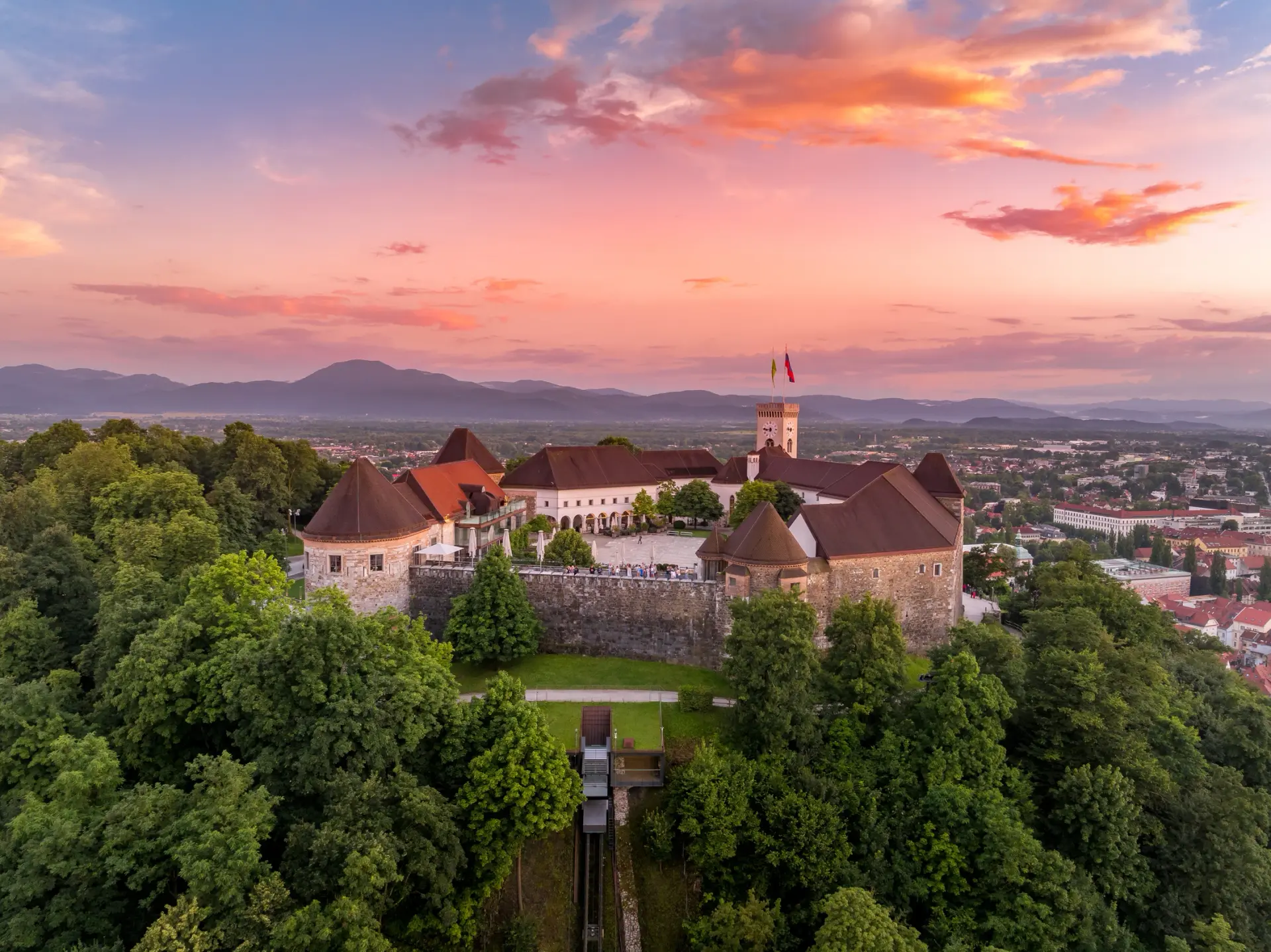
Europe's smallest capital that still feels like a real city
Ljubljana sits in a basin ringed by hills, the Ljubljanica River curving through its center under bridges that architect Jože Plečnik spent decades quietly reshaping. At around 295,000 people it's one of the smallest capitals in Europe, small enough that a first-time visitor can walk from the train station to the castle hill in twenty-five minutes, and confident enough in its own identity that it doesn't perform for tourists the way larger capitals sometimes do. The riverside cafe terraces, the market colonnade, the dragons on the bridge: none of it is staged, it's just how the city looks on an ordinary Tuesday.
What Ljubljana has going for it beyond the postcard center is a genuinely serious commitment to livability. It was the European Green Capital in 2016, the historic core has been closed to private cars since 2007, and the result is a city where the loudest sound most afternoons is a busker or a church bell rather than traffic. It also happens to sit twenty minutes from a mountain lake with an island church on it, which is the reason a lot of visitors first hear the city's name at all.
The honest complications
Ljubljana's small size cuts both ways: it means you can see the highlights fast, but it also means the center can feel genuinely crowded at peak midday in July and August, particularly around the Triple Bridge and Central Market. The city closes down more than larger capitals on Sundays, when many shops and some restaurants outside the tourist core stay shut. And because so much of the city's appeal is outdoor and riverside, a rainy stretch (Ljubljana gets a fair amount of precipitation year-round) can flatten the experience more than it would in a city with more indoor attractions to fall back on.
A city small enough that the neighbourhood barely matters, and yet
Ljubljana is compact enough that almost anywhere central puts you within a twenty-minute walk of everything. Where you base yourself still shapes the trip: how much nightlife noise you want outside your window, and how far you're willing to walk back after dinner.
Center / Old Town
The historic core stretches from Prešeren Square across the Triple Bridge into the old town proper, Stari trg and Mestni trg, climbing gradually toward the castle hill. Car-free, cobbled and lined with Baroque facades, this is the Ljubljana of the postcards, and it's also where most of the city's best restaurants and bars actually are. Staying here means everything is walkable, including the inevitable late-evening river walk.
Trnovo
A short walk down the Ljubljanica from the old town, Trnovo trades the tourist density for a genuinely local, café-and-bar neighbourhood built around Trnovo Church, where the national poet France Prešeren is said to have first met his muse Julija. Trnovo Bridge, one of Plečnik's smaller and lesser-known works, crosses the river here with the same careful detailing as his more famous bridges downtown. Good for travellers who want to be close to the center without staying inside the busiest few blocks of it.
Tabor & Metelkova
Tabor, just north of the old town, holds the Slovenian Ethnographic Museum and Tabor Park, and within it sits Metelkova, a former Austro-Hungarian military barracks squatted in the early 1990s and now a self-declared autonomous cultural zone: street art and murals by day, one of the city's liveliest and edgiest nightlife pockets after dark. A logical base for travellers prioritising the city's alternative culture and evening scene over lakeside quiet.
Around Tivoli Park
West of the old town, the streets bordering Tivoli Park, the city's largest green space, offer a quieter, more residential base a short tram or walk from the center. Good for families or travellers who want easy access to green space and a calmer evening without sacrificing much walkability.
From a converted 16th-century palace to a hostel inside a former prison
Ljubljana's hotel scene is small by capital-city standards but covers every bracket well, from the international five-star chains to boutique properties inside genuinely old buildings. Prices sit below Vienna or Venice but above most Balkan capitals.
At the top, InterContinental Ljubljana brings international five-star standards with the city's most comprehensive spa, an outdoor pool terrace, and rooms looking out over the Ljubljana basin toward the Alps, from around €220 a night. In the heritage-boutique bracket, Antiq Palace, housed in an exquisitely renovated 16th-century palace right in the old town, pairs huge rooms and quiet courtyards with genuine period character, while Hotel Cubo, an art deco-fronted design hotel a few minutes from the Triple Bridge, has picked up international design awards for its interiors, both from around €140-180.
On the river itself, Vander Urbani Resort occupies a converted 1920s building directly on the Ljubljanica with a small rooftop pool and terrace over the old town rooftops, from around €160. At the budget end, Hostel Celica, a former military prison converted into a design hostel with each dorm and private room built from a former cell (each one decorated by a different artist), remains one of the most distinctive hostel stays in Europe, with dorm beds from around €25-30.
Štruklji, Rebula and a wine scene most of Europe hasn't caught up on
Ljubljana's food scene has quietly become one of the more interesting in Central Europe: traditional gostilna cooking sits a few streets from serious modern wine bars pouring producers most of the continent has never heard of, and it's still cheap enough by Western European standards to eat and drink well without planning around it.
Štruklji
Slovenia's rolled dumplings, savoury or sweet, are the dish to try in the capital before heading anywhere else in the country. Julija, on Stari trg in the heart of the old town, does a reliably good vegetarian štruklji alongside solid grilled meats and a proper Slovenian wine list built around Rebula whites and Teran reds. On Trubarjeva cesta, Gostilna Dela, a social enterprise restaurant that trains people with disabilities in hospitality work, serves traditional Slovenian cooking with an unusually strong vegetarian selection, štruklji included.
Slovenian wine bars
Movia, a tiny, dimly lit wine bar right next to the Town Hall, belongs to one of Slovenia's most respected biodynamic wineries and is the single best introduction to serious Slovenian wine in the city. Further out, eVino, run by two-time Slovenian Sommelier of the Year Gašper Čarman, stocks more than a thousand labels from 150 producers, a genuinely serious list for a country most wine drinkers still haven't discovered.
Kranjska klobasa & market food
Plečnik's riverside Central Market, running along the Ljubljanica between the Triple Bridge and the Dragon Bridge, is where locals actually shop, and its stalls and surrounding cafes are a good place to try Carniolan sausage and cheese from small regional producers rather than a tourist-facing plate of the same thing.
A city built for wandering, with one hill to climb
Ljubljana's sights cluster tightly enough around the river that a good two days covers nearly everything on foot. A handful of things reward planning ahead, and this chapter walks through the city roughly the way a well-paced two days would.
The riverside core
Start at Prešeren Square, the city's genuine center of gravity, dominated by the pink Franciscan Church and a statue of the national poet himself. Cross the Triple Bridge (Tromostovje), a single 1842 crossing flanked by two pedestrian bridges Plečnik added between 1929 and 1932, and you're in the old town proper. Immediately to the right, Plečnik's Central Market colonnade runs along the riverbank toward the Dragon Bridge, an Art Nouveau crossing from 1901 guarded by four copper dragons that have become almost as much a symbol of the city as the castle itself. A boat and walking tour along the Ljubljanica (roughly 2.5 hours) is a genuinely good way to see the bridges and riverside facades from a different angle, and a dedicated wine-tasting boat cruise pairs the same river view with a flight of Slovenian wines.
Ljubljana Castle
The Ljubljana Castle funicular, its entrance on Krekov trg just past the Triple Bridge, climbs the hill in under a minute (around €4 single, €7 return, running roughly 9am to 10pm). From the castle grounds, the views stretch back over Prešeren Square and the Triple Bridge below, across Tivoli Park's green band to the northwest, and on a clear day toward the Kamnik Alps and, further off, Mount Triglav. Walking up is a genuine option too, twenty steep minutes through wooded switchbacks, for anyone who wants the exercise or wants to skip the ticket.
Tivoli Park
Tivoli Park, the city's largest green space, sits a short walk west of the old town and is where Ljubljana actually spends its Sunday afternoons. The Jakopič Promenade cuts through the middle of it, and the Cekin Mansion, home to the Contemporary History Museum, and the 17th-century Tivoli Castle both sit inside the park's grounds. A genuinely restful counterpoint to a morning spent on cobblestones.
Metelkova after dark
Metelkova, the former military barracks turned autonomous cultural zone near Tabor, is worth visiting twice: once during the day for the murals, abstract graffiti and welded-metal sculptures covering nearly every surface, and once after dark, when the bars inside open up and the courtyards fill with a mix of students, travellers and locals for some of the city's least conventional nightlife. Neither visit resembles the other.
One, two or three days, planned street by street
Two full days covers Ljubljana properly; a third day is really a Lake Bled day trip in disguise, and most visitors end up taking it.
- Morning
Prešeren Square and the Triple Bridge. Coffee on the square, then across into the old town toward Mestni trg.
- Midday
Central Market and the Dragon Bridge. Browse the market colonnade, then a štruklji lunch at Julija on Stari trg.
- Afternoon
Ljubljana Castle. Funicular up from Krekov trg, walk down through the wooded switchbacks.
- Evening
Riverside dinner and a glass of Rebula. A wine bar like Movia near the Town Hall before or after.
- Day 1
The one-day route: Prešeren Square, Triple Bridge, Central Market, Dragon Bridge, castle funicular, riverside dinner.
- Day 2 morning
Tivoli Park. A slow walk through the Jakopič Promenade and Cekin Mansion grounds.
- Day 2 afternoon
Metelkova by daylight. The murals and street art, then Trnovo for a quieter riverside wander past Trnovo Church and Plečnik's Trnovo Bridge.
- Day 2 evening
Metelkova after dark. The bars and courtyards open up for one of the city's more distinctive nights out.
- Days 1-2
The two-day route above, at an unhurried pace.
- Day 3
Lake Bled. Bus out in the morning, pletna boat to the island, the castle, kremna rezina at Vila Bled, bus back by evening. See the day trip chapter below for full details.
Compact enough to walk, with a bus network for the rest
Ljubljana Jože Pučnik Airport (LJU) sits about 26 kilometers northeast of the city. Arriva's bus line 28 runs to the main bus station roughly hourly from around 5am to 9:30pm, takes about 45 minutes and costs around €4 paid directly to the driver; private shuttle services (GoOpti, Nomago and others) connect to the main train station in about 30 minutes, and a taxi costs around €30 for up to four passengers. There is no direct rail line between the airport and the city center.
Inside the city, the old town and riverside center are car-free and flat enough to cover entirely on foot; almost nothing central is more than a 20-minute walk from Prešeren Square. For trips further out, get the reloadable Urbana card (€2 for the card, then top up credit): a single LPP city bus ride costs €1.30 and covers unlimited transfers for 90 minutes, and the same card also works on the BicikeLJ bike-share system and the castle funicular. BicikeLJ's first 60 minutes are free after a small registration fee, useful for the ride out to Tivoli Park or along the river on a warm afternoon.
Best time to visit and the Christmas market
Ljubljana has a continental climate softened somewhat by its basin setting. May-June and September are the sweet spots: warm days, manageable crowds, and the riverside cafe terraces at their best. July and August are busier and hotter; winter is quiet and can be genuinely cold, though December brings a well-regarded Christmas market along the Ljubljanica with lights strung across the water.
Pricier than the Balkans, cheaper than Vienna
Ljubljana sits comfortably in the middle of the European capital price range: noticeably cheaper than Vienna, Venice or Zurich, but more expensive than Zagreb, Belgrade or Sarajevo. The main cost trap is Lake Bled's lakeside accommodation on a day trip that turns into an overnight, everything in the capital itself is reasonably priced by comparison.
- Hostel dorm €25-35
- Market food and gostilna lunches €12-20
- Urbana card bus rides and walking
- Free riverside walks plus one paid sight
- Boutique hotel €140-180
- Restaurant meals with wine €30-50
- Castle funicular, a boat tour, a wine bar stop
- Bled day trip by bus
- InterContinental or equivalent €220+
- Tasting menus and serious wine bars
- Private guides and tours
- Private Bled or Postojna transfer
One of Europe's safest capitals, with one thing to know
Ljubljana is exceptionally safe by any European standard, consistent with Slovenia's ranking as the 4th safest country in the world in the 2026 Global Peace Index. Violent crime against visitors is essentially a non-issue, the car-free center feels comfortable to walk at night, and the city's small scale means it's hard to get seriously lost or stranded far from help.
The one thing actually worth knowing: pickpocketing, concentrated at the busiest points, the Central Market on Saturday mornings, the Triple Bridge area in peak summer, and any large festival or Christmas market crowd, can occur at the level of a typical European capital. Ordinary bag and pocket awareness is sufficient; nothing more is warranted. Ljubljana is also excellent for solo female travellers, with street harassment uncommon and the riverside evening atmosphere feeling relaxed for travellers of any gender. The EU-standard emergency number is 112 from any phone; the direct police line is 113.
Lake Bled alone justifies the trip to Ljubljana
Ljubljana's central position makes it an excellent base for the rest of Slovenia. Four trips are worth a day each, and all are manageable without a rental car.
Lake Bled
Slovenia's single most photographed sight, and the flagship day trip from the capital: a pilgrimage church on a small island, a cliffside medieval castle, and the Julian Alps rising behind both. Buses run roughly hourly from Ljubljana's main bus station; trains stop at Lesce-Bled station, about 4 kilometers outside town, requiring a short local bus or taxi onward. Once there, a pletna boat, the traditional flat-bottomed boats rowed by licensed local boatmen, ferries visitors out to the island (around €18-20 return, about 10 minutes each way); ring the church bell once you're there, tradition holds it grants a wish. Bled Castle, perched on its cliff above the lake, charges around €15 entry for panoramic views over the whole basin. Save room for kremna rezina, the layered custard-and-cream cake invented at the town's Hotel Park in 1953, best eaten at Café Belvedere inside Vila Bled, a former royal and Tito-era retreat with a Plečnik-designed lakeside terrace (around €9 a slice). Castle, boat and cake together run roughly €45-55 per person for the day.
Postojna Cave
An electric train carries visitors more than a kilometer into a 24-kilometer network of karst tunnels and galleries before continuing on foot, the most-visited cave system in the country. Combine it with nearby Predjama Castle, built directly into a cliffside cave mouth, for a full day.
Škofja Loka
A medieval town about 25 minutes from Ljubljana with one of the best-preserved historic centers in Slovenia and a hilltop castle above it. A gentler, far less crowded alternative or add-on to the bigger-name sights, and easily combined with a half rather than a full day.
Piran & the Adriatic coast
Slovenia's short, Venetian-flavored stretch of Adriatic coastline, anchored by Piran's old town and Tartini Square. The furthest of these four day trips from the capital, and best done as a full day rather than a rushed half.
Ljubljana FAQ
Is Ljubljana safe for tourists?
Very safe. Slovenia ranked 4th safest country in the world in the 2026 Global Peace Index, and Ljubljana's small, car-free center is comfortable to walk at night. Pickpocketing at busy summer events is the main practical concern.
How many days do I need in Ljubljana?
Two full days covers the city itself well: one for the old town and castle, one for the market, Metelkova and the riverside neighbourhoods. Add a third day for the Lake Bled day trip, which most visitors do anyway.
How much does Ljubljana cost per day?
Budget travellers manage on €50-70 a day with hostels and market food; mid-range runs €100-150. Ljubljana is cheaper than Vienna or Venice but pricier than most Balkan capitals.
When is the best time to visit Ljubljana?
May-June and September: warm weather, manageable crowds, and outdoor cafe season along the river. July and August are busier and hotter; December has a well-regarded Christmas market along the Ljubljanica.
Can I visit Lake Bled as a day trip from Ljubljana?
Yes, easily. Buses run roughly hourly and take about an hour to an hour and twenty minutes, costing around €6.30 one way. It's the single most popular day trip from the city and easily done without a car.
How do I get from Ljubljana Airport to the city centre?
Arriva's bus line 28 runs roughly hourly from around 5am to 9:30pm, takes about 45 minutes and costs around €4. A taxi costs around €30 for up to four passengers; airport shuttles also connect to the main train station in about 30 minutes.
What is the best area to stay in Ljubljana?
The Old Town/Center for first-timers: walkable, car-free and close to everything. Trnovo for a quieter, more local riverside base a short walk away. Tabor is convenient for Metelkova's nightlife.
Do I need to speak Slovene in Ljubljana?
No. English is widely spoken in the capital, especially among people under 40, in hotels, restaurants and tourist-facing businesses.
Is Ljubljana walkable?
Very. The old town and riverside center are largely car-free and flat, and most sights are within a 15 to 20 minute walk of Prešeren Square. The castle funicular covers the one real climb.
What is Metelkova?
A former military barracks turned self-declared autonomous cultural centre, now Ljubljana's best-known street art site by day and its edgiest nightlife district after dark, a short walk from the old town near Tabor.
What Stays With You
Ljubljana doesn't try particularly hard to convince you of anything, and that restraint is most of what makes it work. The dragons on the bridge, the market colonnade that's still just a market, the castle hill that residents climb for the exercise as much as the view: none of it needed a marketing campaign, it just needed a city willing to keep its historic core free of cars and let the river do the rest.
Sit on the Ljubljanica in the evening, watch the castle lights come on above the rooftops, and understand why a city this small ended up feeling like plenty.