
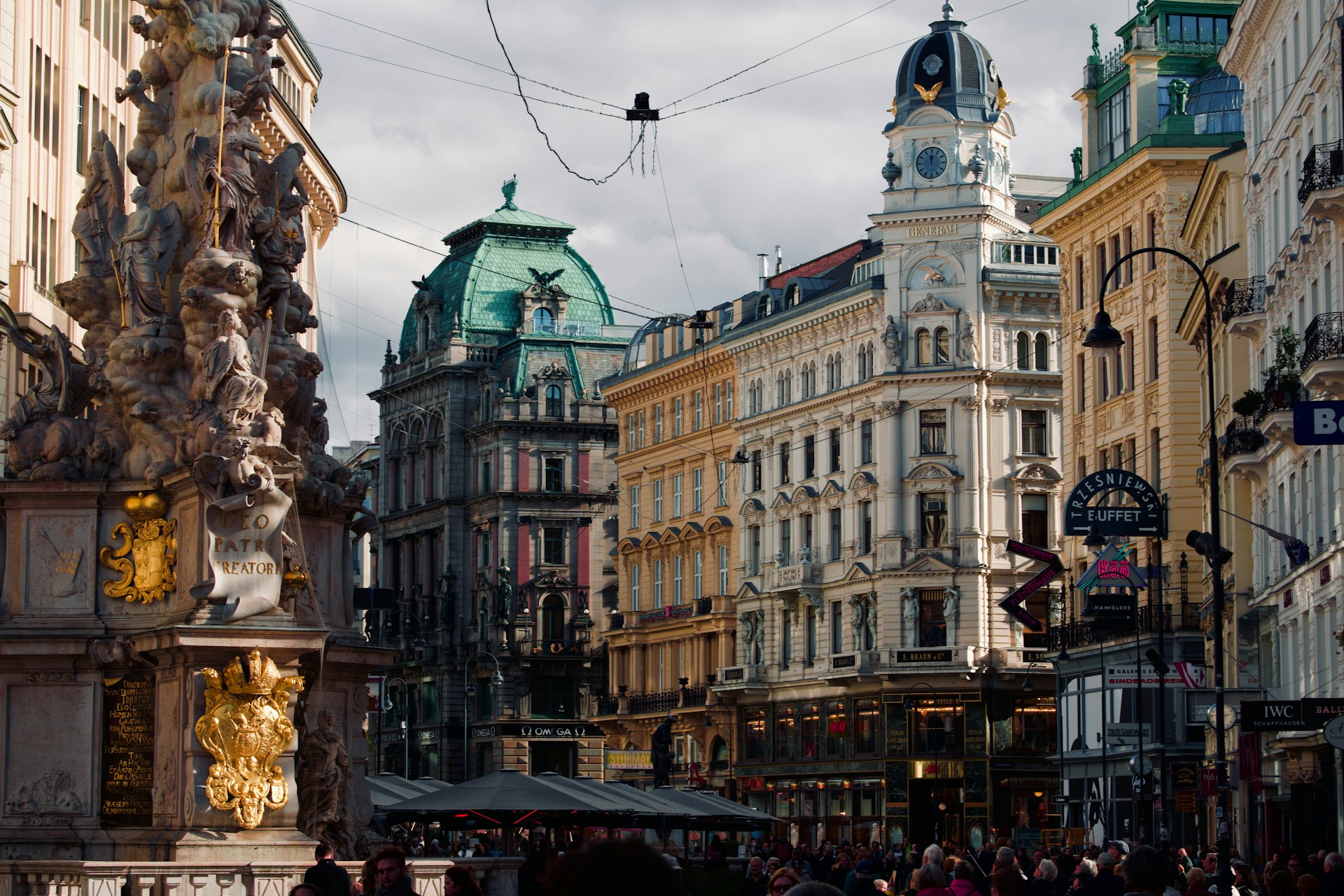
A capital still dressed for an empire that ended in 1918
Vienna was built to run a territory of some 50 million people across Central Europe, and it shows: the Ringstrasse boulevard circling the old town is lined with museums, the opera house and government buildings on a scale the modern Austrian capital, population under 2 million, doesn't strictly need but has never stopped maintaining. The result is a city that feels genuinely grand without the crowds of Paris or Rome, walkable in a way few former imperial capitals are, and unusually serious about a specific, slow ritual: sitting in a coffeehouse with one drink for as long as you like, a tradition UNESCO recognized as intangible cultural heritage in 2011.
What surprises most first-time visitors is how much of this imperial inheritance is simply open and affordable to walk through. St. Stephen's Cathedral costs nothing to enter, the Naschmarkt market has fed the city since the 16th century, and even the grandest coffeehouses charge the same €4-5 for a Melange whether you're Sigmund Freud's ghost or a first-time tourist working out the tram map. Vienna rewards a slow pace more than almost any European capital: rushing it defeats the point.
The honest complications
Vienna is not a budget city; it runs mid-range Western European prices, and the 1st district hotels near the cathedral charge accordingly. Schönbrunn Palace and the cathedral draw genuine crowds by midday in summer, walk-up queues of 45 to 90 minutes are common in July and August without a pre-booked timed ticket. Sunday closing hits visitors who don't plan around it: most shops and supermarkets shut, though museums, restaurants and the palaces stay open. And Vienna's formal social register, correct titles, punctuality, a reserved public manner, reads as coldness to some visitors before it reads as anything else; it usually isn't, but it takes a beat to recalibrate to.
A compact capital, four districts that matter
Vienna's most useful sights sit within the Ringstrasse or a short tram ride beyond it, and the choice of base comes down to how much you want to pay for proximity to St. Stephen's Cathedral versus a livelier, more local feel a few minutes further out.
Innere Stadt (1st district)
The old town inside the Ringstrasse holds St. Stephen's Cathedral, the Hofburg, the State Opera and the highest concentration of sights in the city, all within a twenty-minute walk of each other. It's the obvious first-timer's base and the most expensive district for both hotels and restaurants; staying here trades budget for not needing public transport for most of a trip.
Naschmarkt & Neubau/Mariahilf (6th/7th districts)
The streets around the Naschmarkt market and the Neubau district just north of it are Vienna's cafe-and-boutique quarter: independent galleries, secondhand shops and some of the best casual eating in the city, still a short walk or one U-Bahn stop from the Innere Stadt. This is the balance-of-price-and-atmosphere pick most repeat visitors land on.
Leopoldstadt (2nd district)
Just across the Danube Canal from the centre, Leopoldstadt runs 40 to 50% cheaper on hotels while sitting one U-Bahn stop from the Innere Stadt. It's home to the Prater amusement park and its surrounding green space, twice the size of New York's Central Park, making it a natural pick for families or budget-conscious travellers unwilling to sacrifice much convenience.
Landstraße (3rd district)
Home to the Belvedere Palace and its Klimt collection, Landstraße is quieter and more residential than the centre, popular with longer-stay visitors and diplomatic families. A short tram ride from the Innere Stadt, with fewer tourist-facing restaurants and more genuine neighbourhood ones.
From the Habsburgs' own hotel to a hostel bed on the Naschmarkt
Vienna's hotel scene spans genuine imperial-era institutions to modern hostels, with prices sitting solidly mid-range for a Western European capital across every bracket.
At the top, Hotel Sacher Wien, open since 1876 directly opposite the State Opera on Kärntner Straße, is Vienna's most storied address, furnished with antiques and the original home of the Sachertorte, from around €480 a night. In the Innere Stadt's boutique bracket, Hotel Topazz & Lamée, a few steps from Stephansplatz, and Steigenberger Hotel Herrenhof, in a converted 19th-century textile hall near the university, both run roughly €150-250 with design-forward rooms and central locations.
In Neubau, the city's cafe-and-gallery district, Vienna Boutique Hostel pairs dorm beds from around €55-65 with private rooms from €115-130 a short walk from the historic centre. At the budget end right on the market itself, Wombat's City Hostel Vienna Naschmarkt occupies an Art Nouveau building beside the market, with dorm beds from around €45 and a lively bar downstairs.
Schnitzel the size of a plate, coffee that comes with no pressure to leave
Vienna eats at every level from market stall to three-Michelin-star, and the coffeehouse and Heuriger wine-tavern traditions are as central to the city's food culture as any single dish on a menu.
Wiener Schnitzel
Figlmüller, on Bäckerstraße near Stephansplatz and serving its famous oversized schnitzel since 1905, is the city's benchmark: a veal or pork cutlet that spills over the edge of the plate, best shared or eaten with real hunger. Reservations are worth making for dinner.
Coffeehouse culture
Café Central on Herrengasse, once the meeting point for Freud, Trotsky and a roster of early-20th-century intellectuals, remains the grandest of Vienna's historic coffeehouses, marble columns and all. For the Sachertorte itself, Café Sacher beside the Opera and Café Demel on Kohlmarkt have spent over a century disputing which serves the true "original" recipe; both are excellent, Demel is usually the calmer of the two.
The Naschmarkt
Vienna's largest market, running along the Wienzeile since the 16th century, mixes produce stalls with bistros covering everything from schnitzel to Middle Eastern mezze. Vollpension, an "intergenerational" café near the market where grandmothers bake from family recipes, is a genuinely different kind of stop for apple strudel and coffee. A flea market takes over the western end every Saturday.
Heuriger wine taverns
Mayer am Nussberg and Sirbu am Nussberg, both on the vineyard slopes above the city, pair the self-serve cold-buffet Heuriger tradition, marked by a bundle of pine branches over the door, with views back over Vienna. A taxi or the 38A bus from Heiligenstadt U-Bahn station gets you there for the current vintage of Grüner Veltliner and an unhurried evening.
Fine dining
Steirereck im Stadtpark, holding three Michelin stars under chef Heinz Reitbauer, is Austria's most celebrated restaurant and one of the only two three-star tables in the country alongside Amador; a tasting menu here is a genuine occasion rather than a quick meal, book weeks ahead.
Two palaces, a cathedral, a market and a Ferris wheel
Vienna's major sights are dense enough to cover in two focused days, with the two imperial palaces doing most of the heavy lifting for anyone new to the city.
St. Stephen's Cathedral & the Hofburg
St. Stephen's Cathedral (Stephansdom), its tiled roof visible across the old town, anchors the Innere Stadt and costs nothing to enter, though the catacombs and south tower climb are ticketed extras. A ten-minute walk away, the Hofburg, the Habsburgs' winter residence for six centuries, houses the Sisi Museum and Imperial Apartments (individual entry €17.50) alongside the Imperial Treasury; the combined Sisi Ticket at €43, covering the Hofburg, Schönbrunn Palace and the Imperial Furniture Collection, saves €12-15 over buying separately if you're doing both palaces.
Schönbrunn Palace
The Habsburgs' summer residence, a short U-Bahn ride from the centre, is Vienna's most visited single site: the Grand Tour of the state rooms costs €28, and the surrounding gardens, maze and the world's oldest continuously operating zoo make it easy to spend half a day. Book timed entry online in July and August, when walk-up queues run 45 to 90 minutes at midday.
Belvedere Palace
The Upper Belvedere holds Gustav Klimt's "The Kiss," the single most-reproduced piece of Austrian art, alongside a wider collection of Austrian painting from the Baroque era to the Vienna Secession, entry from around €27. The Baroque gardens between the Upper and Lower Belvedere are free to walk and offer one of the best skyline views over the Innere Stadt.
Naschmarkt & the Prater
The Naschmarkt (see Food, above) rewards a slow morning browse, and Leopoldstadt's Prater amusement park, with its 1897 Riesenrad Ferris wheel still turning over the city skyline, is worth an afternoon whether or not you ride anything: the surrounding green space is where Viennese families actually spend a Sunday, not the museums.
One, two or three days, planned street by street
Two full days cover Vienna's essentials properly; even one focused day hits the highlights. A third day is best spent on the Wachau Valley, and worth adding if your schedule allows it.
- Morning
St. Stephen's Cathedral and the Hofburg. The cathedral, then the Sisi Museum and Imperial Apartments.
- Midday
Naschmarkt. Lunch among the market stalls, then a coffeehouse stop at Café Central on the walk back.
- Afternoon
Schönbrunn Palace. The Grand Tour and the gardens, booked ahead if visiting in summer.
- Evening
Figlmüller for schnitzel, or a Heuriger evening at Sirbu am Nussberg if you'd rather trade the restaurant for the vineyard view.
- Day 1
The one-day route: Stephansdom, the Hofburg, the Naschmarkt, Schönbrunn, dinner at Figlmüller.
- Day 2 morning
Belvedere Palace. Klimt's "The Kiss" and the Baroque gardens.
- Day 2 afternoon
Prater & Leopoldstadt. The Riesenrad and the park, a change of pace from museums and palaces.
- Day 2 evening
Café Sacher or Demel for the original Sachertorte debate, then a nightcap in the Naschmarkt-adjacent bars of Neubau.
- Days 1-2
The two-day route above, at a gentler pace.
- Day 3
Wachau Valley. A train up the Danube to Melk Abbey, a boat to Dürnstein, and a train back from Krems, back in Vienna by evening.
A compact centre, an efficient train and metro network
Vienna International Airport (VIE) sits about 18km southeast of the centre. The City Airport Train (CAT) runs nonstop to Wien Mitte in 16 minutes for €14.90 one way; the ÖBB S7 suburban train covers the same route in about 23 minutes for €5.40 and is the better value for most visitors. A taxi runs roughly €35-45.
The Innere Stadt itself is entirely walkable, and the five-line U-Bahn network covers everything beyond it efficiently: a single ticket costs €3.20, a 24-hour ticket €10.20, and a 7-day ticket €28.90 (note that 48- and 72-hour passes were discontinued as of January 2026). The U-Bahn runs 24 hours on Friday and Saturday nights, with night buses covering the rest of the week. Trams are the scenic way to trace the Ringstrasse itself.
Is the Vienna Pass worth it, and when to visit
The Vienna Pass, covering 70-plus attractions, costs €84 for one day up to €164 for six days. It pays off if you're planning to hit four or more paid sights in a day; for a lighter pace, individual tickets or the €43 Sisi Ticket (Hofburg plus Schönbrunn) usually work out cheaper.
Vienna works as a city break year-round since it doesn't depend on beach or hiking weather. May, June and September are the most comfortable months; December adds the Christmas markets, genuinely worth the cold; January and February are the cheapest and quietest months for both flights and hotels.
Moderate by Western European capital standards
Vienna costs noticeably less than Zurich, Geneva or Paris while delivering a comparable density of sights. The main cost trap is the same as any capital: eating at the handful of tourist-facing restaurants directly on Stephansplatz instead of walking a few minutes into Neubau or the Naschmarkt.
- Hostel dorm bed €45-65
- Bakery & Naschmarkt meals €6-12
- 24-hour transport ticket €10.20
- Free sights: Stephansdom, Belvedere gardens
- Boutique or 3-star hotel €150-250
- Restaurant dinners €18-30/person
- Palace & museum entries
- Occasional taxi or CAT train
- Hotel Sacher or equivalent €400-500+
- Tasting menu at Steirereck
- Vienna Pass & private guides
- CAT train over the S-Bahn
Safe by any capital-city standard, pickpockets aside
Vienna is safe for tourists. Violent crime against visitors is rare, the central districts are fine to walk at night with normal urban awareness, and Austria overall carries a Level 1 "Exercise Normal Precautions" rating from the US State Department, its lowest risk category. The practical risk that actually affects visitors is pickpocketing, not violent crime.
Three things actually catch visitors: pickpocketing, concentrated around Stephansplatz, the Naschmarkt's crowded stalls, and the U3 subway line, often worked by pairs exploiting a crowd; petition and distraction scams near transport hubs and the Danube Canal, where a clipboard petition or a staged spill on your clothing sets up a second person to work your bag; and overpriced restaurants right on the main tourist squares, avoidable by walking a few minutes into a side street. Vienna rates well for solo female travellers: well-lit streets, weekend 24-hour U-Bahn service, and low rates of street harassment in the central districts.
Emergency numbers match the rest of Austria: 112 general emergency (English-speaking), 133 police, 144 ambulance, 122 fire.
The Wachau Valley, and Bratislava if you want a second country
Vienna's position on the Danube and near the Slovak border makes it a strong base for two very different day trips: a slow river valley of abbeys and vineyards, or an hour's train ride into an entirely different capital.
Wachau Valley & Melk Abbey
Direct trains run from Wien Westbahnhof to Melk in about an hour, where the restored Baroque Melk Abbey sits dramatically above the Danube; its library and marble hall are the highlights of the tour. From Melk, a DDSG Blue Danube boat down the river to Dürnstein, the fortified wine town where Richard the Lionheart was once imprisoned, takes under two hours and passes the terraced vineyards the Wachau is known for. A train back to Vienna runs from Krems, a short bus or bike ride past Dürnstein, making a full loop possible in a single day.
Bratislava, Slovakia
Slovakia's capital sits under an hour from Vienna by direct train, both countries full Schengen members so there's no border check to slow you down. Bratislava's compact old town, its hilltop castle, and notably lower prices than Vienna make it a genuinely worthwhile half-day add-on rather than a token detour.
Vienna FAQ
Is Vienna safe for tourists?
Yes. Violent crime against visitors is rare and Vienna is fine to walk at night in the central districts with normal urban awareness. Pickpocketing around Stephansplatz, the Naschmarkt and the U3 subway line is the main practical risk, not violent crime.
How many days do I need in Vienna?
Two full days covers the essentials: one for the Innere Stadt and the Hofburg, one for Schönbrunn or the Belvedere plus a coffeehouse and Heuriger evening. A third day fits the Wachau Valley day trip well.
How much does Vienna cost per day?
Budget travellers manage on €70-110 a day with hostel beds and market or bakery meals; mid-range runs €150-220. Vienna is moderate by Western European capital standards, cheaper than Zurich or Paris.
When is the best time to visit Vienna?
May, June and September: warm without peak crowds. December is excellent for the Christmas markets despite the cold. Vienna works year-round as a city break since it doesn't depend on beach or hiking weather.
What is the Naschmarkt?
Vienna's largest and liveliest food market, running along the Wienzeile since the 16th century, with produce stalls, bistros covering everything from Wiener Schnitzel to Middle Eastern mezze, and a Saturday flea market at its western end.
Is the Vienna Pass worth it?
Only if you're museum- and palace-heavy: the 1-day pass costs €84 versus roughly €70-90 for Schönbrunn, the Hofburg and Belvedere bought separately. For a lighter sightseeing pace, individual tickets or the combined Sisi Ticket usually work out cheaper.
How do I get from Vienna Airport to the city centre?
The City Airport Train (CAT) runs nonstop to Wien Mitte in 16 minutes for €14.90 one way. The ÖBB S7 suburban train covers the same route in about 23 minutes for €5.40 and is the better-value option for most visitors.
What is the best area to stay in Vienna?
The Innere Stadt (1st district) for first-timers who want everything within walking distance, or the Naschmarkt-adjacent Mariahilf and Neubau districts for a better balance of price, atmosphere and still-easy access to the centre.
Can I do a day trip to the Wachau Valley from Vienna?
Yes, easily. Direct trains run from Wien Westbahnhof to Melk in about an hour; combine Melk Abbey with a Danube boat to Dürnstein and a train back from Krems for a full day covering the valley's main sights.
Do I need to book Schönbrunn and Hofburg tickets in advance?
Strongly recommended in summer. Walk-up queues at Schönbrunn can run 45-90 minutes at midday in July and August; timed-entry tickets bought online in advance skip straight to security.
What Stays With You
Vienna doesn't have Rome's chaos or Paris's romance, and it isn't trying for either. What it has is a city built at imperial scale that decided, sometime after the empire actually ended, to keep the palaces open, keep the coffee cheap, and let anyone sit in a marble-columned room built for the Habsburg court for as long as they want on the price of a single Melange. The schnitzel that spills off the plate at Figlmüller, the vineyard view from a Heuriger bench on the Nussberg, the century-old argument over whose Sachertorte is the real one: none of it is trying to impress you, and somehow that's exactly why it does.
Sit in a coffeehouse on your last afternoon with a newspaper you can't quite read and let the waiter leave you alone. That, more than any single palace, is what Vienna is actually offering.