
What You're Actually Getting Into
Denmark is a country that makes a certain kind of traveler feel immediately at home and another kind feel faintly guilty. Everything works. The trains run. The bike lanes are wider than some European roads. The cafes are warm and candlelit regardless of the weather outside, which is frequently grim. People queue without being told to. Nobody honks. The streets are clean not because of enforcement but because it would genuinely embarrass a Dane to leave litter behind.
Copenhagen is the obvious anchor and it earns every superlative it receives. It's also genuinely expensive in ways that can derail a trip if you don't plan around it. A beer at a Vesterbro bar runs 70-90 DKK. A sit-down dinner for two at a mid-range restaurant is 600-900 DKK before wine. The New Nordic restaurant scene that Noma made famous trickles down in real and affordable ways, but you need to know where to look. The mistake most visitors make is staying entirely in Copenhagen: Bornholm, three hours by ferry into the Baltic, has beaches and smoked herring shacks with almost no tourists from outside Scandinavia, and Jutland's North Sea coast is windswept and beautiful in exactly the way postcards don't capture.
The honest complications
Copenhagen is consistently ranked among the ten most expensive cities in Europe, and this genuinely shapes a trip if you don't plan around it: supermarket lunches, cooking with market produce, and cycling instead of taxis are not optional frugality tips here, they're how a normal-length trip stays affordable. The weather is also a real factor: wind off the North Sea and the Baltic is consistent even in summer and cuts through a regular jacket, and winter darkness descends around 3:30pm. None of this diminishes the trip, but arriving with a windproof layer and a realistic budget makes it considerably smoother.
A History Worth Knowing
The history of Denmark does not begin quietly. It begins with longships. From roughly 793 CE, when a Viking raid on the monastery at Lindisfarne in northeast England announced Scandinavia's arrival on the European stage, the Norse peoples from what is now Denmark spent three centuries as the most feared seafarers, traders and settlers in the known world. They reached North America around 1000 CE, five centuries before Columbus. They founded Dublin. They gave Normandy its name. The word "Viking" was not an ethnicity but an occupation: to go viking was to go raiding, and the Danes were very good at it.
- ~793 CE
Viking Age begins. Danish Vikings raid Lindisfarne; three centuries of seafaring, settlement and trade follow.
- ~1000
Leif Eriksson reaches America. Five centuries before Columbus, recorded matter-of-factly in the sagas.
- 1397
Kalmar Union. Denmark, Norway and Sweden unite under Danish rule, the empire's territorial peak.
- 1658
Treaty of Roskilde. Sweden takes the southern provinces; Denmark's territorial dominance ends.
- 1800s
Social reinvention. Grundtvig's folk high schools and cooperative farming; the Danish model of civil society begins.
- 1943
The October Rescue. Danish civilians ferry nearly 7,000 Jews to neutral Sweden in fishing boats, one of WWII's most remarkable acts.
- 2003
Noma opens. René Redzepi's restaurant rewrites global food culture; New Nordic cuisine becomes a movement.
Read the full history: the Kalmar Union, the folk high schools, and post-war Denmark
At its height in the 14th and 15th centuries, the Danish Crown controlled not just Jutland and the islands but also Norway, Iceland, Greenland and parts of modern Sweden. The Øresund strait between Copenhagen and Malmö was Danish on both sides, and Denmark collected tolls from every ship that passed through, making it one of the wealthiest states in Europe for two centuries. The 17th century was less kind: wars with Sweden cost Denmark its southern provinces and control of the strait, and by the 19th century the country had lost Norway to Sweden and Schleswig-Holstein to Prussia.
What emerged from that period of loss was unexpected: a reimagining of what Denmark could be. The philosopher N.F.S. Grundtvig founded the folk high school movement, a network of residential adult education schools built on the idea that an enlightened, engaged citizenry mattered more than military dominance. Danish cooperative farming transformed rural economics. The idea that Denmark could lead through social design rather than territorial conquest took root in this era and never really left. Post-war Denmark built what it's now famous for: one of the world's most comprehensive welfare states, a design culture that influenced every IKEA catalog and Apple product thereafter, an architecture tradition that produced Jørn Utzon (the Sydney Opera House) and Jan Gehl, and a food scene that, starting with Noma in 2003, forced the entire world to reconsider what Northern European cooking could mean.
Top Destinations
Denmark is small, you can drive from the German border to Copenhagen in under four hours, but it rewards the traveler who moves off the obvious track. Copenhagen is mandatory and worth several days. Beyond it, the country breaks into three distinct zones: the islands (Zealand, Funen, Bornholm), the peninsula of Jutland, and the autonomous territories of Greenland and the Faroe Islands, which are politically Danish but geographically and culturally their own thing entirely.
Copenhagen
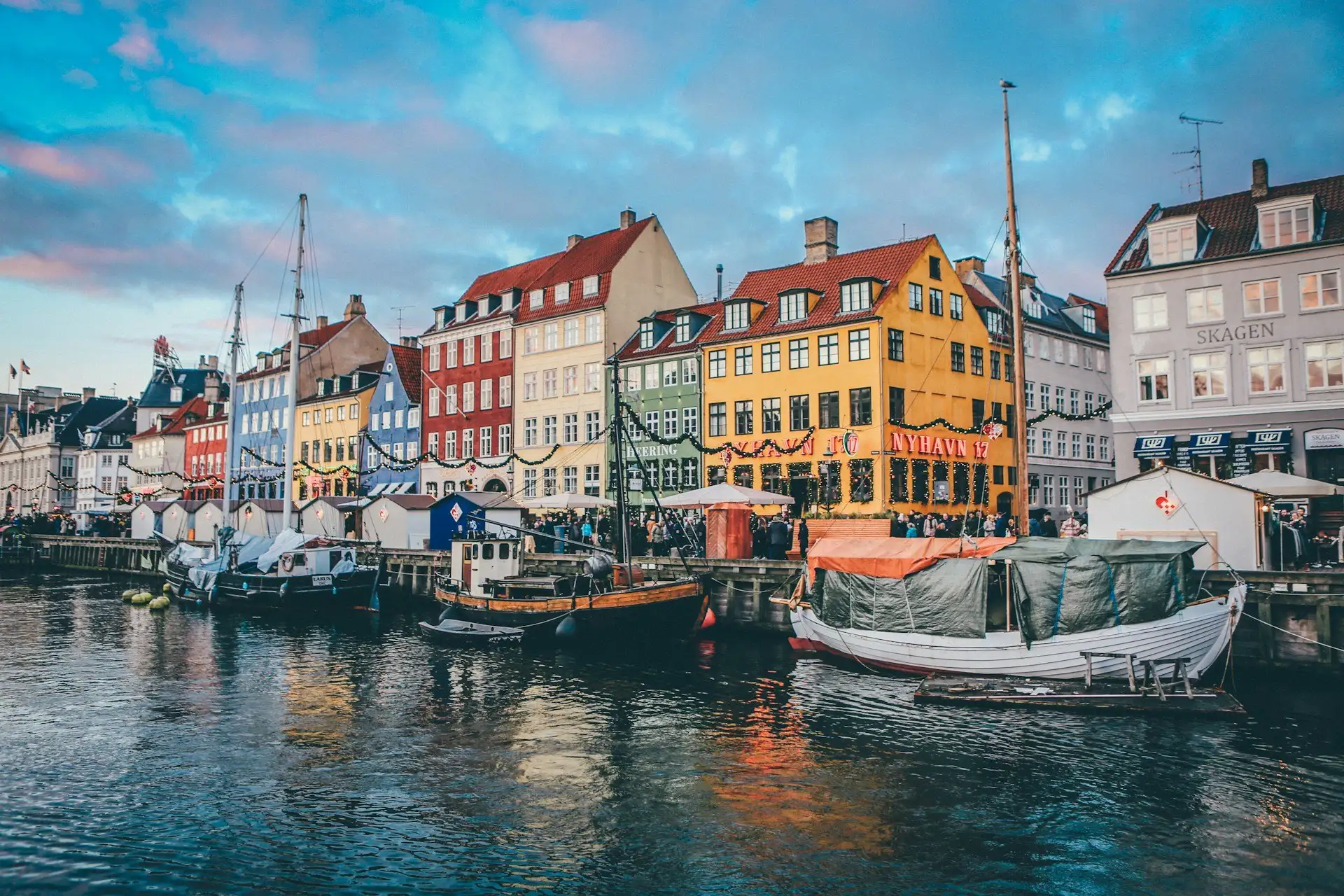
Copenhagen is a city that looks like it was designed by committee and somehow got it exactly right. Nyhavn's colored townhouses are on every postcard and still worth seeing in person. The Meatpacking District (Kødbyen) is where the city actually goes out at night, bars, restaurants and galleries in former slaughterhouses off Vesterbro. The National Museum is free and covers 14,000 years of Danish history across 10,000 objects without ever feeling exhausting. Tivoli Gardens, the 1843 amusement park in the city center, is the kind of place that should be a tourist trap and instead is genuinely magical at night. Rent a bike from Donkey Republic within 20 minutes of landing; everything changes.
Bornholm
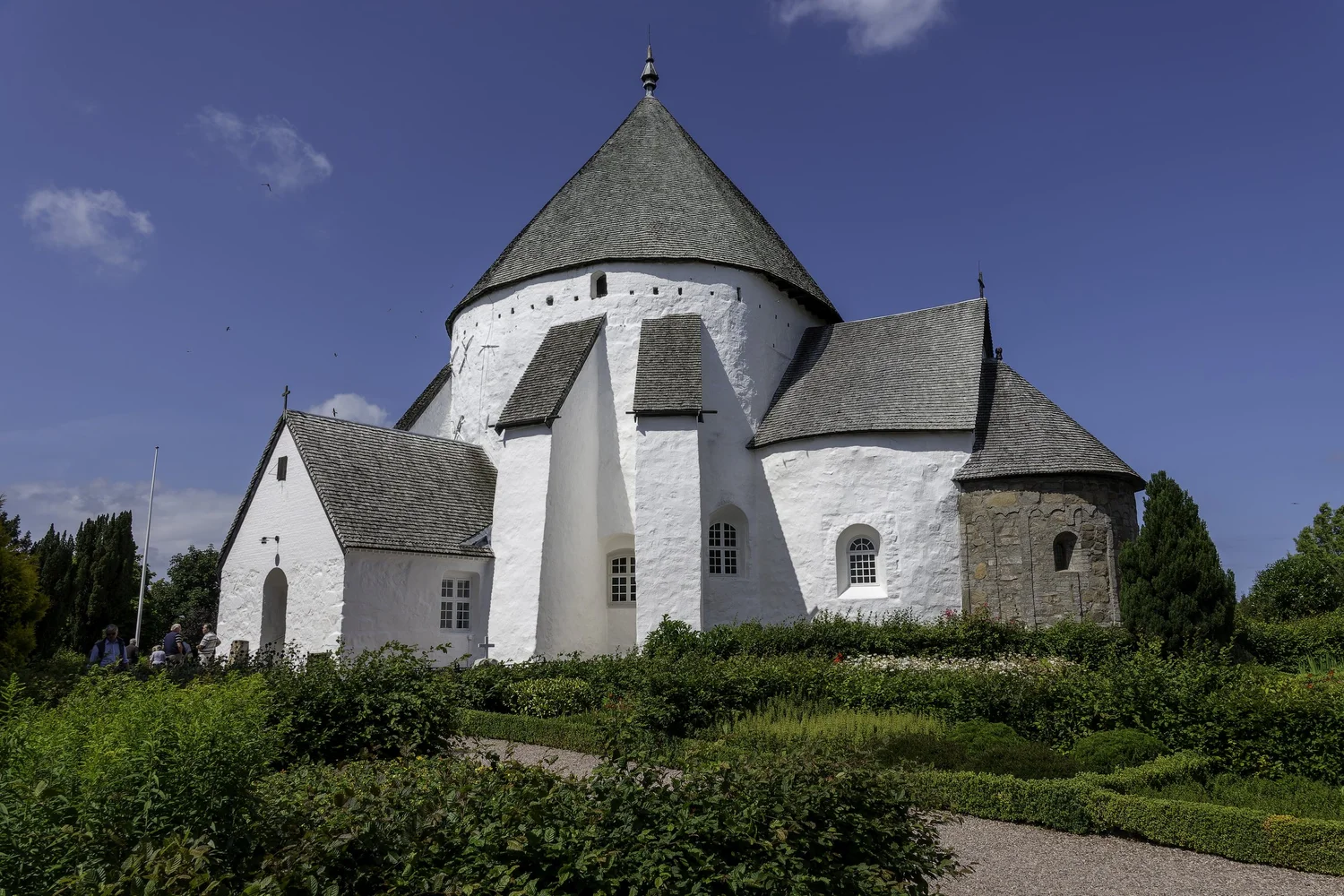
Bornholm sits alone in the Baltic Sea, equidistant from Denmark, Sweden and Poland, three hours by overnight ferry from Copenhagen or 25 minutes by plane. It has the highest sunshine hours in Denmark, excellent beaches, a colony of round Viking-era churches found nowhere else in the world, and a tradition of smoking herring over alder wood the island has practiced continuously since the Middle Ages. Visit in August when the smokehouses run at full capacity and you can eat directly from the smokehouse door at Gudhjem for 50 DKK.
North Zealand & Roskilde
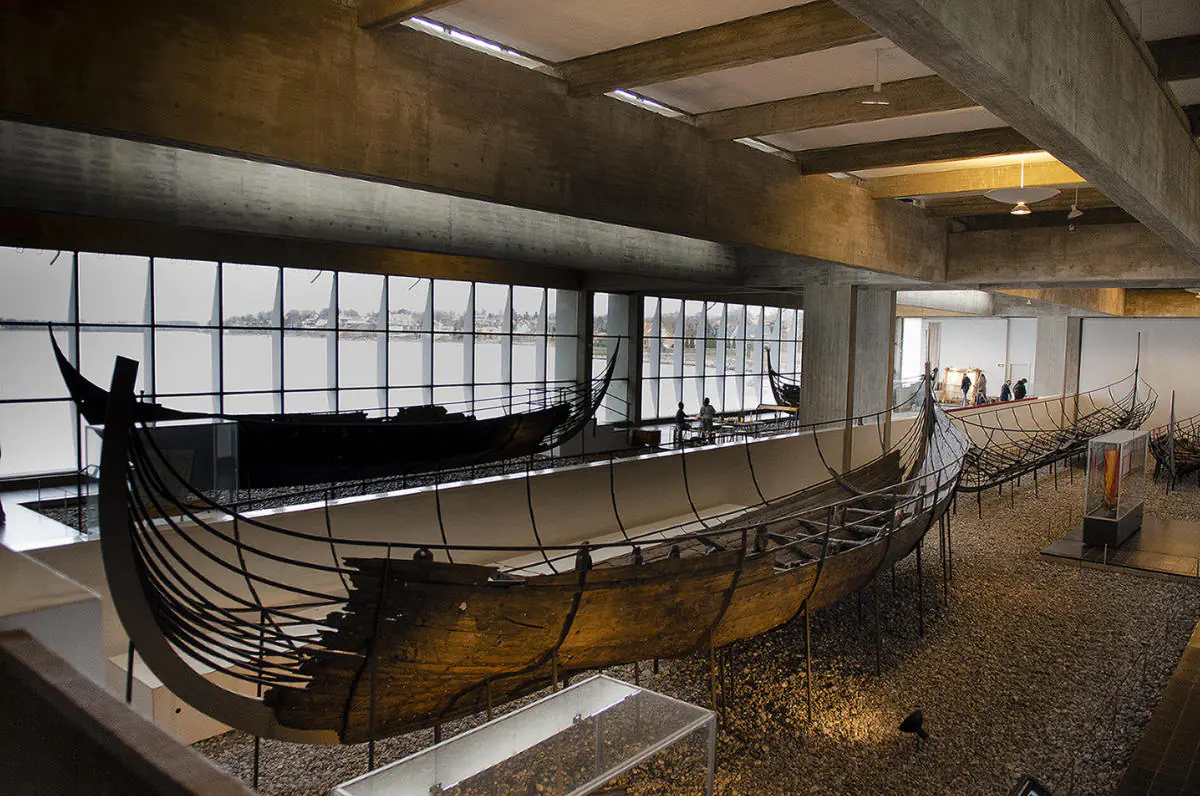
The coast north of Copenhagen along the Øresund is called the Danish Riviera without irony. Kronborg Castle at Helsingør, Shakespeare's Elsinore, is 45 minutes by train. The Louisiana Museum of Modern Art at Humlebæk may be the most beautifully situated art museum in Europe, modern sculpture in gardens above the strait with Sweden visible across the water. Roskilde, 30 minutes by train, holds the Viking Ship Museum's five original vessels and a cathedral containing the tombs of 39 Danish kings and queens.
Aarhus
Aarhus is where Danes who think Copenhagen has gotten too expensive and self-important go to live well. Denmark's second city in population and arguably first in energy per square meter. The ARoS art museum, topped by Olafur Eliasson's rainbow panorama walkway, is worth the trip alone. The Latin Quarter has the best concentration of independent cafes and wine bars, and the street food market in the old docklands runs May through October.
Ribe & the Wadden Sea
Denmark's oldest town, founded around 700 CE, in southwest Jutland. The cathedral has stood since the 12th century, the streets follow their original medieval layout, and Ribe's roughly 8,000 inhabitants feel completely outside time. Pair it with a day on the nearby Wadden Sea mudflats, a UNESCO World Heritage site you can walk across at low tide.
Faroe Islands
Technically part of the Danish Realm but self-governing, and different enough from mainland Denmark to deserve separate planning entirely. Eighteen volcanic islands in the North Atlantic, 300km north of Scotland. Waterfalls drop directly into the sea. The village of Gásadalur was accessible until 2004 only by foot over a mountain pass. Puffin colonies and sheep outnumber people two to one. Fly direct from Copenhagen on Atlantic Airways, two to three hours of flight for a landscape that looks like nowhere else on earth.
Culture & Etiquette
Danes are not unfriendly. They are, however, reserved in a way that sometimes reads as cold to visitors from more outwardly expressive cultures. The person sitting next to you on the S-tog will not start a conversation. Once you understand that Danish social warmth is real but runs on a different voltage, you'll find it genuinely pleasant. There's a concept called Janteloven, a Scandinavian cultural principle that translates roughly as "don't think you're better than anyone else," and it explains a lot: why Danes don't brag, why expensive clothes are worn without visible branding, why the prime minister cycles to work.
Do
- Respect cycle lanes absolutely. Stepping into one without looking is the single fastest way to cause a Dane genuine distress. The lanes are infrastructure, not decoration.
- Be punctual. Danish social culture treats lateness as a form of disrespect. If invited somewhere at 19:00, 19:05 is acceptable; 19:20 requires an explanation.
- Split bills without drama. Splitting a restaurant bill equally among a group is entirely standard; going Dutch is the default, not a negotiation.
- Remove shoes at the door. In Danish homes, shoes come off at the entrance; follow the row you'll see at the door.
- Greet shopkeepers. A "hej" when entering a small shop is expected, not elaborate, just acknowledged.
Don't
- Ignore the bike lanes. Cyclists ring their bell and it is not a friendly sound, it's a warning.
- Ask invasive personal questions early on. What do you earn, are you married, why don't you have children, these aren't topics for a first or second conversation with a Dane.
- Assume card payment everywhere. Denmark is nearly cashless, but some outdoor markets and older establishments still prefer cash.
- Complain about the weather loudly. Danes have adapted to their climate through hygge rather than complaints; complaining about the rain reads like complaining about mountain height to a Swiss person.
- Tip extravagantly. Tipping isn't standard, and 10% is the outer limit of what anyone expects; service staff are paid a living wage.
Deeper culture: hygge, design as a value, and sustainability
Hygge in practice. Hygge isn't something you perform or book. It's what happens when a group of people slow down together: candles lit on a weekday evening, a pot of coffee, no agenda. Danes light more candles per capita than any other nation, the average Danish household burns 6kg of wax a year.
Design is a value. Danish design isn't a style, it's a philosophy that an object should work perfectly and look as though it couldn't be any other shape. Arne Jacobsen's Series 7 chair, Bjarke Ingels' 8 House, the original Bang & Olufsen speakers. The Designmuseum in Copenhagen has the best survey of what this means, 145 DKK to enter.
Sustainability isn't optional. Denmark aims to be carbon neutral by 2045 and treats this as a project management problem rather than an aspiration. Recycling infrastructure is thorough and color-coded, and buying secondhand, cycling and eating less meat are mainstream behaviors, not lifestyle statements.
Food & Drink
Twenty years ago, Scandinavian food had a global reputation roughly equivalent to its climate: functional, honest, not particularly exciting. Then Noma happened. René Redzepi's restaurant, open from 2003 and named best restaurant in the world four times, convinced the entire world that foraged sea buckthorn, fermented mushrooms and Nordic dairy deserved the same serious attention as French sauces and Italian pasta. It closed its permanent location in 2024, but its influence is everywhere, from 300-DKK lunch spots to what 7-Eleven sells as a grab-and-go sandwich.
Smørrebrød 110-160 DKK
The open sandwich is Denmark's national dish in everything but official declaration: rye bread, good butter, and something on top, pickled herring with dill cream, roast beef with crispy onions, egg with mayo and shrimp. Kanal Caféen in Copenhagen has been doing it since 1852.
Wienerbrød
What the rest of the world calls a Danish pastry, Danes call wienerbrød because the technique was imported from Austrian bakers in the 1850s and then substantially improved. Hart Bageri and Juno the Bakery are the best in Copenhagen; get there before 10am or the cardamom rolls are gone.
Craft Beer 70-100 DKK
Mikkeller, To Øl and Warpigs (a Mikkeller/3 Floyds collaboration) anchor a genuine craft beer scene. Drinking outdoors in parks and on canal edges is entirely legal and normal; a Christianshavn canal evening with a 7-Eleven beer (35 DKK) is one of the great free activities in any European capital.
Herring & Seafood
Pickled herring in a dozen preparations is the foundation of the traditional Danish table. On Bornholm, watch it smoked over alder wood at Røgeriet and eat it standing outside; order the marinerede sild and røgede sild side by side.
New Nordic, Accessible 150-250 DKK
Without a Noma or Geranium reservation, Kadeau sources exclusively from Danish suppliers and Bornholm ingredients, and the current generation of natural wine bars and bistros in Vesterbro and Nørrebro do small-plates New Nordic without the theater.
Coffee Culture 40-55 DKK
Copenhagen takes coffee seriously in the Scandinavian tradition: light roasts, filter methods, minimal milk. The Coffee Collective on Jægersborggade roasts some of the best coffee in Europe across five locations.
When to Go & Itineraries
The honest answer is summer, and most people know this already. June and July give you up to 17 hours of daylight in Copenhagen and a city that visibly exhales after a long winter, though accommodation prices peak in July. May and early September give you most of the benefits with fewer people and lower prices. Winter is the sleeper pick: December in Copenhagen is genuinely magical, Christmas markets at Tivoli and on Strøget, candles in every window, hygge at full operational capacity.
All four seasons compared, with temperatures
| Season | Verdict | Temps | Prices & crowds |
|---|---|---|---|
| Jun-Aug | Best | 17-22°C | Peak prices, busy; Roskilde Festival in July, Aarhus Festuge in August |
| May | Best | 10-17°C | Mid prices, moderate crowds; cherry blossoms, tulips in north Jutland |
| Dec-Feb | Good, atmospheric | 0-5°C | Lower prices, quiet; Tivoli Christmas markets, hygge at full force |
| Oct-Nov | Think twice | 5-12°C | Low prices, quiet; the least distinctive time of year, grey and wet |
Copenhagen averages. The Faroe Islands are consistently cooler and wetter year-round; Bornholm is noticeably sunnier than the rest of Denmark.
Itineraries
Four to five days in Copenhagen plus two to three days elsewhere is the standard first visit. Bornholm requires a ferry booking in advance, especially in summer; the Faroe Islands require a separate flight booking and a completely different packing list.
- Days 1-4
Copenhagen. Bike the harbor loop, Nyhavn and Christianshavn, Designmuseum and Torvehallerne, Nørrebro in the afternoon, Louisiana Museum day trip, Tivoli Gardens in the evening.
- Day 5
Roskilde day trip. Viking Ship Museum in the morning, cathedral in the afternoon, back to Copenhagen for dinner.
- Days 6-7
North Zealand. Kronborg Castle at Helsingør, a short ferry to Helsingborg in Sweden for lunch, slow morning in Copenhagen before departure.
- Days 1-5
Copenhagen deep dive. Frederiksberg, National Museum, a smørrebrød restaurant evening, a natural wine bar evening, one evening cooking with Torvehallerne produce.
- Days 6-7
Roskilde + North Zealand. Viking ships, Kronborg, Louisiana Museum, no need to move accommodation.
- Days 8-10
Aarhus. ARoS museum, Aarhus Street Food docks on a summer evening, Den Gamle By open-air museum, a day trip to the Mols Bjerge hills.
- Days 11-14
Bornholm. Overnight ferry or fly from Aarhus. Bike the coastal path, eat smoked herring at Gudhjem, swim at Dueodde, visit the round church at Østerlars.
- Days 1-6
Copenhagen + islands. Slow Copenhagen exploration plus Roskilde and North Zealand day trips, one overnight in Helsingør to catch the castle at dawn.
- Days 7-10
Bornholm. Fly or ferry, bike the island over three days, the slowest and most Scandinavian stretch of the trip.
- Days 11-14
Aarhus + Jutland. Two days in the city, then drive south: Ribe for a night, the Wadden Sea mudflats, the North Sea coast at Blåvand.
- Days 15-21
Faroe Islands. Fly from Billund or Copenhagen to Vágar. Two days in Tórshavn, a drive around Streymoy and Eysturoy, puffins if visiting May through August.
Getting there & around
Getting around Copenhagen is genuinely a pleasure. The Metro runs 24 hours, the S-tog regional rail connects the suburbs, and the bike lane network is so comprehensive that cycling is often faster than any vehicle alternative. Beyond Copenhagen, the DSB intercity train network connects most of Denmark within 3-4 hours; car rental is the best option for rural Jutland and anywhere off a direct rail line.
All transport options with prices: Metro, trains, ferries, car rental
| Option | Price | Notes |
|---|---|---|
| Copenhagen Metro | 24 DKK/trip | Runs 24/7, four lines, the M2 goes direct to the airport in 15 minutes. |
| Intercity trains (DSB) | 200-400 DKK | Copenhagen-Aarhus: 3 hrs. Copenhagen-Odense: 1.5 hrs. Book ahead for weekend travel. |
| Ferries | 200-800 DKK | Bornholm ferry: 5.5 hrs overnight or 1hr20 fast ferry. Book ahead in summer when car ferries sell out. |
| Car rental | 400-800 DKK/day | Essential for rural Jutland and the Wadden Sea coast. Drives on the right; speed cameras are frequent and strict. |
Copenhagen City Pass: the 72-hour pass costs 389 DKK and covers Metro, bus and S-tog plus entry to most major museums. Worth it for four or more museums and multiple daily transport uses; for a cycling-and-walking trip, a daily Metro pass at 130 DKK may cover what you actually need. GetTransfer offers fixed-price pickups from Copenhagen Airport.
Where to stay
Design hotels
Hotel SP34 in the Latin Quarter, the Nimb Hotel inside Tivoli, and 71 Nyhavn Hotel in a converted warehouse use their spaces imaginatively; not cheap, but the design is part of what you're paying for.
Boutique & guesthouses
Vesterbro and Nørrebro have the best concentration of independent guesthouses, Axel Guldsmeden near Kødbyen and smaller guesthouses along Istedgade, at a more manageable price than the Strøget center.
Hostels
Generator Copenhagen and Steel House are large and social; Danhostel Copenhagen City sits directly opposite Tivoli. Private rooms can approach hotel prices in summer.
Summerhouses
Coastal Jutland and Bornholm are full of traditional Danish sommerhus rentals through DanCenter or Novasol; a summerhouse with a wood burner and sea view for a week is the best value accommodation Denmark offers.
Budget Planning
Denmark is expensive and there's no polite way around it. Copenhagen is consistently ranked among the ten most expensive cities in Europe. The strategies that actually work: supermarket lunches (Netto, Lidl and Irma all sell excellent ready food), cooking in your accommodation with Torvehallerne produce, and cycling rather than using taxis. The city's many free or low-cost museums help significantly if you time your visits.
- Hostel dorm or budget guesthouse
- Supermarket lunches, one sit-down meal
- Bike rental instead of transport
- Free museums (National Museum among others)
- Boutique guesthouse or mid-range hotel
- Torvehallerne lunch, restaurant dinner
- City Pass for transport + major museums
- Day trips to Roskilde or North Zealand
- Design hotel in Copenhagen or Aarhus
- New Nordic tasting menu dinner
- Private experiences and guided tours
- Faroe Islands flights and accommodation
Quick reference prices: coffee, smørrebrød, transport
| Cappuccino | 45-55 DKK |
| Smørrebrød (one piece) | 85-160 DKK |
| Craft beer (bar) | 70-95 DKK |
| Beer from 7-Eleven | 25-40 DKK |
| Metro single fare | 24 DKK |
| Bike rental (day) | 120 DKK |
| Mid-range hotel, Copenhagen | 1,000-1,800 DKK/night |
| Bornholm overnight ferry | 320-600 DKK |
Prices reflect July 2026 research and drift over time. Treat them as a planning baseline, not a quote.
Visa & Entry
Denmark is a Schengen Area member, meaning its borders are integrated with most other EU countries for entry purposes. Citizens of the US, Canada, Australia, New Zealand, the UK and most other Western countries can enter visa-free for stays of up to 90 days within any 180-day period. EU and EEA citizens have unrestricted freedom of movement. One note: the EU's ETIAS pre-travel authorisation system was still being rolled out as of 2026 and implementation timelines have shifted repeatedly, so verify current requirements before booking.
✓ Valid passport
Valid for the duration of your stay; UK passport holders should check remaining validity against post-Brexit Schengen entry rules.
✓ 90-day Schengen rule
Your 90 days covers all Schengen countries combined, not 90 days per country; track your time carefully on multi-country trips.
⚠ ETIAS, check current status
The EU's pre-travel authorisation system for visa-exempt travelers was being phased in as of 2026. Verify whether it's required for your nationality before booking.
✓ Faroe Islands & Greenland
Not part of the Schengen Area despite being Danish territories; entry requirements may differ from mainland Denmark.
| Denmark | Sweden | |
|---|---|---|
| Daily budget | $80-100, Copenhagen among Europe's priciest cities | Comparable, Stockholm runs similarly expensive |
| Signature city | Copenhagen: flat, cycling-friendly, canal-lined | Stockholm: spread across 14 islands, more hills |
| Islands | Bornholm in the Baltic, round Viking churches | Gotland and the Stockholm archipelago |
| Autonomous territories | Faroe Islands and Greenland, outside Schengen | None comparable |
| Food scene | Noma's legacy runs deep at every price point | Strong New Nordic scene too, slightly less internationally dominant |
Safety, Solo Women & Family
Denmark is one of the safest countries in the world and Copenhagen is one of the safest capitals in Europe. Violent crime is rare and the things that do happen are rarely directed at tourists. The areas most tourists visit, Indre By, Vesterbro, Nørrebro, Frederiksberg, are among the most crime-free urban areas in Europe. The only genuine risk most visitors encounter is a bicycle-related incident: look both ways before crossing any marked lane.
Bicycle lanes
The single genuine safety risk for tourists. Cyclists move fast and have right of way. Never step into a cycle lane without looking, and never walk in one.
Faroe Islands weather
Genuinely unpredictable and changes fast. Sea cliffs without barriers are the main hazard; never approach cliff edges in strong wind, and wear waterproof layers outside urban areas.
Christiania
Freetown Christiania in Copenhagen's Christianshavn is a tourist attraction and generally safe during daytime. Photography isn't permitted on Pusher Street; follow that rule without discussion.
Solo women and healthcare
Solo women: Denmark ranks among the top five countries globally for solo female travel. The combination of genuine gender equality, reliable 24-hour public transport, and a social culture built on mutual respect makes solo travel extremely comfortable.
Healthcare: Denmark has world-class healthcare. EU/EEA/UK visitors with EHIC or GHIC receive emergency treatment; non-EU visitors should have comprehensive travel insurance. Danish emergency rooms are efficient but not free for uninsured visitors.
Emergency numbers
Embassies in Copenhagen
Most embassies are in the Frederiksstaden and Østerbro districts north of central Copenhagen.
- USA
- +45-33-41-71-00
- UK
- +45-35-44-52-00
- Australia
- +45-70-26-36-76
- Canada
- +45-33-48-32-00
- New Zealand
- +45-33-37-77-02
- Germany
- +45-35-45-99-00
- France
- +45-33-67-01-00
- Netherlands
- +45-33-70-72-00
Useful apps: the "1813 Copenhagen" health app connects you to medical advice in English. The Faroe Islands use +298 as their country code and have their own emergency services at 112.
Family travel & pets
Denmark is one of the best countries in the world for family travel, and this isn't an accident. Danish urban planning was built around children: cycle paths wide enough for cargo bikes carrying two kids, parks integrated into every neighborhood, museums designed with children as primary visitors. Tivoli Gardens (155 DKK adults, 105 DKK children) is best experienced after dark when 100,000 colored lights come on, and the Viking Ship Museum in Roskilde has children standing in silent awe in front of thousand-year-old ships.
Beaches with kids, cargo bikes, and bringing pets
Beaches: Bornholm's Dueodde is the best in Denmark, fine white sand and clean Baltic water. Amager Strandpark is a 4.6km beach 15 minutes by Metro from central Copenhagen, remarkable for a capital city. Jutland's North Sea coast has dramatically wide beaches with strong surf and summer lifeguards.
Pets: as an EU member, Denmark follows EU pet travel rules, dogs and cats entering from another EU country need a microchip, valid rabies vaccination and an EU Pet Passport. Dogs are permitted on S-tog and regional trains in off-peak hours with a reduced-fare ticket, in many public parks, and at a growing number of pet-friendly cafes. UK visitors need a GB Pet Health Certificate issued within 10 days of travel post-Brexit.
Denmark FAQ
Is Denmark expensive to visit?
Yes, Copenhagen is consistently ranked among the ten most expensive cities in Europe. Budget travelers manage on $80-100 a day using supermarket lunches, free museums and cycling instead of taxis; a casual restaurant dinner for two easily reaches 1,000-1,200 DKK.
Do I need a visa for Denmark?
Citizens of the US, UK, Canada, Australia, New Zealand and most Western countries can enter visa-free for up to 90 days within any 180-day period, since Denmark is a Schengen Area member. EU/EEA citizens have unrestricted entry.
How many days do you need in Denmark?
Four to five days in Copenhagen plus two to three days elsewhere is the standard first visit. A week covers Copenhagen and one region well; two weeks adds Aarhus, Bornholm and Jutland.
What is hygge?
A Danish concept describing the comfort of slowing down together, candles lit, no agenda, nobody checking their phone. It isn't something you can book as an experience; it's what happens when Danish social life runs at its normal pace.
Is Denmark safe to visit?
Yes, one of the safest countries in the world, and Copenhagen is one of Europe's safest capitals. The only genuine everyday risk for tourists is stepping into a bike lane without looking, cyclists move fast and have the right of way.
Are the Faroe Islands part of Denmark?
Yes, politically, along with Greenland, but both are self-governing autonomous territories, and neither is part of the Schengen Area despite being Danish. The Faroe Islands are reached by direct flight from Copenhagen in about two hours.
What is New Nordic cuisine?
A culinary movement launched by Noma in Copenhagen in 2003, built on foraged, local and fermented Nordic ingredients treated with the same seriousness as French or Italian cooking. Noma's permanent restaurant closed in 2024, but its influence runs through Copenhagen's food scene at every price point.
What is the best time to visit Denmark?
June to August for long daylight hours and outdoor life, or May and early September for the same benefits with fewer crowds and lower prices. December is a genuine sleeper pick for Christmas markets and hygge at full intensity.
Is Denmark good for families with kids?
Yes, exceptionally. Danish urban planning is built around children, cycle paths wide enough for cargo bikes, parks in every neighborhood, and museums designed for young visitors, making it one of the most relaxed family destinations in Europe.
Is Denmark cheaper than Sweden?
Roughly comparable, both rank among Europe's most expensive countries, though Denmark's Copenhagen tends to edge out Stockholm slightly on restaurant and hotel prices while offering a flatter, more cycling-friendly layout.
You'll Light More Candles When You Get Home
The strangest souvenir from a Denmark trip is behavioral. People come back and light candles on Tuesday evenings for no particular reason. They buy better rye bread. They start cycling to places they would previously have driven to. They slow dinner down. None of this is conscious. It's just what happens when you've spent time in a place that takes ordinary life seriously enough to do it beautifully.
There's a word in Danish, arbejdsglæde, that means the joy of work, the satisfaction found in doing your job well. It has no direct equivalent in most other languages because most other cultures don't assume this is something you should feel. Denmark built a society around the idea that you should. The candles are part of the same instinct: life is happening right now, in this room, and it deserves a decent light.