
What You're Actually Getting Into
Norway sells itself on landscape more than any country needs to: a coastline of roughly 100,000 kilometers once every fjord and island is counted, glaciers, the Arctic Circle crossing two-fifths of the mainland, and hiking that regularly ends somewhere a drone shot would call unbelievable. What the postcards leave out is that Norway built this trip on North Sea oil discovered in 1969, and quietly became one of the wealthiest countries on earth in the process, with a sovereign wealth fund now worth well over a trillion dollars. That wealth shows up everywhere as a traveler: in the punctual trains, the excellent tap water, and the prices, which are genuinely among the highest in Europe.
The trade-off is real but manageable. Restaurant meals and alcohol will shock a first-time visitor: a modest dinner with a couple of beers can run 500-700 NOK per person. Groceries, hiking, and the fjords themselves cost nothing extra once you're there, and the country's excellent hostel network and self-catering culture mean a genuinely tight budget is possible if you're willing to cook and hike rather than dine and drive everywhere.
The honest complications
Norway is not cheap at any budget level, and pretending otherwise sets travelers up for a bad surprise around day three. The weather is genuinely changeable in the mountains and fjords even in summer, and travelers who treat a t-shirt-and-shorts forecast as gospel on a Preikestolen or Trolltunga hike put themselves at real risk. Public transport is excellent between major towns but infrequent in rural fjord country, so a trip built entirely around trains and buses will move slower than one with a rental car. And the country is genuinely vast for its population: Bergen to Oslo is a seven-hour train through spectacular scenery, not a quick hop, and the far north (Lofoten, Tromso) is its own multi-day trip, not a detour.
A History Worth Knowing
Norway's story runs from Viking raiders and traders through four centuries under the Danish crown, a century in a union with Sweden, a peaceful 1905 independence, brutal German occupation in the Second World War, and then, within a single generation, a transformation from a modest fishing and shipping economy into one of the richest nations on earth once oil was found in the North Sea. The short version of how the country you're visiting got here.
- 793-1066
The Viking Age. Norwegian seafarers raid, trade and settle from Newfoundland to the Caspian Sea. Harald Fairhair unifies the coastal petty kingdoms around 872; Olav Tryggvason and Olav II drive the country's Christianization through the following century.
- 1397-1814
Union with Denmark. The Kalmar Union folds Norway into a joint Scandinavian crown; after Sweden exits in 1523, Norway remains under Danish rule for nearly three more centuries, effectively as a Danish province.
- 1814
A constitution, then a new union. Denmark cedes Norway to Sweden after the Napoleonic Wars. Norwegians draft their own constitution at Eidsvoll on 17 May, still celebrated as Constitution Day, before being forced into a personal union under the Swedish king.
- 1905
Independence. The union with Sweden dissolves peacefully after a referendum. Prince Carl of Denmark becomes King Haakon VII, Norway's first resident monarch in five centuries.
- 1940-1945
German occupation. Despite declared neutrality, Germany invades in April 1940. King Haakon VII and the government govern in exile from London; the home resistance and merchant marine become central to the Allied war effort.
- 1969-present
Oil. The Ekofisk field is discovered in the North Sea. Decades of disciplined management, including a sovereign wealth fund that invests the surplus rather than spends it, turn Norway into one of the world's wealthiest countries per capita.
Read the full history: the Sami, two EU referendums, and the oil fund
Norway's indigenous Sami people have herded reindeer and fished across Finnmark and the wider Sapmi region, spanning northern Norway, Sweden, Finland and Russia's Kola Peninsula, for thousands of years, with a distinct language family, flag and parliament (the Sametinget) that predate and outlast the nation-state borders drawn across their territory. Norwegianization policies through the 19th and 20th centuries suppressed Sami language and culture; formal recognition and cultural revival have accelerated since the 1980s.
Norwegians have twice rejected European Union membership by referendum, in 1972 and again in 1994, both times by relatively narrow margins concentrated in rural, fishing and farming constituencies wary of losing control over resources. Norway instead joined the European Economic Area in 1994, giving it single-market access, and the Schengen Area in 2001, giving it passport-free travel with the rest of Europe, all without the political integration or agricultural and fisheries rules of full EU membership.
The oil fund. Formally the Government Pension Fund Global, it was established in 1990 to invest the state's petroleum revenue abroad rather than spend it domestically, both to avoid overheating the Norwegian economy and to save for a future after the oil runs out. It now owns roughly 1.5% of all listed shares on earth and is the largest single sovereign wealth fund in the world, a rare example of a resource-rich country converting a finite commodity into permanent, broadly shared wealth rather than volatility or corruption.
Top Destinations
Norway is long and thin, roughly 2,500 kilometers from the Skagerrak in the south to the Russian border in the Arctic north, so no single trip covers all of it. Most first-time visitors choose between the capital and fjord country in the south and west, or extend north to the Arctic for the midnight sun or the northern lights. A week covers one region properly; two weeks lets you combine Oslo, Bergen and the western fjords without rushing.
Oslo, the low-key capital
Oslo is the practical base for most first trips: the country's main international airport, its largest concentration of museums and restaurants, and an easy launch point for the Oslofjord islands and the Holmenkollen ski jump above the city. It is less overtly dramatic than the fjords or the north, and rewards two or three unhurried days rather than a rushed stopover. We cover Oslo in full in our dedicated Oslo city guide, with neighborhoods, hotels, restaurants and a day-by-day itinerary.
Bergen, gateway to the fjords
Bergen is Norway's second city and the traditional starting point for fjord country: a compact, hilly harbor town built around Bryggen, the UNESCO-listed row of colorful wooden Hanseatic merchant houses along the wharf, with the Fløibanen funicular climbing to a viewpoint over the city and surrounding mountains in about eight minutes. It rains often, a standing local joke, but the old town, the covered fish market and the seven-mountain setting make it worth a full day or two on either end of a fjord trip.
Geirangerfjord & Naeroyfjord
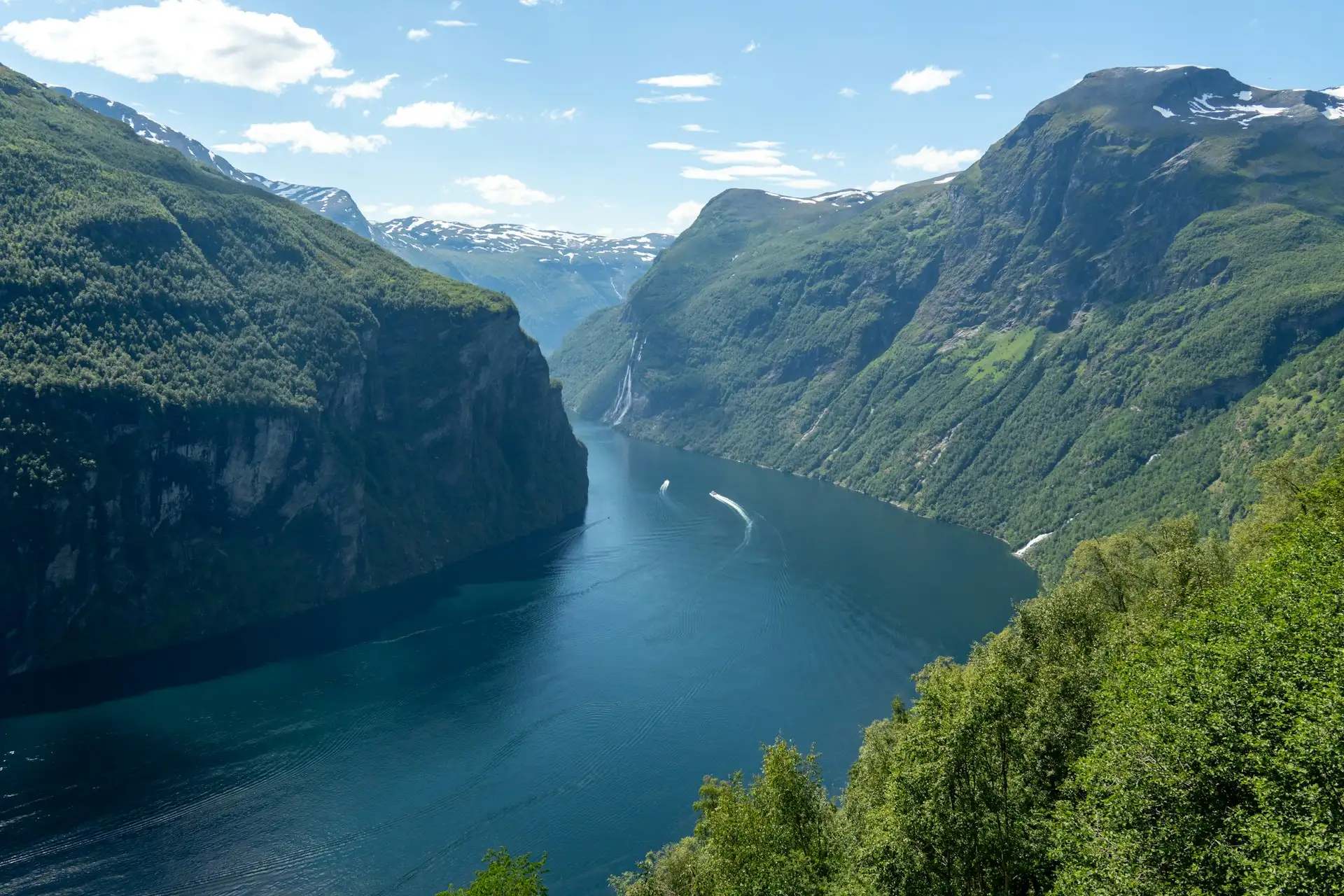
Norway's two UNESCO-listed fjords are the country's signature landscape: sheer cliffs, cascading waterfalls (the Seven Sisters and the Suitor at Geiranger), and water so still it mirrors the mountains above it. The classic way to see both without a car is the Norway in a Nutshell route, combining the Bergen Railway, the steep Flam Railway down to the fjord, and a quiet, largely electric cruise through the Naeroyfjord; it runs as a self-guided day trip or multi-day version from Oslo, Bergen or Flam, with prices varying widely by operator and season.
Lofoten, the postcard islands
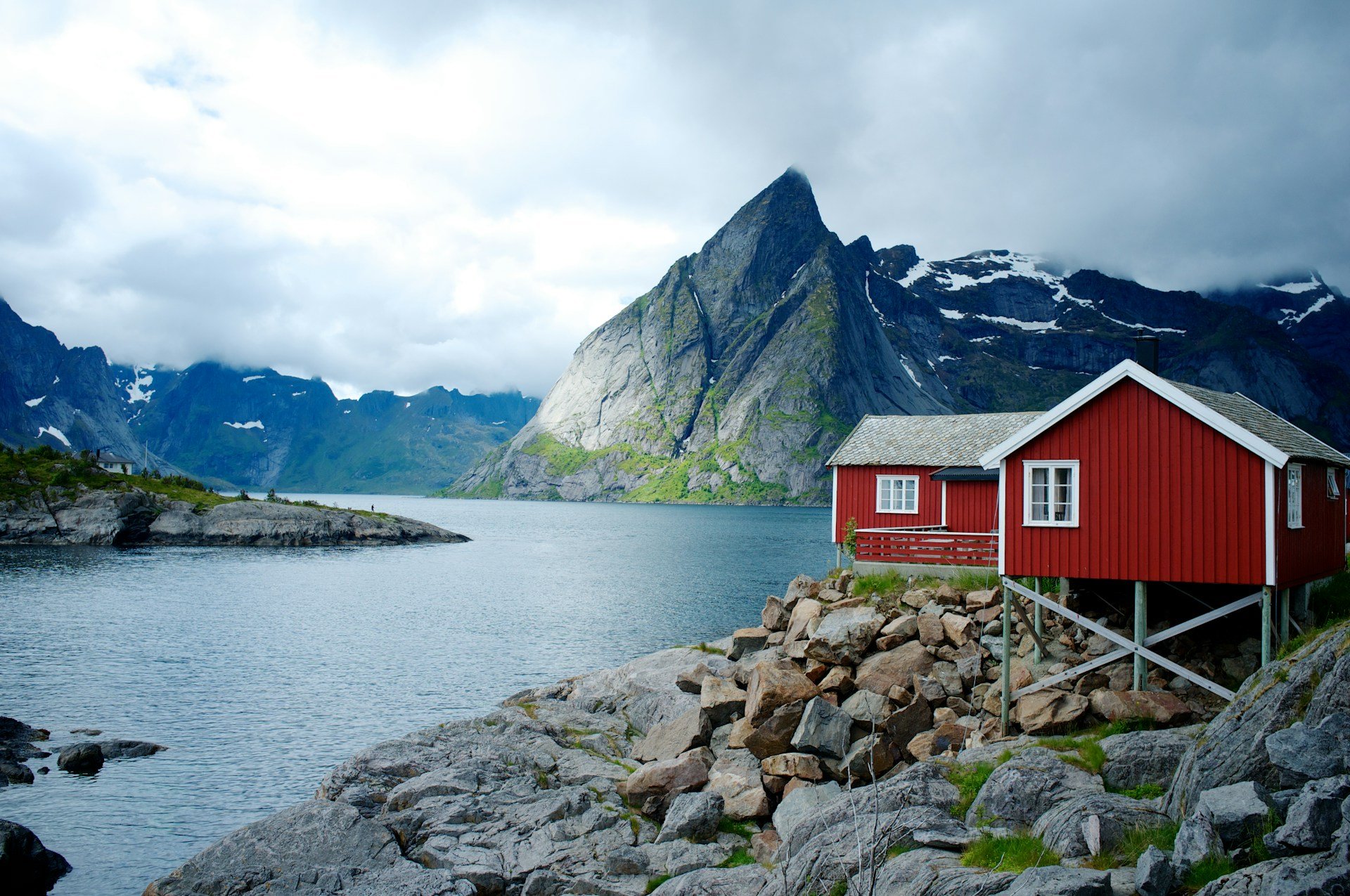
The Lofoten archipelago, just north of the Arctic Circle, packs jagged granite peaks straight out of the water, red-painted rorbuer fishing cabins, and white-sand beaches that look tropical and feel Arctic into a few small islands connected by bridges and tunnels. Reine and Hamnoy are the most photographed villages; the E10 highway itself is one of the great scenic drives in Europe. Best reached by flying into Bodo or Harstad/Narvik and driving or bussing in, or via the Hurtigruten coastal ferry.
Tromso & the northern lights
Tromso has built itself into Norway's main northern lights base: a genuine small city (not just a launch pad) with its own Arctic Cathedral, cable car and museums, plus easy access to aurora tours, dog-sledding and reindeer sledding. It gets busy and pricey in winter; travelers who want a quieter, cheaper base for the same aurora belt increasingly look to Alta, Lyngen or Senja instead.
Trondheim, the historic third city
Norway's original capital and third-largest city centers on the Nidaros Cathedral, Scandinavia's largest medieval building and the traditional coronation church of Norwegian kings, alongside the colorful wooden warehouses of the Bakklandet district along the Nidelva river. Quieter and cheaper than Oslo or Bergen, with its own fjord and a genuine university-town energy from a large student population.
Preikestolen & Trolltunga
Preikestolen (Pulpit Rock), a flat plateau dropping 604 meters straight into Lysefjord near Stavanger, is Norway's most-hiked trail: about 8 kilometers round trip, 4-5 hours, well-marked and busy in summer. Trolltunga, a narrow rock tongue jutting out above Lake Ringedalsvatnet near Odda, is longer and harder (roughly 20-28 kilometers round trip depending on the trailhead, 10-12 hours), far less crowded, and the reason the new upper P3 trailhead car park exists, cutting hours off the approach for a limited number of vehicles a day.
Hidden gems beyond the main circuit
The zones above cover a first or second trip well. With extra days, these reward the detour.
Trolltunga's home valley
Odda itself, once a grim industrial town, has quietly become a base for some of Norway's best hiking beyond Trolltunga, including the Buarbreen glacier arm and the Tyssestrengene waterfall, one of Europe's tallest, with almost none of the crowds.
Art Nouveau Alesund
Rebuilt almost entirely in Art Nouveau style after a catastrophic 1904 fire, this fishing town on the coast between Bergen and Trondheim has a genuinely unusual architectural character and is the launch point for the Atlantic Road.
The Atlantic Road
An 8-kilometer stretch of road hopping between skerries on a series of low bridges, fully exposed to the open sea. Dramatic in a storm, genuinely photogenic in any weather.
Sami culture around Karasjok
The unofficial Sami capital, with the Sami Parliament building and cultural centers offering an honest, non-touristy introduction to reindeer herding culture, quite different from the staged experiences sold in Tromso.
Rural folk culture south of Oslo
A traditional valley of stave-built farmhouses and folk music largely untouched by tourism, an easy detour for travelers driving between Oslo and the southern coast.
Longyearbyen & the polar wilderness
Technically part of Norway but a distinct, expensive trip of its own: polar bears outnumber people, the sun doesn't set from April to August, and doesn't rise from late October to mid-February.
Culture & Etiquette
Two concepts explain most of Norwegian social life. Friluftsliv, roughly "open-air life," is a near-universal cultural commitment to being outdoors in all weather, captured in the Norwegian saying that there's no such thing as bad weather, only bad clothing. Janteloven, the unwritten Law of Jante, discourages boasting or standing out; modesty and equality are default social values, and visible displays of wealth or status land awkwardly even in a genuinely wealthy country.
Do
- Take off your shoes indoors. Standard in homes and many guesthouses; look for a pile of shoes by the door.
- Be punctual. Norwegians take stated meeting and departure times literally; arriving even a few minutes late without notice reads as disrespectful.
- Round up or add 10% for good restaurant service. Appreciated but genuinely optional, since service staff are paid a living wage rather than relying on tips.
- Respect queues and personal space. Norwegians queue precisely and generally don't make small talk with strangers on public transport; this is normal reserve, not rudeness.
- Learn a couple of words. Takk (thanks) and hei (hi) go a long way; almost everyone under 60 speaks fluent English regardless.
Don't
- Expect to buy wine or spirits at a supermarket. Only beer under 4.7% ABV is sold in regular shops; wine and spirits are sold solely through the state-run Vinmonopolet, with limited hours and no Sunday trading.
- Boast about money, status or achievements. Janteloven runs deep; understated is the default register even among genuinely accomplished people.
- Underestimate mountain weather. Conditions on Preikestolen, Trolltunga or any fjord-country trail can shift from sun to sleet within an hour, any month of the year.
- Assume small talk is welcome everywhere. Norwegians are warm once you know them but comfortable with silence; don't read reserve on a train or in a lift as unfriendliness.
- Drink and drive, even a little. Norway's blood alcohol limit (0.02%) and enforcement are among the strictest in Europe.
Deeper culture: 17 May, the bunad, and dugnad
17 May, Constitution Day. Norway's national day marks the signing of the 1814 constitution and is celebrated with children's parades (the barnetog) rather than military ones, brass bands, ice cream, and the whole country in its best clothes: genuinely one of the most joyful, least jingoistic national holidays in Europe.
The bunad. Traditional folk costumes, distinct by region and often handed down through families or made to order at significant expense, worn on 17 May, weddings and other formal occasions. Seeing dozens of different regional bunader in one place on Constitution Day is a genuine cultural spectacle.
Dugnad. A tradition of unpaid, communal volunteer work, cleaning a shared courtyard, organizing a school fundraiser, that's treated as a civic obligation rather than a favor. It underpins a lot of Norway's strong sense of collective responsibility.
Food & Drink
Norwegian food centers on what the coast and mountains actually produce: extraordinarily fresh salmon and other seafood, game and reindeer in the north, dairy from mountain farms, and a handful of dishes that are acquired tastes even for other Scandinavians. Eating out is expensive almost everywhere; the best value is often a bakery, a supermarket counter, or a fish market rather than a sit-down restaurant.
Faarikaal National dish
Lamb and cabbage stewed together with whole peppercorns until the meat falls off the bone, traditionally eaten in autumn and formally recognized as Norway's national dish. Simple, hearty, and everywhere from home kitchens to traditional restaurants.
Brunost Brown cheese
A caramelized whey cheese, sweet and faintly like fudge, sliced thin with a special cheese slicer (ostehøvel, a genuine Norwegian invention) onto waffles or bread. Divisive with first-time visitors, beloved by everyone who grew up on it.
Salmon & seafood 120-250 kr
Norway is the world's largest exporter of farmed salmon, and it shows: fish markets in Bergen and coastal towns sell it, and shrimp, cod and king crab, at a fraction of what the same freshness costs elsewhere.
Rakfisk Autumn specialty
Trout fermented for months, then eaten raw with flatbread and sour cream. A genuine acquired taste even within Norway, mostly served at dedicated autumn rakfisk festivals in the eastern valleys.
Reindeer
A Sami-origin dish now found on menus across Norway, particularly in the north: reindeer stew or thin-sliced reindeer with lingonberry and mashed potato is a genuinely distinctive plate.
Aquavit (akevitt) 80-120 kr/glass
A caraway and dill-spiced spirit, traditionally aged in oak sherry casks on ships crossing the equator and back, drunk ice-cold alongside rich food. Look for Linie brands, named for the equator-crossing tradition.
When to Go & Itineraries
Late June through August is the reliable window for the fjords, the midnight sun and mountain hiking, when passes are clear and days are impossibly long. Late September to mid-October and late February to mid-March are the sweet spots for the northern lights in the north, combining dark enough skies with more tolerable weather than deep winter. Shoulder season (May, early June, September) trades a little weather risk for noticeably thinner crowds and lower prices.
All four seasons compared, with what's actually open
| Season | Verdict | Notes |
|---|---|---|
| Jun-Aug | Best for fjords & hiking | Midnight sun in the north, mountain passes open, peak prices and crowds |
| Late Sep-Oct | Best for northern lights (early) | Fjord cruises largely still running, fewer crowds, unpredictable weather |
| Nov-Jan | Quiet, dark | Many mountain roads and hikes closed; good for cities, skiing and polar night in the far north |
| Feb-Mar | Best for northern lights (late) | Reliable snow and aurora activity, days lengthening again |
Oslo averages around 22°C in July and -4°C in January; Bergen is milder but wetter year-round; Tromso and the far north see genuine polar night in December and 24-hour daylight in June.
Itineraries
Seven days covers Oslo and one fjord region without rushing. Two weeks adds Bergen properly and either the far north or a serious hiking detour. Norway rewards slowing down more than most European countries: fewer stops, done properly, beats a checklist trip.
- Days 1-2
Oslo. Vigeland Park, the Opera House, Bygdoy's museums and the Munch Museum. Full detail in our Oslo guide.
- Days 3-4
Norway in a Nutshell to Bergen. The Bergen Railway, Flam Railway and Naeroyfjord cruise in one spectacular day, overnighting in Bergen.
- Days 5-7
Bergen & the fjords. Bryggen and the Floibanen funicular, a Geirangerfjord day trip or extra fjord cruise, fly back to Oslo or home from Bergen airport.
- Days 1-3
Oslo. The full city at an unhurried pace, including a day trip to Holmenkollen and the Oslofjord islands.
- Days 4-6
Norway in a Nutshell & Bergen. The classic rail-and-fjord route, two nights in Bergen for Bryggen, the fish market and the funicular.
- Days 7-9
Geirangerfjord & Alesund. The fjord ferry between Geiranger and Hellesylt, then on to Art Nouveau Alesund and the Atlantic Road.
- Days 10-12
Trondheim. Nidaros Cathedral and the Bakklandet district, a quieter, cheaper city to decompress in.
- Days 13-14
Return via Oslo or fly onward from Trondheim, depending on your route home.
- Days 1-4
Oslo & Norway in a Nutshell, as the 14-day itinerary above.
- Days 5-8
Bergen, fjords & hiking. Add Preikestolen (via Stavanger) or Trolltunga (via Odda) to the fjord leg.
- Days 9-11
Alesund & the Atlantic Road en route north.
- Days 12-14
Trondheim, full two days plus travel.
- Days 15-21
Lofoten & Tromso. Fly north, a week for the islands and, if the season is right, the northern lights.
Getting there & around
Oslo Airport (OSL, Gardermoen) is the main international gateway, with direct flights from most major European and several North American hubs; Bergen, Trondheim, Stavanger and Tromso all have their own international or well-connected domestic airports for a regional start or finish. Domestically, trains connect the major cities (Oslo-Bergen is the classic scenic run, about seven hours), while the fjord regions genuinely favor a rental car (roughly 600-1,300 NOK a day, plus expensive fuel and tolls) or the ferry-and-bus network for reaching villages the railway skips.
All transport options with prices: trains, Hurtigruten, domestic flights
| Option | Price | Notes |
|---|---|---|
| Oslo-Bergen train | From ~750 kr | About 7 hrs, one of Europe's great scenic rail journeys. Book ahead for the cheapest fares. |
| Flam Railway | ~500-600 kr return | 20 km, one of the steepest standard-gauge railways in the world, part of Norway in a Nutshell. |
| Rental car | 600-1,300 kr/day | Best for fjord country; fuel runs well above US/UK prices and many roads have tolls (AutoPASS). |
| Domestic flights | Varies widely | Practical for reaching Bergen, Tromso or Bodo from Oslo quickly; book early for the best fares. |
| Hurtigruten coastal ferry | Premium pricing | The historic coastal steamer route from Bergen to Kirkenes, now mostly sold as multi-day cruises rather than point-to-point transport. |
Practical prep: Norway is close to a cashless society; contactless card payment works almost everywhere and cash is rarely needed. Buy a local SIM or an eSIM before landing, since mobile coverage, while good on main routes, thins out in remote fjord and mountain areas. Standard travel insurance should specifically cover hiking and mountain rescue if you plan to do Preikestolen, Trolltunga or backcountry trails.
Budget Planning
Norway is consistently ranked among the most expensive countries in Europe, and restaurant dining and alcohol are where that reputation is earned. Groceries, hiking and nature cost nothing extra, so the gap between a tight budget and a comfortable one is wider here than almost anywhere else on the continent.
- Hostel dorm 300-400 kr
- Supermarket meals & waffle stops
- Regional trains & buses
- Free hikes, fjord views & islands
- Mid-range hotel or guesthouse
- Restaurant dinners 300-500 kr/person
- Rental car or Norway in a Nutshell
- A fjord cruise or museum pass
- Design hotels in Oslo or Bergen
- Tasting menus (Maaemo-tier dining)
- Private fjord & hiking guides
- Northern lights charter tours
Quick reference prices: coffee, beer, trains, hostels
| Coffee (cafe) | 45-55 kr |
| Draft beer (0.4L) | 95-130 kr |
| Mid-range restaurant main | 250-400 kr |
| Waffle with brunost | 50-70 kr |
| Hostel dorm bed | 300-400 kr/night |
| Oslo-Bergen train (advance) | from ~750 kr |
| Rental car (economy) | 600-1,300 kr/day |
| Oslo Pass (24h) | ~595 kr |
Prices reflect August 2026 research and drift over time, especially fuel, rental cars and peak-season accommodation. Treat them as a planning baseline, not a quote, and check the current NOK exchange rate before you go.
Visa & Entry
Norway is not an EU member but is a full Schengen Area participant, so entry rules follow the same Schengen 90/180-day framework as its EU neighbors: US, UK, Canadian, Australian and New Zealand citizens, among others, can enter visa-free for tourism for up to 90 days within any 180-day period. Time in Norway counts against the same Schengen clock as time in France, Germany or Italy, unlike non-Schengen Balkan countries such as Albania. Rules do change; the Norwegian Directorate of Immigration (UDI) is the authoritative source.
✓ Valid passport
At least 3 months validity beyond your planned departure date from the Schengen Area.
✓ ETIAS from Q4 2026
Visa-exempt travelers, including US, UK, Canadian and Australian citizens, will need to register online in advance once ETIAS launches later in 2026; it is a low-cost screening, not a visa.
✓ Proof of funds & onward travel
May be requested at the border, particularly a return or onward ticket and evidence of sufficient funds for the stay.
✓ Schengen, not EU
Norway is in the Schengen Area and the European Economic Area but is not an EU member state, a distinction that matters for customs and duty-free rules, not for the visa-free entry itself.
| Norway | Iceland | |
|---|---|---|
| Signature landscape | Fjords, mountains, the Arctic coast | Volcanoes, glaciers, geothermal fields |
| Daily budget | 900-1,300 kr (~80-115 EUR), expensive | Comparably expensive, often pricier on tours and car rental |
| Getting around | Trains plus car for fjord country | Almost entirely by rental car (Ring Road) |
| Northern lights | Tromso and the far north, Sept-Mar | Anywhere outside Reykjavik, Sept-Mar |
| Country size | Much larger; regions need real travel time between them | Small enough to circle in 7-10 days |
Safety, Solo Women & Family
Norway is rated Level 1, Exercise Normal Precautions, by the US State Department, its lowest advisory tier, and ranks consistently among the safest countries in the world by violent crime. The real risks for visitors are environmental: mountain and fjord-country weather that shifts quickly, and winter driving conditions, not crime.
Mountain & hiking safety
Conditions on Preikestolen, Trolltunga and fjord-country trails can turn from clear to sleet within an hour, any month. Tell someone your plan, start early, check the forecast that morning, and carry proper layers even in July.
Pickpocketing
Rare by international standards but concentrated at Oslo Central Station and other crowded tourist spots. Ordinary bag awareness is enough; violent crime against visitors is genuinely uncommon.
Winter driving
Black ice, sudden fog and single-lane mountain roads are real hazards from October to April. Winter tires are legally required and rental agencies fit them automatically; drive to the road, not the speed limit.
Two more things worth knowing: online scams and eastern Oslo
Financial and romance scams targeting people in Norway (not specifically tourists) are reported by local authorities more often than street crime; the practical relevance for a visitor is mainly to be wary of unsolicited online contact before or during a trip, not a specific in-person risk.
Parts of eastern Oslo see occasional gang-related and drug-related crime, almost entirely not involving tourists and well outside the standard sightseeing routes through Sentrum, Frogner, Grunerlokka and Bygdoy.
Solo women travelers
Norway consistently ranks among the top few countries in the world for solo female travelers, with street harassment rare and a reserved but not unwelcoming culture that generally leaves solo travelers alone rather than approaching them. The main precaution is the same one that applies to everyone: respecting mountain weather on solo hikes, telling someone your route, and not treating a clear morning forecast as a guarantee for the whole day.
Emergency numbers
Embassies in Oslo and mountain rescue
All three emergency numbers work from any phone, including without a Norwegian SIM, and operators generally speak English. Most embassies are located in or near the Frogner and Skillebekk areas of Oslo.
- USA
- +47 21 30 85 40
- UK
- +47 23 13 27 00
- Germany
- +47 23 27 54 00
- France
- +47 23 28 46 00
- Canada
- +47 22 99 53 00
- Australia
- via The Hague, +31 70 310 8200
Mountain emergency: for hiking incidents, call 112. In remote fjord and mountain areas response can take time, so registering your route with a guesthouse or the Norwegian Trekking Association (DNT) hut network before setting out is genuinely useful, not just formality.
Family travel & pets
Norway is a strong family destination: low crime, punctual and easy-to-navigate public transport, and a culture that treats being outdoors with kids as completely normal rather than an achievement. Oslo's Vigeland Park and the Bygdoy museums both work well for children, and the Oslofjord island ferries make an easy, cheap half-day out. The main friction point is cost: restaurant meals for a family of four add up fast, so leaning on supermarkets and self-catering apartments matters more here than in most of Europe.
Bringing pets into Norway
EU pet passport holders can enter with dogs, cats and ferrets given valid rabies vaccination and a microchip, plus a tapeworm treatment for dogs administered by a vet 1-5 days before arrival, a stricter rule than many neighboring countries. Non-EU visitors need an equivalent veterinary health certificate and the same tapeworm treatment window. Check current requirements with the Norwegian Food Safety Authority (Mattilsynet) before traveling, since the tapeworm rule is enforced strictly at the border.
Norway FAQ
Is Norway safe to visit?
Yes. Norway is rated Level 1, Exercise Normal Precautions, by the US State Department, and ranks among the safest countries in the world for violent crime. The real risks are mountain weather and driving conditions, not crime.
How expensive is Norway?
One of the most expensive countries in Europe. Budget travelers manage on 900-1,300 NOK a day (roughly 80-115 euros), mid-range on 1,800-2,800 NOK. Alcohol and restaurant dining are the biggest cost shocks; groceries and nature are far more reasonable.
Do I need a visa for Norway?
Citizens of the US, UK, Canada, Australia and New Zealand can enter visa-free for up to 90 days in any 180-day period under Schengen rules. From the fourth quarter of 2026, the same visa-exempt travelers will also need to register for ETIAS online before arrival.
Is Norway in the European Union?
No. Norwegians rejected EU membership in referendums in 1972 and 1994. Norway is instead part of the European Economic Area and the Schengen Area, giving it single-market access and visa-free Schengen travel without EU membership.
When is the best time to visit Norway?
Late June through August for the fjords, the midnight sun and hiking, when the days are longest and mountain roads are open. Late September to mid-October and February to mid-March are best for the northern lights in the north.
How many days do you need in Norway?
Seven days covers Oslo and one fjord region well. Two weeks adds Bergen, the classic Norway in a Nutshell route, and either Lofoten or a hiking-focused detour to Preikestolen or Trolltunga.
What are the best fjords to see in Norway?
Geirangerfjord and Naeroyfjord, both UNESCO World Heritage Sites, are the two most dramatic and most visited. The Naeroyfjord is usually seen as part of the Norway in a Nutshell route from Bergen or Oslo via Flam.
When can I see the northern lights in Norway?
From late September to late March in the north, above or near the Arctic Circle. Tromso is the main base; statistically the best windows are late September to mid-October and late February to mid-March, when nights are dark but the weather is milder than deep winter.
Is it better to rent a car in Norway?
For the fjord regions, yes: a car reaches viewpoints and villages the trains and buses skip. Rentals run roughly 600-1,300 NOK a day plus expensive fuel and tolls. For an Oslo-Bergen-Oslo trip, the train and ferry-based Norway in a Nutshell route is often easier than driving.
Is Norway safe for solo female travelers?
Yes, consistently ranked among the top few countries in the world for solo female travelers. Harassment is rare and the culture is reserved rather than intrusive. The main precaution is respecting mountain weather on solo hikes, not personal safety in towns and cities.
Is Norway good for families with kids?
Yes. Low crime, excellent and punctual public transport, and a culture built around outdoor life make it an easy country to travel with children, though the cost of restaurants and activities adds up quickly for a family of four.
Is Norway cheaper or more expensive than Iceland?
Broadly comparable and both expensive by European standards. Norway's restaurant and alcohol prices tend to run higher due to state alcohol monopolies and taxation; Iceland's tour and car rental prices are often the bigger line item there.
What Stays With You
Every traveler who does Norway properly comes home with the same specific image: standing on a rock ledge or a ferry deck with a fjord spread out below, thinking that no photograph they took actually captures the scale of it. That's true, and it's the honest reason to go rather than just look at pictures of it. The country makes you pay for the privilege, in both the literal cost of a meal and the discipline of respecting weather you don't control, and most people who've done it once say that's a fair trade.
Pack the right jacket, budget more than you think you need, and go somewhere with real quiet at the end of the day. Friluftsliv isn't a slogan here. It's how the whole country is actually built.