
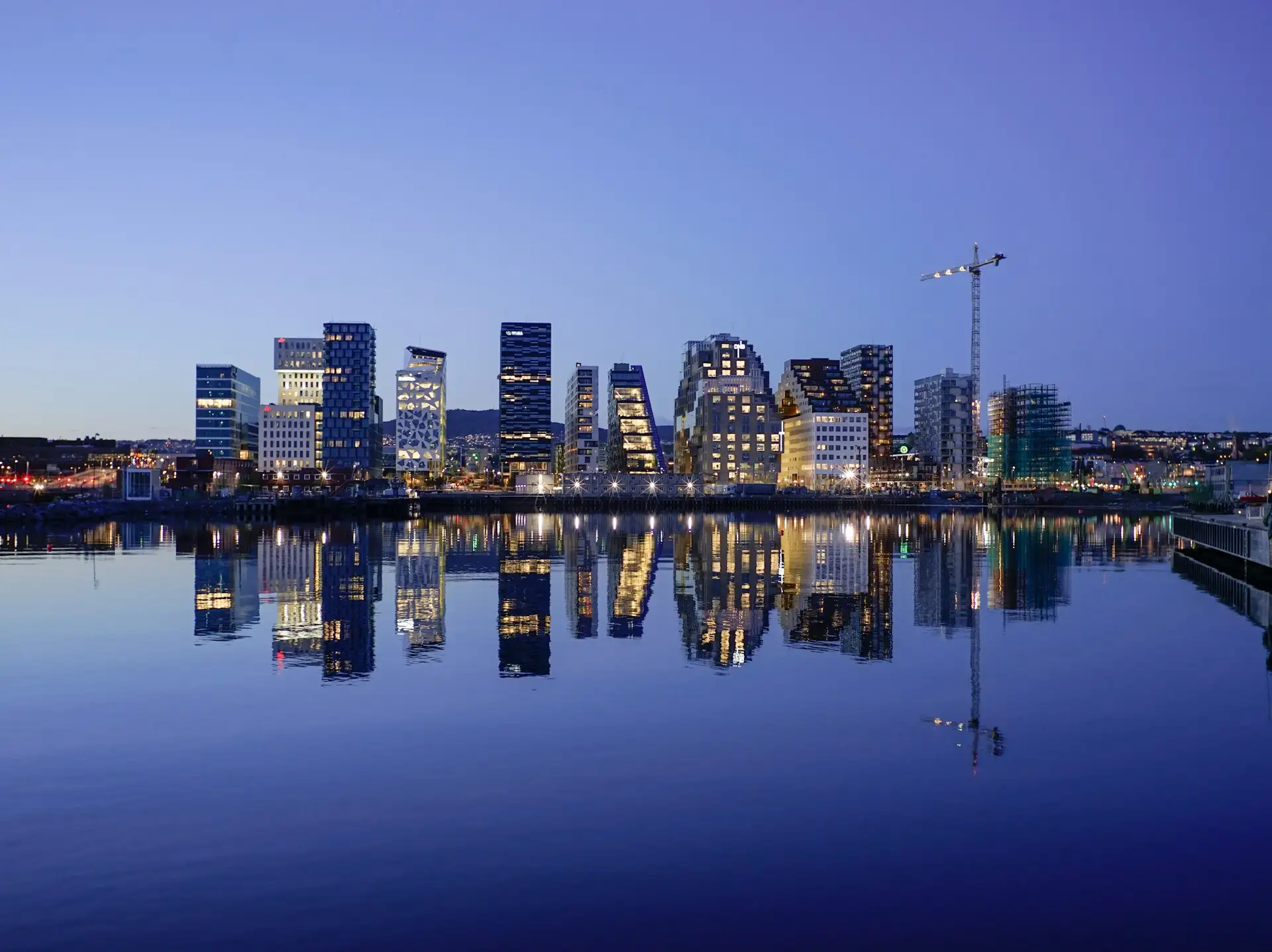
A capital built around a fjord, not a river
Oslo is Norway's capital, largest city and main gateway, and it wears its oil-age wealth openly: a purpose-built waterfront opera house you walk across the roof of, a new Munch Museum tower in Bjorvika, and a harbor promenade of new architecture on land that was container docks twenty years ago. It also sits directly against Nordmarka, the forest that rings the city, so a fifteen-minute metro ride from downtown gets you to hiking trails, lakes and, in winter, cross-country ski tracks lit for night skiing.
What surprises first-time visitors most is the scale: with around 700,000 people in the city proper, Oslo feels more like a well-funded regional capital than a European megacity, walkable end to end for most of its central sights, with the Oslofjord and its islands a short ferry ride from the harbor at any point in the day.
The honest complications
Oslo is genuinely one of the most expensive capitals in the world, and restaurant and bar prices catch first-time visitors off guard more than almost anything else about the trip. The Museum of the Viking Age, the planned successor to the old Viking Ship Museum, remains closed for rebuilding as of this guide (targeted reopening in 2027), so the famous Oseberg and Gokstad ships are not currently viewable in Oslo; the Fram and Kon-Tiki museums on the same Bygdoy peninsula more than fill the gap in the meantime. And Oslo's weather is genuinely Nordic: pack for rain and a real temperature swing even in summer.
Five areas, and where you actually want to be
Oslo's neighborhoods split cleanly by character: the historic, business-oriented center, an affluent western district built around its namesake park, a younger eastern district with the city's best independent food and drink, and two waterfront zones built almost entirely in the last two decades.
Sentrum
Downtown Oslo: Karl Johans Gate running from the Royal Palace to Oslo Central Station, the Cathedral, and Akershus Fortress on the harbor. Central to everything and the easiest base for a first visit, though quieter and less atmospheric at night than Grunerlokka.
Frogner
West of the center, Frogner is Oslo's grandest residential district, home to Vigeland Sculpture Park and a concentration of embassies and townhouse architecture. Quiet at night, walkable to Sentrum, and a good base for travelers who want calm evenings over nightlife.
Grunerlokka
East across the Akerselva river, Grunerlokka was working-class industrial Oslo and is now the city's hippest neighborhood: vintage shops, natural wine bars, and the Mathallen food hall in a converted 1902 ironworks. Fewer tourists, better value than Sentrum, and the neighborhood most Oslo residents would tell you to stay in.
Bjorvika
The former container docks east of Central Station, rebuilt over the last two decades around the Opera House and the new Munch Museum. Modern, striking, and increasingly full of good restaurants, though it can feel a little corporate after dark away from the harborfront.
Tjuvholmen & Aker Brygge
The western harbor's answer to Bjorvika: architect-designed apartment blocks, the Astrup Fearnley Museum, and the ferry piers for the Oslofjord islands and Bygdoy. Good for a design-conscious stay, with restaurant prices to match.
From design hotels to Norway's best-value hostel bunks
Oslo hotel prices sit at the higher end of Europe even before you add the country's alcohol and restaurant costs on top, but the range still runs from a genuinely excellent hostel network to some of the more distinctive design hotels in the Nordics. These picks cover the main budgets and neighborhoods.
At the top of the market, The Thief in Tjuvholmen is Oslo's best-known design hotel, art-filled, harbor-facing and built around a rooftop bar and spa, from around $313 a night. Amerikalinjen in Sentrum, set in the former headquarters of the Norwegian America Line shipping company, pairs original maritime details with a lively ground-floor restaurant and bar scene, a strong mid-to-upper pick right by Central Station.
In the design-boutique bracket, First Hotel Grims Grenka in Sentrum mixes Norwegian art and rooftop city views with rates that flex widely by season, often starting around $100-150 in off-peak periods. For value without sacrificing location, Cochs Pensjonat in Frogner is a long-standing budget guesthouse near the Royal Palace, with simple singles from around €55 and private doubles from €70.
At the budget end, HI Oslo Haraldsheim, a hillside hostel a short tram ride from the center, is the classic backpacker base with dorm beds from around $42 (roughly 400 NOK) including breakfast, and views back over the city and fjord.
From a three-Michelin-star tasting menu to a 130-kroner market plate
Oslo's food scene runs from serious, internationally recognized fine dining to a genuinely good casual and market scene, all filtered through prices that are high even by Nordic standards. The trick is knowing where the value actually is: food halls and markets, not mid-range sit-down restaurants.
Maaemo
Norway's most celebrated restaurant, holding three Michelin stars since 2016, built entirely around hyper-seasonal Norwegian and Nordic ingredients. A genuine special-occasion splurge, not a casual dinner; book weeks ahead.
Mathallen
Oslo's answer to a European food market, set in a converted 1902 ironworks along the Akerselva river in Grunerlokka: around a dozen stalls and restaurants under one roof, from Norwegian seafood to international options, and one of the best ways to sample widely without committing to a full sit-down meal.
Fiskeriet
Part seafood market, part casual bistro, known for straightforward, well-executed fish and chips, creamy fish soup and cod croquettes. A reliable, unpretentious lunch pick in a city where that's not always easy to find.
Vippa
A seasonal food market in a converted harbor warehouse near Akershus Fortress, with 15 to 20 stalls covering everything from Norwegian fish dishes to Thai and Ethiopian food. Casual, cheap by Oslo standards, and one of the best summer evening spots in the city.
Sculptures, polar ships, and a roof you're meant to walk on
Oslo's sights split naturally into a harbor-and-Bjorvika day, a Bygdoy museum day, and a Frogner-and-forest day. None of it requires more than public transport, and the city rewards slowing down between stops rather than rushing a checklist.
Vigeland Sculpture Park
The world's largest sculpture park by a single artist: over 200 granite and bronze works by Gustav Vigeland spread through Frogner Park, centered on the 14-meter Monolith carved from one block of stone. Completely free, always open, and the single most-visited attraction in Norway. Give it at least an hour; longer if the weather's good and a picnic is involved.
Bygdoy peninsula: Fram, Kon-Tiki and the Folk Museum
A short bus or, from April to October, ferry ride from the City Hall pier reaches a cluster of museums built around Norwegian exploration and heritage. The Fram Museum houses the polar ship Fram, used on Amundsen's South Pole expedition and Nansen's Arctic drift, the ship you can walk aboard rather than just view from outside. Next door, the Kon-Tiki Museum holds Thor Heyerdahl's original balsa-wood raft from his 1947 Pacific crossing. The Norwegian Museum of Cultural History (Norsk Folkemuseum) rounds out the peninsula with open-air historic buildings including a 13th-century stave church. Note that the Museum of the Viking Age, successor to the old Viking Ship Museum, remains closed for a major rebuild as this guide is written, targeted to reopen in 2027; check current status before planning around it.
Bjorvika: the Opera House and the Munch Museum
The Oslo Opera House, a sloped white marble and granite building you're meant to walk up and across, gives free harbor and fjord views from its roof at any hour, opera ticket or not. A short walk away, the new Munch Museum, a 13-story tower opened in 2021, holds the world's largest collection of Edvard Munch's work, including versions of The Scream, across floors that trace his full career, not just the famous image.
Akershus Fortress & the harbor
A 13th-century fortified castle on the harbor's edge, built under King Haakon V, with grounds that are free and open for a walk even outside museum hours, and views back across the water to Bjorvika and the Opera House. Oslo City Hall (Radhuset), the red-brick harborside building where the Nobel Peace Prize is awarded each December, has free public access to its murals and sculpture-filled halls by Norwegian artists including Henrik Sorensen and Alf Rolfsen.
Holmenkollen
The iconic ski jump tower above the city, still an active competition venue, with a ski museum built into its base and a viewing platform at the top reached by lift. On a clear day the view stretches over Oslo and the fjord to the hills beyond; the surrounding Nordmarka forest has marked trails for a longer walk or, in winter, cross-country skiing.
One, two or three days, planned neighborhood by neighborhood
Two to three full days covers Oslo properly; even a single well-planned day hits the essentials. These routes group sights by neighborhood to minimize backtracking.
- Morning
Vigeland Park. An unhurried hour among the Monolith and the surrounding sculptures, then a tram back toward the center.
- Midday
Harbor & Akershus Fortress. Walk the fortress grounds, then lunch at Fiskeriet or a stall at Mathallen if you route through Grunerlokka.
- Afternoon
Bjorvika. The Opera House roof, then the Munch Museum tower next door.
- Evening
Dinner in Grunerlokka or, May to September, Vippa on the harbor for a casual last night.
- Day 1
The one-day route: Vigeland Park, the harbor, Bjorvika's Opera House and Munch Museum, dinner in Grunerlokka.
- Day 2 morning
Bygdoy peninsula. Ferry or bus to the Fram Museum, Kon-Tiki Museum and the Norwegian Museum of Cultural History.
- Day 2 afternoon
Holmenkollen. The ski jump tower and museum, with a walk in the Nordmarka forest if the weather holds.
- Day 2 evening
Tjuvholmen. The Astrup Fearnley Museum's architecture and a harborside dinner.
- Days 1-2
The two-day route above, at a gentler pace.
- Day 3
Oslofjord islands. A ferry from Aker Brygge to Hovedoya for the ruined monastery and grassy meadows, or island-hop to Gressholmen, using a regular transit ticket both ways.
Compact, punctual, and easy to cover without a car
Oslo Airport (OSL, Gardermoen) sits about 45 kilometers north of the city. The Vy regional train reaches Oslo Central Station in around 23 minutes for about 129 NOK, the best value option; the dedicated Flytoget airport express is faster, around 19 minutes, for about 258 NOK. Both are far cheaper and usually faster than a taxi.
Inside the city, all public transport (metro, trams, buses and the Oslofjord ferries) runs under the Ruter system on a single ticket type, easy to buy via the RuterBillett app. The Oslo Pass (from 595 NOK for 24 hours) bundles free entry to over 30 museums and attractions, including the Munch Museum and Holmenkollen, with unlimited Ruter transport and the Vy airport train; if you're planning to hit two or three paid museums plus regular transit, it typically pays for itself.
Best time to visit and getting around further afield
Oslo has a genuine four-season climate: late May through August brings long daylight, outdoor dining and easy island-hopping; September is still pleasant with thinning crowds; winter is cold (averaging around freezing) but the city stays fully functional, with Holmenkollen's ski trails and a genuine Nordic Christmas market atmosphere in December.
Beyond the city, Oslo Central Station is the hub for the Bergen Railway (about 7 hours to Bergen, one of Europe's great scenic train rides) and connections toward Trondheim and the fjords. A rental car makes sense only if you're heading into fjord country immediately after Oslo; within the city itself, a car is a genuine liability given limited and expensive parking.
One of Europe's most expensive capitals, with real ways to manage it
Oslo consistently ranks among the most expensive cities in Europe, on par with or above Zurich and Copenhagen for restaurant dining and alcohol. The gap between a disciplined budget trip and a restaurant-every-night trip is unusually wide here.
- Hostel dorm 300-400 kr
- Supermarket meals & Mathallen stalls
- Ruter transport or the Oslo Pass
- Vigeland Park, harbor walks, free museums
- Design or mid-range hotel
- Restaurant meals 250-500 kr/person
- Oslo Pass for museums & transport
- An Oslofjord ferry day trip
- The Thief or equivalent design hotel
- Maaemo or other tasting-menu dining
- Private city or fjord tours
- Norway in a Nutshell add-on
One of Europe's safest capitals, with one real thing to know
Oslo rates around 9.0/10 on our safety scale, in line with Norway's Level 1, Exercise Normal Precautions rating from the US State Department. Violent crime against visitors is rare, the city is comfortable to walk at night in Sentrum, Frogner, Grunerlokka and Bjorvika, and Oslo is consistently rated among the best cities in the world for solo female travelers.
The one thing that actually catches visitors: pickpocketing, concentrated around Oslo Central Station and other crowded tourist spots, at a level similar to other major European cities. Keep bags closed and in front of you in crowds and you've covered the realistic risk. Some occasional gang and drug-related activity exists in specific eastern Oslo neighborhoods well outside the standard sightseeing routes; it isn't something a visitor sticking to the sights above will likely encounter. Emergency numbers are 112 for police, 113 for ambulance, and 110 for fire, all working from any phone.
The fjord, the forest, and Norway's fjord country beyond
Oslo's position at the head of its own fjord and against a forested ridge makes short, easy trips possible with just a regular transit ticket, while the country's grander western fjords are more of a multi-day extension than a single day out.
Oslofjord Islands
Ferries run from the piers at Aker Brygge to a handful of small islands inside the fjord. Hovedoya, the closest and most popular, has the ruins of a medieval monastery and grassy meadows made for a picnic. Gressholmen, once the site of Oslo's seaplane airport, is quieter, with wooded trails and sheltered coves; Langoyene further out has sandy beaches and a designated summer campsite. All are part of the Ruter public transport network, so no separate ticket or tour booking is needed.
Holmenkollen & Nordmarka
Beyond the ski jump tower itself, the surrounding Nordmarka forest has an extensive network of marked hiking trails in summer and lit cross-country ski tracks in winter, reachable entirely by metro from the city center. An easy half-day of forest and lake scenery without leaving the Oslo transit system.
Norway in a Nutshell (Bergen & the fjords)
For travelers with an extra day, the classic Norway in a Nutshell route runs from Oslo via the Bergen Railway, the steep Flam Railway and a Naeroyfjord cruise, either as a very long single day or, more comfortably, with an overnight in Bergen or Flam. It's less a casual day trip than a proper taste of fjord country, and worth planning as its own leg rather than squeezing in at the end of an Oslo visit. Full detail lives in our Norway country guide.
Oslo FAQ
Is Oslo safe for tourists?
Yes. Oslo is one of the safest capital cities in Europe; violent crime against visitors is rare. The main concern is pickpocketing around Oslo Central Station and other crowded tourist spots, not personal safety.
How many days do I need in Oslo?
Two to three full days covers the city well: one for Vigeland Park and Frogner, one for the Bygdoy museums and the harbor, and a third for Holmenkollen and the Oslofjord islands. A fourth day fits an easy fjord or Norway in a Nutshell add-on.
How much does Oslo cost per day?
Budget travelers manage on 900-1,300 NOK a day with a hostel dorm and supermarket meals; mid-range runs 1,800-2,800 NOK. Oslo is one of the most expensive capital cities in Europe, on par with or above Zurich and Copenhagen for restaurant dining.
When is the best time to visit Oslo?
Late May to August for long daylight, outdoor dining and the Oslofjord islands; the city stays enjoyable through September. Winter is cold but atmospheric, with Christmas markets and easy access to skiing at Holmenkollen.
Is Oslo expensive compared to other European capitals?
Yes, consistently ranked among the most expensive in Europe alongside Zurich, Geneva and Copenhagen. Restaurant meals and alcohol are the biggest shock; museums, transport and groceries are closer to typical Western European prices.
How do I get from Oslo airport to the city center?
The Vy regional train takes about 23 minutes to Oslo Central Station for around 129 NOK, the cheapest option. The Flytoget airport express is faster, about 19 minutes, for around 258 NOK. Both run frequently from Oslo Airport (Gardermoen).
What is the best area to stay in Oslo?
Sentrum or Frogner for first-timers: central, walkable and close to the main sights. Grunerlokka for a livelier, younger, more local feel with better-value food. Tjuvholmen or Aker Brygge for a design-forward waterfront base.
Is the Oslo Pass worth it?
Usually yes if you're museum-heavy: a 24-hour pass costs around 595 NOK and includes free entry to 30-plus attractions plus public transport, including the airport train on Vy. Add up two or three museum entries and it typically pays for itself.
Can I see the northern lights from Oslo?
Realistically, no. Oslo sits too far south and has too much light pollution for reliable aurora viewing. For the northern lights, Tromso and other locations north of or near the Arctic Circle are the honest answer, not Oslo.
Is Oslo walkable?
Yes. The center is compact and flat by Norwegian standards, and the metro, trams and buses (all under the Ruter system) cover everything else, including the ferries to the Oslofjord islands on a regular transit ticket.
What Stays With You
Oslo doesn't try to convince you it's the most beautiful capital in Europe, and that's part of what makes it work. The city gets on with being genuinely, functionally excellent: trains that arrive when they say they will, a park full of naked granite figures that somehow isn't strange after the first ten minutes, and a harbor where a museum built around a 19th-century polar exploration ship sits a short ferry ride from a roof you're actively encouraged to walk across. None of it is trying too hard, which is why the good parts land as hard as they do.
Budget more than you expect, walk up onto the Opera House roof at golden hour, and take the ferry to Hovedoya at least once just because a regular bus ticket gets you there. That's the whole trick to doing Oslo well.