
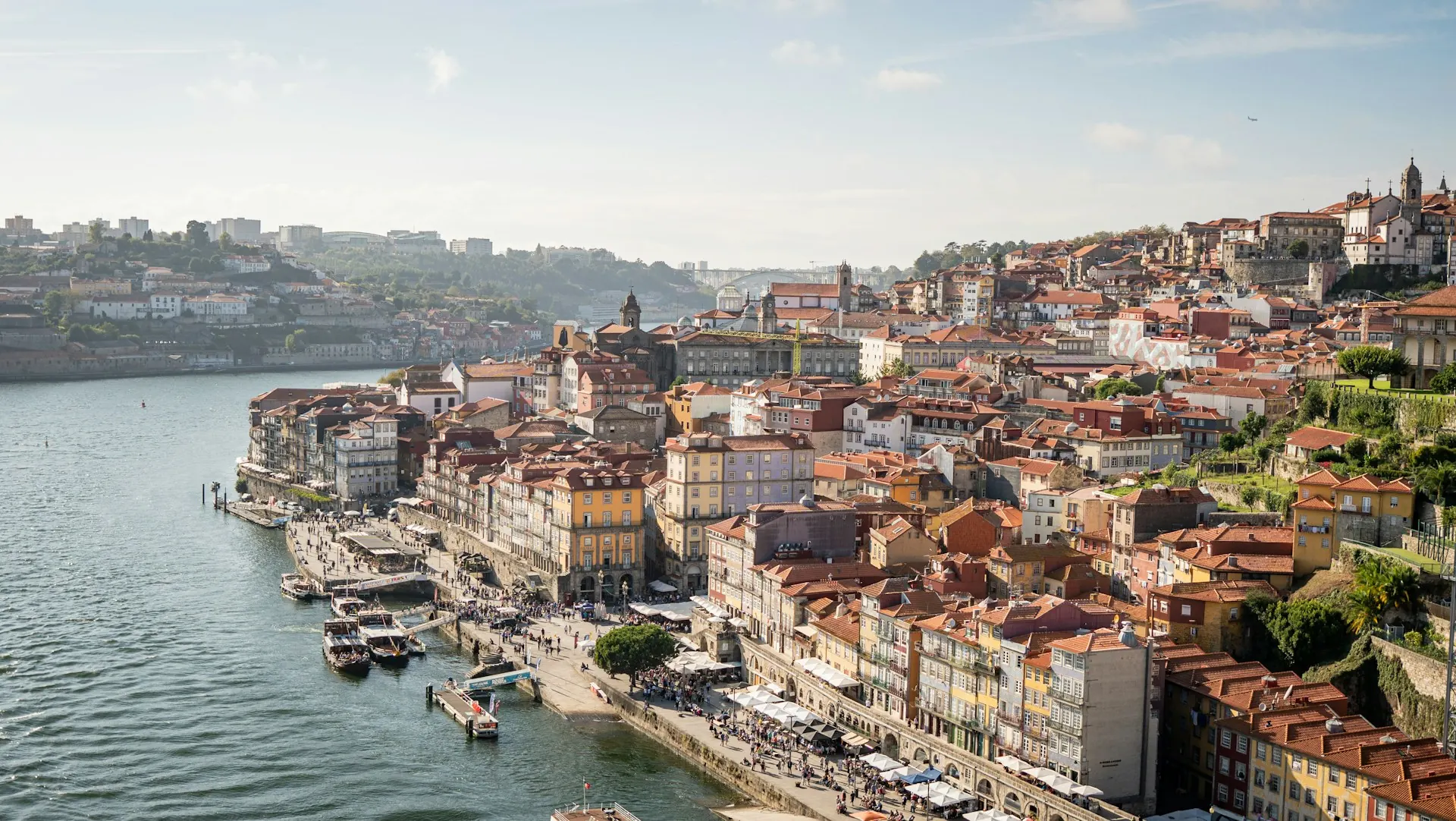
Portugal's second city plays second fiddle to nobody
Porto sits on a steep gorge above the Douro River, its terraced hillsides covered in buildings that range from medieval to art nouveau to crumbling 1970s concrete, often on the same street. It is photogenic without trying to be and affordable without feeling cheap. The city rewards slow travel: the hills are steep enough that you earn your views, the food and wine are exceptional at every price point, and the late afternoon light bouncing off the azulejo tiles and the Douro is one of those things that photographs well but still surprises you in person.
What changed in the last decade is that the world found out. Porto went from a well-kept secret to one of Europe's most visited cities in a remarkably short time. The tourist infrastructure is now excellent and English is widely spoken. But go two streets back from the waterfront and you are in a neighbourhood that still belongs to its residents, where lunch costs €9 with wine and the day's dish is written on a chalkboard.
The honest complications
The crowds in Ribeira and around Livraria Lello can be genuinely overwhelming in peak summer, and the tourist restaurants along the waterfront charge Lisbon prices for Porto-quality food. The hills are real: some streets feel more like staircases, the cobblestones are uneven, and twisted ankles are common enough that flat, grippy shoes are the single best packing decision you can make. And Porto is proud in a way that occasionally borders on chippy about Lisbon, which locals will cheerfully tell you took the credit for the country Porto built. This is a feature, not a bug.
Seven hills, five neighbourhoods that matter
Porto's neighbourhoods are defined by their relationship to the river and the hills. Where you base yourself comes down to how much you want to walk and how much noise you can sleep through.
Ribeira
The medieval waterfront district is the Porto of the postcards: colourful houses stacked above narrow alleys, the Dom Luís I Bridge overhead, and the best views of Vila Nova de Gaia across the river. It is UNESCO listed, genuinely beautiful, and also the city's most tourist-saturated few hundred metres. Staying here means waking up to the river and falling asleep to the bars; pack earplugs or embrace it.
Baixa
Porto's downtown is slightly less scenic than Ribeira but quieter at night, more practical, and central enough to walk to everything: São Bento station, Clérigos Tower, the Bolhão market, Livraria Lello. For a first visit, this is the base that makes the whole city a ten-to-twenty-minute walk.
Bonfim
East of the centre, Bonfim has become Porto's most interesting neighbourhood for eating and drinking: fewer tourists, more locals, better prices, and a concentration of independent restaurants the guidebooks haven't caught up with. If you care more about dinner than about the view from your window, stay here.
Foz do Douro
Where the Douro meets the Atlantic: wide promenades, rocky beaches, upmarket restaurants, and a slower, salt-air pace twenty minutes from the centre by historic tram. Best for a second visit, or for travellers who want the sea more than the sights.
Vila Nova de Gaia
Technically a separate city, Gaia sits directly across the Douro from Ribeira and holds every port wine lodge that matters, including Taylor's, Graham's and Sandeman. The views back towards Porto from the upper ridge, and from the cable car that connects it to the riverside, are the best in the region.
From palace hotels to the best hostel scene in Europe
Porto's hostels are consistently ranked among Europe's best, with social atmospheres and included breakfasts that justify the hype, and the mid-range is full of converted townhouses with character that chain hotels cannot match. These six picks cover every budget, and each one earns its place.
At the top, The Yeatman in Vila Nova de Gaia is Porto's finest hotel, perched above the port lodges with a Michelin-starred restaurant, a serious wine cellar, and an infinity pool looking straight across at the Ribeira skyline, from about €280 a night and worth every one of them for the view alone.
In the boutique bracket, Torel Avantgarde (from €180) is a hillside hotel with rooms themed around Portuguese icons, a rooftop pool with arguably the best view in central Porto, and an exceptional breakfast, while Hotel Infante Sagres (from €130) has been the city's grand classic since 1951: art deco interiors, Portuguese tiles throughout, one of the best hotel bars in the city, and staff who genuinely know Porto.
For value on the water, Guest House Douro (from €80) is a compact family-run guesthouse right on the Ribeira waterfront; book the river-view rooms. And at the budget end, Pilot Design Hostel in Bonfim (from €18) and the award-winning Gallery Hostel in Baixa (from €20, with an art gallery on the ground floor and free wine tasting nights) are the two properties that built Porto's hostel reputation.
Compare hotels on the map
Port wine, francesinha and pastéis de nata, in that order
Porto's food scene is one of Europe's most underrated, and the city has no interest in being fashionable about it. The best meals are often in no-menu tascas where the day's dish is written on a chalkboard and costs €8 including wine, while the tasting menus at the upper end are serious and still cheaper than comparable restaurants in Lisbon or Madrid.
Francesinha
The city's defining dish: a layered sandwich of cured meats and sausage, covered in melted cheese, then drowned in a thick tomato-beer sauce and served with fries. Invented here in the 1950s and not found authentically anywhere else. Café Santiago in Baixa is the most famous address; queue before noon or after 2pm.
Port wine
Fortified wine from Douro Valley grapes, aged in the lodges directly across the river. Drink tawny (oak-aged, nutty) or vintage (bottle-aged, more complex); ruby is the entry level, fine but not what Porto is known for. The cellar tours at Graham's, Taylor's and Ramos Pinto all include tastings and are genuinely interesting rather than a sales pitch.
Bacalhau
Salted cod prepared in supposedly 365 ways. Bacalhau à Brás (shredded with eggs and potatoes), com natas (with cream) and à Gomes de Sá (with potatoes, olives and hard-boiled egg) are the Porto classics. Do not leave without eating it at least once.
Pastéis de nata
Portugal's custard tart, eaten warm with a bica (espresso) at a standing counter. Confeitaria do Bolhão next to the market does an excellent version. Lisbon's pastel de Belém is more famous; Porto's are just as good.
A city best explored on foot and slightly lost
Porto rewards wandering more than any other city in Europe. The best experiences are often unplanned: a miradouro discovered at the top of a steep street, a tile-covered chapel around a corner, a bar that has been there since 1930. A few things do need advance booking, and this chapter walks through the city roughly the way a good three days would.
The riverfront and Gaia
Start where everyone starts, but do it properly. Walk the Ribeira quay early, before the crowds, then cross the upper deck of the Dom Luís I Bridge on foot, one of the great free experiences in Europe, with the whole gorge laid out below. On the Gaia side, tour one port lodge rather than three: Graham's has the most comprehensive tour, Taylor's the best terrace view, and Ramos Pinto the smallest crowds and an excellent museum, all €15-25 with tastings. Take the cable car down the Gaia hillside, and come back across the lower deck at water level. The classic six-bridges Douro cruise (50 minutes, €15-20, boats every half hour from the Ribeira quay) shows you a Porto you cannot see from land and is better value than it looks.
Baixa's landmarks
The azulejo murals inside São Bento station are the best free art in Porto; give them ten unhurried minutes. From there it is a short climb to Clérigos Tower, 225 steps up the baroque granite for the definitive 360-degree view (€6, timed entry, go at sunset). Livraria Lello, the neo-gothic bookshop with the legendary double staircase, is genuinely beautiful and genuinely overwhelmed between 10am and 5pm; book the first morning slot online and remember the €8 ticket is redeemable against any book. Two minutes away, the side garden of the Igreja do Carmo looks down the hill towards the Douro at sunset and is almost always empty. And the one interior most visitors walk straight past: the Palácio da Bolsa, Porto's former stock exchange, whose neo-Moorish Arab Room took 18 years to build and is one of the most impressive rooms in Portugal (€10, guided tour only).
Evenings and fado
Porto fado is rawer and more melancholic than the Lisbon version. Casa da Mariquinhas and Café Progresso in Bonfim both do authentic evenings (€25-45, bookable online); skip the tourist dinner-fado packages in Ribeira, where the music is usually fine but the food and prices are not. For a regular night out, the bar streets around Galerias de Paris and Rua Cândido dos Reis stay busy until 4am on weekends.
The free miradouros
Porto's viewpoints are free, rarely crowded, open all hours, and better than any paid attraction. Jardim do Morro on the Gaia side is the classic sunset over the Ribeira skyline; Serra do Pilar above it is even higher; Miradouro da Vitória and Miradouro da Rua das Aldas cover the Porto side. These are the first places locals take visitors, and the reason to keep one evening unplanned.
One, two or three days, planned street by street
Three full days covers Porto properly; even one well-planned day delivers the essentials. These routes are walkable, sequenced to dodge the worst queues, and end each day somewhere worth being at sunset.
- Morning
São Bento and Baixa. The azulejo murals at São Bento station, coffee and a pastel de nata from Confeitaria do Bolhão at the market, then up Clérigos Tower before the queues build.
- Midday
Francesinha at Café Santiago. Arrive just before noon or just after 2pm. Walk it off downhill through the Ribeira alleys to the waterfront.
- Afternoon
Across the bridge to Gaia. The upper deck of the Dom Luís I Bridge on foot, one port lodge tour, and the cable car down to the riverside.
- Sunset
Jardim do Morro. The whole city turning gold across the river. Dinner back in Baixa or Bonfim.
- Day 1
The one-day route: São Bento, Bolhão, Clérigos, francesinha, Gaia lodges, Jardim do Morro at sunset.
- Day 2 morning
Livraria Lello at opening. Book the first slot, then the quiet side garden of the Igreja do Carmo next door and coffee in Cedofeita.
- Day 2 afternoon
Palácio da Bolsa and the river. The Arab Room tour, then the six-bridges cruise from the Ribeira quay.
- Day 2 evening
Bonfim for dinner. A tasca with a handwritten menu and vinho verde. The Porto evening locals actually have.
- Days 1-2
The two-day route above, at a gentler pace, adding Miradouro da Vitória and Serra do Pilar.
- Day 3, option A
Douro Valley by train. The Linha do Douro along the riverbank to Pinhão, lunch at a quinta, boat or train back. One of Europe's great rail days; book ahead during September harvest.
- Day 3, option B
Foz do Douro and the Atlantic. Historic tram 1 along the river to Foz, the coastal promenade, a seafood lunch, and a slow afternoon where the river meets the ocean.
Small enough to walk, hilly enough to regret it sometimes
Porto's historic centre is compact but extremely hilly; a ten-minute map route can feel like twenty on the ground. From the airport, Metro Line E runs to Trindade in the centre in about 30 minutes for around €2.50 with an Andante card, against €18-22 for an Uber or a €25 fixed-rate taxi. In the city, get the reloadable Andante card (€0.60 plus credit, sold at any metro station): it covers the six metro lines, buses, the Funicular dos Guindais up from Ribeira and the Elevador da Lapa, both of which are genuinely useful rather than tourist novelties.
Uber and Bolt are cheap by Western European standards (€4-10 for most central trips) and essential for steep hills late at night. The historic trams, line 1 along the river to Foz and line 22 circling through Baixa, are attractions as much as transport: slow, charming, €3.50 a ride, and watch your pockets on the 22. E-bikes (€15-25 a day, several rental shops near Ribeira) make the hills manageable, and the flat riverside path to Foz is an excellent ride; the centre itself is too steep and cobbled for regular bikes.
Best time to visit and São João
Porto has a mild Atlantic climate. April to June and September to October are the sweet spots: warm days, manageable crowds, lower prices than peak summer. July and August are busy and can be hot, though the Atlantic breeze keeps it bearable. Winter is quiet, green and rainy, with the city largely to yourself.
São João, the night of 23-24 June, is Porto's patron saint festival and one of Europe's great street parties: the entire city out with plastic hammers and squeaky leeks (traditional), sangria in the streets, and fireworks over the Douro at midnight. Accommodation books out months ahead; plan around it deliberately, either to be there or to avoid it.
One of Western Europe's best-value cities
Porto is significantly cheaper than Lisbon, Barcelona or Paris. The hostels are excellent at the budget end, the mid-range is genuinely affordable, and the main cost trap is eating in Ribeira, where tourist restaurants charge Lisbon prices for Porto-quality food.
- Hostel dorm €18-30
- Tascas, bakeries and the mercado €15-25
- Metro and walking €3-6
- Free miradouros plus one paid sight
- Boutique hotel or B&B €70-130
- Restaurant meals with wine €35-60
- Metro plus the occasional Uber
- Cellar tour, river cruise, a museum
- The Yeatman or equivalent €180+
- Tasting menus and fine dining
- Private Douro Valley wine tour
- Fado dinner evenings
One of Europe's safest cities, with three things to know
Porto rates 9.0/10 on our safety scale. Violent crime against tourists is extremely rare, the city is safe at night including the historic centre and Bonfim, and the bar streets stay busy until 4am on weekends without notable issues. Porto is also excellent for solo female travellers: harassment is rare, the streets feel safe at all hours, and the hostel scene makes meeting other travellers easy.
The three things that actually catch visitors: pickpocketing, concentrated around Ribeira, Livraria Lello and especially tram 22 on busy days, so keep bags closed and in front of you; the cobblestones, which are uneven enough that twisted ankles are genuinely common, so wear flat shoes with grip; and drivers, who move slowly in the centre but don't always yield to pedestrians. That's the whole list. Emergency number is the EU-standard 112 from any phone, and the tourist police line is 222 092 000.
The Douro Valley alone justifies the trip to Porto
Porto's position at the mouth of the Douro makes it an outstanding base for northern Portugal. Four trips are worth a day each, and all four run by train from São Bento or Campanhã.
Douro Valley
Terraced vineyards dropping steeply to the river, on one of the great train journeys in Europe: the Linha do Douro runs along the riverbank the whole way. Take the train out, eat lunch at a quinta, and come back by boat or rail. Book ahead in September during harvest, or take an organised Douro Valley tour with transport and tastings included.
Guimarães
The birthplace of Portugal: a medieval castle, Romanesque churches, and a UNESCO-listed historic centre less crowded than Porto's. The pousada in the converted monastery is worth the trip for lunch alone.
Braga
Portugal's religious capital, with extraordinary baroque churches and the hilltop Bom Jesus sanctuary reached by an 18th-century hydraulic funicular. A younger, livelier city than its reputation suggests.
Viana do Castelo
A coastal town at the mouth of the Lima River: a beautiful historic centre, Atlantic beaches, a hilltop basilica, and still largely undiscovered by international tourism.
Porto FAQ
Is Porto safe for tourists?
Porto is one of the safest cities in Europe. Violent crime against tourists is extremely rare; the main concerns are pickpocketing in crowded spots like Ribeira and tram 22. Standard city awareness is all you need.
How many days do I need in Porto?
Three full days covers the city well: one for Ribeira and the Gaia port lodges, one for Baixa's landmarks and Bonfim, one for Foz and the miradouros. A fourth day fits a Douro Valley or Guimarães trip and is worth adding.
How much does Porto cost per day?
Budget travellers manage on €40-60 a day with hostels and tasca meals; mid-range runs €90-150. Porto is significantly cheaper than Lisbon, Paris or Barcelona.
When is the best time to visit Porto?
May-June and September-October: warm weather, manageable crowds, lower prices. July and August are hot and busy. The São João festival on 23-24 June is one of Europe's great street parties and worth planning around.
Is Porto better than Lisbon?
They are different cities. Porto is smaller, cheaper, hillier and more authentically Portuguese in feel; Lisbon is bigger and more cosmopolitan. For a short break Porto is easier to cover thoroughly in 3-4 days.
How do I get from Porto airport to the centre?
Metro Line E runs from the airport to Trindade in about 30 minutes for around €2.50 with an Andante card. Uber costs €18-22 and taxis charge a fixed rate of about €25.
What is the best area to stay in Porto?
Baixa and Bonfim for first-timers: central, walkable and quieter at night. Ribeira for the most atmospheric waterfront setting but expect noise. Foz do Douro for a residential pace by the Atlantic.
Do I need to speak Portuguese in Porto?
No. English is widely spoken in hotels, restaurants and tourist areas. A few words, obrigado (thank you), por favor (please), go a long way and are genuinely appreciated.
Is Porto walkable?
Yes, but the hills are real and some streets feel like staircases. Wear flat shoes with grip; the funiculars and elevators cover the worst climbs, and the tram or Uber handles Foz and longer distances.
What is the Andante card and do I need one?
Porto's reloadable transit card: €0.60 for the card, then load credit. It works on the metro, buses, funiculars and airport line, and pays for itself after two metro rides. Buy one at any metro station.
What Stays With You
Porto does not perform for visitors, and that is exactly why it works. The city gets on with its life, laundry between the azulejos, old men arguing about football outside the tasca, the same families running the same counters for three generations, and lets you walk through the middle of it. The bridge at golden hour, the first glass of tawny on a Gaia terrace, the €9 lunch that outclassed the €40 dinner: none of it was staged for you, which is why all of it sticks.
Go up to Jardim do Morro on your last evening, watch the city turn gold across the river, and understand why the Portuenses never felt the need to move to Lisbon.