
What You're Actually Getting Into
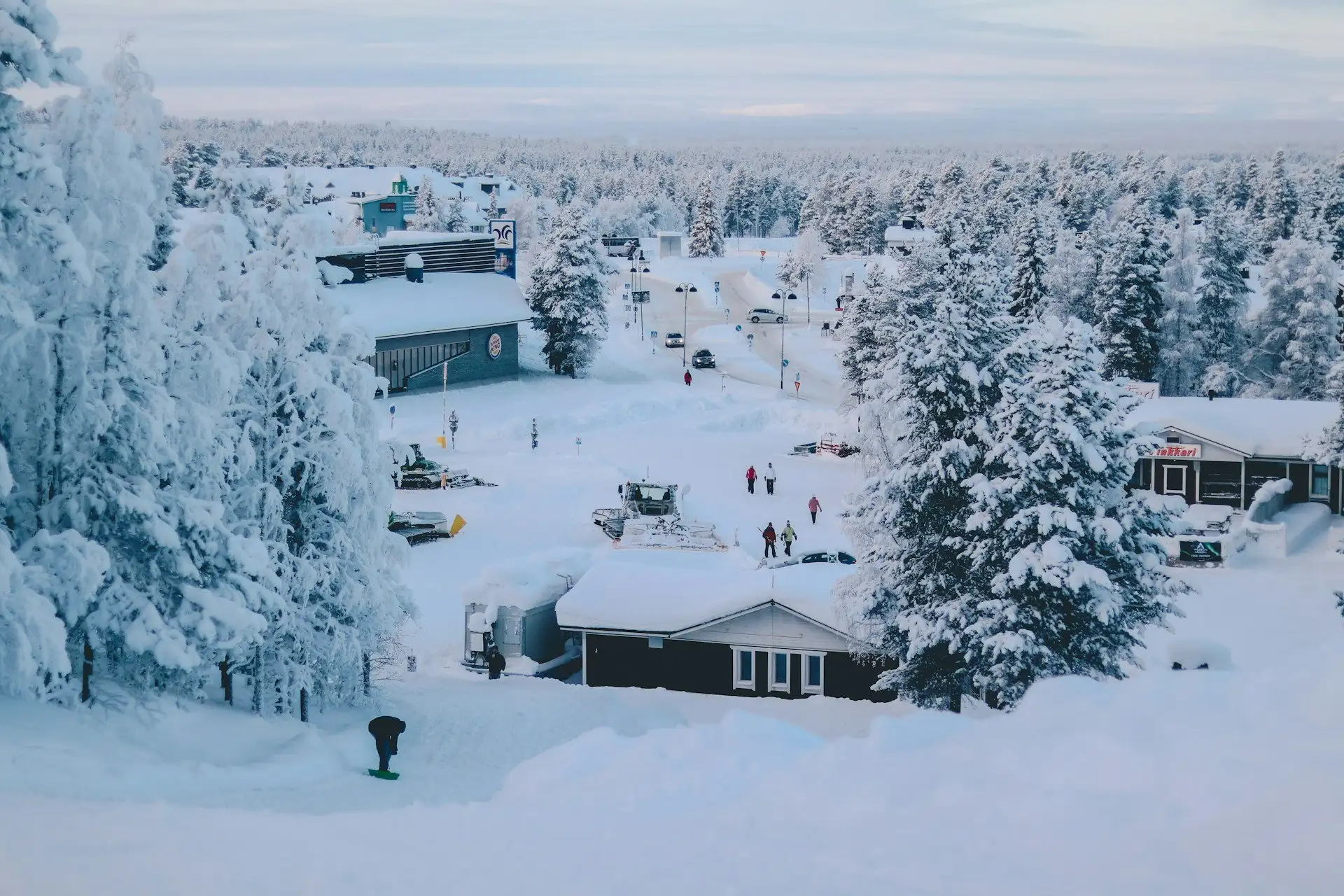
Finland is the country that keeps winning the World Happiness Report and somehow makes it look effortless rather than smug. Nearly 188,000 lakes, more forest per person than almost anywhere in Europe, a capital that treats good design as a civic duty rather than a luxury, and a northern third of the country that crosses the Arctic Circle into genuine reindeer-herding, husky-safari, northern-lights territory. Finland joined NATO in April 2023, sharing a 1,340-kilometer border with Russia, the longest of any EU member, a fact that shapes more of daily Finnish conversation than most visitors expect.
The country rewards travelers who come with a plan for two fairly different Finlands. The south, Helsinki, the Lakeland, Turku and the archipelago, is a green, watery, well-connected Europe with excellent trains and a coffee habit (Finns drink more coffee per capita than any nation on earth) that borders on national identity. The north, Lapland, is something else again: Sámi reindeer-herding communities, husky and snowmobile safaris, and, from late August through March, a real shot at the aurora borealis. Few countries fit both a European city break and something close to an Arctic expedition into one itinerary this cleanly.
The honest complications
Finland is genuinely expensive: restaurant meals, alcohol and taxis all carry some of the highest prices and taxes in the EU, and anything stronger than 5.5% beer is sold only through the state-run Alko monopoly with restricted hours. Winter in the south means short, grey daylight (Helsinki gets under six hours of weak daylight around the solstice), which some travelers find atmospheric and others find draining. Finns have a genuine reputation for reserved, low-small-talk communication, real rather than unfriendly, and it can read as coldness to visitors used to more performative warmth. And Lapland's marquee draw, the northern lights, is a probability game, not a guarantee: clear skies and solar activity both have to cooperate, and no operator can promise a sighting on any single night.
A History Worth Knowing
Finland spent roughly 700 years as part of Sweden, then became an autonomous Grand Duchy of Russia in 1809, declared independence in December 1917, survived a brutal civil war, and then twice fought off Soviet invasion in the Winter War and Continuation War without losing its sovereignty. Decades of careful Cold War neutrality followed, then EU membership in 1995, and in April 2023, a decisive break with that neutral tradition: full NATO membership.
- 12th-13th century
Swedish rule begins. Christianization and Swedish crown control gradually extend across Finland, shaping the country's legal and administrative traditions for the next 700 years.
- 1809
Grand Duchy of Russia. Sweden cedes Finland to Russia; Finland becomes an autonomous Grand Duchy under the Tsar, keeping its own senate, laws and, later, currency.
- 6 December 1917
Independence declared. Finland's parliament declares independence; the Bolshevik government in Russia recognizes it on 31 December 1917.
- 1918
Civil war. A short, bitter conflict between Reds and Whites follows independence, leaving scars on Finnish politics for a generation.
- 1939-1940
The Winter War. The Soviet Union invades; heavily outnumbered Finnish forces hold on for over three months before a peace treaty cedes Karelia but preserves independence.
- 1941-1944
The Continuation War. Finland fights the USSR again alongside Germany, ending in an armistice, war reparations, and the definitive loss of Karelia.
- 1995
EU membership. Finland joins the European Union; it adopts the euro in 2002, one of the first countries to do so.
- April 2023
NATO membership. Finland becomes NATO's 31st member, ending decades of military non-alignment in direct response to Russia's invasion of Ukraine.
Read the full history: sisu, the Winter War and the shift to NATO
Finland's centuries under the Swedish crown left it with Swedish law, a Swedish-speaking upper class, and, still today, Swedish as an official language alongside Finnish. The 1809 transfer to Russia was, unusually for the period, a genuine autonomy: Finland kept its own senate, legal system and eventually its own currency (the markka, from 1860) while the Tsar ruled as Grand Duke. Late 19th-century Russification attempts, restricting the Finnish senate's powers and pushing the Russian language, fed a nationalist movement built partly on the Kalevala, the national epic compiled from oral folklore in 1835, and on the music of Jean Sibelius.
Independence in December 1917 was immediately followed by a civil war between the socialist Reds and the conservative, German-backed Whites, a trauma that shaped Finnish politics for a generation. The Winter War of 1939-1940 is the story Finns tell most often about themselves: heavily outnumbered and outgunned, the Finnish army under Field Marshal Mannerheim held the Soviet invasion for over three months in brutal winter conditions before a peace treaty ceded roughly 10% of Finnish territory, mostly Karelia, while keeping the country independent. The concept of sisu, a stubborn, gritted-teeth resolve, is inseparable from how Finns remember it. The Continuation War of 1941-1944, fought alongside Germany in an attempt to reclaim the lost territory, ended in another armistice and further reparations to the USSR, reparations that, paradoxically, helped force the rapid industrialization of postwar Finland.
The Cold War brought a careful, sometimes uncomfortable neutrality known abroad as "Finlandization," staying formally non-aligned while managing a delicate relationship with the Soviet Union next door. Nokia, founded in 1865 as a paper mill, became the world's largest mobile phone maker through the 1990s and 2000s before losing that position to smartphones in the 2010s, a rise and fall that still shapes how Finland thinks about its economy. Russia's full-scale invasion of Ukraine in February 2022 ended the neutrality tradition almost overnight: Finland applied for NATO membership within months and became a full member in April 2023, doubling the alliance's direct border with Russia.
Top Destinations
Finland divides naturally into the green south (Helsinki, the Lakeland, Turku and the archipelago) and the Arctic north (Lapland). The country is long, roughly 1,160 kilometers from the south coast to the northern border, so combining both halves properly takes real time: a short trip should pick one, a two-week trip can do both without rushing either.
Helsinki, the design capital
Helsinki gets a full guide of its own, covering neighborhoods, where to stay, and every named restaurant and sight worth your time: read the complete Helsinki city guide. In short: a compact, walkable capital on a granite peninsula, built around Nordic design, Suomenlinna's sea fortress, and a genuinely excellent public transit network. Two to three days covers it well.
Porvoo, the postcard old town
Porvoo, about 52 kilometers east of Helsinki, is Finland's second-oldest town and the easiest half-day trip from the capital: cobbled streets, colorful wooden Old Town houses, and a row of red former warehouses along the river that shows up in half of Finland's tourism photography. Reachable by bus in under an hour; on summer Saturdays a heritage steam-era railcar runs the route as a novelty rather than a practical timetable.
Savonlinna & Lake Saimaa
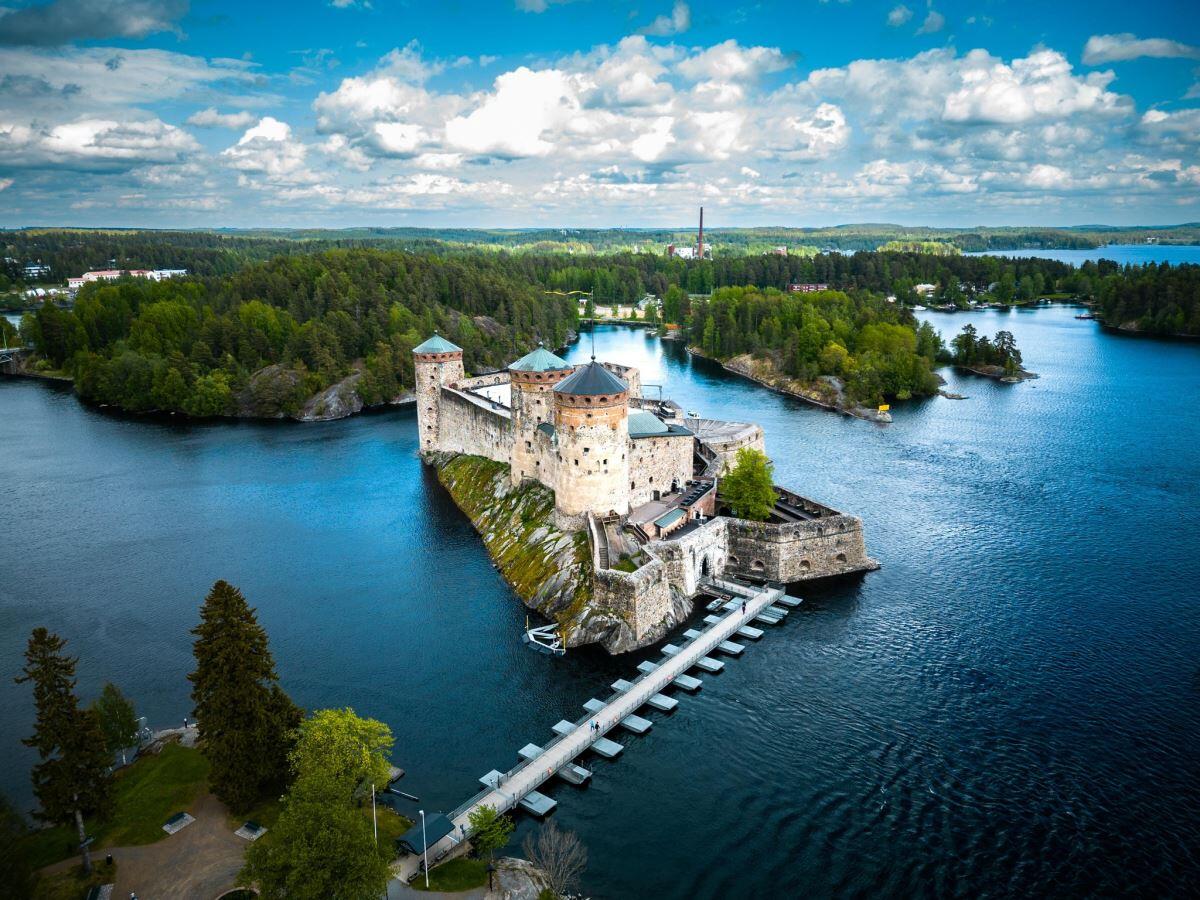
Savonlinna sits in the heart of the Saimaa lake system, Finland's largest, a sprawling maze of islands and channels that is also home to the rare, endangered Saimaa ringed seal, found nowhere else on earth. The town's landmark is Olavinlinna, the world's northernmost surviving medieval castle, built in 1475 on an islet in the strait; every July its courtyard becomes a 2,264-seat opera house for the month-long Savonlinna Opera Festival, Finland's best-known cultural event, drawing tens of thousands of visitors since Finnish soprano Aino Ackté staged the first festival there in 1912.
Punkaharju & the ridge
Punkaharju, a narrow, pine-covered esker ridge running between two lakes near Savonlinna, has been a scenic set-piece since the 19th century, when Tsar Alexander I ordered it protected. Walk or cycle the ridge road with water on both sides, or paddle the Saimaa channels by kayak: this is the region's classic, unhurried way to spend a day.
Rovaniemi & Santa Claus Village
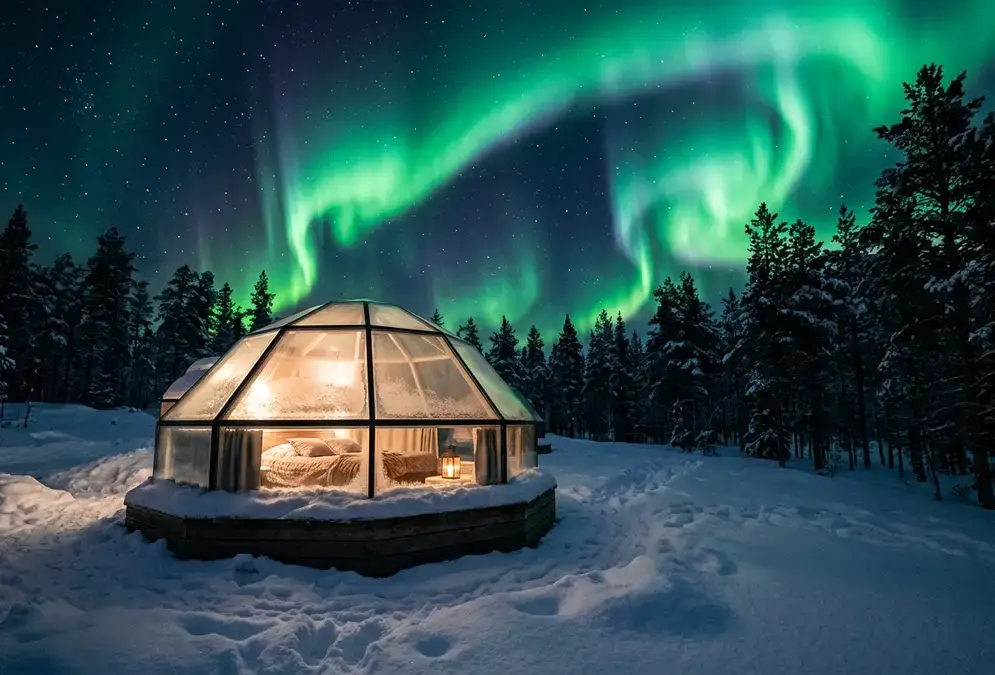
Rovaniemi, Lapland's capital, markets itself as the official hometown of Santa Claus, and Santa Claus Village, a short drive from the town center, straddles the Arctic Circle line itself: you can stand with one foot in each hemisphere and meet Santa on any day of the year. It's also the practical gateway for husky and reindeer safaris, snowmobile trips, and glass-roofed igloo stays under the aurora.
The northern lights & the midnight sun
North of the Arctic Circle, the aurora borealis is visible on a meaningful share of clear, dark nights roughly from late August through March, with the long winter darkness of December and January giving the most viewing hours, weather permitting. In summer the pattern flips entirely: for several weeks around the June solstice, the sun doesn't set at all this far north, the genuine midnight sun. Levi and Ylläs are Lapland's main ski and hiking resort towns; Inari, further north, is the center of Sámi culture and home to the Sámi parliament.
Turku, the original capital
Turku, on the southwest coast, is Finland's oldest city and was its capital until 1812, when the Russian Tsar moved the seat of government to Helsinki, closer to St. Petersburg. Turku Castle, begun in the 1280s, and Turku Cathedral, the medieval mother church of Finland's Lutheran faith, are both still standing and open to visitors. The Aura River running through the city center gives Turku a relaxed, low-rise feel that contrasts with Helsinki's density.
The Åland Islands
The Åland archipelago, an autonomous, demilitarized, Swedish-speaking region of Finland between Turku and Stockholm, is reachable by ferry from either city. Åland has its own flag, its own postage stamps, and a slower, more rural Baltic pace than mainland Finland; the wider archipelago beyond it, part of the Archipelago Sea, is dotted with tens of thousands of islands and islets, best explored by ferry-hopping or private boat in summer.
Sauna, a living tradition
Finland's sauna culture, the customs, rituals and social meaning around sauna bathing rather than the buildings themselves, was inscribed on UNESCO's Representative List of the Intangible Cultural Heritage of Humanity in December 2020, Finland's first entry on that list. With an estimated 3.2 million saunas for a population of 5.6 million, and roughly 90% of Finns bathing at least weekly, this isn't a spa amenity, it's closer to a national infrastructure. Public saunas in Helsinki are covered in the city guide; in the countryside, a wood-fired smoke sauna (savusauna) followed by a plunge into a lake is the archetypal version.
Everyman's right & the national parks
Finland's "everyman's right" (jokamiehenoikeus) is a longstanding legal principle that lets anyone roam, forage berries and mushrooms, and camp temporarily on most land, public or private, without asking permission, one of the most permissive access rights in Europe. Nuuksio National Park, about 45 minutes from Helsinki, is the easiest place to use it: lakes, pine forest and marked trails a short drive from the capital. Koli National Park in North Karelia, several hours further east, has Finland's most celebrated single view, the ridge overlooking Lake Pielinen that inspired both Sibelius and the painter Akseli Gallen-Kallela.
Hidden gems beyond the main circuit
The zones above cover a first or second trip well. With extra days, these are the spots that rarely make the standard guides but reward the detour.
Hanko
A Victorian-era seaside spa town on Finland's southernmost tip, with wooden villas, Baltic sandy beaches, and a quiet, faded-grandeur charm that most international visitors never see.
Koli National Park
Finland's most painted and photographed landscape: a forested ridge dropping to Lake Pielinen, the view that shaped 19th-century Finnish national romanticism.
Kuopio
A Lakeland city known for its smoke saunas and kalakukko, a rye-crust pie stuffed with fish and pork baked for hours: a proudly local dish you won't find pushed on visitors elsewhere.
Culture & Etiquette
Finnish culture runs on a specific, genuine reserve: comfort with silence, minimal small talk with strangers, and a strong respect for personal space, none of which is unfriendliness once you understand the code. Sisu, a stubborn, teeth-gritted resolve in the face of hardship, is the closest thing Finland has to a national personality trait, and it explains a lot about both the Winter War and the national relationship with harsh winters.
Do
- Take your shoes off indoors. Removing shoes at the door, in homes and often in saunas or some offices, is close to universal and expected of guests.
- Accept a sauna invitation. Being invited to sauna, whether at a Finnish home, a summer cottage or a public sauna, is a genuine social ritual, not a spa upsell. Going along, even briefly, is the polite response.
- Respect queues and personal space. Finns queue precisely and keep noticeable physical distance in public; standing too close or skipping a line reads as genuinely rude, not just awkward.
- Learn a couple of Finnish words. Kiitos (thank you) and Hei (hi) go further than you'd expect from a country this comfortable in English.
- Be on time. Punctuality is taken seriously for both social plans and public transport, which mostly runs exactly on schedule.
Don't
- Mistake reserve for hostility. A quiet tram car or a stranger who doesn't make small talk in a queue isn't being cold; it's the default social setting, not a reaction to you.
- Force conversation in lifts, queues or on public transport. Unprompted chat with strangers in these settings is unusual and can come across as intrusive rather than friendly.
- Expect to buy wine or spirits at a regular supermarket. Anything above 5.5% alcohol is sold only through the state Alko monopoly, with limited hours and no Sunday trading in most locations.
- Skip the plunge if you're at a lakeside sauna. Alternating sauna heat with a cold lake or sea dip is the whole point, not an optional extreme-sports add-on.
- Underestimate winter driving conditions. Ice, snow and moose or reindeer on rural roads, especially at dawn and dusk, are the real hazards outside the cities, not crime.
Deeper culture: the Kalevala, Sibelius, the Moomins and Sámi culture
The Kalevala. Finland's national epic, compiled from oral folk poetry by Elias Lönnrot and first published in 1835, gave 19th-century Finland a shared mythology and language it could rally around during Russification, and it still underpins Finnish art, place names and even the Finnish translation of "The Lord of the Rings," which J.R.R. Tolkien partly modeled his invented Elvish language on.
Jean Sibelius. Finland's most important composer, whose orchestral tone poem "Finlandia" (1899) became an unofficial anthem of national resistance during Russification and is still played at moments of national significance today.
The Moomins. Tove Jansson's hippo-like troll family, created from the 1940s onward, are Finland's best-known cultural export after Nokia and remain enormously popular with Finnish children and adults alike; Moominworld theme park operates near Naantali, close to Turku.
Sámi culture. The Sámi are Europe's only recognized indigenous people, with communities across northern Finland, Norway, Sweden and Russia. Finland's Sámi parliament sits in Inari, and reindeer herding remains a genuine livelihood, not a tourist performance, in much of Lapland; visitors should treat reindeer encounters and Sámi cultural sites with the same respect they'd bring to any working community.
Food & Drink
Finnish food is built around what the forests, lakes and short growing season actually produce: rye, wild berries and mushrooms, freshwater fish, and reindeer and game in the north. It's rarely showy, but a proper Finnish lunch buffet at a decent price and a good rye loaf will do more to explain the country than most restaurants aimed at tourists.
Ruisleipä Rye bread
Dense, dark, sour rye bread is closer to a national symbol than a side dish, eaten with butter, cheese or cold cuts at nearly every meal. Look for the darker, denser varieties over supermarket-soft versions.
Karjalanpiirakka ~€1-2
Karelian pasties: thin rye crusts filled with rice or potato porridge, traditionally topped with munavoi, a mashed egg-and-butter spread. A market or bakery staple and one of the best cheap breakfasts in the country.
Lohikeitto €12-18
A creamy salmon soup with potatoes and dill, found on nearly every casual lunch menu and at the Helsinki Market Square stalls. Simple, filling, and one of the country's genuine comfort foods.
Poronkäristys €18-28
Sautéed reindeer, thin-sliced and cooked in its own juices, traditionally served with mashed potato and lingonberry sauce. A Lapland specialty that has spread to menus across the country.
Berries & foraging
Bilberries (Finnish blueberries), lingonberries and, if you're lucky, cloudberries appear in everything from breakfast to dessert; thanks to everyman's right, foraging your own in season is genuinely legal almost anywhere.
Coffee culture €3-4/cup
Finland drinks more coffee per capita than any other country. Filter coffee, often with a cinnamon or cardamom bun (pulla) alongside, is the default café order rather than espresso drinks.
When to Go & Itineraries
Finland effectively runs two peak seasons on opposite ends of the calendar. June to August brings long daylight (up to around 19 hours in Helsinki, genuine midnight sun north of the Arctic Circle), warm Lakeland swimming weather, and the Savonlinna Opera Festival. December to February is Lapland's season: snow, huskies, reindeer, and the best odds of the northern lights, while the south turns dark, cold and comparatively quiet.
All four seasons compared, with temperatures
| Season | Verdict | Temps | Notes |
|---|---|---|---|
| Jun-Aug | Best for the south | 15-22°C Helsinki, warmer inland | Long daylight, Lakeland swimming, midnight sun in the far north |
| Dec-Feb | Best for Lapland | -15 to -5°C Lapland, 0 to -5°C Helsinki | Snow activities, northern lights, but short, dark days in the south |
| May & Sep | Good, quieter | 8-16°C | Lower prices, fewer crowds, unreliable weather |
| Mar-Apr & Oct-Nov | Shoulder | -5 to 10°C | Slushy transition months; not the best time for either half of the country |
Lapland's winter can drop well below -20°C in January; Helsinki rarely sees extreme cold thanks to the moderating Baltic Sea, but daylight around the December solstice is under six hours.
Itineraries
A week covers Helsinki plus one region well. Two weeks lets you combine the south and Lapland properly, which is when Finland's two-halves character really pays off.
- Days 1-3
Helsinki. Neighborhoods, Suomenlinna, the design museums, and a day trip to Porvoo. Full detail in the Helsinki city guide.
- Days 4-6
Fly to Rovaniemi. Santa Claus Village and the Arctic Circle, a husky or reindeer safari, and, in winter, an aurora-watching evening away from town lights.
- Day 7
Return to Helsinki. A last morning at the Market Square before departure.
- Days 1-3
Helsinki. The full city circuit; see the Helsinki guide for a street-by-street plan.
- Days 4-5
Turku & the archipelago. Turku Castle and Cathedral, then a short ferry into the Archipelago Sea or onward to Åland.
- Days 6-7
The Lakeland. Savonlinna and Olavinlinna Castle, a Saimaa kayak trip, and the Punkaharju ridge.
- Days 8-12
Lapland. Rovaniemi and Santa Claus Village, then Levi or Inari for skiing, Sámi culture, or deeper wilderness time.
- Days 13-14
Return south. Porvoo on the way back into Helsinki for a slower final stretch.
- Days 1-3
Helsinki extended. The full city guide, plus Porvoo and a slower pace through the design museums.
- Days 4-6
Turku & Åland. Turku's old town, then a proper two-night stint in the Åland Islands.
- Days 7-10
The Lakeland, unhurried. Savonlinna, Punkaharju, Kuopio's smoke saunas, and time on the water.
- Days 11-17
Lapland in depth. Rovaniemi, Levi or Ylläs, and Inari for Sámi culture, with several nights allocated purely to aurora chances.
- Days 18-21
Slow return. Koli National Park en route south, then a final unhurried stretch in Helsinki.
Getting there & around
Helsinki-Vantaa Airport (HEL) is Finland's main international gateway and Finnair's hub, with strong long-haul connections including some of the fastest routes between Europe and East Asia. Ferries also connect Helsinki to Tallinn (about 2.5-3.5 hours) and to Stockholm (overnight). VR's trains link the southern cities well: Helsinki to Turku in about two hours, Helsinki to Tampere in under two. Lapland is far enough that most visitors fly (about 1.5 hours from Helsinki to Rovaniemi) or take the overnight sleeper train rather than drive the 8-10 hour route.
Practical prep: SIMs, insurance and packing for the seasons
Buy a Finnish SIM at the airport or arrivals kiosks, or get an eSIM before landing; coverage is excellent even in rural Lapland. Standard travel insurance works for most of Finland, but confirm winter sports and remote-area coverage if you're doing snowmobiling, husky sledding or backcountry hiking. Pack in genuine layers for winter (thermal base layers, a proper insulated coat, waterproof boots): Lapland cold is a different order of magnitude from a typical European winter. In summer, a light jacket for cool evenings and, near lakes, some insect repellent for mosquito season (June-July) go a long way.
Where to stay
Helsinki
Covered in full in the Helsinki city guide, from hostel dorms to design hotels. The obvious first base for almost any Finland itinerary.
Lakeland cottages
Waterfront mökki cabins around Savonlinna and the Saimaa lakes, often with a private sauna, are the classic way to experience the Lakeland: book directly through regional tourism sites for the best selection.
Lapland glass igloos & cabins
Glass-roofed igloos for aurora-watching from bed, most famously at Kakslauttanen near Saariselkä, book out months ahead for winter; standard log cabins and hotels in Rovaniemi and Levi are considerably cheaper.
Turku & Åland
Central Turku hotels along the Aura River put you within walking distance of the castle and cathedral; Åland's main town, Mariehamn, has a small but reliable hotel selection for archipelago-hopping bases.
Budget Planning
Finland is genuinely one of the pricier countries in Europe, closer to Norway or Iceland than to the rest of the EU. There isn't really a cheap version of a Finland trip, but there is a well-managed one: lunch buffets, self-catering with supermarket groceries, and the extensive rail and transit network all keep costs from spiraling.
- Hostel dorm €24-40
- Lunch buffet (lounas) €12-15
- Public transport day pass
- Free museums, nature, everyman's-right camping
- Hotel or boutique guesthouse
- Restaurant dinners €25-45/person
- A paid museum or sauna experience daily
- Occasional taxis or domestic flights
- Design hotels or a Lapland glass igloo
- Michelin-tier dining
- Private guided safaris and tours
- Domestic flights over trains
Quick reference prices: coffee, transit, meals
| Filter coffee | €3-4 |
| Lunch buffet (lounas) | €12-15 |
| Mid-range dinner, no alcohol | €25-45 |
| Draft beer (bar) | €7-9 |
| HSL single ticket, Helsinki (app/card) | ~€3.30 |
| HSL day ticket, airport zone (ABC) | ~€12.80 |
| Hostel dorm bed | €24-40/night |
| Helsinki-Tallinn ferry, one way | from ~€14 |
Prices reflect August 2026 research and drift over time, especially transit fares, which HSL adjusts annually. Treat them as a planning baseline, not a quote.
Visa & Entry
Finland is a full Schengen Area member: US, EU, UK, Australian, Canadian and New Zealand citizens enter visa-free for up to 90 days in any 180-day period, and that allowance is shared across the entire Schengen zone, not just Finland. Rules do change; the Finnish Ministry for Foreign Affairs is the authoritative source. ETIAS, a pre-travel authorization for visa-exempt visitors, is expected to launch in late 2026 and will apply across all of Schengen, including Finland.
✓ Valid passport
Standard Schengen rule: valid for at least 3 months beyond your planned departure date, and issued within the last 10 years.
✓ Proof of funds & return travel
May be requested at the border for air arrivals, though it's rarely checked for typical Western passport holders on short stays.
✓ Schengen 90-day clock
Time in Finland counts against the same 90/180-day allowance as time in France, Germany or any other Schengen country. Track your days carefully on a multi-country European trip.
✓ ETIAS from late 2026
Once live, visa-exempt visitors will need to apply online before travel; it is not a visa and is expected to be inexpensive and largely automatic for most applicants.
| Finland | Estonia | |
|---|---|---|
| Daily budget | €70-100 gets you a lean day; genuinely expensive | €45-65 covers the same style of trip comfortably |
| Character | Nordic design, lakes and forest, Arctic Lapland | Baltic medieval old town, faster-growing digital scene |
| Getting there from each other | 2.5-3.5 hour ferry from Tallinn | Same ferry, same crossing time |
| Signature draw | Northern lights and Santa's official hometown | Tallinn's UNESCO-listed medieval Old Town |
| Schengen | Yes, shared 90-day clock | Yes, same shared clock |
Safety, Solo Women & Family
Finland is consistently rated one of the safest countries in the world. Violent crime against visitors is rare, and Helsinki and other Finnish cities are comfortable to walk at night with normal urban awareness. The real, practical risks for visitors are environmental rather than criminal: icy pavements and roads in winter, and moose or reindeer wandering onto rural roads, especially around dawn and dusk.
Winter conditions
Ice on pavements and roads causes more visitor injuries than anything else in Finland. Wear boots with real grip, walk deliberately, and if driving, fit winter tires (legally required in winter months) and slow down.
Wildlife on rural roads
Moose and reindeer collisions are a genuine road hazard outside towns, worse at dawn, dusk and in fog. Reduce speed on rural roads, especially in Lapland where reindeer roam freely near highways.
Petty theft
Low by European standards. Pickpocketing exists in crowded spots like Helsinki Central Station and busy trams, but at a noticeably lower rate than most major European tourist hubs.
Finland is not a high-scam destination: the honest, low-friction culture that makes daily life straightforward extends to tourism, and the deliberate overcharging or hustling common in some other guides on this site is genuinely rare here. Standard travel awareness, confirming taxi and tour prices upfront, is enough.
Solo women travelers
Finland rates very highly for solo women travelers: low harassment rates, safe public transport at any hour, and a culture where being left alone in public is the norm rather than something to navigate around. Helsinki, the Lakeland towns and Lapland's tourist infrastructure are all comfortable for solo travel. The main practical note is seasonal rather than social: winter darkness means planning outdoor activities, hikes, aurora-watching, around genuinely short daylight hours in the south. Full detail on our Solo Woman Explorer pages.
Emergency numbers
Finland uses a single number, 112, for police, ambulance and fire, reachable free from any phone, including a locked or SIM-less mobile.
Family travel & pets
Finland is an excellent family destination: playgrounds, family facilities and free nature access are everywhere, public transport is stroller-friendly, and Lapland's Santa Claus Village in Rovaniemi is built specifically around family visits and works well for kids of almost any age. Lakeland cottages with private lake access are also a natural fit for families wanting an unstructured week.
Bringing pets to Finland
EU pet passport holders can enter with dogs, cats and ferrets given valid rabies vaccination and a microchip, plus a tapeworm treatment for dogs arriving from outside Finland, Norway, the UK, Ireland or Malta. Non-EU visitors need an equivalent veterinary health certificate. Dogs are welcome in many outdoor spaces and some cafés, though leash rules apply in towns and nature reserves.
Finland FAQ
Is Finland safe to visit?
Yes, consistently rated one of the safest countries in the world. Violent crime against visitors is rare, and the main risks are winter road conditions and moose or reindeer on rural roads, not crime.
Is Finland expensive?
Yes, Finland is one of the pricier destinations in Europe. Budget travelers manage on €70-100 a day, mid-range on €150-220. Restaurant meals and alcohol carry some of the highest taxes in the EU.
Do I need a visa for Finland?
Citizens of the US, EU, UK, Australia and Canada can enter visa-free for up to 90 days in any 180-day period under Schengen rules. Finland is a full Schengen member, so time here counts against that shared 90-day allowance.
When is the best time to visit Finland?
June to August for Helsinki, the Lakeland and long daylight hours; December to February for Lapland, snow activities and the best chance of the northern lights. The two halves of the country effectively run on opposite peak seasons.
How many days do you need in Finland?
A week covers Helsinki and either the Lakeland or a short Lapland trip. Two weeks lets you combine Helsinki, the south coast and Lapland properly without rushing either.
Where can I see the northern lights in Finland?
Lapland, north of the Arctic Circle around Rovaniemi, Levi, Ylläs and Inari, offers the best odds, roughly from late August through March, with the darkest winter months giving the most viewing hours. Helsinki, at 60 degrees north, sees them only rarely and faintly.
Is Finland in the EU and Schengen?
Yes to both. Finland joined the EU in 1995, adopted the euro in 2002, and is a full Schengen member. It also joined NATO in April 2023.
What language is spoken in Finland?
Finnish and Swedish are both official languages, with Sami languages recognized in the north. English is spoken confidently by the large majority of Finns, especially anyone under 60, so language is rarely a barrier for visitors.
Is Finland good for solo female travelers?
Very. Finland regularly ranks among the safest countries in the world for women traveling alone, with low harassment rates and safe public transport at any hour.
Is Finland good for families with kids?
Yes. Playgrounds, family facilities and free nature access are everywhere, and Lapland's Santa Claus Village in Rovaniemi is built specifically around family visits.
What Stays With You
Finland doesn't oversell itself, which is exactly why it works. Nobody in Helsinki is trying to convince you the coffee break is sacred, or that a lake plunge after the sauna is the whole point of the evening: it just is, and you're welcome to notice or not. The forest goes on for a long time in every direction, the lakes outnumber almost anything else on the map, and somewhere past the Arctic Circle the sky occasionally does something that no photograph quite prepares you for.
Go for the design and the lakes in summer, or the dark and the aurora in winter, and don't be surprised if the quiet is the thing you end up missing most.