
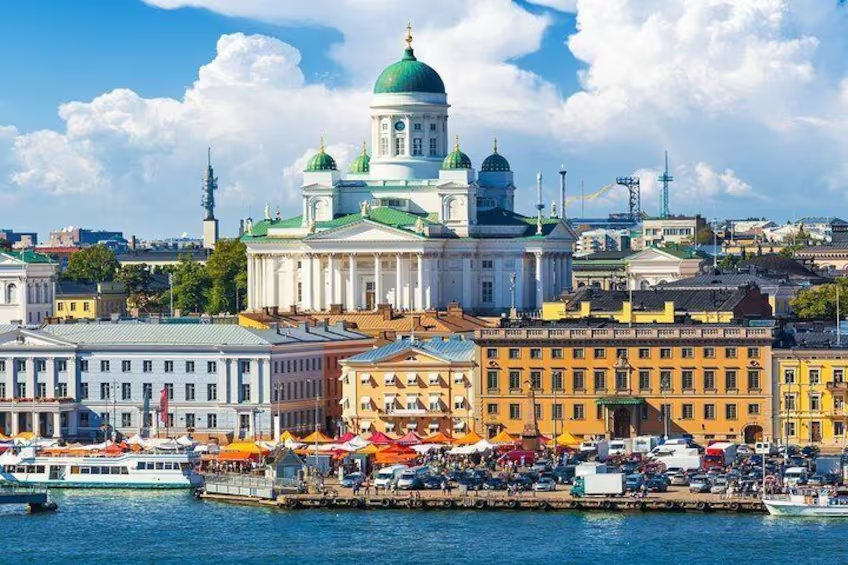
The capital that treats good design as infrastructure
Helsinki sits on a granite peninsula pushed out into the Gulf of Finland, surrounded by an archipelago of small islands, the sea fortress of Suomenlinna the most visible of them from the harbor. The city is compact, flat by Nordic standards, and built around the idea that design, in buildings, furniture, transit maps, everyday objects, should simply work well for everyone, not sit behind museum glass. It shows up everywhere from the trams to the public library.
What surprises first-time visitors is how livable the whole thing feels rather than how photogenic. Helsinki isn't chasing the tourist numbers of Paris or Rome, and it doesn't need to: a genuinely happy, orderly country's capital, with a serious sauna culture, an excellent transit network, and a Baltic-Nordic identity that borrows from Sweden, Russia and its own Finnish stubbornness in roughly equal measure. Go two streets back from the Market Square and you're in a neighborhood locals actually live in, where lunch costs €13 and the day's soup is chalked on a board.
The honest complications
Helsinki is expensive: restaurant dinners, taxis and alcohol all sit at the pricier end of Europe, and anything above 5.5% alcohol is sold only through the state Alko monopoly, which keeps limited hours and closes Sundays. Winter daylight is genuinely short, under six hours of weak light around the December solstice, which some visitors find atmospheric and others find hard going. Finns are reserved with strangers by default, not unfriendly, which can read as coldness if you're expecting more performative warmth. And several of the best sights, the design museums especially, are modest in scale: come for the city as a whole, not for one blockbuster attraction.
Five districts, one very walkable centre
Helsinki's centre is small enough that most visitors end up crossing several neighborhoods on foot without noticing. Where you base yourself comes down to how central you want to be and how much nightlife noise you can sleep through.
Kruununhaka
Helsinki's oldest district, home to Senate Square, the Presidential Palace and the government buildings, with cobblestone streets running down to the harbor. Helsinki Cathedral's white neoclassical facade dominates the skyline from here. Quiet at night, central by day, and the natural first base for a first visit.
Kamppi
Helsinki's modern commercial core, anchored by the Kamppi Center shopping and bus terminal where multiple metro and bus lines converge. Less scenic than Kruununhaka but extremely practical: everything in the centre is a short walk from here, including the design hotel Klaus K.
Punavuori
South of Kamppi, Punavuori anchors Helsinki's official Design District: independent boutiques, galleries and a fashionable cafe scene spread across a compact grid of streets. A good base for travelers who want to shop and eat rather than sightsee non-stop.
Kallio
Once working-class, now Helsinki's liveliest neighborhood for bars and independent restaurants, with noticeably cheaper prices than the centre. A short tram ride from everything that matters, and the base of choice for budget travelers who still want atmosphere.
Katajanokka
A residential peninsula east of the Market Square, home to Uspenski Cathedral and the former-prison Hotel Katajanokka. Quieter than the centre, with Art Nouveau apartment blocks and the Suomenlinna ferry terminal a short walk away.
From a converted prison to Helsinki's best hostel sauna
Helsinki's hotel scene runs from grand 19th-century classics to design-forward boutiques, with a genuinely good budget layer underneath. These five picks cover the range, and each earns its place for a specific reason beyond just location.
At the top, Hotel Kämp on the Esplanadi is Helsinki's grand historic address, a 19th-century landmark with spa facilities and a location in the middle of the design district, from around €400 a night. In the boutique bracket, Hotel Klaus K in Kamppi (from around €120-130) is a design hotel built around Finnish literary themes, a short walk from the Kamppi Chapel of Silence, with genuinely striking room design for the price.
For something with real history, Hotel Katajanokka (from around €130-170) occupies a former county prison dating to the 1830s, in use as a jail until 2002 and converted into a boutique hotel in 2007; the protected red-brick exterior and main hallway are the giveaway. At the budget end, Eurohostel near the Katajanokka ferry terminal has dorm beds from around €24 a night and a free Finnish sauna for guests, a genuinely good way to try the ritual without a separate booking. And in summer only, June through August, Academica Summer Hostel in Töölö turns university student housing into a budget hostel from around €47 a night, complete with its own sauna and kitchen.
Salmon soup, cinnamon buns and two Michelin stars
Helsinki's food scene runs from market-stall salmon soup to genuinely serious tasting menus, with rye bread, coffee and cinnamon buns as the connective tissue between every price point. Reservations matter more here than in most European capitals: the good tables book out.
Market Square (Kauppatori)
The waterfront market by the harbor is where locals and visitors both end up, selling fresh salmon, herring and the creamy dill-flecked lohikeitto (salmon soup) straight from stalls with harbor views. Go before the cruise-ship crowds arrive mid-morning for the best atmosphere.
Café Regatta
A tiny red seaside cottage café on the Töölö waterfront, famous for cinnamon buns baked and eaten by an open fire, with the water and, in season, the Sibelius Monument a short walk away. Small, crowded, and worth the wait.
Olo & Grön
Olo, near the Market Square, and Grön, founded by chef Toni Kostian in 2015, are both Michelin-starred kitchens built around Nordic ingredients and Finnish foraging traditions, the two names locals mention first when talking about the high end of Helsinki dining.
Restaurant Nolla
The Nordic region's first zero-waste restaurant, run without a single trash can: staff wear aprons made from recycled bed sheets, drinks arrive in repurposed bottles, and kitchen scraps go back to the farms that supplied them. It's also simply a well-regarded Finnish-Nordic tasting menu, not just a concept.
Kappeli
A 19th-century glass pavilion restaurant and cafe in the middle of Esplanadi park, one of Helsinki's oldest dining rooms and still a good spot for coffee and people-watching between museum stops.
Design, sea forts and a church carved into rock
Helsinki's sights are spread across a compact area, most of them reachable on foot or with one tram ride, and a handful genuinely need advance booking. This chapter moves through the city roughly the way a good two or three days would.
Suomenlinna, the sea fortress
Suomenlinna, a UNESCO World Heritage-listed 18th-century sea fortress spread across several linked islands, is Helsinki's single best half-day activity: 15 minutes by ferry from the Market Square, the crossing itself included on a standard HSL zone AB ticket. Wander the ramparts, tunnels and cannon positions freely, and stop at the Suomenlinna Museum for context on how the fortress shaped the city's defense for over two centuries.
Senate Square and the two cathedrals
Helsinki Cathedral, the white neoclassical landmark on Senate Square, anchors the classic postcard view of the city and is free to enter. Across the harbor in Katajanokka, Uspenski Cathedral, consecrated in 1868 and widely cited as the largest Orthodox church in Western Europe, offers a completely different, onion-domed red-brick counterpoint. Seeing both within an hour of each other is one of the more efficient ways to understand Helsinki's layered Swedish-Russian-Finnish history.
The rock church and the design museums
Temppeliaukio Church, the "Rock Church," is carved directly into solid granite bedrock with a copper dome overhead, a genuinely unusual piece of 1960s architecture and one of Helsinki's most photographed interiors; entry is a modest fee. The Design Museum (around €22) covers Finnish design history from Aalto to Marimekko, while the Ateneum Art Museum, the Finnish National Gallery, holds the country's best collection of Finnish and international painting. Kiasma, the Museum of Contemporary Art, rounds out the trio for anyone with a full design-and-art day in mind.
Oodi, sauna and the sea pool
Oodi, the central library facing the Parliament building, is free to enter and worth it purely as architecture: a striking wood-and-glass civic building that Helsinki treats as a genuine public living room, not just a book repository. For the sauna side of the city, Allas Sea Pool on the South Harbour combines heated pools with a cold sea-water basin and saunas overlooking the water, around €14 for adults, while Löyly, the architecturally striking public sauna on the Hernesaari waterfront, is the more design-forward, slightly pricier version of the same ritual with direct Baltic Sea plunge access.
One, two or three days, planned district by district
Three full days covers Helsinki properly, including Suomenlinna and a sauna session; even one well-planned day delivers the highlights. These routes are walkable, with the ferry timed to avoid the worst crowds.
- Morning
Senate Square and the cathedrals. Helsinki Cathedral, then across the harbor to Uspenski Cathedral in Katajanokka.
- Midday
Market Square lunch. Salmon soup from a harbor stall, then the ferry out to Suomenlinna.
- Afternoon
Suomenlinna. Two to three hours on the fortress islands, back on the ferry by late afternoon.
- Evening
Design District dinner. A lounas-priced kitchen in Punavuori, then a walk through Esplanadi park past Kappeli.
- Day 1
The one-day route: Senate Square, Uspenski Cathedral, Market Square lunch, Suomenlinna, Design District dinner.
- Day 2 morning
Temppeliaukio Church and the museums. The Rock Church first, then the Design Museum or Ateneum depending on your interest.
- Day 2 afternoon
Oodi and Kiasma. The central library, then contemporary art next door, both an easy walk from Kamppi.
- Day 2 evening
Sauna and Kallio. A session at Allas Sea Pool or Löyly, then dinner and drinks in Kallio for the local nightlife.
- Days 1-2
The two-day route above, at a gentler pace, adding Café Regatta by the Töölö waterfront.
- Day 3, option A
Porvoo. A half-day trip to Finland's postcard-pretty old town, back in Helsinki by evening.
- Day 3, option B
Nuuksio National Park. A slower nature day about 45 minutes from the city, lakes and pine forest under everyman's right.
Compact, flat, and one of Europe's easiest transit systems
Helsinki-Vantaa Airport (HEL) sits about 19 kilometers north of the centre. The I and P airport trains run to the city in roughly 30 minutes and require an ABC-zone HSL ticket (around €5-6 for a single fare); a taxi or rideshare takes 25-35 minutes depending on traffic. Within the city, HSL runs trams, buses, the metro and commuter trains on a single zone-based ticket: a standard AB-zone single costs around €3.30 bought on the HSL app or card (€3.50 for contactless card payment on board), and day tickets covering one to 13 days are better value for most stays.
The Suomenlinna ferry is operated within the HSL network and included on a standard AB-zone ticket, so no separate fare is needed to reach the fortress. Helsinki's historic tram network is one of the most useful in Europe for visitors: routes cross most of the neighborhoods described above, and riding one end to end is a reasonable way to get oriented on arrival.
Best time to visit and the summer daylight
Helsinki has a moderate, Baltic-influenced climate for its latitude. June to August brings genuinely long daylight, up to around 19 hours around the solstice, though Helsinki itself sits south of the Arctic Circle and doesn't get true midnight sun. Winter (December-February) is atmospheric with snow and Christmas markets but daylight drops to under six hours around the solstice; layer up, the cold is real even if it's milder than Lapland.
One of the Nordics' pricier capitals, managed well
Helsinki costs more than most European capitals, closer to Stockholm or Oslo than to Berlin or Lisbon. The hostel layer is genuinely good value, the lunch buffet keeps food costs sane, and the main trap is ordering wine or spirits at restaurant markup instead of planning an Alko stop.
- Hostel dorm €24-40
- Lunch buffets and market stalls €15-25
- HSL day ticket and walking
- Free Oodi, Suomenlinna grounds, one paid sight
- Boutique hotel €130-200
- Restaurant meals with a glass of wine €40-70
- HSL day tickets plus the occasional taxi
- Suomenlinna, a museum, a sauna session
- Hotel Kämp or equivalent €400+
- Tasting menus at Olo or Grön
- Private guided tours
- Löyly private sauna sessions
One of Europe's safest capitals, with two things to know
Helsinki rates 9.2/10 on our safety scale. Violent crime against tourists is extremely rare, the city is comfortable to walk at night including Kallio's bar streets, and Helsinki is excellent for solo female travelers: harassment is rare and public transport feels safe at any hour.
The two things that actually catch visitors: icy pavements in winter, genuinely the most common cause of visitor injury, so wear boots with real grip from November through March; and pickpocketing, low by European standards but not zero, concentrated around the Central Railway Station and crowded trams in summer. Emergency number is the single Finnish line 112, used for police, ambulance and fire, free from any phone.
Old towns, national parks and Estonia across the water
Helsinki's position on the Gulf of Finland makes it a strong base for day trips in three directions: inland to nature, east to Finland's prettiest old town, or across the water to another country entirely.
Porvoo
Finland's second-oldest town, with cobbled streets, colorful wooden Old Town houses and a row of red riverside warehouses that appear in half the country's tourism photography. Small enough to see properly in half a day; a bus takes under an hour, and on summer Saturdays a heritage steam railcar covers the same route as a scenic novelty.
Nuuksio National Park
The closest real wilderness to the capital: lakes, pine and spruce forest, and marked trails you're free to hike, camp beside and forage from under Finland's everyman's right. A genuine escape from the city without a full day lost to travel.
Tallinn, Estonia
Multiple daily ferries (Tallink Silja, Viking Line and Eckerö Line) cross to Tallinn's UNESCO-listed medieval Old Town in roughly 2.5 to 3.5 hours depending on the operator, with same-day return fares from around €14. It's a genuinely different country and a different architectural tradition in half a day's travel, no visa complications since Finland and Estonia share the same Schengen 90-day clock.
Helsinki FAQ
Is Helsinki safe for tourists?
Helsinki is one of the safest capital cities in Europe. Violent crime against tourists is extremely rare; the main concerns are icy pavements in winter and occasional pickpocketing around the Central Railway Station and crowded trams. Standard city awareness is all you need.
How many days do I need in Helsinki?
Two to three full days covers the city well: one for the historic centre and Suomenlinna, one for the design museums and Katajanokka, one for Kallio, sauna culture and a slower pace. A fourth day fits a Porvoo or Tallinn day trip.
How much does Helsinki cost per day?
Budget travellers manage on €75-110 a day with hostels and lunch buffets; mid-range runs €160-230. Helsinki is one of the pricier Nordic capitals, closer to Stockholm or Oslo than to most of continental Europe.
When is the best time to visit Helsinki?
June to August: long daylight up to around 19 hours, warm enough for outdoor cafes and Suomenlinna picnics, and the liveliest the city gets. Winter (December-February) is atmospheric and quiet but daylight drops to under six hours around the solstice.
How do I get from Helsinki Airport to the city centre?
The I and P airport trains run to the centre in about 30 minutes and require an ABC-zone HSL ticket, around €5-6 for a single. A taxi or rideshare takes 25-35 minutes depending on traffic.
What is the best area to stay in Helsinki?
Kruununhaka or Kamppi for first-timers: central, walkable and close to Senate Square and the harbour. Katajanokka for a quieter waterfront setting near the Suomenlinna ferry. Kallio for budget stays and nightlife.
Do I need to speak Finnish in Helsinki?
No. English is spoken confidently by the large majority of Finns, especially anyone under 60, and nearly all hotels, restaurants and museums operate comfortably in English.
Is Helsinki walkable?
Yes, the centre is compact and flat by Nordic capital standards. Trams and the metro cover longer distances easily, and the Suomenlinna ferry is included on a standard HSL zone AB ticket.
What is the HSL ticket and do I need one?
HSL is Helsinki's transit system, covering trams, buses, the metro, commuter trains and the Suomenlinna ferry. A single AB-zone ticket costs around €3.30 bought on the app or card; day tickets are better value for a multi-day stay.
What Stays With You
Helsinki doesn't perform for visitors, and that's exactly why it works. The city gets on with its routines, the coffee break, the after-work sauna, the ferry commuters heading out to the islands, and simply lets you walk through the middle of it. The cathedral steps at golden hour, the first cinnamon bun by the fire at Café Regatta, the €15 lunch that outclassed a €50 dinner elsewhere: none of it was staged, which is why it sticks.
Take the ferry out to Suomenlinna on a clear evening, watch the city recede across the water, and understand why Finns keep winning that happiness ranking without seeming to try very hard.