
What You're Actually Getting Into
Iceland has gone from a little-visited stopover between North America and Europe to one of the most photographed countries on earth in about fifteen years, and the landscape mostly explains why: this is a country still being built by the same geological forces that built it in the first place. The Reykjanes Peninsula, thirty minutes from the capital, has erupted repeatedly since 2021. The Mid-Atlantic Ridge runs straight through Thíngvellir National Park, visibly pulling North America and Europe apart at about two centimeters a year. Geothermal energy heats nearly every building on the island and feeds the Blue Lagoon and Sky Lagoon that most visitors end up soaking in at some point.
None of this comes cheap. Iceland imports most of its food and consumer goods across open ocean to a population of under 400,000, and prices reflect it: a casual restaurant meal runs $25-35, a pint of beer $10-12, a modest hotel room $180-250 a night in summer. What you get in exchange is a landscape with almost no equivalent anywhere else that's this accessible: waterfalls you can walk behind or beside within a two-hour drive of the capital, black sand beaches, glaciers, and a level of personal safety that lets you actually relax into it.
The honest complications
Iceland's weather changes fast and without much warning: rain, wind and sun can all happen within an hour, and the Icelandic Met Office's road and weather alerts (safetravel.is and vedur.is) are not optional reading before you drive anywhere outside the capital. The Reykjanes Peninsula near Grindavík has experienced repeated volcanic eruptions since 2021, most recently ending in August 2025, and magma has continued accumulating beneath the area since; it is a real, monitored, geographically contained situation, not a country-wide one, but it can affect the Blue Lagoon's opening hours and a small area of road on short notice. And the cost is not a minor inconvenience: this is one of the most expensive countries in Europe to eat, sleep and rent a car in, and a trip planned on a Southern European budget will run into trouble fast.
A History Worth Knowing
Iceland was one of the last places in Europe to be settled, first by Norse chieftain Ingólfur Arnarson around 874 AD, and the country's medieval sagas, still readable by modern Icelanders in something close to the original, record that founding era in unusual detail. Six centuries under Norwegian and then Danish rule followed, ending in a 1944 independence vote so lopsided it reads like a typo. The modern story is shorter and stranger: a 2008 banking collapse that briefly made Iceland an economic cautionary tale, followed by a tourism boom that reshaped the entire economy within a decade.
- c. 874 AD
Settlement. Ingólfur Arnarson, traditionally credited as the first permanent Norse settler, establishes a farm at what becomes Reykjavík.
- 930 AD
The Althíngi founded. Chieftains establish a national assembly at Thíngvellir, among the oldest continuously operating parliamentary institutions in the world.
- 1262
Union with Norway. Iceland submits to the Norwegian crown, ending the medieval commonwealth period; Danish control follows in the 14th century.
- 1944
Independence. Iceland becomes a republic on 17 June, with over 97% of voters backing the split from occupied Denmark.
- 2008
Banking collapse. Iceland's three major banks fail within days of each other, one of the most severe national economic crises of the modern era.
- 2010-present
Tourism boom. The Eyjafjallajökull eruption puts Iceland on the world's front pages; visitor numbers grow roughly tenfold over the following decade.
Read the full history: the sagas, the Cod Wars, and the 2008 crash
Iceland's medieval sagas, written down mostly in the 13th century about events several centuries earlier, are the country's founding literary achievement and remain a genuine point of national identity: modern Icelanders can read them with only moderate difficulty, a linguistic continuity almost unmatched in Europe. The Althíngi, founded in 930 at Thíngvellir, is frequently cited as the world's oldest parliament, though it lost real legislative power for centuries under Norwegian and Danish rule and was only fully restored after independence.
The 20th century brought a slow, largely peaceful path to full sovereignty: home rule in 1904, a personal union with Denmark in 1918, and full independence in 1944, declared at Thíngvellir itself. The mid-to-late 20th century "Cod Wars," a series of fishing-rights disputes with the United Kingdom that involved actual ship-ramming incidents in the North Atlantic, ended in Iceland's favor and shaped its fiercely protected 200-mile fishing zone today.
The 2008 financial crisis hit Iceland harder relative to its size than almost any other country: all three major banks collapsed within a week, the currency lost roughly half its value, and the country briefly became a global symbol of financial overreach. The recovery, helped by a currency devaluation that made Iceland suddenly cheap and by the global attention from the 2010 Eyjafjallajökull eruption that grounded European air travel for days, fed directly into the tourism boom that has since become the country's largest industry, now larger than fishing.
Top Destinations
Iceland divides naturally into the capital region, the Golden Circle, the South Coast, the Snæfellsnes Peninsula, and the wider Ring Road that circles the whole island. Most first-time visitors, correctly, spend the bulk of their trip in the southwest quarter: it holds the highest concentration of accessible highlights anywhere on the island, all within a few hours of Reykjavík.
Reykjavík, the world's northernmost capital
Reykjavík is small by capital-city standards, walkable in its entirety, and the natural base for anyone not doing a full Ring Road loop. The full Reykjavík city guide covers neighborhoods, hotels, restaurants, day trips and a full itinerary. It's also, practically speaking, the only real airport gateway: Keflavík International Airport (KEF) sits about 45 minutes southwest of the city.
Thíngvellir, Geysir & Gullfoss
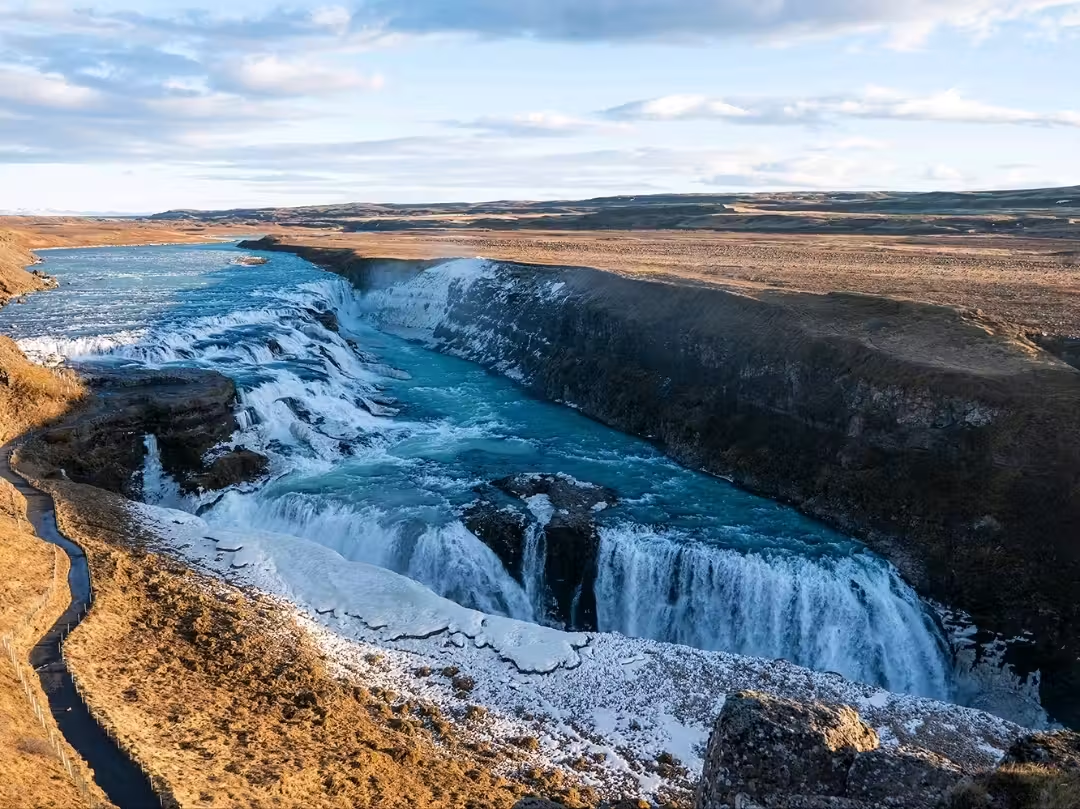
The Golden Circle is a roughly 230-kilometer loop, under 100km from Reykjavík at its closest point, and the single most-visited route in the country for good reason: three major sights within a comfortable day. Thíngvellir National Park is both the site of the historic Althíngi and the visible rift where the North American and Eurasian tectonic plates pull apart. Geysir, the geothermal field that gave the English word "geyser" its name, has the reliably active Strokkur erupting every few minutes to heights of 15-20 meters. Gullfoss, the "golden falls," drops the gláacial Rívar River into a canyon in two dramatic stages. All three sites are free to enter; parking runs about 1,000 ISK per car at Thíngvellir and Geysir.
Seljalandsfoss, Skógafoss & Reynisfjara
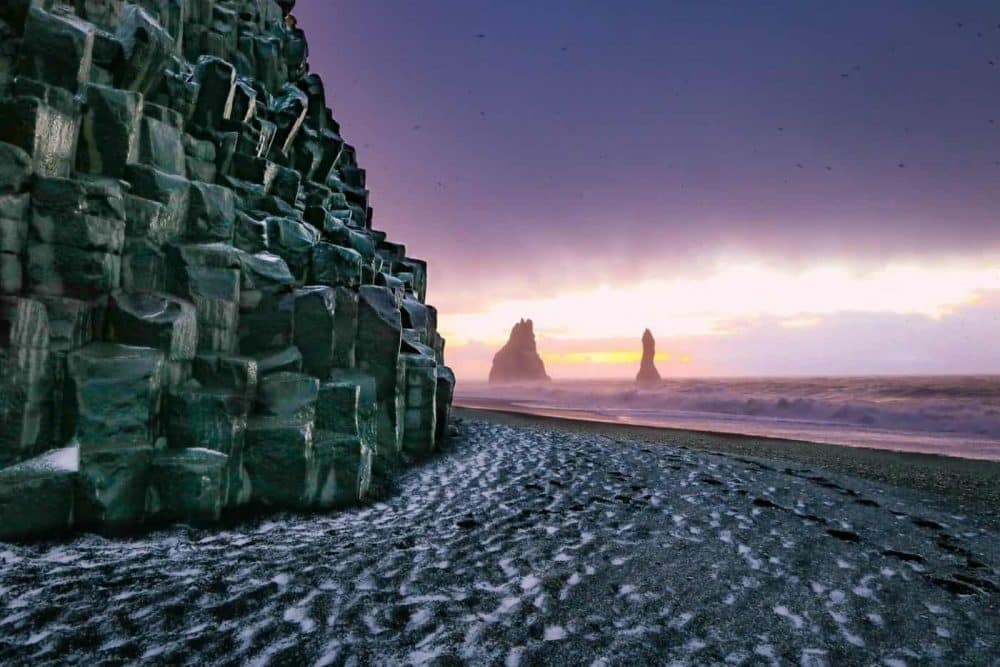
The South Coast, following Route 1 east from Reykjavík, packs an extraordinary concentration of landmarks into a single road. Seljalandsfoss, about two hours from the capital, is famous for the path behind the falling water itself (bring a rain layer). Half an hour further, Skógafoss drops 60 meters in a single sheer curtain, with a staircase to a viewing platform at the top. Another thirty minutes on, the village of Vík í Mýrdal and the black sand beach at Reynisfjara, with its basalt columns and sea stacks, are Iceland's most photographed stretch of coastline, and also the site of genuinely dangerous sneaker waves: never turn your back on the ocean here.
The peninsula nicknamed "Iceland in miniature"
Snæfellsnes, about two hours (145km) west of Reykjavík, packs glaciers, lava fields, black and golden beaches and fishing villages into a single peninsula, which is exactly why it earns the "Iceland in miniature" tag. Kirkjufell, a distinctively pointed mountain near Grundarfjörður, is one of the most photographed peaks in the country. The Snæfellsjökull glacier-topped volcano, made famous internationally by Jules Verne's "Journey to the Center of the Earth," anchors its own national park at the peninsula's tip. Circling the full peninsula in a day is intensive (10-12 hours) but genuinely feasible.
The full loop: Route 1
The Ring Road (Route 1) circles the entire island, roughly 1,330 kilometers, and rewards travelers with two weeks or more: Jokulsárlón glacier lagoon and its neighboring Diamond Beach in the southeast, the volcanic and geothermal area around Mývatn in the north, and Akureyri, the "capital of the north," among the highlights. The interior Highlands, reached mostly by unpaved F-roads that require a 4x4 and are only open in summer (roughly June to September, conditions permitting), hold Landmannalaugar's rhyolite mountains and geothermal hot rivers but are a separate, more demanding trip layered on top of the Ring Road itself.
Hidden gems beyond the main circuit
The zones above cover a first or second trip well. With extra days or a full Ring Road loop, these are the spots that reward going further.
Jokulsárlón & Diamond Beach
A glacial lagoon where icebergs calve off Vatnajökull and drift out to a black beach studded with washed-up ice chunks. About 5 hours from Reykjavík one-way, usually a Ring Road stop rather than a day trip.
Mývatn & Húsavík
A geothermal lake district with lava formations, mud pools and its own nature baths, plus Húsavík, widely considered Iceland's best whale watching town.
Landmannalaugar
Rhyolite mountains in improbable reds, greens and yellows, plus a natural hot river to soak in after the hike. Reached by F-road, 4x4 required, open roughly June to September.
The Westfjords
The least-visited major region: dramatic fjords, the Látrabjarg bird cliffs, and Dýnján, sometimes called Iceland's Grand Canyon. Long drives, minimal crowds.
The Westman Islands (Vestmannaeyjar)
A volcanic archipelago reached by ferry from Landeyjahofn, with one of Europe's largest puffin colonies and the 1973 Eldfell eruption site, where part of the town was buried in lava.
Vatnshellir Cave
An 8,000-year-old lava tube on Snæfellsnes, open on guided tours only, that descends into the volcanic system that likely inspired Jules Verne.
Culture & Etiquette
Icelandic culture runs on a small, tight-knit population (under 400,000 people) with a literary tradition older than almost anywhere else in Europe and a famously dry, understated sense of humor. Icelanders use patronymic surnames rather than family surnames, formed from a parent's first name plus "-son" or "-dóttir," which is why the national phone directory is alphabetized by first name. Belief in the "hidden people" (huldufolk), elf-like beings said to live in rocks and lava fields, remains a genuine if often tongue-in-cheek part of the culture: road planning has occasionally been rerouted around specific rocks out of local caution.
Do
- Shower before entering any pool or hot tub. Iceland enforces this strictly at public geothermal pools, thoroughly and without a swimsuit; it's a genuine hygiene norm, not a suggestion.
- Take your shoes off indoors. Icelandic homes, and some guesthouses, expect shoes off at the door.
- Book restaurants and popular tours ahead in summer. July and August fill up fast given the country's small hospitality capacity relative to visitor numbers.
- Check road and weather conditions daily. road.is and vedur.is are standard reading before any drive outside Reykjavík, even in summer.
- Use "please" sparingly and directness generously. Icelandic doesn't have a direct equivalent of "please" the way English does; polite phrasing and tone carry the courtesy instead.
Don't
- Drive off marked roads or park on moss. Icelandic moss takes decades to regrow once damaged, and off-road driving is illegal and heavily fined.
- Ignore weather and road closures. Underestimating Icelandic weather is the leading cause of visitor rescues and fatalities, not crime.
- Get too close to cliff edges, glaciers or the ocean at Reynisfjara. Unstable edges, hidden crevasses and sneaker waves have all caused serious visitor incidents.
- Expect tipping culture. Service is included in prices; tipping is not expected and can even seem to over-formalize a casual interaction.
- Assume all "Ring Road" sections are paved and open year-round. Sections of the interior and even parts of the ring itself can close seasonally.
Deeper culture: the sagas, hidden people, and gender equality
The sagas. Written mostly in the 13th century about events from earlier centuries, the Icelandic sagas are prose narratives of feuds, settlement and exploration that remain foundational to national identity and, unusually, are still readable by native speakers today with only moderate difficulty thanks to the language's slow rate of change.
Huldufolk. Belief in hidden people and elves persists as a genuine, if often lightly held, part of the culture; several road projects have been altered around specific rock formations after local objection, and it's treated with more sincerity in rural areas than in Reykjavík.
Gender equality. Iceland has topped the World Economic Forum's Global Gender Gap Index for over a decade, and this shows up practically: extensive parental leave, high female workforce participation, and a culture that visiting solo women in particular tend to find notably comfortable.
Patronymic names. Instead of inherited family surnames, most Icelanders take their father's (or, increasingly, mother's) first name plus "-son" or "-dóttir." Formal address uses first names, including for the President.
Food & Drink
Icelandic food centers on what the island actually produces well: lamb that graze free-range on wild herbs, extraordinarily fresh seafood, and skyr, a thick, protein-heavy dairy product technically a soft cheese despite being sold as yogurt. Prices are high across the board, so the best-value eating is often the most traditional: a hot dog stand or a bowl of soup rather than a formal restaurant.
Pylsur (hot dogs) ~$6-8
The Icelandic hot dog blends lamb, pork and beef, served "with everything": ketchup, sweet mustard, remoulade, raw and crispy fried onion. Cheap, ubiquitous, and genuinely good.
Lamb & Seafood $30-50
Free-range lamb and fresh cod, haddock or arctic char, often simply grilled or pan-fried, are the backbone of Icelandic dining, at both casual and fine-dining prices.
Skyr ~$4-6
A centuries-old Icelandic dairy staple, thick and tangy, technically a fresh cheese despite being marketed and eaten like yogurt. Available everywhere from gas stations to fine dining desserts.
Lobster Soup $20-30
A creamy, langoustine-based soup that's become something of a national specialty at harbor-side restaurants, particularly around Reykjavík's Old Harbour.
Brennívín
Iceland's signature schnapps, an unsweetened caraway-flavored spirit nicknamed "Black Death," traditionally taken alongside fermented shark as a rite of passage for visitors.
Hákarl (fermented shark)
Cured, ammonia-scented Greenland shark, a genuine if extreme culinary tradition and more of a dare than a daily food; sold in small cubes for the curious.
When to Go & Itineraries
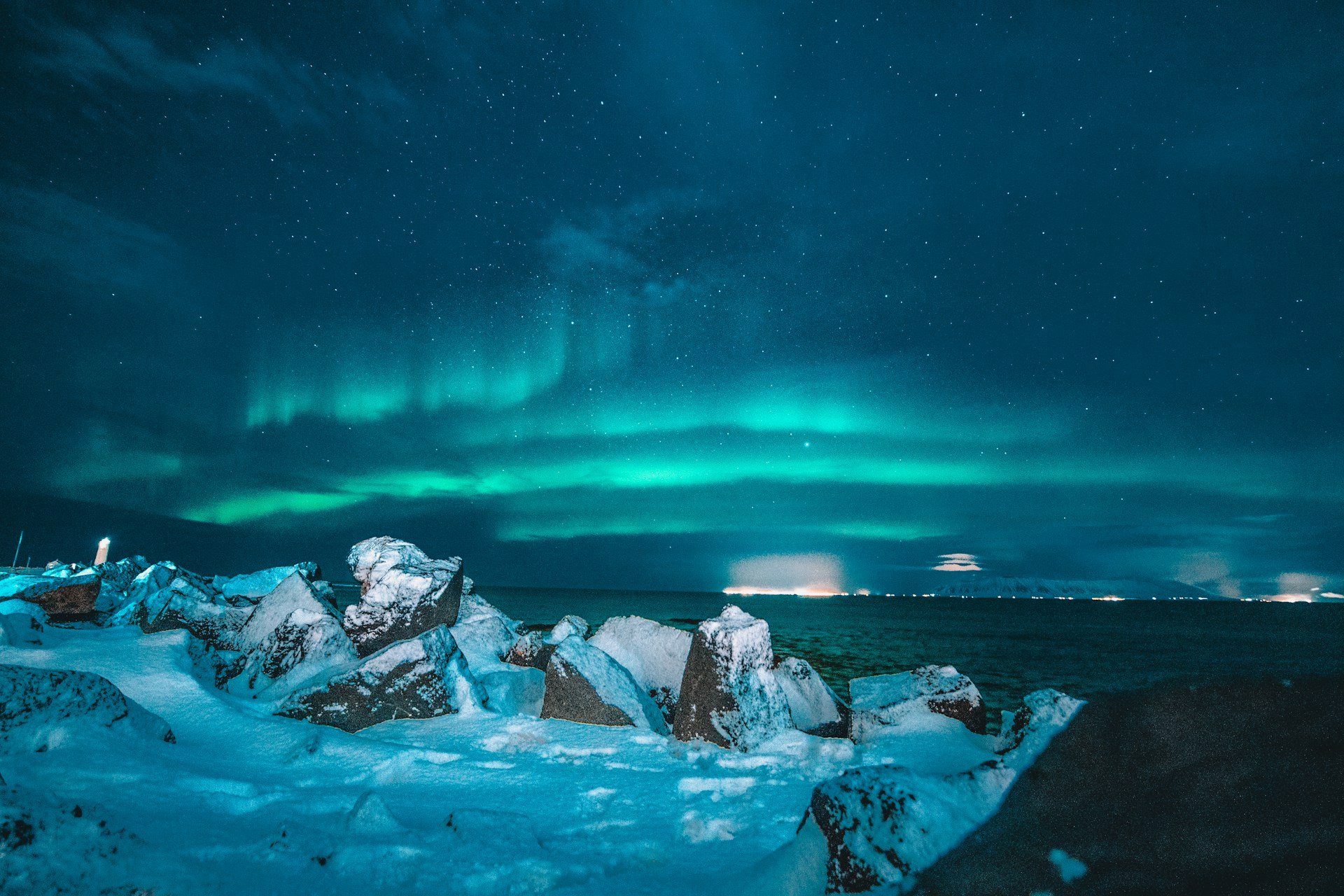
June through August brings near-24-hour daylight (the sun barely sets from mid-May to mid-August), the mildest weather, whale watching at its best, and full access to the Highlands, but also peak prices and the biggest crowds at marquee sites. September through March flips the trade-off: real odds at the Northern Lights, noticeably lower prices, but as little as 4-5 hours of daylight in December and January, and winter driving conditions that demand real caution.
All seasons compared, with daylight and temperatures
| Season | Verdict | Daylight | Prices & access |
|---|---|---|---|
| Jun-Aug | Best for access | ~20-24 hrs | Peak prices; Highlands F-roads open |
| Sep-Oct | Good balance | ~10-14 hrs | Lower prices, early Northern Lights chances |
| Nov-Feb | Best for aurora | ~4-7 hrs | Lowest prices; winter driving, F-roads closed |
| Mar-May | Good, variable | ~10-17 hrs | Shoulder prices; roads reopening gradually |
Reykjavík averages around 13°C in July and around 0°C in January, but "feels like" temperatures run colder with wind chill, which is near-constant. Iceland does not observe daylight saving time and stays on GMT year-round.
Itineraries
Seven days covers the southwest highlights well without rushing. Two weeks allows a full, unhurried Ring Road circuit of the island; three weeks adds the Westfjords or a genuine Highlands detour.
- Days 1-2
Reykjavík. Settle in, Hallgrímskirkja, the Old Harbour, and jet lag recovery.
- Day 3
Golden Circle. Thíngvellir, Geysir and Gullfoss as a self-drive or organized day tour.
- Days 4-5
South Coast. Seljalandsfoss, Skógafoss, Reynisfjara and Vík, overnighting near Vík or Hella.
- Days 6-7
Blue Lagoon or Sky Lagoon, then Reykjavík. A geothermal soak on the way back toward Keflavík, final night in the capital.
- Days 1-2
Reykjavík and the Golden Circle.
- Days 3-5
South Coast to Jokulsárlón. Seljalandsfoss, Skógafoss, Reynisfjara, then on to the glacier lagoon and Diamond Beach.
- Days 6-8
East & North. The Eastfjords, then across to Mývatn's geothermal area and Húsavík for whale watching.
- Days 9-10
Akureyri & back west. The "capital of the north," then the long drive back toward the west coast.
- Days 11-12
Snæfellsnes Peninsula. Kirkjufell, the national park, and coastal villages.
- Days 13-14
Reykjavík. A geothermal lagoon and a slower final couple of days in the capital.
- Days 1-3
Reykjavík & Golden Circle, at a gentler pace.
- Days 4-7
South Coast to Jokulsárlón, with time added for the Vestmannaeyjar ferry and puffin colonies (summer only).
- Days 8-11
East, Mývatn & Húsavík, with an extra night for the Eastfjords' quieter villages.
- Days 12-15
The Westfjords, the least-visited major region: long drives, Látrabjarg bird cliffs, minimal crowds.
- Days 16-18
Snæfellsnes, plus a Highlands detour to Landmannalaugar if traveling in summer with a 4x4.
- Days 19-21
Reykjavík, a lagoon day, and buffer days for weather-related schedule changes.
Getting there & around
Keflavík International Airport (KEF), about 45km southwest of Reykjavík, is the country's near-total gateway, served by Icelandair, Play and seasonal routes from major European and North American hubs (roughly 3 hours from New York or London). A rental car is close to essential for anything beyond Reykjavík and organized tours: public transport outside the capital is minimal. Economy cars run roughly $40-80/day in shoulder season, climbing to $120-200+/day for SUVs in peak summer, plus insurance and a per-day road tax on some rental agreements.
All transport options with prices: Flybus, rental cars, F-roads
| Option | Price | Notes |
|---|---|---|
| Flybus (KEF-Reykjavík) | ~3,999 ISK one-way | 45-minute ride to BSÍ bus terminal, departs 30-60 min after each flight. |
| Airport bus (route 55) | ~2,400 ISK | Cheaper public bus alternative to BSÍ terminal; less frequent. |
| Rental car (2WD, shoulder season) | $40-80/day | Sufficient for the Ring Road and Golden Circle in summer; add CDW insurance. |
| Rental car (SUV/4x4, peak summer) | $120-200+/day | Required for any F-road (Highlands) driving; only legal terrain for F-roads. |
| Domestic flights | Varies | Reykjavík (RVK domestic) to Akureyri or Egilsstaðir cuts hours off a Ring Road trip. |
F-roads: unpaved mountain and interior roads, marked with an "F" prefix, are only legally drivable in a 4x4 and only open roughly June to September depending on snowmelt; standard rental insurance often excludes river crossings and F-road damage, so check the policy specifically.
Practical prep: check road.is and vedur.is daily for road and weather conditions, download the SafeTravel app and file a travel plan for any remote hike, and buy an eSIM before landing since signal thins out fast outside towns.
Where to stay
Reykjavík full-service hotels
The capital has the country's widest range, from design-forward properties near the harbor to international chains near Laugavegur; see the full Reykjavík guide for specific picks.
South Coast & Golden Circle guesthouses
Farm stays and small guesthouses around Hella, Hvolsvöllur and Vík put you closer to the waterfalls and beaches for an early, less crowded start the next morning.
Ring Road overnight stops
Akureyri, Höfn and Egilsstaðir have the widest hotel selection in the north and east; book well ahead in July and August, when the country's total room inventory genuinely runs short.
Hostels & guesthouses
Dorm beds and shared guesthouses are the realistic budget option nationwide; kitchens for self-catering are the single biggest lever on a tight Iceland budget.
Budget Planning
Iceland is genuinely one of the most expensive countries in Europe, and budgeting for a Southern European or Balkan trip's daily cost here will run out fast. Accommodation and rental cars are the biggest levers; food is expensive everywhere but self-catering even partially makes a real difference.
- Hostel dorm bed $40-70
- Self-catered meals + occasional pylsur
- Shared rental car costs or bus tours
- Free sites: Golden Circle, waterfalls, beaches
- 3-star hotel or guesthouse $180-280
- Restaurant meals $30-50/person
- Rental car $80-150/day
- Blue Lagoon or Sky Lagoon entry
- Design hotels in Reykjavík
- Fine dining, incl. Michelin-recommended tables
- Private tours and glacier/ice cave excursions
- 4x4 rental for Highlands access
Quick reference prices: hot dogs, coffee, entry fees
| Pylsur (hot dog) | ~$6-8 |
| Coffee | ~$6-7 |
| Casual restaurant meal | $25-35 |
| Beer (pint) | $10-12 |
| Flybus, KEF to Reykjavík | ~3,999 ISK one-way |
| Blue Lagoon, Comfort package | ~11,990 ISK ($96) |
| Sky Lagoon, Pure Pass | ~9,490 ISK ($75) |
| Rental car, economy shoulder season | $40-80/day |
| Whale watching tour | $91-309 |
Prices reflect August 2026 research and drift with the season, especially rental cars and accommodation in July-August. Treat them as a planning baseline, not a quote. At time of writing, roughly 121 ISK equaled 1 USD.
Visa & Entry
Iceland is not an EU member but is part of the Schengen Area and the European Economic Area, and its visa rules follow the common Schengen policy: US, EU, UK, Australian, Canadian and New Zealand citizens enter visa-free for up to 90 days in any 180-day period. Because Iceland is inside Schengen, time spent here counts against the same 90-day allowance as the rest of the zone, unlike non-Schengen stops such as Albania or Montenegro.
✓ Valid passport
At least 3 months validity beyond your planned departure from the Schengen Area.
✓ Return/onward ticket
May be requested at immigration, along with proof of accommodation and sufficient funds.
✓ Schengen 90/180 tracking
Time in Iceland counts against your total Schengen allowance if you're combining it with mainland Europe.
✓ ETIAS (coming, not yet required)
The EU's ETIAS pre-travel authorization for visa-exempt visitors has been delayed multiple times; as of August 2026 it is not yet required, with 2027 now the likelier launch window.
| Iceland | Norway | |
|---|---|---|
| Daily budget | $130-170+ gets you far; one of Europe's priciest | Similarly expensive, comparable daily costs |
| Landscape | Volcanic: waterfalls, black sand, glaciers, geysers | Fjords, mountains, and a much larger landmass |
| Logistics | Compact island, one main road (the Ring Road) | Sprawling coastline, ferries and longer distances |
| Northern Lights | Strong odds Sep-Mar, easy access from Reykjavík | Excellent further north, especially Tromsø |
| Best for | A tightly packed one- to two-week highlight loop | Longer trips or a fjord-focused itinerary |
Safety, Solo Women & Family
Iceland is consistently ranked among the safest countries in the world, and for visitors, that reputation holds up: violent crime against tourists is essentially unheard of, cities and rural areas alike are comfortable to walk at any hour, and the real risks are entirely natural, not criminal. Weather, driving conditions, and unmarked natural hazards, not people, are what actually hurt visitors here.
Weather & driving
Conditions change fast and wind gusts can be severe enough to rip car doors off; check road.is and vedur.is daily and don't push through a closure or a storm warning.
Sneaker waves & cliffs
Reynisfjara and similar black sand beaches have unpredictable, powerful waves that have swept visitors out to sea; stay well back from the waterline and never turn your back on the ocean.
Volcanic activity
The Reykjanes Peninsula near Grindavík has erupted repeatedly since 2021, most recently ending August 2025, with magma still accumulating; it's a monitored, geographically contained situation that can affect the Blue Lagoon's hours, not a country-wide risk.
Two more things worth knowing: glaciers and geothermal areas
Glacier walking and ice caves should only be done with a certified guide: crevasses are frequently invisible under fresh snow, and unguided glacier walks are a recurring source of visitor rescues.
Geothermal areas like Geysir have boiling water and unstable ground just off the marked paths. Stay on boardwalks and ropes, keep children close, and treat "do not cross" signage as a hard rule rather than a suggestion.
The scams to actually know about
Iceland is not a scam-heavy destination, low crime and a small tourism industry mostly keep it that way. The one pattern worth knowing: unlicensed "tour operators" advertising cheap glacier or ice cave trips without proper certification or equipment. Book glacier, ice cave and Highlands activities only through established, licensed operators, since the risk here is safety, not just being overcharged.
Solo women travelers
Iceland rates exceptionally well for solo women, consistently among the best countries in the world on international safety indexes. Street harassment is rare, hitchhiking has a long (if now declining) tradition, and hostel and tour culture is well set up for solo travelers of any gender. The precautions that matter here are the same ones that matter for everyone: weather, driving, and natural hazards, not personal safety around other people. Full detail on our Solo Woman Explorer pages.
Emergency numbers
Embassies in Reykjavík and the SafeTravel app
Iceland uses a single number, 112, for all emergencies, with English-speaking operators. The free 112 Iceland app lets you register your location before heading into remote areas, so rescue teams know where to start looking if you don't check in. Most embassies and consulates are based in Reykjavík.
- USA
- +354-595-2200
- UK
- +354-550-5100
- Germany
- +354-530-1100
- France
- +354-575-9600
- Canada
- via Copenhagen, +45-3348-3200
- Australia
- via Copenhagen (Honorary Consul, Reykjavík)
Volcano and weather alerts: the Icelandic Met Office (vedur.is) publishes real-time updates on the Reykjanes activity and aviation color codes; safetravel.is aggregates road, weather and volcanic hazard alerts in one place before you drive anywhere.
Family travel & pets
Iceland is an excellent family destination: low crime, clean, and built around outdoor activity that works for a wide range of ages, from splashing in a geothermal pool to (for older kids) a guided glacier walk or whale watching trip. The main adjustments are practical: pack real layers regardless of season, keep young children well back from cliffs, geothermal areas and the ocean at black sand beaches, and budget for the fact that family-of-four meals out add up fast.
Kids at geothermal pools, and bringing pets
Geothermal pools with children: nearly every town has a public swimming pool complex with hot tubs and often waterslides, genuinely cheaper and more local than the Blue Lagoon or Sky Lagoon, and a great way to let kids burn energy on a long driving day. The mandatory pre-swim shower rule applies to everyone regardless of age.
Pets: Iceland has strict import rules to protect its disease-free livestock and unique horse breed: dogs and cats need an import permit applied for well in advance, a minimum quarantine period historically applied (rules have eased for EU pet-passport-eligible animals from approved countries but requirements are specific and should be confirmed directly with MAST, Iceland's food and veterinary authority, months before travel).
Iceland FAQ
Is Iceland safe to visit?
Yes, Iceland is consistently ranked one of the safest countries in the world. Violent crime against visitors is essentially unheard of. The real risks are natural: changeable weather, unmarked hazards near cliffs and glaciers, and driving conditions, not crime.
How expensive is Iceland?
Genuinely expensive, one of the priciest countries in Europe. Budget travelers manage on $130-170 a day with hostel beds and cooking some meals, mid-range runs $250-350. A casual restaurant meal costs $25-35 and a beer costs $10-12.
Do I need a visa for Iceland?
Citizens of the US, EU, UK, Australia, Canada and New Zealand can enter visa-free for up to 90 days in any 180-day period. Iceland is in the Schengen Area, so time there counts toward your overall Schengen allowance.
When is the best time to visit Iceland?
June to August has near-24-hour daylight, the best weather and the widest access to the Highlands, but the highest prices and crowds. September to March offers a real shot at the Northern Lights and lower prices, with far less daylight.
How many days do you need in Iceland?
Seven days covers Reykjavík, the Golden Circle and the South Coast comfortably. Two weeks allows a full Ring Road circuit around the island at an unhurried pace.
Is the Reykjanes volcano still erupting?
The most recent eruption on the Reykjanes Peninsula ended in August 2025, but magma has continued accumulating beneath the Svartsengi area and another eruption is considered likely. It affects a specific zone near Grindavík, not the rest of the country, and is closely monitored by the Icelandic Met Office.
Do I need to rent a car in Iceland?
For anything beyond Reykjavík and organized day tours, yes. Public transport outside the capital is minimal, and the Golden Circle, South Coast and Ring Road are built around having your own vehicle. Rentals run $40-80 a day in shoulder season, far more in July and August.
Is Iceland in the European Union?
No. Iceland is not an EU member, but it is part of the Schengen Area and the European Economic Area, which is why EU, US, UK and other Western passport holders can enter visa-free for 90 days.
What language is spoken in Iceland?
Icelandic, a North Germanic language that has changed little since medieval times, close enough that Icelanders can still read the 13th-century sagas in the original. English is spoken fluently by nearly everyone in tourism, hospitality and under about age 60.
Is Iceland safe for solo female travelers?
Yes, Iceland regularly rates among the best countries in the world for solo women, in cities and on the road alike. The precautions that matter are about weather and driving, not personal safety.
Is Iceland good for families with kids?
Yes. Iceland is low-crime, clean and geared toward outdoor activity that works well with kids: geothermal pools, waterfalls you can walk right up to, and (weather permitting) glacier walks and whale watching for older children.
Can I drink the tap water in Iceland?
Yes, and it is some of the best in the world: unfiltered glacial and spring water safe to drink straight from any tap. Bottled water is unnecessary and mostly bought by tourists who don't realize this.
What Stays With You
Iceland doesn't ease you in. The airport road out of Keflavík already runs through a black lava field with almost no vegetation, and within a day most visitors have stood behind a waterfall, watched a geyser go off on schedule, or driven past a spot where the ground is visibly, geologically coming apart. It costs what it costs because the country decided, correctly, that it didn't need to compete on price when it has almost no competition on landscape.
What people actually remember afterward is rarely the single most-photographed waterfall. It's usually something quieter: a public pool in a random town at 9pm with steam rising into cold air, or a stretch of empty Ring Road where the only other sign of humanity for twenty minutes was a single farmhouse. Go with the budget for it, and go with a real rain layer.